
Conveyancing Solicitors in London: A National Guide to Seamless Property Transactions 2026

Conveyancing Solicitors in London: A National Guide to Seamless Property Transactions 2026

Did you know that in 2026, nearly one in three property sales in England still falls through before reaching the finish line? Buying or selling a home shouldn’t feel like a gamble, yet the process often remains fraught with uncertainty. You’ve likely heard the horror stories: silent solicitors, unexpected fees cropping up at the final hour, or the sinking feeling when a property chain begins to wobble. It’s frustrating when you’re treated like just another file in a high-volume system. Finding the right conveyancing solicitors london can change that experience entirely, providing the calm, steady presence needed to steer through the current market.

This guide shows you how to secure a seamless transaction by choosing a partner who provides pragmatic advice and a boutique level of care. We’ll explore how to avoid hidden costs, manage complex leasehold matters, and ensure you have direct access to an experienced professional throughout your journey. Whether you’re calculating the latest Stamp Duty rates or registering an overseas entity, this guide provides the clarity you need for a stress-free completion, combining London-standard expertise with a truly national reach.

Key Takeaways

  • Learn how to distinguish between high-volume “conveyancing factories” and boutique firms that prioritise personal connection and robust risk management.
  • Understand the critical stages of the 2026 property timeline, including how to identify potential “red flags” during the search and survey review phase.
  • Gain clarity on complex legal requirements, such as leasehold enfranchisement and the mandatory registration of overseas entities owning UK property.
  • Discover why instructing conveyancing solicitors london provides the sophisticated legal oversight necessary for high-value transactions, regardless of where in the country you are moving.
  • Explore the value of pragmatic advice and fixed-fee pricing in ensuring a stress-free exchange and completion without the worry of hidden costs.

Selecting the Right Conveyancing Solicitors in London for Your Move

Conveyancing is the essential legal process of transferring property ownership from a seller to a buyer. It’s a journey that involves rigorous title checks, contract negotiations, and the secure transfer of significant funds. Whilst many providers offer these services, choosing conveyancing solicitors london provides a layer of legal protection that high-volume “factories” often lack. Solicitors are uniquely qualified to handle complex titles, restrictive covenants, or unregistered land. Unlike licensed conveyancers who specialise solely in property, a solicitor’s broader legal training allows them to identify issues that might impact your future estate planning or wider litigation risks.

Peace of mind comes from knowing your firm is regulated by the Solicitors Regulation Authority (SRA). This regulation ensures strict adherence to professional standards and provides access to a compensation fund if errors occur. Many clients seek London-based expertise for transactions across England and Wales because they require a “sophisticated guide” who can manage high-value assets with precision. This level of oversight is particularly valuable in a market where roughly one in three sales currently falls through before completion.

The Role of Professional Integrity in Property Law

Maintaining a balance between modern efficiency and traditional legal values is essential for a successful transaction. A “people-first” philosophy ensures that you aren’t just a reference number in a database. In 2026, where the average home purchase takes roughly 120 days, sound judgment amongst complex legal jargon is what prevents a property chain from collapsing. Your solicitor should act as a steady hand, providing empathetic reassurance whilst managing the technical intricacies of the law to keep your move on track.

Fixed Fees vs. Hourly Rates: What to Expect

Transparency in pricing is the cornerstone of a stress-free move. You should always look for clear, fixed-fee quotes to avoid “hidden extra” surprises on completion day. It’s a common pitfall to choose the cheapest quote available; often, the lowest price correlates with the slowest service and high-volume processing. A reliable firm will provide a comprehensive breakdown of disbursements. These are costs paid to third parties on your behalf, which typically include:

  • HM Land Registry fees: Costs for registering your ownership.
  • Property Searches: Local authority, water, and environmental reports.
  • Stamp Duty Land Tax (SDLT): The tax due on your purchase.
  • Bank transfer fees: Charges for the secure movement of completion funds.

By prioritising fixed pricing and direct access to an experienced solicitor, you protect yourself from the delays and communication breakdowns that often plague the UK property market.

The Residential Conveyancing Process: A Step-by-Step Timeline

The journey from an agreed offer to receiving your keys is often viewed as a complex black box. In 2026, the average timeline for a property transaction in England remains roughly 120 days. It begins with “Instruction,” where you formally appoint your legal team. Experienced conveyancing solicitors london will immediately issue initial enquiries to the seller’s side, setting a firm foundation. This stage aligns with the official government guide on buying and selling, ensuring all legal protocols are met from the outset. Once the foundation is laid, the process moves into property searches and a rigorous survey review to uncover any potential “red flags” before you’re financially committed.

Pre-Exchange Diligence: Why Detail Matters

A solicitor’s primary duty is to protect your interests by investigating title deeds and local authority searches with precision. “A meticulous approach to pre-exchange enquiries is the only way to prevent costly disputes after completion.” At Feltons, we provide pragmatic advice during the survey review stage. We don’t just pass on technical reports; we help you interpret how a specific search result or survey finding might affect your long-term investment or future resale value. This level of scrutiny is what prevents the fear of a chain collapsing at the eleventh hour.

Once your mortgage offer is issued, your solicitor ensures the lender’s requirements align perfectly with the contract terms. This is a critical checkpoint where legal and financial requirements meet. If you’re looking for a firm that prioritises this level of detailed oversight, you might speak with a specialist solicitor to discuss your specific requirements. Following this, you reach the exchange of contracts, the definitive point where the transaction becomes legally binding.

Preparing for Completion Day

Completion day involves the precise coordination of transferring funds through the banking system. Your solicitor manages this flow, ensuring the seller’s side receives the balance on time so that keys can be released. The work doesn’t end when you move in. Your legal team handles the essential post-completion tasks, such as paying Stamp Duty Land Tax (SDLT) to HMRC on your behalf. The final step is the formal registration of your title with HM Land Registry, a process that provides the ultimate security of ownership. Using conveyancing solicitors london ensures these administrative hurdles are cleared with professional efficiency, regardless of where your new home is located.

Standard residential transactions are often straightforward, but complex titles require a higher level of legal scrutiny. This is where the expertise of conveyancing solicitors london becomes indispensable. Whilst standard administrative tasks keep a move progressing, adhering to The Law Society’s Conveyancing Protocol ensures that even the most intricate matters are handled with professional integrity. For property developers managing multiple plots or investors looking at commercial leasing, the legal requirements shift significantly. Commercial property law demands a deeper analysis of repairing obligations and usage classes, which differs greatly from the consumer-focused protections of residential law.

Leasehold Extensions and Tenant Rights

Leaseholders often face specific challenges as their term shortens. It’s vital to consider extending a lease before the remaining term drops below 80 years. Once this threshold is crossed, the cost of extension increases significantly due to “marriage value” calculations. Our role as a sophisticated guide is to help you secure these rights efficiently. Whether you’re interested in an individual extension or participating in collective enfranchisement to purchase your freehold, seeking guidance from Leasehold Enfranchisement Experts ensures your long-term investment remains secure and marketable.

The Register of Overseas Entities (ROE)

Legal requirements for international owners have become much more stringent in 2026. Beneficial owners of overseas entities that own UK property must register with Companies House. Non-compliance isn’t just a minor administrative error; it carries severe risks. Failing to register can lead to restrictions on your ability to sell, lease, or even charge the property against a mortgage. We provide the pragmatic advice needed to handle this registration process with precision. You can find detailed support through our guide on Overseas Entity Beneficial Owner Registration, which helps international clients maintain full control over their UK assets. This niche expertise allows us to support complex, international-scale matters whilst maintaining the personal connection of a boutique firm.

For developers, managing these layers of complexity across multiple titles requires a methodical approach. Sound judgment is required to balance the fast-paced nature of development with the rigorous demands of the Register of Overseas Entities and modern leasehold reform. By choosing a firm that combines London-grade expertise with a national reach, you ensure that every plot and every entity is handled with the same high-end reliability.

Conveyancing Solicitors in London: A National Guide to Seamless Property Transactions 2026

Why a Boutique National Firm Beats a High-Volume Conveyancing Factory

The UK property market is increasingly dominated by “conveyancing factories” that prioritise volume over individual care. These firms often operate on a call centre model, where clients rarely speak to the same person twice and files are processed by junior clerks rather than qualified professionals. For a high-value asset, this lack of continuity is a significant risk. Choosing conveyancing solicitors london with a boutique ethos ensures that your transaction is managed by a dedicated expert who understands the nuances of your specific case. This approach combines modern digital efficiency with the traditional human touch, providing a steady presence whilst navigating the complexities of a national move.

Direct Access to Expert Legal Minds

There is a stark contrast between being a reference number in a database and having direct access to an experienced solicitor. At Feltons, we reject the junior clerk approach in favour of senior oversight. This direct line of communication is vital because it prevents delays in the property chain; your solicitor can make immediate, informed decisions without waiting for a supervisor’s approval. We define pragmatic legal advice as the ability to solve complex title problems or chain issues through sound judgment without resorting to unnecessary litigation. This focus on practical solutions keeps your transaction moving forward when others might stall amongst technicalities.

By maintaining a lower case-to-staff ratio, boutique firms can act as a sophisticated guide through every stage of the process. This personalised oversight is particularly effective for transactions involving high-value properties where the margin for error is slim. If you value a partner who prioritises your legal security and provides clear, direct communication, you can contact our team for a tailored quote.

Discreet and Personalised Service

Privacy is a paramount concern for many of our clients, especially high-net-worth individuals or those involved in sensitive sales. A boutique firm has the flexibility to tailor its behaviour to the specific needs and expectations of the client, providing a level of discretion that high-volume firms simply cannot match. We understand that a property transaction is a personal milestone as much as a legal one. Our methodology is designed to provide empathetic reassurance whilst maintaining the highest professional standards. For those seeking a deeper understanding of the legal framework surrounding their move, our guide on Navigating Residential Property Law offers further insights into securing your property rights with confidence.

Ultimately, the “people-first” philosophy of a boutique firm ensures that the human impact of the legal work is never forgotten. Whether you are buying a first home or managing a complex commercial lease, having a trusted advisor who values personal rapport makes the difference between a stressful ordeal and a seamless completion.

Feltons Solicitors LLP isn’t a high-volume legal practice. We’ve built our reputation on the belief that property law is about people, not just paperwork. By choosing conveyancing solicitors london who value personal rapport, you ensure that your transaction receives the dedicated oversight it deserves. Our firm balances the technical precision required for complex property matters with a supportive approach that keeps you informed at every stage. We act as a steady presence in a market that can often feel unpredictable, providing the calm authority needed to see your move through to a successful completion.

Whilst we are rooted in the capital, our reach is truly national. We handle transactions across England and Wales, applying the same high-end reliability to a rural freehold purchase as we do to a sophisticated London leasehold extension. Our expertise extends across the full spectrum of property law, ensuring we can support you through various life stages and investment goals. Our services include:

  • Residential and commercial conveyancing.
  • Commercial lease renewals and negotiations.
  • Registration of overseas entities owning UK property.
  • Leasehold enfranchisement and extensions.
  • Complex litigation and dispute resolution.

A Legacy of Sound Judgement

Established in 2010 by Paula Felton, the firm has grown into a trusted advisor for clients seeking more than just a standard administrative service. Our background in complex litigation and dispute resolution provides us with a unique perspective on property law. We don’t just process files; we anticipate risks before they become obstacles. This legacy of sound judgement means your property interests are in safe, expert hands. We understand that we’re protecting your legacy as much as your financial investment, and we take that responsibility seriously.

Next Steps for Your Conveyancing

Moving property is a significant life event that requires a methodical and supportive legal process. We invite you to experience a different standard of care, where direct access to an experienced solicitor is the norm, not the exception. Obtaining a tailored quote is a straightforward process designed to provide you with clear, fixed-fee transparency from the outset. We encourage you to reach out for an initial consultation to discuss the specific nuances of your transaction.

Contact Feltons Solicitors for a pragmatic approach to your conveyancing and discover how our boutique level of care can provide the security and peace of mind you need for your next property journey. Whether you’re navigating a first-time purchase or a complex commercial divestment, our team is ready to act as your sophisticated guide.

Securing Your Property Future with Confidence

Navigating the UK property market in 2026 requires a partner who understands that every transaction is a significant life event. We’ve explored how the right legal oversight prevents the common pitfalls of slow communication and hidden fees. By choosing a firm that prioritises direct access to experienced legal experts over high-volume call centres, you ensure that even the most complex leasehold or overseas entity matters are handled with precision. The sophisticated guidance provided by conveyancing solicitors london acts as a steadying force, allowing you to move forward with quiet confidence.

Feltons Solicitors LLP was established in 2010 to provide the pragmatic advice and boutique level of care that high-net-worth individuals and diligent homeowners deserve. Whether you’re managing a national sale or a commercial lease renewal, our team is committed to delivering a stress-free exchange and completion. We invite you to instruct Feltons Solicitors for your property transaction today and experience a more methodical, supportive approach to property law. Your next chapter deserves the security of expert hands, and we’re here to guide you every step of the way.

Frequently Asked Questions

How long does the conveyancing process usually take in 2026?

In 2026, the average timeline for a property transaction in England is approximately 120 days. This duration can vary depending on the complexity of the property chain and the responsiveness of all parties involved. Whilst some transactions might exchange in around 68 days, many factors can extend the process. A dedicated solicitor helps manage these timelines through proactive communication and pragmatic advice.

What are the main costs involved in hiring conveyancing solicitors in London?

The costs associated with hiring conveyancing solicitors london generally consist of professional fees and disbursements. Professional fees cover the legal expertise and time dedicated to your file. Disbursements are costs paid to third parties on your behalf, including HM Land Registry fees, local authority searches, and Stamp Duty Land Tax. You should look for a fixed-fee quote to ensure transparency and avoid unexpected charges during completion.

Do I need to visit my solicitor’s office in person during the move?

No, you do not typically need to visit our office in person. Modern digital efficiency allows us to manage transactions across the country through secure electronic portals, video consultations, and digital identity checks. This approach ensures you receive high-end reliability and personal connection regardless of your location. Whilst we value personal rapport, our systems are designed to provide a seamless experience that respects your time and geographical distance.

What is the difference between a solicitor and a licensed conveyancer?

A solicitor is a qualified legal professional with broad training across various areas of law, including litigation and dispute resolution. This background is invaluable for identifying complex title issues that a licensed conveyancer might overlook. Choosing a solicitor provides a more comprehensive level of risk management for high-value assets. It ensures that your property journey is guided by a professional with a deep understanding of the wider legal landscape.

What happens if my property chain collapses at the last minute?

If a property chain collapses, your solicitor will immediately assess the legal and financial implications. Whilst a collapse is stressful, having a calm and steady presence is vital to exploring alternative solutions, such as finding a new buyer or negotiating a delayed completion. We provide pragmatic advice to protect your deposit and minimise losses. Our experience in dispute resolution helps us manage these high-pressure situations with the quiet confidence needed to find a way forward.

Can Feltons Solicitors handle property purchases outside of London?

Yes, Feltons Solicitors LLP provides a boutique level of care with a truly national reach. We handle residential and commercial conveyancing across the whole of England and Wales. Our London-grade expertise is accessible to clients regardless of their property’s location. By utilising modern digital tools and maintaining a methodical flow of communication, we ensure that every client receives the same high standard of service and personal attention, whether they are buying in a city centre or a rural area.

What is Stamp Duty Land Tax and how is it calculated?

Stamp Duty Land Tax (SDLT) is a tax paid to HMRC when you purchase a property or land over a certain price in England and Northern Ireland. It’s calculated using tiered rates based on the purchase price. For example, in 2026, the portion up to £125,000 is 0%, whilst the portion between £250,001 and £925,000 attracts a 5% rate. Different rules apply for first-time buyers and those purchasing additional properties.

Why is leasehold enfranchisement important for flat owners?

Leasehold enfranchisement is a powerful legal right that allows flat owners to collectively purchase the freehold of their building or individually extend their lease. This process is essential because a shortening lease can significantly decrease a property’s market value and make it difficult to remortgage. Under the Leasehold and Freehold Reform Act 2024, standard extensions have increased to 990 years. Securing these rights ensures long-term asset protection and gives you greater control over management costs.


Expert Solicitors for International Property Buyers: Navigating the UK Market

Expert Solicitors for International Property Buyers: Navigating the UK Market

Did you know that failing to update the Register of Overseas Entities can lead to daily fines of up to £2,500 and even criminal prosecution for entity officers? For many global investors, the dream of owning a piece of the UK market can quickly feel overshadowed by a dense thicket of regulatory requirements. You likely recognise that the process involves much more than a simple transaction; it requires managing strict anti-money laundering checks and public registration of beneficial owners across different time zones. Partnering with specialist solicitors for international property buyers ensures these hurdles don’t become roadblocks.

This article provides the clarity you need to master the legal complexities of UK property acquisition. We’ll guide you through the nuances of international conveyancing and the vital steps for overseas entity registration. You’ll learn how to achieve a seamless transaction whilst maintaining full compliance with Companies House and HMRC. By the end, you’ll understand how to secure your assets through proper estate planning and navigate the latest Stamp Duty surcharges. We’ve outlined the path to a secure, successful acquisition that respects both your time and your privacy.

Key Takeaways

  • Understand why the evolving UK regulatory landscape requires specialised knowledge to navigate complex source of wealth and anti-money laundering requirements successfully.
  • Learn about the mandatory Register of Overseas Entities (ROE) and the significant legal risks involved if registration isn’t completed correctly before your transaction.
  • Discover how to integrate your property acquisition with robust estate planning to protect your assets from international inheritance tax complications and multi-jurisdictional issues.
  • Engaging expert solicitors for international property buyers ensures your conveyancing process remains seamless whilst managing legal obligations across different time zones and jurisdictions.
  • Explore the benefits of a discreet, boutique approach that prioritises personal connection and professional integrity throughout your UK investment journey.

Why International Property Buyers Require Specialist UK Solicitors

The UK property market has evolved into a meticulously regulated environment. For non-residents, the acquisition process is no longer a straightforward financial exchange. It’s a complex legal journey. Standard firms often find themselves ill-equipped to handle the specific scrutiny applied to foreign capital. This is where specialist solicitors for international property buyers become indispensable. They don’t just process paperwork; they manage the intricate layers of compliance that define modern property law.

Understanding the UK conveyancing process is fundamental, but for international clients, the legal transfer of ownership is only half the story. Specialist firms bridge the gap between global financial structures and English statutory requirements. Whether you’re acquiring a residential penthouse or a commercial retail unit, your legal representative must possess a dual-lens expertise. Feltons acts as a sophisticated guide, ensuring that every transaction aligns with both current legislation and your long-term investment goals.

Navigating the Regulatory Landscape in 2026

By 2026, Anti-Money Laundering (AML) checks have become exceptionally rigorous. Standard conveyancing firms frequently struggle with international Source of Wealth (SOW) requirements because they lack experience with diverse global banking systems. We provide “plain English” advice to help you manage the following hurdles:

  • Verification of complex international funding structures and offshore accounts
  • Compliance with updated Law Society property information forms (TA6 and TA7)
  • Digital identity verification and electronic signatures across different jurisdictions

This approach combines traditional professional integrity with the modern efficiency required for high-stakes deals. With approximately 202,568 residential properties in England and Wales registered to overseas addresses, the demand for nuanced, expert oversight has never been higher. We ensure that your background and financial standing are presented clearly to satisfy UK regulators without compromising your privacy.

The Advantage of Boutique Legal Representation

Choosing a boutique firm means moving away from the impersonal, high-volume processing found in larger practices. We prioritise a discreet, tailored service where personal rapport is the foundation of our work. You won’t be passed between junior clerks. Instead, you’ll benefit from a steady, expert presence throughout your acquisition journey. This “people-first” philosophy ensures the human impact of your investment is never forgotten. It’s about providing a calm, dependable environment where your privacy is protected and your interests are championed by dedicated solicitors for international property buyers.

The Register of Overseas Entities: A Vital Compliance Step

Compliance with the Register of Overseas Entities (ROE) is no longer a peripheral concern; it’s a mandatory gateway for any foreign organisation wishing to own UK land. Since the implementation of the Economic Crime (Transparency and Enforcement) Act 2022, the Land Registry will not register a transfer of title unless the overseas entity has a valid ROE ID. This requirement adds a significant layer of due diligence that many traditional firms aren’t prepared to handle. Experienced solicitors for international property buyers recognise that securing this registration is the first critical step in any successful acquisition.

Failing to comply with these regulations carries severe penalties. You could face daily fines of up to £2,500, whilst unpaid penalties may attract interest at 8% per annum. In extreme cases of non-compliance, entity officers may face criminal prosecution and prison sentences of up to five years. We act as your steady partner; we ensure that every detail is verified according to The Law Society’s Conveyancing Protocol to protect your investment and your reputation.

Who Must Register as an Overseas Entity?

The Register of Overseas Entities is the mandatory public record for foreign-owned UK land. Any company, partnership, or trust formed outside the UK must register if it holds or intends to acquire property. The process requires identifying the “beneficial owners”—typically individuals who hold more than 25% of the shares or voting rights, or who exercise significant control. Identifying these individuals in multi-layered corporate structures requires a methodical and orderly legal mindset. Our role is to unpick these complexities, ensuring that your registration is accurate and compliant with Companies House standards.

The Verification Process Explained

Verification is the most rigorous part of the process. A regulated UK solicitor must verify the identity of all beneficial owners before the application is submitted. You’ll need to provide original or certified incorporation documents, proof of address, and government-issued identification. This isn’t a one-time task; overseas entities must file an annual update statement every 12 months, due within 14 days of the anniversary of their initial registration. The statutory fee for this update is currently £134.

Managing these deadlines whilst overseeing a global portfolio can be taxing. For a deeper dive into these requirements, you may find our guide on Overseas Entity Beneficial Owner Registration: A Guide for UK Property Owners in 2026 helpful. If you are managing a complex corporate structure, our team can assist with the Registration of Overseas Entities to ensure your purchase remains on track. We provide a calm, discreet service that prioritises your privacy whilst ensuring full transparency where the law demands it.

Strategic Asset Protection and Estate Planning for Non-Residents

Acquiring a UK asset shouldn’t be viewed in isolation. It’s a significant financial commitment that carries immediate implications for your global estate. The standard Inheritance Tax (IHT) rate in the UK is 40% on the value of assets above the nil-rate band of £325,000. This threshold is currently frozen until April 2031. For non-residents, the legal landscape shifted on 6 April 2025 with the introduction of a residency-based system. If you’ve been a UK resident for fewer than 10 of the last 20 tax years, you’re generally only liable for IHT on your UK-situated assets. However, long-term residents may find their worldwide assets under scrutiny. Specialist solicitors for international property buyers provide the discreet guidance necessary to navigate these thresholds whilst protecting your family’s future.

The transparency requirements for these assets have also tightened. As of 31 August 2025, trust information on the Register of Overseas Entities became publicly accessible. This makes it vital to structure your holdings with both compliance and privacy in mind. We act as a sophisticated guide, helping you understand how these public records intersect with your need for confidentiality and secure asset protection.

Wills and Trusts for International Buyers

Relying on a foreign will to cover a UK house is a high-risk strategy. English probate courts often require extensive documentation to validate overseas testamentary documents; this can lead to months of delays and mounting legal costs. A separate UK will, specifically drafted for your local assets, ensures a smoother transition for your heirs. Family trusts also offer a robust layer of security. They can help manage how assets are passed down whilst providing a degree of long-term stability. For a comprehensive look at these strategies, read A Complete Guide to Estate Planning: Protecting Your Legacy in 2026.

Managing Contentious Probate and Disputes

Multi-jurisdictional estates are naturally prone to conflict. Differences in legal systems or family expectations can quickly escalate into formal disputes. Preparing for these possibilities requires a solicitor who is as comfortable with litigation as they are with conveyancing. Feltons manages these sensitive matters with quiet confidence. We prioritise pragmatic advice that seeks to resolve issues before they reach a courtroom. Our “people-first” philosophy means we understand that behind every financial arrangement is a human story. We act as a steady presence, ensuring that your estate is managed with professional integrity and personal rapport. By involving solicitors for international property buyers early, you can build a defensive structure that minimises the risk of future family discord.

Expert Solicitors for International Property Buyers: Navigating the UK Market

The Conveyancing Process: From Instruction to Completion

The instruction phase marks the beginning of a rigorous verification period. Unlike high-volume firms that treat clients as mere file numbers, boutique solicitors for international property buyers prioritise a personal connection from the outset. We meticulously verify your source of funds and overseas identity to satisfy stringent UK anti-money laundering regulations. This methodical approach ensures the transaction rests on a solid legal foundation before you move toward the exchange of contracts. It’s a process that requires patience and precision to avoid the pitfalls of non-compliance.

The exchange of contracts represents the point of no return. For international clients, this stage involves managing legal obligations across different jurisdictions and time zones. Once completion is reached, we handle the intricacies of Stamp Duty Land Tax (SDLT) filings. It’s vital to account for the 2% non-resident surcharge and the 5% additional dwelling surcharge, which increased on 31 October 2024. We then finalise the registration at the Land Registry. This ensures your title is secure and fully compliant with current UK property law, providing you with peace of mind in a complex market.

Residential vs Commercial Conveyancing

Commercial acquisitions often require more extensive due diligence into planning permissions, business rates, and environmental reports than residential purchases. For those investing in residential flats, understanding leasehold enfranchisement and extensions is essential to protecting the long-term value of the asset. Our role is to unpick these nuances, ensuring you aren’t caught out by hidden costs or restrictive covenants. You can find more detail on these processes in our guide to Navigating Residential Property Law: A Comprehensive Guide for UK Homeowners.

Overcoming Common Transactional Hurdles

International bank transfers and currency fluctuations can create significant stress during the final stages of a purchase. We act as a steady, calm presence, liaising directly with property developers and overseas agents to ensure funds arrive exactly when needed. Our communication remains deliberate and reassuringly paced, shielding you from the frantic energy of high-pressure sales environments. If you require expert guidance through these cross-border logistical challenges, our team offers tailored Residential and Commercial Conveyancing services designed specifically for the global investor. We ensure your journey from initial instruction to final completion is as seamless and secure as possible.

Feltons Solicitors LLP operates on a “people-first” principle. Whilst technical legal proficiency is the baseline for any firm, we believe the human impact of a property acquisition is paramount. Our role as solicitors for international property buyers is to act as a calm, steady presence amidst the complexities of the UK market. We provide more than just transactional support; we offer a partnership rooted in high-end reliability and personal rapport. This approach ensures that you aren’t just another file in a high-volume system, but a valued client receiving tailored, boutique care.

Discretion is a cornerstone of our practice. High-net-worth investors and international entities require a level of privacy that larger, factory-style firms often struggle to maintain. We prioritise your confidentiality throughout every stage of the process, from the initial identity checks to the final Land Registry filings. By combining traditional professional integrity with a forward-thinking methodology, we deliver a service that feels both grounded and current. Our pragmatic approach ensures that sound judgment is applied to every cross-border matter, protecting your interests with quiet confidence and poise.

A Tailored Experience for Every Client

We have intentionally moved away from dense, archaic legalese. Instead, we favour a contemporary, “plain English” approach that remains formal and respectful. This ensures you are fully informed without being overwhelmed by inaccessible terminology. Our nationwide expertise serves a diverse global clientele, providing the worldly experience necessary to handle international-scale matters whilst maintaining a deeply rooted commitment to high professional standards. This reliability provides the peace of mind essential for secure asset protection and long-term investment success.

Next Steps: Securing Your UK Property Investment

Beginning the instruction process from abroad doesn’t have to be a source of stress. Early engagement with solicitors for international property buyers is the most effective way to ensure a seamless transition. By involving us before you commit to a purchase, we can advise on the initial due diligence and compliance requirements that often delay transactions. This proactive stance helps avoid the administrative roadblocks and legal hurdles associated with complex cross-border acquisitions.

We invite you to contact Feltons for a confidential consultation regarding your acquisition. Our team is ready to act as your sophisticated guide, ensuring your UK property investment is built on a foundation of legal excellence and personal connection. Whether you are navigating a residential purchase or a complex commercial portfolio, we provide the steady hand and expert insight required to secure your assets with confidence.

Securing Your Future in the UK Property Market

Successfully acquiring property in the UK as an overseas investor requires a delicate balance of financial ambition and legal precision. Success depends on mastering mandatory requirements like the Register of Overseas Entities whilst ensuring your acquisition is supported by robust estate planning. Standard conveyancing is no longer sufficient in a landscape defined by rigorous compliance and shifting tax residency rules. By partnering with specialist solicitors for international property buyers, you ensure that every regulatory hurdle is cleared with poise and professional integrity.

Feltons Solicitors LLP provides the discreet, boutique service high-net-worth individuals require. We offer pragmatic legal advice tailored to the nuances of international jurisdictions, acting as your steady partner through every stage of the process. Our specialist expertise in the Registration of Overseas Entities ensures your portfolio remains compliant and your privacy is respected. Don’t leave your investment to chance in an increasingly transparent world. We invite you to instruct Feltons Solicitors for your international property acquisition today. Your journey toward a secure and successful UK property portfolio starts with a single, informed conversation.

Frequently Asked Questions

Do I need to be in the UK to buy property with a solicitor?

No, you don’t need to be physically present in the UK to complete a purchase. Digital reforms implemented in 2026, including electronic signatures and AI-assisted conveyancing, allow for entirely remote transactions. Your solicitors for international property buyers will manage the process via secure digital platforms. You’ll need to provide verified identification from your home jurisdiction, but the actual transfer of title is handled electronically through the Land Registry.

What is the Register of Overseas Entities and does it apply to me?

The Register of Overseas Entities is a mandatory public record for foreign companies and trusts owning UK land. It applies if you intend to buy property through an offshore entity. Failure to register results in daily fines of up to £2,500 and prevents the Land Registry from transferring the property title. We specialise in this registration, ensuring your beneficial owners are correctly identified and verified according to the latest statutory requirements.

How long does the conveyancing process take for international buyers?

While a standard transaction might take 8 to 12 weeks, international buyers should prepare for a longer timeline. The additional layers of due diligence, such as verifying overseas source of wealth and completing ROE registration, can add several weeks to the process. We provide a steady, methodical flow to keep the transaction moving, but time zone differences and cross-border bank transfers naturally require more deliberate coordination than domestic deals.

Can I buy UK property through an offshore company or trust?

Yes, you can acquire property through an offshore company or trust provided you comply with transparency laws. You must register with Companies House as an overseas entity before the purchase completes. This involves disclosing beneficial owners who exercise significant control. As specialist solicitors for international property buyers, we guide you through these requirements, ensuring your corporate structure remains compliant whilst protecting your assets through proper legal oversight and discreet management.

What are the Stamp Duty (SDLT) implications for non-UK residents?

Non-UK residents face specific Stamp Duty Land Tax surcharges that significantly impact the total cost of acquisition. A 2% surcharge applies to all residential purchases by non-residents. Additionally, if you already own property elsewhere, a 5% surcharge for additional dwellings applies, which was increased on 31 October 2024. These are cumulative, meaning an overseas buyer of a second home could pay 7% above the standard residential rates, making early financial planning essential.

Do I need a UK will if I only own one property in the country?

Yes, a UK will is strongly recommended even for a single property to avoid complex legal hurdles. Relying on a foreign will often leads to probate disputes and significant delays in the English courts. A dedicated UK will ensures your property passes to your heirs efficiently and can help manage Inheritance Tax liabilities. Our estate planning services provide a discreet way to secure your legacy and avoid the pitfalls of multi-jurisdictional inheritance issues.

How do solicitors verify my source of wealth from abroad?

Solicitors verify your wealth through a combination of bank statements, certified identification, and documents proving the origin of your capital. This might include evidence of a business sale, inheritance, or investment dividends. We use secure digital verification tools to streamline this process. Our approach is pragmatic and thorough, ensuring we meet strict anti-money laundering regulations whilst respecting your privacy and providing a high standard of personal connection during the verification phase.

What is the difference between residential and commercial property law for investors?

Residential law focuses on individual rights, leasehold enfranchisement, and extensions, whereas commercial property law involves more complex due diligence. Commercial transactions require detailed investigations into planning permissions, business rates, and environmental liabilities. Investors must also consider different VAT implications and structural requirements for commercial units. We offer comprehensive support across both sectors, helping you understand the specific legal obligations and asset protection strategies relevant to your chosen investment class.

Title Transfer Solicitors UK: A Complete Guide to Property Ownership Changes in 2026

Title Transfer Solicitors UK: A Complete Guide to Property Ownership Changes in 2026

Transferring a property title is rarely a simple administrative update; it’s a significant financial realignment that can trigger unforeseen tax liabilities or breach mortgage covenants if handled without precision. You likely want to ensure your family’s future or adjust your equity share without the process becoming a source of stress or legal uncertainty. It’s natural to feel concerned about the complexities of Stamp Duty Land Tax (SDLT) or the strict requirements of your mortgage lender during such a transition.

This guide provides the clarity you need to manage these changes effectively, ensuring your financial interests remain protected throughout. By engaging experienced title transfer solicitors uk, you can navigate the legal nuances of inheritance, relationship breakdowns, or gifting property with quiet confidence. We will explore the essential steps to satisfy the Land Registry whilst minimising tax exposure, ensuring professional oversight provides the indemnity protection your assets deserve in 2026.

Key Takeaways

  • Learn the critical legal difference between a full transfer of ownership and a transfer of equity to ensure your Land Registry records are accurately updated.
  • Discover how to manage title changes during major life events, such as marriage or relationship breakdowns, whilst protecting your long-term financial interests.
  • Understand why obtaining lender consent or arranging a remortgage is a non-negotiable step in the title transfer process for properties with existing debt.
  • Identify why instructing professional title transfer solicitors uk is essential for mitigating risks like identity fraud and ensuring your transaction satisfies rigorous anti-money laundering requirements.
  • Gain insights into managing “consideration” and Stamp Duty Land Tax (SDLT) liabilities to minimise tax exposure and prevent unexpected costs.

Understanding Title Transfer and Transfer of Equity in the UK

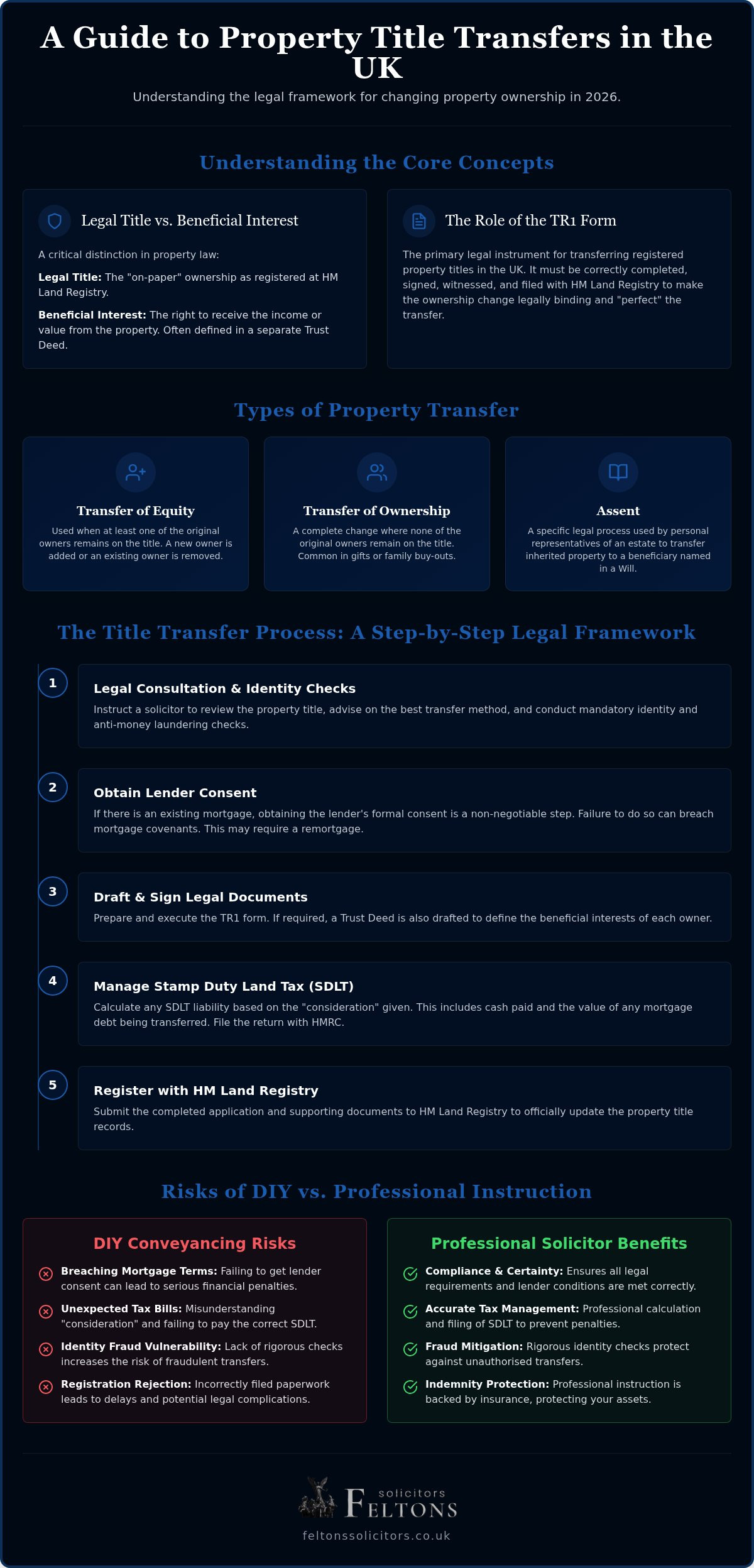
Changing the names on a property deed involves more than a simple clerical update at HM Land Registry; it’s a formal legal transition that requires precision to avoid future disputes. Title transfer is the overarching process of altering the official ownership records, but the specific path you take depends on your circumstances. For instance, a “Transfer of Equity” is used when at least one of the original owners stays on the title, such as when a partner is added after marriage. Conversely, a “Transfer of Ownership” involves a total change where none of the original owners remain, often seen in gifts or family buy-outs.

When dealing with inherited property, a distinct process known as an “Assent” is required. If you’ve been left a home in a Will, the personal representatives of the estate must use an Assent to formally vest the property in your name. This step is vital for making your ownership legally binding, yet it’s frequently misunderstood by those attempting to manage probate without professional guidance. Choosing the correct mechanism is paramount because it dictates your obligations for Stamp Duty Land Tax (SDLT) and your standing with mortgage lenders. Even in transfers where no money is exchanged, the value of a mortgage being transferred can be classed as “consideration”, which can trigger a tax liability.

Legal Title vs. Beneficial Interest

Legal ownership isn’t always as straightforward as the names on the Land Registry might suggest. There is a critical distinction between legal title, which represents the “on paper” ownership, and beneficial interest, which relates to the right to receive the value or income from the property. In many cases, a Trust Deed is drafted alongside the transfer to define these interests clearly. Instructing a residential property law firm ensures these layers of ownership are correctly documented, protecting your investment if circumstances change or relationship dynamics shift.

The Role of the TR1 Form and HM Land Registry

The primary instrument used to facilitate these changes for registered titles is the TR1 form. This document acts as the legal bridge between the current and new owners. Once signed and witnessed, it must be filed with HM Land Registry to make the transfer “perfect”. Without this official registration, the legal title doesn’t technically pass to the new owner. During Conveyancing, it’s also essential to verify that the property’s plan descriptions are accurate, particularly if the transfer involves dividing a plot or changing boundaries. Professional title transfer solicitors uk provide the necessary due diligence to ensure these technical details are handled flawlessly, preventing future boundary disputes or registration delays.

Common Reasons to Organise a Property Title Transfer

Life’s milestones frequently demand a shift in property ownership. Whether you’re blending households or settling an inheritance, the legal title must align with your current intentions. Many homeowners choose to add a spouse or partner to their deeds following marriage or cohabitation. This ensures that both parties have a recognised legal stake in their shared home. However, this isn’t a mere administrative tick-box. It requires formalising the transferring ownership process through the Land Registry to prevent future disputes and ensure clarity for any mortgage lender involved.

Title transfers also facilitate the “buying out” of a co-owner. This is a common scenario amongst siblings who have inherited a property together or joint tenants who have decided to part ways. One party pays a sum to the other to acquire their share, necessitating a formal update to the title deeds. Engaging professional title transfer solicitors uk is critical here to ensure the “consideration” is recorded correctly and that any existing mortgage lender consents to the change. Without this professional oversight, you risk breaching mortgage terms or facing complications when you eventually decide to sell.

Divorce and Financial Settlements

During a relationship breakdown, the home is often the most significant asset to be divided. A divorce and financial arrangements lawyer will structure the property transfer to comply with court orders or separation agreements, ensuring the legal title matches the agreed financial settlement. In some cases, a “Mesher Order” might be used. This defers the sale or transfer of the property until a specific event occurs, such as a child reaching adulthood or completing their education. We understand the emotional weight of these transitions; our role is to provide a calm, steady hand to ensure the legal process remains as smooth and discreet as possible.

Estate Planning and Gifting

Gifting a share of your home to children is a popular strategy for managing future liabilities, but it comes with strict regulatory hurdles that go far beyond simple paperwork. Under the “seven-year rule”, the gift may still be subject to Inheritance Tax if you pass away within seven years of the transfer. Additionally, if you continue to live in the property without paying market rent, HMRC may view it as a “gift with reservation of benefit”, potentially nullifying the tax advantages. You must also be aware of “deliberate deprivation of assets” rules; local authorities often scrutinise property transfers if you later require care funding. Integrating these changes into a wider estate planning strategy is the only way to ensure your legacy is protected. When navigating these complex scenarios, the guidance of title transfer solicitors uk ensures that every legal and tax implication is accounted for. If you are considering a property gift, speaking with a specialist can help clarify your tax position.

The journey begins with a detailed consultation to establish the “consideration” involved in the transaction. In legal terms, consideration isn’t limited to physical cash; it includes the value of any mortgage debt the new owner is taking on. Once this value is determined, the formal drafting of the Transfer Deed, or TR1 form, commences. If you’re sharing ownership in specific proportions, your title transfer solicitors uk will also prepare a Trust Deed to document these beneficial interests clearly. This ensures that the “on paper” ownership matches the financial reality of each party’s contribution.

Executing the deed requires a formal signing in the presence of an independent witness who is not a party to the transfer. Following this, the application is submitted to HM Land Registry along with the necessary filing fees. As of 2026, registration fees are tiered based on property value; for example, a property valued between £200,001 and £500,000 incurs a fee of £330. The process is only “perfected” once the Land Registry updates the digital register, a step that confirms the new ownership status to the world.

Navigating Mortgage Lender Requirements

Lenders maintain a significant interest in who holds the legal title, as any change affects the security of their loan. If a property is mortgaged, you must obtain formal consent before the transfer can proceed. For those leaving the title, a “Release of Covenant” is necessary to ensure they’re no longer liable for the debt. Lenders almost always require a solicitor to act for them during this process to ensure their interests remain protected. This dual representation streamlines the transition whilst satisfying the lender’s rigorous compliance and identity standards.

Stamp Duty Land Tax (SDLT) Implications

A common misconception is that tax only applies when money changes hands. However, SDLT is calculated based on the “chargeable consideration”. If you’re added to a title and take responsibility for a portion of an existing mortgage, that share of the debt is considered payment. In 2026, the standard SDLT threshold begins at £125,000. Even if the consideration falls below this level and no tax is due, you must still file an SDLT return with HMRC within 14 days of completion. Expert title transfer solicitors uk manage these filings on your behalf, preventing the risk of late payment penalties or inquiries from the tax authorities.

Title Transfer Solicitors UK: A Complete Guide to Property Ownership Changes in 2026

The Risks of DIY Conveyancing versus Professional Instruction

The assumption that a property title transfer is merely a matter of filling in forms is a frequent and costly mistake. In reality, the process involves complex legal obligations that, if mismanaged, can leave your most valuable asset vulnerable. Professional title transfer solicitors uk provide a critical layer of security through rigorous Anti-Money Laundering (AML) checks and identity verification. These protocols aren’t just bureaucratic hurdles; they’re essential defences against the rising threat of property fraud. By instructing a professional, you’re also benefiting from Professional Indemnity Insurance. This ensures that if a technical error occurs, your financial interests are fully protected, a safeguard that is entirely absent in a DIY approach.

Most mortgage lenders will simply refuse to engage with unrepresented individuals. They require the assurance that a qualified solicitor is overseeing the transaction to protect their security. Attempting to handle the transfer yourself often leads to a stalemate where the lender won’t release the necessary documents, causing significant delays and potential breaches of contract. These delays can be particularly damaging when a transfer is part of a time-sensitive financial settlement or inheritance plan.

Identity Verification (ID1 and ID3)

For those who choose to proceed without a solicitor, HM Land Registry mandates a strict identity verification process using forms ID1 or ID3. This requires you to find a professional, such as a solicitor or notary, to witness your signature and verify your credentials for a fee. This process is often cumbersome and time-consuming for DIYers, as many firms are reluctant to verify identity for non-clients due to the liability involved. Conversely, when you use a solicitor for the entire transaction, identity verification is integrated seamlessly into the process, providing a higher level of security for all parties involved.

Avoiding Future Litigation

Errors made during a DIY transfer often lie dormant for years, only surfacing during a future sale or upon the death of an owner. Poorly drafted deeds frequently lead to “Contentious Probate” or bitter ownership disputes amongst heirs, which are far more expensive to resolve than the initial legal fees. A solicitor acts as a discreet partner, ensuring that every detail, from the rights of way to the distribution of beneficial interest, is tied up correctly. In the context of property law, indemnity is a financial safeguard that protects you against losses arising from professional errors or omissions. To ensure your property interests are handled with the precision they deserve, you should instruct Feltons Solicitors for your title transfer.

How Feltons Solicitors Facilitates Seamless Title Transfers

Feltons Solicitors understands that property is more than a legal asset; it’s the foundation of your personal and financial security. As a boutique firm, we move away from the high-volume, impersonal processing common in the industry. Instead, we position ourselves as your sophisticated guide, handling the technical complexities of the law whilst maintaining a genuine human connection. Choosing the right title transfer solicitors uk means finding a partner who values your privacy and provides the discreet, high-standard service your situation demands. We don’t just process paperwork; we provide a calm, steady presence during what can often be a stressful period of transition.

Our expertise extends to the most intricate ownership structures. We regularly assist with overseas entity beneficial owner registration, ensuring that international property interests remain compliant with evolving UK regulations. When disputes arise amongst co-owners, we apply a pragmatic, resolution-focused approach to protect your equity and restore stability. This “people-first” philosophy ensures that while the technical legal work is paramount, the human impact of our work is never forgotten.

A Tailored Approach for Private Clients

We recognise that a title transfer is often a single piece of a much larger puzzle. Whether you’re navigating a relationship breakdown or finalising an inheritance, we integrate our property advice into your broader life changes. We’ve discarded archaic legalese in favour of a “plain English” methodology, ensuring you feel informed and empowered at every stage. This boutique level of care prioritises personal rapport, meaning you’ll deal directly with the expert managing your case rather than being passed between anonymous departments. It’s an approach that values modern efficiency without sacrificing traditional professional integrity.

Expertise in Complex and Leasehold Matters

Leasehold properties present unique challenges, particularly regarding extensions and management rights. As leasehold enfranchisement experts, we understand how these nuances impact the transfer of title and the long-term value of your investment. Our team possesses the worldly experience required to handle high-net-worth portfolios and complex international interests with absolute precision. As experienced title transfer solicitors uk, we invite you to a confidential consultation to discuss your specific circumstances and discover how we can facilitate a seamless transition for your property assets. Our goal is to provide the security and comprehensive care you need to move forward with confidence.

Securing Your Property Interests for the Years Ahead

Managing a property ownership change is a significant life event that requires more than just administrative accuracy; it’s about ensuring your legal title reflects your current life circumstances whilst protecting your equity from unforeseen tax or mortgage complications. By navigating the nuances of the TR1 form, satisfying SDLT requirements, and securing lender consent, you establish a solid foundation for your future. These steps are essential for maintaining the integrity of your investment and preventing contentious disputes in years to come.

Instructing expert title transfer solicitors uk provides the professional indemnity and identity security that DIY methods simply cannot offer. Feltons Solicitors, a boutique firm established in 2010, combines specialist expertise in residential and commercial conveyancing with pragmatic, people-first advice. We pride ourselves on being a steady, sophisticated guide through complex legal transitions, ensuring every detail is perfectly aligned with your long-term goals. Contact Feltons Solicitors for expert guidance on your property title transfer today. Taking this proactive step ensures your property remains a secure legacy for you and your family.

Frequently Asked Questions

Do I need a solicitor to transfer property title to my spouse?

While you can legally manage a transfer yourself if there’s no mortgage, instructing title transfer solicitors uk is strongly recommended to ensure the deed is “perfected” at the Land Registry. If a mortgage is involved, lenders almost always insist on professional representation to protect their security. Using a solicitor also provides professional indemnity insurance, which safeguards your home against technical errors that could lead to future ownership disputes or complications whilst you eventually sell.

How much does a title transfer solicitor cost in the UK?

Legal fees for a straightforward transfer of equity typically range between £400 and £900 plus VAT, depending on the complexity of the case. You must also account for disbursements, such as HM Land Registry fees, which are tiered based on the property’s value. For example, a property valued between £200,001 and £500,000 currently incurs a registration fee of £330. We provide transparent, fixed-fee quotes to ensure you have complete certainty over your costs.

Can I transfer property title if there is still a mortgage?

Yes, you can transfer the title, but you must obtain formal consent from your mortgage lender first. The lender will assess the financial stability of the remaining or new owners to ensure they can meet the repayment obligations. This process often involves a “Release of Covenant” for any departing owner. Your solicitor will act for both you and the lender to ensure all regulatory requirements are met and the mortgage deed is updated correctly.

How long does the title transfer process take at the Land Registry?

The legal preparation and signing of deeds usually take between four and eight weeks. Once the application is submitted to HM Land Registry, the time taken to update the digital register can vary significantly. While simple transfers are often processed within a few weeks, more complex cases or those requiring additional queries can take several months. Your solicitor will monitor the progress and provide updates until the new title deed is officially confirmed.

Do I have to pay Stamp Duty on a transfer of equity?

Stamp Duty Land Tax (SDLT) is payable if the “chargeable consideration” exceeds the current threshold of £125,000. Consideration includes any cash payment made for the share plus the proportion of the outstanding mortgage being taken over. If you’re added to a title and take on 50% of a £300,000 mortgage, your consideration is £150,000, which may trigger a tax liability. You must file an SDLT return even if no tax is actually due.

What is the difference between a Transfer of Equity and an Assent?

A Transfer of Equity is used when at least one of the current legal owners remains on the title, such as adding a partner. An Assent is a specific legal process used to transfer property from a deceased person’s estate to a beneficiary named in a Will. Whilst both result in a change at the Land Registry, an Assent requires the involvement of the estate’s personal representatives and follows distinct probate regulations to ensure the transfer is legally binding.

Can a property title be transferred as a gift?

You can transfer a property title as a gift, but this often triggers significant tax implications. If you don’t survive for seven years after the gift, it may be subject to Inheritance Tax. If the property isn’t your primary residence, Capital Gains Tax might also apply based on the market value at the time of the transfer. It’s essential to seek professional advice to understand how gifting impacts your broader estate planning and potential tax exposure.

What documents do I need to provide to my title transfer solicitor?

You’ll need to provide valid photo identification and recent proof of address to satisfy Anti-Money Laundering (AML) regulations. Additionally, your solicitor will require your latest mortgage statement, details of any money changing hands, and a copy of the existing title deeds if the property is unregistered. Providing these documents promptly allows your title transfer solicitors uk to conduct the necessary due diligence and prepare the TR1 form without unnecessary delays to your transaction.