

Could years of exposure to silica dust at work be linked to a lung condition diagnosed much later? Establishing that connection can feel difficult, especially if you’re unsure which employers, jobs or sites to include. Speaking with silicosis claims solicitors UK can help you understand what may need to be assessed, without assuming that a claim will succeed.
You may have questions about whether your work history is relevant, which records could help, or whether time limits apply. A solicitor can review your circumstances and consider how medical evidence, past employment and details of workplace exposure fit together.
This guide explains how silicosis claims are assessed, what information may help build a clearer picture, and what to ask when comparing solicitors and funding arrangements. It also covers why identifying potentially responsible parties can matter, even when exposure happened many years ago. Feltons Solicitors LLP handles silicosis litigation and can provide legal guidance based on your circumstances.
Key Takeaways
- A silicosis diagnosis alone doesn’t establish legal responsibility. An assessment considers the illness alongside work-related exposure and the circumstances of the case.
- Medical records, employment history and details of dusty tasks may help a solicitor investigate how exposure occurred and who may be responsible.
- When comparing silicosis claims solicitors UK, ask about relevant experience, who will manage your case, how updates work and how funding is explained.
- Limitation rules depend on the circumstances and jurisdiction. Ask a solicitor to review the relevant deadline promptly.
- Feltons Solicitors handles personal injury claims, including silicosis litigation, and can assess your circumstances without promising a particular outcome.
Silicosis claims solicitors UK: what a claim may involve
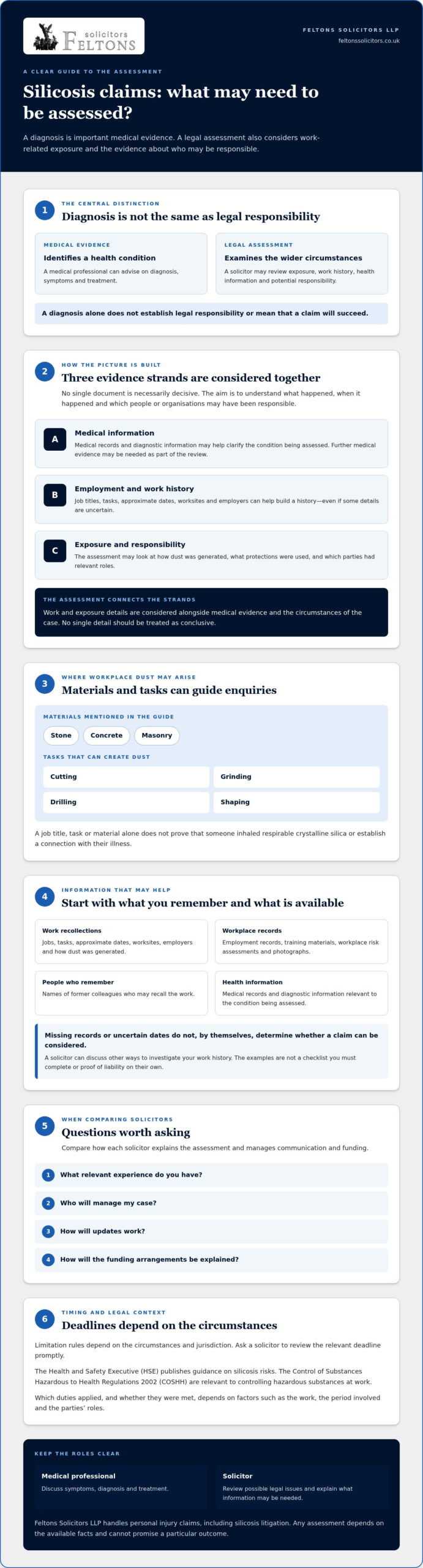
Silicosis is a lung disease associated with breathing in respirable crystalline silica dust. A medical diagnosis identifies a health condition, but it does not establish who may be legally responsible or whether a claim will succeed. A legal assessment considers the evidence about exposure, health and responsibility in the circumstances of the individual case.
A diagnosis is medical evidence; a claim assessment examines whether workplace exposure and evidence about responsibility may support legal action. A solicitor can review those questions but cannot diagnose or treat silicosis. For a general overview of the condition, see Silicosis. Discuss questions about symptoms or diagnosis with a medical professional.
How workplace silica exposure may relate to silicosis
Silica may be present in materials such as stone, concrete and masonry. Cutting, grinding, drilling or shaping these materials can create dust. However, a job title or the material alone doesn’t prove that someone inhaled respirable crystalline silica or establish a connection with their illness.
A solicitor may ask what work you did, where and when it took place, how dust was generated and what protections were used. They may consider those details alongside medical evidence and health history. Each person’s exposure circumstances and health need individual assessment, and no single detail should be treated as conclusive.
Who may ask a solicitor about a silicosis claim?
Current or former workers with a relevant diagnosis may ask silicosis claims solicitors UK to consider their legal options. You don’t need to have every employer, site or date immediately to hand. Your recollections, old work documents and information from former colleagues may provide starting points for further enquiries.
If you’re unsure what your diagnosis means, speak to a medical professional. A solicitor has a different role: they can review potential legal issues and explain what information may be needed, but they don’t determine your medical condition.
Feltons Solicitors LLP handles personal injury claims, including silicosis litigation. Any legal assessment should reflect the available facts, including your work history and medical evidence, and explain what can and cannot be concluded at that stage. An initial review can help clarify possible next steps without promising a particular outcome.
What evidence can silicosis claims solicitors use to assess responsibility?
A solicitor may consider how your work, medical history and possible silica exposure fit together. No single document is necessarily decisive. The aim is to build a fuller picture of what happened, when it happened and which people or organisations may have been responsible.
Evidence is assessed collectively, not by one document alone. Records can help test and support your recollections, but their relevance depends on your circumstances. The examples below may assist an assessment. They are not a checklist you must complete or proof of liability in themselves.
Work history and possible silica exposure records
Write down what you remember about each job, including job titles, tasks, approximate dates, worksites and employers. Note activities that created dust, such as cutting or grinding materials, without treating a task or material as proof of exposure on its own.
Where available, useful information may include employment records, training materials, workplace risk assessments, photographs or the names of former colleagues who remember the work. Don’t worry if dates are uncertain or documents are missing. Gaps don’t, by themselves, determine whether a claim can be considered. A solicitor can discuss other ways to investigate your work history.
Medical records and investigation of potential responsibility
Medical records and diagnostic information may help clarify the condition being assessed and form part of the legal review. A solicitor may consider them alongside your work history and exposure details, and may need further medical evidence to understand how the available information relates to the claim.
Workplace safety context can also be relevant. The Health and Safety Executive (HSE) publishes HSE guidance on silicosis risks, while the Control of Substances Hazardous to Health Regulations 2002 (COSHH) are relevant to controlling hazardous substances at work. Which duties applied, and whether they were met, depends on factors such as the work, the period involved and the parties’ roles. A solicitor must assess those questions against the evidence and applicable law, rather than assume that a particular employer breached a duty.
Potentially responsible parties may not be obvious from a job title or one set of records. Silicosis claims solicitors UK can review the available material, identify gaps to explore and explain what it may mean for your legal options. You can also read about discussing your silicosis claim circumstances with Feltons Solicitors.
How to compare silicosis claims solicitors in the UK
Comparing silicosis claims solicitors UK involves more than choosing a firm based on a headline or funding label. Look for clear answers about how your work history, medical information and possible exposure will be considered, and what the solicitor can and cannot say at an early stage.
| What to compare | Questions to ask |
|---|---|
| Relevant experience | Has the solicitor handled silicosis or related industrial disease claims? How will they assess the legal and factual issues in your circumstances? |
| Evidence review | What information would help with an initial assessment? How might the firm investigate past employment, exposure circumstances and potentially responsible parties? |
| Communication | Who will handle your case day to day? How will updates be provided, and who can explain complex medical or workplace evidence in plain English? |
| Funding and costs | Can the firm explain the proposed funding agreement, deductions, disbursements and any potential liability if the case does not succeed? |
Questions to ask a prospective solicitor
Ask what details they need to begin, such as approximate dates, job tasks, employers or worksites. You can also ask how they may investigate gaps in your work history and how they would explain technical or difficult-to-interpret evidence. You don’t need to arrive with a complete file. The solicitor should clarify what may be useful and what can be explored further.
Old exposure or incomplete records don’t automatically mean a claim is impossible. They may make an investigation more challenging, but the significance of missing details depends on the case. Ask how the solicitor would assess the information that remains available rather than relying on a general assurance either way. For health information and questions about diagnosis, the NHS information on silicosis is a useful patient-facing resource. Legal and medical assessments have different purposes.
Understand the funding agreement
A “no win, no fee” description alone doesn’t tell you what you might pay. Read the actual agreement and ask for written clarification of fees, any deductions from compensation, disbursements and what could be payable if the claim is unsuccessful. Ask the solicitor to explain unfamiliar terms and confirm whether any insurance or other arrangements are proposed. Funding options and client contributions vary, so don’t assume terms apply unless they’re set out and explained for your case.
Take time to compare the answers and consider whether you feel informed, not pressured. A useful discussion should leave you clearer about the proposed approach, who is responsible for your case and the financial terms you’re being asked to accept.
What happens after you contact a solicitor about silicosis?
The first discussion is an opportunity to explain your circumstances and understand what a legal assessment may involve. The process varies, but it may include these four broad steps:
- Initial discussion: You outline your diagnosis, work history and concerns.
- Information gathering: The solicitor identifies useful records and may investigate employment and exposure details.
- Legal assessment: They consider the available information, possible responsibility and relevant time limits.
- Next-step explanation: You’re told what options may be available and what further information or investigation could be needed.
This is an indicative sequence, not a promise that every matter will proceed in the same way. Ask what information is confidential and how it will be used. You can also ask what to expect if the solicitor needs more details before giving an initial view.
Preparing for an initial legal discussion
A few notes can help you explain your circumstances, but don’t delay getting in touch because your records are incomplete. If possible, write down employers, approximate work dates, tasks, worksites and anything you recall about dusty conditions. Diagnosis letters, medical records and employment documents may also be useful if readily available. The solicitor can explain what else might assist and how to approach gaps in your recollection.
If you’re contacting a solicitor on behalf of a family member who has died, the information needed and legal considerations may differ. The silicosis claim after death guide explains some of the issues bereaved families may wish to consider.
Limitation periods and jurisdiction-specific advice
Ask the solicitor to review limitation promptly. The relevant deadline can depend on where the claim is brought, the dates involved and when you knew, or could reasonably have known, that your illness might be linked to work. Don’t assume that a long gap since exposure means a claim is automatically barred, or that there is always time to wait.
In England and Wales, the Limitation Act 1980 generally provides a three-year period for personal injury claims, commonly calculated from the date of diagnosis or the date of knowledge. The precise application requires legal review. Scotland and Northern Ireland have distinct legal frameworks, so their rules should not be assumed to match those in England and Wales. A qualified solicitor should confirm the applicable jurisdiction and current limitation rules for your circumstances.
If you’re considering silicosis claims solicitors UK, ask for a clear explanation of the initial assessment and any urgent deadlines. You can find out about discussing your silicosis claim circumstances with Feltons Solicitors.
How Feltons Solicitors can help with a silicosis claim assessment
Feltons Solicitors LLP handles personal injury claims, including silicosis litigation. A legal assessment can help clarify how the information you have may relate to potential legal options. It won’t determine your medical condition or guarantee that a claim can proceed.
The firm provides legal advice, not medical diagnosis, treatment or respiratory health services. Direct medical questions to an appropriate healthcare professional. The legal review has a different purpose: to consider your circumstances and explain what can reasonably be assessed from the information available.
What a tailored legal assessment should clarify
A useful assessment should explain what is known, what remains uncertain and what might need further investigation. Depending on your circumstances, the discussion may cover:
- What you remember about possible workplace exposure and the information available about your diagnosis.
- Which employers or other parties may need to be considered, and what further enquiries could help identify responsibility.
- Whether additional records or information may be needed before more complete advice can be given.
- Possible next steps, relevant time-limit questions and any uncertainties that affect the assessment.
You can also ask how the proposed funding arrangements work. Request a clear explanation of the agreement, including any fees, deductions, disbursements or potential liabilities. Make sure you understand the terms before deciding how to proceed, and don’t assume a particular funding option is available unless it has been confirmed for your case.
Taking a considered next step with Feltons
It’s reasonable to have questions before sharing details or deciding whether to take a matter further. Ask how information you provide will be handled, who will review it and what the solicitor can explain at the initial stage. You don’t need to have every document or date resolved before starting a conversation.
Feltons also handles litigation and dispute resolution. Its advice should reflect your individual circumstances, with a clear explanation of what is known, what needs checking and what options may be open to you. No assessment can promise a particular result.
If you’re considering silicosis claims solicitors UK, you can discuss your circumstances with Feltons and ask questions about a potential silicosis claim assessment.
Take a considered next step
A potential silicosis claim depends on how the available evidence connects your diagnosis, work history and possible workplace exposure. A solicitor can assess those details together, explain what remains uncertain and identify time-limit questions that need attention. Comparing how firms communicate, review evidence and explain funding can also help you make an informed choice.
Feltons Solicitors LLP handles silicosis litigation as part of its personal injury services, as well as litigation and dispute resolution. Its role is to provide legal guidance, not medical diagnosis or treatment, and any assessment will depend on your circumstances.
If you’re looking for silicosis claims solicitors UK, contact Feltons Solicitors to discuss your silicosis claim options. You can raise your questions and learn what information may help clarify your legal options, without being promised a particular outcome.
Frequently Asked Questions
Can I make a silicosis claim if my exposure happened many years ago?
A long gap since exposure doesn’t, by itself, decide whether a claim can be assessed. The dates of your diagnosis, when you first knew your illness might be work-related and the jurisdiction can all matter. Silicosis claims solicitors UK can review those details and explain any limitation concerns. Old or incomplete employment records don’t automatically rule out an assessment, but it’s sensible to seek advice promptly rather than assume there is no time-sensitive issue.
How do I prove that work caused my silicosis?
A solicitor may assess medical records alongside your work history, tasks, possible exposure circumstances and any available workplace documents. These may help build a picture of where and how exposure could have occurred and which parties may need to be considered. No single document necessarily proves responsibility, and the evidence needed depends on the case. A solicitor can explain the legal investigation; only a qualified medical professional can diagnose silicosis or advise on treatment.
What happens if my former employer has closed down?
A former employer’s closure doesn’t automatically settle whether a claim can be investigated. A solicitor may review your employment history, identify potentially responsible parties and consider whether relevant insurance or business records can be traced. The options depend on the evidence and applicable law. Gather any information you have, such as payslips, contracts or colleagues’ details, but don’t assume the claim is impossible if documents are missing.
Is there a time limit for a silicosis claim in the UK?
Time limits may apply, but the relevant rule depends on the jurisdiction, dates and when important facts became known. In England and Wales, personal injury claims are generally subject to a three-year period running from the date of knowledge or diagnosis, subject to legal assessment. Scotland and Northern Ireland have different rules. Don’t rely on a general online deadline to decide your position; ask a solicitor to check the applicable limitation rules promptly.
Can my family pursue a silicosis claim after someone has died?
In some circumstances, legal options may be considered after a person has died, but eligibility and the appropriate route depend on the facts and applicable law. The family may need information about the person’s diagnosis, work history and estate. A solicitor can explain what may be relevant without guaranteeing that a claim can proceed. Read the guide to silicosis claims after death for further information for bereaved families.
Do I need a confirmed silicosis diagnosis before contacting a solicitor?
You can ask a solicitor what information may be relevant even if you’re uncertain about your diagnosis or whether it relates to work. A solicitor can’t diagnose an illness or recommend treatment. Speak to an appropriate healthcare professional about medical concerns, and don’t delay care while seeking legal guidance. For an initial legal discussion, it may help to note your previous jobs, tasks and possible exposure circumstances, even if some details are uncertain.
How do solicitors charge for silicosis claims?
Funding arrangements vary, so ask for the proposed agreement in writing and have its terms explained before deciding whether to proceed. Clarify any legal fees, deductions from compensation, disbursements and possible liabilities, including what could happen if the claim doesn’t succeed. A “no win, no fee” description alone doesn’t explain every term or mean there can never be costs. Check what applies to your circumstances and don’t assume all firms offer the same arrangement.