

Tunnel worker dust disease claims solicitors: a guide to your options

Tunnel worker dust disease claims solicitors: a guide to your options

What if you remember the dust and conditions in a tunnel, but not every contractor or date you worked there? Incomplete records don’t automatically determine whether your diagnosis could be connected with your work. Tunnel worker dust disease claims solicitors can assess how your medical history may relate to your employment and possible exposure.

It’s understandable to feel unsure, particularly when symptoms or a diagnosis arise years after tunnel work has ended. Conditions such as silicosis can be associated with occupational dust exposure, but every person’s circumstances are different. Medical evidence, recollections of site work and surviving employment records may all help build a clearer picture.

This guide explains which dust diseases may be relevant, what medical, work and exposure information could support an assessment, and why legal time limits need careful consideration. It also outlines how specialist solicitors can review the available evidence and explain your options without promising a particular outcome. Feltons Solicitors handles specialist silicosis litigation and complex disputes, offering considered guidance to people weighing up their next step.

Key Takeaways

  • Silicosis, pneumoconiosis and asbestosis are distinct diagnoses. Understanding which condition you have is an important starting point.
  • A claim assessment may bring together medical records, tunnel work history and evidence of possible dust exposure.
  • Missing work records or symptoms that appeared years later don’t automatically settle your options. Time limits depend on the facts of your case.
  • When comparing tunnel worker dust disease claims solicitors, consider their occupational disease experience and how clearly they explain evidence, risks and next steps.
  • Feltons handles specialist silicosis claims and complex litigation, with guidance tailored to your medical and work history.

Tunnel worker dust disease claims: which conditions and exposures matter?

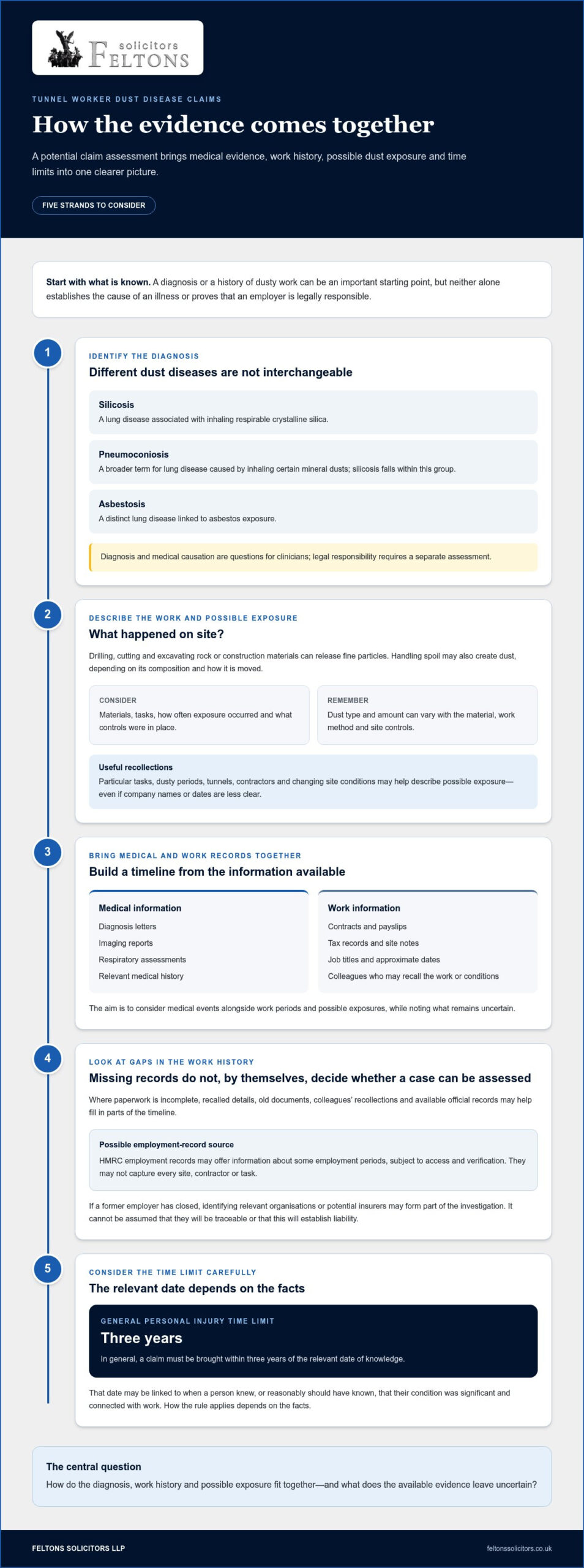
A dust disease claim is a potential personal injury claim assessed by looking at medical evidence alongside a person’s work and exposure history. For tunnel workers, relevant questions may include what materials were present, which tasks created dust, how often exposure occurred and what controls were in place. A diagnosis or history of dusty work can be an important starting point, but neither alone establishes the cause of an illness or proves that an employer is legally responsible.

How can tunnel work expose people to respirable dust?

Drilling, cutting and excavating rock or construction materials can release fine particles into the air. Handling spoil may also create dust, depending on its composition and how it is moved. Some rock and construction materials contain respirable crystalline silica, particles small enough to be breathed deep into the lungs. The type and amount of dust can vary with the material, work method and controls used on site.

A work history may span several tunnels, contractors and changing site conditions. You may recall particular tasks or dusty periods more clearly than company names or dates. Those details can help describe possible exposure, but should be considered alongside records and medical evidence, not treated as proof on their own.

What is the difference between silicosis, pneumoconiosis and asbestosis?

Silicosis is a lung disease associated with inhaling respirable crystalline silica. Pneumoconiosis is a broader term for lung disease caused by inhaling certain mineral dusts; silicosis falls within this wider group. Asbestosis is a distinct lung disease linked to asbestos exposure. These terms describe different diagnoses or categories, not interchangeable names for any illness following dusty work. A general medical overview is available in Pneumoconiosis and other dust-related diseases.

The distinction matters because the suspected substance and medical diagnosis shape how exposure history is examined. Evidence of silica-bearing rock, for example, does not establish asbestosis, just as a history of asbestos exposure does not itself confirm a particular disease. Tunnel materials and conditions can vary between projects, so each potential exposure needs individual consideration. Diagnosis and medical causation are questions for clinicians; legal responsibility requires a separate assessment of the available evidence.

For a potential claim, the key is the connection between diagnosis, work and exposure. Tunnel worker dust disease claims solicitors can consider those strands together, while keeping the medical assessment distinct from the legal question of responsibility.

Linking tunnel worker diagnoses to workplace exposure

Assessing a potential claim means bringing several strands of evidence together: the diagnosed condition, the work and materials involved, the employers or contractors connected with that work, and the applicable legal time limit. Medical records may show when a condition was identified and how it has developed. An occupational history can then be considered alongside them to explore whether particular work may have involved relevant dust exposure.

This is an investigation, not an assumption that a diagnosis proves who was responsible. The Health and Safety Executive’s official statistics on occupational lung disease provide wider context about work-related illness, but general figures cannot establish the cause of an individual’s condition or the outcome of a claim.

Which medical and work records may help assess a claim?

Start with what you have. Useful material may include diagnosis letters, imaging reports, respiratory assessments and relevant medical history. Work evidence could include contracts, payslips, tax records, site notes, job titles, approximate dates and the names of colleagues who may remember the work or conditions.

You don’t need a complete file before an assessment can begin. A solicitor can help organise the information, identify gaps and consider what further investigation may be appropriate. The aim is to build a clear timeline linking medical events with work periods and possible exposures, while noting what remains uncertain.

What if employers have closed or the work history is incomplete?

Missing paperwork does not, by itself, decide whether a case can be assessed. Tunnel work may involve several contractors and changing arrangements, so write down any details you can recall, even if dates are approximate. Old documents, colleagues’ recollections and available official records may help fill in parts of the timeline.

HMRC employment records may offer a possible source of information about some employment periods, subject to access and verification. They may not capture every site, contractor or task. If a former employer has closed, identifying relevant organisations or potential insurers may be part of the investigation. However, it cannot be assumed that they will be traceable or that this will establish liability.

Time limits also need individual attention. In general, a personal injury claim must be brought within three years of the relevant date of knowledge, which may be linked to when a person knew, or reasonably should have known, that their condition was significant and connected with work. How that rule applies depends on the facts, so don’t rely on diagnosis or retirement dates alone to determine your position.

Incomplete evidence can still be worth organising. Tunnel worker dust disease claims solicitors can review the medical and work history together, explain what is known and what needs investigation, and discuss possible next steps. Explore Feltons’ personal injury and silicosis claims support for guidance tailored to your circumstances.

Can you claim if symptoms appeared years later or records are missing?

Symptoms appearing long after tunnel work ended don’t automatically make a claim impossible. Some occupational lung diseases can take years to become apparent, so the passage of time alone doesn’t settle whether a claim can be considered. Equally, a diagnosis or remembered exposure doesn’t, by itself, prove that a particular employer was legally responsible.

How do delayed symptoms affect a potential claim?

In England and Wales, a personal injury claim must generally be brought within three years of the relevant date. For a disease claim, this may run from the date of knowledge: when you knew, or should reasonably have known, that you had a significant condition and that it might be linked to your work. A diagnosis may be important, but it isn’t automatically the relevant date in every case. The way the time limit applies depends on the individual facts, so seek legal advice promptly after a diagnosis rather than trying to calculate the deadline alone.

Keep medical correspondence, appointment dates and diagnosis documents together. A simple timeline can also help: note when symptoms began, when you first sought medical advice, what you were told and when a possible work connection was raised. These details can help a solicitor assess the limitation question alongside medical and occupational evidence. Don’t discard older records, even if they seem incomplete.

Does a former employer closing prevent an investigation?

No. A business closing doesn’t, by itself, establish whether a potential claim can be investigated. Depending on the available evidence, enquiries may include identifying the relevant employer or contractor and exploring whether an insurer can be traced. Those steps can be complex, and there’s no guarantee that a responsible party or insurer will be found. Missing employment paperwork is a separate issue from proving exposure, medical causation, legal responsibility or compliance with the time limit.

There may also be a separate state benefit route. GOV.UK explains the Industrial Injuries Disablement Benefit (IIDB) scheme, which is distinct from a personal injury claim and has its own eligibility rules. Whether it’s relevant depends on the diagnosed condition and personal circumstances.

Don’t assume that years passing or an employer closing answers the legal question. Tunnel worker dust disease claims solicitors can review the circumstances, explain how limitation rules may apply and identify what further enquiries could help. Advice can clarify your options without guaranteeing that a claim will succeed.
Tunnel worker dust disease claims solicitors: a guide to your options

How should you compare tunnel worker dust disease claims solicitors?

Choosing legal support is a significant decision, particularly when a possible claim involves a complex work history or a condition identified years after exposure. Look for a solicitor who understands industrial disease litigation and can explain how medical evidence, tunnel tasks and employment history may fit together. Clear advice should also cover uncertainties, possible risks, relevant time limits and next steps, without suggesting that a claim or compensation is guaranteed.

What experience and approach should a specialist demonstrate?

Useful guidance should make technical issues understandable. You should be able to see how a solicitor would consider diagnosis records alongside the materials handled, tasks performed, work sites and contractor relationships you can recall. Feltons handles specialist silicosis litigation and complex disputes, with advice tailored to the information and circumstances of each case.

Use these points to consider whether the proposed approach is clear and practical:

Question to consider Useful indicator What to clarify in writing
How will my medical and work history be assessed? The explanation connects diagnosis, possible exposure and employment evidence, and identifies gaps without treating assumptions as facts. What information is needed from you, and what further enquiries may be considered?
How will the legal position and time limits be reviewed? The solicitor explains that the assessment depends on your circumstances and distinguishes evidence of illness from questions of causation and responsibility. What limitation issues have been identified, and what should happen next?
How will I understand progress and decisions? Communication is in plain English, reflects your needs and makes risks and options understandable. How will updates be provided and important decisions explained?

What should you understand about costs and funding?

Funding terms can differ between firms and cases, so don’t assume one arrangement applies to every claim. Before deciding how to proceed, read the proposed agreement and ask for a written explanation of how legal costs are handled, whether any deductions could apply and when you might be responsible for payments. Make sure you understand the terms and their implications rather than relying on a general description of a funding arrangement.

Clear advice should help you make an informed choice, not rush you towards one. If you’re considering your options, discuss your tunnel worker dust disease claim with Feltons.

What happens when you ask Feltons about a tunnel worker dust disease claim?

Speaking to a solicitor can clarify what information may matter and what options could be available. Feltons handles complex litigation and specialist silicosis claims, with guidance shaped around each person’s medical history, work and potential exposure. An initial conversation doesn’t determine the outcome of a claim, but it can make the next steps clearer.

What information can you prepare before speaking to a solicitor?

If it’s convenient, gather what you have. You don’t need a complete file before making an enquiry. Useful starting details may include:

  • A diagnosis summary, medical letters or details of relevant assessments.
  • Approximate dates of tunnel work, known employers or contractors, and any sites you remember.
  • The tasks you carried out, materials you worked with and conditions where dust was present.
  • What you recall about dust controls, protective equipment and colleagues who may remember the work.

Approximate dates and partial memories can still help shape an initial discussion. Don’t delay seeking advice solely because some records are missing or you can’t remember every employer.

How can Feltons support an occupational silicosis enquiry?

The process can be considered step by step:

  1. Initial enquiry: Share the outline of your diagnosis and tunnel work, including anything you’re uncertain about.
  2. Information gathering: Relevant medical records, employment details and recollections of tasks or exposure can be organised for review. Gaps may be identified for possible further investigation.
  3. Case assessment: The available evidence is considered together to assess the potential connection between your condition and work, explain relevant legal issues and discuss possible next steps.

Feltons’ experience in silicosis litigation informs a tailored review of medical evidence, work history and potential exposure. Any assessment is specific to the circumstances and evidence available; it doesn’t guarantee eligibility, legal responsibility or a particular result.

If you’re enquiring on behalf of someone who has died, you may also find Feltons’ guide to a silicosis claim after death helpful. Each situation deserves careful consideration.

A clear first conversation can help you understand what may be relevant. If you’re considering speaking with tunnel worker dust disease claims solicitors, Feltons invites you to discuss your circumstances and potential next steps.

Take a clear next step with your work history

A potential tunnel dust disease claim depends on more than the name of a diagnosis. Silicosis, pneumoconiosis and asbestosis are distinct conditions, and assessing a possible claim means considering medical evidence alongside your work and exposure history. Missing records or symptoms that emerged years later don’t automatically settle the question, but time limits and legal responsibility need careful, individual assessment.

Specialist tunnel worker dust disease claims solicitors can help organise the available information, identify gaps and explain what may happen next. Feltons handles specialist silicosis litigation and complex disputes, with guidance tailored to the circumstances and evidence of each case. No outcome can be assumed, but a considered review can help you make an informed decision.

If you’re ready to discuss your circumstances, speak with Feltons Solicitors. A clear conversation can be a constructive first step towards understanding your options.

Frequently Asked Questions

Can tunnel workers claim compensation for silicosis?

A tunnel worker may be able to explore a claim if medical and workplace evidence supports a link between diagnosed silicosis and occupational exposure. Specialist tunnel worker dust disease claims solicitors can assess the available information, including work history, potential exposure, possible legal responsibility and relevant time limits. A diagnosis or tunnel work alone doesn’t guarantee a successful claim. The assessment depends on the individual evidence and circumstances.

What dust diseases can affect tunnel workers?

Tunnel workers may encounter different dusts depending on the rock, construction materials and tasks involved. Silicosis is associated with inhaling respirable crystalline silica. Pneumoconiosis is a broader term for certain lung diseases caused by mineral dust, whilst asbestosis is linked to asbestos exposure. These are distinct conditions, not interchangeable labels. A clinician must diagnose the illness, and medical evidence is needed to assess its possible connection with an individual’s work.

Can I make a claim if I cannot remember all my tunnel employers?

An incomplete work history doesn’t automatically prevent an initial assessment. Approximate dates, tunnel sites, job roles, contractors, contracts, payslips and the names of former colleagues may help build a timeline. Other employment records may also provide useful details, depending on what is available and accessible. A solicitor can review the information you have, identify gaps and explain whether further enquiries about former employers or insurers may be appropriate.

What if the company I worked for has closed?

A former employer closing doesn’t, by itself, determine whether a claim can be investigated. The company’s history, the work you carried out, potential legal responsibility and any relevant insurance arrangements may need to be examined. Enquiries to trace an insurer or another responsible party may be possible, but there’s no guarantee one will be found. Details such as the employer’s name, work dates, site and role can help guide those enquiries.

How long after tunnel work can dust disease symptoms appear?

There isn’t one timeline that applies to everyone. Some occupational lung diseases may become apparent years after exposure has ended, so stopping tunnel work doesn’t necessarily establish when a condition was recognised or linked to work. In England and Wales, a personal injury claim generally has a three-year limit linked to the relevant date of knowledge, but how it applies is fact-specific. Keep medical correspondence and seek advice about your circumstances promptly.

What evidence do solicitors need for a tunnel dust disease claim?

Useful information may include diagnosis letters, medical records, imaging or respiratory assessment reports, work dates, employers and contractors, tunnel sites, tasks and materials handled. Notes about dust controls or protective equipment may also help, as could contracts, payslips, tax records and colleagues’ details. You don’t need a complete file before seeking advice. A solicitor can help organise what is available, identify missing information and discuss possible next steps.

How much does it cost to instruct tunnel worker dust disease claims solicitors?

Costs depend on the proposed funding arrangement and the circumstances of the case. Don’t assume every solicitor uses the same terms, or that there will be no legal costs or deductions. Before deciding whether to proceed, ask for a clear written explanation of how fees are handled, what deductions may apply and whether you could be responsible for any payments. Read the agreement carefully and raise anything you don’t understand.

Silicosis Claims Solicitors UK: A Guide to Your Legal Options

Silicosis Claims Solicitors UK: A Guide to Your Legal Options

Could years of exposure to silica dust at work be linked to a lung condition diagnosed much later? Establishing that connection can feel difficult, especially if you’re unsure which employers, jobs or sites to include. Speaking with silicosis claims solicitors UK can help you understand what may need to be assessed, without assuming that a claim will succeed.

You may have questions about whether your work history is relevant, which records could help, or whether time limits apply. A solicitor can review your circumstances and consider how medical evidence, past employment and details of workplace exposure fit together.

This guide explains how silicosis claims are assessed, what information may help build a clearer picture, and what to ask when comparing solicitors and funding arrangements. It also covers why identifying potentially responsible parties can matter, even when exposure happened many years ago. Feltons Solicitors LLP handles silicosis litigation and can provide legal guidance based on your circumstances.

Key Takeaways

  • A silicosis diagnosis alone doesn’t establish legal responsibility. An assessment considers the illness alongside work-related exposure and the circumstances of the case.
  • Medical records, employment history and details of dusty tasks may help a solicitor investigate how exposure occurred and who may be responsible.
  • When comparing silicosis claims solicitors UK, ask about relevant experience, who will manage your case, how updates work and how funding is explained.
  • Limitation rules depend on the circumstances and jurisdiction. Ask a solicitor to review the relevant deadline promptly.
  • Feltons Solicitors handles personal injury claims, including silicosis litigation, and can assess your circumstances without promising a particular outcome.

Silicosis claims solicitors UK: what a claim may involve

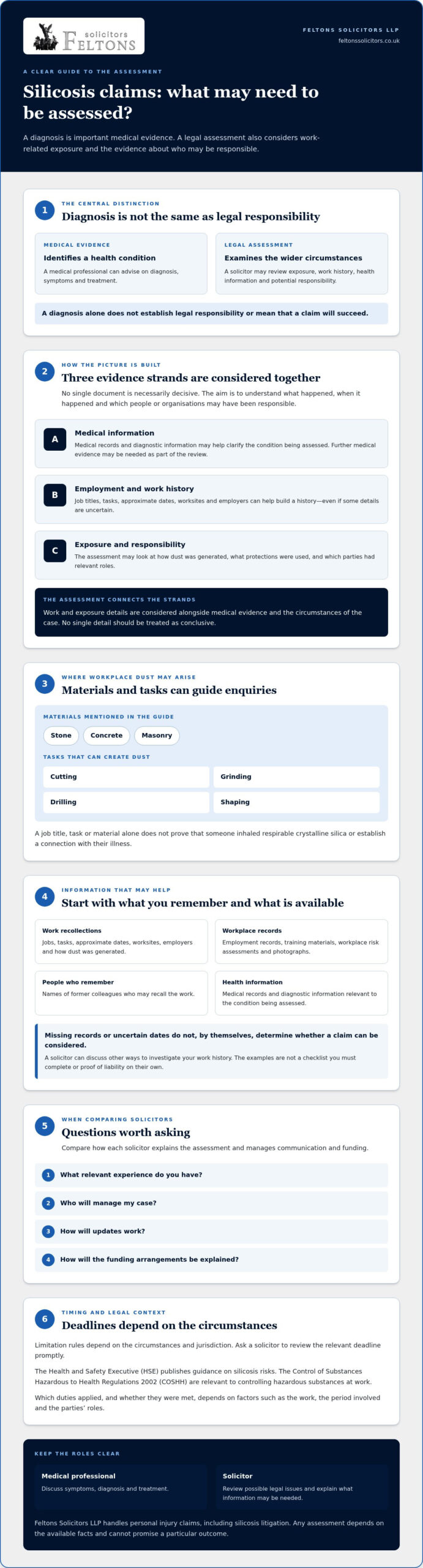
Silicosis is a lung disease associated with breathing in respirable crystalline silica dust. A medical diagnosis identifies a health condition, but it does not establish who may be legally responsible or whether a claim will succeed. A legal assessment considers the evidence about exposure, health and responsibility in the circumstances of the individual case.

A diagnosis is medical evidence; a claim assessment examines whether workplace exposure and evidence about responsibility may support legal action. A solicitor can review those questions but cannot diagnose or treat silicosis. For a general overview of the condition, see Silicosis. Discuss questions about symptoms or diagnosis with a medical professional.

How workplace silica exposure may relate to silicosis

Silica may be present in materials such as stone, concrete and masonry. Cutting, grinding, drilling or shaping these materials can create dust. However, a job title or the material alone doesn’t prove that someone inhaled respirable crystalline silica or establish a connection with their illness.

A solicitor may ask what work you did, where and when it took place, how dust was generated and what protections were used. They may consider those details alongside medical evidence and health history. Each person’s exposure circumstances and health need individual assessment, and no single detail should be treated as conclusive.

Who may ask a solicitor about a silicosis claim?

Current or former workers with a relevant diagnosis may ask silicosis claims solicitors UK to consider their legal options. You don’t need to have every employer, site or date immediately to hand. Your recollections, old work documents and information from former colleagues may provide starting points for further enquiries.

If you’re unsure what your diagnosis means, speak to a medical professional. A solicitor has a different role: they can review potential legal issues and explain what information may be needed, but they don’t determine your medical condition.

Feltons Solicitors LLP handles personal injury claims, including silicosis litigation. Any legal assessment should reflect the available facts, including your work history and medical evidence, and explain what can and cannot be concluded at that stage. An initial review can help clarify possible next steps without promising a particular outcome.

What evidence can silicosis claims solicitors use to assess responsibility?

A solicitor may consider how your work, medical history and possible silica exposure fit together. No single document is necessarily decisive. The aim is to build a fuller picture of what happened, when it happened and which people or organisations may have been responsible.

Evidence is assessed collectively, not by one document alone. Records can help test and support your recollections, but their relevance depends on your circumstances. The examples below may assist an assessment. They are not a checklist you must complete or proof of liability in themselves.

Work history and possible silica exposure records

Write down what you remember about each job, including job titles, tasks, approximate dates, worksites and employers. Note activities that created dust, such as cutting or grinding materials, without treating a task or material as proof of exposure on its own.

Where available, useful information may include employment records, training materials, workplace risk assessments, photographs or the names of former colleagues who remember the work. Don’t worry if dates are uncertain or documents are missing. Gaps don’t, by themselves, determine whether a claim can be considered. A solicitor can discuss other ways to investigate your work history.

Medical records and investigation of potential responsibility

Medical records and diagnostic information may help clarify the condition being assessed and form part of the legal review. A solicitor may consider them alongside your work history and exposure details, and may need further medical evidence to understand how the available information relates to the claim.

Workplace safety context can also be relevant. The Health and Safety Executive (HSE) publishes HSE guidance on silicosis risks, while the Control of Substances Hazardous to Health Regulations 2002 (COSHH) are relevant to controlling hazardous substances at work. Which duties applied, and whether they were met, depends on factors such as the work, the period involved and the parties’ roles. A solicitor must assess those questions against the evidence and applicable law, rather than assume that a particular employer breached a duty.

Potentially responsible parties may not be obvious from a job title or one set of records. Silicosis claims solicitors UK can review the available material, identify gaps to explore and explain what it may mean for your legal options. You can also read about discussing your silicosis claim circumstances with Feltons Solicitors.

How to compare silicosis claims solicitors in the UK

Comparing silicosis claims solicitors UK involves more than choosing a firm based on a headline or funding label. Look for clear answers about how your work history, medical information and possible exposure will be considered, and what the solicitor can and cannot say at an early stage.

What to compare Questions to ask
Relevant experience Has the solicitor handled silicosis or related industrial disease claims? How will they assess the legal and factual issues in your circumstances?
Evidence review What information would help with an initial assessment? How might the firm investigate past employment, exposure circumstances and potentially responsible parties?
Communication Who will handle your case day to day? How will updates be provided, and who can explain complex medical or workplace evidence in plain English?
Funding and costs Can the firm explain the proposed funding agreement, deductions, disbursements and any potential liability if the case does not succeed?

Questions to ask a prospective solicitor

Ask what details they need to begin, such as approximate dates, job tasks, employers or worksites. You can also ask how they may investigate gaps in your work history and how they would explain technical or difficult-to-interpret evidence. You don’t need to arrive with a complete file. The solicitor should clarify what may be useful and what can be explored further.

Old exposure or incomplete records don’t automatically mean a claim is impossible. They may make an investigation more challenging, but the significance of missing details depends on the case. Ask how the solicitor would assess the information that remains available rather than relying on a general assurance either way. For health information and questions about diagnosis, the NHS information on silicosis is a useful patient-facing resource. Legal and medical assessments have different purposes.

Understand the funding agreement

A “no win, no fee” description alone doesn’t tell you what you might pay. Read the actual agreement and ask for written clarification of fees, any deductions from compensation, disbursements and what could be payable if the claim is unsuccessful. Ask the solicitor to explain unfamiliar terms and confirm whether any insurance or other arrangements are proposed. Funding options and client contributions vary, so don’t assume terms apply unless they’re set out and explained for your case.

Take time to compare the answers and consider whether you feel informed, not pressured. A useful discussion should leave you clearer about the proposed approach, who is responsible for your case and the financial terms you’re being asked to accept.

Silicosis Claims Solicitors UK: A Guide to Your Legal Options

What happens after you contact a solicitor about silicosis?

The first discussion is an opportunity to explain your circumstances and understand what a legal assessment may involve. The process varies, but it may include these four broad steps:

  • Initial discussion: You outline your diagnosis, work history and concerns.
  • Information gathering: The solicitor identifies useful records and may investigate employment and exposure details.
  • Legal assessment: They consider the available information, possible responsibility and relevant time limits.
  • Next-step explanation: You’re told what options may be available and what further information or investigation could be needed.

This is an indicative sequence, not a promise that every matter will proceed in the same way. Ask what information is confidential and how it will be used. You can also ask what to expect if the solicitor needs more details before giving an initial view.

Preparing for an initial legal discussion

A few notes can help you explain your circumstances, but don’t delay getting in touch because your records are incomplete. If possible, write down employers, approximate work dates, tasks, worksites and anything you recall about dusty conditions. Diagnosis letters, medical records and employment documents may also be useful if readily available. The solicitor can explain what else might assist and how to approach gaps in your recollection.

If you’re contacting a solicitor on behalf of a family member who has died, the information needed and legal considerations may differ. The silicosis claim after death guide explains some of the issues bereaved families may wish to consider.

Limitation periods and jurisdiction-specific advice

Ask the solicitor to review limitation promptly. The relevant deadline can depend on where the claim is brought, the dates involved and when you knew, or could reasonably have known, that your illness might be linked to work. Don’t assume that a long gap since exposure means a claim is automatically barred, or that there is always time to wait.

In England and Wales, the Limitation Act 1980 generally provides a three-year period for personal injury claims, commonly calculated from the date of diagnosis or the date of knowledge. The precise application requires legal review. Scotland and Northern Ireland have distinct legal frameworks, so their rules should not be assumed to match those in England and Wales. A qualified solicitor should confirm the applicable jurisdiction and current limitation rules for your circumstances.

If you’re considering silicosis claims solicitors UK, ask for a clear explanation of the initial assessment and any urgent deadlines. You can find out about discussing your silicosis claim circumstances with Feltons Solicitors.

How Feltons Solicitors can help with a silicosis claim assessment

Feltons Solicitors LLP handles personal injury claims, including silicosis litigation. A legal assessment can help clarify how the information you have may relate to potential legal options. It won’t determine your medical condition or guarantee that a claim can proceed.

The firm provides legal advice, not medical diagnosis, treatment or respiratory health services. Direct medical questions to an appropriate healthcare professional. The legal review has a different purpose: to consider your circumstances and explain what can reasonably be assessed from the information available.

What a tailored legal assessment should clarify

A useful assessment should explain what is known, what remains uncertain and what might need further investigation. Depending on your circumstances, the discussion may cover:

  • What you remember about possible workplace exposure and the information available about your diagnosis.
  • Which employers or other parties may need to be considered, and what further enquiries could help identify responsibility.
  • Whether additional records or information may be needed before more complete advice can be given.
  • Possible next steps, relevant time-limit questions and any uncertainties that affect the assessment.

You can also ask how the proposed funding arrangements work. Request a clear explanation of the agreement, including any fees, deductions, disbursements or potential liabilities. Make sure you understand the terms before deciding how to proceed, and don’t assume a particular funding option is available unless it has been confirmed for your case.

Taking a considered next step with Feltons

It’s reasonable to have questions before sharing details or deciding whether to take a matter further. Ask how information you provide will be handled, who will review it and what the solicitor can explain at the initial stage. You don’t need to have every document or date resolved before starting a conversation.

Feltons also handles litigation and dispute resolution. Its advice should reflect your individual circumstances, with a clear explanation of what is known, what needs checking and what options may be open to you. No assessment can promise a particular result.

If you’re considering silicosis claims solicitors UK, you can discuss your circumstances with Feltons and ask questions about a potential silicosis claim assessment.

Take a considered next step

A potential silicosis claim depends on how the available evidence connects your diagnosis, work history and possible workplace exposure. A solicitor can assess those details together, explain what remains uncertain and identify time-limit questions that need attention. Comparing how firms communicate, review evidence and explain funding can also help you make an informed choice.

Feltons Solicitors LLP handles silicosis litigation as part of its personal injury services, as well as litigation and dispute resolution. Its role is to provide legal guidance, not medical diagnosis or treatment, and any assessment will depend on your circumstances.

If you’re looking for silicosis claims solicitors UK, contact Feltons Solicitors to discuss your silicosis claim options. You can raise your questions and learn what information may help clarify your legal options, without being promised a particular outcome.

Frequently Asked Questions

Can I make a silicosis claim if my exposure happened many years ago?

A long gap since exposure doesn’t, by itself, decide whether a claim can be assessed. The dates of your diagnosis, when you first knew your illness might be work-related and the jurisdiction can all matter. Silicosis claims solicitors UK can review those details and explain any limitation concerns. Old or incomplete employment records don’t automatically rule out an assessment, but it’s sensible to seek advice promptly rather than assume there is no time-sensitive issue.

How do I prove that work caused my silicosis?

A solicitor may assess medical records alongside your work history, tasks, possible exposure circumstances and any available workplace documents. These may help build a picture of where and how exposure could have occurred and which parties may need to be considered. No single document necessarily proves responsibility, and the evidence needed depends on the case. A solicitor can explain the legal investigation; only a qualified medical professional can diagnose silicosis or advise on treatment.

What happens if my former employer has closed down?

A former employer’s closure doesn’t automatically settle whether a claim can be investigated. A solicitor may review your employment history, identify potentially responsible parties and consider whether relevant insurance or business records can be traced. The options depend on the evidence and applicable law. Gather any information you have, such as payslips, contracts or colleagues’ details, but don’t assume the claim is impossible if documents are missing.

Is there a time limit for a silicosis claim in the UK?

Time limits may apply, but the relevant rule depends on the jurisdiction, dates and when important facts became known. In England and Wales, personal injury claims are generally subject to a three-year period running from the date of knowledge or diagnosis, subject to legal assessment. Scotland and Northern Ireland have different rules. Don’t rely on a general online deadline to decide your position; ask a solicitor to check the applicable limitation rules promptly.

Can my family pursue a silicosis claim after someone has died?

In some circumstances, legal options may be considered after a person has died, but eligibility and the appropriate route depend on the facts and applicable law. The family may need information about the person’s diagnosis, work history and estate. A solicitor can explain what may be relevant without guaranteeing that a claim can proceed. Read the guide to silicosis claims after death for further information for bereaved families.

Do I need a confirmed silicosis diagnosis before contacting a solicitor?

You can ask a solicitor what information may be relevant even if you’re uncertain about your diagnosis or whether it relates to work. A solicitor can’t diagnose an illness or recommend treatment. Speak to an appropriate healthcare professional about medical concerns, and don’t delay care while seeking legal guidance. For an initial legal discussion, it may help to note your previous jobs, tasks and possible exposure circumstances, even if some details are uncertain.

How do solicitors charge for silicosis claims?

Funding arrangements vary, so ask for the proposed agreement in writing and have its terms explained before deciding whether to proceed. Clarify any legal fees, deductions from compensation, disbursements and possible liabilities, including what could happen if the claim doesn’t succeed. A “no win, no fee” description alone doesn’t explain every term or mean there can never be costs. Check what applies to your circumstances and don’t assume all firms offer the same arrangement.

Silicosis Compensation Claims UK: A Specialist Guide to Legal Redress in 2026

Silicosis Compensation Claims UK: A Specialist Guide to Legal Redress in 2026

Could a diagnosis that feels like an ending actually be the starting point for securing your family’s future? For many workers, the discovery of an occupational lung disease brings immediate concerns about physical health and long-term financial stability. Understanding the landscape of silicosis compensation claims uk is essential for anyone facing this reality in 2026, as the legal framework provides a clear pathway to both accountability and essential care.

It’s understandable to feel overwhelmed by the complexities of litigation, especially when you are managing symptoms whilst trying to decipher the strict three-year “date of knowledge” rule. We believe that you deserve a discreet, professional partner to handle the legal burden so you can focus on your wellbeing. This guide offers expert clarity on the 18th Edition Judicial College Guidelines, updated Industrial Injuries Disablement Benefit rates, and the precise steps required to hold negligent parties responsible. You will learn how to navigate the claims process with confidence; ensuring your family’s financial security is protected through tailored legal redress and specialist support.

Key Takeaways

  • Identify how employer breaches of the Health and Safety at Work Act 1974 and COSHH regulations form the legal foundation of a successful claim.
  • Understand the complexities of silicosis compensation claims uk by identifying the strict three-year limitation period and the “date of knowledge” rule.
  • Explore how the 18th Edition Judicial College Guidelines are used to assess general damages for pain, suffering, and loss of amenity in 2026.
  • Learn the vital difference between general and special damages to ensure every aspect of your future care and financial loss is recovered.
  • Discover the benefits of a bespoke, partner-led legal service that prioritises personal rapport and expert guidance throughout the litigation process.

Silicosis is a debilitating condition characterised by irreversible lung scarring. It occurs when respirable crystalline silica (RCS) is inhaled, leading to inflammation and permanent tissue damage. Crucially, the UK legal system views this as an avoidable occupational illness. If you’ve been diagnosed, understanding What is Silicosis? from a legal perspective is the first step toward justice. Every worker has a fundamental right to a safe environment where dust exposure is strictly controlled. When employers fail to provide adequate ventilation or protective equipment, they may be liable for silicosis compensation claims uk.

Legal redress often depends on the clinical presentation of the disease. Chronic silicosis typically develops after decades of low-level exposure, whilst accelerated silicosis appears within five to ten years of more intense work. Acute silicosis is the most severe, often manifesting within months of extreme exposure. Courts recognise that each form requires a different approach to evidence, but all stem from the same failure to manage workplace hazards. The UK legal system treats silica dust as a significant health hazard, and the Health and Safety Executive (HSE) maintains strict workplace exposure limits to protect workers from these life-altering outcomes.

The Emerging Crisis: Engineered Stone and Modern Exposure

The rise of artificial stone kitchen worktops has created a modern “front line” for silicosis cases. These products can contain up to 95% silica, far exceeding the levels found in natural granite or marble. In August 2024, the first UK cases linked to this industry were identified in young men, highlighting a systemic failure in dust suppression during the cutting and polishing phases. If you work in fabrication or fitting, you may have been exposed to lethal dust levels without proper warning. The legal implications for this sector are profound, as many manufacturers have failed to adapt their safety protocols to the high silica content of modern materials.

Traditional Industries at Risk amongst UK Workers

Whilst engineered stone dominates recent headlines, traditional sectors continue to see high rates of illness. Construction, demolition, and stone masonry remain high-risk environments. Workers in pottery, ceramics, and sandblasting are also frequently exposed. Even historical exposure in mining and quarrying leads to silicosis compensation claims uk in 2026. The long latency period of chronic silicosis means symptoms often appear years after a worker has left the industry. This makes early legal advice essential to ensure that evidence from past workplaces is preserved and historical negligence is correctly identified.

Establishing Employer Negligence and the Duty of Care

Proving negligence is the cornerstone of any successful legal redress. Under the Health and Safety at Work etc. Act 1974, your employer carries a statutory duty to ensure your health and safety “so far as is reasonably practicable.” This is not a mere suggestion; it’s a legal mandate. For those pursuing silicosis compensation claims uk, this duty means providing a workplace where the risk of inhaling crystalline silica is managed with forensic precision. When a company fails to maintain these standards, they’re not just being negligent; they’re breaking the law.

The Control of Substances Hazardous to Health (COSHH) Regulations 2002 provide the specific technical framework for this duty. Employers must prevent exposure or, where that’s impossible, adequately control it. This usually requires the installation of “local exhaust ventilation” (LEV) to capture dust at the source. If an employer relies solely on basic masks without addressing the environment itself, they’ve likely breached their duty. The current Workplace Exposure Limit (WEL) for respirable crystalline silica is 0.1 mg/m³ over an eight-hour period. Exceeding this limit is a clear indicator of systemic failure and provides strong grounds for a claim.

Breach of Duty: What Constitutes Negligence?

Negligence often manifests through a lack of proper equipment or oversight. In many silicosis compensation claims uk, we see a recurring pattern of failure in three specific areas:

  • Respiratory Protective Equipment (RPE): Failing to provide high-specification masks that are face-fit tested for the individual worker.
  • Inadequate Training: Not educating staff on the “invisible” dangers of silica dust or the correct way to use suppression systems.
  • Health Surveillance: Ignoring the legal requirement under COSHH to provide regular lung function tests for at-risk employees.

The Role of the HSE and Regulatory Standards

HSE guidance documents, particularly the L5 Approved Code of Practice, are frequently used as benchmarks in court to establish what a “reasonable” employer should have done. In January 2025, the HSE published updated guidance specifically for those working with stone, clarifying the rigorous steps required to control exposure in modern fabrication shops. Proving that an employer “knew or ought to have known” about these risks is simpler in 2026, as the medical evidence and NHS guidance on silicosis have made the dangers common knowledge in industrial sectors. If you’re concerned about how these regulations apply to your specific work history, consulting a specialist in industrial disease litigation can provide the clarity you need to proceed.

Assessing Claim Value: General vs Special Damages

Determining the financial value of a claim is a methodical process that balances your immediate suffering with your future requirements. In the UK legal system, compensation is divided into two distinct categories: General and Special Damages. General Damages are awarded for pain, suffering, and loss of amenity (PSLA). This figure compensates you for the physical and psychological impact of the disease itself. According to the 18th Edition of the Judicial College Guidelines published in April 2026, a younger person experiencing severe disability and a heightened chance of premature death may receive between £123,000 and £166,000. For significant decline in lung function and impaired breathing, the brackets typically range from £67,000 to £86,000.

These figures reflect the clinical reality of the condition. The irreversible nature of lung scarring, as detailed in NHS information on silicosis, means that courts must account for a permanent reduction in quality of life. Whilst General Damages address the injury, they’re often only one part of silicosis compensation claims uk. To truly secure your family’s future, we must look closely at the financial losses that stem directly from your diagnosis.

Quantifying Special Damages and Future Losses

Special Damages aim to reimburse you for every penny lost due to your illness. This calculation is often complex and requires expert forensic accounting. We prioritise the recovery of lost earnings, including future wages and the impact on your pension contributions. Beyond income, we secure funding for essential medical interventions that go beyond standard care. This includes private pulmonary rehabilitation, oxygen therapy, and the cost of professional caregivers. As the disease progresses, we also account for necessary home adaptations, such as the installation of stairlifts or specialised bathroom equipment, ensuring you can maintain your independence and dignity at home.

Claims on Behalf of Families and Dependants

When a diagnosis results in a fatal outcome, the legal focus shifts to protecting the dependants left behind. The law allows for the recovery of a Statutory Bereavement Award and the reimbursement of funeral expenses. More importantly, we can claim for the “loss of dependency,” which covers the financial support the deceased would have provided to their spouse or children. Securing this accountability provides a vital safety net for families during an exceptionally difficult time. If you are handling the affairs of a loved one, our specialised guide on silicosis claim after death provides a compassionate and detailed overview of the legal steps available to you.

The Claims Process: A Step-by-Step Path to Justice

Timing is often the most critical factor in successful silicosis compensation claims uk. The law dictates a strict three-year limitation period for starting a claim. This clock begins ticking on the “date of knowledge,” which is typically the day you received a formal diagnosis or the moment you reasonably suspected your respiratory issues were work-related. Because the symptoms of chronic silicosis can take decades to manifest, this rule ensures that the path to justice remains open long after the initial exposure occurred. However, waiting until the final months of this period can make evidence gathering more difficult, so early intervention is always advisable.

A robust case relies on the testimony of independent medical experts. We work closely with leading pulmonologists who specialise in occupational lung diseases to provide a definitive link between your workplace conditions and your clinical health. These experts use advanced CT imaging and specialist lung function tests to quantify the extent of your impairment. This medical evidence serves as the foundation for your claim, ensuring that your compensation reflects the true severity of your condition rather than a generic estimate.

Many claimants worry about what happens if their former employer has ceased trading or cannot be traced. This is a common scenario in industrial disease litigation. If the original company is gone, we can often trace their historical insurers who remain liable for the claim. In cases where no insurer can be found, you may still be eligible for a lump-sum payment under the Pneumoconiosis etc. (Workers’ Compensation) Act 1979. As of April 2026, these government-backed payments have been increased to ensure workers aren’t left without support simply because a business has closed its doors.

Gathering Evidence to Support Your Claim

Success in court requires a meticulous reconstruction of your working life. We begin by obtaining your full employment history from HMRC to identify every period of potential exposure. Witness statements from former colleagues are equally vital; they provide first-hand accounts of the dust levels, the lack of ventilation, or the absence of protective equipment. Combined with your medical records and CT imaging, this creates a comprehensive evidence trail that is difficult for defendants to dispute.

Navigating the Pre-Action Protocol

The formal legal journey begins with a Letter of Claim sent to the defendant or their insurer. They have a set period to investigate and provide a response regarding liability. Our personal injury solicitors manage this entire dialogue, aiming for a fair settlement through negotiation whilst remaining fully prepared to issue court proceedings if a defendant is uncooperative. We prioritise a smooth, discreet process that protects your privacy whilst pursuing the maximum redress. If you’re ready to begin this process, you can contact our specialist team for a confidential consultation to discuss your options.

Why Choose Feltons Solicitors for Silicosis Litigation?

Selecting the right legal representation is the most consequential decision you’ll make following a diagnosis. At Feltons Solicitors, we understand that you aren’t just looking for a lawyer; you’re seeking a discreet partner to guide you through a period of profound uncertainty. We specialise in silicosis compensation claims uk by combining high-level professional authority with a genuine, empathetic reassurance. Our firm intentionally avoids the high-volume approach of larger practices, opting instead for a boutique service where your case receives the individualised attention it requires. We prioritise your peace of mind, ensuring that the legal process remains a supportive experience rather than an additional burden on your health.

Our expertise in complex litigation allows us to maintain a national reach whilst preserving the personal rapport of a trusted advisor. We believe in pragmatic, expert advice delivered in plain English. You won’t find dense, archaic legalese here; we prefer transparent communication that keeps you informed and empowered. Our people-first philosophy means that whilst the technical legal work is paramount, we never lose sight of the human impact of your condition. We’re committed to securing the financial security you need for long-term care and family stability, managing every detail with the quiet confidence that comes from years of specialist experience.

A Discreet and Supportive Legal Partnership

We position ourselves as a calm, steady presence in the face of stressful situations. Our partner-led approach ensures that your claim is managed by a senior expert from start to finish, providing a level of reliability that high-volume firms simply cannot match. We focus on minimising the burden on you by handling all negotiations and evidence gathering with methodical precision. This allows you to focus on your wellbeing whilst we work discreetly to secure the maximum redress for your suffering and future needs.

Securing Your Future with Feltons

Our firm provides access to a hand-picked network of the UK’s leading medical experts and pulmonary rehabilitation specialists. This ensures your clinical evidence is beyond reproach. Beyond industrial disease, our team possesses the worldly experience necessary to handle complex matters involving significant assets. You can explore our expertise in divorce and financial arrangements to see how our broader commitment to asset protection and bespoke legal care benefits all our clients. Whether you’re seeking accountability from a negligent employer or looking to protect your family’s financial future, we’re here to provide a sophisticated, high-standard service tailored to your unique circumstances.

Securing Your Future and Restoring Your Peace of Mind

Navigating a diagnosis of occupational lung disease is an immense challenge, but you don’t have to face it alone. We’ve explored how identifying employer negligence through COSHH breaches and understanding the 2026 Judicial College Guidelines are essential steps toward justice. Success in silicosis compensation claims uk hinges on early action and the meticulous gathering of medical evidence from specialist pulmonologists. By respecting the strict three-year limitation period and focusing on both general and special damages, you can ensure your family’s financial security is preserved whilst you focus on your health.

Feltons Solicitors provides the calm, steady guidance needed to manage these complex litigation matters. Our boutique, partner-led service ensures you receive individualised attention whilst benefiting from our national reach across the United Kingdom. We’re committed to transparent, plain English communication and a people-first philosophy that prioritises your wellbeing at every stage. We invite you to Arrange a discreet consultation with our specialist silicosis solicitors today. Taking this first step is the most effective way to hold negligent parties accountable and secure the specialist care you deserve. Your future stability is our primary concern.

Frequently Asked Questions

What is the time limit for making a silicosis compensation claim in the UK?

You must generally start your claim within three years of the date you first became aware you had the condition. This is known as the “date of knowledge,” which is often the day you received a formal clinical diagnosis from a specialist. Because the symptoms of chronic silicosis can take decades to appear, the court focuses on when you reasonably should have known about the illness rather than when the original dust exposure occurred.

Can I still claim if the company I worked for no longer exists?

Yes, you can still pursue legal redress even if your former employer has ceased trading or been dissolved. We specialise in tracing historical liability insurers who remain responsible for industrial disease claims many years after a business closes. If an insurer cannot be located, you may still be eligible for a lump-sum payment from the government under the Pneumoconiosis etc. (Workers’ Compensation) Act 1979, which provides a vital safety net for workers.

How much compensation am I likely to receive for a silicosis diagnosis?

The value of silicosis compensation claims uk depends on the severity of your symptoms and the financial impact on your future. Under the 18th Edition Judicial College Guidelines (2026), general damages for pain and suffering can range from £39,000 for moderate breathing difficulties to over £166,000 for severe disability. Special damages for lost earnings, private medical care, and home adaptations are calculated separately and often form a significant portion of the final settlement.

Do I need to go to court to secure silicosis compensation?

Most silicosis cases are settled through detailed negotiation without the need for a full court hearing. Our approach is to build such a robust evidence base that the defendant’s insurers recognise the necessity of a fair settlement. Whilst we prepare every case with the diligence required for a trial, a formal court appearance is rare. We prioritise a discreet process that achieves the maximum redress whilst minimising the stress on you and your family.

Can I make a claim on behalf of a family member who has passed away?

You can make a claim for a loved one who has died as a result of occupational silica exposure. The three-year limitation period usually begins from the date of death or the date a post-mortem confirms the condition. These claims are designed to provide financial security for dependants, covering the loss of the deceased’s income and pension, alongside a Statutory Bereavement Award and the recovery of funeral expenses.

What evidence do I need to prove my employer was negligent?

Proving negligence requires a combination of medical records and occupational history. We obtain your HMRC employment records to verify your work history and secure witness statements from former colleagues to describe the working conditions. Specialist medical reports from independent pulmonologists are also essential to link your lung damage to the specific dust levels at your workplace. This evidence proves that the employer failed to implement necessary controls like local exhaust ventilation.

Will making a claim affect my current employment or benefits?

It’s illegal for an employer to dismiss you or treat you unfavourably because you’ve started a compensation claim. Pursuing silicosis compensation claims uk is a protected legal right. Furthermore, a civil claim is distinct from state benefits like the Industrial Injuries Disablement Benefit (IIDB). Whilst some state benefits may be recovered by the DWP from the final settlement to avoid “double recovery,” the primary goal of your claim is to secure the long-term financial support the state cannot provide.

How long does a typical silicosis compensation case take to resolve?

A typical claim usually takes between 12 and 24 months to reach a conclusion, depending on how quickly the defendant admits liability. Cases involving companies that have ceased trading can take slightly longer as we must trace the historical insurance providers. We work at a steady, deliberate pace to ensure that every aspect of your future care needs is quantified, ensuring you don’t settle for less than you’re entitled to.