
Public liability injury claims and who can claim compensation

Public liability injury claims and who can claim compensation

An accident in a public place doesn’t automatically mean you can claim, but you may be entitled to compensation if another party’s negligence caused your injury. Public liability injury claim solicitors can assess whether the circumstances support a claim. In England and Wales, the Occupiers’ Liability Act 1957 places a duty on those responsible for public spaces to take steps to ensure visitors’ reasonable safety, according to UK Parliament.

It’s understandable to be unsure whether your injury is covered or who should be held responsible, particularly when the accident happened in a place open to the public. Personal injury claimants usually have three years from the date of injury to make a claim, according to UK Parliament.

This guide explains who may bring a public liability injury claim, which injuries may be covered and what financial losses compensation could include. It also outlines the time limit and practical steps, helping you assess whether your circumstances may justify taking the matter further.

Key Takeaways

  • You may be able to claim if another party’s negligence caused your injury; responsibility for public spaces in England and Wales includes a duty to take reasonable steps to keep visitors safe.
  • Personal injury claims usually have a three-year time limit from the date of injury, so understanding when the deadline applies can help you decide what to do next.
  • Compensation may account for both the effects of an injury and related financial losses, such as treatment costs or lost earnings.
  • Injuries from accidents in public places can vary widely; the circumstances, evidence and impact on your life all help determine whether a claim may be possible.

Who can make a claim for Public Liability Compensation?

You may be able to claim if another party’s negligence caused your injury or property damage in a public place. The key questions are whether they failed to take reasonable care and whether that failure caused the harm.

Understanding public liability injury claims

A public liability injury claim seeks compensation from a person or organisation whose activities or unsafe premises caused injury or property damage. Under the Occupiers’ Liability Act 1957, those responsible for public spaces in England and Wales have a duty to take steps to ensure visitors’ reasonable safety, according to UK Parliament. There is no fixed settlement timetable: liability, medical recovery, available evidence and negotiations affect how long resolution takes. Rules are not uniform across the UK; this Act applies to England and Wales, so the law relevant to an accident in Scotland or Northern Ireland may differ.

Accident settings and unsafe conditions

Claims may arise in shops, restaurants, leisure venues, car parks, other business premises or public spaces. Examples include slipping on an unmarked wet floor, tripping over damaged paving or being struck by falling stock. The location alone does not establish responsibility. The issue is whether an unsafe condition caused the accident and injury.

After an accident, report it promptly to the manager, owner or relevant authority. Ask for the incident to be recorded, and note the date, time and precise location. If you can, photograph the hazard and surrounding area before conditions change. For a pavement defect, a 10p or 50p coin beside the hole can help show its depth or height.

Keep details that may help explain what happened and its consequences:

  • Witness names and addresses, plus any account they provide.
  • Medical records and details of treatment, including a GP visit or hospital attendance.
  • Receipts for prescriptions, travel to treatment and damaged belongings.

Members of the public may claim where another party’s negligence caused their harm. A court-appointed litigation friend can act for someone under 18 or someone unable to claim themselves, acting in that person’s best interests. These records help lawyers assess responsibility and support the account of the accident.

Personal injury claim time limits

For most public liability personal injury claims, the usual deadline is three years from the date of injury. The starting point can differ in some circumstances, including clinical negligence claims and claims involving children.

The time limit for making a claim

Personal injury claimants usually have three years from the date of injury to start a public liability claim, according to UK Parliament. The deadline concerns starting legal proceedings, not completing treatment or recovery. Record when the accident happened, when symptoms began and how your condition developed. If the cause of an injury became clear later, the date you became aware of it may affect the calculation.

Claim time limits and exceptions

Children have a different deadline: they have three years from their 18th birthday to make a public liability claim, according to UK Parliament. The applicable deadline for a claim made on behalf of someone who has died may depend on the circumstances. These rules make the claimant’s age and circumstances central when working out the relevant deadline.

Clinical negligence has a stated limitation period of three years from the event that caused the injury or illness, or from when the claimant became aware that the event caused harm. For example, someone may connect an ongoing injury with earlier treatment only after receiving later medical information. The event date and date of awareness are therefore important when assessing this type of claim.

Funding arrangements do not extend a limitation period, so keep the deadline in mind while considering how to fund a liability compensation claim. In England, under a conditional fee agreement, the solicitor receives no fees if the claimant loses, although the claimant may still have to pay the other side’s legal fees and expenses. If the claim succeeds, arrangements for paying the solicitor’s fees and expenses depend on the funding agreement.

Some house contents, car or travel insurance policies in England include legal expenses cover that may help with personal injury legal costs. Review the policy wording for the type of claim covered and any conditions. Personal injury claim advice can help clarify the relevant deadline and funding arrangement.
Public liability injury claims and who can claim compensation

Compensation for injury and financial losses

A compensation claim may cover the injury’s effects and financial losses caused by the accident. The amount depends on the injury, recovery and evidence supporting each loss.

Compensation amounts for injuries

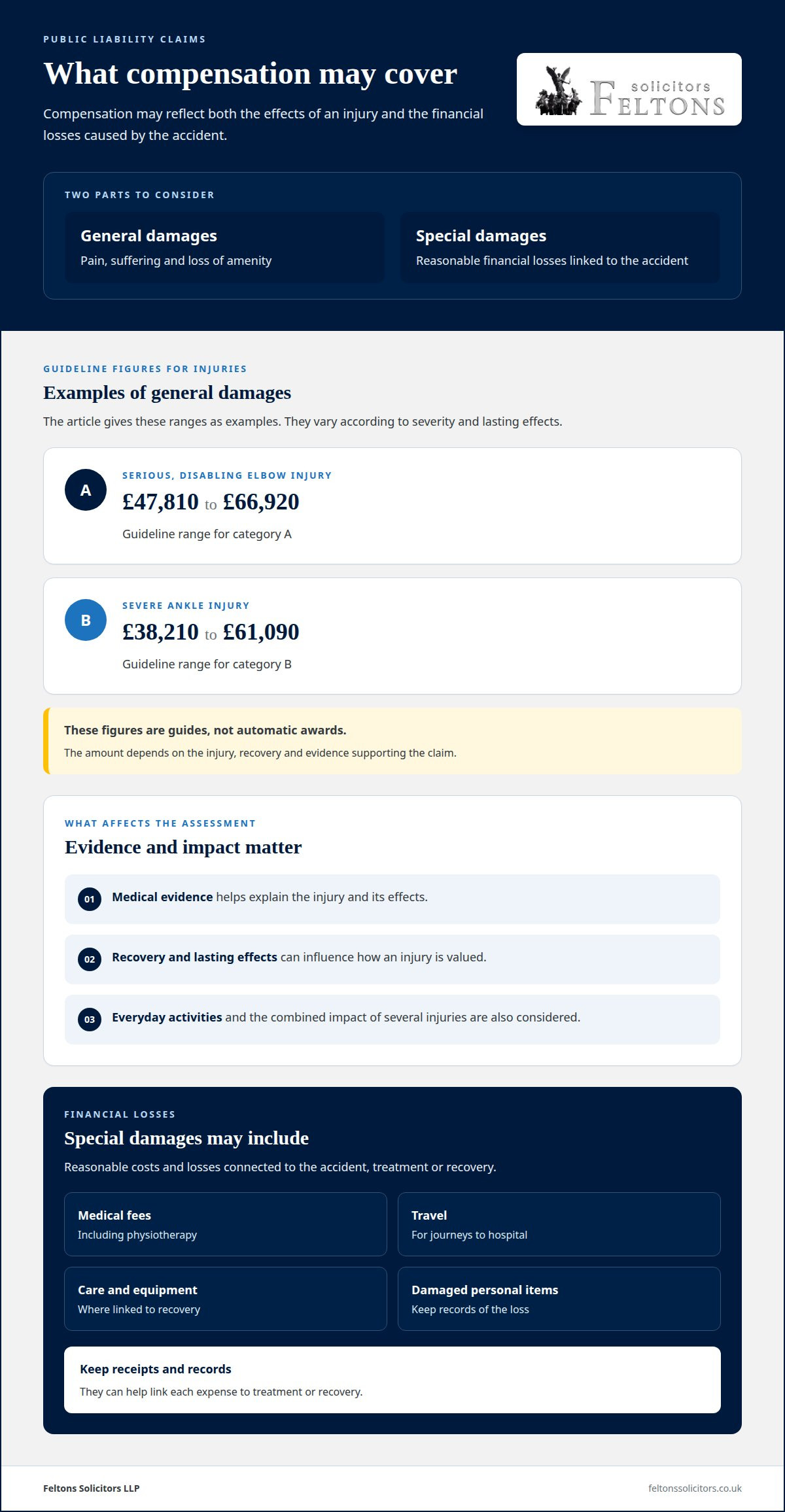
General damages reflect pain, suffering and loss of amenity. Guideline figures vary with the injury’s severity and lasting effects. For example, a serious, disabling elbow injury in category A has a guideline range of £47,810 to £66,920. A severe ankle injury in category B has a range of £38,210 to £61,090. These figures are guides, not automatic awards.

The assessment considers medical evidence, recovery and the effect on everyday activities. A fracture with continuing symptoms may be valued differently from an injury that heals fully. If several injuries occur together, their combined impact also matters.

Losses and expenses

Special damages may cover reasonable financial losses linked to the accident, such as medical fees, physiotherapy, travel to hospital, care, equipment and damaged personal items. Keep receipts and records linking each expense to treatment or recovery. For serious injuries, an assessment may also consider care needs, home adaptations and future costs.

Compensation for loss of earnings

If an injury stops you working, lost earnings may form part of your claim. Evidence could include payslips, employer records and details of time away from work. If a serious injury affects your future employment, the assessment may also consider future salary and pension losses. It looks at how the injury changed your ability to work, not simply how many days you missed.

Factors affecting compensation

The injury’s severity, recovery, treatment needs and effect on daily life all influence compensation. Evidence of expenses and earnings helps show the financial impact. Responsibility matters too: where a claimant is equally responsible for the accident or injury, the payout may be reduced by 50%. The organisation’s role, the available evidence and the connection between the accident and each loss are also relevant to the overall assessment.

Injuries covered by public liability claims

No single injury type automatically qualifies for public liability compensation. The central issue is whether another party’s negligence caused the harm and whether evidence supports that connection. A relatively minor injury can have lasting effects, while a serious diagnosis alone does not establish responsibility.

Claims may involve physical injuries suffered in shops, restaurants, car parks or public walkways. Examples include a sprained ankle after a fall, a fracture caused by a trip or a head injury from falling stock. Back, wrist, knee and elbow injuries can also affect movement, work and everyday activities. The circumstances and consequences matter as well as the medical diagnosis.

Slips and impacts can cause soft tissue injuries, bruising and strains. More serious accidents may cause brain injuries, significant fractures or lasting disability. Rest, ice, compression and elevation are often advised for minor strains, bruises and soft tissue injuries. Medical records can document the injury, treatment and recovery, showing how the harm developed after the accident.

To assess a claim, a specialist considers how the accident happened, what condition caused it and how the injury affected you. For example, evidence of a damaged step alongside medical notes recording an ankle fracture may help establish a clear sequence. Witness accounts, photographs, incident reports and treatment records can each support different parts of your account.

Evidence should capture practical consequences as well as the diagnosis. Note changes to walking, sleep, caring responsibilities or paid work, and keep receipts for treatment, travel and other related expenses. These details help explain the injury’s impact and identify associated losses. Public liability injury solicitors can assess how the available evidence supports your claim.

Discuss your public liability injury claim to understand how the injury, its cause and supporting evidence can be assessed together.

Feltons Solicitors LLP: Personal Injury and Silicosis Claims

Feltons Solicitors LLP handles personal injury and silicosis claims, including cases arising from accidents in public places or business premises. Our solicitors can assess the circumstances, available evidence and effects on your health and daily life, helping clarify the issues involved.

If you are considering whether to proceed, Feltons Solicitors LLP can explain the legal process and the information relevant to assessing your claim. This can help you weigh the next steps with a clearer understanding of your position.

For advice about a potential personal injury claim, contact Feltons Solicitors LLP.

Take the next step with a clearer picture

After an accident, uncertainty about responsibility, evidence or the effect on your future can make it difficult to decide what to do. A focused legal assessment can bring these issues together and identify practical next steps for your circumstances.

Feltons Solicitors LLP can consider how the accident occurred, the available records and the impact on your health and everyday life. This gives you a clearer basis for deciding whether to pursue a claim and what information may be relevant. The strength and value of any claim depend on its individual facts.

Feltons Solicitors LLP handles personal injury and silicosis claims. If you would like to discuss your situation and understand the options available, contact Feltons Solicitors LLP. Taking that conversation at your own pace can help you make an informed decision about what comes next.

Frequently Asked Questions

What injuries can I claim for?

You may be able to claim for a physical injury caused by another party’s negligence, but a diagnosis alone does not establish liability. A shoulder injury from an unsecured barrier or a burn caused by unsafe equipment could be considered if evidence links the hazard to your harm. The injury’s severity, duration and effects on everyday activities help shape the assessment. Medical records can document symptoms and treatment.

How are public liability accident injuries treated?

Treatment depends on the injury and its clinical needs. A healthcare professional may assess symptoms, recommend treatment and arrange follow-up. More serious injuries may need specialist care or rehabilitation. Keep appointment letters, treatment plans and records of changes in your condition. For example, notes about restricted movement after a shoulder injury can show how symptoms affected daily tasks over time.

Can I claim if the accident was partly my fault?

A claim may still be possible if you shared responsibility for the accident. Compensation may be reduced to reflect your share of fault, so evidence about each person’s actions matters. For instance, investigators may consider whether a hazard was clearly marked and whether your actions contributed to the incident. Give an accurate account, including details that may not seem favourable.

How do I find the right solicitor?

Look for a solicitor with relevant personal injury experience and a clear understanding of public liability cases. In England, the Law Society’s personal injury accreditation scheme is one relevant credential to consider. Ask how the solicitor will assess responsibility, gather evidence and keep you informed. A useful initial discussion should explain the proposed approach in plain English and identify the information needed to assess your circumstances.

How much compensation will I receive?

There is no single award for a particular accident. Compensation depends on the injury and its consequences, including medical evidence, recovery, restrictions on daily life and documented financial losses. For example, two people with similar fractures may have different claims if one quickly returns to normal activities while the other needs continuing care or can no longer do their usual work.

How much do I have to pay to pursue a claim?

What you pay depends on the funding agreement and its terms. Under a conditional fee agreement in England, a solicitor receives no fees if the claim is unsuccessful, but you may still be responsible for the other side’s legal fees and expenses. If you win, the other side will normally pay the solicitor’s fees and expenses. Read the agreement carefully to understand your position.
Amputation injury compensation claims for injured people

Amputation injury compensation claims for injured people

The headline figure is only part of an amputation claim. Compensation may cover pain, suffering and loss of amenity, as well as treatment, lost earnings, care, equipment, prostheses and home adaptations. Amputation injury compensation solicitors can also assess financial losses and future needs.

Time limits matter too. According to the UK Government, most personal injury and medical negligence claims must be made within 3 years of the accident or the date of knowledge. In England and Wales, compensation may be reduced if you share responsibility for the accident.

This guide explains what a claim may include, how shared responsibility and time limits can affect it, and why compensation varies by injury. It also sets out practical steps and the information that may help move a claim forward.

Key Takeaways

  • Identify when the relevant time limit starts, as the accident date and date of knowledge can both matter.
  • Build a clear picture of the support and expenses a claim may need to account for, including rehabilitation and prosthetic provision.
  • Understand how shared responsibility can affect the compensation payable, rather than assuming it automatically prevents a claim.
  • Use compensation ranges as a starting point, then consider how the injury’s location and its effect on future needs shape an individual assessment.

Is there a time limit for making an amputation claim?

In the UK, most personal injury and medical negligence claims must be made within 3 years of the accident or date of knowledge, according to the UK Government. The accident date is usually clear, such as the day a workplace machine caused an injury. The date of knowledge may matter where the connection between an earlier injury and later limb loss becomes apparent afterwards. Acting promptly helps preserve records and identify witnesses.

For an injured person who was under 18 when an accident happened in England and Wales, the usual three-year claim period does not begin until their 18th birthday. This means the adult time limit does not run during childhood. A parent or guardian can seek legal advice about a child’s circumstances before then, particularly where treatment, recovery or the cause of the amputation remains under investigation.

Amputation claims may follow workplace incidents, road traffic accidents, school accidents or playground accidents. Examples include machinery injuries at work, road collisions and serious injuries involving unsafe equipment. A medical negligence claim may arise if negligent treatment caused or worsened the injury that led to amputation. It must establish that the surgeon or practitioner was negligent. Each type of claim depends on evidence linking the responsible person’s or organisation’s actions to the limb loss.

Eligibility depends on more than the fact of amputation. A claim must show that another party was legally responsible and that their actions caused the injury or its consequences. Medical records, accident reports, witness accounts and treatment timelines can help establish what happened. For instance, records may link an accident injury to later surgery. If the injured person also contributed to the accident, a claim may still be possible, although compensation can be reduced to reflect their share of responsibility.

An amputation claim may sometimes proceed beyond the usual three-year limitation period if the original injury directly led to the later amputation. The link between the initial harm and the eventual limb loss is central. Evidence may need to show how an accident injury developed and why amputation followed. As dates and medical causation can be complex, early legal advice can help clarify the applicable time limit and what evidence supports the claim.

What does an amputation claim provide compensation for?

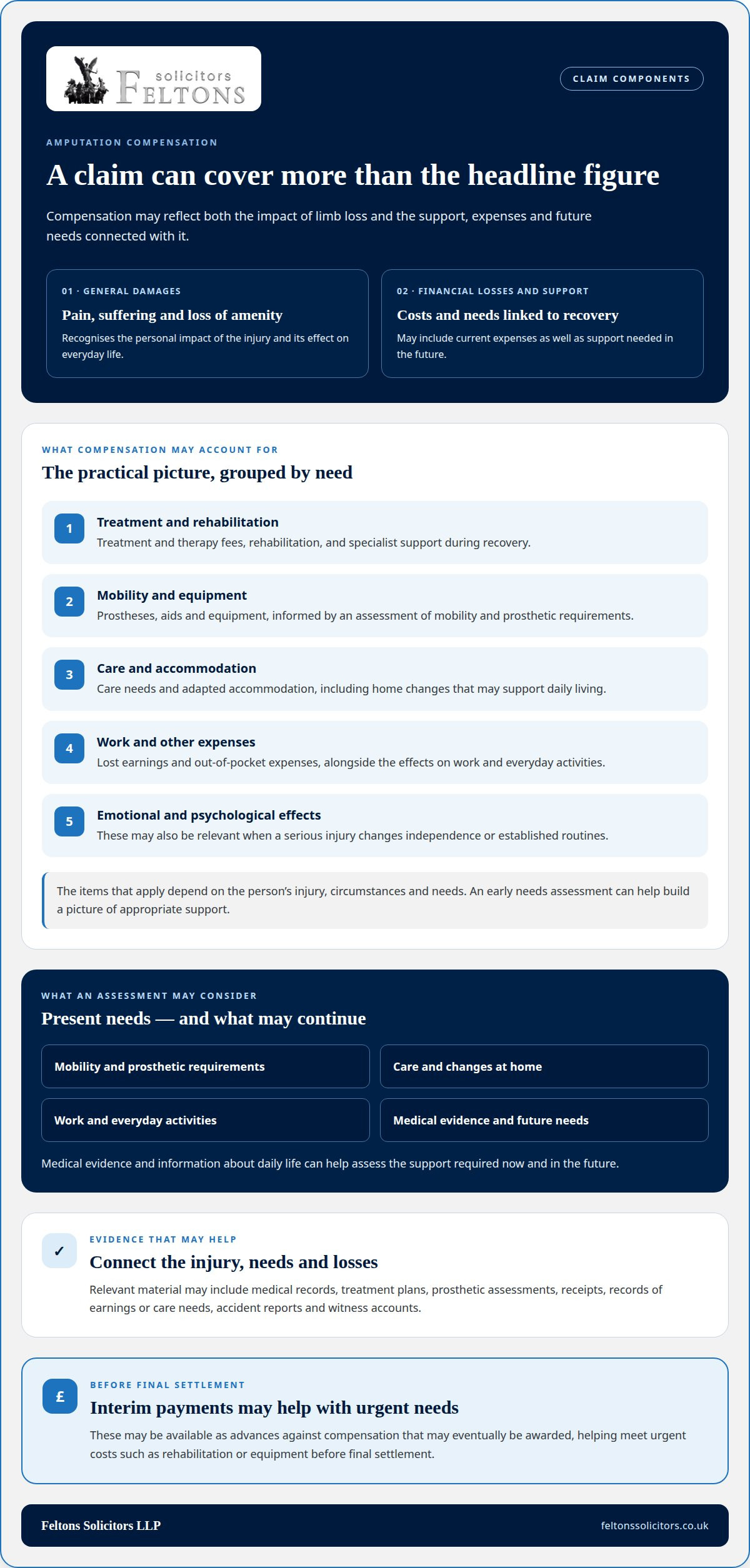
An amputation claim can cover both the immediate consequences of limb loss and needs that continue during recovery. Compensation may include treatment and therapy fees, rehabilitation, prostheses, aids and equipment, care, adapted accommodation, lost earnings and out-of-pocket expenses. For example, a claim may account for specialist rehabilitation and home changes needed to support daily living. General damages can also reflect pain, suffering and loss of amenity.

An early needs assessment can help identify appropriate support. It may consider mobility, prosthetic requirements, care needs and changes at home, as well as the effects on work and everyday activities. Lawyers use this information alongside medical evidence to assess present and future needs. Emotional and psychological effects may also be relevant, particularly when a serious injury changes a person’s independence or established routines.

When comparing amputation injury compensation solicitors, consider their experience with serious injury claims, rehabilitation planning and evidence of future needs. Ask how they will explain the claim’s progress and funding terms in clear language. These questions can help you understand the proposed approach before deciding how to proceed.

Fees depend on the case and are explained after a quote request. The work involved, complexity and funding arrangement affect costs. A no-win, no-fee agreement sets out how legal fees are handled if the claim succeeds or is unsuccessful. Read the terms carefully before deciding whether to proceed.

Evidence may include medical records, treatment plans, prosthetic assessments, receipts and records of earnings or care needs. Accident reports and witness accounts can help establish how the injury happened. Amputation injury compensation solicitors can review these materials to assess how they support the claim and its losses.

Interim payments may be available as advances against compensation that may eventually be awarded. They can help meet urgent needs, such as rehabilitation or equipment, before final settlement. Specialist legal support can assess how those needs relate to the claim.

For help with the legal aspects of a serious injury, explore personal injury claims support.

Amputation injury compensation claims for injured people

Contributory negligence

Contributory negligence means an injured person shares some responsibility for the accident. In England and Wales, that responsibility can reduce compensation rather than automatically prevent a claim. For example, if a claimant is found 25% responsible, they may receive 75% of the compensation otherwise payable. The reduction reflects the claimant’s share, so establishing how the accident happened remains important.

In a road traffic accident, evidence may show that another driver caused the collision while the injured person’s actions also contributed. The same principle can apply to workplace accidents involving machinery or safety procedures. Accident reports, witness accounts and relevant records help establish the sequence of events. The claimant’s conduct is considered alongside the actions of the person or organisation alleged to have caused the injury.

Medical negligence claims raise a different question: whether negligent treatment caused or worsened the injury that led to amputation. A claim must establish that the surgeon or practitioner was negligent. For example, evidence may need to show that a treatment decision or delay caused avoidable harm, rather than simply preceding the limb loss. Medical records and expert assessment can help explain the treatment, the injury’s progression and the connection to amputation.

Where negligence and the claimant’s actions both contributed, the evidence must distinguish their respective roles. A personal injury claim after an accident may involve a different chain of events from a clinical negligence claim following surgery or delayed treatment. The assessment considers what caused the harm and how each party’s conduct contributed. This can affect compensation, including payments for losses arising from the amputation.

Shared responsibility does not, by itself, determine whether a claim can proceed. The key steps are to establish the responsible party’s negligence, link it to the limb loss and assess any contribution by the claimant. Anyone who suffered an amputation after an accident or treatment should preserve relevant records and seek legal advice about how the evidence applies to their circumstances.

Amputation compensation ranges

Amputation compensation ranges offer a starting point for understanding general damages, including pain, suffering and loss of amenity. Figures vary according to the limb and level of amputation. They do not represent the full value of a claim, which may also include financial losses and the cost of future needs.

The location of the injury is only one part of the assessment. For example, ranges differ for an amputation above or below the knee. The claimant’s circumstances, recovery, ability to work and the effect on everyday activities also inform the overall claim. A settlement may therefore include general damages alongside special damages for proven financial losses and expenses.

Future needs can significantly affect the total claim. Evidence about prostheses, rehabilitation, care and necessary adaptations helps explain expected costs and practical impact. Interim payments may help meet urgent needs before final settlement. The final calculation should distinguish these expenses from the compensation range for pain and suffering, rather than treating one figure as the whole claim.

Use the ranges as a guide, then assess how the injury affects your individual circumstances and future needs. To discuss the factors relevant to your amputation compensation claim, contact the personal injury team.

Feltons Solicitors LLP: Personal Injury and Silicosis Claims

Feltons Solicitors LLP handles personal injury claims, including cases involving serious injuries such as amputation. If you are considering a claim after an accident or negligent treatment, legal advice can help clarify the evidence needed, the time limit and how compensation may reflect your losses and future needs.

A claim can involve complex medical records, questions about responsibility and an assessment of ongoing expenses. Feltons Solicitors LLP can guide you through the legal aspects of a personal injury claim and explain the next steps clearly. Early advice is particularly useful when treatment records, accident evidence or the connection between an injury and a later amputation need careful consideration.

To discuss your circumstances and possible next steps, contact Feltons Solicitors LLP.

Take the next step with a clear plan

After a serious injury, decisions about work, care and daily life can feel closely connected to the legal process. A useful next step is to list the questions that matter most to you, such as how a claim may address future needs or what evidence could explain the injury’s impact. This gives your discussion with a solicitor a practical focus.

Amputation injury compensation solicitors can assess the legal issues and explain how your circumstances may shape a claim. Feltons Solicitors LLP handles personal injury claims and can discuss your situation and the options available, recognising that every case is different.

If you’re ready to talk through your circumstances, contact Feltons Solicitors LLP. A considered conversation can help you decide what to do next, at a pace that feels manageable.

Frequently Asked Questions

How do I make a claim?

Start by obtaining legal advice about who may be responsible and whether the available evidence supports a claim. A solicitor can review relevant records, including accident reports, medical notes and correspondence about treatment. Keep documents showing expenses or changes to work and daily activities. For example, records of paid care can help explain the practical effects. The solicitor can then set out the proposed claim and its next steps.

Can I claim for “phantom limb” pain?

Yes. Pain experienced after an amputation can be included in the assessment of pain and suffering. Explain the symptoms to your treating medical professionals and describe how they affect everyday activities. Medical notes, treatment records and evidence of effects on sleep, mobility or routine can help show the impact. The claim must connect the symptoms to the injury and its consequences.

Can I claim for the psychological effects of losing a limb?

Yes. Psychological and emotional effects can be considered alongside the physical injury. Explain what has changed, such as confidence at work, social activities or independence, and discuss these effects with your healthcare team. Relevant clinical records and evidence of day-to-day impact can help document your experience. The assessment considers how amputation has affected your life, rather than treating the physical injury in isolation.

Can I claim if the accident was partly my fault?

Yes. Shared responsibility does not automatically prevent a personal injury claim, but it can reduce compensation to reflect your contribution. The circumstances and evidence are considered together, including what each person did and how that contributed to the accident. Witness accounts and accident records, for example, can help establish the sequence of events and inform the assessment of responsibility.

What does the loss of limb claims process involve?

The process typically involves investigating how the amputation occurred, gathering relevant records and assessing the injury’s effects. Medical evidence helps explain the condition and treatment, while financial documents show losses connected with the injury. The parties then consider responsibility and the claim’s value. Many amputation claims are settled out of court, although the route depends on the issues raised and whether liability and value can be agreed.

What compensation can you claim for an amputation injury in the UK?

A claim can include general damages for pain, suffering and loss of amenity, alongside special damages for financial losses and expenses. Depending on the evidence, these may cover treatment, rehabilitation, care, equipment, prostheses, home adaptations and lost income. The overall assessment considers the injury’s effects and the claimant’s needs, including future losses. Any award depends on establishing responsibility and supporting the claimed losses with relevant evidence.

Industrial asthma compensation claims for UK workers

Industrial asthma compensation claims for UK workers

A workplace asthma diagnosis can raise two separate questions: did exposure at work contribute to the condition, and might compensation or state benefits be available? In the UK, industrial asthma compensation claims generally need to be brought within three years of first knowing about the problem or of last exposure, whichever is later. Occupational asthma can develop after exposure to workplace substances, sometimes over a long period.

It’s understandable to be unsure what evidence matters, particularly if symptoms developed gradually or the employer has since closed. This guide explains occupational asthma, how medical records and workplace evidence may help link it to exposure, and what steps may matter when pursuing a claim.

It also covers tracing insurance when an employer has ceased trading and how Industrial Injuries Disablement Benefit may relate to a separate compensation claim. The overview can help you understand the issues, your options and possible next steps.

Key Takeaways

  • Occupational asthma can develop after exposure to workplace substances; consider how your work history and symptoms may be connected.
  • Medical records and workplace information can help build a clearer picture of exposure and its effects.
  • If a former employer has closed, company records and the Employers’ Liability Tracing Office may help identify its insurer.
  • Industrial Injuries Disablement Benefit and compensation are separate routes, so understand how each may apply to your circumstances.

What if my employer has ceased trading?

Yes. Workers can develop occupational asthma after leaving a job, and a former employer’s closure does not automatically prevent a claim. A claim may still be possible if evidence links the condition to workplace exposure and shows that an employer failed to take reasonable steps to protect workers.

Industrial asthma compensation claims pursued by UK workers may involve an employer’s liability insurer rather than the former business itself. UK employers are legally required to have employers’ liability insurance, and the insurer or its solicitors will handle a workplace compensation claim. The Employers’ Liability Tracing Office (ELTO) and Companies House records may help identify a former employer’s insurer.

Start by gathering employment dates, job descriptions, medical records and details of chemicals or other substances encountered at work. Safety documents, training records, incident reports and colleagues’ accounts may help show the exposure and what the employer knew. Keep evidence of when symptoms began and when a medical professional linked them to work. The usual time limit for a respiratory disease claim is three years from diagnosis by a medical professional or from the victim’s death.

Employers should assess risks from hazardous substances, provide suitable protective equipment and maintain workplace ventilation. The Control of Substances Hazardous to Health (COSHH) Regulations 2002 are relevant to occupational asthma claims, according to the UK legislation register (legislation.gov.uk). COSHH information and training duties may also help show what workers were told about asthma hazards.

Former employees may claim if evidence supports a link between their illness and past work. Contractors or subcontractors may also have a route if another party was responsible for their health and safety and they can show they did not control their working environment. A self-employed person solely responsible for that environment generally cannot claim against an employer on that basis.

In England, Wales, Scotland and Northern Ireland, begin by documenting exposure and obtaining relevant medical evidence, then identify the responsible employer or party and insurer. The legal process can depend on where the claim is brought. If a family member has died, a claim must be brought within three years of the date of death, according to the UK legislation register (legislation.gov.uk).

What is occupational asthma?

Occupational asthma develops when workplace exposure causes asthma, sometimes after a few weeks or many years. There is no single fixed compensation amount: assessment considers the condition’s severity, its effect on daily life and work, and resulting financial losses.

Workplace causes and exposures

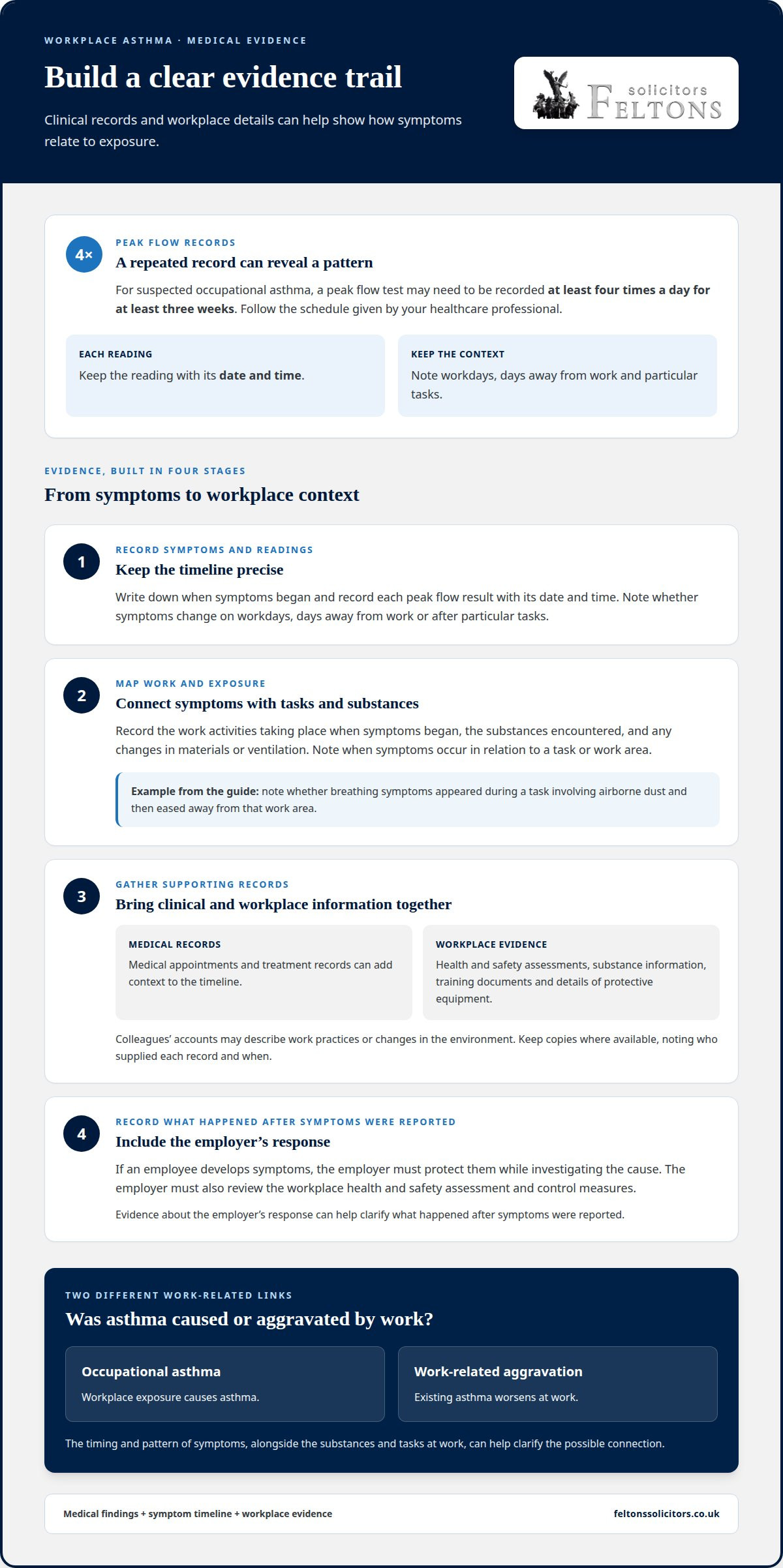
Workplace substances may trigger allergic or irritant-induced asthma. Examples include dust, lime, chalk, sand, silica, soot, plaster and flour. With allergic asthma, exposure can prompt the body to react to a substance; irritant-induced asthma follows exposure to substances that irritate the airways. The timing and pattern of symptoms, alongside the substances present at work, can help clarify a possible connection.

Asthma caused or aggravated by work

Occupational asthma is caused by workplace exposure, while work-related aggravation means an existing asthma condition worsens at work. These are different links between a job and breathing symptoms. Consider whether asthma began after exposure or whether symptoms existed before and became more troublesome during particular tasks or shifts. Symptom patterns and exposure history can help distinguish the two.

Industries linked to occupational asthma

Occupational asthma is associated with work involving airborne allergens and irritants, rather than one specific job title. Dust and flour, for example, may be present in different working environments; silica, plaster, lime and soot are other relevant substances. Up to 3,000 people in the UK are affected each year. Record the tasks performed, materials handled and when symptoms occur, as these details can help identify workplace exposure.

Where work-related exposure may have caused or aggravated asthma, legal support for a workplace injury claim can help you consider the next steps.

Industrial asthma compensation claims for UK workers

Medical evidence linking asthma to workplace exposure

Medical evidence can help link asthma symptoms to a particular workplace exposure. A useful record combines clinical findings with a clear timeline of symptoms, tasks and substances encountered.

For suspected occupational asthma, a peak flow test may need to be recorded at least four times a day for at least three weeks. Follow the schedule given by your healthcare professional, and keep each reading with its date and time. Note whether symptoms change on workdays, days away from work or after particular tasks.

Build an exposure timeline alongside the test results. Record when symptoms began, what work activities were taking place, and any changes in materials or ventilation. For example, note whether breathing symptoms appeared during a task involving airborne dust and then eased away from that work area. Medical appointments and treatment records can add context.

Workplace evidence can help explain the exposure pattern. Relevant records may include health and safety assessments, substance information, training documents and details of protective equipment. Colleagues’ accounts can also describe work practices or changes in the environment. Keep copies where available, noting who supplied each record and when.

If an employee develops symptoms, the employer must protect them while investigating the cause. The employer must also review the workplace health and safety assessment and control measures. Evidence about the employer’s response can clarify what happened after symptoms were reported.

The Equality Act 2010 requires an employer to make reasonable adjustments for an employee with occupational asthma, according to the UK legislation register (legislation.gov.uk). Adjustments should address the employee’s circumstances and may relate to their duties or exposure. Keep written records of reported symptoms, discussions and any changes made at work.

Arrange the evidence in date order, from early symptoms through testing, workplace reports and treatment. This helps present a coherent account of how symptoms relate to exposure, rather than relying on one isolated reading or recollection.

State benefits and industrial disease compensation

Industrial Injuries Disablement Benefit (IIDB) and a workplace compensation claim are separate routes. IIDB may be available to people with occupational asthma, and the amount depends on how much their health has been affected. Compensation, by contrast, concerns whether a party responsible for workplace safety caused the illness by failing to protect workers. Each route has its own purpose and assessment.

Apply for IIDB as soon as possible to avoid losing benefits. A diagnosis of occupational asthma is relevant, but the benefit amount relates to the effect on your health. Keep medical records describing symptoms and treatment together with evidence of how breathing difficulties affect everyday activities. This information helps show the condition’s impact.

A compensation claim focuses on the connection between workplace exposure, the employer’s actions and the resulting disease. Evidence may include medical records, employment history and details of substances encountered at work. For example, records showing exposure to a hazardous substance alongside medical evidence linking symptoms to it can help explain the basis of a claim. The employer’s liability insurer or its solicitors handle a claim brought against the employer.

Keep the two processes organised separately. Note when you applied for IIDB, retain correspondence about the benefit, and keep compensation documents with your employment and medical records. Don’t assume that applying for one route automatically starts the other. An IIDB application addresses state support; a compensation claim addresses responsibility for workplace harm. Both may be relevant after an occupational asthma diagnosis, but each has its own evidence and purpose.

  • Record the diagnosis and its effect on your health.
  • Apply for IIDB promptly and retain the application correspondence.
  • Organise exposure evidence separately for a compensation claim.

For help considering a workplace injury claim alongside your evidence, discuss your legal options.

Feltons Solicitors LLP: Divorce and Financial Arrangements

Feltons Solicitors LLP handles Personal Injury and Silicosis Claims, making its personal injury service a relevant next step if you are considering a claim about workplace harm. Once you have gathered medical records and information about your exposure, legal advice can help you understand how the evidence may support a claim and what issues need attention.

This section concerns workplace illness, rather than divorce or financial arrangements. Feltons also handles those matters, alongside Wills, Probate, and Estate Planning and Residential and Commercial Conveyancing. For an asthma-related claim, focus your discussion on the workplace exposure, diagnosis and resulting impact, so the legal issues can be considered in context.

To discuss your circumstances, contact Feltons Solicitors LLP or visit feltonssolicitors.co.uk.

Take the next step with clarity

Deciding what to do after a workplace illness can feel like another burden while managing your health. A focused conversation can help you identify the questions that matter in your circumstances and consider a practical way forward. You don’t need to have every detail resolved before seeking legal guidance.

If you’re considering industrial asthma compensation claims in the UK, think about what you most need help understanding: whether your work history supports a claim, how the illness has affected your life, or what pursuing a claim may involve. Setting out your main concern gives the discussion a practical starting point and keeps the focus on your priorities.

Feltons Solicitors LLP handles Personal Injury and Silicosis Claims. For guidance about your situation, contact Feltons Solicitors LLP about your claim. Taking an informed next step can help you approach the decision with greater confidence.

Frequently Asked Questions

Who will pay the compensation?

A successful workplace compensation claim is generally handled through the employer’s liability insurer. The insurer or its solicitors deal with the claim on the employer’s behalf, so you’re not usually negotiating payment directly with an individual manager. The amount and payment arrangements depend on how the claim is resolved. Keep letters about any settlement or payment with your medical and employment records.

Will my case go to court?

Only a small percentage of industrial disease claims proceed to trial. A court hearing is therefore not the usual outcome, although this depends on whether responsibility and the claim’s value can be agreed. Keep copies of important documents and respond carefully to requests for information. If court proceedings are required, your legal representative can explain the steps and what your involvement will entail.

Can I make a claim for compensation if I’m self-employed, or a contractor?

Contractors and subcontractors may have a claim if another party was responsible for their health and safety and they can show they did not control their working environment. By contrast, someone who was self-employed and solely responsible for that environment generally cannot claim against an employer on that basis. Clarify who controlled the site, equipment and safety arrangements, and preserve any contracts or work instructions.

How much will it cost to fund my claim?

Funding costs depend on the agreement used for the claim. Funding arrangements vary, so check your agreement to understand whether you may need to pay costs if the claim does not succeed. If successful, a portion of compensation is set aside for court costs and related fees. Read the funding agreement carefully to understand what may be deducted, which expenses it covers and what happens if the claim does not succeed.

My employer has gone out of business, can I still claim?

Yes, an employer’s closure does not automatically prevent a claim. The Employers’ Liability Tracing Office and Companies House records may help identify the former employer’s insurer. Gather the employer’s exact name, trading names and employment records, as these details can help distinguish the relevant business from similarly named companies. Insurance may provide a route for pursuing a claim after the business has ceased trading.

What are the time limits on making a claim?

For a respiratory disease claim, the usual limit is three years from diagnosis by a medical professional or the victim’s death. For industrial disease claims, the limit may run from knowledge of the condition or last exposure, whichever is later. A deceased family member’s claim must be brought within three years of death, according to the UK legislation register (legislation.gov.uk). Record diagnosis and exposure dates promptly.