
Expert Divorce Solicitor: Navigating Separation and Financial Settlements in 2026

Expert Divorce Solicitor: Navigating Separation and Financial Settlements in 2026

While a no-fault divorce might simplify the initial paperwork, does it actually protect your pension, your property, or your peace of mind? Many people assume that because the legal process has become more accessible, the need for an expert divorce solicitor has diminished. You’re likely feeling the weight of this transition; perhaps you’re worrying about how a simple filing might leave your financial future vulnerable or impact your children’s stability. It’s a natural concern when the stakes involve everything you’ve worked to build.

This guide provides a clear, professional roadmap through the legal landscape of England and Wales in 2026. You’ll learn how to secure a fair financial settlement and protect your emotional well-being throughout the process. We will explore the nuances of the current system, the critical importance of a legally binding clean break, and how specialist legal oversight can transform a stressful confrontation into a structured, dignified transition. By focusing on pragmatic solutions and tailored advice, you can move forward with the confidence that your interests are fully protected.

Key Takeaways

  • Discover why the no-fault divorce system simplifies the legal procedure but does not automatically protect your assets without professional oversight.
  • Learn the essential steps of the divorce process in England and Wales, ensuring you meet every requirement from the initial application to the final order.
  • Understand how an expert divorce solicitor helps you achieve a legally binding clean break, preventing your former partner from making future financial claims.
  • Gain insight into the importance of full and frank financial disclosure to secure a settlement that prioritises fairness and long-term stability.
  • Explore how a boutique, people-first legal strategy can minimise conflict and protect your emotional well-being during a difficult transition.

The Role of a Divorce Solicitor in the No-Fault Era

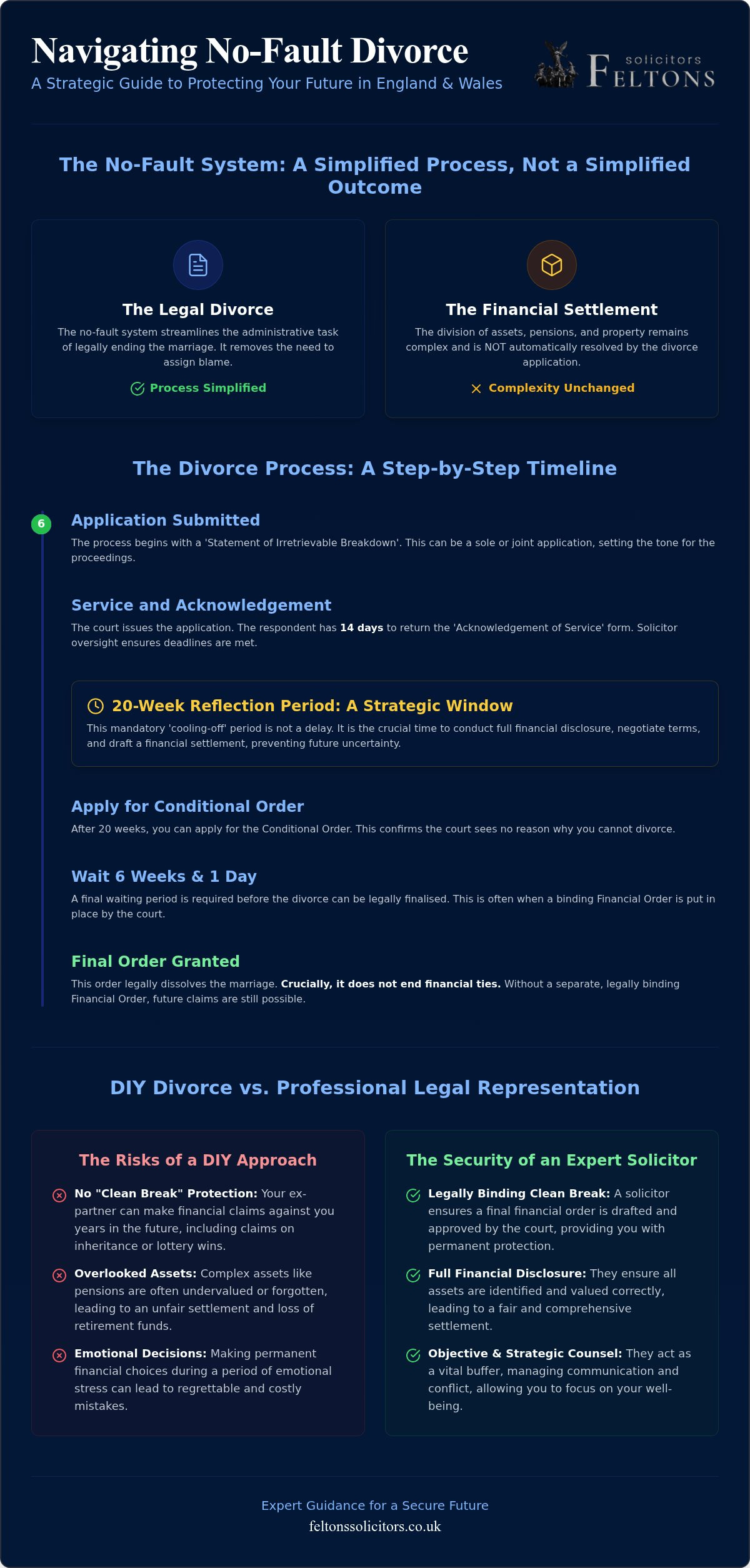
The introduction of no-fault divorce in 2022 changed the procedural nature of separation, but it didn’t remove the complexities of uncoupling a shared life. Many believe that because they no longer need to prove “unreasonable behaviour” or “adultery,” the process is now a simple administrative task. This is a common misconception. A divorce solicitor does far more than file paperwork; they provide the strategic oversight necessary to protect your long-term interests. While the online portal allows you to end the marriage legally, it does nothing to resolve the division of assets or ensure your financial independence.

Separating the legal dissolution of a marriage from the financial settlement is crucial. One ends the contract of marriage, whilst the other secures your future. In high-conflict situations, your solicitor acts as a vital buffer. They manage communications with your former partner, allowing you the space to focus on your emotional recovery and your children’s needs without the stress of direct legal confrontation.

The Strategic Advantage of Professional Counsel

Professional counsel provides a level of scrutiny that automated systems cannot match. We often see complex cases where one party may have “forgotten” certain assets or where pension structures are not immediately transparent. A skilled divorce solicitor identifies these discrepancies early. They ensure every legal document is drafted with precision to prevent future claims, providing you with a definitive clean break. This balance of objective legal strategy and empathetic support ensures you aren’t making permanent decisions based on temporary emotional states.

Navigating the 20-Week Reflection Period

The reflection period is a statutory requirement introduced in 2022. It serves as a mandatory “cooling off” window between the initial application and the Conditional Order. Rather than viewing this as a delay, it’s a period that should be used effectively for full and frank financial disclosure. By initiating the exchange of financial information during these twenty weeks, you can often reach an agreement on asset division by the time the divorce is ready to proceed to the final stage. This proactive approach minimises uncertainty and helps you transition into your new life with a clear plan.

Step-by-Step: The Divorce Process in England and Wales

The legal journey to end a marriage is now defined by a clear, chronological sequence. It begins with the initial application, where you or your spouse provide a “Statement of Irretrievable Breakdown” to the court. This statement is the foundation of the modern no-fault system; it removes the need for blame and focuses instead on the reality that the relationship has ended. Once the court issues the application, the “Service of Papers” occurs, and the respondent has 14 days to return the “Acknowledgement of Service” form. Engaging a divorce solicitor at this early stage ensures these deadlines are met and that the initial filing doesn’t inadvertently complicate future financial claims.

Following the initial application, the 20-week reflection period begins. Once this period concludes, you can apply for the Conditional Order. This document confirms the court sees no reason why you cannot divorce. The final stage is obtaining the Final Order, which can be applied for six weeks and one day after the Conditional Order is granted. This final decree legally dissolves the marriage, but it is rarely the end of the legal work required.

The Dual Track: Marriage vs. Finances

A common pitfall is assuming the Final Order provides total closure. It doesn’t. Whilst it ends your status as a married person, it does not automatically terminate your financial ties or obligations to your former spouse. This is why we recommend running financial negotiations alongside the divorce proceedings. Achieving a legally binding financial order ensures that your assets, including property and pension rights, are protected from future claims. Timing the application for the Final Order is particularly sensitive; doing so before a financial order is in place can sometimes jeopardise your rights to a spouse’s pension if they were to pass away unexpectedly.

Joint vs. Sole Applications

You now have the choice to apply for divorce individually or as a joint couple. A sole application follows the traditional route where one party initiates the process. Conversely, a joint application can set a more collaborative tone from the outset, potentially reducing friction and legal costs. At Feltons, we help organise joint applications for clients who wish to maintain a constructive relationship throughout the transition. Whether you choose a sole or joint path, an experienced divorce solicitor ensures that your specific circumstances are accounted for, preventing procedural errors that could lead to delays or additional court fees.

The rise of online portals and “quick-fix” DIY kits has created a perception that ending a marriage is a simple administrative task. While these kits offer a lower upfront cost, they often represent a false economy. A DIY approach typically only addresses the legal dissolution of the marriage, leaving complex financial issues entirely unresolved. Without the oversight of a qualified divorce solicitor, you may inadvertently leave the door open for your former spouse to make significant financial claims against your future earnings, inheritances, or business interests years after the marriage has ended.

The necessity for precise administrative filing is a constant across borders; for instance, individuals navigating family law or name change requirements in the United States may seek assistance from Nevada State Forms & Filing Services to ensure their documents are prepared to a professional standard.

Professional representation adds value by identifying the nuances that standard forms overlook. In cases involving shared property or business ownership, a solicitor ensures that valuations are accurate and that the division of assets is legally binding. This isn’t just about filling in boxes; it’s about strategic foresight. The question isn’t whether you can afford the legal fee, but whether you can afford the risk of an insecure financial future.

When DIY is a High-Risk Strategy

Certain circumstances demand a more sophisticated level of legal scrutiny. If your marriage involves international assets, overseas entities, or a significant disparity in income, a DIY approach is inherently high-risk. These factors require expert interpretation to ensure fairness and compliance with UK regulations. Separation is also a critical time to review your broader financial legacy. Integrating estate planning into your separation strategy ensures that your assets are protected and your wishes are clear, preventing your former partner from benefitting from your estate in the event of your death before the final order is granted.

The Feltons Approach to Cost-Effectiveness

Our philosophy is rooted in pragmatism and people-first service. We understand that legal fees are a concern, which is why we focus our resources on high-impact financial negotiations rather than unnecessary litigation. By providing clear, transparent communication regarding our fees, we ensure you remain in control of your costs. An experienced divorce solicitor from our team acts as your trusted advisor, seeking the most direct path to a fair settlement. This methodical approach avoids the frantic energy of high-pressure legal battles, opting instead for a steady, deliberate flow that prioritises your long-term security and emotional well-being.
Expert Divorce Solicitor: Navigating Separation and Financial Settlements in 2026

Securing Your Future: Financial Arrangements and Asset Protection

While the Final Order legally dissolves a marriage, it is the financial settlement that dictates your quality of life thereafter. In England and Wales, the court operates under the Matrimonial Causes Act 1973, which prioritises the principle of “fairness.” This doesn’t always mean a 50/50 split. Instead, judges consider various factors, including the welfare of any children, the duration of the marriage, and the future needs of both parties. Achieving a just outcome requires a methodical approach to asset division, ensuring that your contributions, both financial and non-financial, are recognised.

Transparency is the cornerstone of any successful negotiation. Both parties are legally required to provide “full and frank” disclosure of their assets through a document known as Form E. This comprehensive process covers everything from property and bank accounts to complex investments and business interests. A divorce solicitor plays a pivotal role here, scrutinising these disclosures to ensure no assets are undervalued or omitted. Once the financial landscape is clear, several types of orders can be sought, including lump sum payments, property transfers, and pension sharing. For most, the ultimate goal is a Clean Break Order, which provides the security of knowing that neither party can make future financial claims against the other.

Protecting High Net Worth and Business Assets

Cases involving significant wealth or private businesses require a more nuanced strategy. Valuing a professional practice or a family-run company is rarely straightforward; it involves assessing liquidity, future earnings, and tax implications. Our expertise in protecting assets during divorce allows us to navigate these complexities with precision. Whether you are seeking to ring-fence pre-marital wealth or ensure a business remains viable post-separation, a divorce and financial arrangements lawyer provides the objective counsel needed to reach a pragmatic resolution without unnecessary risk.

Spousal Maintenance vs. Capital Settlements

The court distinguishes between “needs” and “sharing” when determining financial awards. Spousal maintenance is a periodic payment for a former partner’s living costs. Whilst some settlements involve an ongoing payment, there is a growing trend towards “term orders” that provide support for a fixed period to encourage financial independence. If you are unsure how these principles apply to your specific circumstances, you should speak with a specialist solicitor to discuss your options. We focus on balancing immediate capital needs with long-term income requirements, ensuring your settlement is both fair and sustainable.

Why Choose Feltons Solicitors for Your Divorce?

Selecting a divorce solicitor is a deeply personal choice that extends far beyond technical competence. At Feltons Solicitors LLP, we recognise that you aren’t just looking for a legal representative; you’re seeking a trusted advisor to guide you through one of life’s most challenging transitions. Established in 2010 by Paula Felton, our firm provides a bespoke alternative to high-volume legal practices. We combine traditional professional integrity with a modern, efficient delivery that respects both your time and your privacy. Our “people-first” philosophy ensures that whilst we’re technically rigorous in our legal application, we never lose sight of the human impact of our work.

Our expertise spans both domestic separations and complex international matters, allowing us to handle high-value asset protection with the same care we apply to sensitive family dynamics. We pride ourselves on being a steady, dependable presence, projecting quiet confidence even in the most high-pressure situations. By choosing a boutique service, you benefit from a level of personal rapport and tailored strategy that larger firms often struggle to replicate.

A Discreet Partner in Stressful Times

Privacy is a cornerstone of our service, particularly for clients involved in high-profile or sensitive cases. We act as a discreet partner, ensuring your personal matters remain confidential whilst we work towards a pragmatic resolution. Our approach prioritises constructive negotiation and dispute resolution to avoid the unnecessary trauma and expense of court proceedings wherever possible. We understand that every family dynamic is unique, and our advice is always tailored to respect your specific circumstances and long-term goals. This methodical, reassuring pace helps you feel supported and in capable hands throughout the entire process.

Taking the First Step Towards Your New Chapter

Preparing for your first meeting with a divorce solicitor can feel daunting, but it’s the first step towards your new chapter. To make this initial consultation as productive as possible, we suggest gathering basic information such as your marriage certificate and a general overview of your joint and individual assets. This allows us to provide more specific, actionable insights from the very beginning. Whether you require support with complex financial arrangements or a straightforward clean break order, our specialist team is available to provide national legal support. We invite you to arrange a consultation to discuss how we can protect your interests and help you move forward with confidence.

Securing Your Financial Future and Personal Peace of Mind

Divorce in 2026 is less about assigning blame and more about strategic preparation for your new life. While the legal dissolution of a marriage has become more streamlined, the underlying financial complexities remain as significant as ever. Ensuring a fair division of assets and obtaining a legally binding clean break order are the most critical steps you can take to protect your independence. An expert divorce solicitor acts as your sophisticated guide, navigating the nuances of pension sharing, property transfers, and business valuations with precision.

Feltons Solicitors LLP has been a steady presence for clients since 2010, specialising in high-net-worth financial arrangements with a discreet, boutique approach. We combine national reach with the personal service that complex family matters deserve. By prioritising pragmatic dispute resolution over unnecessary conflict, we help you transition with dignity and security. You deserve a partner who values your privacy as much as your legal outcome.

If you are ready to move forward, contact Feltons Solicitors for a discreet consultation on your divorce and financial arrangements. You don’t have to face this transition alone; expert support is available to help you build a stable foundation for the years ahead.

Frequently Asked Questions

How much does a divorce solicitor cost in the UK?

Legal costs vary depending on the complexity of your assets and whether the separation is contested. You must pay a mandatory court fee of £628 to file the application, which is a standard charge in England and Wales. Professional fees are then structured based on the time required to negotiate financial settlements and draft the necessary orders. High-net-worth cases involving complex pensions or business interests naturally require a more significant investment in specialist expertise.

Can I get a divorce without a solicitor if we agree on everything?

You can technically file for divorce yourself, but this is often a high-risk strategy for your financial future. Agreeing on the end of the marriage is not the same as securing a legally binding financial settlement. Without a professional divorce solicitor to draft and file a Consent Order, your former spouse could still make financial claims against you many years later. Professional oversight ensures your agreement is permanent and provides a definitive clean break.

How long does the divorce process take in 2026?

A standard divorce typically takes between six and eight months to complete. This timeline is dictated by mandatory statutory periods, including a 20-week reflection period between the initial application and the Conditional Order. Following this, there is a further six-week and one-day wait before you can apply for the Final Order. Whilst the procedural steps are fixed, complex financial negotiations can sometimes extend the overall timeframe beyond these minimums.

What is a Financial Remedy Order and do I need one?

A Financial Remedy Order is a legally binding document approved by the court that outlines how assets, income, and pensions are divided. You need this order to ensure that any agreement you reach with your spouse is enforceable and final. Without it, the “financial door” remains open, meaning either party could apply to the court for money or property long after the Final Order has dissolved the marriage itself.

Will I have to go to court for my divorce?

Most people never have to attend court during their divorce proceedings. The process is now largely administrative, with judges reviewing paperwork submitted through the online portal. If you can reach an agreement on financial matters and child arrangements through solicitor-led negotiation or mediation, the court will simply approve the orders by post. Court hearings are generally a last resort reserved for cases where parties cannot reach a pragmatic compromise.

Can my ex-spouse claim money after the divorce is finalised?

Yes, an ex-spouse can potentially make a claim against your assets years after the divorce unless you have a Clean Break Order. The Final Order ends the marriage, but it doesn’t automatically end the financial relationship. An experienced divorce solicitor ensures that a court-approved Consent Order is in place, which formally dismisses future claims and protects your future earnings, business growth, and any inheritances you might receive later in life.

What happens to the family home in a divorce settlement?

The family home is treated as a priority asset, with the court focusing on the housing needs of both parties and any children. The outcome depends on your specific circumstances; the property might be sold and the proceeds split, or one person may buy out the other’s share. In some cases, a “Mesher Order” is used to defer the sale until a child reaches a certain age, ensuring stability for the family during their minority.

Is a no-fault divorce quicker than the old system?

No-fault divorce was not designed to be faster, but rather to be less confrontational. The introduction of the 20-week reflection period ensures that the process is deliberate and provides couples with time to consider the implications of their separation. Whilst the statutory waiting periods mean the process takes a similar amount of time as the old system, the reduction in conflict often makes it easier to reach financial agreements more efficiently.


A Comprehensive Guide to Estate Planning: Protecting Your Legacy in 2026

A Comprehensive Guide to Estate Planning: Protecting Your Legacy in 2026

Did you know that in 2026, nearly 70% of digital investors still have no formal plan for their heirs to access their online assets? It is a striking figure that highlights a broader, more unsettling truth; many people mistakenly believe a simple will is enough to protect their life’s work. You likely feel a deep sense of responsibility to ensure your hard-earned assets reach the right hands. However, the fear of the state claiming a significant portion through Inheritance Tax remains a heavy burden. It’s natural to feel anxious about potential family disputes or confused by the technical gap between a basic will and a comprehensive estate planning strategy.

We believe your legacy is about more than just numbers. It is about the people you love and the values you have built. This guide provides a sophisticated roadmap to securing your assets and ensuring your family’s future remains legally protected. We will explore how to minimise tax liabilities under current thresholds, such as the frozen £325,000 nil-rate band, and provide clarity on protecting vulnerable beneficiaries. From the intricacies of the Residence Nil-Rate Band to the upcoming 2027 changes to pension taxation, we’ll help you find the peace of mind that comes from a truly robust plan.

Key Takeaways

  • Understand why estate planning is a comprehensive legal strategy that goes far beyond a simple will to include lifetime gifts and protective powers of attorney.
  • Identify the essential pillars of a robust plan, focusing on how a valid Will and a Lasting Power of Attorney work together to safeguard your interests.
  • Learn how to navigate the complexities of Inheritance Tax by utilising the Nil-Rate Band and the Residence Nil-Rate Band to protect your family’s inheritance.
  • Discover a methodical approach to auditing your global assets, including digital accounts and international property, to ensure nothing is overlooked.
  • Recognise the value of a boutique legal partner in managing complex estates and preventing future family disputes or costly litigation.

Defining Estate Planning in the Modern UK Context

Estate planning is a holistic legal and financial strategy designed to manage your assets during your lifetime and ensure their orderly distribution after your death. It is far more than just drafting a document; it is a methodical process that aligns your personal values with the practicalities of the law. By creating a comprehensive overview of estate planning, you establish a clear roadmap that protects your legacy from unnecessary tax burdens and legal ambiguity. Most importantly, it serves as a vital safeguard against the rigid, impersonal rules of intestacy, which apply when no valid plan is in place.

Beyond the Will: A Holistic Legal Strategy

Whilst a Will is the cornerstone of any legacy, it often isn’t enough to address the complexities of modern life. If you own a business, hold international assets, or have a blended family structure, a standard Will might leave significant gaps. Effective estate planning incorporates wider tools such as lifetime gifting, trusts, and the registration of Lasting Powers of Attorney. These mechanisms do more than just distribute wealth; they protect it. A well-structured plan can help shield assets from being depleted by care home costs or becoming entangled in divorce proceedings within the family. Because legislation evolves, having a dedicated solicitor ensures your strategy remains compliant with current tax laws and legal precedents.

The Risks of Inaction: Intestacy and Legal Uncertainty

Dying “intestate” means the state determines who inherits your estate based on a fixed hierarchy, regardless of your personal relationships or intentions. Under current rules in England and Wales, if you die without a Will and have a spouse and children, your partner is entitled to personal belongings and a statutory legacy of £322,000. They only receive half of the remaining estate, with the other half going to your children. This often creates unintended financial hardship and emotional distress. Without professional guidance, the risk of contentious probate disputes increases significantly. A clear, legally binding plan reduces this burden on grieving relatives, providing them with the certainty and peace of mind they need during a difficult time. It prevents the state from becoming the default architect of your family’s future.

The Essential Pillars of a Robust Estate Plan

A successful approach to estate planning relies on several interconnected legal instruments. Relying on a single document is like building a house without a roof; it might look complete, but it won’t withstand the elements. Beyond the Will, which acts as your primary instruction manual, you must consider tools that protect you whilst you’re still alive and others that manage your wealth long after you’ve gone. These pillars provide a framework that ensures your wishes are followed precisely, regardless of what the future holds.

The foundation is a valid Will. It is the only way to ensure your assets are distributed exactly as you intend. Without it, your estate is subject to the rigid rules of intestacy. To support this, many people also include a Letter of Wishes. This is a non-binding document that provides your executors with personal guidance on matters such as funeral arrangements or the specific distribution of sentimental items. It adds a human touch to the clinical precision of a legal Will.

Lasting Power of Attorney: Protecting Your Interests During Life

An LPA is arguably as vital as a Will. It grants a person you trust the authority to make decisions on your behalf if you lose mental capacity. There are two distinct types: Health and Welfare, and Property and Financial Affairs. Many younger professionals and business owners overlook this, assuming it’s a concern for the distant future. However, if an accident or illness leaves you unable to manage your business interests or personal bank accounts, your family could face a costly application to the Court of Protection. The legal process of registering an LPA with the Office of the Public Guardian takes time, so it’s a step that should be taken whilst you are fit and healthy. If you’re unsure where to start, you can organise your estate planning with the help of a specialist to ensure every base is covered.

Trusts and Asset Protection: Sophisticated Legacy Management

Trusts are sophisticated legal vehicles that allow you to dictate how and when beneficiaries receive their inheritance. They are particularly effective for protecting minor children or vulnerable relatives who might struggle to manage a large lump sum. For those with complex property portfolios, trusts can help manage the transition of ownership across generations whilst potentially offering protection from third-party claims. If your estate includes international property, you must also be aware of the overseas entity beneficial owner registration requirements to ensure your holdings are compliant with current UK law. Whilst your executors will eventually follow official probate guidance to settle your affairs, having these structures in place now reduces the administrative and emotional burden they will face later.

Inheritance Tax is often the most significant concern for those embarking on estate planning. It can feel like a silent partner in your financial life, waiting to claim a portion of what you have worked to build. Currently, the standard Nil-Rate Band remains frozen at £325,000 until April 2031. However, many homeowners can also benefit from the Residence Nil-Rate Band (RNRB), which provides an additional £175,000 allowance when passing a main residence to direct descendants. Understanding these Inheritance Tax thresholds and rules is the first step toward mitigation. For married couples or civil partners, these allowances are transferable, potentially creating a combined tax-free threshold of £1 million.

Reliefs and exemptions play a critical role in sophisticated planning. Transfers between spouses are generally tax-free, and leaving at least 10% of your net estate to charity can reduce your overall IHT rate from 40% to 36%. For business owners, Business Property Relief (BPR) is an essential tool. As of April 6, 2026, 100% relief for business and agricultural assets is capped at a combined £2.5 million per individual. Above this threshold, relief is reduced to 50%, making precise valuation and early advice vital for those with significant commercial interests. For estates valued at more than £2 million, the RNRB is also tapered, reducing by £1 for every £2 that the estate exceeds the threshold.

Strategic Gifting and the Seven-Year Rule

Gifting assets during your lifetime is an effective way to reduce the taxable value of your estate. Most significant gifts are considered Potentially Exempt Transfers (PETs), which only become entirely tax-free if you survive for seven years after making the gift. You must be cautious of the ‘Gift with Reservation of Benefit’ rule. You cannot, for example, gift your family home to your children whilst continuing to live there rent-free, as HMRC will still view it as part of your estate. You can, however, utilise your annual £3,000 gift allowance or make small gifts of up to £250 per person each tax year without any IHT implications.

Life Insurance and Pensions in Estate Planning

Pensions have traditionally been one of the most tax-efficient ways to pass on wealth, as they usually sit outside your estate for IHT purposes. However, from April 6, 2027, most unused defined-contribution pension pots will become subject to Inheritance Tax, a change that will affect thousands of families. Life insurance policies should also be managed with care; by writing a policy in trust, the payout goes directly to your beneficiaries rather than forming part of your legal estate. If your circumstances involve complex family dynamics or former partners, consulting a divorce and financial arrangements lawyer ensures your tax strategy doesn’t conflict with existing legal obligations.

A Comprehensive Guide to Estate Planning: Protecting Your Legacy in 2026

The Estate Planning Process: A Methodical Approach

Transitioning from understanding legal tools to implementing them requires a disciplined, step-by-step methodology. Effective estate planning begins with a comprehensive audit of your entire financial landscape. This isn’t limited to your bank balance; it includes international property holdings, business interests, and outstanding liabilities. You must also identify your primary objectives. Are you prioritising maximum tax efficiency, the protection of a vulnerable relative, or the smooth continuity of a family business? Clear goals determine which legal structures will serve you best and provide the necessary certainty for your executors.

Assessing Your Global Assets and Liabilities

We recommend creating what many call an “Estate Bible”. This is a secure, centralised record for your executors that lists every account, insurance policy, and property you own. For those with significant real estate interests, working with a residential property law firm ensures that complex title issues or leasehold extensions are resolved before they become probate problems. Don’t forget your digital legacy. With 85.6% of digital investors failing to include online assets in their Wills as of 2026, ensuring access to cryptocurrency, social media, and cloud-stored photos is a critical modern requirement that prevents your digital life from being locked away forever.

Preventing Contentious Probate and Family Disputes

The human cost of a poorly drafted plan often manifests in painful family conflict. Contentious probate is on the rise, but professional oversight can significantly reduce the likelihood of a successful challenge. Precise drafting and the inclusion of objective explanations for your decisions help manage expectations and discourage legal disputes amongst beneficiaries. We often use “no-contest” clauses or detailed solicitor’s file notes as vital evidence of your mental capacity and intentions at the time of signing. This level of detail provides a robust shield for your executors, ensuring your wishes are followed whilst protecting your loved ones from the trauma of litigation.

Once your documents are executed, your plan shouldn’t sit in a drawer gathering dust. Review your affairs at least every five years or following major life events such as marriage, divorce, or the birth of grandchildren. Legislation and personal circumstances change, and your strategy must evolve alongside them to remain effective. To begin your own methodical review and ensure your affairs are in order, you can contact our estate planning team for a discreet, professional consultation.

Feltons Solicitors LLP understands that legal documents are only as effective as the strategy behind them. Since our establishment in 2010 by Paula Felton, we’ve prioritised a boutique level of care that high-volume firms often struggle to replicate. We combine traditional professional integrity with modern efficiency to ensure your affairs are handled with the discretion they deserve. Our people-first philosophy means we never lose sight of the human impact of our work. Whether we’re drafting a simple Will or managing complex international litigation, our focus remains on providing a calm, steady presence. We act as a sophisticated guide, navigating you through the nuances of the law whilst ensuring your personal connection to the firm remains at the heart of our service.

A Discreet, Boutique Service for Complex Estates

High-net-worth individuals often face unique challenges that require more than a template-driven approach. We specialise in providing tailored solutions for those with intricate family structures or diverse asset portfolios across multiple jurisdictions. Having a single point of contact who understands your entire history is invaluable; it ensures that your estate planning remains cohesive and aligned with your long-term vision. For those seeking deeper insights into legacy protection, our complete guide to estate planning offers further details on how we safeguard complex holdings. We handle everything from residential conveyancing to the registration of overseas entities, ensuring no part of your global footprint is left exposed to unnecessary risk or tax liability.

Securing Your Future with Pragmatic Legal Advice

Choosing the right solicitor is the most important decision you’ll make in this process. We’re committed to providing pragmatic advice in plain English, avoiding the dense, archaic legalese that often leads to confusion. Our professional fees are transparent and fair, ensuring you feel in control of the process from the very first meeting. The initial consultation is designed to be a thorough yet reassuring experience where we listen to your concerns and map out a bespoke strategy. We believe that estate planning shouldn’t be a source of anxiety; it should be a source of confidence. Our firm is deeply rooted in the community yet possesses the worldly experience necessary to handle international-scale matters with ease. Take the first step towards securing your family’s future and achieving true peace of mind today.

Secure Your Legacy with Certainty and Care

Effective estate planning is about more than just wealth; it’s about providing your family with a clear, conflict-free future. By addressing the essential pillars, from robust Wills to Lasting Powers of Attorney, and navigating the frozen £325,000 Nil-Rate Band, you ensure your assets remain in the right hands. A methodical audit of your global and digital holdings prevents the state from becoming the default architect of your family’s inheritance and ensures your wishes are followed precisely.

Established in 2010 by Paula Felton, Feltons Solicitors LLP specialises in complex property and private client law. We provide pragmatic, people-first legal advice tailored to your unique circumstances. Whether you’re managing a domestic estate or intricate international interests, we act as your trusted advisor to ensure every legal detail is meticulously handled. Take the first step towards true peace of mind and contact Feltons Solicitors LLP for a discreet estate planning consultation. You’ve worked hard to build your legacy; now, let us help you protect it for the generations to come.

Frequently Asked Questions

What is the difference between a will and estate planning?

A Will is a specific legal document that dictates how your assets are distributed after death, whilst estate planning is a comprehensive strategy for managing your affairs during your lifetime and beyond. It encompasses a wider range of tools, including Lasting Powers of Attorney, trusts, and tax mitigation tactics. Whilst a Will is the foundation, a full plan ensures that your financial, legal, and personal interests are protected against unforeseen circumstances like incapacity or excessive tax liabilities.

How much can I leave to my children before they pay Inheritance Tax?

Under current 2026 rules, an individual can typically leave up to £500,000 to their children tax-free by combining the £325,000 Nil-Rate Band with the £175,000 Residence Nil-Rate Band. For married couples or civil partners, these allowances are transferable, allowing for a combined threshold of up to £1 million. Anything above these limits is generally taxed at 40%, unless specific exemptions or charitable reliefs apply to the remainder of the estate.

Do I need a solicitor for estate planning, or can I do it myself?

Whilst you can legally draft your own documents, professional legal oversight is strongly recommended for anyone with complex assets, business interests, or international property. A solicitor ensures that your documents are technically valid and structured to minimise tax liabilities effectively. Professional guidance also provides vital evidence of mental capacity and intent, which significantly reduces the likelihood of your wishes being challenged through contentious probate litigation later.

What happens to my estate if I do not have a will?

If you die without a Will, your estate is distributed according to the rigid rules of intestacy rather than your personal wishes. In England and Wales, a surviving spouse is entitled to all personal belongings, a statutory legacy of £322,000, and half of the remaining estate. The other half is divided amongst your children. This often creates financial uncertainty and may leave unmarried partners with no automatic inheritance rights at all.

Can estate planning protect my home from being sold for care home fees?

Certain legal structures, such as life interest trusts or severing a joint tenancy, can help protect a portion of your home’s value for your beneficiaries. However, you must be cautious of ‘deprivation of assets’ rules, where the local authority may challenge transfers made specifically to avoid care costs. Because this area of law is highly nuanced, it requires a bespoke approach to ensure your plan is both effective and legally compliant.

How often should I review my estate plan and will?

We recommend reviewing your estate plan and Will at least every five years to ensure they still reflect your wishes and current legislation. You should also update your documents immediately following major life events, such as marriage, divorce, or the birth of a child. Significant changes in your financial situation, such as purchasing international property or starting a business, also necessitate a professional review to maintain the plan’s effectiveness.

What is a Lasting Power of Attorney and why is it part of estate planning?

A Lasting Power of Attorney (LPA) is a legal document that appoints trusted individuals to make decisions on your behalf if you lose mental capacity. It is a vital part of estate planning because it protects your interests whilst you are still alive. Without an LPA, your family might have to undergo a costly and lengthy application to the Court of Protection to manage your bank accounts, business affairs, or health care needs.

Can I include my digital assets, like social media and cryptocurrency, in my estate plan?

Yes, you should absolutely include digital assets like cryptocurrency, social media accounts, and online photo libraries in your plan. As of 2026, a significant majority of people still haven’t made provisions for their digital legacy, which can lead to these assets being lost forever. Including a specific digital asset clause and providing your executors with clear instructions on how to access these platforms is now an essential part of modern legacy protection.

High Net Worth Divorce Solicitors London: Protecting Complex Assets

High Net Worth Divorce Solicitors London: Protecting Complex Assets

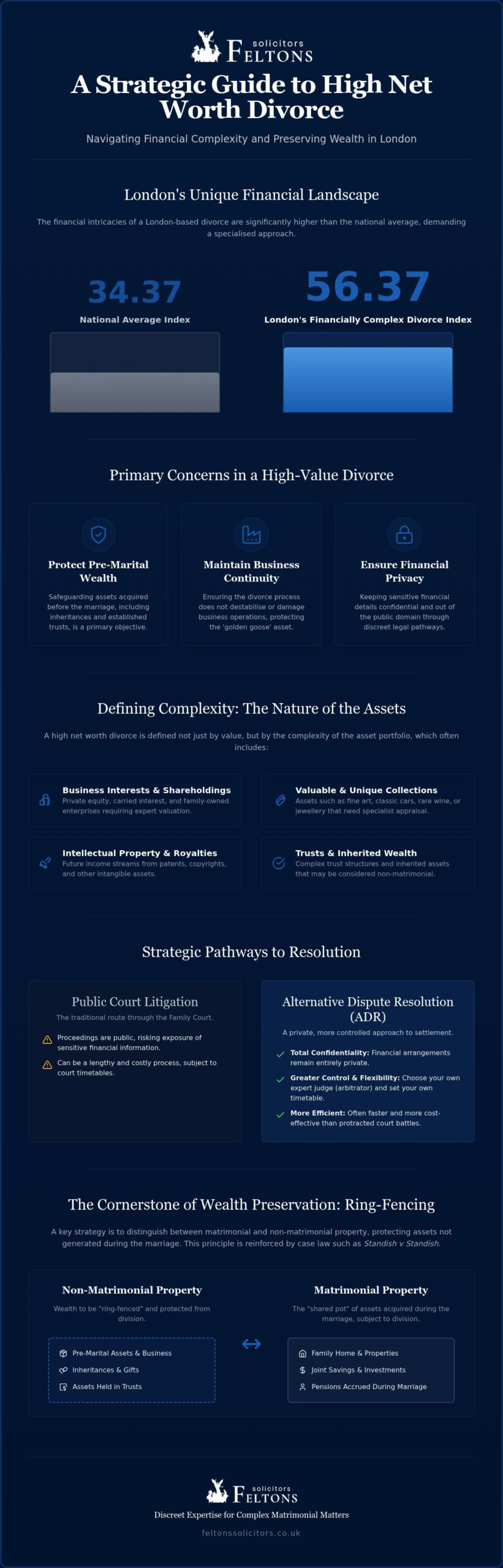
Did you know that London’s “Financially Complex Divorce Index” is currently 56.37, which is significantly higher than the national average of 34.37? For individuals with substantial assets, the end of a marriage brings a unique set of anxieties that go far beyond standard emotional distress. You are likely concerned about maintaining business continuity, protecting pre-marital wealth, and keeping your private financial affairs away from the public eye. Finding the right high net worth divorce solicitors london is the first step in ensuring these complex elements are handled with the discretion they deserve.

We understand that a high-value divorce is a strategic exercise in wealth preservation rather than a standard legal template. This guide provides a clear path through the intricacies of high-value settlements, focusing on strategic asset protection and bespoke legal solutions. We will explore how to value non-liquid assets, navigate international jurisdictions, and utilise recent case law like Standish v Standish to protect your financial legacy whilst ensuring a fair resolution. By the end of this article, you will have a comprehensive understanding of how to manage your divorce with minimal disruption to your professional and personal life.

Key Takeaways

  • Understand what constitutes a high net worth divorce in 2026 and why these cases demand a specialised approach to protect your future.
  • Learn how high net worth divorce solicitors london employ strategic methods to ring-fence pre-marital wealth, trusts, and commercial interests.
  • Discover the advantages of private justice through arbitration and Financial Dispute Resolution to ensure your financial arrangements remain entirely confidential.
  • Master the essential steps for financial disclosure, including the critical role of Form E and the coordination of expert valuations for non-liquid assets.
  • Explore the benefits of a boutique legal partnership that prioritises personal rapport and senior-level expertise for international matrimonial matters.

A high net worth divorce is a process involving complex financial structures, business interests, and international assets. Whilst the core principles of divorce law in England and Wales have been simplified by no-fault legislation, the financial remedy stage has grown increasingly sophisticated. In 2026, the Family Court is tasked with unpicking intricate wealth structures whilst maintaining a commitment to fairness and the “sharing principle.” This requires a level of forensic detail that standard proceedings simply don’t demand. For those with significant estates, partnering with high net worth divorce solicitors london is essential to ensure that wealth is not just divided, but protected through intelligent legal architecture.

The role of the court has evolved to recognise that wealth preservation is a legitimate concern, particularly when assets were acquired long before the marriage began. However, without a bespoke strategy, the risk of “asset dissipation” or unfair valuation is high. These cases require a departure from the “one-size-fits-all” approach, moving instead towards a model of private justice and expert-led negotiation.

The Threshold of Complexity

Complexity in a high-value divorce rarely stems from the size of a bank balance alone. Instead, it arises from the nature of the assets involved. Standard online divorce calculators fail to account for the nuances of a diversified portfolio. We often see disputes centred on assets such as:

  • Private equity holdings and carried interest.
  • Valuable collections of fine art, classic cars, or rare wine.
  • Intellectual property rights and future royalty streams.
  • Inherited wealth and pre-acquired property.

Recent judicial trends, including the application of the Standish v Standish principles, have reinforced the need to distinguish between matrimonial and non-matrimonial property. Identifying which assets should be “ring-fenced” is a critical first step in any high-value settlement.

The Importance of Jurisdiction

London remains a global hub for matrimonial finance, often referred to as the “divorce capital of the world” due to the court’s broad powers to award maintenance and share assets. For international couples, the choice of where to file—often called “forum shopping”—can result in vastly different financial outcomes. If you hold property in multiple countries or have an international business presence, the jurisdiction you choose will dictate the tax implications and the enforceability of any final order. High net worth divorce solicitors london provide the worldly experience necessary to navigate these cross-border challenges, ensuring your interests are protected regardless of where your assets are physically located.

Protecting Complex Assets: Trusts, Business Interests, and Property

Protecting a lifetime of wealth accumulation requires more than just a standard financial disclosure. It demands a forensic understanding of how different asset classes interact with current law. High-value matrimonial disputes often hinge on the distinction between “matrimonial” assets, which are shared, and “non-matrimonial” wealth, such as inheritances or pre-existing business stakes. Experienced high net worth divorce solicitors london work to ring-fence these assets, ensuring the settlement reflects the unique origins of your wealth. Understanding these high-net-worth divorce complexities is essential for anyone looking to preserve their financial legacy whilst navigating a separation.

Business Interests and Shareholdings

Your business is often your most significant asset, but it is also the most vulnerable during a divorce. The court’s primary objective is to achieve a fair division without killing the “Golden Goose.” This means valuations must be precise. We utilise forensic accountants to unwrap complex corporate structures, looking beyond the balance sheet to assess liquidity and latent tax liabilities. Whether you hold a minority shareholding or lead a family-owned enterprise, maintaining business continuity is paramount. A structured approach ensures that a settlement doesn’t force a sale or disrupt daily operations.

Trusts and Offshore Structures

Trusts are frequently at the centre of high-value disputes. The court distinguishes between “nuptial settlements,” which can be varied by a judge, and third-party trusts that remain outside the matrimonial pot. Transparency is now a legal requirement, particularly with the introduction of the overseas entity beneficial owner registration. Failing to account for these disclosure standards can lead to severe penalties or adverse inferences from the court. If your wealth is held via offshore entities, you need a partner who understands the intersection of property law and family finance.

Pensions and Retirement Provision

High-value pensions, including SIPPs and SSAS structures, require specialised handling. Whilst many couples look at pension sharing orders, high net worth individuals often prefer “offsetting,” where one party keeps the pension in exchange for other assets like the family home. With the 2026 tax landscape and previous changes to lifetime allowances, accurate actuarial valuations are non-negotiable. Our team can help you structure these financial arrangements to ensure long-term security without sacrificing current liquidity. Partnering with high net worth divorce solicitors london ensures that every element of your retirement portfolio is weighed correctly against your immediate needs.

Strategic Pathways: Litigation vs. Alternative Dispute Resolution

Choosing the right forum for a high-value separation is as much a commercial decision as it is a legal one. Whilst the default route often involves the court system, the inherent lack of privacy in public hearings can be a significant deterrent for those with sensitive business interests or public profiles. In the current legal environment, high net worth divorce solicitors london are increasingly steering clients towards “private justice” models. These pathways offer a level of discretion and control that the traditional court process simply cannot match, allowing for a resolution that remains entirely amongst the parties involved.

The rise of Private Financial Dispute Resolution (FDR) hearings has transformed how wealthy couples settle their affairs. Instead of waiting months for a court date, parties can hire a specialist judge—usually a senior barrister or retired member of the judiciary—to provide a non-binding indication of the likely outcome. This focused, one-day event often facilitates a settlement that avoids the adversarial nature of a final trial. For those seeking to minimise disruption to their professional lives, this bespoke approach is often the most efficient route to a clean break.

The Court Process and Financial Disclosure

If your case proceeds through the courts, the duty of “full and frank disclosure” is absolute. Every asset, from offshore holdings to minority shareholdings, must be declared on a Form E. Failing to comply can lead to severe penalties, including cost orders or the court drawing “adverse inferences” about your wealth. It is vital to work with a divorce and financial arrangements lawyer who can meticulously prepare this documentation. You can expect the process to begin with a First Appointment to define the issues, followed by an FDR where the court encourages a settlement based on a judge’s preliminary view.

Private Arbitration and Mediation

Arbitration has become the preferred choice for many high net worth individuals because it is binding, confidential, and significantly faster than the court system. You select the arbitrator and the venue, ensuring the process fits your schedule rather than the court’s calendar. Equally, mediation offers a space for creative financial arrangements that a judge might not have the jurisdiction to order. When legal points are particularly contentious, obtaining a formal counsel’s opinion can provide the clarity needed to break a deadlock without stepping foot in a courtroom. By engaging high net worth divorce solicitors london who are experienced in these alternative pathways, you can protect your reputation whilst securing a fair financial future.

High Net Worth Divorce Solicitors London: Protecting Complex Assets

Preparing for a High-Value Settlement: A Professional Checklist

Preparation is the foundation of any successful high-value settlement. It’s not just about compliance; it’s about building a strategic framework that protects your long-term interests. Whilst the court mandates the exchange of Form E, the complexity of a high-net-worth estate often requires additional documentation that goes far beyond the standard requirements. Engaging high net worth divorce solicitors london early in the process allows for a meticulous review of your financial position before any formal disclosure is made. You should organise a comprehensive schedule of all global assets, including those held in trusts or via overseas entities.

Managing your behaviour during this period is equally critical. Whilst the emotional toll of a separation is significant, the financial decisions you make now will define your lifestyle for decades to come. We act as a steady, professional presence, helping you separate emotional impulses from logical financial objectives. This methodical approach ensures that no stone is left unturned and no asset is undervalued. If you are beginning this process, you can book a confidential consultation with our senior team to discuss your specific requirements.

The Role of Forensic Experts

In cases involving diversified wealth, we frequently instruct third-party experts to provide clarity. Forensic accountants are essential for tracing assets that may have been diverted or hidden amongst complex corporate layers. Their expertise is also vital for valuing unique holdings, such as cryptocurrency portfolios or vast tracts of agricultural land, which standard valuers might overlook. Beyond simple valuation, these experts help us design tax-efficient settlement structures. This ensures that the division of assets doesn’t trigger unnecessary Capital Gains Tax liabilities, which can be as high as 24% for residential property gains in the 2026/27 tax year.

Securing Interim Financial Support

A divorce can sometimes lead to immediate liquidity issues, especially if one party controls the primary income streams. We can apply for “Maintenance Pending Suit” to ensure your ongoing costs are covered whilst the final settlement is negotiated. Equally, a Legal Fees Order can be sought to ensure both parties have access to top-tier representation, preventing one side from being “out-litigated” due to a lack of immediate funds. Protecting the family home and maintaining your standard of living during the proceedings is a priority. By working with high net worth divorce solicitors london, you ensure that your immediate financial security is robustly defended from day one.

The Feltons Advantage: Discreet Expertise for Matrimonial Matters

Choosing the right legal partner is a decision that extends beyond mere technical competence. At Feltons Solicitors LLP, we’ve built a reputation as high net worth divorce solicitors london by combining traditional professional integrity with a modern, pragmatic delivery. Established in 2010 by Paula Felton, our firm was founded on the belief that complex matrimonial matters require a “people-first” philosophy. We don’t believe in high-volume processing; instead, we offer a boutique level of care that ensures your personal connection to your legal advisor is never lost amongst the paperwork. This steady, calm presence is vital when dealing with the high-stakes environment of a multi-million-pound estate.

Our integrated approach is what truly sets us apart. Because we possess deep expertise in both family law and property matters, including the specialised registration of overseas entities, we can handle every facet of your divorce under one roof. This seamless coordination prevents the fragmentation of advice that often occurs in larger, more impersonal firms. We’re committed to providing discreet, sound judgment that prioritises your privacy whilst avoiding the expense and public exposure of unnecessary litigation. Our goal is always a fair resolution that protects your pre-marital wealth and business continuity without the need for aggressive court battles.

A Tailored Professional Partnership

A successful settlement is often the result of quiet confidence and meticulous preparation. Our team manages international and cross-border complexities with a steady hand, drawing on years of experience handling high-stakes litigation for both national and international clients. We understand that your reputation is as valuable as your financial assets. By acting as a sophisticated guide, we help you navigate these turbulent waters with minimal disruption to your professional life. This tailored approach ensures that the human impact of the legal work is always considered alongside the technical outcomes, leading to more sustainable and amicable agreements.

Next Steps: Securing Your Financial Future

Early intervention is often the deciding factor in wealth preservation. By engaging high net worth divorce solicitors london at the earliest opportunity, you can ensure that your global assets are correctly structured and protected before disputes escalate. We invite you to arrange a confidential consultation where we can discuss your specific circumstances and develop a bespoke strategy for your future. Whether you are dealing with complex trusts, international property portfolios, or private business interests, we provide the steady presence you need to move forward with confidence. Your financial security and personal peace of mind are our primary concerns.

Contact Feltons Solicitors for expert guidance on your divorce and discover the benefit of a partnership built on trust, discretion, and senior-level expertise.

Securing Your Financial Legacy with Confidence

Navigating a high-value separation requires more than just legal knowledge; it demands a strategic architecture that respects your privacy and protects your commercial interests. We’ve explored how identifying non-matrimonial assets and utilising private justice pathways can mitigate the risks of public disclosure and asset dissipation. By prioritising a forensic approach to disclosure and valuing complex business structures accurately, you can achieve a settlement that ensures long-term stability. Partnering with high net worth divorce solicitors london who offer a boutique, “people-first” service ensures that your specific needs remain the focus of every decision.

Our expertise across matrimonial finance, complex property, and trusts allows us to handle international-scale matters with the quiet confidence you deserve. It’s about moving forward with clarity whilst preserving the wealth you’ve worked hard to build. We provide pragmatic, expert advice tailored to your unique circumstances, ensuring that your future is built on a solid financial foundation. Secure your financial future with a confidential consultation at Feltons Solicitors. You don’t have to navigate these complexities alone; we’re here to guide you through every step with discretion and care.

Frequently Asked Questions

How long does a high net worth divorce usually take in the UK?

High net worth divorces typically take between 12 and 18 months to conclude. This timeline is often dictated by the complexity of valuing global assets and the speed of financial disclosure. Choosing high net worth divorce solicitors london who utilise private arbitration can often shorten this process significantly compared to the backlogged public court system.

Can I protect assets I inherited before the marriage?

Pre-marital inheritances can often be ring-fenced if they have remained separate from matrimonial finances. The court distinguishes between matrimonial and non-matrimonial property, especially following the Standish v Standish ruling. However, if these assets are required to meet the “needs” of the other party, the court retains the discretion to include them in the final settlement.

What happens to my business if I get divorced?

Judges generally try to avoid forcing the sale of a business to preserve it as a “Golden Goose” for future income. Instead, the value of the business is often “offset” against other assets, such as the family home or pension funds. Forensic valuations are essential to determine liquidity and ensure the business remains viable post-settlement.

Is a pre-nuptial agreement legally binding during a high net worth divorce?

Whilst not automatically binding, pre-nuptial agreements are usually upheld by the court if they were entered into freely and with full financial disclosure. Both parties must have received independent legal advice at least 21 days before the marriage. The agreement must also be “fair” and ensure the basic needs of both parties and any children are met.

How are offshore trusts treated by the UK Family Court?

The Family Court has the power to vary “nuptial settlements” or treat trust assets as resources available to one party. If a trust is deemed to be a matrimonial asset, its value will be included in the financial pot. Specialist high net worth divorce solicitors london are required to navigate the intersection of trust law and matrimonial finance to protect these structures.

What is a Private FDR and why should I consider one?

A Private Financial Dispute Resolution hearing allows you to hire a specialist judge to adjudicate your case in a confidential setting. This pathway is preferred by high-profile individuals seeking speed and discretion. It provides a non-binding indication of the likely court outcome, often facilitating a settlement without the need for a public trial.

Can my spouse claim a share of my future earnings or bonuses?

Spouses generally cannot claim a direct share of future earnings post-separation, but bonuses can be relevant to maintenance calculations. If there is a clear maintenance requirement, the court may order a percentage of future bonuses to be paid for a fixed term. This ensures the lower-earning party’s needs are met whilst the higher-earner retains their professional incentives.

How is the “standard of living” during the marriage used to calculate maintenance?

The lifestyle enjoyed during the marriage is a key factor in assessing “needs” for spousal maintenance. In high-value cases, the court aims to prevent a sudden and unfair drop in living standards for the lower-earning spouse. Whilst maintenance isn’t always for life, it provides a transition period to help the party adjust to their new financial circumstances.