
Protecting Assets During Divorce: A Strategic Checklist for Complex Settlements in 2026

Protecting Assets During Divorce: A Strategic Checklist for Complex Settlements in 2026

For many high-net-worth individuals, the most significant threat to a lifetime of achievement isn’t a market downturn, but the lack of a clear strategy during a complex financial settlement divorce. It’s entirely natural to feel a sense of unease as you face the prospect of dividing assets you’ve worked tirelessly to accumulate over decades. You might find yourself confused by the evolving legal definitions of matrimonial versus non-matrimonial property, particularly following the Supreme Court’s 2025 ruling in Standish v Standish regarding pre-marital wealth.

We understand that you’re seeking a fair outcome that respects your contributions whilst avoiding the stress of aggressive litigation. This guide provides the clarity you need to protect your interests, offering a meticulous roadmap to safeguard your financial future through expert legal strategy and precise asset organisation. We’ll examine the current 2026 legal landscape, including the government’s latest consultation on nuptial agreements, and provide a strategic checklist to ensure your settlement is both legally binding and discreetly managed.

Key Takeaways

  • Gain clarity on how the courts interpret “fairness” in 2026 and learn to distinguish between matrimonial and non-matrimonial assets to protect your pre-marital wealth.
  • Navigate the nuances of a complex financial settlement divorce by organising a comprehensive inventory of global interests, from digital currencies to offshore holdings.
  • Identify why professional valuations for businesses, property, and private collections are essential for establishing a fair and legally robust baseline.
  • Evaluate the most effective strategies for managing high-value pensions and the family home to ensure long-term financial stability after the proceedings.
  • Understand the strategic importance of total transparency in financial disclosures to prevent future litigation and protect your reputation throughout the process.

Understanding Complex Financial Settlements in 2026

A complex financial settlement divorce differs significantly from a standard separation. It involves intricate webs of wealth that often include family businesses, offshore trusts, and significant digital portfolios. Whilst many couples begin with divorce settlement basics, high-value cases require a deeper analysis of how assets are structured and held. In 2026, the legal landscape is particularly nuanced. The UK government’s “A Fairer End to Relationships” consultation, launched in June 2026, aims to codify the principles of “needs” and “sharing” into statutory law. This means the court’s interpretation of fairness is becoming more structured, making it vital to present a clear, evidence-based financial position from the outset.

Proactive asset protection is essential during the early stages of separation. Without a strategic approach, wealth built over decades can be vulnerable to aggressive litigation or poor management. Identifying which assets are truly matrimonial and which should be ring-fenced is the first step in ensuring a fair outcome that respects your individual contributions. It’s a process that requires both technical precision and a calm, methodical mindset.

The Risk of Unprotected Assets

Lack of preparation often leads to unintended asset dissipation. In the current economic climate of 2026, market volatility and inflation can rapidly alter the real-world value of shares, property, and pensions. Relying on a “DIY” approach or outdated valuations is a significant risk. If you don’t secure professional appraisals early, you might find yourself negotiating based on inaccurate figures. This often results in settlements that fail to provide long-term security. With court fees for divorce applications standing at £612 as of February 2026, the financial stakes of getting the process right the first time are exceptionally high.

Matrimonial vs Non-Matrimonial Property

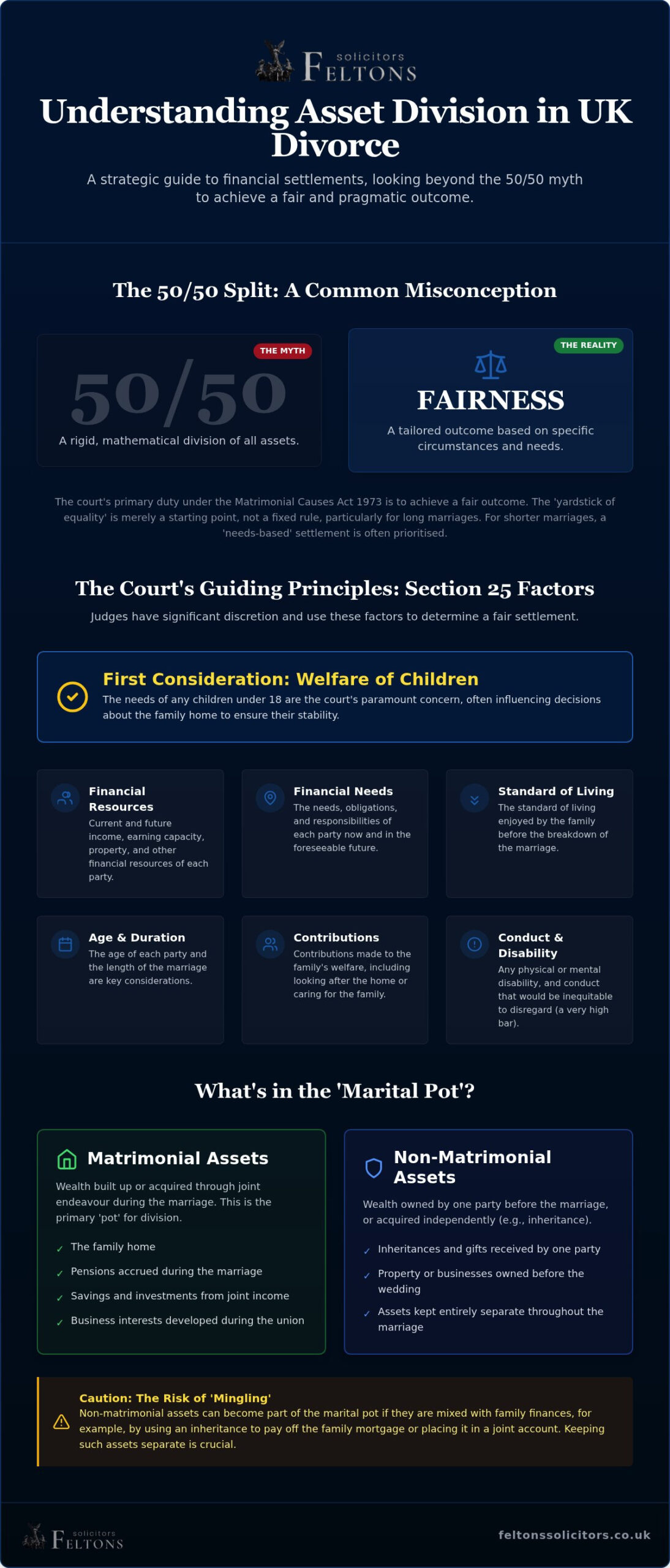
Distinguishing between matrimonial and non-matrimonial property is a cornerstone of any complex financial settlement divorce. Generally, matrimonial assets are those acquired during the marriage, whilst non-matrimonial assets include inherited wealth or property owned before the wedding. However, the boundaries often blur. The Supreme Court’s July 2025 ruling in Standish v Standish clarified that transferring pre-marital assets to a spouse for tax planning doesn’t automatically make them matrimonial property. Tracing these assets back to their original source is crucial. If funds have been “commingled”, for example, by using an inheritance to pay off a joint mortgage, they may lose their protected status. Precise record-keeping is your best defence in ring-fencing your private wealth.

The Asset Protection Checklist: Immediate Steps to Take

Taking immediate action is the most effective way to maintain control over your financial narrative. Navigating a complex financial settlement divorce requires more than just legal advice; it demands a structured, methodical approach to asset management from the very first day of separation. By establishing a clear baseline of your financial position, you reduce the risk of confusion or conflict later in the process. Preparation is your most reliable tool for achieving a fair and discreet resolution.

  • Organise a global inventory: Document all assets, including digital currencies, offshore interests, and private equity holdings.
  • Secure expert valuations: Obtain professional reports for property, businesses, and art collections to establish current market values.
  • Review legal documents: Update your Will and any existing trusts to reflect your change in circumstances and protect your beneficiaries.
  • Document non-matrimonial wealth: Gather evidence for assets acquired before the marriage or through inheritance to support ring-fencing claims.
  • Establish a legal strategy: Engage a specialist solicitor early to coordinate your financial disclosure and protection plan.

Financial Documentation and Inventory

Creating a secure digital vault for your financial records is a practical first step. This should house at least three years of bank statements, tax returns, and property deeds. Whilst the specific legal requirements vary, consulting a Financial Implications of Divorce Checklist can help you identify the primary documents needed to build your case. It’s also vital to distinguish between joint and sole liabilities. Identifying shared debts early prevents one party from accumulating liabilities that could impact the final settlement. For those with international interests, updating trusts is particularly urgent given the 2026 federal estate tax exemption has risen to $15,000,000 per person. Maintaining a clear paper trail is the only way to demonstrate that funds haven’t been commingled with matrimonial property.

Professional Valuations in 2026

Market conditions in 2026 remain fluid, making up-to-the-minute expert reports essential for a fair division of assets. Relying on estimates or outdated figures can lead to significant financial loss. Forensic accountants play a critical role here, particularly when valuing private businesses or complex share schemes. They provide the technical depth required to ensure valuations are court-compliant, which helps avoid protracted disputes over asset worth. Securing your future often begins with professional advice on financial arrangements to ensure every asset is correctly documented. This precision is vital as the UK government moves closer to codifying financial remedy principles following the 2026 family law reform consultation. Professional valuations establish a baseline that protects both parties, ensuring the final agreement is grounded in current reality rather than speculation.

Managing Complex Assets: Pensions, Property, and Businesses

Managing high-value assets requires a shift from simple arithmetic to expert financial planning in divorce. This is where the intricacies of a complex financial settlement divorce become most apparent. Every decision regarding a pension pot or a family business carries long-term tax and lifestyle consequences that must be weighed with precision. Achieving a fair outcome involves balancing immediate liquidity needs with the preservation of long-term wealth.

Pensions and Long-Term Security

Pensions are often the most undervalued asset in a settlement. In 2026, understanding the current rules on Cash Equivalent Transfer Values (CETVs) is vital, as these figures can fluctuate based on interest rates and gilt yields. You’ll typically choose between a Pension Sharing Order, which carves out a portion of the fund for the spouse, and Pension Offsetting, where one party retains the pension in exchange for a larger share of other assets like the family home. Expert actuarial advice is non-negotiable for large pots to ensure the “true value” is captured, rather than just the surface-level cash figure. For a deeper look at how these disclosures work, see our Financial Disclosure in Divorce UK: A Complete Guide for 2026.

Safeguarding Business Interests

Protecting corporate continuity is often a primary concern for business owners. The court generally aims to avoid the forced sale of a family-run or private company, but it must ensure the non-owning spouse receives a fair share of the value. “Liquidity” is the deciding factor here. If the business doesn’t have the cash reserves to buy out a spouse’s interest, the court may look at structured payments or offsetting against other matrimonial property. Reviewing your shareholders’ agreements is a critical defensive step. These documents often contain “trigger events” or valuation formulas that can provide a framework for the court, helping to ring-fence the company’s operational integrity.

When wealth spans borders, jurisdictional complexities arise. With the 2026 federal estate tax exemption in the US now permanently set at $15,000,000 per person, international tax planning becomes a central pillar of the negotiation. For those with American real estate interests, understanding specific encumbrances is crucial; Fridman Legal provides specialist guidance on home liens and debt relief. Whether it’s a holiday home in Europe or an offshore trust, each asset must be examined through the lens of both UK and local law to prevent double taxation or unforeseen levies. This methodical approach ensures your global interests remain protected whilst meeting the legal requirements of a complex financial settlement divorce.

Protecting Assets During Divorce: A Strategic Checklist for Complex Settlements in 2026

The Financial Disclosure Process: Strategic Transparency

Financial disclosure is often the most demanding phase of a complex financial settlement divorce. It is not merely an administrative exercise; it is a strategic opportunity to establish the undeniable facts of your financial life. Approaching this process with total transparency protects you from future allegations of concealment. Conversely, a meticulous review of your spouse’s disclosure ensures that the final division is based on the full reality of the matrimonial pot. In high-value cases, the goal is clarity, not conflict.

  • Step 1: Complete Form E with absolute accuracy to prevent future challenges to the settlement.
  • Step 2: Scrutinise the opposing disclosure for inconsistencies in income or asset valuations.
  • Step 3: Use forensic accounting where complex corporate or trust structures require unpicking.
  • Step 4: Negotiate a settlement from a position of strength based on verified data.
  • Step 5: Secure a Consent Order to make the settlement legally binding and final.

The Importance of Form E

Form E serves as the definitive cornerstone of UK financial disclosure, providing the court with a granular view of each party’s global wealth. Failing to disclose assets is a grave risk. If hidden wealth is discovered at a later date, the court possesses the power to “set aside” the original order. This leads to costly re-litigation and potential financial penalties. Presenting complex information clearly is a skill in itself. We recommend using structured schedules for shareholdings or international property portfolios to help the court understand your position without confusion or delay; if your portfolio includes interests in Israel, you can learn more about Salior Ben Hamou Law Office for dedicated legal representation.

Forensic Accounting and Hidden Assets

In high-stakes cases, common red flags include a sudden drop in business profitability or a lifestyle that far exceeds declared income. Forensic experts are skilled at tracing funds amongst complex offshore structures, identifying where assets may have been diverted or undervalued. This investigation must remain discreet to preserve the professional integrity of the proceedings. By verifying every figure, you ensure that the eventual settlement is fair and final. If you require assistance with your financial disclosure, contact our experts in divorce and financial arrangements for a discreet consultation. This methodical verification process ensures that no stone is left unturned, providing the security you need for your financial future.

A sophisticated guide does more than interpret the law; they anticipate the emotional and financial ripples of every decision made during a complex financial settlement divorce. In high-stakes negotiations, the technical accuracy of your legal team is paramount, yet the human element cannot be ignored. We act as a steady presence, ensuring that whilst the legal work is rigorous, your personal well-being and privacy remain protected. Moving from a state of uncertainty to a structured legal plan requires a partner who values discretion as much as they value a fair settlement.

The Feltons Approach to Complex Divorce

At Feltons Solicitors LLP, we prioritise personal connection over high-volume processing. Every client is unique, and we believe your legal strategy should be equally bespoke. Our team specialises in unpicking the intricate details of high-net-worth matters, from the valuation of private equity to the management of offshore trusts. We understand that for many, the goal is a resolution that maintains professional integrity and avoids the public nature of aggressive litigation. As a dedicated divorce and financial arrangements lawyer, we provide the quiet confidence needed to handle international assets and significant matrimonial wealth with absolute discretion. We bridge the gap between traditional professional standards and modern efficiency, ensuring your case is handled with the highest level of care.

Securing Your Financial Future

A well-negotiated settlement is the foundation of your peace of mind for 2026 and the years that follow. With the UK government currently consulting on major family law reforms, having a legal team that stays ahead of statutory changes is a significant advantage. Whether we are navigating the new rights for cohabiting couples or applying the principles of the 2025 Standish v Standish ruling to your pre-marital wealth, our focus remains on your long-term security. Our high net worth divorce solicitors are adept at finding creative, legally binding solutions that protect your interests without unnecessary conflict. We invite you to contact our team for a confidential consultation to discuss how we can support you through this transition. By establishing a clear, evidence-based strategy today, you can step into the future with financial clarity and the assurance that your legacy is secure.

Securing Your Financial Legacy Beyond 2026

Achieving a fair resolution requires more than just legal knowledge; it demands a meticulous, evidence-led approach to every asset you own. By following a structured checklist and maintaining total transparency during disclosure, you protect yourself from future disputes whilst ensuring your contributions are fully recognised. We’ve explored how distinguishing non-matrimonial property and securing expert valuations are the cornerstones of a successful outcome.

Navigating a complex financial settlement divorce is a significant undertaking, but you don’t have to face it alone. Feltons Solicitors LLP was established in 2010 by Paula Felton as a boutique firm specialising in complex private client matters. We bring a high level of expertise to international and high-net-worth litigation, providing the calm, steady presence needed to reach a legally binding finality. Our approach prioritises your privacy and long-term security above all else.

If you’re ready to move from uncertainty to a structured plan, we’re here to help. Book a discreet consultation with our expert divorce solicitors to discuss your unique circumstances. You’ve worked hard to build your wealth, and we’re committed to helping you protect it.

Frequently Asked Questions

What assets are protected in a divorce in the UK?

Non-matrimonial assets, such as wealth acquired before the marriage or through inheritance, are the primary candidates for protection. These assets are typically ring-fenced provided they haven’t been “commingled” with joint finances. The court looks at whether these funds were used to purchase the family home or support the joint lifestyle. Meticulous documentation is required to prove the source and separate nature of these assets from the shared matrimonial pot.

Can I protect my business from my spouse during divorce?

The court generally avoids the forced sale of a business to ensure corporate continuity and ongoing income. Protecting your interests often involves “offsetting” the value of the business against other matrimonial assets like the family home or pension funds. Shareholders’ agreements and clear valuations from forensic accountants are vital tools in this process. They help define the business as a separate entity rather than a shared matrimonial asset that must be divided.

How are pensions split in a complex financial settlement?

Pensions are typically managed through Pension Sharing Orders or Pension Offsetting within a complex financial settlement divorce. A Sharing Order transfers a percentage of one party’s pension credit to the other, whilst offsetting allows one spouse to keep their pension in exchange for other assets. In 2026, it’s essential to obtain an up-to-date Cash Equivalent Transfer Value (CETV) and seek actuarial advice to understand the fund’s true long-term value rather than just the cash figure.

What happens if my spouse hides assets during the disclosure process?

If a spouse hides assets, the court has the power to draw “adverse inferences” or even set aside the final order entirely. This means the case can be reopened, often resulting in significant financial penalties for the non-disclosing party. We utilise forensic accountants to trace funds through offshore structures and corporate accounts. Total transparency in your own Form E is your best defence against future allegations and costly legal challenges.

Is inherited wealth always split 50/50 in a UK divorce?

Inherited wealth is not automatically split 50/50; it is often treated as non-matrimonial property if kept separate. However, if the inheritance was used for the “joint benefit” of the family, such as paying off a shared mortgage, it may be considered commingled. The court’s decision depends on the length of the marriage and the financial needs of both parties. Tracing the inheritance back to its original source is a critical step in ring-fencing these funds.

How long does a complex financial settlement usually take in 2026?

A complex settlement typically takes between 9 and 18 months to resolve, depending on the intricacy of the assets involved. This timeline accounts for the 20-week reflection period required under no-fault divorce laws. Securing valuations for international property or private businesses can extend the process. Early organisation of your financial documentation is the most effective way to prevent unnecessary delays and ensure a smoother progression towards a final agreement.

Do I need a Consent Order if we have already agreed on the split?

A Consent Order is absolutely necessary to ensure your agreement is legally binding and final. Without this court-approved document, either party could potentially make a financial claim against the other many years after the divorce is finalised. Even if you have reached an amicable agreement, the Consent Order provides the “clean break” required to protect your future earnings and any assets you acquire independently after the marriage ends. Working with spousal maintenance solicitors UK can help ensure your Consent Order is structured to provide a genuine clean break and guard against future income claims.

How can I ring-fence assets I owned before the marriage?

Ring-fencing pre-marital assets requires clear evidence that the property or funds remained separate throughout the marriage. The 2025 Supreme Court ruling in Standish v Standish reinforced that transferring assets for tax planning doesn’t automatically make them matrimonial property. You must demonstrate a clear “paper trail” showing the assets weren’t used for joint family purposes. This methodical approach is vital for safeguarding wealth built before the relationship began.

Leasehold Enfranchisement Experts: A Guide to Securing Your Property Rights in 2026

Leasehold Enfranchisement Experts: A Guide to Securing Your Property Rights in 2026

Owning a leasehold property shouldn’t feel like a race against a ticking clock, yet for many, the 80-year threshold remains a source of significant financial anxiety. You likely feel that the legal process is unnecessarily opaque, especially when faced with strict statutory deadlines and the fear of escalating premiums. It’s a common frustration to feel like a tenant in your own home while the freeholder retains control. By partnering with leasehold enfranchisement experts, you can transform this uncertainty into a strategic advantage, ensuring your property remains a secure asset for decades to come.

In this guide, we’ll show you how to navigate the complexities of the latest legislation, including the 2024 reforms that have already simplified the path to ownership. We will explore how the abolition of the two-year ownership requirement and the new 990-year extension standards allow you to eliminate ground rent and regain management control. You’ll discover a clear, methodical approach to increasing your property’s market value whilst avoiding the pitfalls of complex legal notices. From understanding premium calculations to managing collective enfranchisement, this overview provides the professional clarity you need to secure your property rights in 2026.

Key Takeaways

  • Understand why the 80-year threshold acts as a financial cliff and how acting early prevents the significant costs associated with Marriage Value.
  • Distinguish between the legal protections offered by the statutory route and the potential pitfalls of informal agreements with freeholders.
  • Discover how the 50% rule empowers you and your neighbours to force the sale of a freehold and gain full control over building management.
  • Learn how leasehold enfranchisement experts navigate complex premium calculations and procedural risks to secure your property’s long-term value.
  • Identify the strategic steps required to eliminate ground rent obligations and secure a 990-year lease extension under current legislation.

Understanding Leasehold Enfranchisement and the Critical 80-Year Rule

Leasehold enfranchisement is the legal mechanism that empowers flat owners to secure their investment and gain genuine autonomy. In essence, it allows you to either extend your lease or, in collaboration with your neighbours, purchase the freehold of the entire building. For many homeowners, this isn’t just a legal formality; it’s a vital step to remove onerous ground rent clauses and ensure the property remains attractive to future buyers. Seeking guidance from leasehold enfranchisement experts ensures that these complex statutory procedures are handled with the precision they require.

Why the 80-Year Threshold is a Critical Deadline

The 80-year mark represents a significant financial pivot point. Once a lease drops below this threshold, a concept known as Marriage Value enters the calculation. This represents the potential increase in the property’s value after a lease extension is granted. Under current rules, the leaseholder must pay the freeholder 50% of this added value as part of the extension premium. This additional cost can run into thousands of pounds, making the process far more expensive than it needs to be.

Beyond the immediate expense, a short lease severely impacts mortgageability. Most high-street lenders are reluctant to offer finance on properties with fewer than 80 years remaining, which significantly reduces the pool of potential buyers. Acting before you hit this financial cliff is always the most cost-effective strategy. While recent reforms aim to eventually phase out Marriage Value, it remains a present factor in 2026 that requires careful navigation to avoid overpaying.

Individual Extension vs. Collective Enfranchisement

Deciding between an individual extension and a collective purchase depends on your long-term goals for the building. A statutory lease extension, now standardised to 990 years under recent reforms, is often the simplest path for an individual tenant. It resets the clock and reduces ground rent to zero. This is a pragmatic choice if you’re looking for immediate security without needing to coordinate with other residents.

However, if you’re frustrated by high service charges or poor building maintenance, the Collective enfranchisement process might be more appropriate. This involves joining forces with at least 50% of the qualifying tenants in your block to buy the freehold. Once successful, you and your neighbours become your own landlord, providing total control over management decisions and future costs. This collective approach doesn’t just protect your lease; it transforms how your building is run. Our team of leasehold enfranchisement experts can help you weigh these options to determine which strategy aligns best with your financial interests.

When you decide to secure your property rights, you’ll face a choice between the statutory path or an informal negotiation. The statutory route, primarily governed by the Leasehold Reform, Housing and Urban Development Act 1993 for flats, provides a robust shield for homeowners. For those owning houses, the Leasehold Reform Act 1967 offers the primary legal foundation. Choosing the formal route ensures that the freeholder cannot simply ignore your request or impose arbitrary terms. It requires the service of a valid Section 42 notice for extensions or a Section 13 notice for collective enfranchisement. These documents are precise legal instruments that, when handled by leasehold enfranchisement experts, lock the freeholder into a strict, legally binding process.

Navigating the Statutory Process under the 1993 Act

The statutory framework is defined by its methodical timeline. Once your initial notice is served, the freeholder has a fixed period to provide a counter-notice. This structure prevents the delays that often plague private negotiations. Under the updated 2026 landscape, the Act guarantees a significant extension, typically moving towards the new 990-year standard, and reduces ground rent to a peppercorn value. If a premium cannot be agreed through negotiation, you have the right to take the matter to the First-tier Tribunal. This serves as an essential safety net, ensuring that the final price is determined by law rather than a landlord’s whim.

The Pitfalls of Informal Lease Extension Agreements

It’s common for freeholders to approach leaseholders with “friendly” informal offers. These deals might appear attractive because they often bypass the initial costs of a formal valuation. However, these agreements can be a trap. Freeholders frequently use informal deals to slip in rising ground rent clauses or shorter extension terms than the law would otherwise grant. Without the protection of the 1993 Act, you lose your right to appeal to a tribunal if things go wrong. These private arrangements often lack the long-term security provided by the statutory route.

A boutique approach ensures that every detail of your agreement is scrutinised to prevent long-term financial loss. If you’re unsure which path to take, consulting with leasehold enfranchisement experts can help you avoid these expensive pitfalls and secure a deal that truly protects your equity. Relying on professional, pragmatic guidance is the only way to ensure an informal proposal doesn’t compromise your investment for years to come. By choosing the formal statutory route, you remain in control of the process from start to finish.

Collective Enfranchisement: Uniting to Purchase the Freehold

Collective enfranchisement is a powerful tool for leaseholders seeking to escape the limitations of a third-party landlord. By joining forces, you can legally compel your freeholder to sell the building’s freehold to a company owned by you and your neighbours. This process is governed by the 50% rule; if half of the flats in your block agree to participate, the freeholder cannot refuse the sale. Working with leasehold enfranchisement experts ensures that this collective effort is managed with the necessary legal rigour to avoid procedural delays and interpersonal friction.

The strategic advantage of owning a “share of freehold” in the current UK market cannot be overstated. It significantly increases the liquidity of your asset, as buyers often prefer properties where they have a direct say in management. Beyond the financial gain, it eliminates the frustration of dealing with unresponsive managing agents or inflated service charges. You and your fellow residents become the masters of your own building’s destiny.

This level of control is particularly valuable when planning future renovations or maintenance. For residents who wish to upgrade their building to a premium standard, partnering with a high-end firm such as Daniels Contractors ensures that any development work reflects the property’s increased value and prestige.

Eligibility Criteria for Qualifying Tenants

To proceed, the building itself must meet specific criteria. Primarily, at least two-thirds of the flats must be held by “qualifying tenants”, which is defined as those with original lease terms exceeding 21 years. Mixed-use buildings also have strict thresholds that have evolved recently. As of March 2025, the threshold for non-residential space was increased, allowing buildings with up to 50% commercial use to qualify for enfranchisement. This change has opened the door for many residents in urban centres to take control of their properties. However, certain exclusions apply, such as buildings where the landlord is a resident and the block contains four or fewer flats.

Organising a Nominee Purchaser and Participation Agreements

Success in a collective claim requires a clear legal structure. You must form a “Nominee Purchaser,” which is typically a private limited company. Each participating leaseholder becomes a shareholder, and this entity will eventually hold the freehold title once the transaction completes. Because these claims involve multiple parties and significant sums of money, the risk of a neighbour withdrawing mid-process is a genuine concern. This is why participation agreements are vital. These contracts ensure every member remains committed to their financial share of the premium and professional fees.

Even during these collective negotiations, individual tenant lease extension rights remain a factor, as the new freehold company can often grant 999-year leases to its members at a peppercorn rate. If disputes arise regarding the purchase price or “premium” during the negotiation phase, you can refer to official tribunal guidance to understand how the First-tier Tribunal resolves valuation disagreements. By partnering with leasehold enfranchisement experts, you can navigate these interpersonal and legal complexities with quiet confidence, ensuring a smooth transition to a share-of-freehold status. For a comprehensive step-by-step walkthrough of this process, our guide on working with collective enfranchisement solicitors to buy your freehold in 2026 provides a detailed blueprint from initial organisation through to completion.

Leasehold Enfranchisement Experts: A Guide to Securing Your Property Rights in 2026

Managing the Costs and Procedural Risks of Enfranchisement

Dealing with a difficult or unresponsive freeholder is often the most taxing part of the enfranchisement journey. It is a high-stakes negotiation where financial interests directly collide. You’re legally required to pay a “Premium” to compensate the freeholder for their loss of interest in the property. This figure isn’t just a simple purchase price; it also includes the freeholder’s “reasonable” legal and valuation fees, which you are statutory bound to cover. Our role as leasehold enfranchisement experts is to ensure these costs remain truly reasonable and aren’t used as a tactic to stall your progress or inflate the total bill.

Calculating the Premium and Marriage Value

The premium is built from several technical components, primarily the capitalisation of future ground rent and the “reversionary value,” which represents the value of the property returning to the landlord at the end of the term. Marriage Value is the profit created by merging the leasehold and freehold interests. Whilst recent reforms aim to simplify these calculations, Marriage Value remains a significant factor for any lease with fewer than 80 years remaining. A specialist solicitor works closely with a qualified valuer to challenge freeholder estimates. We use expert evidence to build a robust case, often significantly reducing the final premium if the matter reaches a Tribunal.

Avoiding Professional Negligence and Procedural Delays

In this area of law, precision is your greatest asset. One of the most dangerous procedural traps is missing the strict six-month window to apply to the First-tier Tribunal after receiving a counter-notice. If this deadline passes without a formal agreement or an application, your claim is “deemed withdrawn.” This mistake can be devastating, as you may be barred from reapplying for 12 months, during which time the premium may increase. Understanding exactly what to expect when your landlord response to lease extension notice arrives is essential to ensuring you act within these critical statutory windows. This is where the expertise of a residential property law firm becomes indispensable. We manage the administrative burden, ensuring every notice is served correctly and every statutory deadline is met with room to spare.

Sometimes, the challenge isn’t a difficult freeholder, but an “absentee” one. If your landlord cannot be located after reasonable searches, we can guide you through the Vesting Order process. This allows the County Court to sign the transfer on the freeholder’s behalf, ensuring your rights aren’t held hostage by a missing person. If you’re ready to protect your investment from these technical risks, speak with our leasehold specialists for a pragmatic assessment of your case. We provide the calm, steady presence needed to navigate these complex waters whilst keeping your long-term interests at the forefront of every decision.

How Leasehold Enfranchisement Experts Protect Your Investment

Securing the future of your property requires more than just a successful valuation; it demands a strategic legal approach that spans from the initial notice to final registration. Enfranchisement is a high-stakes manoeuvre where the margin for error remains slim. By engaging leasehold enfranchisement experts, you gain a calm, steady presence that navigates the friction of landlord negotiations whilst protecting your capital. We focus on delivering a bespoke strategy that balances speed and cost with absolute legal security, ensuring your home remains a liquid and valuable asset throughout the 2026 property landscape.

The Role of a Specialist Property Solicitor

A specialist property solicitor provides a level of depth that “off-the-shelf” legal services simply cannot match. Every lease is unique, containing specific covenants and historical quirks that can impact the success of a claim. We move beyond generic advice to provide tailored solutions for complex titles, particularly in mixed-use developments or estates with intricate management structures.

Our work involves close coordination with specialist valuers to ensure that the legal framework and financial strategy are perfectly aligned. Once a premium is agreed or determined by a Tribunal, the process moves into a technical conveyancing phase. This requires the drafting of new lease terms or the transfer of the freehold title with meticulous precision. Managing the registration of these new interests at HM Land Registry is the final, critical step. Any administrative oversight at this stage could cloud your title, making future sales or remortgaging difficult.

Securing Your Property’s Future with Feltons Solicitors LLP

At Feltons Solicitors LLP, we’re committed to a “people-first” philosophy that prioritises your peace of mind. Our approach is defined by traditional professional integrity blended with modern efficiency. We provide pragmatic advice designed to achieve your goals without the need for unnecessary or expensive litigation. This discreet, high-standard service is why we’re trusted by both local residents and international clients who hold significant UK leasehold interests. Whether you’re extending a single lease or leading a collective purchase of a freehold, we act as your sophisticated guide through every stage.

The landscape of property law is shifting, and the reforms of 2026 have created new opportunities for leaseholders to reclaim control. However, the complexity of the statutory process remains. We believe a preliminary consultation is the most vital part of the journey. It allows us to assess the specific merits of your case, identify potential hurdles, and set a clear path forward. By partnering with leasehold enfranchisement experts at Feltons Solicitors LLP, you ensure that your property rights are not just exercised, but fully secured for the long term. It’s about more than just a legal result; it’s about the security of your home and your investment.

Secure Your Property’s Future with Expert Guidance

Securing your property rights in 2026 is no longer a matter of waiting for legislative change; it’s about taking proactive steps to protect your equity. By acting before the 80-year threshold, you avoid the significant costs of Marriage Value and ensure your home remains mortgageable. Whether you choose a statutory 990-year extension or join with neighbours to purchase the freehold, the result is the same: increased market value and the elimination of ground rent obligations. These technical manoeuvres require precision to avoid the procedural traps that often derail informal negotiations.

Established in 2010 by Paula Felton, our firm specialises in complex property litigation and residential conveyancing. We provide pragmatic, discreet legal support for both national and international clients, ensuring every statutory deadline is met with quiet confidence. If you’re ready to move from uncertainty to autonomy, consult our leasehold enfranchisement experts today. We’ll help you navigate the complexities of the law whilst providing the boutique care your investment deserves. Your property is likely your most significant asset; it’s time to ensure it’s fully under your control.

Frequently Asked Questions

What is the difference between a lease extension and enfranchisement?

A lease extension increases the length of your existing lease, whilst enfranchisement involves purchasing the freehold title outright. For flat owners, enfranchisement is usually a collective process where you and your neighbours buy the building. Both routes effectively eliminate ground rent obligations and increase the market value of your property. Our team of leasehold enfranchisement experts can help you determine which path provides the best long-term security for your specific circumstances.

How much does it cost to extend a lease or buy the freehold?

The total cost is comprised of the premium paid to the freeholder and the professional fees for both parties. You are legally responsible for the freeholder’s reasonable legal and valuation costs in addition to your own. The premium varies significantly based on the remaining lease term and the property’s value. Because these calculations are complex, we recommend obtaining a formal valuation to ensure you don’t overpay during the negotiation phase.

What is the 80-year rule in leasehold enfranchisement?

The 80-year rule is a critical threshold where extending a lease becomes significantly more expensive due to Marriage Value. This is the potential increase in property value created by the extension, half of which must be paid to the landlord. Whilst the Leasehold and Freehold Reform Act 2024 aims to eventually phase this out, it remains a vital consideration for leaseholders in 2026. Acting before your lease drops below this mark is the most effective way to protect your equity.

Can my freeholder refuse to extend my lease or sell the freehold?

No, a freeholder cannot refuse a valid statutory request if you meet the eligibility criteria under the 1993 Act. This is a mandatory legal right, not a discretionary favour. If the landlord fails to respond or disputes the terms unreasonably, leasehold enfranchisement experts can apply to the First-tier Tribunal to have the terms determined by law. This ensures that you aren’t held hostage by a difficult or unresponsive landlord.

How long does the leasehold enfranchisement process take?

Most claims take between six and twelve months to complete from the service of the initial notice. The timeline depends heavily on the freeholder’s response and the complexity of the valuation negotiations. If the parties cannot agree on a premium and the matter proceeds to a Tribunal, the process may take longer. We manage every administrative step to ensure your claim stays on track and meets all strict statutory deadlines.

Do I need my neighbours’ permission to buy the freehold?

You don’t need your neighbours’ permission to extend your individual lease, but you do need their participation to buy the freehold. Collective enfranchisement requires at least 50% of the qualifying tenants in a building to join the claim. You don’t need the consent of the remaining residents, though they will have the opportunity to participate if they wish. This collective approach gives you total control over the building’s future management and service charges.

What happens if I cannot find my freeholder?

If your freeholder is missing, you can still proceed by applying for a Vesting Order through the County Court. This legal mechanism allows the court to sign the transfer or lease extension on the freeholder’s behalf after you’ve made reasonable attempts to find them. The premium is then paid into court for the landlord to claim later. It’s a methodical process that ensures an absentee landlord cannot block your legal right to enfranchisement.

Can I extend my lease if I have only just bought the property?

Yes, you can now apply to extend your lease or buy the freehold immediately after purchasing your home. As of 31 January 2025, the previous requirement to have owned the property for two years was abolished. This change allows new owners to act quickly to secure their investment, which is particularly beneficial if the lease is approaching the 80-year mark. You no longer have to wait or rely on the seller to start the process for you.

Overseas Entity Beneficial Owner Registration: A Guide for UK Property Owners in 2026

Overseas Entity Beneficial Owner Registration: A Guide for UK Property Owners in 2026

Did you know that when the Register of Overseas Entities was established, over 12,000 entities failed to meet their initial transparency deadlines, leaving their UK property interests vulnerable to severe legal restrictions? You likely recognise that holding international assets requires a high degree of diligence, yet the intricacies of overseas entity beneficial owner registration can feel unnecessarily burdensome. It’s understandable to worry about the risk of criminal prosecution or the prospect of HM Land Registry freezing a critical transaction due to a filing error.

This guide offers a steady, expert hand to help you navigate these regulatory waters with confidence. We’ll provide the clarity you need to ensure your registration is handled correctly, protecting your reputation and your investments from the substantial fines now being enforced. We’ll outline the current 2026 fee structures, including the £234 registration and update costs, the essential role of UK-regulated verification agents, and the methodical steps required to achieve seamless compliance with Companies House.

Key Takeaways

  • Understand the essential legal requirements under the Economic Crime Act to ensure your UK property titles remain secure and tradable.
  • Identify your Registrable Beneficial Owners by applying the specific 25% threshold for shares and voting rights within your corporate structure.
  • Learn why mandatory verification by a UK-regulated agent is a critical prerequisite for a valid overseas entity beneficial owner registration.
  • Navigate the strict 14-day window for annual update statements to prevent the risk of frozen assets or substantial financial penalties.
  • Recognise how professional legal oversight bridges the gap between complex international entities and current UK compliance standards.

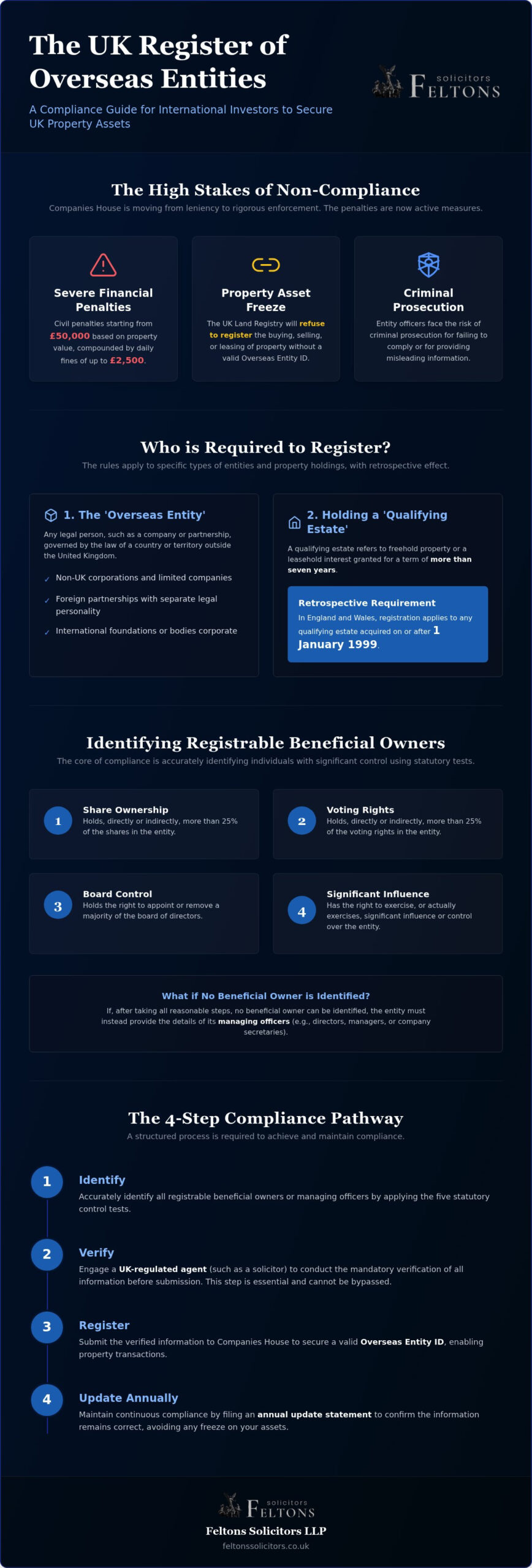
The legal framework governing foreign-owned property in the United Kingdom has undergone a profound transformation. At the heart of this change is the Register of Overseas Entities (ROE), established by the Economic Crime (Transparency and Enforcement) Act 2022. This legislation mandates that any foreign entity wishing to own land in the UK must disclose its true controllers. By 2026, the regulatory climate has shifted from initial education to strict enforcement. Authorities now demand absolute precision in every overseas entity beneficial owner registration, viewing even minor discrepancies as potential compliance failures.

Compliance is no longer a one-time hurdle. The 2026 landscape requires more rigorous data accuracy than in previous years, reflecting a broader push for transparency in global capital flows. For property owners, this means that the information held by Companies House must be verified and updated with meticulous care. Failure to do so doesn’t just result in administrative letters; it can lead to daily fines of up to £2,500 and, in the most serious cases, criminal liability for the entity’s officers. These sanctions are designed to ensure the register remains a reliable source of truth for government agencies and the public alike.

Which Entities Fall Under the Scope?

An “overseas entity” is broadly defined as any legal person, such as a corporation, partnership, or trust, that is governed by the law of a country or territory outside the UK. The scope is notably retrospective. In England and Wales, the requirement applies to land acquired on or after 1 January 1999. In Scotland, the threshold date is 8 December 2014. Whilst certain exemptions exist, they are rarely applicable in practice for commercial or residential holdings. Most international structures holding UK property will find themselves firmly within the remit of the Act.

The Role of Companies House and HM Land Registry

The relationship between Companies House and HM Land Registry is now inextricably linked. When a successful overseas entity beneficial owner registration is completed, the entity is issued a unique Overseas Entity ID. Think of this ID as a “licence” to deal with UK land. Without it, HM Land Registry is legally prohibited from registering any “qualifying disposition” of the property. This means your ability to sell, lease for more than seven years, or even grant a legal charge, such as a mortgage, will be entirely blocked. A valid registration is the key that unlocks your asset’s liquidity; without it, your property transactions will simply stall at the final hurdle. For those entities planning to actively develop their property, this legal compliance often goes hand-in-hand with technical requirements, such as obtaining transport planning reports from specialists like mltraffic.co.uk to support planning applications.

Identifying Registrable Beneficial Owners (RBOs)

Identifying who truly controls an offshore structure is the most technically demanding aspect of overseas entity beneficial owner registration. It isn’t always a straightforward matter of looking at a share certificate. The law sets out specific tests to ensure that those with genuine power cannot remain hidden behind layers of corporate paperwork. According to the official government guidance, an individual or legal entity is registrable if they meet any of the following conditions:

  • Holding more than 25% of the shares in the entity.
  • Holding more than 25% of the voting rights.
  • Having the right to appoint or remove a majority of the board of directors.

Beyond these numerical thresholds, a “catch-all” condition applies to anyone who exercises significant influence or control. This might involve veto rights over major decisions or the ability to direct the entity’s activities through informal arrangements. If you’re unsure how these tiers apply to your specific portfolio, seeking professional legal counsel can provide the reassurance that your filings are accurate and defensible.

The Impact of Trust Structures

Trusts are a primary focus for the 2026 transparency rules. If an overseas entity is held by a trust, the trustees are typically considered registrable beneficial owners. However, the disclosure requirements don’t stop there. You’ll also need to provide details about the settlor, beneficiaries, and any protectors who have the power to influence the trust’s administration. This level of transparency is mandatory for discretionary trusts, even if no distributions have been made to beneficiaries yet.

Indirect Ownership and Parent Undertakings

Many properties are held through a chain of companies. If an individual holds their interest through a “parent undertaking” that is itself a registrable entity, the chain must be traced until a registrable person or a qualifying legal entity is found. This prevents “shell company” loops from obscuring the ultimate owner. Collaborative control, where two or more people act together to meet the 25% threshold, also triggers registration. These “joint interests” require a careful analysis of shareholder agreements and voting patterns.

In rare cases where no individual meets the criteria after exhaustive searches, the entity must instead register its managing officers. This includes directors, managers, or company secretaries. It’s a “fallback” position that ensures there’s always a named person accountable for the entity’s UK property interests. This step should only be taken when you’ve documented that no other beneficial owners exist, as Companies House may request evidence of your due diligence.

For investors based in the Gulf region, you can explore company formation with Ali Al-Masardi Law Firm to ensure your entity is correctly structured from its inception, making subsequent UK compliance much smoother.

The Verification Process: Why Professional Assurance is Essential

The process of overseas entity beneficial owner registration is not a self-service administrative task. Under the 2022 Act, self-certification is strictly prohibited. Every piece of information submitted to Companies House must first be scrutinised and verified by a UK-regulated agent. This requirement ensures that the data on the register is accurate and legally robust. Regulated agents, such as solicitors or qualified accountants, must provide an “agent assurance code” to prove they’ve conducted the necessary due diligence. This rigorous oversight explains why thousands of entities have historically struggled with their filings; as of January 2023, only 19,510 out of 32,440 overseas entities had successfully declared their beneficial owners.

This verification is a heavy responsibility. If an agent fails to perform rigorous checks, Companies House has the power to revoke their assurance code, effectively barring them from the register. At Feltons Solicitors LLP, we position ourselves as a calm, steady presence for clients facing these complex requirements. We understand that for many international owners, the requirement for transparency must be balanced with a need for discretion. Our approach prioritises a boutique level of care, ensuring that while your compliance is absolute, your personal information is handled with the highest standard of professional integrity.

Acceptable Sources of Evidence

Verifying ownership often requires looking beyond simple company books. We rely on independent, third-party registries to confirm the standing of an entity and its controllers. This becomes complex in jurisdictions without public registers or where corporate records are not digitally accessible. In these instances, we work closely with international legal counsel to obtain certified translations of constitutive documents. It’s vital to remember that these verification checks must be conducted no more than 3 months before the date of the application. This ensures that the information provided to Companies House is current and reflects the present reality of the entity’s control structure.

Managing the Risks of Public Disclosure

Privacy is a significant concern for many property owners. Whilst the ROE is a public register, not all information is visible to the world. Specific details, such as a beneficial owner’s residential address or full date of birth, are generally withheld from public view. However, if a person is at serious risk of violence or intimidation, they may apply for “protected status”. This prevents their information from being disclosed even in a limited capacity. Professional guidance is vital here. We help you organise your disclosure to maintain maximum privacy whilst ensuring you remain fully compliant with your statutory obligations.

Overseas Entity Beneficial Owner Registration: A Guide for UK Property Owners in 2026

Maintaining Compliance: Annual Updates and Removals

Securing your initial Overseas Entity ID is a significant milestone, but it does not mark the end of your regulatory obligations. The overseas entity beneficial owner registration is a live requirement that demands ongoing attention. Every year, an overseas entity must file an update statement to confirm that the information held by Companies House remains accurate. This statement is due no later than 14 days after the anniversary of your initial registration. Even if your ownership structure has remained entirely static over the past twelve months, the filing is still mandatory. Since May 1, 2024, the annual update fee has stood at £234, reflecting the increased resources Companies House now dedicates to maintaining the register’s integrity.

A critical risk for many property owners is the “stale” or expired ROE ID. If the annual update is missed, the entity’s status on the public register will change to “undated,” effectively invalidating the Overseas Entity ID. This creates an immediate block at HM Land Registry. Imagine the stress of a sensitive conveyancing transaction stalling at the final hour because your registration is out of date. Buyers and lenders will typically refuse to proceed until the compliance gap is closed. Proactive management of your international portfolio data is the only way to prevent these avoidable delays. If you need to register an overseas entity or manage an upcoming annual update, Feltons Solicitors LLP provides the steady oversight required to keep your status flawless.

Updating Beneficial Owner Information

When changes in control occur, such as the transfer of shares or the appointment of a new director, these must be recorded during the update process. Any new beneficial owner must undergo the same rigorous verification by a UK-regulated agent that was required during the initial registration. Handling the death or insolvency of an individual RBO requires particular sensitivity and legal precision. In these cases, the entity must identify the successor or the person who has stepped into a position of significant influence to ensure the register remains transparent and compliant with the 2022 Act.

Applying for Removal from the Register

If an overseas entity no longer owns any “qualifying estate” in the UK, it may apply to be removed from the register. This process involves a fee of £706 and requires a formal application to Companies House. However, you cannot simply walk away. There is a persistent “duty to deliver” information even after an entity is dissolved or the property is sold. You must ensure that all historical annual updates are complete and that any changes in beneficial ownership up to the point of the property’s disposal have been correctly verified. This methodical approach ensures a clean exit and protects the entity’s officers from future legal disputes.

Feltons Solicitors LLP acts as a vital bridge between complex international corporate structures and the specific, often rigid, demands of UK law. We understand that for offshore trustees and directors, the administrative burden of overseas entity beneficial owner registration can feel like an unnecessary distraction from core business activities. Our role is to absorb that complexity, providing a clear path to compliance that respects your time and your privacy. As a boutique residential property law firm, we prioritise personal connection over high-volume processing. This individualised attention ensures that your registration is not merely a box-ticking exercise, but a robust shield for your high-value UK assets.

The current regulatory environment leaves no room for ambiguity. By positioning ourselves as a calm, steady presence, we help you manage the detailed disclosure requirements that international banks and the Land Registry now expect as standard. We work closely with your existing professional advisors to ensure that every filing is technically perfect. This collaborative approach reduces the risk of transaction blocks and protects your officers from the threat of personal liability. Our focus is on providing high-end reliability, allowing you to hold UK property with absolute confidence in your legal standing. Where your portfolio includes leasehold interests, our leasehold enfranchisement experts can also advise on extending your lease or acquiring the freehold to further strengthen your long-term property rights. For those managing leasehold assets from abroad, our dedicated guidance on leasehold extension for overseas landlords explains how the 2024 reforms and ROE compliance requirements intersect to protect your investment.

Dispute Resolution and Contentious Registration

Internal disagreements regarding who qualifies as a registrable beneficial owner can occasionally arise, particularly within multi-layered trusts or family offices. These situations require more than just administrative filing; they need expert mediation and sound legal judgement. We draw on our deep experience as contentious probate solicitors to resolve complex ownership questions, especially when property is held within an estate or subject to conflicting claims. Whether you’re facing a challenge from a beneficiary or navigating a commercial ownership block, engaging experienced dispute resolution solicitors can help you find a path forward that avoids the drain of protracted litigation whilst maintaining your standing on the register and protecting the entity’s interests.

A Holistic Approach to Property Law

Compliance shouldn’t exist in a vacuum. We ensure that your overseas entity beneficial owner registration aligns perfectly with your long-term estate planning goals and wider tax considerations. For our corporate clients, we provide strategic advice that mirrors the meticulous standard found in leading commercial litigation firms UK. This protects your entity from transparency risks that could lead to future disputes or legal challenges. By integrating ROE compliance into a broader legal strategy, we help you secure your UK property interests for the long term. We invite you to contact us today to discuss how we can support your international portfolio with the discretion and professional integrity it deserves.

Securing Your UK Property Interests for the Future

The regulatory landscape for international property owners is undoubtedly more demanding than in years past. Success requires more than just an initial filing; it necessitates a commitment to annual diligence and absolute transparency. By recognising the importance of correct identification and adhering to the strict 14-day update window, you protect your assets from the risk of frozen transactions and significant financial penalties. Maintaining a valid overseas entity beneficial owner registration is now the fundamental cornerstone of holding UK land through a foreign structure.

At Feltons Solicitors, we provide the specialist expertise in international property law required to handle even the most complex verification cases. Our boutique approach ensures direct partner involvement in your matters, offering a level of discreet, high-standard care that larger firms often struggle to replicate. We take pride in being a steady, dependable partner for offshore trustees and directors alike. Contact Feltons Solicitors for expert assistance with your overseas entity registration to ensure your portfolio remains fully compliant and your property rights are robustly protected. You’re in capable hands, and we’re here to guide you through every step of the process with quiet confidence.

Frequently Asked Questions

What is the deadline for overseas entity beneficial owner registration?

Registration is a mandatory requirement for any overseas entity that currently holds or intends to acquire UK property. Whilst the initial transition period for existing owners ended on 31 January 2023, new entities must register before applying to HM Land Registry. Failure to meet these timelines results in an immediate block on your ability to deal with the land, making compliance an urgent priority for any active property interests.

Can a solicitor verify an overseas entity for the register?

Yes, a solicitor who is a UK-regulated agent is authorised to perform the mandatory verification checks required for the register. This professional assurance is a legal prerequisite, as Companies House will not accept self-certified applications. At Feltons, we provide this service with a focus on precision, ensuring that all beneficial ownership data is verified according to the strict standards set by the 2022 Act.

What are the penalties for failing to register a beneficial owner?

Non-compliance carries severe consequences, including civil financial penalties that start at £10,000 and can increase based on the property’s value. You may also face daily fines of up to £2,500 for ongoing failure to register. In the most serious cases, officers of the entity can face criminal prosecution, resulting in prison sentences of up to five years or unlimited fines, alongside strict property transfer blocks.

Does the Register of Overseas Entities apply to residential property only?

No, the registration requirement applies to both residential and commercial land interests in the UK. Any “qualifying estate,” which includes freehold titles and leaseholds granted for more than seven years, falls within the scope of the legislation. Whether you hold a single luxury apartment or a vast commercial portfolio, your overseas entity beneficial owner registration must be current to ensure your legal title remains secure.

How much does it cost to register an overseas entity in the UK?

As of May 2024, the Companies House fee for initial registration is £234. This same fee of £234 applies to your mandatory annual update statements. If you eventually dispose of all your UK property and wish to be removed from the register, the application for removal fee is £706. These costs are separate from the professional fees charged by your UK-regulated verification agent.

What information is made public about beneficial owners?

The public register displays the name, correspondence address, and the specific nature of the beneficial owner’s control over the entity. For your privacy, sensitive data such as your home address and full date of birth are not visible to the general public. However, this information remains accessible to law enforcement agencies and HMRC to maintain the transparency standards intended by the Economic Crime Act.

Can I sell my UK property if my overseas entity is not registered?

You cannot legally complete a sale, lease, or mortgage of UK land if your entity is not correctly registered with Companies House. HM Land Registry will place a restriction on your property title that prevents the registration of any “qualifying disposition” without a valid Overseas Entity ID. This mechanism ensures that overseas entity beneficial owner registration is completed before any capital can be extracted from the asset.

How often do I need to update my overseas entity registration?

You must file an update statement at least once every twelve months to maintain a valid registration status. This statement must be submitted within 14 days of the anniversary of your initial registration date. Even if no changes have occurred within your corporate structure, you are still legally required to confirm the accuracy of the existing information to avoid your ID being marked as “expired.”