
Registering Overseas Entities for UK Property: A Definitive Guide for 2026

Registering Overseas Entities for UK Property: A Definitive Guide for 2026

Did you know that nearly 40% of overseas entities failed to meet their initial filing deadlines, leaving their UK property portfolios vulnerable to freezing orders and significant fines? When the stakes include daily penalties of up to £2,500 and the potential for criminal prosecution, the pressure to maintain compliance is palpable. We understand that the technicalities of registering overseas entities uk property can feel overwhelming, particularly when trying to define beneficial owners within complex trust structures or identifying a suitably regulated UK agent for mandatory verification.

We’re here to provide the clarity and reassurance you need to manage these requirements with confidence. This definitive guide for 2026 offers expert insight into the registration process, helping you secure your Overseas Entity ID whilst safeguarding your property’s liquidity for future sales or charges. We will walk you through the essential compliance steps, from the initial Companies House application to the critical annual update requirements; ensuring your international investments remain protected and legally sound. By the end of this article, you’ll have a clear roadmap to navigate the Register of Overseas Entities with professional poise.

Key Takeaways

  • Understand the legal framework governing the Register of Overseas Entities to ensure your property interests remain transparent and compliant with UK law.
  • Learn how to identify registrable beneficial owners under the 25% rule, a critical step when registering overseas entities uk property to avoid severe financial penalties.
  • Discover why mandatory verification by a UK-regulated professional is the essential gatekeeper for obtaining your Overseas Entity ID.
  • Recognise that compliance is an ongoing commitment. Annual updates are vital to maintain the liquidity of your assets and prevent transaction delays.
  • Gain practical strategies for auditing your property portfolio and appointing expert legal guidance to manage complex filings on your behalf.

Understanding the Register of Overseas Entities (ROE) Framework

The introduction of the Register of Overseas Entities (ROE) represents a significant shift in how international investors hold assets in Britain. This framework was established under the Economic Crime (Transparency and Enforcement) Act 2022 to ensure that the ultimate owners of UK land are identifiable. Managed by Companies House, the register requires the disclosure of registrable beneficial owners, creating a transparent environment that discourages illicit finance. For many owners, registering overseas entities uk property is no longer a choice but a vital prerequisite for maintaining a functional property portfolio.

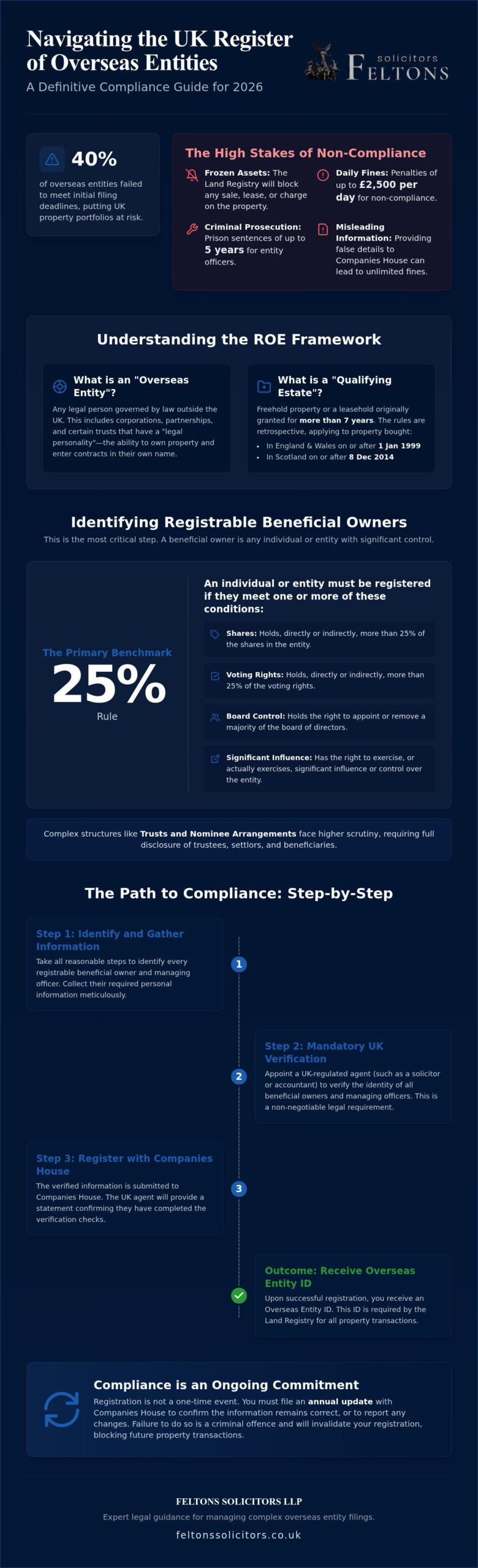
Failing to comply with these regulations carries severe consequences. Companies House has moved beyond an initial period of leniency to a strict enforcement model. Non-compliance is a criminal offence that can result in daily fines of up to £2,500 or, in the most serious cases, prison sentences of up to five years for the entity’s officers. Beyond these sanctions, the Land Registry will block any attempt to sell, lease, or charge the property; this effectively freezes the asset’s value until the entity is correctly registered.

What Qualifies as an Overseas Entity?

An overseas entity is defined as any legal person governed by the law of a country or territory outside the United Kingdom. This definition is purposefully broad, encompassing foreign corporations, limited partnerships, and certain types of trusts. The deciding factor in your registration obligation is whether the entity possesses “legal personality” under its home jurisdiction’s laws. If the body can own property, enter contracts, and sue or be sued in its own name, it likely falls within the scope of the ROE.

The Definition of a Qualifying Estate

The requirement for registering overseas entities uk property applies specifically to “qualifying estates.” In England and Wales, this includes freehold property or leasehold interests originally granted for a term of more than seven years. Accuracy is paramount here, as the regime is retrospective. Entities that purchased land in England and Wales on or after 1 January 1999 must be registered. Different dates apply across the UK, such as 8 December 2014 in Scotland. Since February 2022, the rules have tightened further; any entity that has disposed of property since that date must also provide details of those transactions to remain compliant with current transparency standards.

Identifying Registrable Beneficial Owners and Complex Structures

Determining exactly who must be named on the register is often the most challenging aspect of compliance. A registrable beneficial owner is generally any individual or legal entity that exerts significant control over the overseas entity. The primary benchmark used by Companies House is the 25% rule. If a person holds more than 25% of the shares or voting rights, they must be disclosed. However, control is not always a simple mathematical calculation. Even without meeting the shareholding threshold, an individual who has the right to appoint or remove a majority of the board of directors, or who otherwise exercises “significant influence or control”, falls under the registration requirement.

Accuracy is not just a matter of administrative diligence; it is a vital legal safeguard. Providing false or misleading information to Companies House is a criminal offence that can lead to unlimited fines. The Official UK Government Guidance emphasises that entities must take reasonable steps to identify their beneficial owners before filing. For those managing intricate global portfolios, our team at Feltons Solicitors LLP can provide the discreet expertise needed to map these relationships accurately, ensuring your filings are beyond reproach.

Dealing with Trusts and Nominee Arrangements

Trusts and nominee arrangements face even higher levels of scrutiny under the current framework. Because trusts often lack a single “owner” in the traditional sense, the ROE requires comprehensive details on trustees, settlors, and beneficiaries. This includes anyone else who has the power to exercise control over the trust’s activities. This level of transparency ensures that the true nature of property ownership cannot be obscured by multi-layered legal vehicles. For family offices, professional overseas entity beneficial owner registration is essential to ensure long-term compliance whilst maintaining the privacy of the wider family estate within the bounds of UK law.

Managing Officers: When No Beneficial Owner is Identified

In cases where no beneficial owner can be identified after exhaustive enquiries, the entity must instead provide details for its “managing officers”. These are typically the directors, managers, or company secretaries of the organisation. You cannot simply submit a “no-owner” declaration without demonstrating that every effort was made to find a registrable person. This level of transparency is particularly relevant when considering asset protection in divorce. If ownership of an overseas entity is contested during financial proceedings, the information held on the register can become a pivotal piece of evidence. Failing to correctly identify owners when registering overseas entities uk property could lead to complications that extend far beyond simple filing fees, potentially impacting the very foundation of your legal standing in the UK.

The Mandatory Verification Process: A Step-by-Step Guide

Verification serves as the essential gatekeeper for the entire system; Companies House will simply not issue an Overseas Entity ID without a formal verification statement from a UK-regulated agent. This is far more than a simple identification check. The process involves a rigorous audit of the entity’s structure to ensure every registrable beneficial owner has been correctly identified and their details validated against independent, reliable sources. Because the agent assumes significant legal liability for the accuracy of this data, the process is detailed and requires a methodical approach.

The process of registering overseas entities uk property hinges entirely on this verification stage. It’s important to understand that only specific UK-regulated professionals, such as solicitors, auditors, or insolvency practitioners, are authorised to perform these checks. These agents must verify the information no more than three months before the date the application is submitted to Companies House. If this window is missed, the verification becomes void, and the work must be repeated. This strict timeline ensures that the public register remains as current and accurate as possible.

The Verification Procedure for International Clients

For clients based outside the UK, we follow a structured three-step protocol to ensure compliance is met without unnecessary stress. First, we collate all essential constitutional documents, such as the Certificate of Incorporation and Articles of Association, alongside certified proof of identity for all beneficial owners. Second, we conduct an independent check of foreign registers and corporate structures. This is particularly vital for layered ownership models, as detailed in this Practical Guide to the ROE, to ensure no shadow controllers are overlooked. Finally, once satisfied, the agent submits the formal verification statement directly to Companies House to facilitate the issuance of the ID.

Why Feltons Solicitors LLP is Your Ideal Verification Partner

Choosing the right partner is about more than just filing a form. Our deep expertise in residential property law means we understand the underlying title and the specific requirements of the Land Registry. Feltons Solicitors LLP provides a discreet, boutique service tailored for international clients who value confidentiality and precision. By managing the verification process with such meticulous care, we mitigate the risk of transaction delays. When registering overseas entities uk property, having a trusted advisor ensures that your sales, charges, or leases can proceed without the administrative friction that often plagues less prepared entities.
Registering Overseas Entities for UK Property: A Definitive Guide for 2026

Ongoing Compliance: The Annual Update and Penalties

Maintaining the Register of Overseas Entities is a continuous legal obligation rather than a one-off administrative task. Once you have completed the initial process of registering overseas entities uk property, you must file an update statement every 12 months. This statement confirms that the information held by Companies House remains accurate or provides details of any changes to the beneficial ownership structure that occurred during the year. It’s a rolling commitment to transparency that ensures the UK property market remains secure and well-regulated.

Timing is critical for these filings. The update is due exactly one year from the date of the original registration or the previous update. You have a narrow 14-day window following this date to submit the filing. It’s a common misconception that no action is required if the entity’s structure remains static. On the contrary, a “no change” statement must be filed to keep the Overseas Entity ID valid. Without this active confirmation, the entity is deemed non-compliant, and the administrative burden of registering overseas entities uk property is effectively wasted.

Consequences of Non-Compliance in 2026

By 2026, Companies House has transitioned to a high-enforcement model. They are actively issuing substantial financial penalties to entities that miss their filing deadlines. However, the financial cost is often secondary to the transactional impact. A non-compliant entity loses its ability to deal with its land almost immediately. You cannot sell, lease for more than seven years, or mortgage the property whilst the register is out of date. Additionally, directors and managing officers face personal criminal liability; this makes administrative diligence a matter of personal security for those at the helm of the organisation.

The Link Between Compliance and Estate Planning

Neglecting the register can have profound implications for your wider legal affairs, particularly regarding succession. For instance, an out-of-date or inaccurate register can effectively paralyse the probate and estate planning process. If a property needs to be transferred or sold following the death of a beneficial owner, any discrepancy in the registration will cause significant delays at the Land Registry. Keeping your entity “sale-ready” through consistent updates ensures that your assets remain liquid and your legacy is protected for future generations.

Whilst overseas structures offer clear benefits for privacy and tax planning, they demand meticulous attention to detail. If you are concerned about your current compliance status or require a regulated agent to manage your annual filings, we invite you to speak with us. Contact Feltons Solicitors LLP today to ensure your UK property interests remain fully protected and compliant with all current regulations.

Practical Guidance for Registering and Managing Your Entity

Taking proactive steps now is the most effective way to safeguard your UK interests. The first priority for any international owner is to conduct an immediate audit of all UK property held in overseas names. It’s surprisingly common for older acquisitions to be overlooked, yet the Land Registry’s digital systems are increasingly efficient at flagging unregistered titles. Once identified, appointing a UK-regulated solicitor to manage the verification and filing process provides a single point of accountability. This approach ensures that the complex interplay between foreign corporate law and UK land requirements is handled with the necessary professional poise.

Efficiency in registering overseas entities uk property depends heavily on the state of your corporate records. As we noted previously, verification must be fresh; having your constitutional documents and proof of identity organised in advance is therefore vital. We recommend establishing a permanent digital vault for these records and setting calendar reminders for your annual update statement. Since Companies House now issues automatic penalties for late filings, a “set and forget” mindset is no longer viable for international investors who value their asset’s liquidity.

Resolving Land Registry Restrictions

A “restriction on title” is the primary mechanism the Land Registry uses to enforce compliance. This entry on the register prevents any disposition, such as a sale or a new lease, from being registered unless the entity has complied with its ROE obligations. Removing this restriction requires the successful submission of your registration and the issuance of an Overseas Entity ID. For entities that have already disposed of property but remain on the register, a specific removal process exists to clear the title record. This is particularly complex when an entity owns a block of flats, where leasehold enfranchisement experts are often required to manage the rights of tenants whilst ensuring the superior title remains compliant.

Securing Your Overseas Entity ID

The Overseas Entity ID is a unique alphanumeric code that acts as your passport for all future Land Registry dealings. Once issued, you can verify its status on the public register at any time. This ID must be quoted on every transfer, charge, or lease application you submit. Beyond the immediate administrative requirement, securing this ID allows you to incorporate ROE compliance into your wider legal strategy; for instance, you might explore John Zang Services to gain specialised counsel on how these regulations impact your broader corporate structures.

Whether you are restructuring for tax efficiency or preparing for a future sale, having a valid ID ensures that your transactions proceed without the friction of last-minute compliance hurdles. By treating registering overseas entities uk property as a core component of your asset management, you protect both your capital and your professional reputation. Our team is here to guide you through every stage of this process, providing the discreet, high-standard service your portfolio requires.

Securing Your UK Property Interests for the Long Term

UK land law has evolved significantly, making transparency a cornerstone of property ownership. By ensuring you are correctly registering overseas entities uk property, you protect your assets from the risk of freezing orders and substantial financial penalties. We have explored the necessity of identifying beneficial owners accurately and the vital role of the UK-regulated agent in the mandatory verification process. It is essential to remember that compliance is an active, annual commitment that preserves the liquidity of your investments and ensures your estate remains sale-ready at all times.

As a member of the Law Society specialising in high-value international property transactions, Feltons Solicitors LLP offers a boutique, partner-led legal service designed for those who value privacy and precision. We act as your sophisticated guide through these complex regulations, providing the calm expertise needed to manage your filings with absolute confidence. Contact Feltons Solicitors for expert assistance with your overseas entity registration to ensure your portfolio remains secure and compliant. We are here to help you navigate these requirements with ease and traditional professional integrity.

Frequently Asked Questions

What is the Register of Overseas Entities?

The Register of Overseas Entities is a public database managed by Companies House that identifies the beneficial owners of foreign entities owning land in the United Kingdom. Established under the Economic Crime (Transparency and Enforcement) Act 2022, its primary purpose is to increase transparency and combat money laundering within the UK property market.

Does my overseas company need to register if it bought land before 2022?

Yes, the registration requirement is retrospective for property purchased on or after 1 January 1999 in England and Wales. In Scotland, the requirement applies to land bought on or after 8 December 2014. If your entity still holds a qualifying estate, you must complete the process of registering overseas entities uk property to remain compliant with current law.

How much does it cost to register an overseas entity in the UK?

The mandatory government fee for registering an overseas entity with Companies House is £250. This is separate from any professional fees charged by your UK-regulated verification agent. Additionally, there is a £234 fee for filing the annual update statement and a £706 fee if you eventually apply for removal from the register.

Who is considered a “registrable beneficial owner”?

A registrable beneficial owner is generally any individual or legal entity that holds more than 25% of the shares or voting rights in the overseas entity. The definition also includes anyone who has the right to appoint or remove a majority of the board of directors, or who otherwise exercises significant influence or control over the entity’s activities.

Can I register an overseas entity without a UK solicitor?

Whilst an entity can technically submit its own application, it is impossible to complete the process without a UK-regulated agent. All information regarding beneficial owners must be verified by a professional such as a solicitor or auditor who is supervised under the Money Laundering Regulations. Companies House will not issue an Overseas Entity ID without this formal verification.

What happens if I miss the annual update deadline?

Missing the annual update deadline results in an immediate block on your property’s title, preventing you from selling, leasing, or mortgaging the asset. You may also face daily fines of up to £2,500 and potential criminal prosecution. Consistent diligence when registering overseas entities uk property is the only way to ensure your assets remain liquid and legally protected.

How long does the registration process take?

The registration timeline depends largely on the speed of the verification stage. Once a UK-regulated agent has verified the beneficial ownership and submitted the application, Companies House typically processes the request within a few working days. However, complex corporate structures or entities involving trusts may require additional time for thorough due diligence and document collation.

Is the information on the Register of Overseas Entities public?

Most information provided to the register is available to the public via the Companies House website, including the names of beneficial owners and the entity’s registered office. Certain sensitive details, such as full dates of birth and residential addresses, are protected from public view. This balance ensures transparency whilst respecting the personal privacy of the individuals involved.

Divorce Asset Division Lawyers: Navigating Financial Settlements in 2026

Divorce Asset Division Lawyers: Navigating Financial Settlements in 2026

What if the division of your matrimonial assets wasn’t just a look back at what you’ve built, but a strategic blueprint for your financial independence? When facing a separation in 2026, it’s natural to feel overwhelmed by the complexity of financial disclosure or the rising costs of litigation. Many people worry about losing the family home or failing to secure a fair share of a pension. Working with specialist divorce asset division lawyers can provide the calm, steady guidance needed to navigate these high-stakes negotiations with confidence.

We understand that you want a settlement that is both fair and protective of your non-matrimonial property. This article explains how legal experts approach these settlements to secure your financial future whilst respecting your privacy. You’ll learn about the latest 2026 legal shifts, including the proposed “codification-plus” model and the increasing importance of qualifying nuptial agreements in modern family law. We’ll provide a clear overview of how the legal process works today, ensuring you feel informed and supported at every stage of the journey.

Key Takeaways

  • Understand why the “yardstick of equality” is merely a starting point and how the Matrimonial Causes Act 1973 continues to shape modern financial settlements.
  • Learn to distinguish between matrimonial and non-matrimonial assets to ensure that pre-marital wealth and inheritances are appropriately protected.
  • Gain clarity on the “Section 25 factors” that judges use to determine a fair outcome based on your future needs and past standard of living.
  • Discover how specialist divorce asset division lawyers utilise the Form E disclosure process to build a transparent and strategic foundation for your case.
  • Explore the benefits of a discreet, boutique legal service that prioritises pragmatic solutions and personal rapport over high-conflict litigation.

The Matrimonial Causes Act 1973 remains the bedrock of financial settlements in England and Wales. Even as we move through 2026, this legislation provides the essential structure that courts use to reallocate wealth between separating spouses. It’s a system designed to be flexible. This flexibility allows judges to tailor outcomes to the specific needs of each family, rather than applying a one-size-fits-all rule that might lead to an unjust result.

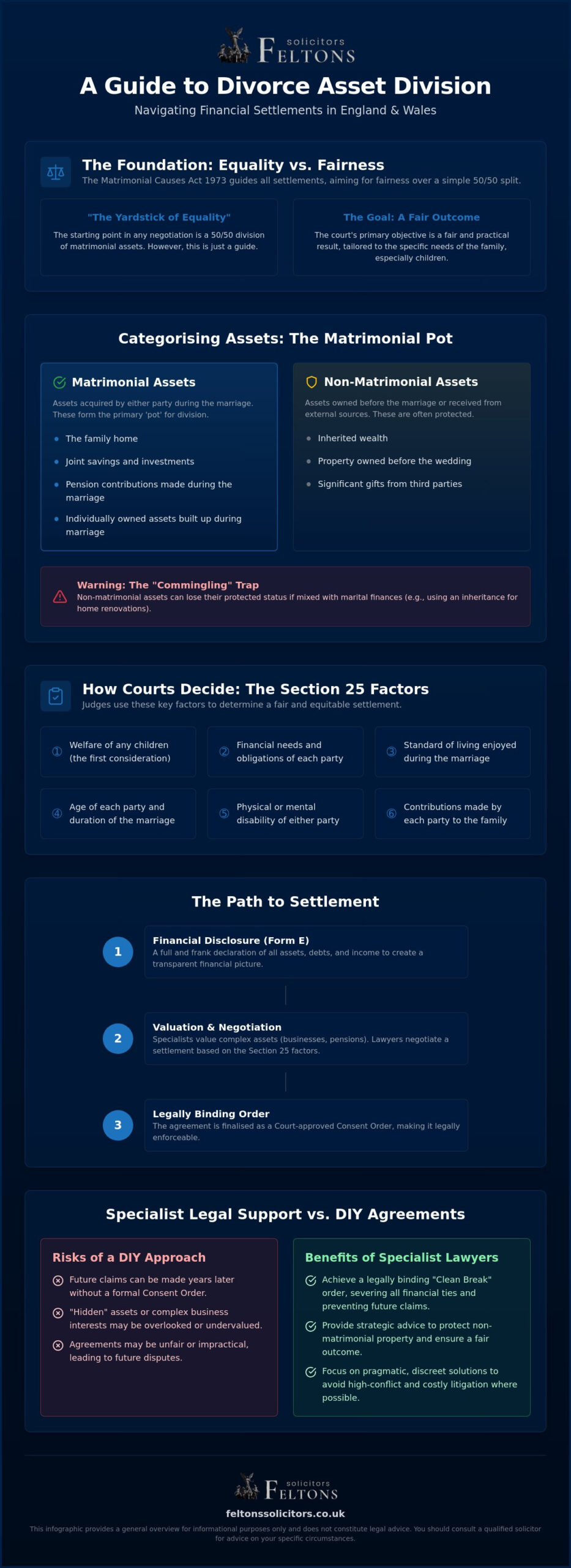
Whilst many people expect an automatic 50/50 split, the “yardstick of equality” is merely the starting point. The court’s ultimate goal is to achieve a result that’s fair and practical for both parties. In many cases, the primary focus is the welfare of any children involved. This often means that the parent with primary care responsibilities may receive a larger share of the matrimonial home or liquid assets to ensure the children have a stable environment. Understanding the legal framework for asset division is the first step toward reaching a resolution that respects your past contributions and your future needs.

A key decision in many divorces is whether to pursue a “clean break” order. This order severs all financial ties between you and your former spouse, preventing future claims against your wealth. However, if there’s a significant disparity in earning capacity, ongoing maintenance obligations might be necessary to ensure both parties can maintain a reasonable standard of living. Specialist divorce asset division lawyers help you determine which path provides the most security for your specific circumstances.

The Starting Point: Equality vs Fairness

In UK law, the concept of equitable distribution doesn’t always mean an equal split. While the court begins with the assumption of equality, it quickly pivots to consider factors like age, health, and future earning potential. A financial settlement is a legally binding resolution that provides absolute finality to the parties’ financial relationship. Expert divorce asset division lawyers work to ensure these deviations from the 50/50 baseline are justified and backed by robust evidence.

Why Legal Representation is Essential for Complex Estates

Attempting a DIY agreement carries significant risks. Without a formal Consent Order, your former spouse could potentially make a claim against your assets years after the divorce is finalised. This is particularly dangerous for those with complex estates, including commercial property or international interests. Experienced legal advisors possess the technical skills to identify “hidden” assets or accurately value business interests that might otherwise be overlooked. For a deeper look at these protections, see our guide on Divorce and Financial Arrangements Lawyer: A Guide to Protecting Your Assets in 2026. Our focus remains on achieving a pragmatic outcome that avoids unnecessary conflict whilst securing your long-term interests.

Identifying and Categorising Matrimonial vs Non-Matrimonial Assets

Determining what belongs in the “matrimonial pot” is one of the most critical steps in any financial settlement. Matrimonial assets generally include everything acquired by either party during the marriage, regardless of whose name appears on the deed or account. This encompasses the family home, joint savings, and even assets built up individually, such as pension contributions made during the years of marriage. Specialist divorce asset division lawyers focus on creating an exhaustive inventory to ensure nothing is overlooked during the disclosure phase.

Non-matrimonial assets are treated differently. These typically consist of inherited wealth, property owned before the wedding, or significant gifts from third parties. Whilst the court’s starting point is to protect these assets, they aren’t always immune from division. The “commingling” trap occurs when separate wealth is mixed with marital finances. For instance, if an inheritance is used to refurbish the family kitchen or pay down a joint mortgage, it may lose its non-matrimonial status. Tracing these funds requires a methodical approach to ensure your pre-marital wealth remains protected where possible.

The Family Home and Other Property Interests

For most couples, the family home is their most significant asset. Several options exist for its distribution: selling the property and splitting the proceeds, one party “buying out” the other’s share, or implementing a Mesher Order. A Mesher Order allows one parent to remain in the home with the children until a specific event, such as the youngest child finishing secondary school, at which point the house is sold. Our extensive experience in residential property law allows us to guide you through these property valuations with precision. We also handle the intersection of personal divorce and commercial property interests, ensuring that business premises aren’t unnecessarily jeopardised by the breakdown of a marriage.

Pensions, Investments, and Business Interests

Pensions are frequently undervalued or ignored, yet they often represent a substantial portion of a couple’s wealth. You must decide between pension sharing, which provides an immediate split of the pension credit, or pension offsetting, where one party keeps their pension in exchange for a larger share of other assets like the house. As you navigate the legal process of divorce, accurate valuation of private businesses is equally vital. A company’s “book value” rarely reflects its true worth in a matrimonial context, particularly when future maintainable earnings and shareholdings are considered. In 2026, we also see an increase in digital assets and international investments. These require a sophisticated guide to ensure they’re correctly categorised and valued. If you’re concerned about how complex investments might be split, speaking with our team can provide the clarity you need to move forward.

How Courts Determine a Fair Financial Settlement

The court’s primary objective is to reach a settlement that is fair, but “fair” is a subjective term that requires careful interpretation by divorce asset division lawyers. Rather than following a rigid formula, judges use a specific framework to evaluate the unique circumstances of each marriage. This process ensures that the final order is tailored to the practical realities of your life after the separation. It’s a nuanced balancing act that considers where you’ve been and, more importantly, where you’re going.

One of the most common misconceptions is the role of “conduct” or bad behaviour. In English law, the reasons for the breakdown of the marriage, such as adultery or unreasonable behaviour, rarely impact the financial outcome. The court only considers conduct if it’s so egregious that it would be “inequitable to disregard it,” which is an exceptionally high bar to meet. Instead, the focus remains firmly on financial needs and the standard of living enjoyed during the marriage. The court aims to ensure that neither party suffers a disproportionate drop in their lifestyle, provided there are enough assets to go around.

Equally vital is the recognition of non-financial contributions. The law treats the role of a stay-at-home parent or homemaker with the same weight as that of the primary breadwinner. This principle of “non-discrimination” ensures that the spouse who sacrificed their career to support the family isn’t penalised during the division of assets. Every contribution to the welfare of the family is valued, reflecting the partnership nature of a modern marriage.

The Section 25 Factors Explained

The Section 25 factors are the statutory checklist every judge must follow. These include the income, earning capacity, property, and other financial resources each party has or is likely to have in the foreseeable future. The court also examines the financial needs, obligations, and responsibilities of each individual. The age of the parties and the duration of the marriage are critical too; a twenty-year marriage will naturally result in a different settlement than a two-year union. These factors provide the structured logic behind what might otherwise feel like an arbitrary process.

Assessing Future Needs and Earning Capacity

A significant part of the court’s work involves balancing immediate housing needs with long-term retirement security. For a spouse who has been out of the workforce for several years, “earning capacity” isn’t just about what they could earn today. It involves a realistic assessment of their potential to re-train and re-enter the professional world. As you finalise these arrangements, it’s essential to look beyond the immediate settlement. Once your financial order is in place, updating your estate planning is a vital next step. You can find more information on this in our complete guide to estate planning, which ensures your legacy remains protected under your new circumstances. Our role as divorce asset division lawyers is to guide you through these transitions with discreet, professional authority, ensuring your interests are represented at every turn.

Divorce Asset Division Lawyers: Navigating Financial Settlements in 2026

Strategic Steps to Organise Your Financial Disclosure

The process of reallocating wealth begins with total transparency. In English law, both parties have a Duty of Full and Frank Disclosure, which requires you to provide a complete and honest picture of your financial position. This isn’t a suggestion; it’s a strict legal requirement. Attempting to obscure the truth often leads to significant delays and increased costs. Experienced divorce asset division lawyers ensure that this process is handled with the necessary precision to protect your integrity and your future settlement.

The cornerstone of this process is Form E. This comprehensive financial statement requires you to list every asset, liability, and income stream you possess. You’ll need to gather specific evidence to support your claims, including twelve months of bank statements for every account held, your last three P60s, and up-to-date property valuations. For those with private pensions, obtaining a Cash Equivalent Transfer Value (CETV) is essential. Gathering these documents early allows your legal team to build a robust strategy based on verified facts rather than estimates.

Failing to disclose assets can have severe consequences. If the court discovers that information has been deliberately withheld, it can impose heavy cost penalties or even draw adverse inferences against the non-disclosing party. A financial order can be reopened years later if it’s proven that the original settlement was based on a lie. Honesty is the only viable legal strategy to achieve a final, binding resolution that cannot be challenged in the future.

The Importance of Transparency

The court takes a very dim view of any attempt to dissipate or hide wealth during a divorce. In cases involving complex estates or international interests, we often collaborate with forensic accountants to trace funds and ensure the matrimonial pot is accurate. A Freezing Order is a powerful legal injunction that prevents a spouse from disposing of or hiding assets before a final settlement is reached. This level of protection is vital for high-net-worth individuals where the risk of asset movement is high.

Avoiding Common Pitfalls in Asset Valuation

Accuracy is paramount when valuing your estate. You should never rely on online valuation tools for your property; these lack the local nuance and physical inspection required for a court-approved valuation. Similarly, using outdated pension CETVs can be a costly mistake, as values can fluctuate significantly within a few months. Our team helps you organise your disclosure methodically to minimise delays. If you’re ready to begin this process with expert support, contact Feltons Solicitors LLP today to discuss your financial arrangements.

Feltons Solicitors LLP offers a refined alternative to high-volume legal practices. Established in 2010, our firm has built its reputation on a boutique model that prioritises the individual over the process. Our divorce asset division lawyers understand that behind every financial disclosure and property valuation is a human story. We apply a people-first philosophy, ensuring that the emotional and human impact of these life-altering changes remains at the forefront of our legal strategy. This approach allows us to act as a calm, steady presence during what is often a period of significant stress and upheaval.

Our advice is consistently pragmatic and focused on the future. Whilst we possess the technical depth to handle complex litigation, we prefer to achieve settlements that translate effectively into your daily life. We project an image of high-end reliability, acting with the quiet confidence that comes from years of handling sophisticated financial reallocations. By choosing a boutique firm, you gain a partner who values personal rapport and delivers a standard of service that respects both modern efficiency and traditional professional integrity.

Our Approach to Financial Arrangements

We believe that the best legal results are achieved through continuity and a deep understanding of your unique circumstances. At our firm, you will have a single, dedicated advisor who manages your case from the initial consultation through to the final order. This direct connection ensures that the nuances of your estate, from residential property to commercial interests, are fully understood and protected. Our worldly experience is particularly beneficial for managing cross-border assets, including the overseas entity registrations required for international wealth. This tailored attention ensures that complex international matters receive the same high standard of care as domestic ones.

Securing Your Future with Discreet Representation

Privacy is a core tenet of our family law practice and a priority for our clients. For high-net-worth individuals, discreet representation is not just a preference but a necessity to protect long-term interests and personal reputations. We guide our clients from conflict toward resolution, favouring dispute resolution and strategic negotiation over unnecessary litigation. As experienced divorce asset division lawyers, we value the trust you place in us and maintain the highest levels of confidentiality at all times.

If you require a partner who understands the complexities of matrimonial finance and the importance of professional discretion, we are here to help. We invite you to book a confidential consultation to discuss your specific needs and goals. Contact Feltons Solicitors LLP today to begin the process of securing your financial future with a team that puts your interests first.

Securing Your Financial Independence in 2026

Transitioning from the breakdown of a marriage to a stable financial future requires a methodical approach and expert oversight. We’ve explored how the legal framework in 2026 prioritises fairness over a simple 50/50 split, particularly when children’s welfare or complex property interests are involved. By accurately categorising your assets and committing to transparent disclosure, you build a foundation for a settlement that respects both your past contributions and your future requirements.

Specialist divorce asset division lawyers act as your sophisticated guide through these intricate negotiations, ensuring that no detail is overlooked and your privacy remains protected throughout. Feltons Solicitors LLP was established in 2010 to provide the pragmatic, discreet legal advice that high-net-worth individuals and those with complex property arrangements require. We invite you to secure your financial future with a confidential consultation at Feltons Solicitors LLP. Taking this first step allows you to move forward with clarity and the quiet confidence that your interests are in capable hands.

Frequently Asked Questions

How are assets divided in a divorce if there is no prenuptial agreement?

Assets are divided according to the framework set out in the Matrimonial Causes Act 1973. In the absence of a prenuptial agreement, the court begins with the “yardstick of equality,” aiming for a 50/50 split. However, this balance is frequently adjusted to account for the welfare of children, the financial needs of each party, and their respective earning capacities. Expert divorce asset division lawyers ensure these factors are correctly weighted to achieve a truly fair outcome.

Can I protect my inheritance from being split during a divorce settlement?

Inheritances can often be protected if they are classified as non-matrimonial assets. This protection usually applies if the funds were kept separate and not “commingled” with joint finances, such as paying off a shared mortgage. However, if the matrimonial pot is insufficient to meet the basic needs of both parties or the children, the court may still look at inherited wealth. Maintaining clear records is essential for ring-fencing these assets during negotiations.

What happens to my business if I get a divorce in the UK?

Your business is generally treated as a matrimonial asset if it was established or developed during the marriage. Courts typically aim to preserve the business as an income-generating entity rather than forcing a sale. This often involves an offsetting approach, where the business owner retains their shares while the other spouse receives a larger portion of the family home or liquid savings. Precise valuation is vital to ensure this trade-off is equitable and sustainable.

Is a 50/50 split of assets mandatory in a UK divorce?

An equal split is not mandatory in English law, as the primary goal is fairness rather than strict arithmetic equality. While 50/50 is the traditional starting point, judges frequently depart from this to meet the “needs” of the parties. For example, a parent with primary care of the children might receive a larger share of the home to ensure stability. Every case is unique, and the final distribution depends on the specific Section 25 factors involved.

How long does it typically take to reach a financial settlement?

Reaching a financial settlement typically takes between nine and eighteen months, depending on the complexity of the assets. Data from 2025 suggests an average timeline of 74 weeks from the initial application to the final order. Cases involving straightforward agreements can be resolved more quickly through a Consent Order. However, disputes over business valuations or international investments can extend the process, as detailed forensic evidence may be required for a fair resolution.

What is a Consent Order and why do I need one?

A Consent Order is a court-approved document that makes your financial agreement legally binding and final. You need one to achieve a “clean break,” which prevents either party from making financial claims against the other in the future. Without this order, your ex-partner could potentially claim a share of your future earnings or inheritances years after your separation. It provides the legal certainty required to move forward with your life independently and securely.

Can my ex-partner claim my pension after we are divorced?

Yes, pensions are considered matrimonial assets and are often subject to sharing or offsetting. Your ex-partner can claim a portion of the pension value built up during the marriage through a Pension Sharing Order. Alternatively, you might agree to keep your full pension in exchange for giving up a larger share of the family home. Our divorce asset division lawyers can help you evaluate which strategy offers the best long-term financial security for your retirement.

What happens if one party refuses to disclose their financial assets?

The court can impose serious sanctions if a party fails to provide full and frank financial disclosure. Judges may issue cost orders, where the offending party pays the other’s legal fees, or they may draw “adverse inferences,” assuming the hidden assets are of significant value. In extreme cases, a Freezing Order can be used to stop the disposal of assets. Honesty is always the most effective strategy to avoid reopening the case years later.

Title Transfer Solicitors UK: Professional Guidance for Property Ownership Changes

Title Transfer Solicitors UK: Professional Guidance for Property Ownership Changes

Could a simple name change on your property deeds inadvertently trigger a five-figure tax bill from HMRC? Many homeowners view the process of adding a partner or gifting a share of a home as a minor administrative update, yet it’s a significant legal realignment with lasting financial consequences. It is understandable that the fear of unexpected Stamp Duty bills and the confusion of Land Registry forms can be daunting. Your property is likely your most valuable asset, and changing its ownership structure requires a delicate balance of technical precision and personal care.

By consulting with experienced title transfer solicitors uk, you can navigate these complexities with total confidence. Our role is to provide a steady hand, ensuring your interests are protected whilst meeting every regulatory obligation. This article explores the nuances of equity transfers, provides clarity on the latest 2026 tax implications, and outlines how to coordinate effectively with mortgage lenders for a seamless, compliant transition.

Key Takeaways

  • Learn the legal distinction between a Transfer of Equity and a Transfer of Ownership to ensure your application matches your specific circumstances.
  • Understand how title transfer solicitors uk manage the due diligence phase to identify existing charges or restrictions that could delay your ownership change.
  • Uncover common misconceptions regarding Stamp Duty Land Tax (SDLT) and why transfers between family members are not always tax-free.
  • Identify the critical role of mortgage lenders in approving title changes and how to liaise with them to avoid a blocked transfer.
  • Gain a step-by-step roadmap of the transfer process, from initial legal instruction through to the final Land Registry registration.

Understanding Title Transfer: Equity vs. Ownership Changes

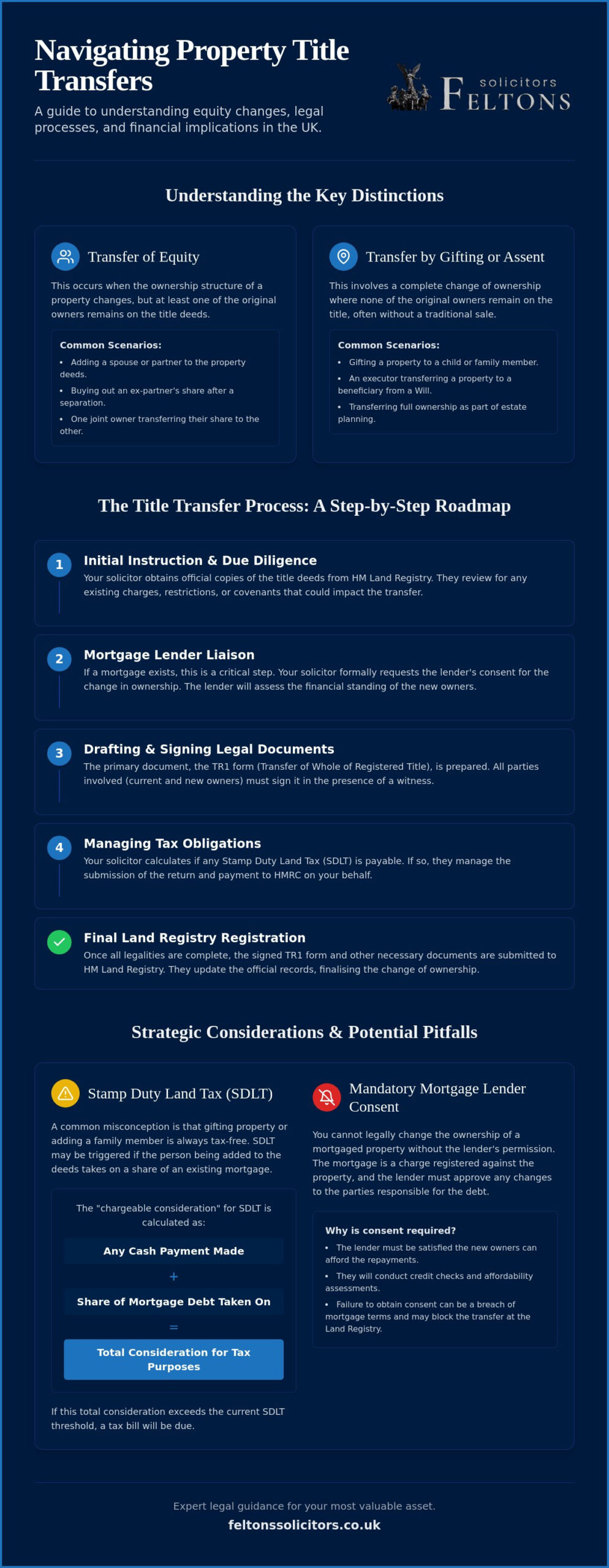
At its core, a title transfer is the formal legal mechanism used to update the ownership records held by HM Land Registry. Whilst many homeowners use the term broadly, the specific legal path depends entirely on the circumstances of the change. Engaging title transfer solicitors uk ensures that these updates are not merely administrative entries but legally robust protections for your assets. The process formally records who holds the legal title to a property, which is a distinct concept from who might have a claim to its underlying financial value.

A deep understanding of English land law is essential for any successful transfer. In British property law, a distinction exists between “legal title” and “beneficial interest.” Legal title refers to the names appearing on the official register, whilst beneficial interest relates to the right to occupy the property or receive proceeds from its eventual sale. Most transfers are executed using a TR1 form. This document acts as the primary instrument to convey the estate from the current owners to the new ones, whether that involves adding a family member or removing an outgoing party.

Transfer of Equity Explained

A transfer of equity occurs when a property remains in the partial ownership of at least one of the original parties. You might encounter this when an owner gets married and wishes to add their spouse to the deeds, or following a relationship breakdown where one partner is bought out. For the process to be classified as a transfer of equity, at least one original owner must remain on the title. In these instances, the consideration is a vital factor. This is not always a cash payment; it often includes the value of the mortgage debt being assumed by the remaining owner. If a mortgage exists, the lender’s consent is mandatory, as they must be satisfied that the incoming or remaining owners can meet the repayments independently.

Transfer by Assent and Gifting

Ownership changes also occur through gifting or following the death of an owner. When a property owner passes away, the executors of the estate use a process called Assent to transfer the title to the beneficiaries named in the Will or determined by the rules of intestacy. This is a delicate time that requires a calm, methodical approach. Gifting property to children whilst retaining a right to reside is another common scenario, though it carries significant risks regarding tax and long-term security. Without professional guidance, such gifts can be challenged by authorities or lead to unintended liabilities. Expert advice helps you navigate these choices whilst ensuring your financial interests remain protected.

Key Scenarios Requiring Title Transfer Solicitors

Property ownership is rarely static; it evolves alongside your personal and professional life. A title transfer serves as the bridge between a significant life event and your long-term financial security. Expert title transfer solicitors uk act as steady guides through these transitions, ensuring that every legal detail is meticulously handled. Whether you are restructuring your estate for inheritance purposes or managing a commercial asset amongst business partners, the precision of the transfer is paramount. These changes are not mere formalities. They are strategic legal realignments that dictate your future rights and liabilities.

In sophisticated tax planning, transferring property title can be a strategic move to manage future liabilities. However, these changes must be executed with a clear understanding of the official transferring ownership (conveyancing) requirements to avoid unnecessary scrutiny from HMRC. For business owners, transferring title between partners often requires a more commercial perspective. It involves balancing corporate interests with individual property rights to maintain operational stability whilst protecting each party’s investment. If you are navigating these complexities, our team at Feltons Solicitors can provide the pragmatic, tailored advice you need to proceed with confidence.

Divorce and Relationship Breakdown

When a relationship ends, the property is often the most significant asset to be divided. A title transfer is the mechanism that executes a court-ordered financial settlement or a voluntary separation agreement. It’s not enough to simply sign over the deeds. You must synchronise the transfer with the formal removal of a party from the mortgage. Failure to do so can leave the departing partner financially liable for a debt on a home they no longer own. For those facing these challenges, consulting a divorce and financial arrangements lawyer provides the holistic support needed to protect your future during a stressful time.

Marriage, Cohabitation, and New Partnerships

Conversely, adding a partner to your property title is a significant gesture of commitment that requires careful legal structuring. You must choose between becoming “Joint Tenants” or “Tenants in Common.” Joint tenants own the property equally, and ownership passes automatically to the survivor. Tenants in common can own specific, unequal shares, which can be left to others in a Will. We often recommend using a Declaration of Trust in these scenarios. This document clearly defines each person’s financial contribution and share of the equity, preventing disputes if the partnership eventually ends. Professional guidance ensures that your existing assets remain protected whilst you build a future with a partner, and if you plan to enhance your home together, WillsByrne Construction & Landscaping LTD offers expert services to help you renovate and landscape your shared property.

The Title Transfer Process: A Step-by-Step Guide

Successfully updating a property title requires a methodical approach that balances legal precision with administrative efficiency. The journey begins with a formal instruction and concludes only when the Land Registry updates the digital register, a step that represents the finality of ownership in UK law. Throughout this progression, experienced title transfer solicitors uk act as the central point of coordination between the transferor, the transferee, and any third-party lenders. This ensures that every party’s interests are aligned and that the transition doesn’t inadvertently breach any existing mortgage covenants or legal restrictions.

Before any documents are signed, your solicitor conducts a rigorous due diligence phase. This involves examining the current Official Copies to identify any charges, cautions, or restrictions that might block the transfer. For instance, a restriction might require the consent of a management company or a former spouse before the register can be updated. Identifying these hurdles early prevents the stress of last-minute delays. It’s this proactive management that distinguishes a professional legal service from a purely administrative one.

Preparation and Form TR1

The TR1 form is the cornerstone of the transaction. It must be drafted with absolute accuracy to reflect the intentions of all parties involved. A common point of confusion is the “consideration” section, which must detail exactly what is being exchanged for the property share. This isn’t limited to cash payments; it includes the value of any mortgage debt being assumed. Getting this right is essential for HMRC compliance and ensures that any potential Stamp Duty liability is correctly calculated. Once drafted, the deed must be executed in the presence of independent witnesses to be legally binding.

Identity Verification and Compliance

Identity verification is often the most significant bottleneck for those attempting a DIY transfer. HM Land Registry imposes stringent requirements for unrepresented parties, typically requiring the completion of ID1 or ID3 forms. These forms often necessitate a physical appointment with a legal professional or magistrate, a hurdle that leads to frequent application rejections for the unwary. By contrast, solicitors verify identity internally using sophisticated digital tools to satisfy Anti-Money Laundering (AML) regulations. This seamless integration protects the integrity of the register and ensures your application moves forward without unnecessary queries.

Registration and Post-Completion

The final stage involves submitting the AP1 application to the Land Registry. This is more than a simple filing; it’s a request to update the legal record of the land. Occasionally, the Land Registry issues “requisitions”—specific questions or requests for clarification that can stall the process if not handled promptly. Your solicitor manages these queries directly, ensuring the application stays on track. Once the register is updated, you’ll receive the new Official Copies. These documents serve as your definitive proof of ownership, confirming that the transfer is complete and your financial interests are secure.

Title Transfer Solicitors UK: Professional Guidance for Property Ownership Changes

Strategic Considerations: SDLT, Mortgages, and Risks

A common fallacy amongst homeowners is that transferring a property title is a tax-neutral event if no cash changes hands. In reality, the legal and financial ramifications are often more complex than a standard sale. Professional title transfer solicitors uk provide the necessary oversight to ensure that a strategic move today doesn’t become a liability tomorrow. Beyond immediate taxes, one must consider the risks of “undervalue” transfers. If a property is gifted or sold significantly below market value, the transaction can be challenged or even set aside by a court if the original owner enters bankruptcy within a specific timeframe. This is why holistic estate planning is vital; it ensures the transfer structure aligns with your long-term legacy goals whilst remaining legally robust.

Stamp Duty Land Tax (SDLT) Pitfalls

HMRC calculates SDLT based on what is known as “chargeable consideration.” This isn’t merely the physical cash that changes hands. It includes the value of any mortgage debt that the person receiving the share takes on. For example, if you transfer half a property with a £400,000 mortgage to a partner, they are effectively “paying” £200,000 by assuming that debt. If this amount exceeds the current SDLT thresholds, a tax bill will be triggered. Whilst exemptions exist for transfers following a divorce or those made under the terms of a Will, navigating these rules requires precision. An inaccurate return can lead to significant penalties and interest charges being levied by HMRC years after the event.

Mortgage Lender Requirements

You cannot simply remove a name from a property title if a mortgage is in place. The lender is essentially a silent partner with a vested interest in who is responsible for the debt. To remove a party, the lender must formally release them from their financial obligations, which usually requires a full assessment of the remaining owner’s income and creditworthiness. Major UK banks have specific “Transfer of Equity” protocols that must be followed. In some cases, the remaining owner may need to remortgage with a different lender to facilitate a buyout of the departing party’s share. Managing these requirements alongside the legal transfer is essential for a seamless transition.

Protecting your property interests requires more than just filling in forms; it demands strategic legal foresight. If you are planning a change in ownership and want to ensure full compliance with HMRC and your lender, contact our expert team at Feltons Solicitors for a professional consultation.

Why Choose Feltons Solicitors for Your Title Transfer?

Selecting the right title transfer solicitors uk is a decision that impacts the long-term security of your most significant asset. At Feltons Solicitors, we believe that property law should be defined by pragmatic, tailored advice rather than rigid administrative scripts. Our firm positions itself as a calm, steady presence for homeowners navigating ownership changes, providing the sophisticated guidance expected of a premier residential property law firm. We understand that a transfer is often the result of a major life transition, and we treat every instruction with the discreet, high-standard care it deserves.

Our expertise is not limited to simple domestic updates. We possess the worldly experience necessary to handle complex commercial title transfers and multi-party realignments that require a methodical, orderly mindset. By choosing Feltons, you gain a partner who values your privacy and personal rapport. We ensure that every detail, from Land Registry compliance to mortgage lender coordination, is handled with absolute precision, protecting your financial interests at every stage of the process.

Boutique Service, National Expertise

We pride ourselves on a boutique service model that combines traditional professional values with modern, efficient delivery. This approach is particularly beneficial for our diverse client base, including international investors who require specialist support for overseas entity registration when managing UK property portfolios. You won’t find yourself trapped in an impersonal call centre or passed between junior clerks. Instead, we provide a single point of contact who understands the specific nuances of your case. Our commitment to transparent, steady communication ensures you remain informed and supported from the initial instruction through to the final registration.

A Holistic Approach to Property Law

Property ownership is often intertwined with other legal complexities, such as leasehold rights or estate planning. Feltons is uniquely placed to advise on transfers involving leasehold enfranchisement, ensuring your transfer doesn’t inadvertently compromise your ability to extend a lease or purchase a freehold later. We take the time to ensure your property transfer aligns with your broader family and financial goals, providing a level of foresight that volume-based firms simply cannot match. Feltons is a firm that prioritises personal connection over high-volume processing. This people-first philosophy ensures that whilst the technical legal work is paramount, the human impact of our work is never forgotten. Whether you are gifting a home to the next generation or restructuring a commercial partnership, we provide the steady hand you need to move forward with confidence.

Securing Your Property Interests for the Future

Changing the names on your property deeds involves balancing legal compliance with long-term financial strategy. We have explored the critical distinctions between transfers of equity and ownership by assent, the necessity of rigorous identity verification, and the often-overlooked Stamp Duty implications. Navigating these requirements doesn’t have to be overwhelming, but it does require a methodical approach to ensure your assets remain protected and your standing with HMRC and mortgage lenders remains secure.

Choosing the right title transfer solicitors uk ensures that these complexities are managed with professional poise and personal care. Established in 2010, Feltons Solicitors is a boutique firm with over 15 years of expertise in both residential and commercial conveyancing. It’s this partner-led focus that allows us to provide pragmatic advice tailored to your unique circumstances, ensuring every detail of your transfer is handled with absolute precision.

Contact Feltons Solicitors today for expert guidance on your property title transfer. We are here to guide you through every step of the process with clarity and confidence.

Frequently Asked Questions

Do I need a solicitor to transfer property to a family member?

You should engage a solicitor to ensure the transfer is legally binding and the deeds are correctly updated at HM Land Registry. Whilst a DIY approach is technically possible for properties without a mortgage, it carries significant risks regarding title defects and tax miscalculations. If a mortgage lender is involved, they will mandatory require professional representation to protect their financial interest in the asset.

How much does a transfer of equity cost in the UK?

The total cost depends on the complexity of your case and whether a mortgage lender’s consent is required. You’ll need to account for professional legal fees alongside third-party disbursements, such as Land Registry filing fees and potential search costs. Every transaction is unique, so it’s essential to obtain a detailed breakdown that includes any potential Stamp Duty Land Tax liabilities before you begin.

Will I have to pay Stamp Duty when transferring title?

Stamp Duty Land Tax (SDLT) is payable if the “chargeable consideration” exceeds the current HMRC thresholds. Consideration isn’t just cash; it includes the value of any mortgage debt that the person receiving the share takes on. Whilst transfers resulting from a divorce or a Will are often exempt, many family transfers do trigger a tax bill that must be settled within 14 days of completion.

Can I remove my ex-partner from the house deeds without their consent?

You cannot remove a co-owner from the property title without their express written consent or a formal court order. If an agreement cannot be reached following a relationship breakdown, you may need to apply for a court order as part of a financial settlement. Once the court grants this order, your title transfer solicitors uk can execute the transfer even if the other party refuses to cooperate.

How long does a title transfer take at Land Registry in 2026?

Straightforward electronic applications are typically processed within a few weeks, though complex cases involving leasehold restrictions or new charges can take longer. The Land Registry continues to prioritise digital submissions from title transfer solicitors uk to ensure efficiency. Your solicitor will manage the entire process, responding to any registry queries promptly to avoid the delays often associated with postal or DIY applications.

What happens to the mortgage during a transfer of title?

The mortgage must be addressed before the title can be updated, as the lender must formally release any outgoing party from their debt obligations. This usually involves a “Transfer of Equity” application where the lender assesses the remaining owner’s ability to maintain the loan alone. If the lender doesn’t consent, you may need to remortgage with a different provider to facilitate the change in ownership.

Is a TR1 form the only document needed for a transfer?

The TR1 form is the primary deed, but it’s only one part of a comprehensive application. You will also need to provide identity verification (ID1 or ID3 forms), an AP1 application for the Land Registry, and an SDLT1 return for HMRC. Leasehold properties often require additional documentation, such as a certificate of compliance or a formal deed of covenant with the freeholder.

What is the difference between a Transfer of Equity and an Assent?

A Transfer of Equity is used when at least one of the original owners remains on the title, such as adding a spouse or buying out a partner. An Assent is the specific legal process used by executors to transfer a property to beneficiaries after an owner has passed away. Both processes update the Land Registry, but they require different forms and legal authority to be successful.