
Pension Sharing Order Lawyers: Strategic Guidance for Your Financial Future

Pension Sharing Order Lawyers: Strategic Guidance for Your Financial Future

A pension is often the single most significant asset in a marriage, yet it remains the most frequently undervalued during a divorce. While property and savings are easily quantified, the true worth of a retirement fund is often hidden beneath layers of complex actuarial data and shifting legislation. Engaging specialised pension sharing order lawyers is not merely a procedural step; it is a strategic necessity to ensure your future remains secure. You likely feel a profound sense of anxiety regarding your standard of living in later life, especially whilst facing the pressure of acrimonious financial negotiations.

We understand that you want more than just a settlement; you want the peace of mind that comes with a genuine clean break. This guide will provide the clarity you need to manage the intricacies of pension division, from understanding implementation fees to the impact of the rising Normal Minimum Pension Age. We will outline how a legally binding Pension Sharing Order can provide the foundation for your long-term stability. By the end of this article, you will have a clear overview of how professional expertise can protect your interests and help you move forward with confidence.

Key Takeaways

  • Recognise why pensions are treated as essential marital assets and how their value is assessed alongside the family home.
  • Understand the technical differences between internal and external transfers to facilitate a genuine clean break financial settlement.
  • Evaluate the long-term benefits of pension sharing against the immediate appeal of offsetting to protect your retirement income.
  • Engage specialised pension sharing order lawyers to manage complex valuations and ensure your final court order is drafted with absolute precision.
  • Discover how full and frank financial disclosure through Form E prevents costly errors and secures your financial future.

Understanding Pensions as Essential Marital Assets

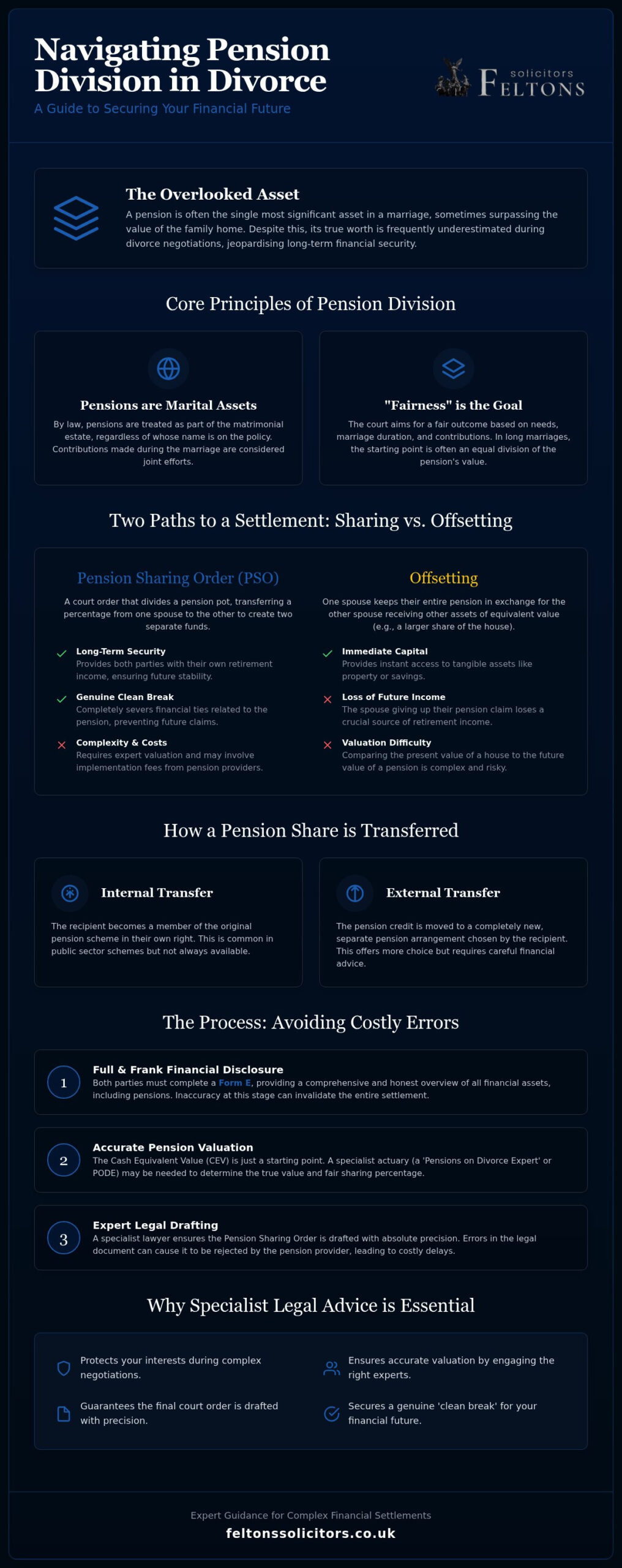
Pensions are frequently the most significant asset in a matrimonial estate, occasionally even surpassing the value of the family home. Despite this, they’re often overlooked or undervalued during initial discussions. It’s a fundamental legal principle that pensions are marital assets. This remains true regardless of whose name is on the policy or which party made the contributions. Because these funds represent future security rather than immediate cash, they require a methodical approach to valuation. Experienced pension sharing order lawyers ensure that these complex financial vehicles are correctly identified and appraised from the outset of the proceedings.

Distinguishing between different types of retirement provision is vital. Whilst the basic State Pension generally cannot be shared, certain “protected payments” or older entitlement structures might be subject to specific rules. In contrast, private and occupational schemes, including final salary and money purchase arrangements, are fully eligible for division. Achieving a genuine clean break financial settlement usually necessitates a formal Pension Sharing Order. Without this legally binding document, one party may retain a claim against the other’s future income, preventing the finality that most couples seek when they separate.

The Legal Framework for Pension Division in the UK

The legal framework for divorce in England and Wales is primarily governed by the Matrimonial Causes Act 1973. This legislation grants the court broad discretion to redistribute assets to achieve a “fair” outcome. Fairness doesn’t always mean an equal split. The court prioritises the financial needs of both parties and any children involved. They’ll consider the duration of the marriage and the contributions each person made, whether financial or through caring for the family. In long marriages, the starting point is often an equal division of the pension’s value to ensure both parties can maintain a comparable standard of living in retirement.

Why “Ring-fencing” Pre-marital Contributions is Complex

There’s a common misconception that any pension growth occurring before the wedding is automatically excluded from the settlement. This isn’t always the case. Courts often view the total pension pot as matrimonial property if it’s required to meet the basic needs of the lower-earning spouse. Ring-fencing requires precise actuarial evidence to prove which portions of the fund should be treated as non-matrimonial. This is where pension sharing order lawyers provide essential value. We help you navigate these arguments, ensuring that your contributions are protected where possible, or conversely, that you aren’t unfairly deprived of a share in a fund that was built up over many years of partnership.

The Mechanics of a Pension Sharing Order (PSO)

A Pension Sharing Order (PSO) is the legal mechanism that facilitates the transfer of a specified percentage of one party’s pension pot to the other. It’s a precise instrument; the court doesn’t award a fixed sum of money, but rather a “pension credit” calculated as a percentage of the fund’s value at the time of transfer. This process can only begin once the Final Order in the divorce has been granted. Navigating this timeline requires steady oversight from pension sharing order lawyers to ensure the paperwork is served correctly and within the strict legal windows. Whilst many focus on private funds, it is also useful to consult government guidance on State Pension sharing to see if any additional “protected payments” apply to your situation.

Internal vs External Pension Transfers

When a PSO is granted, the recipient must decide where the pension credit will be held. An internal transfer allows the recipient to become a member of the original pension scheme in their own right. This is often common in public sector schemes, though it isn’t always an option. Conversely, an external transfer involves moving the credit into a completely different pension arrangement. Some schemes mandate an external transfer, forcing the recipient to find a suitable provider. This choice has significant long-term implications for your retirement income. Our team at Feltons Solicitors LLP works alongside financial advisors to ensure you understand the specific benefits and risks associated with each path.

The Implementation Period and Provider Fees

Once the pension provider receives the court order and the Final Order, a statutory four-month implementation period begins. During this window, the provider must execute the transfer. It’s a critical phase; any errors in the original drafting of the order can lead to the provider rejecting the document, causing significant delays and additional costs.

You should also be aware of the administrative costs. In 2026, implementation fees typically range from £300 to over £3,500, depending on the complexity of the scheme. These fees are usually shared between the parties or paid by the person receiving the credit. pension sharing order lawyers play a vital role here, ensuring the order is drafted with absolute precision to meet the scheme’s specific requirements. This methodical approach prevents the anxiety of a rejected application and ensures your financial future is secured without unnecessary friction.

Pension Sharing vs. Offsetting: Strategic Considerations

Deciding between a pension sharing order and offsetting is one of the most consequential choices you’ll face during financial proceedings. Offsetting involves one party retaining a larger share of non-pension assets, typically the family home, in exchange for waiving their rights to the other’s retirement fund. Whilst this provides immediate stability and housing security, it inherently sacrifices long-term income. This trade-off requires a sophisticated analysis of your current needs versus your future requirements. Strategic pension sharing order lawyers help you weigh these competing interests to ensure you don’t trade a valuable lifetime income for a short-term asset that may carry high maintenance costs.

You should also be aware of Pension Attachment Orders, formerly known as earmarking, though they are now increasingly rare. These orders don’t provide a genuine clean break; the recipient only receives payments when the pension holder chooses to retire. Furthermore, these payments usually cease if the recipient remarries. Because of these limitations, most modern settlements favour the finality of a sharing order or the pragmatism of offsetting.

When Offsetting is the Pragmatic Choice

For younger couples or those with dependent children, offsetting often emerges as the most practical route. It prioritises the immediate need for a stable home environment and avoids the administrative complexities of transferring pension credits. Calculating a fair offset isn’t a simple pound-for-pound exchange. It involves assessing the “utility” of the money; cash today is often considered more valuable than a pension you can’t access for decades. To achieve a fair result, we often use actuarial calculations to determine how much cash is required to “buy out” a specific percentage of a pension, ensuring the settlement remains equitable for both parties.

The Dangers of Misvaluing Pension Assets

A significant risk in divorce negotiations is assuming that the Cash Equivalent Value (CEV) provided by a pension scheme represents its true worth. This is rarely accurate, especially with defined benefit or “final salary” schemes. A £100,000 cash sum in a bank account is not equal to a £100,000 defined benefit pension pot. The cash is liquid and taxable only upon spending, whereas the pension represents a guaranteed, inflation-linked income for life that is subject to different tax treatments. A Pension on Divorce Expert (PODE) is a neutral specialist actuary or financial professional instructed to provide a comprehensive report on the true value and fair division of pension assets. Expert pension sharing order lawyers identify these valuation gaps early, preventing you from agreeing to a settlement that looks fair on paper but leaves you financially disadvantaged in the years to come.
Pension Sharing Order Lawyers: Strategic Guidance for Your Financial Future

The Valuation and Disclosure Process: Avoiding Costly Errors

Full and frank financial disclosure is a mandatory requirement in any divorce proceeding, typically facilitated through the completion of Form E. This document demands absolute honesty regarding all financial interests, including every pension scheme you’ve ever contributed to. Failing to disclose these assets is a grave error that can lead to the court reopening your case years later or even imposing penalties for contempt. Experienced pension sharing order lawyers ensure that every stone is unturned, protecting you from the risks of non-disclosure and ensuring the final settlement is based on a complete financial picture.

The starting point for any valuation is the Cash Equivalent Value (CEV) provided by the pension scheme administrator. Whilst the CEV gives a snapshot of the fund’s current worth, it’s rarely the final word in a fair negotiation. It represents the amount the scheme would pay to transfer your benefits elsewhere, not necessarily the value of the benefits you’d receive if you stayed. For many, relying solely on this figure leads to a settlement that significantly undervalues their future security.

The Role of the Pension On Divorce Expert (PODE)

In cases involving complex or high-value schemes, a standard CEV is almost always insufficient. A Pension On Divorce Expert (PODE) is a neutral actuary or specialist financial professional instructed to provide a comprehensive report. In 2026, a PODE report typically costs between £750 and £3,000, but this investment is often vital. The report provides a more accurate picture of future income, accounting for inflation-linked benefits and tax implications that a simple CEV ignores. We help you conduct a cost-benefit analysis to determine if commissioning an expert report is the right strategic move for your specific circumstances.

Managing Defined Benefit vs. Defined Contribution Schemes

Public sector pensions, such as those for the NHS, Police, or Armed Forces, are “Defined Benefit” schemes and are notoriously difficult to value. These schemes focus on “income equality” in retirement rather than “capital equality.” Simply splitting the capital value of an NHS pension 50/50 might result in one party receiving a much lower monthly income than the other due to different retirement ages or tax brackets. Conversely, Defined Contribution schemes like SIPPs or SSASs are more straightforward but require careful management to ensure the underlying investments aren’t liquidated at a loss during the transfer. If you are concerned about the accuracy of your pension valuations, contact our team at Feltons Solicitors LLP for a discreet consultation to protect your financial interests.

How Specialist Pension Sharing Order Lawyers Protect Your Interests

The final stage of securing your financial future is the translation of complex actuarial data into a robust, enforceable legal document. Specialist pension sharing order lawyers provide the bespoke drafting necessary to ensure that your intentions are accurately reflected in the final court order. A minor clerical error or an ambiguous clause can lead to a pension provider rejecting the order during the implementation period, causing months of delay and additional costs. By meticulously managing the transition from financial disclosure to a final Consent Order, we ensure that your settlement is not just fair in principle, but functional in practice.

A legally binding Consent Order is the only way to achieve a genuine clean break financial settlement. This document effectively closes the door on future claims, providing the certainty you need to rebuild your life. Our role involves more than just filling in forms; we act as a strategic shield, ensuring that the percentage of the pension being shared is calculated to your maximum advantage. We oversee every interaction with the pension scheme administrators, removing the burden of technical correspondence from your shoulders during an already stressful period.

The Boutique Advantage: Tailored Legal Architecture

High-volume law firms often treat pension division as a secondary administrative task. This approach can overlook the nuanced structures of modern retirement funds and the profound human impact of these decisions. At Feltons Solicitors LLP, we offer a boutique alternative that prioritises personal rapport and privacy. We organise your financial disclosure to project clarity and strength, ensuring that your position is articulated with quiet confidence during negotiations. This tailored approach allows us to handle complex matters whilst maintaining the supportive, discreet presence you require during a sensitive life transition.

Securing Your Future with Feltons Solicitors LLP

Our firm was established in 2010 by Paula Felton with a clear mission: to combine modern efficiency with traditional professional integrity. We provide a calm, steady hand in the face of acrimonious negotiations, focusing on pragmatic solutions that avoid unnecessary litigation where possible. However, should your case require robust representation, our expertise in high-net-worth matters ensures your interests are protected with absolute diligence.

Early legal intervention is the most effective way to prevent costly valuation errors and secure a genuine clean break. To understand how we can safeguard your broader portfolio, you may wish to consult our expert divorce and financial arrangements lawyer services. We act as your trusted advisor, ensuring that your technical legal needs are met without losing sight of the human impact of our work. Our goal is to move you from the uncertainty of initial disclosure to the security of a final settlement that protects your lifestyle in retirement.

Securing Your Retirement with Expert Precision

Securing your retirement requires more than a simple division of assets; it demands a methodical strategy that accounts for the nuances of your specific pension schemes. We’ve explored why standard valuations often fall short and how the choice between sharing and offsetting can dictate your financial comfort for decades. By prioritising a genuine clean break, you can step into your future without the lingering anxiety of unresolved financial ties. You deserve a settlement that reflects the true value of your contributions and provides a stable foundation for the years ahead.

Engaging specialised pension sharing order lawyers is the most effective way to manage these complexities whilst protecting your long-term interests. Feltons Solicitors LLP provides a boutique service characterised by high-end reliability and a people-first philosophy. We’re committed to delivering pragmatic, expert advice in even the most complex financial litigation. If you’re ready to secure your financial architecture with a trusted advisor, please contact Feltons Solicitors LLP for a discreet consultation on your financial arrangements. You don’t have to face these negotiations alone; we’re here to provide the calm, steady presence you need to move forward with absolute confidence.

Frequently Asked Questions

What is a Pension Sharing Order (PSO)?

A Pension Sharing Order is a formal court instruction that transfers a specific percentage of one party’s pension pot to their former spouse or civil partner. It’s designed to facilitate a genuine clean break financial settlement by creating a separate pension credit for the recipient. This credit is held in either the original scheme or a new arrangement. Unlike other methods, it provides immediate clarity and independence for both parties’ future retirement planning.

Can I get a Pension Sharing Order after my divorce is finalised?

You can apply for a Pension Sharing Order after your divorce is finalised, provided you haven’t remarried and a court hasn’t already dismissed your financial claims. However, it’s significantly more complex to negotiate these arrangements once the Final Order is granted. Delaying this process can leave your future financial security at risk. It’s always advisable to resolve pension division alongside the divorce proceedings to ensure a comprehensive and legally binding settlement is achieved.

How much does a pension sharing order cost in the UK?

The total cost of a pension sharing order varies based on complexity. As of April 2026, the court fee for a financial consent order is £53. You must also account for pension scheme implementation fees, which typically range from £300 to over £3,500 depending on the provider. If your situation involves complex defined benefit schemes, an expert actuary report may cost between £750 and £3,000. These figures exclude the professional fees for legal drafting and advice.

Are all pensions included in a divorce settlement?

Most pension assets are considered marital property, regardless of whether they were started before the marriage. This includes private pensions, occupational schemes, and Self-Invested Personal Pensions (SIPPs). Whilst the court has the discretion to ring-fence pre-marital contributions, they often include the entire fund if it’s necessary to meet the lower-earning party’s needs. Every scheme must be disclosed during the valuation process to ensure the final settlement is based on accurate data.

What happens if my ex-spouse refuses to disclose their pension value?

If an ex-spouse refuses to disclose their pension value, the court can intervene to enforce full and frank disclosure. Both parties must complete a Form E, which carries a duty of honesty to the court. Failure to comply can result in the court drawing adverse inferences about their wealth or issuing costs orders against them. Experienced pension sharing order lawyers can also apply for a court order to obtain the necessary information directly from the pension provider.

How long does it take for a Pension Sharing Order to be implemented?

Once a pension provider receives the sealed court order and the Final Order, they have a statutory four-month period to implement the transfer. However, the entire process usually takes longer. You must first obtain valuations, negotiate the percentage, and wait for court approval. If the paperwork contains errors, the provider may reject it, restarting the timeline. Methodical legal oversight is vital to ensure the documentation is correct the first time to avoid these delays.

Do I need a lawyer for a Pension Sharing Order?

Whilst you aren’t legally required to use a solicitor, the technical nature of pension division makes professional guidance essential. Pension sharing order lawyers ensure that the order is drafted with the specific wording required by scheme administrators. They also help identify if a Cash Equivalent Value (CEV) accurately reflects the fund’s true worth. Without this expertise, you risk accepting a settlement that leaves you significantly disadvantaged or failing to secure a legally enforceable clean break.

Can I share my State Pension with my ex-partner?

The rules for sharing a State Pension depend on when you reached retirement age. For those reaching pension age after April 2016, the New State Pension generally cannot be shared. The main exception is a protected payment, which represents an entitlement above the full rate. If you reached retirement age before this date, different rules regarding the Additional State Pension may apply. It’s important to check your specific entitlement with the Department for Work and Pensions.

Professional Executors: A Guide to Protecting Your Estate

Professional Executors: A Guide to Protecting Your Estate

Could the person you trust most actually be the worst choice to handle your final wishes? Whilst it’s natural to appoint a close family member to manage your estate, the role of an executor is a heavy legal burden that requires far more than just good intentions. The administrative weight of HMRC filings and the fear of making a costly mistake often turn a gesture of trust into a source of immense stress for those you love. Choosing professional executors for probate ensures that your estate is managed with a level of technical expertise and calm objectivity that a grieving relative simply cannot be expected to provide.

You likely want a transition that’s as seamless as possible, shielding your family from conflict and protecting the value you’ve built over a lifetime. It’s a common goal, but one that’s easily undermined by the complexities of modern estate law and the personal financial liability that executors face. This guide will show you how appointing a professional ensures legal precision, mitigates risk, and provides genuine peace of mind. We’ll examine the benefits of expert oversight, from resolving family disputes before they escalate to safeguarding your legacy against avoidable tax burdens.

Key Takeaways

  • Understand the significant legal and financial liability placed upon executors and why professional oversight is essential to protect your personal assets.
  • Discover how appointing professional executors for probate can save your family from an administrative burden that often exceeds 100 hours of complex legal work.
  • Learn how technical expertise in Inheritance Tax and Capital Gains Tax ensures your estate’s value is protected from avoidable HMRC errors.
  • Explore the benefits of introducing a neutral, professional presence to mitigate family conflict and ensure a smooth distribution of assets.
  • Gain clarity on the practical steps for instructing a solicitor during the estate planning process or appointing them as a co-executor to support a loved one.

Understanding the Role and Responsibility of an Executor

An executor is far more than a title; they serve as the deceased person’s legal personal representative. This position involves Understanding the Role and Responsibility of an Executor as a formal, court-monitored commitment. When an individual applies for a Grant of Probate, they essentially swear an oath. This isn’t a symbolic gesture. It is a binding legal declaration that they will administer the estate according to the law. Whilst many people accept the role as a family favour, it is actually an onerous legal obligation. The court expects a high standard of conduct, regardless of whether the person is a professional or a grieving relative.

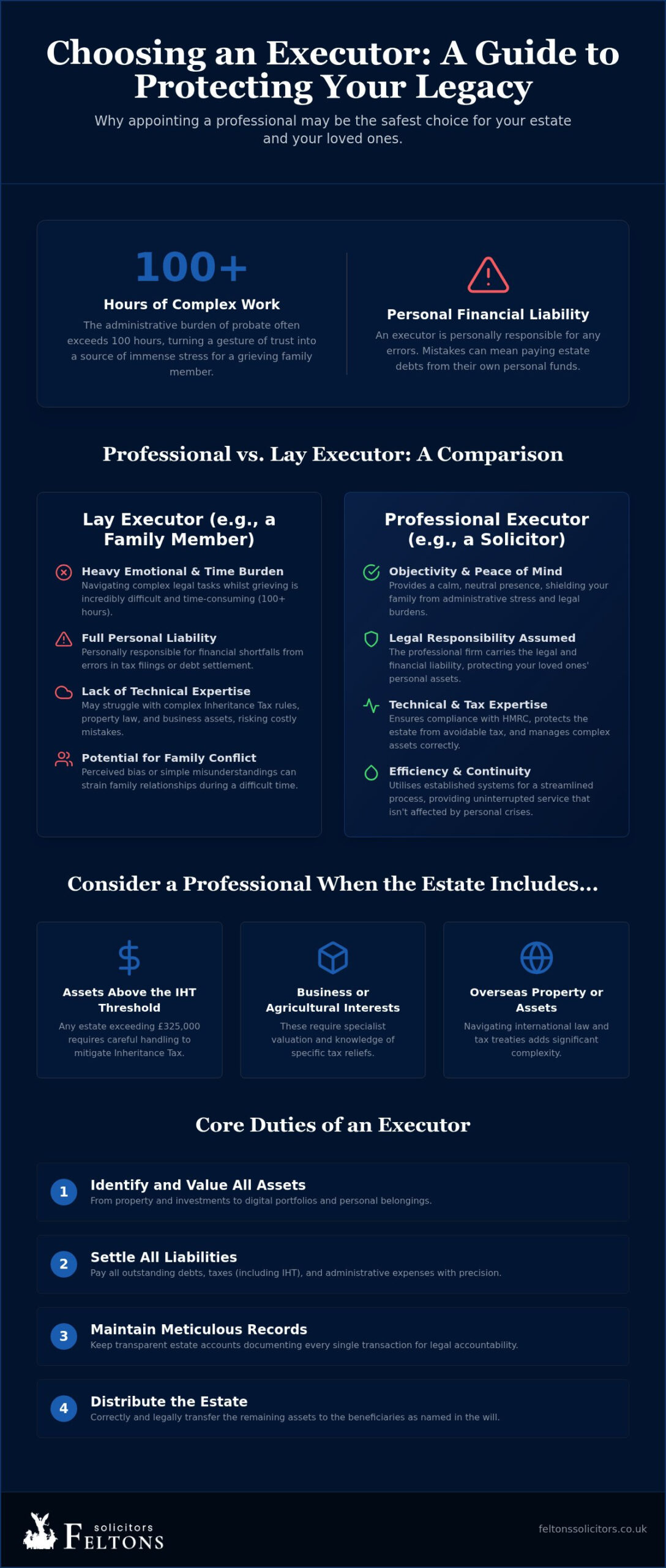
The core duties are clear but demanding. An executor must identify and value every asset, from physical property and jewellery to complex digital portfolios. They must then settle all liabilities, including taxes and outstanding debts, before finally distributing the remaining residue to the named beneficiaries. It is a methodical process that leaves little room for error.

The Legal Duties of Estate Administration

The probate timeline is a marathon, not a sprint. It starts with a comprehensive valuation of the estate to determine if Inheritance Tax (IHT) is due. Dealing with HMRC requires absolute precision. Even minor errors in IHT accounts can lead to significant delays or financial penalties. Meticulous record-keeping is a non-negotiable requirement. Executors must maintain transparent estate accounts that document every transaction. This level of detail is vital if a beneficiary questions the distribution of assets later, providing a clear paper trail of the executor’s actions.

Personal Liability: The Risks Lay Executors Often Ignore

Perhaps the most sobering reality of the role is personal financial liability. Lay executors are personally responsible for any errors made during administration. If assets are distributed to beneficiaries before a creditor is paid or a tax bill is settled, the executor must pay that shortfall from their own personal funds. HMRC and creditors are not required to chase the beneficiaries; they hold the executor accountable. Choosing professional executors for probate removes this weight from your shoulders. Professionals carry the legal responsibility, ensuring every debt is cleared and every tax form is filed correctly. By appointing professional executors for probate, you protect your personal estate from the consequences of administrative oversight and ensure the deceased’s wishes are carried out with legal rigour.

Professional Executors vs. Lay Executors: Making the Right Choice

Choosing between a family member and a professional is often a choice between sentiment and security. Whilst a lay executor brings personal knowledge of the deceased, they often lack the technical infrastructure to handle an estate efficiently. Most lay executors spend upwards of 100 hours navigating the administrative maze of probate. In contrast, professional executors for probate utilise established systems and legal expertise to streamline the process. This efficiency is not just about speed; it ensures that the estate remains compliant with evolving tax regulations and property laws.

Continuity is another factor that is frequently overlooked. A family member may fall ill, lose capacity, or experience their own life crises during the administration period, which can last 12 to 24 months for complex cases. A professional firm provides a steady, uninterrupted presence. They understand How to Appoint or Instruct a Professional Executor to ensure that the transition of assets never stalls. This reliability is the hallmark of a boutique service that prioritises the long-term protection of your legacy.

When to Appoint a Professional Firm

There are specific scenarios where professional intervention is not just helpful but essential. If an estate exceeds the Inheritance Tax threshold of £325,000, the risk of HMRC penalties for valuation errors increases significantly. Similarly, estates involving business interests, agricultural land, or overseas property require a level of specialist knowledge that goes beyond standard probate. If you are managing complex international assets, seeking pragmatic legal advice early can prevent costly litigation later.

The Benefits of Impartiality in Family Estates

Family dynamics can become strained during the distribution of assets, especially when one sibling is tasked with managing the inheritance of others. A professional executor acts as a neutral buffer amongst grieving beneficiaries, removing the perception of bias or favouritism. They provide a calm, objective voice that can prevent minor disagreements from escalating into full-scale legal battles. By involving dispute resolution solicitors at the outset, you ensure that decisions are made based on legal merit rather than emotional history. This impartiality is often the key to maintaining family harmony during a difficult period of transition.

The Practical Advantages of Professional Estate Administration

Professional administration moves beyond simple task management; it is about safeguarding the financial integrity of a legacy. Professional executors for probate bring an arsenal of technical tools to the table, particularly when navigating the intricate layers of Inheritance Tax (IHT) and Capital Gains Tax (CGT). For estates involving property, the challenges often extend into niche areas like leasehold enfranchisement or extensions. A professional firm handles these hurdles internally, ensuring that the sale or transfer of property doesn’t stall due to administrative oversights.

One of the most significant, yet frequently overlooked, benefits is the protection offered by professional indemnity insurance. This acts as the ultimate safety net for beneficiaries. If a genuine error occurs, the insurance covers the loss, whereas a lay executor’s mistake could deplete the estate’s value or their own personal assets. Choosing professional executors for probate ensures that the statutory notices process is managed meticulously. By placing advertisements in The Gazette and local newspapers, they legally protect the estate against claims from unknown creditors, a step many families often miss.

Expertise in Complex Assets and Taxation

When a will includes life interest clauses or complex trusts, the administrative requirements escalate. Professional advisors ensure these structures are managed correctly from the outset. This expertise is vital for estates with international footprints, where the registration of overseas entities is a mandatory requirement for holding UK property. We also focus on optimising reliefs such as Business Property Relief (BPR), ensuring that commercial interests are passed on with minimal tax friction.

Reducing the Administrative Burden on Bereaved Families

Adopting the role of a sophisticated guide, a professional firm manages the heavy lifting whilst the family focuses on their grief. This includes the duties of an executor of an estate such as organising formal valuations for personal effects and property. Instead of a family member chasing banks and utility companies, a methodical flow of communication is established. Beneficiaries receive regular, clear updates, which fosters a sense of security and ensures that everyone remains informed without being overwhelmed by the minutiae of the probate process.

Professional Executors: A Guide to Protecting Your Estate

How to Appoint or Instruct a Professional Executor

Securing the services of professional executors for probate isn’t a decision restricted to the initial drafting of a will. Whether you’re currently in the process of estate planning or you’ve recently found yourself overwhelmed by an existing appointment, there are several ways to integrate professional expertise. The process is designed to be flexible, allowing you to tailor the level of support to the complexity of the assets involved.

Many people choose a hybrid approach by appointing a professional to act as a co-executor alongside a family member. This ensures that whilst a loved one remains involved in personal decisions, the technical and legal heavy lifting is managed by a specialist. If you’ve been named as a lay executor and feel unable to take on the role, you can “renounce” your position, provided you haven’t already started the administration. This allows a professional firm to step in and manage the estate from the outset, protecting you from the personal liability discussed earlier.

Naming a Professional in Your Will

The most straightforward method is naming a firm directly during your lifetime. It’s vital to use the correct legal name of the practice to avoid any ambiguity during the probate application. We often recommend appointing “the partners” of a firm rather than a specific individual. This strategy ensures continuity; if a particular solicitor retires or leaves the firm, the appointment remains valid for the current partners. It’s always wise to discuss this with your chosen solicitor first to ensure they’re happy to act and to confirm their fee structures, providing clarity for your future beneficiaries.

Instructing a Solicitor After a Death Occurs

If a will already exists and names a lay person, that individual can still hire a solicitor to handle the administration. You don’t lose your title as executor, but you delegate the work. You might choose a “Grant Only” service to secure the legal authority to act, or “Full Administration” to have the firm manage everything from tax filings to asset distribution. If you’re one of several executors and cannot act immediately due to work or health, you can opt for “Power Reserved.” This allows the other executors to proceed whilst leaving the door open for you to join the process later if needed. In cases where family tensions rise, transitioning the matter to contentious probate solicitors early can prevent a stalemate. If you’re currently facing a complex estate, our team can provide a clear roadmap for professional estate administration.

Why Feltons Solicitors is Your Trusted Partner for Probate

Feltons Solicitors LLP stands apart from high-volume “probate factories” that treat estate administration as a standard processing task. Established in 2010 by Paula Felton, our firm prioritises a boutique level of care where personal connection is the foundation of every case. We understand that choosing professional executors for probate is a decision rooted in trust. It’s about finding a partner who values traditional professional integrity whilst employing modern, efficient methodologies. We don’t aim for high-volume turnover. Instead, we focus on providing a steady, deliberate presence for families navigating the aftermath of a loss, ensuring that every detail is handled with the precision it deserves.

Our commitment to pragmatic advice means we don’t hide behind archaic legalese. We provide clear, actionable guidance that respects the gravity of your situation. As a firm, we’ve built a reputation for handling complex litigation and dispute resolution with a quiet confidence that reassures our clients. When you appoint professional executors for probate from our team, you’re securing a discreet partner who values privacy and personal rapport above all else.

A Boutique Approach to Complex Estate Matters

Our boutique structure is specifically designed to handle high-value estates that require polished expertise and individualised attention. We possess the worldly experience necessary to manage international-scale matters, such as assets held in multiple jurisdictions or complex corporate interests. This level of service is particularly valuable when an estate’s history is multifaceted. For instance, we often integrate a client’s past divorce and financial arrangements into their current estate planning to ensure that all historical obligations are met and current assets are fully protected. This holistic view ensures that your legacy is not just distributed, but actively safeguarded against future complications.

Our Commitment to Pragmatic, Empathetic Advice

At the heart of our practice is a people-first philosophy. We recognise that whilst the technical legal work is paramount, the human impact of probate is profound and often overwhelming. Our team provides a calm, steady presence for bereaved families, offering empathetic reassurance that helps lower the emotional temperature of the process. We use direct communication to respect your time and provide clarity when it’s needed most. As your sophisticated guide, we ensure that every legal requirement is met with absolute rigour. We invite you to arrange a consultation to discuss your specific estate needs, allowing us to demonstrate the tailored support and professional integrity that Feltons Solicitors brings to every relationship.

Securing Your Legacy with Confidence

Managing an estate is a profound responsibility that shouldn’t come at the cost of your family’s peace of mind. As we’ve explored, the transition to an expert-led process shields your loved ones from personal financial liability and the overwhelming administrative weight of HMRC compliance. By prioritising technical precision and neutral mediation, you ensure that your assets are distributed exactly as intended, without the friction of family disputes or tax errors. Appointing professional executors for probate transforms a complex legal burden into a managed, protected legacy that stands the test of time.

Feltons Solicitors LLP has provided high-standard, discreet service for national clients since 2010. As a boutique firm, we specialise in complex litigation and estate matters, offering the steady guidance you need during life’s most sensitive transitions. We pride ourselves on a people-first philosophy that combines pragmatic legal advice with genuine empathy for those we serve. If you’re ready to protect your estate and provide certainty for your beneficiaries, our team is here to support you. Contact Feltons Solicitors for a professional probate consultation and discover the reassurance of having a trusted advisor by your side. Your legacy deserves the highest level of care.

Frequently Asked Questions

What is a professional executor and how do they differ from a lay executor?

A professional executor is a qualified specialist, such as a solicitor or trust corporation, appointed to manage an estate. Unlike lay executors, who are typically family members or friends, professionals possess technical expertise and are covered by professional indemnity insurance. They operate with objective distance, which is vital for complex assets or potential family disputes. Whilst a lay executor often learns on the job, a professional brings established systems and legal rigour.

Can I appoint a professional executor if I have already named someone else in my will?

You can update your choice by drafting a new will or adding a codicil to your existing one. If the person who made the will has already passed away, the named lay executor can still choose to instruct a firm to handle the administration. This allows the lay person to retain their title whilst delegating the technical work to professional executors for probate, ensuring the estate is managed correctly.

How much do professional executors for probate typically charge in the UK?

Fees for professional services vary based on the complexity of the estate and the level of support required. Some firms charge an hourly rate, whilst others may offer a fixed fee or a percentage of the estate’s total value. It’s standard practice for these costs to be settled from the estate assets rather than by the beneficiaries personally. We recommend requesting a clear, transparent fee estimate during your initial consultation to ensure full clarity.

Is an executor personally liable for Inheritance Tax mistakes?

Executors are personally financially liable for any errors made during the probate process, including underpaying Inheritance Tax or failing to settle debts before distributing assets. HMRC holds the executor responsible for the accuracy of the tax return. If a mistake occurs, the executor may have to pay penalties or shortfalls from their own personal funds. This risk is a primary reason why many choose to appoint professional executors for probate.

Can a professional executor be removed if the beneficiaries are unhappy?

Removing an executor is possible but generally requires a court order unless the executor agrees to step down voluntarily. Beneficiaries must demonstrate serious misconduct, such as a conflict of interest, financial mismanagement, or an unreasonable delay in administration. Mere personal dislike or a disagreement over asset valuation is rarely sufficient. A professional firm prioritises transparent communication and methodical progress to prevent such situations from arising in the first place.

What happens if a professional executor firm goes out of business?

If a law firm ceases to trade, the Solicitors Regulation Authority (SRA) ensures that client files and estate matters are protected. Usually, another firm will take over the files, or the SRA will intervene to manage the transition. Because professional executors are often appointed as “the partners” of a firm rather than a specific individual, the appointment remains valid for the successor practice, ensuring continuity and security for your estate.

Do I need a professional executor for a small, simple estate?

Whilst a professional executor isn’t a legal requirement for smaller estates, they can still provide value by ensuring absolute compliance and speed. If the estate is below the Inheritance Tax threshold and contains only basic assets like a single bank account, a lay executor may find the process manageable. However, if there’s any ambiguity in the will or a risk of family disagreement, the neutrality of a professional provides essential protection.

Can a professional executor help if there is no will (intestacy)?

A professional can be appointed to manage an estate when someone dies intestate. In these cases, the person is technically called an “administrator” rather than an executor, but the duties remain largely the same. A solicitor can help identify the correct beneficiaries under the rules of intestacy, value the assets, and handle the application for Letters of Administration, providing much-needed clarity during a confusing time.

Workplace Disease Solicitors UK: A Comprehensive Guide to Claims in 2026

Workplace Disease Solicitors UK: A Comprehensive Guide to Claims in 2026

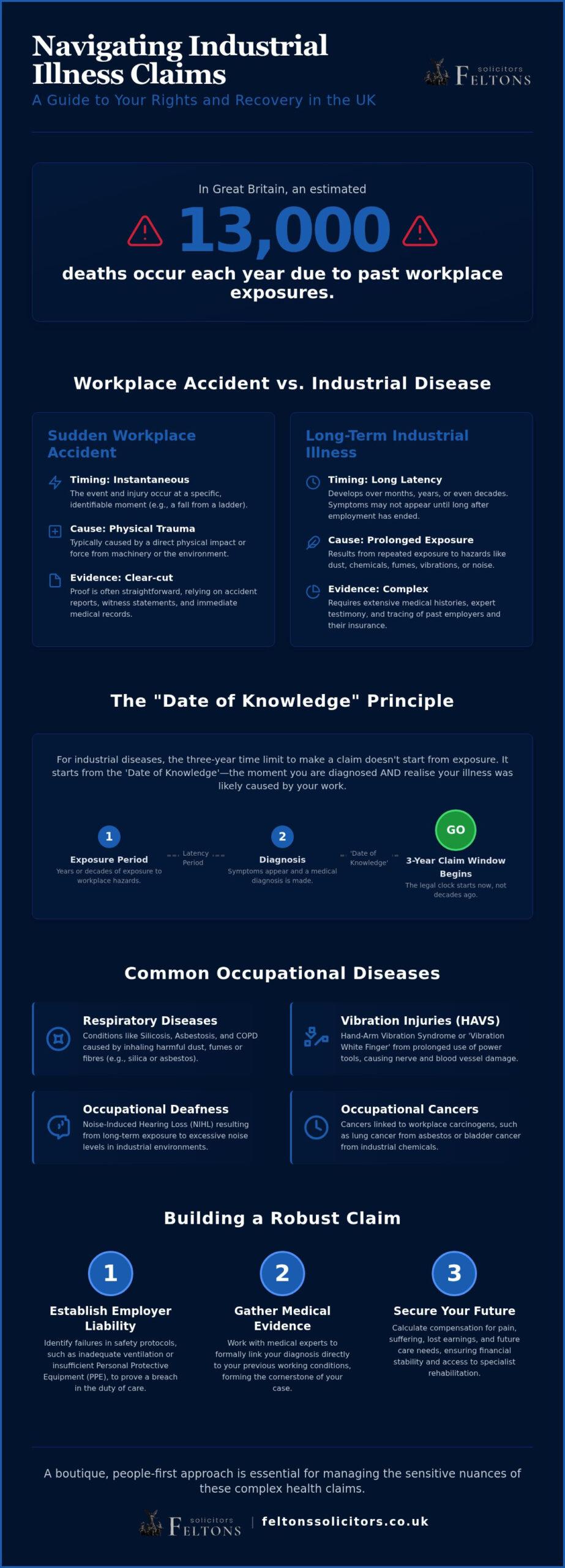
Did you know that an estimated 13,000 deaths occur every year in Great Britain due to past workplace exposures, with many conditions only surfacing decades after you’ve left the job? If you’re struggling with a diagnosis like silicosis or asbestosis, the prospect of taking on a large corporation can feel like an impossible battle whilst your health declines. Partnering with specialist workplace disease solicitors UK ensures you aren’t facing this complex journey alone. It’s natural to feel concerned about the time that has passed or the cost of care, but the law is designed to protect those who’ve been let down by employer negligence.

We understand that your priority is securing financial stability for your future and achieving a sense of justice. This comprehensive guide will show you how to navigate industrial illness claims in 2026 with confidence, focusing on a clear, stress-free path toward recovery. We’ll examine the latest 18th edition Judicial College Guidelines, the critical “date of knowledge” principle for long-latency diseases, and how expert legal guidance provides the boutique level of care you need to rebuild your life.

Key Takeaways

  • Understand the legal distinction between sudden workplace accidents and long-term industrial illnesses to help identify the true nature of your condition.
  • Learn how to establish employer liability by identifying failures in safety protocols or insufficient protective equipment, regardless of how long ago the exposure occurred.
  • Discover how specialist workplace disease solicitors UK navigate the complexities of medical evidence and insurer tracing to build a robust case for your recovery.
  • Recognise why a boutique, people-first approach to legal representation is essential for managing the sensitive nuances of respiratory and vibration-related health claims.
  • Gain a clear understanding of the compensation process, ensuring you can secure the financial future necessary to cover ongoing care and lost earnings.

Understanding Workplace Disease and Industrial Illness in the UK

An Occupational disease is a chronic health condition that develops as a direct result of your working environment or the tasks you were required to perform. Unlike a sudden accident at work, such as a fall from a ladder or a specific injury caused by faulty machinery, an industrial disease is usually the product of long-term exposure. It’s often a “silent” process where damage accumulates over months or even decades before symptoms become noticeable. UK law recognises this unique nature of occupational exposure, providing a legal framework that holds employers accountable for failing to protect their staff from foreseeable risks.

The Health and Safety Executive (HSE) is the national regulator responsible for setting the workplace standards that keep people safe. These standards aren’t suggestions; they’re legal requirements. When an employer ignores safety protocols, they’re in breach of their duty of care. Common distinctions between accidents and diseases include:

  • Timing: Accidents are instantaneous, whilst diseases have a “latency period” where the illness remains hidden.
  • Cause: Accidents often involve physical trauma. Diseases usually involve biological, chemical, or ergonomic hazards like silica dust, loud noise, or repetitive vibrations.
  • Evidence: Proving a disease often requires complex medical histories and expert testimony rather than just an accident report.

The “Date of Knowledge” and Statutory Time Limits

In most personal injury cases, you have three years from the date of the incident to begin legal proceedings. However, applying this rule to industrial illnesses would be unfair, as you might not know you’re ill until twenty years after you’ve retired. This is why the law uses the “date of knowledge” principle. The three-year limit only starts when you’re diagnosed with a condition and realise it was likely caused by your former employment. Specialist workplace disease solicitors UK are essential in these scenarios, as they help establish this timeline and trace former employers or their insurers, even if the company no longer exists. For fatal conditions, this three-year period may begin from the date of death, allowing families to seek the justice their loved ones deserve.

The Human Impact: Beyond Financial Compensation

A diagnosis of a life-changing illness carries a heavy psychological weight that extends far beyond physical symptoms. It’s common to feel a sense of betrayal or anxiety about the future when your health has been compromised by a job you dedicated years to. We believe that seeking legal advice should provide empathetic reassurance during this difficult time. A successful claim does more than just provide a settlement; it opens doors to private medical rehabilitation and specialist care programmes that can significantly improve your quality of life. By focusing on a “people-first” approach, the legal process becomes a tool for recovery, ensuring you have the support needed to manage both the physical and emotional toll of your diagnosis.

Common Occupational Diseases: From Respiratory Conditions to Silicosis

Occupational diseases cover a vast spectrum of conditions, ranging from debilitating skin irritations to terminal lung cancers. Whilst some conditions like occupational dermatitis or asthma might appear soon after exposure, others take decades to manifest. Conditions such as COPD and welder’s lung often stem from years of inhaling fumes or dust in poorly ventilated environments. Beyond respiratory issues, many workers suffer from Hand-Arm Vibration Syndrome (HAVS) or Vibration White Finger due to the prolonged use of power tools. These injuries can make everyday tasks like fastening buttons or holding a kettle incredibly painful. You might also be eligible for the Industrial Injuries Disablement Benefit if your condition has led to a loss of faculty.

The Growing Threat of Silicosis in the UK

Silicosis has emerged as a significant modern threat, particularly within the construction and stone-working sectors. It’s a preventable but incurable lung disease caused by the inhalation of respirable crystalline silica (RCS) dust. High-risk industries include stone masonry, construction, and the manufacturing of engineered stone kitchen worktops. Silicosis is a latent industrial disease that requires specialist forensic legal evidence. If you’re seeking justice following a bereavement, understanding a silicosis claim after death is a vital step for your family’s future.

Asbestos-Related Diseases and Mesothelioma

Asbestos-related diseases continue to represent a substantial portion of industrial illness litigation in the UK. The legacy of asbestos in shipbuilding, construction, and manufacturing means that many people are only now receiving diagnoses. It’s important to differentiate between conditions like pleural thickening, asbestosis, and the terminal cancer mesothelioma. Mesothelioma is particularly aggressive, affecting the lining of the lungs or abdomen. Because of the long latency periods discussed in our previous section, these claims remain a priority for workplace disease solicitors uk. We focus on tracing the insurers of defunct companies to ensure you receive the compensation you deserve.

Occupational cancers can also arise from exposure to hazardous chemicals, mineral oils, or radiation in various industrial processes. Similarly, skin conditions like contact dermatitis affect thousands of workers who handle irritants without adequate protection or correct PPE. If you’re concerned about your health, our team can provide the specialist silicosis and personal injury advice you need to understand your legal options. We prioritise your well-being throughout the entire process.

Securing compensation for an industrial illness isn’t simply a matter of presenting a medical diagnosis. To succeed, you must demonstrate that your employer failed in their legal obligations. In the UK, every employer holds a “duty of care” toward their staff, meaning they’re legally required to provide a safe working environment. This includes conducting thorough risk assessments, providing effective personal protective equipment (PPE), and ensuring adequate ventilation or noise control. When these standards aren’t met, a breach of duty occurs. Professional workplace disease solicitors uk focus on identifying exactly where these safety protocols failed, transforming a complex health crisis into a clear legal argument for negligence.

Proving causation is often the most challenging aspect of these claims. You must show that your condition was directly caused by your work environment rather than outside factors. For conditions like Asbestosis or silicosis, this requires more than just a GP’s note. We work closely with forensic industrial hygienists and specialist medical witnesses who can pinpoint the source of exposure. These experts provide the technical authority needed to link your current health struggles to historic workplace failings, ensuring your case is built on a foundation of scientific fact.

Claiming Against Dissolved or Former Employers

A common misconception is that you can’t make a claim if your former employer has ceased trading or gone into liquidation. This isn’t the case. In the UK, it’s the insurance company that provided cover at the time of your exposure that’s liable for the payout, not the company itself. We utilise the Employers’ Liability Tracing Office (ELTO) and other specialist databases to identify these historic insurers. Even if a firm closed decades ago, we can often find the relevant policy to ensure you aren’t left without financial support. You don’t need the company to still be active to achieve a successful outcome.

The Role of Evidence in Complex Litigation

Building a robust case relies on a methodical collection of evidence. Whilst your memory of the workplace is a vital starting point, we look for tangible proof to support your statement. This includes gathering historic Health and Safety logs, employment records, and even witness statements from former colleagues who worked alongside you. Colleagues often remember the specific conditions, such as a lack of dust extraction or a failure to provide safety training. At Feltons, we use pragmatic investigative techniques to piece together these details, providing a steady and reliable presence throughout the litigation process. We prioritise personal connection, ensuring you’re informed at every stage of the investigation.

Workplace Disease Solicitors UK: A Comprehensive Guide to Claims in 2026

The journey toward financial recovery begins with a detailed initial consultation. This is where we assess the merits of your case, looking closely at your employment history and the nature of your diagnosis. Once we establish a viable path, we arrange for independent medical specialists to evaluate your condition. These assessments are vital; they provide the objective evidence required to value your claim accurately. After the medical phase, we issue a formal Letter of Claim to your former employer or their insurer, outlining the negligence and the impact on your life.

Expert workplace disease solicitors uk don’t just process paperwork; they act as your sophisticated guide through the subsequent negotiations. Most claims reach a settlement during this phase, as insurers often prefer to avoid the costs and uncertainty of a trial. Our role is to ensure the final figure reflects the true extent of your losses, providing you with a sense of security and justice. We prioritize your peace of mind, ensuring the process is as transparent and stress-free as possible.

Calculating Your Compensation: What is Your Claim Worth?

Determining the value of an industrial disease claim involves two distinct categories of damages. General damages compensate you for pain, suffering, and loss of amenity (PSLA). We use the 18th edition of the Judicial College Guidelines, published in April 2026, which included an 8.26% uplift to account for inflation. Special damages cover your tangible financial losses, such as lost earnings and travel expenses for treatment. For many of our clients, the most significant element is the calculation of future care needs. If your illness requires ongoing medical support or home adaptations, these costs are integrated into the settlement to protect your long-term well-being.

Will My Case Go to Court?

The vast majority of workplace disease claims settle out of court, often through professional dispute resolution. Whilst the prospect of a trial can be daunting, it’s rarely a reality for the clients we represent. Our pragmatic approach focuses on building such a robust evidentiary base that the insurer’s liability becomes difficult to contest. If you’re ready to explore your options, you can speak with our specialist solicitors to begin your assessment. We handle the complex litigation whilst maintaining a calm, steady presence, allowing you to focus entirely on your health and recovery.

Why Choose Specialist Workplace Disease Solicitors?

Selecting the right workplace disease solicitors uk is a decision that profoundly impacts your health, your family, and your long-term financial security. Many large legal practices operate as “claims factories”, where cases are processed in high volumes with little room for personal rapport or individual attention. We believe that sensitive health-related claims require a boutique approach. This ensures that every nuance of your medical history and workplace exposure is examined with sound judgment and care. Specialist expertise in niches like silicosis sets a firm apart, as these cases demand a level of forensic detail that generic personal injury firms often overlook. Our goal is to provide a discreet, high-standard service that values your privacy as much as your recovery.

A people-first philosophy is at the heart of everything we do. We understand that behind every claim is a person dealing with a life-altering diagnosis and the anxiety that follows. By prioritising personal connection over high-volume processing, we can offer the empathetic reassurance you need during a stressful time. This tailored experience allows us to build a robust case that reflects the true human impact of employer negligence, ensuring you aren’t just another case number in a database.

The Feltons Difference: Professionalism with Empathy

Feltons Solicitors LLP was established in 2010 with a focus on traditional professional values and quiet confidence. We provide pragmatic advice that cuts through complex legal jargon, offering a clear and logical path forward for our clients. By bridging the gap between established heritage and modern efficiency, we ensure your claim is handled with both the care of a trusted advisor and the precision of a contemporary practice. Securing a settlement is often just the beginning of your financial recovery journey. To protect your legacy and ensure your compensation supports your family for years to come, we suggest exploring Estate Planning as part of your long-term asset protection strategy.

National Reach with a Boutique Feel

We represent clients across the UK, providing a national reach whilst maintaining the intimate, supportive feel of a boutique firm. Our centres of expertise are designed to support you regardless of your location, ensuring you have access to high-end reliability and worldly experience. Throughout the litigation process, we act as your sophisticated guide, handling the pressure of disputes against large corporations so you don’t have to. We prioritise personal connection, ensuring you always understand the status of your claim and the next steps in your recovery. To take the first step toward the justice you deserve, Speak to our specialist solicitors today for a consultation tailored to your specific health and financial needs.

Navigating the path to recovery after a life-changing diagnosis is a complex journey, but you don’t have to walk it alone. As we’ve explored, achieving a successful outcome relies on a forensic understanding of employer liability and the ability to trace historic insurance policies, even decades after your exposure. By choosing specialist workplace disease solicitors uk, you gain more than just legal representation; you secure a sophisticated guide dedicated to your long-term financial security and well-being. Our focus remains on providing a calm, steady presence that respects the human impact of your illness.

Since 2010, Feltons Solicitors LLP has provided pragmatic, expert advice to those affected by complex conditions like silicosis and respiratory diseases. We prioritise a boutique level of care, ensuring your personal rapport with your solicitor is never sacrificed for high-volume processing. If you’re ready to seek justice for employer negligence and secure the compensation you deserve, we’re here to help. We invite you to contact Feltons Solicitors for a discreet consultation on your workplace disease claim. Reclaiming your peace of mind is a vital step toward a more stable future, and we’re committed to supporting you every step of the way.

Frequently Asked Questions

Can I claim for a workplace disease if I am a former employee?

Yes, you can certainly make a claim as a former employee. Industrial diseases often have long latency periods, meaning symptoms might not appear until decades after you’ve left the workplace. The law recognises that your health was compromised during your tenure, and your right to seek compensation remains valid regardless of your current employment status. We focus on tracing the specific period of exposure to hold the relevant employer accountable for their past negligence.

How long do I have to start a workplace disease claim in the UK?

You generally have three years to initiate a claim, but this limit begins from your “date of knowledge” rather than the date of exposure. This is the point at which you were diagnosed and realised your condition was linked to your previous employment. For cases involving a deceased family member, the three-year period starts from the date of death or the date of post-mortem results. It’s advisable to seek legal advice as soon as a diagnosis is confirmed.

What if my former employer no longer exists or has gone bust?

You can still pursue a successful claim even if your former employer is no longer trading. In the UK, compensation is paid by the insurance company that provided Employers’ Liability cover at the time of your exposure. Our team utilises specialist databases and the Employers’ Liability Tracing Office to identify the correct insurer from years ago. This ensures that the closure of a company doesn’t prevent you from accessing the financial support and justice you deserve.

How much does it cost to hire workplace disease solicitors?

Most workplace disease solicitors uk operate on a “No Win, No Fee” basis, formally known as a Conditional Fee Agreement. This arrangement means you don’t pay upfront legal fees, and you only pay a success fee if your claim is successful. Under the Conditional Fee Agreements Order 2013, the success fee is capped at 25% of your damages for pain and suffering. This approach ensures that expert legal representation remains accessible to everyone, regardless of their financial situation.

Will I have to go to court for an industrial disease claim?

It is highly unlikely that you’ll need to attend court in person. Most industrial disease claims handled by workplace disease solicitors uk are settled through negotiation or alternative dispute resolution before a trial date is even set. Our role as your sophisticated guide is to build a case so robust that the insurer chooses to settle out of court. If a hearing is necessary, we provide steady, professional support to ensure you feel prepared and confident.

What is the “Date of Knowledge” in occupational illness cases?

The “Date of Knowledge” is the specific point in time when you first became aware that you were suffering from a significant illness caused by your work. For diseases with long latency periods, like asbestosis, this date is critical because it triggers the three-year statutory time limit for making a claim. It requires a clear link between your medical diagnosis and the specific hazardous environment or substances you encountered during your previous employment history.

Can I claim for a family member who has passed away from a workplace disease?

Yes, the law allows executors or dependants to bring a claim on behalf of a loved one who has passed away. You can seek compensation for the pain and suffering the individual endured, as well as for financial losses such as funeral expenses and loss of financial dependency. We handle these sensitive matters with a boutique level of care and empathy, ensuring that bereaved families can achieve justice and financial security during an incredibly difficult time.

What industries are most at risk for silicosis and lung disease?

High-risk industries include construction, stone masonry, and the manufacturing of engineered stone kitchen worktops. Workers in mining, pottery, and foundries are also frequently exposed to respirable crystalline silica (RCS) dust. Employers in these sectors must implement strict safety measures, such as on-tool extraction and high-quality respiratory protective equipment. If these standards weren’t met during your career, resulting in a lung disease diagnosis, you may have grounds for a robust legal claim against your former employer.