
Statutory Lease Extension: 2026 Guide for UK Leaseholders

Statutory Lease Extension: 2026 Guide for UK Leaseholders

What if your most significant asset was losing value every single day simply because of a date on a calendar? For many of the 4.98 million leaseholders in England, the approaching 80-year threshold feels less like a deadline and more like a financial cliff edge. You likely feel that the current system is weighted against you, particularly when facing the prospect of marriage value costs or aggressive freeholder tactics. Mastering the statutory lease extension process is no longer just a legal necessity; it’s a vital tactical manoeuvre to safeguard your property’s equity against predatory ground rents.

We recognise that the wait for full implementation of the Leasehold and Freehold Reform Act 2024 has created a landscape of uncertainty for many homeowners. You’re likely looking for a steady, experienced hand to guide you through these transitions. This guide promises to help you navigate the legal complexities of the Section 42 process to secure a 90-year extension and eliminate ground rent with professional poise. We’ll provide a methodical overview of your rights, including the abolished two-year ownership rule, the current 2026 tribunal fee structures, and the strategic steps required to neutralise aggressive freeholder counter-proposals whilst protecting your property’s long-term market value.

Key Takeaways

  • Secure a guaranteed 90-year extension to your current term whilst reducing ground rent to a peppercorn to protect your property’s market equity.
  • Master the statutory lease extension process by serving a formal Section 42 notice, which triggers your legal right to a fair and regulated extension.
  • Avoid the risks of informal negotiations that often include hidden ground rent hikes or unfavourable terms designed to benefit the freeholder.
  • Prepare for a structured six-to-twelve-month timeline, beginning with a professional valuation to establish a robust and defensible premium.
  • Recognise the importance of specialist legal expertise in navigating the 2026 regulatory landscape and safeguarding your interests against aggressive counter-proposals.

Understanding the Statutory Lease Extension Process

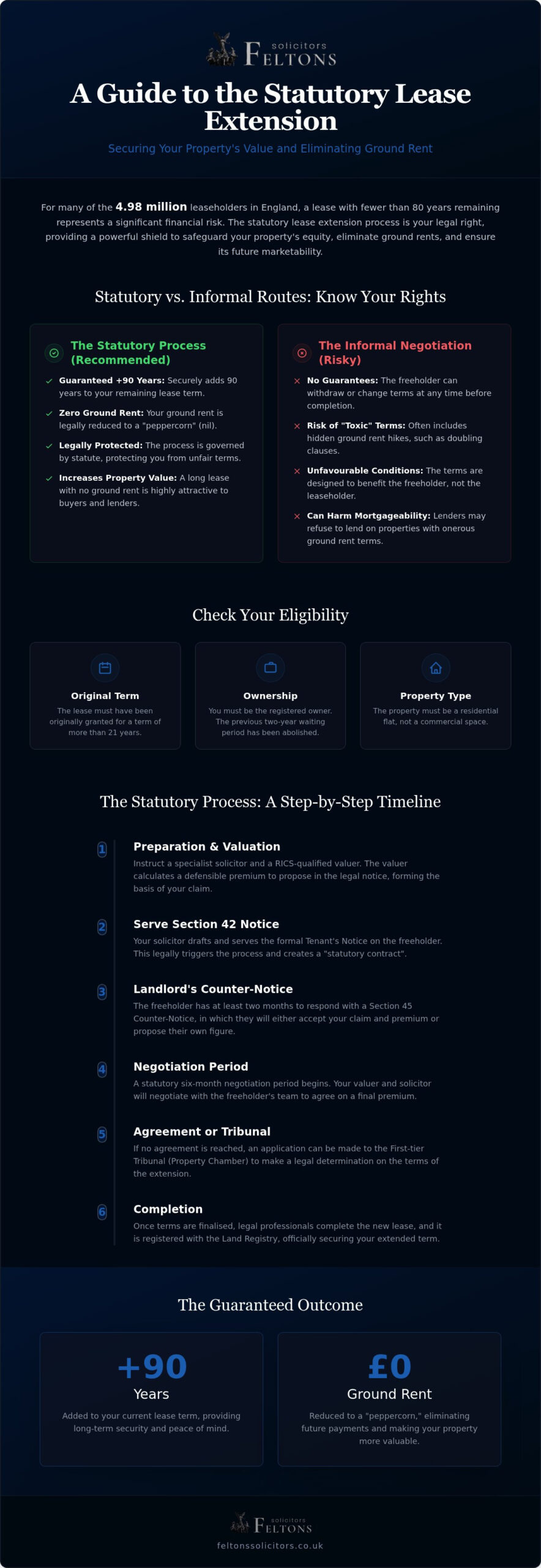
The statutory lease extension process is a formal legal right established by the Leasehold Reform, Housing and Urban Development Act 1993. It empowers qualifying tenants to compel their landlord to grant an extension, providing a level of security that informal agreements simply cannot match. While the Leasehold Reform Act 1967 laid the groundwork for house owners, the 1993 Act remains the primary shield for the 4.98 million leasehold dwellings in England today. In the current 2026 landscape, this route is considered the gold standard. It guarantees an additional 90 years on top of your existing term and ensures your ground rent is extinguished entirely.

The Legal Right to a Peppercorn Rent

A peppercorn rent is a legal fiction that signifies zero financial obligation. In practical terms, it means you’ll never pay ground rent again. This is a powerful advantage when you consider the “toxic” ground rent clauses often found in informal deals. Landlords frequently propose what look like cheaper premiums in exchange for doubling ground rent terms. These clauses can render a property unmortgageable as lenders tighten their criteria in 2026. By choosing the statutory route, you’re protecting your property’s market equity. It makes your home far more attractive to future buyers who want the peace of mind that comes with a clean title.

Who Qualifies for a Statutory Extension?

Qualification rules are now more favourable than ever for leaseholders. One of the most significant shifts occurred in February 2025, when the government abolished the two-year ownership rule. You no longer have to wait to start the process; you can act the moment your name is on the Land Registry. To qualify, you must meet a few specific legal criteria. These requirements are designed to ensure the process remains fair for both parties:

  • Original Term: Your lease must have been granted for more than 21 years originally.
  • Ownership: You must be the registered owner at the Land Registry, though the old two-year waiting period no longer applies.
  • Property Type: The flat must be a residential dwelling, not a purely commercial space.

There are a few exceptions to keep in mind, such as properties held by charitable housing trusts or specific business tenancies. If you’re unsure of your status, a quick check of your original lease document will confirm if you meet the criteria for this protected legal path. Most residential flats in England fall into this category, allowing owners to move forward with confidence.

Phase 1: Serving the Section 42 Tenant’s Notice

Serving the Section 42 Tenant’s Notice is the formal trigger that sets the statutory lease extension process in motion. It’s far more than a simple letter of intent; it’s a legal document that, once served, creates a “statutory contract” between you and the freeholder. This means both parties are legally bound to proceed under the terms of the 1993 Act. Since the abolition of the two-year ownership rule in February 2025, new owners can now serve this notice immediately after completing their purchase. This allows for a swift transition to a more secure title without the previous mandatory waiting period that often left new buyers in a vulnerable position.

The Role of the Specialist Valuer

You cannot simply guess the premium you wish to pay. Proposing an unrealistic figure in your Section 42 notice can lead to the document being deemed invalid or result in a high-pressure counter-proposal from the landlord. A RICS-qualified valuer is essential to calculate a defensible premium based on the property’s current market value and the remaining lease term. Marriage value is the increase in property value following an extension, shared 50/50 with the landlord if the lease is under 80 years. While the 2024 Reform Act aims to eventually abolish this cost, it remains a factor for many in 2026 whilst secondary legislation is finalised. Official guidance on Extending your lease confirms that a professional valuation is the safest way to avoid overpaying.

Drafting the Notice with Legal Precision

Precision is the cornerstone of a successful claim. The notice must contain specific mandatory information, including your full lease details, the proposed premium, and a clear deadline for the freeholder to respond with a counter-notice. This response period is typically two months from the date the notice is served. Any minor administrative error can give an aggressive freeholder grounds to challenge the notice’s validity in court. If the notice is rejected or if you miss subsequent deadlines, it can lead to a “deemed withdrawal.” This is a costly mistake, as it prevents you from reapplying for another twelve months and usually leaves you liable for the landlord’s legal costs.

Our team at Feltons Solicitors ensures every detail aligns perfectly with the requirements of the 1993 Act. We coordinate closely with your valuer to ensure the figures proposed are robust and legally sound. This methodical approach protects you from unnecessary delays and ensures you remain in control of the timeline. If you’re ready to secure your property’s future, our leasehold enfranchisement and extensions specialists can help you draft a notice that stands up to scrutiny.

Formal vs Informal Routes: Why the Statutory Process Protects You

Choosing between the formal and informal route is often the most critical decision a leaseholder will make. The informal route is frequently presented by freeholders as a faster, friendlier alternative to the legal standard. It’s a gamble that rarely pays off for the tenant. Only by navigating the statutory lease extension process can you guarantee a fixed 90-year addition to your term and the total elimination of ground rent. According to the official government guidance on extending a lease, the formal process ensures your ground rent is reduced to a peppercorn, providing a level of wealth preservation that informal “deals” simply cannot replicate.

The Dangers of Informal “Deals”

Freeholders often prefer informal negotiations because they aren’t bound by the strictures of the 1993 Act. This allows them to propose terms that benefit their own investment portfolios rather than your property rights. A common tactic involves offering an extension back to 99 years instead of adding 90 years to the existing term. More concerning is the inclusion of escalating ground rent clauses. Many lenders in 2026 now refuse to provide mortgages on properties where ground rent exceeds 0.1% of the property’s market value. This is where leasehold enfranchisement experts provide essential protection, ensuring you don’t trade away long-term equity for a perceived short-term saving. An informal deal might save on valuation costs today, but it could cost you thousands in lost property value tomorrow.

The Protection of the First-tier Tribunal

The statutory lease extension process provides a vital safety net: the First-tier Tribunal (Property Chamber). If negotiations over the premium or lease terms reach an impasse, either party can apply to the Tribunal to act as an impartial referee. As of July 13, 2026, a new five-tier fee framework is in place, with typical fees including an application fee of £114 and a hearing fee of £227. The mere presence of this fallback position often forces landlords to be more reasonable. They know that if they push for an excessive premium, their behaviour can be scrutinised by a professional panel. This legal leverage is entirely absent in the informal route, where the landlord holds all the cards. Having a mandated fallback ensures you are never at the mercy of an aggressive freeholder’s counter-proposal, providing a steady path toward a fair outcome.
Statutory Lease Extension: 2026 Guide for UK Leaseholders

The Statutory Timeline: What to Expect

The statutory lease extension process typically spans six to twelve months from the initial instruction to the final registration. It’s a marathon, not a sprint, requiring a methodical approach to each legal milestone. The journey begins with a thorough title investigation and a professional valuation to establish your opening position. Once your Section 42 Notice is served, the freeholder has a mandatory two-month window to respond. This period is often used by the landlord to request further information or to arrange their own valuation of your property.

The Counter-Notice and Negotiation Phase

It’s rare for a freeholder to accept your proposed premium without question. The Section 45 Counter-Notice is their formal reply, and it usually proposes a significantly higher figure than your opening offer. Don’t be alarmed by this. It’s a standard part of the procedure. Once this notice is received, it triggers a six-month negotiation window for solicitors and valuers to find a middle ground. We manage this dialogue with calm, steady authority, using the evidence from your RICS valuation to reach a fair settlement. Most cases are resolved through expert compromise during this phase, avoiding the need for a full tribunal hearing.

Completion and Land Registry Registration

Once the premium and lease terms are agreed, the process moves into the conveyancing stage. This involves finalising the new lease document, which legally incorporates the 90-year extension and reduces your ground rent to a peppercorn. You’ll sign the documentation and pay the agreed premium along with the freeholder’s reasonable legal and valuation costs. The final step is ensuring the Land Registry record is updated to reflect your new, extended term. Registration fees in 2026 are based on property value; for example, a property valued between £200,001 and £500,000 currently incurs a fee of £330. You can explore our broader guide on residential property law to see how these registrations safeguard your overall property rights.

If you’re ready to begin your timeline with a trusted advisor, contact our leasehold enfranchisement and extensions specialists for a discreet consultation today.

Instructing a Specialist: How Feltons Solicitors Safeguard Your Interest

Many leaseholders assume any solicitor can handle their extension. This is a risky misconception. The statutory lease extension process involves strict litigation deadlines and technical valuation arguments that go far beyond standard conveyancing. A generalist may miss the nuance of a Section 42 notice or fail to respond to a counter-proposal with the necessary tactical weight. At Feltons, we provide specialised expertise in leasehold enfranchisement, acting as a calm and steady presence during what can be a stressful financial negotiation. We understand that your home is your most significant asset. Protecting its value requires more than just administrative filing; it requires a deep understanding of the 1993 Act and the evolving 2026 regulatory framework.

Early action is particularly vital if your lease is approaching the 80-year mark. While the 2024 Reform Act promises future changes to marriage value, the current legal reality in 2026 still makes extensions significantly more expensive once you cross that threshold. By instructing a specialist early, you lock in your rights and prevent the freeholder from leveraging your expiring term against you. We pride ourselves on a “people-first” philosophy. Whilst the technical legal work is paramount, we never forget the human impact. We handle the complex litigation and the back-and-forth with the freeholder’s legal team so you don’t have to.

A Boutique Approach to Property Law

Unlike high-volume “factory” firms, Feltons offers a tailored experience defined by personal connection and discreet, high-standard service. You won’t be passed between junior clerks. Instead, you’ll have a dedicated advisor who provides pragmatic advice and remains accessible throughout the journey. This boutique level of care is why we’re trusted by both domestic homeowners and international clients with complex UK property portfolios. We project an image of high-end reliability, ensuring that every client feels they’re in capable, worldly hands, regardless of the scale of their matter. Our goal is to provide the quiet confidence you need to resolve even the most aggressive counter-proposals.

Next Steps: Securing Your Property’s Future

The first step toward securing your 90-year extension and a peppercorn ground rent is a professional valuation. Starting this process today allows us to build a robust case before the formal notice is even served. We can provide a bespoke estimate for your specific needs, ensuring you understand the likely costs and timelines involved from the outset. Don’t leave your property’s equity to chance or the whims of an aggressive landlord. Taking control of the statutory lease extension process now is the most effective way to protect your investment for decades to come. Contact Feltons Solicitors for a confidential consultation to discuss how we can safeguard your interests and provide the professional poise your property matters deserve.

Securing Your Property’s Equity for the Decades Ahead

Choosing the right path for your lease extension isn’t just about administrative compliance; it’s a strategic move to preserve your home’s marketability. By committing to the statutory lease extension process, you ensure that your property remains an attractive asset for future lenders and buyers alike. You’ve seen how the Section 42 route eliminates the risk of predatory ground rent hikes whilst providing a legally mandated framework for a fair premium. This formal path remains the only way to guarantee a 90-year extension and the total removal of financial ground rent obligations.

Since 2010, Feltons Solicitors has combined traditional professional values with a modern, pragmatic approach to property law. We specialise in complex leasehold enfranchisement, providing expert guidance to both national and international clients who value discreet, high-standard service. Our “people-first” philosophy ensures you receive the boutique care and steady authority required to navigate these legal complexities with ease. You don’t have to face aggressive freeholder counter-proposals alone.

Don’t let an expiring lease or a complex regulatory landscape dictate your financial future. Secure your property’s future with Feltons Solicitors. You’re in capable hands, and taking this step today will provide the peace of mind you deserve for years to come.

Frequently Asked Questions

How long does the statutory lease extension process take?

A standard statutory lease extension process typically takes between six and twelve months to complete. This timeline accounts for the initial valuation, the two-month window for the landlord’s counter-notice, and the subsequent negotiation period. Whilst some cases resolve faster through efficient dialogue, others may require the full six-month negotiation window to agree on the final premium. We ensure every milestone is met with precision to prevent unnecessary delays in your property’s registration.

Do I still need to own my flat for two years before extending?

No, the previous requirement to own your property for two years was abolished in February 2025. You’re now eligible to serve a Section 42 notice as soon as you become the registered owner at the Land Registry. This change is particularly beneficial for new buyers who wish to address a short lease immediately. It allows you to secure your property’s equity and remove ground rent obligations without a lengthy and potentially costly waiting period.

What happens if my landlord refuses to extend the lease?

Under the 1993 Act, a landlord cannot simply refuse a valid statutory request for a lease extension. If your notice is drafted correctly and you meet the qualification criteria, the freeholder is legally obligated to grant the 90-year extension. In rare cases where a landlord fails to respond or disputes your right without legal grounds, the matter can be escalated to the County Court or the First-tier Tribunal to protect your interests.

How much does a statutory lease extension cost?

The total cost includes the premium paid to the landlord, professional fees, and Land Registry charges. In 2026, valuation surveyors typically charge between £600 and £900, whilst legal fees for each party often range from £800 to £1,300. You are also responsible for the freeholder’s reasonable legal and valuation costs. Land Registry fees for registration currently range from £230 to £330, depending on the property’s value, ensuring your new term is officially recorded.

Can I extend the lease on a house using the statutory route?

Yes, owners of leasehold houses have separate legal rights to extend their leases, though the terms differ from flats. Whilst flat owners receive a 90-year extension, house owners typically qualify for a 50-year extension under the Leasehold Reform Act 1967. The statutory lease extension process for houses follows a different valuation methodology. It’s essential to use a specialist who understands these distinctions to ensure you’re pursuing the most advantageous route for your specific property type.

What is the difference between a Section 42 and a Section 45 notice?

A Section 42 notice is the tenant’s official trigger for the extension, whilst a Section 45 notice is the landlord’s formal counter-proposal. The Section 42 notice outlines your proposed premium and lease terms. The landlord then has two months to respond with a Section 45 notice, which either accepts your terms or, more commonly, proposes a higher premium. This exchange of notices establishes the legal framework for the subsequent negotiation phase between both parties.

Why is 80 years such a critical threshold for lease extensions?

The 80-year mark is critical because it triggers “marriage value,” which significantly increases the premium you must pay. Once a lease falls below this threshold, you’re legally required to share 50% of the property’s potential value increase with the landlord. Although the Leasehold and Freehold Reform Act 2024 intends to abolish this cost, as of September 2026, these provisions are not yet in effect. Acting before your lease reaches this point is vital.

Will my ground rent really go down to zero?

Yes, your ground rent will be reduced to a “peppercorn,” which effectively means you have zero financial obligation. This reduction is a mandatory requirement of the statutory process under the 1993 Act. Unlike informal deals where a landlord might try to maintain or even increase ground rent, the formal route provides a permanent solution. This makes your property far more attractive to lenders and future buyers by removing an ongoing financial burden.

Contested Probate Lawyers UK: A Guide to Resolving Estate Disputes in 2026

Contested Probate Lawyers UK: A Guide to Resolving Estate Disputes in 2026

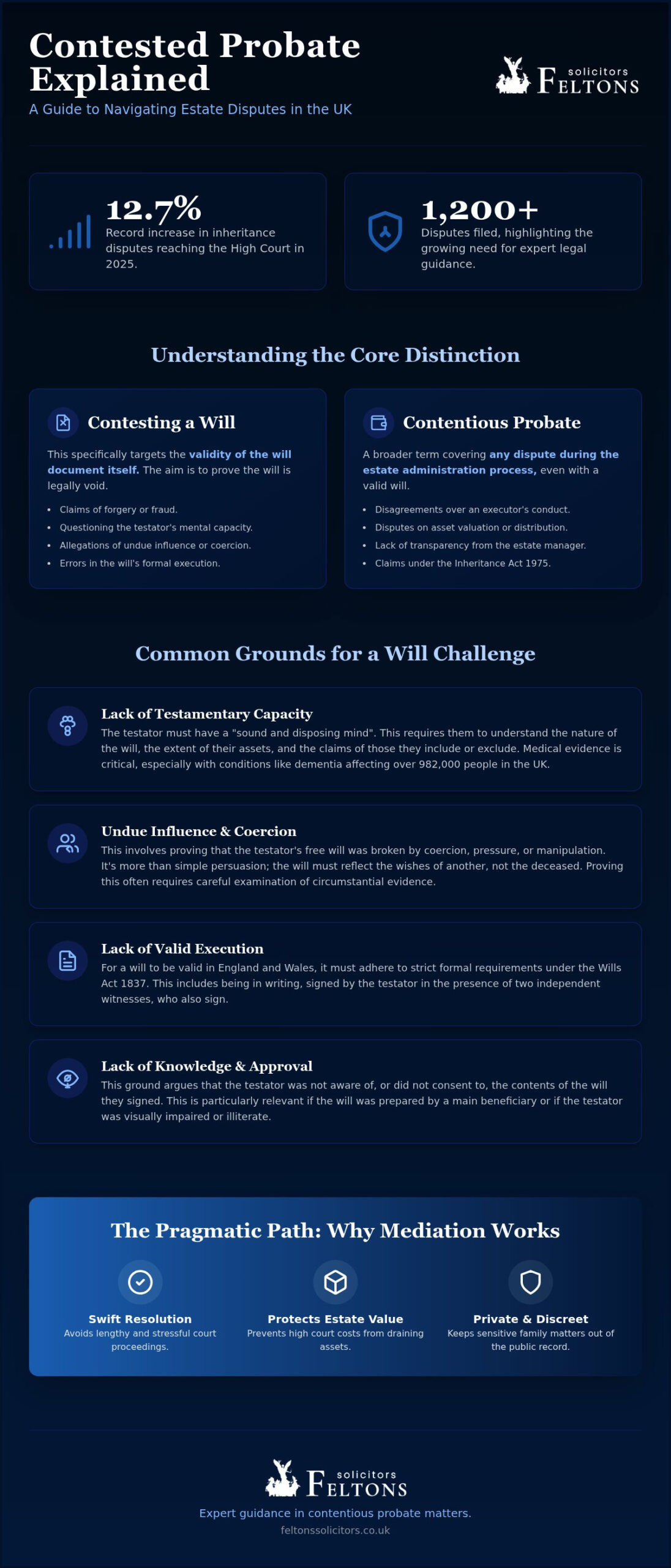
With over 1,200 inheritance disputes reaching the High Court in 2025, a record 12.7% increase from the previous year, estate litigation is no longer a rarity in the UK. Facing a legal challenge during a time of grief is incredibly draining, especially when family tensions rise and the fear of mounting costs begins to overshadow your inheritance. You’re likely looking for clarity amongst complex laws and a way to ensure the deceased’s wishes are truly honoured. Engaging experienced contested probate lawyers uk can provide the steady, professional presence you need to manage these sensitive matters with precision and care.

We understand that your priority is a fair outcome that doesn’t exhaust the estate’s value in court fees. Whether you’re seeking the removal of an incompetent executor or challenging the validity of a will, this guide outlines the essential steps for a resolution in 2026. You’ll learn how to navigate strict time limits and why mediation is often the most pragmatic path to a swift, private settlement. By focusing on strategic discretion, you can protect your interests whilst preserving what matters most.

Key Takeaways

  • Understand the vital distinction between challenging a will’s validity and disputing the probate process itself to ensure your legal strategy is accurately targeted.
  • Learn about the legal requirements for testamentary capacity and why securing medical evidence early is essential for a robust claim.
  • Explore how experienced contested probate lawyers uk utilise mediation to resolve disputes swiftly whilst preventing high court costs from draining the estate’s value.
  • Gain clarity on the “costs follow the event” rule and how to navigate the financial risks associated with inheritance litigation in 2026.
  • Discover the benefits of a pragmatic, people-first approach that focuses on achieving a fair distribution of assets through discreet and professional negotiation.

Understanding Contested Probate in the UK

Contentious probate refers to any legal disagreement arising during the administration of a deceased person’s estate. It’s a broad term that encompasses far more than just arguments over a final testament. Whilst many people use “contesting a will” and “contested probate” interchangeably, they represent distinct legal challenges that require different strategic approaches. Seeking the guidance of contested probate lawyers uk early in the process is a pragmatic way to protect the estate’s value and ensure your interests are professionally represented during a sensitive time.

Contested Probate vs. Contesting a Will

Contesting a will specifically targets the validity of the document itself. This might involve claims of forgery, lack of testamentary capacity, or undue influence during the document’s creation. In contrast, contentious probate covers a wider range of issues, such as the conduct of an executor or disagreements over how assets are being managed and distributed. Both areas require specialist estate planning knowledge to navigate the nuances of the law effectively. Understanding which path your dispute falls under is the first step toward a resolution.

When Does an Estate Administration Become Contentious?

Disputes often begin with subtle red flags that suggest the administration isn’t proceeding as it should. You might notice a lack of transparency from the person managing the estate or experience unexplained delays in receiving basic information. Common triggers include the discovery of unexpected beneficiaries or the realisation that significant assets appear to be missing from the inventory. In many instances, a claimant might feel they were unfairly excluded from a will, leading them to seek relief under the Inheritance (Provision for Family and Dependants) Act 1975.

Disagreements amongst beneficiaries regarding the valuation of unique assets, such as property or private business interests, can also stall the process. If a resolution isn’t immediately visible, a “caveat” can be lodged at the Probate Registry. This formal notice prevents the court from issuing a Grant of Probate, effectively pausing the administration whilst the dispute is settled. This is often a necessary safeguard to ensure that assets aren’t distributed incorrectly whilst legal questions remain unanswered. Expert contested probate lawyers uk can help you determine if a caveat is the right tool for your specific situation.

Taking legal action isn’t about being aggressive; it’s about ensuring the deceased’s true intentions are honoured and that the estate is handled with integrity. Early intervention often prevents minor misunderstandings from escalating into costly, long-term litigation.

Common Grounds for Contesting Probate and Wills

For a will to be legally binding in England and Wales, it must adhere to strict formalities. It must be in writing, signed by the testator, and witnessed by two independent adults. Beyond these technicalities, the testator’s mental state and intentions are equally critical. If you suspect these standards weren’t met, consulting professional legal advisors can help clarify your options. One often overlooked ground is “Knowledge and Approval,” which requires proof that the deceased truly understood and consented to the specific contents of the will. This is particularly relevant if the document was drafted by a beneficiary or if the testator had significant sensory impairments.

Lack of Testamentary Capacity and Undue Influence

Under the criteria established in Banks v Goodfellow (1870), a testator must understand the nature of their will, the extent of the assets they are distributing, and the moral claims of those they are excluding. Capacity disputes often hinge on medical evidence; with 982,000 people in the UK currently living with dementia, medical records have become the cornerstone of many modern claims. Expert contested probate lawyers uk use these records to determine if the testator possessed a “sound and disposing mind” at the moment of execution.

Undue influence represents a different challenge. Legally, there is a sharp distinction between “influence,” which is common in families, and “undue influence,” which involves coercion that breaks the testator’s free will. Proving this requires showing that the will does not reflect the deceased’s actual wishes, but rather the demands of another. Because coercion often happens behind closed doors, these cases require a meticulous review of circumstantial evidence and witness testimony.

Inheritance Act 1975: Reasonable Financial Provision

Even a valid will can be challenged if it fails to make “reasonable financial provision” for certain individuals. Under the Inheritance (Provision for Family and Dependants) Act 1975, spouses, civil partners, children, and those financially dependent on the deceased can bring a claim. The court’s assessment of “reasonable” varies. For a spouse, the standard is usually higher than for other dependants, who are typically limited to provision for their maintenance. Specialist support from contested probate lawyers uk is often the most effective way to quantify these claims and negotiate a fair settlement.

Time is the most significant factor here. Claims must be filed within six months of the Grant of Probate. Missing this deadline often means losing the right to claim entirely. If you’re considering a challenge, the first step is often stopping a probate application by entering a caveat. This provides the necessary time to investigate the grounds for your dispute without the estate being distributed prematurely.

Resolving an inheritance dispute requires a methodical approach that balances legal rigour with emotional sensitivity. Whilst the image of a dramatic courtroom battle is common, the reality of modern estate litigation in the UK is far more measured. The process typically begins with a formal Letter of Claim, which clearly outlines the legal grounds for the challenge and the evidence supporting it. If the dispute involves the circumstances under which a will was drafted, Challenging a will often involves requesting a “Larke v Nugus” statement from the original drafting solicitor to gain clarity on the deceased’s intentions.

In situations where family members are at an impasse, appointing a professional executor can be a pragmatic solution. These neutral third parties manage the estate administration with total impartiality, ensuring that assets are protected whilst the underlying legal issues are resolved. This step often prevents the “pot” of assets from being diminished by ongoing conflict. Expert contested probate lawyers uk act as sophisticated guides through these stages, ensuring every procedural requirement is met whilst maintaining a focus on a swift resolution.

The Role of Mediation and Alternative Dispute Resolution

Over 95% of UK probate disputes are settled through Alternative Dispute Resolution (ADR) before they ever reach a full court hearing. Mediation is the most common form of ADR; it involves a neutral third party facilitating a private discussion between the parties to reach a mutually acceptable agreement. This approach is highly effective for high-value estates where privacy is paramount. Unlike a court trial, which is a matter of public record, mediation allows sensitive financial and family details to remain confidential. It is a discreet way to reach a settlement that respects the deceased’s legacy whilst providing beneficiaries with a certain, final outcome.

Entering a Caveat: Preventing the Grant of Probate

A caveat is a powerful procedural tool that prevents the Probate Registry from issuing a Grant of Probate. It essentially pauses the administration of the estate, giving parties time to investigate potential claims. Once a caveat is in place, the person seeking the Grant can issue a “Warning.” This requires the person who entered the caveat to file an “Appearance” within eight days to explain their interest in the estate. Entering a caveat without merit can lead to cost penalties, so it’s a step that should only be taken with the advice of contested probate lawyers uk. When used correctly, it ensures the estate isn’t distributed whilst legitimate questions remain unanswered.

Contested Probate Lawyers UK: A Guide to Resolving Estate Disputes in 2026

One of the most persistent myths in estate litigation is that the estate always pays the legal fees. In reality, the court follows the general principle that costs follow the event. This means the unsuccessful party is typically ordered to pay a significant portion of the winner’s legal costs. For this reason, contested probate lawyers uk place immense value on early, pragmatic risk assessments. Whilst the court has discretion to order costs from the estate, this is usually reserved for cases where the deceased’s own actions, such as an ambiguous will, caused the litigation. If the court finds a claim was brought without merit, the individual claimant may be held personally liable for the expenses.

Resolving a dispute is rarely an overnight process. A straightforward claim settled via mediation might conclude within six to nine months. However, if a case proceeds to a full High Court trial, the timeline can easily extend to eighteen months or two years. These delays often stem from the time required to gather medical records, witness statements, and expert reports. If you are concerned about the financial implications of a dispute, speaking with our litigation and dispute resolution experts can provide the clarity you need to proceed with confidence.

Assessing the Merits of Your Claim

Before a claim is issued, a solicitor will often make a “Larke v Nugus” request. This allows for the collection of information from the professional who drafted the will, providing vital insight into the testator’s intentions and the circumstances of the signing. This evidence is a cornerstone of any merit assessment. We also evaluate the proportionality of the claim; it is rarely in a client’s interest to pursue a dispute where the projected legal costs outweigh the potential inheritance. A pragmatic early assessment ensures that your resources are focused on achievable, fair outcomes rather than speculative legal battles.

Time Limits and the Statute of Limitations

As previously noted, claims under the Inheritance Act 1975 must be brought within six months of the Grant of Probate. However, other claims have different windows. For example, a claim for a share of a person’s estate under a will or the rules of intestacy typically has a twelve-year limit. Despite these longer statutory periods, the court does not look favourably on those who stand idly by. If you wait several years whilst the estate is distributed and assets are spent, the court may strike out your claim under the doctrine of laches. Urgency is essential to preserve the estate’s assets and ensure witnesses’ memories remain fresh. Seeking counsel immediately upon discovering a potential dispute is the most effective way to safeguard your position.

Why Feltons Solicitors for Contentious Probate Matters

Choosing the right contested probate lawyers uk is a decision that impacts both your financial future and your family’s long-term harmony. Feltons Solicitors LLP, established in 2010 by Paula Felton, combines modern legal delivery with traditional professional values. We position ourselves as a discreet partner for those facing sensitive family matters, providing a boutique level of care that prioritises personal connection over high-volume processing. This people-first philosophy remains at the heart of our practice, guiding every case we handle, whether we are assisting with complex probate litigation or divorce and financial arrangements.

A Discreet and Pragmatic Approach to Disputes

We act as a steady, calm presence during what is often one of the most stressful periods of a client’s life. Our approach is rooted in the belief that litigation should be a tool for resolution, not an end in itself. By focusing on bespoke, tailored solutions, we ensure that the specific nuances of your situation are understood and addressed. We don’t believe in a one-size-fits-all methodology. Instead, we serve as a sophisticated guide, weighing the human impact of every legal strategy alongside its technical merits. This pragmatic mindset helps us avoid unnecessary conflict whilst securing the best possible outcome for our clients. As a trusted advisor, we value your privacy and personal rapport, ensuring that every step taken is in your best interests.

National Expertise for Complex Estates

Whilst we maintain a boutique feel, our experience is global in scope. We possess the worldly expertise necessary to handle complex, high-value disputes for both national and international clients. This includes resolving matters involving overseas entities, intricate trust structures, and unique asset portfolios that require a sophisticated level of legal analysis. We are fully equipped to represent your interests in any UK court or mediation centre, providing a consistent standard of high-end reliability regardless of your location. Our firm is deeply rooted and community-conscious, yet we have the reach to handle international-scale matters with ease. We understand that high-net-worth estates often involve cross-border complications that demand a higher standard of service. We invite you to contact us for a confidential consultation to discuss the unique complexities of your estate dispute and how we can help you navigate them with confidence.

Securing Your Inheritance with Strategic Guidance

Navigating an inheritance dispute requires more than just legal knowledge; it demands a partner who understands the delicate balance between protecting assets and preserving family relationships. By identifying grounds for a claim early and utilising procedural tools like caveats, you can ensure the estate is managed with integrity. Whilst the prospect of litigation is daunting, the rise in mediation offers a private, cost-effective alternative to the public courtroom.

As a boutique firm established in 2010, Feltons Solicitors LLP provides the high-end, tailored support necessary for complex litigation. We are specialists in dispute resolution with a national reach, yet we maintain a people-first philosophy that prioritises your personal well-being. Our team acts as a sophisticated guide, helping you assess the merits of your case whilst avoiding unnecessary expenditure. If you are facing an estate disagreement, engaging experienced contested probate lawyers uk is the most pragmatic step toward a fair distribution.

Contact Feltons Solicitors today for discreet, professional advice on your probate dispute. We are here to provide the steady, reliable presence you need to resolve these matters with confidence.

Frequently Asked Questions

What is the difference between contested probate and contesting a will?

Contesting a will specifically challenges the document’s legal validity, such as claims of forgery or lack of capacity. Contested probate is a broader term covering any dispute during the estate administration, including the conduct of executors or the valuation of assets. Experienced contested probate lawyers uk can assist with both, ensuring that either the document itself or the subsequent distribution process adheres to strict legal standards.

How long do I have to contest probate in the UK?

The time limit depends entirely on the type of claim you’re bringing. For claims under the Inheritance Act 1975, you must file within six months of the date the Grant of Probate is issued. Challenges to a will’s validity technically have no statutory limit, but waiting too long can be fatal. If the assets have already been distributed amongst beneficiaries, the court may refuse to hear your case.

Can an executor be removed if they are not acting properly?

Yes, the court has the authority to remove an executor who is found to be incompetent, dishonest, or causing significant delays. This usually requires an application under Section 50 of the Administration of Justice Act 1985. You must provide evidence that the estate’s welfare is at risk. Replacing a difficult executor with a neutral professional is often a pragmatic way to ensure the deceased’s wishes are finally honoured.

Who pays the legal costs in a contested probate case?

The general rule in UK litigation is that costs follow the event, meaning the unsuccessful party usually pays the winner’s legal fees. It is a common misconception that the estate always covers these expenses. If a claim is found to be without merit, the individual bringing the challenge may be held personally liable. Consulting contested probate lawyers uk for a merit assessment is vital to avoid significant financial risk.

Do I have to go to court to resolve an inheritance dispute?

No, the vast majority of inheritance disputes are resolved through Alternative Dispute Resolution without ever reaching a courtroom. Mediation is a highly successful method where a neutral third party helps all sides reach a private settlement. This approach is often preferred because it’s faster, less expensive, and keeps sensitive family financial details off the public record. It allows for a more flexible and empathetic resolution than a judge’s ruling.

Can I contest a will if I was left out of it entirely?

You can bring a claim if you fall into a specific category of eligible persons under the Inheritance Act 1975. This includes spouses, civil partners, children, and anyone who was being financially maintained by the deceased. The court will examine whether the will made reasonable financial provision for your needs. These cases are complex and require a detailed review of your financial position and your relationship with the deceased.

What happens to the estate whilst probate is being contested?

The administration of the estate is typically paused to ensure assets aren’t distributed whilst their ownership is in question. Entering a caveat is the standard procedural step to stop the Grant of Probate from being issued. In some instances, the court might appoint a professional administrator to manage assets like property or investments. This prevents the estate’s value from diminishing whilst the parties work toward a final legal resolution.

What is a Larke v Nugus statement and do I need one?

A Larke v Nugus statement is a formal response from the solicitor who prepared the will, detailing the circumstances of its execution. It’s an essential piece of evidence if there are concerns about the testator’s mental capacity or potential undue influence. Your legal advisor will request this statement early in the dispute. It provides a clear, professional account that often helps determine the merits of a claim before formal litigation begins.

Expert Solicitors for International Property Buyers: Navigating the UK Market

Expert Solicitors for International Property Buyers: Navigating the UK Market

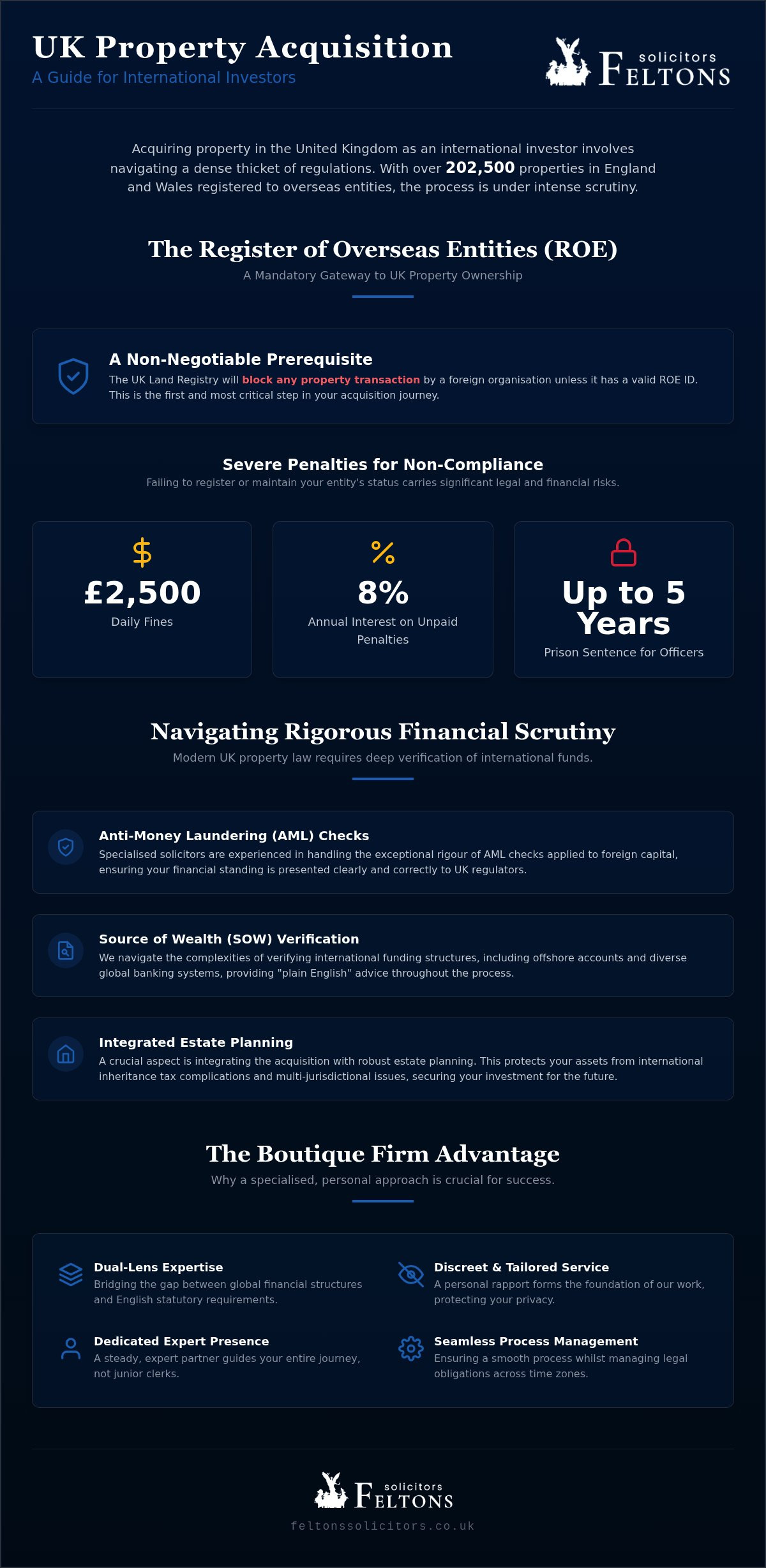
Did you know that failing to update the Register of Overseas Entities can lead to daily fines of up to £2,500 and even criminal prosecution for entity officers? For many global investors, the dream of owning a piece of the UK market can quickly feel overshadowed by a dense thicket of regulatory requirements. You likely recognise that the process involves much more than a simple transaction; it requires managing strict anti-money laundering checks and public registration of beneficial owners across different time zones. Partnering with specialist solicitors for international property buyers ensures these hurdles don’t become roadblocks.

This article provides the clarity you need to master the legal complexities of UK property acquisition. We’ll guide you through the nuances of international conveyancing and the vital steps for overseas entity registration. You’ll learn how to achieve a seamless transaction whilst maintaining full compliance with Companies House and HMRC. By the end, you’ll understand how to secure your assets through proper estate planning and navigate the latest Stamp Duty surcharges. We’ve outlined the path to a secure, successful acquisition that respects both your time and your privacy.

Key Takeaways

  • Understand why the evolving UK regulatory landscape requires specialised knowledge to navigate complex source of wealth and anti-money laundering requirements successfully.
  • Learn about the mandatory Register of Overseas Entities (ROE) and the significant legal risks involved if registration isn’t completed correctly before your transaction.
  • Discover how to integrate your property acquisition with robust estate planning to protect your assets from international inheritance tax complications and multi-jurisdictional issues.
  • Engaging expert solicitors for international property buyers ensures your conveyancing process remains seamless whilst managing legal obligations across different time zones and jurisdictions.
  • Explore the benefits of a discreet, boutique approach that prioritises personal connection and professional integrity throughout your UK investment journey.

Why International Property Buyers Require Specialist UK Solicitors

The UK property market has evolved into a meticulously regulated environment. For non-residents, the acquisition process is no longer a straightforward financial exchange. It’s a complex legal journey. Standard firms often find themselves ill-equipped to handle the specific scrutiny applied to foreign capital. This is where specialist solicitors for international property buyers become indispensable. They don’t just process paperwork; they manage the intricate layers of compliance that define modern property law.

Understanding the UK conveyancing process is fundamental, but for international clients, the legal transfer of ownership is only half the story. Specialist firms bridge the gap between global financial structures and English statutory requirements. Whether you’re acquiring a residential penthouse or a commercial retail unit, your legal representative must possess a dual-lens expertise. Feltons acts as a sophisticated guide, ensuring that every transaction aligns with both current legislation and your long-term investment goals.

Navigating the Regulatory Landscape in 2026

By 2026, Anti-Money Laundering (AML) checks have become exceptionally rigorous. Standard conveyancing firms frequently struggle with international Source of Wealth (SOW) requirements because they lack experience with diverse global banking systems. We provide “plain English” advice to help you manage the following hurdles:

  • Verification of complex international funding structures and offshore accounts
  • Compliance with updated Law Society property information forms (TA6 and TA7)
  • Digital identity verification and electronic signatures across different jurisdictions

This approach combines traditional professional integrity with the modern efficiency required for high-stakes deals. With approximately 202,568 residential properties in England and Wales registered to overseas addresses, the demand for nuanced, expert oversight has never been higher. We ensure that your background and financial standing are presented clearly to satisfy UK regulators without compromising your privacy.

The Advantage of Boutique Legal Representation

Choosing a boutique firm means moving away from the impersonal, high-volume processing found in larger practices. We prioritise a discreet, tailored service where personal rapport is the foundation of our work. You won’t be passed between junior clerks. Instead, you’ll benefit from a steady, expert presence throughout your acquisition journey. This “people-first” philosophy ensures the human impact of your investment is never forgotten. It’s about providing a calm, dependable environment where your privacy is protected and your interests are championed by dedicated solicitors for international property buyers.

The Register of Overseas Entities: A Vital Compliance Step

Compliance with the Register of Overseas Entities (ROE) is no longer a peripheral concern; it’s a mandatory gateway for any foreign organisation wishing to own UK land. Since the implementation of the Economic Crime (Transparency and Enforcement) Act 2022, the Land Registry will not register a transfer of title unless the overseas entity has a valid ROE ID. This requirement adds a significant layer of due diligence that many traditional firms aren’t prepared to handle. Experienced solicitors for international property buyers recognise that securing this registration is the first critical step in any successful acquisition.

Failing to comply with these regulations carries severe penalties. You could face daily fines of up to £2,500, whilst unpaid penalties may attract interest at 8% per annum. In extreme cases of non-compliance, entity officers may face criminal prosecution and prison sentences of up to five years. We act as your steady partner; we ensure that every detail is verified according to The Law Society’s Conveyancing Protocol to protect your investment and your reputation.

Who Must Register as an Overseas Entity?

The Register of Overseas Entities is the mandatory public record for foreign-owned UK land. Any company, partnership, or trust formed outside the UK must register if it holds or intends to acquire property. The process requires identifying the “beneficial owners”—typically individuals who hold more than 25% of the shares or voting rights, or who exercise significant control. Identifying these individuals in multi-layered corporate structures requires a methodical and orderly legal mindset. Our role is to unpick these complexities, ensuring that your registration is accurate and compliant with Companies House standards.

The Verification Process Explained

Verification is the most rigorous part of the process. A regulated UK solicitor must verify the identity of all beneficial owners before the application is submitted. You’ll need to provide original or certified incorporation documents, proof of address, and government-issued identification. This isn’t a one-time task; overseas entities must file an annual update statement every 12 months, due within 14 days of the anniversary of their initial registration. The statutory fee for this update is currently £134.

Managing these deadlines whilst overseeing a global portfolio can be taxing. For a deeper dive into these requirements, you may find our guide on Overseas Entity Beneficial Owner Registration: A Guide for UK Property Owners in 2026 helpful. If you are managing a complex corporate structure, our team can assist with the Registration of Overseas Entities to ensure your purchase remains on track. We provide a calm, discreet service that prioritises your privacy whilst ensuring full transparency where the law demands it.

Strategic Asset Protection and Estate Planning for Non-Residents

Acquiring a UK asset shouldn’t be viewed in isolation. It’s a significant financial commitment that carries immediate implications for your global estate. The standard Inheritance Tax (IHT) rate in the UK is 40% on the value of assets above the nil-rate band of £325,000. This threshold is currently frozen until April 2031. For non-residents, the legal landscape shifted on 6 April 2025 with the introduction of a residency-based system. If you’ve been a UK resident for fewer than 10 of the last 20 tax years, you’re generally only liable for IHT on your UK-situated assets. However, long-term residents may find their worldwide assets under scrutiny. Specialist solicitors for international property buyers provide the discreet guidance necessary to navigate these thresholds whilst protecting your family’s future.

The transparency requirements for these assets have also tightened. As of 31 August 2025, trust information on the Register of Overseas Entities became publicly accessible. This makes it vital to structure your holdings with both compliance and privacy in mind. We act as a sophisticated guide, helping you understand how these public records intersect with your need for confidentiality and secure asset protection.

Wills and Trusts for International Buyers

Relying on a foreign will to cover a UK house is a high-risk strategy. English probate courts often require extensive documentation to validate overseas testamentary documents; this can lead to months of delays and mounting legal costs. A separate UK will, specifically drafted for your local assets, ensures a smoother transition for your heirs. Family trusts also offer a robust layer of security. They can help manage how assets are passed down whilst providing a degree of long-term stability. For a comprehensive look at these strategies, read A Complete Guide to Estate Planning: Protecting Your Legacy in 2026.

Managing Contentious Probate and Disputes

Multi-jurisdictional estates are naturally prone to conflict. Differences in legal systems or family expectations can quickly escalate into formal disputes. Preparing for these possibilities requires a solicitor who is as comfortable with litigation as they are with conveyancing. Feltons manages these sensitive matters with quiet confidence. We prioritise pragmatic advice that seeks to resolve issues before they reach a courtroom. Our “people-first” philosophy means we understand that behind every financial arrangement is a human story. We act as a steady presence, ensuring that your estate is managed with professional integrity and personal rapport. By involving solicitors for international property buyers early, you can build a defensive structure that minimises the risk of future family discord.

Expert Solicitors for International Property Buyers: Navigating the UK Market

The Conveyancing Process: From Instruction to Completion

The instruction phase marks the beginning of a rigorous verification period. Unlike high-volume firms that treat clients as mere file numbers, boutique solicitors for international property buyers prioritise a personal connection from the outset. We meticulously verify your source of funds and overseas identity to satisfy stringent UK anti-money laundering regulations. This methodical approach ensures the transaction rests on a solid legal foundation before you move toward the exchange of contracts. It’s a process that requires patience and precision to avoid the pitfalls of non-compliance.

The exchange of contracts represents the point of no return. For international clients, this stage involves managing legal obligations across different jurisdictions and time zones. Once completion is reached, we handle the intricacies of Stamp Duty Land Tax (SDLT) filings. It’s vital to account for the 2% non-resident surcharge and the 5% additional dwelling surcharge, which increased on 31 October 2024. We then finalise the registration at the Land Registry. This ensures your title is secure and fully compliant with current UK property law, providing you with peace of mind in a complex market.

Residential vs Commercial Conveyancing

Commercial acquisitions often require more extensive due diligence into planning permissions, business rates, and environmental reports than residential purchases. For those investing in residential flats, understanding leasehold enfranchisement and extensions is essential to protecting the long-term value of the asset. Our role is to unpick these nuances, ensuring you aren’t caught out by hidden costs or restrictive covenants. You can find more detail on these processes in our guide to Navigating Residential Property Law: A Comprehensive Guide for UK Homeowners.

Overcoming Common Transactional Hurdles

International bank transfers and currency fluctuations can create significant stress during the final stages of a purchase. We act as a steady, calm presence, liaising directly with property developers and overseas agents to ensure funds arrive exactly when needed. Our communication remains deliberate and reassuringly paced, shielding you from the frantic energy of high-pressure sales environments. If you require expert guidance through these cross-border logistical challenges, our team offers tailored Residential and Commercial Conveyancing services designed specifically for the global investor. We ensure your journey from initial instruction to final completion is as seamless and secure as possible.

Feltons Solicitors LLP operates on a “people-first” principle. Whilst technical legal proficiency is the baseline for any firm, we believe the human impact of a property acquisition is paramount. Our role as solicitors for international property buyers is to act as a calm, steady presence amidst the complexities of the UK market. We provide more than just transactional support; we offer a partnership rooted in high-end reliability and personal rapport. This approach ensures that you aren’t just another file in a high-volume system, but a valued client receiving tailored, boutique care.

Discretion is a cornerstone of our practice. High-net-worth investors and international entities require a level of privacy that larger, factory-style firms often struggle to maintain. We prioritise your confidentiality throughout every stage of the process, from the initial identity checks to the final Land Registry filings. By combining traditional professional integrity with a forward-thinking methodology, we deliver a service that feels both grounded and current. Our pragmatic approach ensures that sound judgment is applied to every cross-border matter, protecting your interests with quiet confidence and poise.

A Tailored Experience for Every Client

We have intentionally moved away from dense, archaic legalese. Instead, we favour a contemporary, “plain English” approach that remains formal and respectful. This ensures you are fully informed without being overwhelmed by inaccessible terminology. Our nationwide expertise serves a diverse global clientele, providing the worldly experience necessary to handle international-scale matters whilst maintaining a deeply rooted commitment to high professional standards. This reliability provides the peace of mind essential for secure asset protection and long-term investment success.

Next Steps: Securing Your UK Property Investment

Beginning the instruction process from abroad doesn’t have to be a source of stress. Early engagement with solicitors for international property buyers is the most effective way to ensure a seamless transition. By involving us before you commit to a purchase, we can advise on the initial due diligence and compliance requirements that often delay transactions. This proactive stance helps avoid the administrative roadblocks and legal hurdles associated with complex cross-border acquisitions.

We invite you to contact Feltons for a confidential consultation regarding your acquisition. Our team is ready to act as your sophisticated guide, ensuring your UK property investment is built on a foundation of legal excellence and personal connection. Whether you are navigating a residential purchase or a complex commercial portfolio, we provide the steady hand and expert insight required to secure your assets with confidence.

Securing Your Future in the UK Property Market

Successfully acquiring property in the UK as an overseas investor requires a delicate balance of financial ambition and legal precision. Success depends on mastering mandatory requirements like the Register of Overseas Entities whilst ensuring your acquisition is supported by robust estate planning. Standard conveyancing is no longer sufficient in a landscape defined by rigorous compliance and shifting tax residency rules. By partnering with specialist solicitors for international property buyers, you ensure that every regulatory hurdle is cleared with poise and professional integrity.

Feltons Solicitors LLP provides the discreet, boutique service high-net-worth individuals require. We offer pragmatic legal advice tailored to the nuances of international jurisdictions, acting as your steady partner through every stage of the process. Our specialist expertise in the Registration of Overseas Entities ensures your portfolio remains compliant and your privacy is respected. Don’t leave your investment to chance in an increasingly transparent world. We invite you to instruct Feltons Solicitors for your international property acquisition today. Your journey toward a secure and successful UK property portfolio starts with a single, informed conversation.

Frequently Asked Questions

Do I need to be in the UK to buy property with a solicitor?

No, you don’t need to be physically present in the UK to complete a purchase. Digital reforms implemented in 2026, including electronic signatures and AI-assisted conveyancing, allow for entirely remote transactions. Your solicitors for international property buyers will manage the process via secure digital platforms. You’ll need to provide verified identification from your home jurisdiction, but the actual transfer of title is handled electronically through the Land Registry.

What is the Register of Overseas Entities and does it apply to me?

The Register of Overseas Entities is a mandatory public record for foreign companies and trusts owning UK land. It applies if you intend to buy property through an offshore entity. Failure to register results in daily fines of up to £2,500 and prevents the Land Registry from transferring the property title. We specialise in this registration, ensuring your beneficial owners are correctly identified and verified according to the latest statutory requirements.

How long does the conveyancing process take for international buyers?

While a standard transaction might take 8 to 12 weeks, international buyers should prepare for a longer timeline. The additional layers of due diligence, such as verifying overseas source of wealth and completing ROE registration, can add several weeks to the process. We provide a steady, methodical flow to keep the transaction moving, but time zone differences and cross-border bank transfers naturally require more deliberate coordination than domestic deals.

Can I buy UK property through an offshore company or trust?

Yes, you can acquire property through an offshore company or trust provided you comply with transparency laws. You must register with Companies House as an overseas entity before the purchase completes. This involves disclosing beneficial owners who exercise significant control. As specialist solicitors for international property buyers, we guide you through these requirements, ensuring your corporate structure remains compliant whilst protecting your assets through proper legal oversight and discreet management.

What are the Stamp Duty (SDLT) implications for non-UK residents?

Non-UK residents face specific Stamp Duty Land Tax surcharges that significantly impact the total cost of acquisition. A 2% surcharge applies to all residential purchases by non-residents. Additionally, if you already own property elsewhere, a 5% surcharge for additional dwellings applies, which was increased on 31 October 2024. These are cumulative, meaning an overseas buyer of a second home could pay 7% above the standard residential rates, making early financial planning essential.

Do I need a UK will if I only own one property in the country?

Yes, a UK will is strongly recommended even for a single property to avoid complex legal hurdles. Relying on a foreign will often leads to probate disputes and significant delays in the English courts. A dedicated UK will ensures your property passes to your heirs efficiently and can help manage Inheritance Tax liabilities. Our estate planning services provide a discreet way to secure your legacy and avoid the pitfalls of multi-jurisdictional inheritance issues.

How do solicitors verify my source of wealth from abroad?

Solicitors verify your wealth through a combination of bank statements, certified identification, and documents proving the origin of your capital. This might include evidence of a business sale, inheritance, or investment dividends. We use secure digital verification tools to streamline this process. Our approach is pragmatic and thorough, ensuring we meet strict anti-money laundering regulations whilst respecting your privacy and providing a high standard of personal connection during the verification phase.

What is the difference between residential and commercial property law for investors?

Residential law focuses on individual rights, leasehold enfranchisement, and extensions, whereas commercial property law involves more complex due diligence. Commercial transactions require detailed investigations into planning permissions, business rates, and environmental liabilities. Investors must also consider different VAT implications and structural requirements for commercial units. We offer comprehensive support across both sectors, helping you understand the specific legal obligations and asset protection strategies relevant to your chosen investment class.