

Buying UK Commercial Property: Overseas Entity Guide 2026

Buying UK Commercial Property: Overseas Entity Guide 2026

In 2026, the Register of Overseas Entities is no longer a hurdle; it is the foundation of the UK commercial conveyancing process. You likely recognise that the landscape for a commercial property purchase by overseas entity uk has shifted, placing transparency at the heart of every transaction. It’s natural to feel a sense of unease regarding the stringent disclosure of beneficial ownership or the threat of severe penalties for administrative oversights. These concerns are valid, as a single delay in verification can stall a high-value acquisition indefinitely.

We’re here to provide a steady hand through this process, offering the expert legal guidance you need to secure your investment with confidence. This guide provides a clear roadmap for your acquisition, ensuring you meet every requirement of the Register of Overseas Entities. We’ll walk you through the latest reporting standards, the annual update statement cycle, and the practical steps required to achieve a completion that is entirely free from regulatory friction. You’ll gain the clarity necessary to manage your international portfolio whilst maintaining total compliance with Companies House.

Key Takeaways

  • Understand how the Economic Crime (Transparency and Enforcement) Act 2022 has made transparency the central pillar of the UK property market.
  • Gain clarity on the 25% control tests used to define beneficial owners, ensuring your entity meets all mandatory disclosure requirements without delay.
  • Discover how to structure your commercial property purchase by overseas entity uk to balance tax efficiency with regulatory ease.
  • Follow a methodical five-step roadmap for conveyancing that integrates Register of Overseas Entities verification into the heart of the legal process.
  • Recognise the value of bespoke legal support in avoiding the administrative friction and heavy penalties associated with non-compliance.

The Regulatory Landscape: Buying UK Commercial Property in 2026

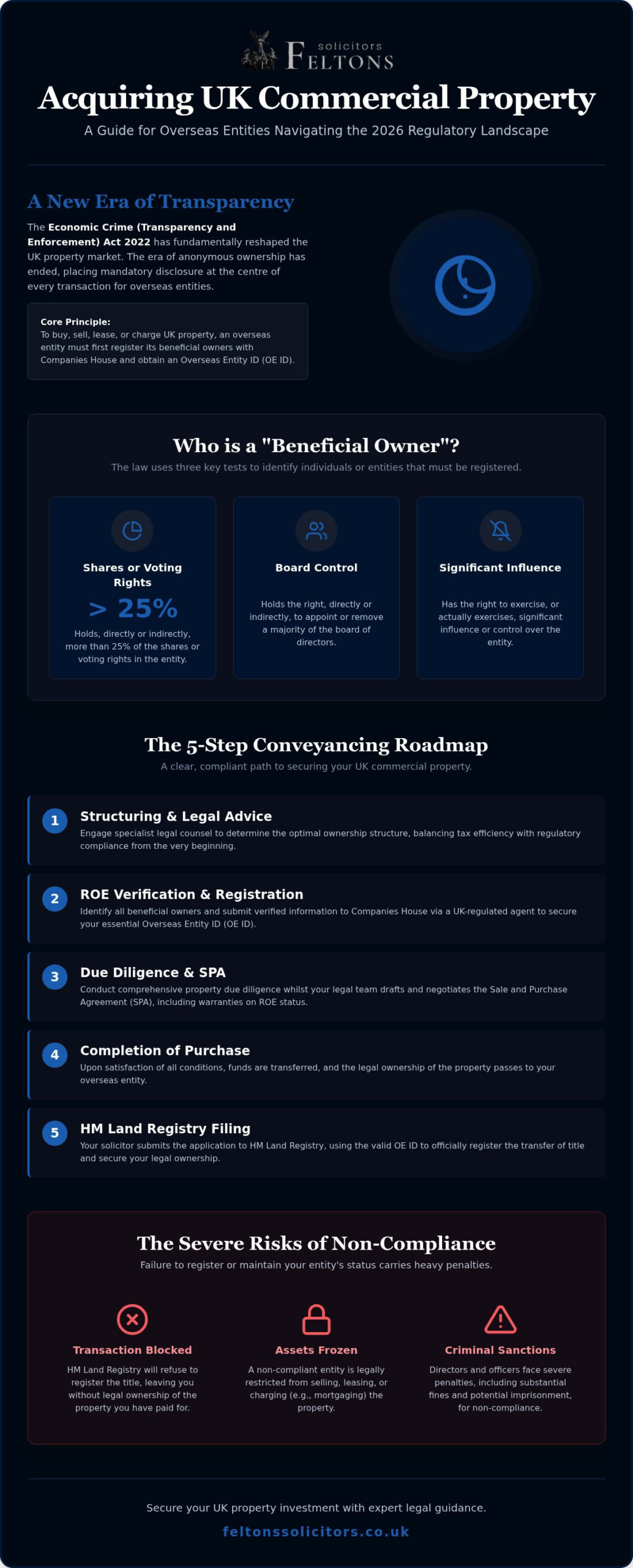
The introduction of the Economic Crime (Transparency and Enforcement) Act 2022 fundamentally altered how international investors approach the UK market. By 2026, the era of anonymous property ownership has effectively ended. Every commercial property purchase by overseas entity uk now begins with a rigorous compliance check, as the legislation serves as a robust gatekeeper for the nation’s real estate assets. HM Land Registry acts as the final enforcement point. They’ll simply refuse to register the transfer of title if the purchasing entity hasn’t secured a valid Overseas Entity ID before completion.

The Shift Towards Transparency

The UK has meticulously organised its property laws to prioritise transparency and deter illicit finance. This shift means that corporate structures once favoured for their privacy are now subject to intense scrutiny. To participate in the market, overseas entities must disclose their “Beneficial Owners” to Companies House. This isn’t a mere administrative formality; it’s a mandatory requirement to ensure that the ultimate individuals in control are identifiable. Investors who embrace this “clean” approach often find that their transactions proceed with greater efficiency, whilst those who ignore the requirements face immediate roadblocks. Lenders and sellers are increasingly wary of opaque ownership chains that might trigger money laundering concerns.

Consequences of Non-Compliance

Failing to adhere to these regulations carries risks that extend far beyond simple transaction delays. Without a verified registration, an entity cannot legally register its ownership at HM Land Registry. This leaves the buyer in a precarious position where they’ve paid for a property but don’t hold the legal title. For any commercial property purchase by overseas entity uk, the lack of an OE ID is a terminal flaw in the conveyancing process. Additionally, the legal framework imposes strict restrictions on future dealings. A non-compliant entity will find it impossible to lease, charge, or sell the asset. Perhaps most significantly, directors and officers of the entity may face criminal sanctions, including heavy fines or even imprisonment, if they knowingly provide false information or fail to update the register annually.

Given these complexities, seeking specialist legal advice before signing a Sale and Purchase Agreement (SPA) is essential. A well-drafted SPA should include specific warranties regarding the entity’s status on the Register of Overseas Entities to protect your interests from the outset. Early preparation ensures that the path to completion remains clear and that your investment is protected by a solid legal foundation.

The Register of Overseas Entities (ROE): A Mandatory First Step

The Register of Overseas Entities is a public register managed by Companies House that records the details of foreign-domiciled owners of UK land. It’s a non-negotiable part of any commercial property purchase by overseas entity uk. An Overseas Entity ID (OE ID) is the unique 10-digit code required for all Land Registry filings to prove the entity is compliant. Without this identifier, your transaction cannot legally proceed to completion. The register ensures that the true owners behind corporate veils are identifiable, creating a more transparent environment for high-value investments.

Identifying a “Beneficial Owner” is the core of the registration process. Usually, this refers to any individual or legal entity that holds more than 25% of the shares or voting rights in the overseas company. However, the law also applies control tests. If an individual has the power to appoint or remove a majority of the board of directors, or otherwise exercises significant influence, they’re a beneficial owner regardless of their shareholding percentage. Identifying these individuals accurately is the first step in building a compliant acquisition structure.

The Verification Process Explained

Accuracy is paramount when submitting data to the register. A UK-regulated agent, such as a solicitor, must verify the information before it’s formally submitted. This involves a methodical review of international corporate documents, which often requires certified translations or apostilles to meet UK standards. When dealing with trusts or complex layering in offshore structures, the verification becomes significantly more intricate. We examine the entire chain of ownership to ensure every registrable person is correctly identified, providing a sense of security for our clients whilst satisfying the stringent requirements of the Economic Crime Act.

Maintaining Your OE ID

Registration isn’t a one-off event. You must file an update statement every 12 months, even if your beneficial ownership remains unchanged. This 12-month update cycle is critical for ongoing property management. A lapsed OE ID can freeze your ability to deal with the asset, preventing you from selling or charging the property. If a change in ownership occurs whilst a transaction is mid-flight, the register must be updated within 14 days of the anniversary of the initial registration to avoid administrative friction.

Managing these statutory requirements requires a professional and methodical approach. Feltons Solicitors LLP provides dedicated support for overseas entity beneficial owner registration, ensuring your filings are precise and timely. If you’re concerned about meeting these deadlines or navigating the verification process, our team can act as your trusted legal partner to maintain your entity’s standing and protect your investment.

Structuring Your UK Commercial Property Acquisition

Choosing the right vehicle for a commercial property purchase by overseas entity uk is a decision that balances tax efficiency against administrative ease. Whilst offshore structures in jurisdictions like the British Virgin Islands (BVI) or Jersey remain common, the regulatory tide is turning. Your choice of entity doesn’t just affect your tax profile; it dictates your ability to secure UK debt finance. Many domestic lenders prefer the familiarity of a UK-incorporated subsidiary. It simplifies their own due diligence and security requirements, often leading to more favourable lending terms.

Offshore Entities vs UK SPVs

Using an offshore entity from a jurisdiction like the Isle of Man can offer specific tax advantages, yet it comes with a heavier administrative burden. You’ll often need formal legal opinions from counsel in that jurisdiction to satisfy UK lenders or HM Land Registry. This adds cost and time to the transaction. Conversely, a UK-resident Special Purpose Vehicle (SPV) is often more straightforward to manage. Foreign directors should also consider their legal liability. Whilst a corporate veil exists, UK law can occasionally look through it in cases of environmental breach or health and safety failures. A UK subsidiary can act as a useful buffer for international parents.

Stamp Duty Land Tax (SDLT) and VAT Considerations

The tax landscape for international investors is nuanced. Whilst the 2% non-resident SDLT surcharge primarily targets residential assets, it can impact mixed-use properties or commercial-residential hybrids. You must also account for the Annual Tax on Enveloped Dwellings (ATED) if your commercial acquisition includes high-value residential elements. VAT is another critical factor. If a seller has “opted to tax” the property, the purchase price effectively increases by 20% upfront. Whilst you can often recover this, it creates a significant cash flow requirement that must be managed during the commercial property purchase by overseas entity uk.

Deciding on the right structure requires a methodical look at your long-term goals. We often advise clients to weigh the merits of commercial property law: buying vs leasing before committing to a specific corporate vehicle. A bespoke approach ensures that your structure remains robust against future regulatory shifts. It provides the security and flexibility needed for sophisticated international portfolio management.
Buying UK Commercial Property: Overseas Entity Guide 2026

The 5-Step Conveyancing Journey for Overseas Entities

Successfully managing a commercial property purchase by overseas entity uk requires more than just capital; it demands a synchronised legal strategy. By 2026, the Register of Overseas Entities (ROE) isn’t a separate administrative task but a core component of the conveyancing timeline. If these steps aren’t perfectly aligned, you risk significant transaction delays or, in the worst cases, a total collapse of the deal. We guide our clients through a methodical five-step process to ensure a smooth transition from offer to ownership.

  • Step 1: Pre-contract due diligence and ROE verification. Before any formal commitment, we verify your entity’s status and ensure your OE ID is active and updated.
  • Step 2: Drafting the contract and negotiating the Sale and Purchase Agreement (SPA). We negotiate specific clauses that protect international buyers, particularly regarding warranties for ROE compliance.
  • Step 3: Exchange of contracts and payment of the deposit. This is the point of no return. We manage the secure transfer of the 10% deposit, ensuring funds are held safely in a client account.
  • Step 4: Pre-completion checks. We perform final anti-money laundering (AML) updates and ensure the seller’s ROE status is also valid, preventing any blocks at the Land Registry.
  • Step 5: Completion and registration. Funds are transferred, and we submit the application to HM Land Registry using your unique 10-digit OE ID.

Enhanced Due Diligence and AML

Overseas entities are subject to “Enhanced Due Diligence” under UK law. This means your legal team must go beyond simple identity checks. You’ll need to provide clear documentation regarding your Source of Wealth (SoW) and Source of Funds (SoF). These protocols are designed to confirm that the capital used for the commercial property purchase by overseas entity uk is legitimate and transparent. In 2026, “Know Your Customer” (KYC) requirements are more rigorous than ever, often requiring detailed histories of corporate earnings or investment returns. Preparing this documentation early prevents the “compliance bottleneck” that often stalls international transactions.

Navigating the Completion Process

The final stages of a cross-border transaction involve unique logistical challenges. Coordinating international bank transfers requires precision to account for currency fluctuations and varying time zones. Furthermore, the execution of legal deeds whilst overseas remains a point of detail; whilst digital signatures are increasingly accepted, some documents still require “wet-ink” signatures witnessed by a notary. It’s often beneficial to work with a residential property law firm with deep commercial expertise to handle these nuances. They can bridge the gap between high-standard international service and the practical realities of UK property law.

If you’re planning an acquisition, our specialist commercial conveyancing team is ready to provide the discreet, high-standard support your transaction deserves. Contact us to ensure your next investment is handled with the poise and technical precision it requires.

In 2026, the complexity of a commercial property purchase by overseas entity uk means that standard legal support is often insufficient. International investors require a partner who understands the high stakes of cross-border acquisitions and the rigorous demands of the Economic Crime Act. At Feltons Solicitors LLP, we position ourselves as a calm, steady presence in the face of these stresses. We recognise that whilst the technical legal work is paramount, the human impact of these transactions is never forgotten. Our approach is designed to provide you with high-end reliability and the quiet confidence that your investment is secure.

Mitigating the risk of transaction collapse is our primary objective. A single administrative oversight in beneficial ownership disclosure or a lapsed OE ID can lead to immediate blocks at HM Land Registry. These errors don’t just delay completions; they can lead to heavy financial penalties and reputational damage. By choosing a specialist firm, you ensure that every detail is scrutinised by experts who handle these complex verification services daily. We manage the intricate due diligence required for international corporate documents, ensuring your path to completion remains clear of regulatory friction.

Discreet and Tailored Service

We believe that high-standard international service should feel personal. As a boutique firm, we prioritise personal connection over high-volume processing, acting as a sophisticated guide through the UK legal market. This allows us to provide pragmatic advice that is tailored to your specific portfolio goals. Whether you are a first-time investor or managing a large commercial estate, we offer the same level of discreet, high-standard care. This commitment to excellence extends across our firm, from our conveyancing team to our leasehold enfranchisement experts, ensuring your property rights are always protected.

Contact Feltons Solicitors LLP for International Acquisitions

Beginning your verification and conveyancing process early is the most effective way to ensure a successful acquisition. We’re ready to assist with your initial registration on the Register of Overseas Entities and manage the entire conveyancing journey on your behalf. Our team bridges traditional professional integrity with modern efficiency to deliver results that respect your time and your capital. To take the first step towards a frictionless completion, secure your UK commercial investment with Feltons Solicitors LLP today. Let us act as your trusted advisor in the UK property market.

Securing Your UK Investment with Confidence

The shift towards total transparency in the UK property market represents a significant evolution, yet it should not deter sophisticated international capital. As we’ve discussed, the key to a successful commercial property purchase by overseas entity uk lies in the early alignment of corporate structuring and ROE verification. By addressing the nuances of beneficial ownership and the specifics of the five-step conveyancing journey, investors can avoid the pitfalls of transaction delays and regulatory penalties. The goal is to transform these statutory requirements from a hurdle into a standard, efficient part of your portfolio management.

At Feltons Solicitors LLP, we provide the calm, steady guidance necessary to handle these high-value matters with precision. Our firm operates as a discreet partner, bridging modern efficiency with a deep respect for professional integrity and personal rapport. We invite you to speak with our specialist commercial conveyancing team today to ensure your next acquisition is managed with the boutique-level care it deserves. Together, we can secure your position in the UK market with absolute confidence.

Frequently Asked Questions

Can an overseas company still buy property in the UK after the 2022 Act?

Yes, overseas companies can continue to invest in the UK market. The Economic Crime (Transparency and Enforcement) Act 2022 didn’t ban foreign ownership; it simply introduced a mandatory registration requirement. To complete a commercial property purchase by overseas entity uk, the buyer must obtain a valid Overseas Entity ID from Companies House. This identifier proves the entity has disclosed its beneficial owners, allowing the Land Registry to process the transfer of title without legal obstruction.

How long does it take to register an overseas entity with Companies House?

Registration typically takes a few working days once Companies House receives the application. However, the pre-submission phase often takes longer. A UK-regulated agent must first verify all beneficial ownership details, which involves reviewing international corporate documents and identity records. Depending on the complexity of your offshore structure and the speed of document retrieval, the entire process from initial instruction to receiving your OE ID usually spans several weeks. Early preparation is essential for maintaining transaction timelines.

What happens if an overseas entity fails to update its beneficial owner information?

Failing to file an annual update statement has severe consequences for your investment. Your Overseas Entity ID will become invalid, which effectively freezes your ability to deal with the property. You won’t be able to sell, lease, or charge the asset until the register is corrected. Additionally, the entity and its officers may face daily fines. For any commercial property purchase by overseas entity uk, maintaining an active registration is a critical ongoing compliance duty.

Do I need a UK bank account to buy commercial property as a foreign entity?

You aren’t legally required to hold a UK bank account to buy commercial property, but it’s practically indispensable. Whilst you can often transfer purchase funds from abroad, you’ll need a domestic account to manage rental income, pay UK taxes, and handle utility bills or service charges. Many international investors find that setting up a UK-resident Special Purpose Vehicle (SPV) makes opening a domestic account significantly easier than doing so for a foreign-domiciled company.

Is the Register of Overseas Entities information available to the public?

Yes, most information on the Register of Overseas Entities is accessible to the public. Anyone can search Companies House to view the names of beneficial owners and the entity’s registration details. Certain sensitive information, such as home addresses or full dates of birth, remains protected from public view. This transparency is a central pillar of the 2022 Act, designed to ensure that the ultimate individuals in control of UK land are identifiable to the public.

How much does the ROE verification process cost for a foreign company?

The cost of the verification process varies based on the complexity of your corporate structure. Companies House charges a fixed registration fee of £100 and an annual update fee of £120. Beyond these government charges, you’ll also incur professional fees for the mandatory verification services provided by a UK-regulated agent. These fees reflect the rigorous due diligence required to examine international deeds, trust documents, and shareholder registers to ensure total accuracy before submission.

Can I use an overseas entity to buy residential property as well as commercial?

Overseas entities can buy both commercial and residential property in the UK. However, the tax regimes differ significantly. Residential acquisitions trigger a 2% non-resident SDLT surcharge, which does not apply to non-residential commercial assets. You may also face the Annual Tax on Enveloped Dwellings (ATED) for high-value homes. Regardless of the property type, the requirement to register with Companies House remains mandatory for any foreign-domiciled legal entity owning UK land.

What are the penalties for providing false information to the Register of Overseas Entities?

Providing false or misleading information to the register is a serious criminal offence. If an individual or entity knowingly submits incorrect data, they face significant penalties under the Economic Crime Act. This includes potential unlimited fines and criminal prosecution for both the entity and its officers. The UK government uses these stringent measures to maintain the integrity of the register, ensuring that all disclosures regarding beneficial ownership are both honest and verifiable.

Personal Injury Solicitors: A Guide to Specialist Legal Support in 2026

Personal Injury Solicitors: A Guide to Specialist Legal Support in 2026

In an era of automated portals and high-volume legal processing, the true value of a claim isn’t found in a software algorithm. It’s found in the hands of a specialist who understands the human cost of an accident. Choosing the right personal injury solicitors is no longer just about finding a firm to fill out forms; it’s about securing a partner who treats your recovery with the same professional integrity you’d expect from a trusted advisor.

It’s natural to feel a sense of trepidation when facing the UK court system. You might be concerned about hidden legal fees or feel frustrated by impersonal “claims factories” that lack a human touch. We understand that you want more than just a settlement; you want the peace of mind that comes from knowing your future is protected. This guide will help you navigate these complexities with pragmatic, expert advice tailored to your long-term recovery. We’ll provide a clear, jargon-free overview of the current legal landscape, including the 2026 whiplash tariff levels and the nuances of the intermediate track, so you can move forward with absolute confidence.

Key Takeaways

  • Understand why specialist personal injury solicitors are vital for navigating the nuances of duty of care and securing settlements for life-altering injuries.
  • Explore the complexities of occupational health claims, specifically focusing on the technical expertise required for silicosis and workplace accident litigation.
  • Learn how to identify a trusted advisor by prioritising pragmatic judgement and professional integrity over the impersonal approach of high-volume firms.
  • Navigate the procedural framework of a claim, including the importance of the three-year limitation period and the structure of “No Win No Fee” agreements.
  • Discover the distinction between general and special damages to ensure your final settlement supports your long-term recovery and financial stability.

Understanding the Role of Specialist Personal Injury Solicitors

Personal injury law serves as a vital safeguard within the UK legal system, ensuring that individuals who suffer harm due to another’s negligence can seek redress. At its heart lies the concept of a “duty of care”. This is a legal obligation requiring individuals and organisations to act in a way that avoids causing foreseeable harm to others. When this duty is breached, personal injury solicitors step in to bridge the gap between a traumatic event and a sustainable recovery.

For those facing life-altering injuries, the support of a specialist isn’t a luxury; it’s a necessity. Insurance companies often employ sophisticated tactics to minimise payouts or expedite settlements before the full extent of an injury is known. A dedicated solicitor acts as a discreet shield, protecting your rights and ensuring that any settlement accounts for future rehabilitation needs. Understanding What is a Personal Injury Solicitor? helps clarify that their role extends far beyond paperwork; they’re expert advocates who navigate the tension between legal requirements and human recovery.

The Legal Basis for a Compensation Claim

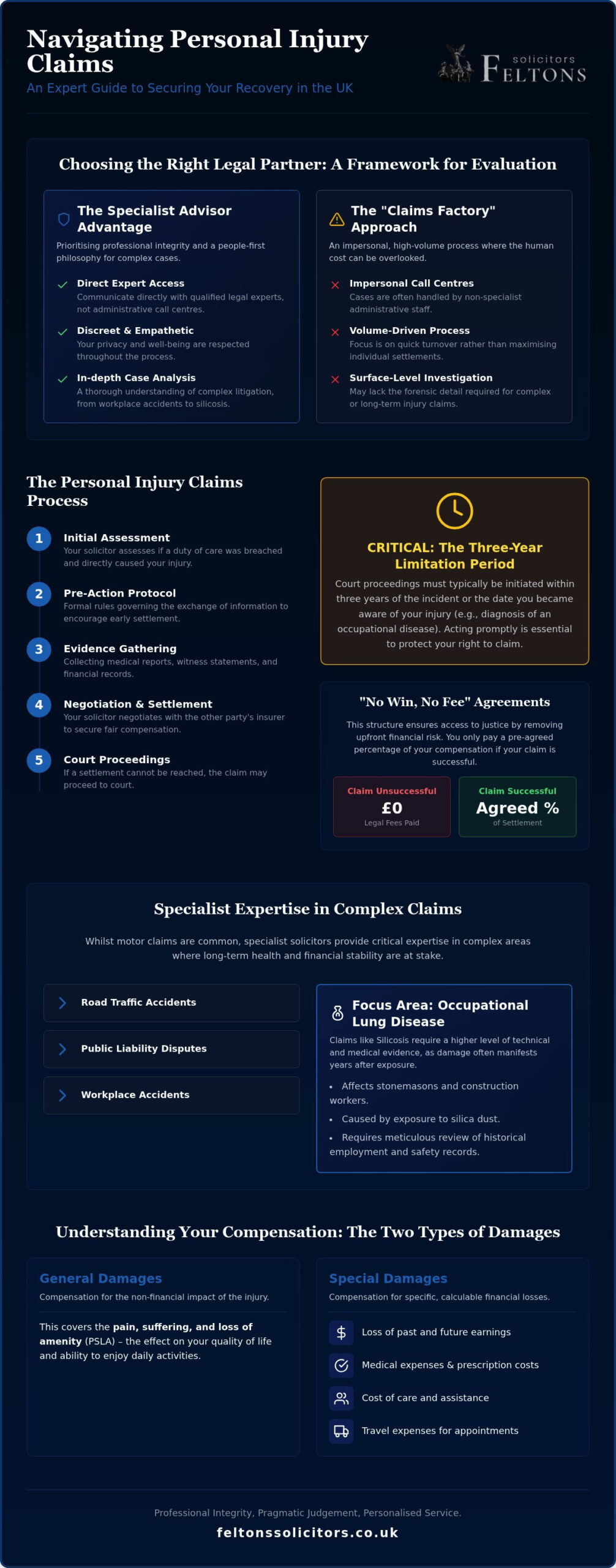
To succeed in a claim, you must prove that a duty of care existed, that it was breached, and that this breach directly caused your injuries. This process is governed by the Pre-Action Protocol, a set of procedural rules designed to encourage the exchange of information and early settlement without the need for court proceedings. Expert personal injury solicitors will assess the merits of your case by examining medical evidence and witness statements, providing a pragmatic view on the strength of your claim from the outset.

Boutique Service vs High-Volume Claims Factories

The rise of high-volume “claims factories” has led to an impersonal approach where cases are treated as numbers on a spreadsheet. In contrast, a boutique firm like Feltons Solicitors LLP prioritises a personal connection. Since our establishment in 2010, we’ve focused on a people-first philosophy that values traditional professional integrity alongside modern efficiency. This tailored approach offers several distinct advantages:

  • Direct access to qualified legal experts rather than administrative call centres.
  • Discreet and empathetic communication that respects your privacy.
  • A thorough understanding of complex litigation, including specialist areas like silicosis claims.

Choosing a boutique partner ensures that the human impact of your injury remains the central focus of the litigation process. We believe that professional authority and empathetic reassurance shouldn’t be mutually exclusive.

Personal injury claims cover a broad spectrum, ranging from road traffic incidents to public liability disputes. Whilst motor-related claims remain the most frequent, with 300,867 cases registered in the 2025/26 period, the legal landscape is shifting towards more intricate matters. Workplace accidents, particularly those involving long-term health implications, require a level of forensic detail that high-volume firms often overlook. Expert personal injury solicitors must look beyond the immediate event to consider the cumulative impact of an injury on a client’s life and livelihood.

Occupational lung disease litigation has become a critical area of focus in recent years. The law provides clear protections for workers exposed to hazardous substances, yet many remain vulnerable to outdated safety practices. Proving a breach of duty in these scenarios involves a meticulous review of historical employment records and safety protocols. It’s about establishing exactly where the failure occurred and how it could’ve been prevented through proper ventilation or protective equipment. This depth of investigation is what separates specialist support from generic legal services.

Specialist Expertise in Silicosis Claims

Identifying the symptoms of silica dust exposure, such as persistent coughing and progressive breathlessness, is often the first step in a long journey toward justice. Silicosis is a devastating condition that primarily affects stone masons and construction workers, particularly those working with engineered stone. These claims require a higher level of technical and medical evidence because the damage often manifests years after the initial exposure. Our team understands the nuances of these disputes and the emotional toll they take on families. For those who’ve lost a loved one to this condition, our silicosis claim after death guide offers a supportive framework for navigating the legal aftermath of a bereavement.

Serious and Catastrophic Injury Litigation

When an accident results in brain or spinal injuries, the litigation process becomes exponentially more complex. These high-value claims aren’t just about immediate pain; they’re about lifetime care, specialised equipment, and significant lost earnings. We frequently engage medical witnesses and forensic accountants to quantify the true, long-term cost of your recovery. Securing interim payments is a priority in these cases. These early funds allow you to access private rehabilitation and home modifications whilst the final settlement is still being negotiated. If you’re managing the aftermath of a serious incident, speaking with experienced personal injury solicitors can provide the pragmatic advice needed to secure your future.

Selecting the right personal injury solicitors is a decision that impacts both the legal outcome of your case and your emotional well-being throughout the process. It’s essential to distinguish between a boutique law firm and a claims management company. Whilst a management company often acts as a high-volume intermediary, a specialist firm provides direct access to qualified legal experts who handle your case from instruction to settlement. Look for practitioners who demonstrate a blend of experience, empathy, and pragmatic judgement. Accreditation from the Association of Personal Injury Lawyers (APIL) serves as a vital benchmark, indicating a commitment to the highest standards of victim representation and ongoing professional development.

Questions to Ask During Your Initial Consultation

Preparation is key to ensuring a solicitor aligns with your specific needs. During your first meeting, focus on the practicalities of your representation rather than just the potential settlement figure. Ask specifically: “Who will actually be handling my day-to-day case work?” In high-volume firms, your file might be passed amongst junior clerks; in a boutique environment, you should expect a senior advisor to lead the process. Inquire about their direct experience with your specific injury or occupational illness, especially for complex matters like silicosis. Finally, confirm how they organise their communication. You deserve a partner who provides regular, jargon-free updates rather than one who leaves you waiting for news.

Understanding the Financial Side of Your Claim

Financial anxiety shouldn’t prevent you from seeking justice. Most personal injury solicitors operate on a “No Win No Fee” basis, formally known as a Conditional Fee Agreement (CFA). This structure effectively eliminates upfront financial risk. If the claim is unsuccessful, you don’t pay your solicitor’s fees. To provide total security, your solicitor will often arrange After the Event (ATE) insurance. This policy protects you against the risk of having to pay the defendant’s legal costs or disbursements, such as court fees and medical report costs, if the case doesn’t succeed.

Transparency regarding success fees is paramount for building trust. As of 2026, the success fee a solicitor can deduct from your compensation is capped at 25% of the damages awarded for pain, suffering, and past financial losses. It’s important to understand that this cap doesn’t apply to compensation for future losses, such as long-term care or future loss of earnings. A trusted advisor will provide a clear, written breakdown of these costs at the outset. This methodical approach ensures there are no hidden surprises, allowing you to focus on your recovery whilst your legal team manages the technical complexities of the litigation.

Personal Injury Solicitors: A Guide to Specialist Legal Support in 2026

The Personal Injury Claims Process: A Step-by-Step Framework

The journey toward compensation is governed by strict procedural milestones designed to ensure fairness for all parties. Time is a critical factor. For most UK claims, the law imposes a three-year limitation period from the date of the accident or the date you first became aware of your injury. Missing this window usually prevents any legal action, so seeking advice early is paramount. Once you instruct personal injury solicitors, the process begins with a thorough initial assessment to establish the merits of your case and formalise the “No Win No Fee” agreement.

Following the initial instruction, your legal team moves into the evidence-gathering phase. This involves securing medical records, taking witness statements, and, where necessary, obtaining police reports. Once a robust case is built, a formal Letter of Claim is sent to the defendant. They typically have a fixed period of up to three months to investigate and respond regarding liability. This stage determines whether the case moves toward a negotiated settlement or requires more formal litigation to resolve disputes over who was at fault.

The Critical Importance of Evidence

Success in personal injury litigation relies on the quality of the documentation provided. It’s essential to record every detail of how the injury has affected your daily life. This includes keeping a diary of symptoms and a folder of receipts for “Special Damages”. These are the quantifiable financial losses you’ve incurred, such as:

  • Travel expenses to and from medical appointments.
  • The cost of private physiotherapy or specialist rehabilitation.
  • Loss of earnings, including future pension contributions.
  • Care and assistance provided by family members.

Independent medical experts play a pivotal role here. They provide the objective valuations that solicitors use to calculate “General Damages”, which compensate for your pain, suffering, and loss of amenity.

Will My Case Go to Court?

The prospect of a court hearing often causes significant anxiety for claimants. However, the vast majority of personal injury cases are settled through negotiation or Alternative Dispute Resolution (ADR) before they ever reach a courtroom. Modern litigation is designed to encourage early settlement, as this reduces costs and provides a faster resolution for the injured party. If a settlement cannot be reached, your solicitor will handle all the technical preparations for a hearing, ensuring you feel supported and fully briefed at every stage. If you’re ready to begin this process with a trusted advisor, contact our personal injury solicitors to discuss your next steps.

Securing Your Future: Pragmatic Settlements and Long-term Recovery

The resolution of a claim is not merely the end of a legal process; it’s the commencement of your long-term recovery. The central tenet of personal injury law is the principle of restitutio in integrum, which involves placing you back in the position you would’ve enjoyed had the accident never occurred. Whilst no amount of money can undo a physical injury, a carefully structured settlement provides the financial foundation for a dignified life. Experienced personal injury solicitors focus on pragmatic outcomes rather than merely chasing unrealistic figures that may lead to protracted and risky court battles.

Pragmatic advice is often the most valuable asset a solicitor can provide at this stage. Some firms might focus on inflated settlement estimates to secure instructions, but a trusted advisor prioritises a realistic assessment. This ensures your immediate needs and future security are met without unnecessary risk. This balanced approach allows you to move forward with a settlement that is both fair and sustainable, providing the peace of mind you need to focus on rehabilitation.

Calculating the Real Value of Your Claim

Valuing a case involves a detailed analysis of two distinct categories of damages. General Damages compensate for non-financial impacts, specifically pain, suffering, and loss of amenity (PSLA). This assessment is based on medical evidence and judicial guidelines to reflect the severity of the injury. Special Damages, however, address the quantifiable financial losses. Personal injury solicitors must meticulously account for several factors:

  • Past and future loss of earnings, including lost pension contributions and promotion prospects.
  • The cost of “gratuitous care” provided by family members during your recovery.
  • Loss of ability to perform household tasks, such as gardening or DIY, which may now require paid assistance.
  • Travel expenses and the cost of specialised medical equipment or home modifications.

In serious cases, the calculation of future losses is influenced by the Ogden Discount Rate, which was adjusted to +0.5% in January 2025. This change impacts how lump-sum payments are structured to ensure they last a lifetime, making expert legal guidance more critical than ever.

A Holistic Approach to Legal Care

A successful settlement often brings new responsibilities, particularly regarding the management of significant funds. It’s often vital for claimants to consider expert estate planning to protect their compensation for the long term. This might involve the creation of a Personal Injury Trust, which can help ring-fence settlement funds so they don’t affect your eligibility for means-tested benefits.

At Feltons, we view our role as more than just litigation. We provide a steady, reassuring presence, ensuring that your legal strategy aligns with your broader life goals. By integrating technical legal skill with a people-first philosophy, we help you secure a future that is defined by your resilience rather than your injury. Our commitment to discreet, high-standard service ensures that you’re supported every step of the way.

Restoring Your Quality of Life through Expert Advocacy

Navigating the aftermath of a serious injury requires more than just technical legal knowledge; it demands a partnership built on trust and professional integrity. We’ve explored how specialist personal injury solicitors provide the essential expertise necessary for complex litigation, particularly in niche areas like silicosis and occupational disease. By choosing a boutique firm, you ensure that your recovery is managed with a “people-first” philosophy, where pragmatic advice takes precedence over the impersonal approach of high-volume claims firms. Understanding the nuances of the claims process allows you to approach your future with a sense of security and control.

Our team offers a steady, reassuring presence to guide you through every stage of your claim. As specialist silicosis litigation experts, we provide a partner-led boutique service that prioritises your privacy and long-term well-being. We’re committed to delivering pragmatic, jargon-free legal advice tailored to your specific circumstances and recovery goals. Please contact Feltons Solicitors for a discreet consultation on your personal injury claim. Your journey toward a sustainable recovery begins with a single, confident step toward securing the support you deserve.

Frequently Asked Questions

What is the time limit for making a personal injury claim in the UK?

The standard limitation period for starting a claim is three years from the date of the accident. If your injury or illness developed over time, such as silicosis, this three-year window begins from the “date of knowledge” when you first realised your condition was linked to your work. It’s vital to seek legal advice early to ensure all evidence is preserved and your right to seek redress is protected.

How much will it cost me to hire a personal injury solicitor?

Most personal injury solicitors operate on a “No Win No Fee” basis, meaning there are no upfront costs to pay. If your claim is successful, your solicitor will deduct a success fee from your compensation. By law, this is capped at 25% of the damages awarded for your pain, suffering, and past financial losses. If the claim doesn’t succeed, you generally won’t owe any legal fees to your solicitor.

Can I claim compensation if the accident was partly my fault?

Yes, you can still pursue a claim even if you were partially responsible for the incident. This is known as “contributory negligence”. In these cases, the court or insurance company will assign a percentage of fault to each party. Your final compensation award will then be reduced by that same percentage. For example, if you were 25% at fault, you’d receive 75% of the total damages calculated for your claim.

How long does a typical personal injury claim take to settle?

The duration of a claim depends heavily on its complexity and whether the defendant admits liability. Straightforward road traffic claims might settle within nine to twelve months. However, complex litigation involving serious injuries or occupational lung diseases can take significantly longer, often between eighteen months and three years. This extra time ensures that the full long-term impact of your injury is medically understood before a final settlement is reached.

What is the difference between a solicitor and a claims management company?

A solicitor is a qualified legal professional regulated by the Solicitors Regulation Authority (SRA) who handles your case directly. In contrast, a claims management company (CMC) often acts as a middleman, gathering your details and selling them as a “lead” to a law firm. Choosing personal injury solicitors ensures you receive specialist, partner-led advice from the outset rather than being processed through a high-volume call centre or an impersonal administrative system.

Will I have to attend a medical examination as part of my claim?

Yes, attending an independent medical examination is a standard requirement for valuing your claim. Your solicitor will arrange an appointment with a specialist who will review your medical records and assess the physical or psychological impact of your injury. The resulting report serves as the primary evidence for calculating “General Damages”, which compensate you for your pain, suffering, and the loss of amenity you’ve experienced since the accident.

Can I switch solicitors if I am unhappy with my current legal representation?

You have the absolute right to change your legal representation at any point if you feel your current solicitor isn’t providing the level of service you expect. This is a straightforward process where your new firm will request your file from your previous representative. If you’re frustrated by a lack of communication or feel your case is being handled by an impersonal “claims factory”, switching to a boutique firm can provide the personal attention you need.

What happens to my compensation if I am receiving state benefits?

Receiving a lump-sum compensation payment can affect your eligibility for means-tested state benefits. To prevent this, your solicitor can help you set up a Personal Injury Trust. By placing your settlement funds into a trust, the money is “ring-fenced” and disregarded by the Department for Work and Pensions (DWP) when assessing your capital. This ensures you can use your compensation for rehabilitation and future needs whilst still receiving the state support you’re entitled to.

Inheritance Tax Planning Solicitors: Protecting Your Family Legacy in 2026

Inheritance Tax Planning Solicitors: Protecting Your Family Legacy in 2026

What if the most expensive bill your family ever receives is the one that arrives after you’re gone? With the Treasury projected to collect over £9 billion in inheritance tax by the 2026/27 tax year, the “death tax” is no longer a concern reserved solely for the ultra-wealthy. Frozen thresholds and recent reforms to business reliefs mean that many more family homes and hard-earned savings are now falling into the 40% tax net. Partnering with experienced inheritance tax planning solicitors is no longer just a financial precaution; it’s a vital step in ensuring your life’s work isn’t dismantled by HMRC.

It’s natural to feel a sense of unease when faced with complex HMRC rules and the fear of losing a legacy you’ve spent decades building. We believe that your estate should benefit those you love most, rather than being unnecessarily eroded by tax liabilities. This article explores how expert planning can safeguard your assets, providing a clear strategy to minimise tax and protect the family home. We will preview the latest 2026 legislative changes, from business property relief caps to upcoming shifts in pension treatment, giving you the peace of mind that your family legacy remains secure and intact.

Key Takeaways

  • Understand how frozen thresholds and rising property values are placing more family homes within the 40% tax bracket than in previous decades.
  • Learn to navigate the specific rules surrounding the Nil Rate Band and Residence Nil Rate Band to protect up to £1 million of your joint estate.
  • Discover the strategic benefits of the “Seven-Year Rule” and trusts to gift assets whilst ensuring your beneficiaries receive the maximum possible benefit.
  • Identify why engaging expert inheritance tax planning solicitors is essential for conducting a comprehensive audit of your property, pensions, and global interests.
  • Explore how a boutique, people-first approach to estate planning provides the discreet and tailored guidance necessary to secure a complex family legacy.

Understanding Inheritance Tax: The “Silent” Threat to Your Estate

Inheritance tax is often described as a voluntary levy because, with the right guidance from inheritance tax planning solicitors, its impact can be significantly mitigated. At its core, Inheritance Tax in the United Kingdom is a 40% charge on the portion of an estate that exceeds specific thresholds. While it was once perceived as a tax for the wealthy, rising property values combined with frozen tax-free bands have created a “fiscal drag” that pulls many more families into the net. This isn’t just a financial burden; it’s a source of profound emotional stress. Without a clear plan, beneficiaries may face difficult decisions or even disputes amongst themselves during an already painful time. The Nil Rate Band is the foundational tax-free allowance in the UK, providing a baseline of £325,000 that can be passed on without triggering a tax charge.

The 40% Factor: Why Doing Nothing is Costly

The 40% rate is one of the highest tax figures in the UK, yet it only applies to the value above your available allowances. For many, the most significant allowance is the Residence Nil Rate Band (RNRB), which provides an additional £175,000 when a main residence is left to direct descendants. However, if your estate’s value exceeds these combined limits, the tax bill can be staggering. We often see families forced into a “fire sale” of the family home or cherished assets simply to satisfy HMRC within the required six-month window. This pressure is entirely avoidable with proactive organisation. It’s about protecting the liquidity of your estate so your loved ones aren’t left with a debt they can’t afford to pay.

Common Misconceptions About Estate Planning

A frequent mistake is the belief that inheritance tax only affects the super-rich. With the average UK house price rising, many modest estates now exceed the thresholds. Another misconception is that a basic Will is enough. While a Will is vital for stating who gets what, it rarely addresses the complex tax structures needed to preserve wealth over generations. Finally, many assume that gifting assets is a simple, immediate solution. In reality, gifts are subject to strict rules and can lead to unexpected tax charges if not handled with professional care. Engaging inheritance tax planning solicitors ensures these nuances are managed, protecting your legacy from avoidable erosion whilst giving you the confidence that your affairs are in order.

Key Thresholds and Reliefs: The Framework of UK Tax Planning

Effective tax planning begins with a clear understanding of the allowances available to you. Every individual in the UK currently benefits from a Nil Rate Band (NRB) of £325,000. This is the amount you can pass on to your beneficiaries entirely tax-free amongst other potential exemptions. When a main residence is involved, the Residence Nil Rate Band (RNRB) provides an additional £175,000 allowance, provided the property is left to direct descendants like children or grandchildren. For married couples and civil partners, these allowances are even more powerful. Any unused portion of a deceased partner’s NRB or RNRB can be transferred to the survivor, effectively doubling the tax-free threshold. You can find the most recent updates on these figures in the official government IHT guidance.

Accurate valuation is the cornerstone of a robust estate plan. This is particularly true for complex assets such as property with leasehold interests. The value of a leasehold property can fluctuate significantly based on the remaining term of the lease, making it essential to obtain professional valuations that HMRC will accept. Our inheritance tax planning solicitors work closely with property experts to ensure every asset is accounted for at its true market value, preventing overpayment or future disputes with the tax office whilst ensuring full compliance.

The Role of the Family Home in Your Estate

The family home is often a person’s most valuable asset. By combining both the NRB and the RNRB, a couple can potentially pass on up to £1 million without triggering an inheritance tax bill. It’s vital to be aware of the tapering rules; for estates valued at more than £2 million, the RNRB is reduced by £1 for every £2 the estate’s value exceeds this threshold. If your estate includes significant property holdings, you might find our residential property law guide helpful for understanding how ownership structures impact your tax position.

Specialist Reliefs for Business and Agricultural Assets

For business owners and farmers, the landscape changed significantly in April 2026. Business Property Relief (BPR) and Agricultural Property Relief (APR) can provide up to 100% relief on qualifying assets, but this is now capped at a combined £2.5 million per person. Value exceeding this cap generally receives 50% relief. To qualify, assets must meet strict criteria, such as being a trading business rather than an investment company. Meticulous documentation is required to satisfy HMRC that these reliefs apply. If you’re concerned about how these caps affect your commercial interests, it’s wise to review your estate planning with a specialist who understands both the legal and commercial nuances.

Bespoke Strategies: Gifts, Trusts, and Lifetime Planning

Lifetime planning is about taking proactive steps today to ensure your family’s future is unburdened by tax liabilities. One of the most effective tools used by inheritance tax planning solicitors is the Potentially Exempt Transfer (PET). This allows you to gift assets of any value, which then become exempt from tax if you survive for seven years from the date of the transfer. Beyond simple gifts, you might consider leaving at least 10% of your net estate to a qualifying charity. This altruistic choice reduces the standard 40% inheritance tax rate to 36% across your entire taxable estate, potentially saving your family a significant sum whilst supporting a cause you value. For many, life insurance remains a cornerstone of a robust strategy. When a policy is written into a Trust, the payout doesn’t form part of your taxable estate; instead, it provides immediate liquidity for your beneficiaries to settle any IHT bill without the need to sell the family home.

Utilising Trusts to Protect Assets and Control Distribution

Trusts offer a sophisticated way to remove assets from your estate whilst maintaining a level of influence over how and when they are distributed. A Discretionary Trust allows you to appoint trustees who decide which beneficiaries receive funds, providing flexibility for changing family circumstances. Alternatively, a Life Interest Trust can protect a spouse’s right to live in a property whilst ensuring the capital eventually passes to children. You can find more detail on these structures in our guide to estate planning. These arrangements require precise legal drafting to ensure they remain compliant with HMRC’s evolving rules and provide the protection your family needs.

The Nuances of Gifting and Taper Relief

Not all gifts are subject to the seven-year rule. Every individual has an annual exemption of £3,000, which can be carried forward for one year if unused. Small gifts of up to £250 to any number of people and specific wedding gifts are also immediately exempt. When larger gifts are made, Taper Relief applies if you survive between three and seven years. This relief reduces the tax rate on the gift itself on a sliding scale, though it’s a common misconception that it reduces the value of the gift for the purposes of the nil-rate band. The UK government’s guide to Inheritance Tax provides the specific percentage breakdowns for these periods. It’s vital to avoid a “Gift with Reservation of Benefit” (GROB). This occurs if you give an asset away, such as your home, but continue to use it without paying a full market rent. HMRC will treat such assets as if they never left your estate, potentially negating your entire planning strategy. Our inheritance tax planning solicitors ensure your gifts are structured correctly to avoid these common pitfalls.

Inheritance Tax Planning Solicitors: Protecting Your Family Legacy in 2026

The Planning Process: How Inheritance Tax Solicitors Organise Your Affairs

Organising a complex estate requires a methodical approach that balances technical legal requirements with your personal family values. Expert inheritance tax planning solicitors act as a sophisticated guide, leading you through a structured process designed to provide clarity and security. This journey begins with a comprehensive audit of your global estate. We examine everything from residential and commercial property holdings to pension funds and interests in overseas entities. By understanding the full scope of your assets, we can identify potential tax exposures that a more superficial review might miss, which is why the involvement of inheritance tax planning solicitors is so vital.

Once the audit is complete, the focus shifts to your specific family goals. This people-first philosophy ensures the resulting strategy reflects your priorities, whether that’s protecting a business for the next generation or ensuring a spouse is provided for. The planning then moves through three critical implementation phases:

  • Drafting and Updating: We refine your Will to incorporate tax-efficient structures, such as the trusts discussed in previous sections.
  • Active Implementation: This involves setting up lifetime gift programmes or establishing trusts to remove assets from the taxable estate whilst retaining necessary control.
  • Continual Oversight: A legacy is not static. We schedule regular reviews to ensure your plan remains effective as tax laws evolve or your personal circumstances change.

Collaborating with Financial Advisors

We believe the best results are achieved through professional synergy. Whilst our role focuses on legal asset protection and the drafting of complex documents, financial advisors provide the investment strategy and product selection. We frequently collaborate with a client’s existing professional network to ensure the legal framework and financial investments work in perfect harmony. This holistic approach ensures that no aspect of your wealth is left vulnerable to avoidable tax “bites.” If you’re ready to begin this process, you can contact our specialist team today for a discreet consultation.

Reviewing Your Plan: Adapting to Change

Life rarely follows a linear path. Major milestones such as marriage, the birth of grandchildren, or a change in business ownership necessitate an immediate review of your IHT strategy. Significant life events like separation also require careful handling to protect assets from being unnecessarily depleted. In such cases, consulting a divorce and financial arrangements lawyer ensures that your estate plan remains robust even during periods of personal transition. Regular reviews also safeguard your legacy against shifts in government policy, ensuring that your tax-mitigation strategies remain fully compliant with the latest HMRC rules.

Why Choose Feltons Solicitors for Your IHT Planning?

Choosing the right inheritance tax planning solicitors is a decision that impacts generations. Since our establishment in 2010, Feltons Solicitors LLP has positioned itself as a sophisticated guide for families seeking to protect their wealth. We offer a boutique service level that prioritises personal connection over high-volume processing. This means you aren’t just another file; you’re a partner whose legacy we are committed to safeguarding. Our national service handles complex, international-scale matters with the same quiet confidence we bring to every consultation. We take pride in our “plain English” approach. We believe that professional authority shouldn’t be inaccessible. By stripping away unnecessary legalese, we ensure you feel informed and in control of your financial future.

A unique advantage of our firm is the synergy between our private client work and our deep expertise in residential and commercial property law. Most inheritance tax liabilities are tied to property value. Our background in conveyancing and leasehold matters allows us to provide pragmatic, high-standard advice that other firms might overlook. We understand the nuances of valuation and the legal structures required to protect property assets effectively. This dual expertise ensures that your most valuable assets are managed with precision and care.

A People-First Philosophy to Legal Care

Legal work is essentially about human impact. We adopt a people-first philosophy, recognising that estate planning can be a sensitive or stressful process. Our team acts as a calm, steady presence, guiding you through the technicalities with empathetic reassurance. We value traditional professional integrity, yet we embrace modern efficiency to deliver results that are both thorough and timely. Building a personal rapport is central to our method. It allows us to understand the specific goals of your family, ensuring the strategy we build is truly bespoke. You deserve a solicitor who listens as much as they advise.

A Discreet Partner for High-Net-Worth Individuals

For high-net-worth individuals, privacy is paramount. We act as a discreet partner, handling high-value estates with the utmost confidentiality. Our experience extends to complex matters such as overseas entity beneficial owner registration, ensuring that international property interests are fully compliant and tax-efficient. We handle the intricacies of global assets so you don’t have to. Protecting your legacy is a serious responsibility. We invite you to begin this journey with a confidential consultation, where we can discuss your priorities in a secure and professional environment. Your peace of mind is our primary objective.

Securing Your Legacy for the Generations to Come

Protecting your hard-earned assets from the 40% inheritance tax levy requires more than just a simple Will; it demands a proactive and highly organised strategy. We’ve explored how frozen thresholds and rising property values have made expert planning essential for modern families. By utilising bespoke tools such as lifetime gifting and carefully structured trusts, you can ensure your beneficiaries receive the maximum benefit from your estate whilst maintaining your family’s financial harmony.

As a firm established in 2010, Feltons Solicitors LLP provides a boutique service that combines national expertise with a deeply personal touch. We specialise in property-linked estate planning, ensuring that the unique complexities of your home and commercial interests are fully addressed. Choosing the right inheritance tax planning solicitors is the first step towards achieving lasting peace of mind. Our team is here to act as your sophisticated guide, providing the discreet and pragmatic advice you need to navigate HMRC’s evolving rules.

Secure your family’s future—contact Feltons Solicitors LLP today for bespoke inheritance tax advice. You’ve spent a lifetime building your legacy; let us help you ensure it is protected for those who matter most.

Frequently Asked Questions

Is inheritance tax planning legal and compliant with HMRC?

Yes, inheritance tax planning is entirely legal and compliant with HMRC when it focuses on legitimate tax mitigation. This involves utilising statutory reliefs and exemptions, such as the nil-rate bands or business property relief, to reduce the tax burden on your estate. It’s fundamentally different from tax evasion, which is illegal. Our inheritance tax planning solicitors ensure that every strategy implemented is transparent, professionally documented, and adheres strictly to the latest UK legislation.

Can I avoid inheritance tax by giving my house to my children now?

Gifting your home to your children whilst you continue to live there is usually ineffective for tax purposes. HMRC views this as a “Gift with Reservation of Benefit.” Unless you pay a full market rent to your children, the property remains part of your estate for tax calculations. This rule prevents individuals from artificially reducing their estate’s value whilst still enjoying the benefits of the asset. Proper planning requires more sophisticated legal structures.

What is the seven-year rule for inheritance tax?

The seven-year rule applies to Potentially Exempt Transfers, which are lifetime gifts that fall outside your estate if you survive for seven years. If you die within this period, the gift is added back into your estate’s value. Taper relief may reduce the tax rate on the gift if you survive at least three years, but it doesn’t reduce the value of the gift itself. It’s a complex sliding scale that requires meticulous record-keeping.

How much can I leave to my children tax-free in 2026?

In 2026, an individual can typically pass on up to £500,000 tax-free, provided their estate includes a main residence left to direct descendants. This total includes the £325,000 Nil Rate Band and the £175,000 Residence Nil Rate Band. For married couples or civil partners, these allowances can be combined to allow up to £1 million to be passed on without triggering a tax charge. However, these thresholds are subject to tapering for larger estates.

Do I need a solicitor for inheritance tax planning or can I do it myself?

Whilst it’s possible to attempt estate planning yourself, the risks of costly errors are exceptionally high. HMRC’s rules are intricate, and a single mistake in a trust deed or gift record can negate your entire strategy. Engaging inheritance tax planning solicitors provides the security of professional indemnity and ensures your plan is bespoke to your family’s needs. We provide the sophisticated guidance necessary to navigate these complex legal frameworks whilst prioritising your family’s harmony.

What happens if I die without a Will or an inheritance tax plan?

Dying without a Will or plan means your estate is distributed according to the laws of intestacy. This often results in assets passing to people you didn’t intend to benefit and can lead to a much higher tax bill. Without professional organisation, your family may lose out on valuable reliefs like the Residence Nil Rate Band, potentially forcing the sale of the family home to pay HMRC. It leaves your legacy to chance.

Can business owners claim relief on their company assets?

Yes, business owners can claim Business Property Relief on qualifying trading assets. However, as of April 2026, 100% relief is capped at a combined £2.5 million per person for business and agricultural property. Any value exceeding this threshold only receives 50% relief. This change makes it essential for business owners to review their succession plans to ensure their commercial interests remain protected under the new rules. Proactive restructuring may be necessary to preserve value.

How does the Residence Nil Rate Band work if I sell my home to move into care?

If you sell your home to move into care or a smaller property, you may still be eligible for “downsizing additions” to the Residence Nil Rate Band. This relief ensures you aren’t penalised for moving to a less valuable home later in life. Provided the original property was your main residence and you leave assets of equivalent value to your direct descendants, you can often still claim the full allowance. It provides vital flexibility for elderly homeowners.