
Collective Enfranchisement: A Comprehensive Guide to Buying Your Freehold in 2026

Collective Enfranchisement: A Comprehensive Guide to Buying Your Freehold in 2026

Did you know that 86% of leaseholders have experienced a rise in service charges over the last two years? It is a sobering figure that reflects the frustration many feel when trapped by escalating costs and a lack of transparency from their landlords. You likely feel that your home’s value is slowly diminishing as the lease shortens, whilst having no say in how your building is managed. We understand that this position feels both restrictive and financially draining.

By pursuing collective enfranchisement, you and your neighbours can finally reclaim control. This guide will show you how to navigate the complex legal journey of collective enfranchisement to secure your building’s freehold and gain total property autonomy. We’ll provide a clear roadmap through the 2026 legal landscape; we will explain the current rules on marriage value and the methodical steps required to transform your building into a resident-controlled asset that commands its true market value. You don’t have to remain at the mercy of a distant freeholder when a path to ownership is within reach.

Key Takeaways

  • Understand the essential 50% participation rule and building requirements to confirm your block’s eligibility for a claim.
  • Navigate the statutory process with confidence, from establishing a nominee purchaser company to serving the Section 13 Initial Notice.
  • Learn why acting before the 80-year lease threshold is a critical financial priority for every participant in a collective enfranchisement claim.
  • Discover how expert legal guidance helps your group avoid procedural errors that could delay your path to freehold ownership by up to a year.
  • Gain the strategic tools needed to negotiate a fair premium and secure full management control over your building’s future.

What is Collective Enfranchisement? Defining Your Right to the Freehold

At its core, collective enfranchisement is a powerful legal mechanism that allows leaseholders of a block of flats to join together and compel their landlord to sell them the freehold. It’s a statutory right established under the Leasehold Reform, Housing and Urban Development Act 1993. Whilst the 1993 Act remains the foundation, the legal landscape in 2026 has been refined by subsequent legislation, including the recent Commonhold and Leasehold Reform Bill. This process transforms your relationship with your home; you move from being a tenant with a finite term to a part-owner of the entire building and the land it sits upon.

Choosing this path offers a level of security that a simple lease extension cannot match. A lease extension merely adds time to your clock, whereas enfranchisement removes the clock entirely. It’s a permanent solution to the inherent limitations of leasehold ownership. Instead of asking for permission to make changes or paying for the privilege of staying in your own home, you and your neighbours become the ultimate decision-makers.

The Strategic Advantages of Owning the Freehold

The transition to freehold ownership brings immediate financial and operational relief. One of the most significant benefits is the total elimination of ground rent. With the government currently consulting on capping ground rents at £250 per year, owning the freehold ensures you aren’t just waiting for a cap; you’re removing the obligation altogether. You also gain direct control over service charge expenditure. Research shows that 86% of leaseholders have seen their service charges rise in the last two years. By owning the freehold, your group can choose contractors, set budgets, and ensure every penny is spent efficiently on the building’s upkeep.

  • 999-year leases: Once you own the freehold, the group can grant each participating leaseholder a new 999-year lease at a “peppercorn” ground rent for no additional cost.
  • Enhanced saleability: Statistics indicate that 78% of estate agents have struggled to sell leasehold properties due to restrictive terms. A share of freehold makes your flat significantly more attractive to future buyers.

Common Misconceptions Amongst Leaseholders

Many residents hesitate to start the process because of persistent myths. A common fear is that the freeholder can simply refuse to sell. This is incorrect. If your building meets the eligibility criteria, the landlord has no legal right to say no; the process is a “forced” sale. Another misunderstanding is the level of participation required. You don’t need 100% of the flat owners to agree. As long as 50% of the qualifying tenants participate, the claim can proceed. Lastly, don’t assume the building becomes “self-run” overnight. The group usually forms a Nominee Purchaser company to hold the freehold, and you can still choose to hire a professional managing agent, but they’ll now report to you instead of the landlord.

Eligibility Criteria: Does Your Building Qualify for Enfranchisement?

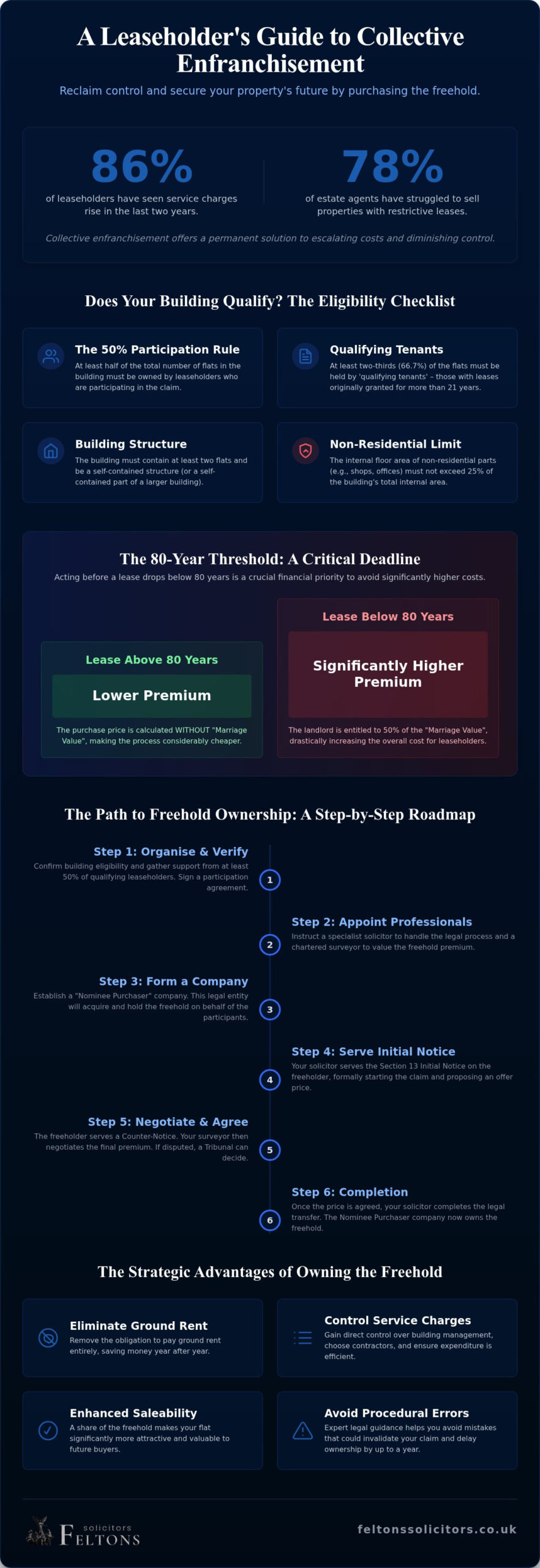
Before embarking on the journey toward freehold ownership, you must establish whether your building and your group meet the strict statutory requirements. Not every property qualifies for collective enfranchisement, so a thorough initial audit is essential to avoid wasted time and expense. The building itself must be self-contained, or a self-contained part of a building, and it must contain at least two flats. Crucially, at least two-thirds of the total number of flats in the building must be owned by “qualifying tenants”—those whose leases were originally granted for a term of more than 21 years.

The “50% Rule” is often the most significant practical hurdle for residents to overcome. For a claim to be valid, at least half of the total number of flats in the building must participate in the purchase. If your block contains only two flats, both leaseholders must usually join the claim. Unlike individual lease extensions, there’s no requirement to have owned your property for two years before participating; you’re eligible to join the group from the day you complete your flat purchase.

The Residential vs Commercial Balance

The proportion of non-residential space within your building can be a deciding factor for eligibility. Under current law, if more than 25% of the internal floor area (excluding common parts like hallways and stairwells) is used for commercial purposes, such as shops or offices, the building is disqualified. This calculation is precise and often requires a professional surveyor to verify the exact split. Whilst the 2024 Reform Act proposed increasing this threshold to 50%, that specific change has not yet been implemented. It’s wise to review government guidance on enfranchisement costs and eligibility criteria to ensure your building’s layout doesn’t block your right to buy.

Qualifying Tenant Restrictions

Not every leaseholder automatically counts as a qualifying tenant. If an individual or a single company owns more than two flats in the building, they’re legally disqualified from being a qualifying tenant for that specific block. Furthermore, business tenancies are excluded from the process. To manage the acquisition, participating residents usually form a “Nominee Purchaser” company. This entity acts as the legal vehicle that will eventually hold the freehold title on behalf of the group. If you’re uncertain about your neighbours’ eligibility or the status of mixed-use units, seeking expert advice on leasehold enfranchisement and extensions can provide the clarity needed to move forward with confidence.

The Statutory Process: A Step-by-Step Roadmap to Success

The path to securing your freehold is a methodical one, governed by strict statutory timelines. It begins not with a legal notice, but with group cohesion. You’ll need to organise your neighbours and establish a ‘Nominee Purchaser’, which is typically a private company limited by shares. This entity will eventually hold the legal title on behalf of the participants. Once the group is formed and the building’s valuation is understood, you serve the Section 13 Initial Notice on the freeholder. This document acts as the formal catalyst for the entire collective enfranchisement claim.

The Crucial Role of the Participation Agreement

Before any formal notices are sent, a Participation Agreement is essential. This internal contract binds the leaseholders together, ensuring that nobody can drop out at the last minute and leave others with a larger financial burden. It clearly outlines how the purchase price and professional fees will be split amongst the group. Managing neighbours who choose not to participate is equally important; the agreement should detail how their share of the freehold is funded and held, protecting the investment of those who are taking the lead. Without this document, the group’s unity is vulnerable to the stresses of a long legal process.

After receiving your notice, the freeholder has at least two months to provide a Section 21 Counter-Notice. They’ll likely dispute the proposed premium. This leads to a period of negotiation where your solicitor and valuer work to find a middle ground. Most cases are settled through professional dialogue, but if an agreement cannot be reached within six months of the counter-notice, the matter moves to the First-tier Tribunal (Property Chamber). Understanding the valuation principles for collective enfranchisement is vital during this phase to ensure your expectations remain grounded in statutory reality.

Serving the Initial Notice Correctly

Precision is paramount when serving the Section 13 Notice. A single administrative error can render the notice invalid, potentially forcing the group to wait 12 months before they can re-apply. The notice must include the names of all participating leaseholders, the proposed premium, and details of any intermediate leasehold interests. It’s a delicate balance; your initial offer must be realistic to avoid being struck out as a bad-faith application. You must also ensure all relevant landlords are served simultaneously to prevent procedural delays that the freeholder could exploit.
Collective Enfranchisement: A Comprehensive Guide to Buying Your Freehold in 2026

Calculating the Cost: Valuation, Premiums, and Professional Fees

The financial commitment required for collective enfranchisement is often the primary concern for any resident group. It’s not just a simple purchase price; it’s a multi-layered financial puzzle that requires precise calculation. The total premium consists of the ‘diminution in value’ of the freeholder’s interest, which compensates them for the loss of future ground rent and the eventual return of the property. You must also account for ‘injurious affection’ if the sale reduces the value of the landlord’s other neighbouring property, though this is less common in standard residential blocks.

The 80-year lease threshold remains the most critical date in your financial diary. If any participating lease falls below this mark, ‘marriage value’ becomes payable, which can significantly increase the final premium. Waiting for legislative reform is currently a high-stakes gamble. Whilst the 2024 Reform Act aims to abolish marriage value, these specific provisions are not yet in force as of late 2026. Currently, the government is consulting on new valuation rates with a deadline of 21 October 2026. For those with leases approaching the 80-year mark, acting now under known rules is often safer than waiting for implementation dates that remain uncertain.

Marriage Value and the 2026 Legislative Landscape

Marriage value represents the potential increase in the total value of the flats once the freehold and leasehold interests are ‘married’ together. Under current 2026 rules, the freeholder is entitled to 50% of this calculated profit. As the lease length decreases, this figure climbs steeply. Recent legislative attempts have sought to simplify this formula, but for now, the traditional calculation remains the legal standard. If your group is debating the timing of your claim, you should seek professional leasehold enfranchisement and extensions advice to model potential costs accurately before your leases shorten further.

Professional Fees: What to Expect

Budgeting for the process requires a ‘fighting fund’ to cover both your own expenses and those of the freeholder. By law, leaseholders are currently liable for the freeholder’s ‘reasonable’ legal and valuation costs. This is a common point of friction, as the definition of ‘reasonable’ is often open to interpretation. You must also budget for your own specialist valuer. Their role is to negotiate the premium down, often saving the group far more than their professional fee. If negotiations stall and you reach the First-tier Tribunal, additional costs for expert witnesses and hearing fees will apply. Establishing a clear cost-sharing agreement amongst the group early on prevents financial disputes from derailing the claim at the final hurdle.

The complexity of the statutory framework means that precision isn’t just a preference; it’s a legal necessity. In a collective enfranchisement claim, a single administrative oversight, such as an incorrectly served notice or a failure to identify all intermediate landlords, can result in the claim being struck out. If this happens, the group is often legally barred from serving a new notice for 12 months. During that year, property values may rise and leases will certainly shorten, potentially pushing the group into higher premium brackets or marriage value territory. Professional stewardship ensures these procedural traps are avoided from the outset.

Expert legal representation also acts as a strategic shield against aggressive freeholders. Whilst your valuer determines the figures, your solicitor handles the tactical delivery of the claim. They ensure that the freeholder’s counter-proposal is scrutinised for “reasonableness” and that the group isn’t pressured into an over-valuation. This collaborative approach between legal and valuation experts is what ultimately secures the best possible terms for the residents. At Feltons, we position ourselves as your sophisticated guide, providing a calm and steady presence throughout what can be a high-stakes negotiation.

Navigating Complex Disputes and Tribunals

There are moments when the First-tier Tribunal becomes unavoidable, particularly when a freeholder remains intransigent regarding the premium or the terms of the transfer. In these instances, having a partner with specific experience in litigation and dispute resolution is vital. We help you decide when a settlement is pragmatic and when a more assertive stance is required to protect your investment. Beyond the courtroom, we manage the meticulous transfer of management records and the freehold title. This ensures that the new resident-led structure is legally sound and that the transition from leaseholder to freeholder is seamless.

Next Steps for Your Building

To begin, your group should focus on two parallel tracks: securing an initial valuation and building consensus amongst your neighbours. Crafting the right message to other residents is essential to ensuring you meet and maintain the 50% participation threshold. Once you have a core group, the formal legal process can commence with the drafting of the Participation Agreement and the formation of your Nominee Purchaser company. This methodical preparation is the foundation of a successful claim.

If you are ready to reclaim autonomy over your building and secure its long-term marketability, Contact Feltons Solicitors for expert guidance on your collective enfranchisement claim. We provide the boutique level of care and national expertise necessary to handle your property matters with high-end reliability and professional integrity.

Taking Command of Your Building’s Future

Achieving full property autonomy is a significant milestone. It transforms your asset from a depreciating lease into a permanent home. By navigating the collective enfranchisement process, you eliminate the burden of ground rent and gain direct oversight of service charge expenditure. This strategic shift not only protects your financial interests but also restores the pride of ownership that comes with managing your own environment. You’ve worked hard for your home; now it’s time to truly own it.

Success in these complex matters depends on a methodical approach and high-standard legal support. Feltons Solicitors LLP offers specialist expertise in this field, providing pragmatic and empathetic legal advice tailored to your group’s specific needs. We handle complex property matters on a national scale, acting as a calm and steady presence throughout your journey. Secure your property’s future with Feltons Solicitors and begin the transition toward total management control. We are here to ensure your path to the freehold is clear, secure, and professionally managed.

Frequently Asked Questions

Can our freeholder refuse to sell the freehold if we meet all criteria?

No, the freeholder cannot legally refuse to sell if you meet the statutory criteria. Collective enfranchisement is a mandatory right that compels a landlord to transfer the freehold to qualifying residents. If they fail to respond to your notice or attempt to block the claim without valid legal grounds, your solicitor can apply to the County Court for a vesting order. This ensures the transfer proceeds regardless of the landlord’s willingness.

How long does the collective enfranchisement process typically take?

The process typically takes between 12 and 18 months from the service of the Initial Notice to final completion. This timeline accounts for the statutory response periods and the necessary period of negotiation regarding the premium. If disputes regarding the valuation require a First-tier Tribunal hearing, the duration may extend beyond this range. Effective organisation amongst your neighbours during the pre-notice stage is the best way to prevent unnecessary delays.

What happens if some neighbours in the block do not want to participate?

You only need 50% of the qualifying tenants to participate in the claim to proceed. Those who choose not to join will simply remain leaseholders. Their landlord will change from the current freeholder to the new resident-owned company. Whilst they won’t share in the ownership or the ability to grant themselves 999-year leases, they must still pay their ground rent and service charges to your new management structure.

Do we need to set up a company to buy the freehold?

Whilst not strictly a legal requirement, it is the standard and most practical method for managing the freehold. Setting up a private company limited by shares allows the group to hold the title collectively and manage the building efficiently. Each participating resident typically becomes a shareholder and director. This structure provides a clear framework for decision-making and ensures the freehold remains stable even when individual flats are sold to new owners.

Can we buy the freehold if the building has a shop on the ground floor?

You can buy the freehold provided the non-residential part of the building does not exceed 25% of the total internal floor area. This calculation excludes common parts like stairwells. If the shop is large, it might disqualify the building under current 2026 rules. Although legislative reforms have proposed increasing this limit to 50%, these changes are not yet in force. A professional survey is essential to determine the exact commercial-to-residential ratio.

What are the typical costs involved in a collective enfranchisement claim?

Costs include the purchase premium, your own legal and valuation fees, and the freeholder’s reasonable professional costs. You should also budget for Stamp Duty Land Tax and the administrative costs of incorporating a company. Because collective enfranchisement requires the leaseholders to indemnify the landlord for their “reasonable” expenses, it’s vital to have an expert solicitor who can challenge any excessive or unjustified fee claims from the freeholder’s legal team.

How does buying the freehold affect my individual lease?

Buying the freehold doesn’t automatically cancel your existing lease, but it allows the group to grant each participant a new 999-year lease at a peppercorn ground rent. This effectively eliminates ground rent and future lease extension costs. Your individual lease remains the document that governs your daily rights and responsibilities, but you will now be part of the entity that enforces those rules, giving you total management autonomy over your building.

What is the ‘Nominee Purchaser’ and who should we choose?

The Nominee Purchaser is the legal entity or person named in the Initial Notice who will take the title to the freehold. In almost all collective enfranchisement cases, the group chooses to form a new company for this purpose. This company acts as a neutral vehicle that represents all participants equally. Choosing a company structure protects individual residents from personal liability and simplifies the process of transferring interests when a flat is sold.

Financial Settlement in UK Divorce: A Comprehensive Guide to Protecting Your Assets (2026)

Financial Settlement in UK Divorce: A Comprehensive Guide to Protecting Your Assets (2026)

Is a standard 50/50 split actually the fairest way to divide your life’s work, or is it simply a convenient starting point that overlooks your specific future needs? You’ve spent years building your assets, and the prospect of losing the family home or seeing a hard-earned pension fund diminished is understandably daunting. It’s entirely natural to feel a sense of anxiety regarding your financial independence whilst navigating the legal system. We understand that you seek a resolution that is both discreet and efficient, prioritising stability over conflict.

This guide provides the expert insight required to secure a favourable financial settlement divorce uk, ensuring your interests remain protected through meticulous disclosure and bespoke negotiation. By moving beyond generic templates, we focus on tailored strategies that reflect the true value of your matrimonial estate. You’ll learn how to achieve a definitive clean break, understand the 2026 court fee updates, and discover how to safeguard your wealth for the years ahead. We offer the steady, professional guidance you need to move forward with absolute confidence and peace of mind.

Key Takeaways

  • Learn how courts apply Section 25 factors to determine a fair financial settlement divorce uk, moving beyond the common misconception of an automatic 50/50 split.
  • Understand your legal obligation for full and frank financial disclosure and how the meticulous completion of Form E protects your future interests.
  • Explore the benefits of alternative dispute resolution methods, such as mediation and arbitration, to reach a discreet agreement whilst avoiding a bitter court battle.
  • Discover why a financial consent order is essential to achieving a definitive clean break and preventing future claims from your former spouse.
  • Gain insight into managing complex or international assets with a calm, steady approach that prioritises your long-term financial security and peace of mind.

Understanding Financial Settlements in UK Divorce Law

A financial settlement in UK divorce is a legally binding agreement that details how assets, property, and income are divided between separating parties. It is a common misconception that the divorce process itself automatically addresses these financial matters. The divorce petition merely ends the legal contract of marriage. In contrast, a financial order provides the finality needed to secure your future. Without a court-sealed order, your former spouse could potentially make a claim against your assets years, or even decades, after the decree is absolute.

Achieving a “clean break” is often the primary objective for those seeking a discreet and efficient resolution. A Clean Break Order dismisses future financial claims, ensuring that any wealth you build post-divorce remains yours alone. Relying on an informal “handshake” agreement is a significant risk. These arrangements lack legal enforceability and offer no protection if circumstances change or relationships sour. Only a court-approved order provides the peace of mind that your financial obligations are truly concluded.

The Legal Framework: Matrimonial Causes Act 1973

The Matrimonial Causes Act 1973 remains the primary authority for a financial settlement divorce uk. When reviewing an application, the court’s first priority is always the welfare of any children under eighteen. Beyond this, judges exercise broad discretion to achieve a result that is “fair”. Modern interpretations have shifted away from rigid formulas towards a pragmatic assessment of each party’s future needs, earning capacity, and contributions to the family. This ensures that the settlement is tailored to the specific realities of your household rather than a generic template.

Matrimonial vs Non-Matrimonial Assets

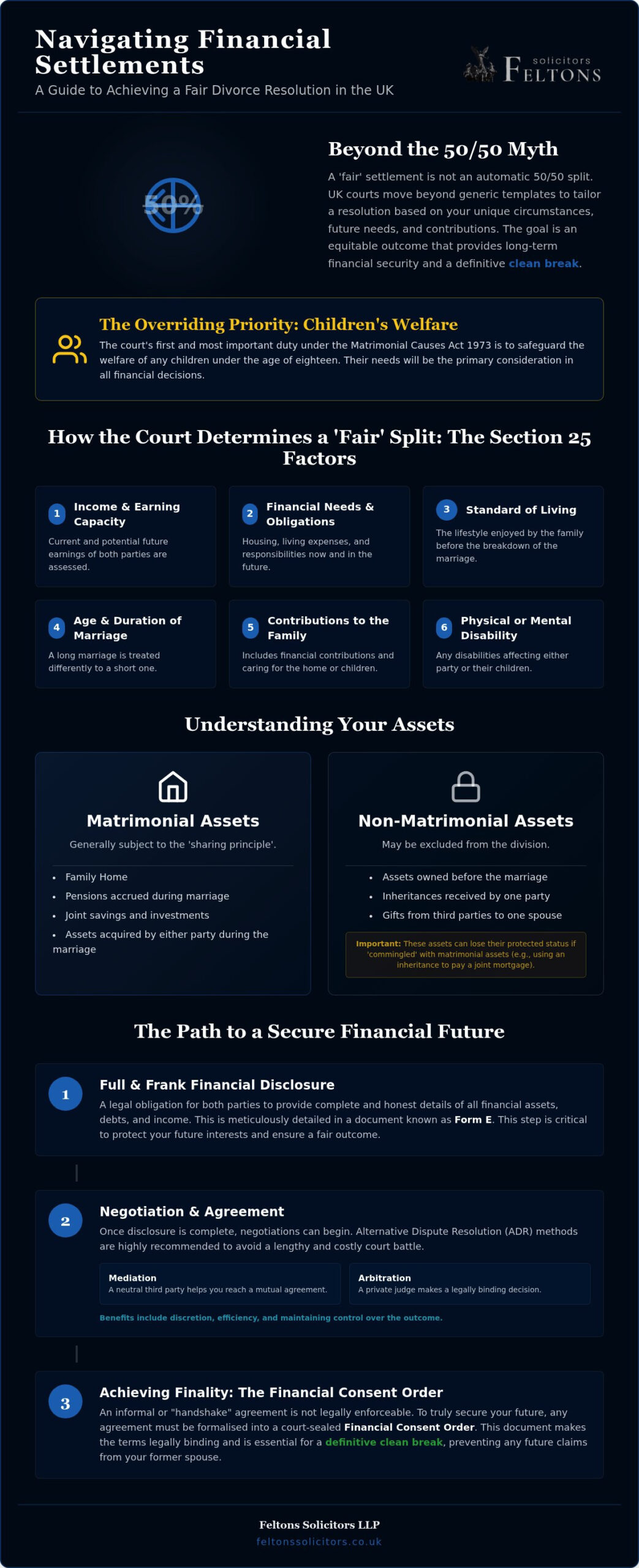
Distinguishing between asset types is essential for a precise and equitable division. Matrimonial assets generally include everything acquired during the marriage, such as the family home, joint savings, and pensions. These are typically subject to the sharing principle. Non-matrimonial assets often include property owned before the wedding or specific inheritances and gifts received during the relationship.

However, the treatment of non-matrimonial assets is rarely straightforward. If these assets have been “commingled”, for instance by using an inheritance to pay off a joint mortgage, they may lose their protected status. The court evaluates how long the marriage lasted and whether these assets are required to meet the other party’s basic needs. Expert legal insight is vital here to ensure your pre-marital wealth is appropriately ring-fenced wherever possible, maintaining your financial independence post-divorce.

How the Court Determines a ‘Fair’ Financial Split

The concept of “fairness” in a financial settlement divorce uk is often misunderstood as a simple mathematical exercise. Whilst a 50/50 division is frequently used as a starting point for long marriages, it’s by no means an automatic rule in English and Welsh law. The court’s primary objective is to reach an equitable outcome that reflects the unique circumstances of the family. This involves balancing various factors, including the standard of living enjoyed during the marriage. Judges rarely consider personal “conduct” or “blame” for the breakdown of the relationship unless it’s exceptionally egregious and has a direct, significant impact on the financial position. Instead, the focus remains on practical needs and future security.

The Section 25 Criteria Explained

Judges derive their authority from a specific set of criteria known as the Section 25 factors. These rules require a thorough, methodical assessment of each party’s position. The court will examine your income and earning capacity, looking not just at what you earn now, but what you could potentially earn in the future. They’ll also consider your current and future financial needs, obligations, and responsibilities. The age of each party and the duration of the marriage play a significant role; a twenty-year marriage is treated very differently from a two-year union. Additionally, the court weighs contributions to the welfare of the family, ensuring that a spouse who sacrificed their career to manage the home is not financially penalised. This discretionary approach allows for a tailored resolution that accounts for the nuances of your specific household.

Prioritising the Needs of Children

The court has a statutory duty to place the welfare of any children under eighteen at the forefront of its decision-making. This priority often dictates the division of the family home. If one parent remains the primary caregiver, the court may prioritise their housing needs to ensure the children have a stable and secure environment. This might result in an unequal split of capital to facilitate a property purchase or a deferred sale of the matrimonial home. The goal is to minimise disruption to the children’s lives, even if it means a less-than-equal division of the current assets. Understanding how these factors apply to your situation is essential for long-term planning. If you require a bespoke assessment of your matrimonial assets, our team provides the steady, professional guidance needed to navigate these complexities with confidence.

The Critical Role of Full and Frank Financial Disclosure

Full and frank disclosure is the cornerstone of any robust financial settlement divorce uk. It requires both parties to provide a comprehensive and honest overview of their global financial position, ensuring that negotiations are based on fact rather than assumption. This process is primarily facilitated through “Form E”, a detailed document that organises your financial evidence, including bank statements, property valuations, and income details. Providing a complete picture from the outset isn’t merely a procedural requirement; it’s a strict legal obligation. If one party is found to have hidden assets or provided misleading information, the court has the power to set aside the final order, potentially reopening the litigation years later at significant expense.

The strategic completion of Form E ensures that the negotiation starts from a position of absolute clarity. We often engage professional valuers to assess complex assets, such as private collections or property portfolios, to prevent disputes over their true worth. This methodical approach ensures that the matrimonial “pot” is accurately defined before any division begins, providing the firm foundation necessary for a fair and lasting agreement.

Dealing with Pensions and Business Assets

Pensions are frequently the most significant asset after the family home, yet they remain one of the most misunderstood areas of asset division. A Pension Sharing Order provides a definitive clean break by transferring a percentage of one party’s pension credit to the other. In contrast, a Pension Attachment Order acts more like maintenance, where payments are made only once the pension holder retires. It is vital to note that whilst many private schemes can be split, the new state pension (for those reaching state pension age from April 2016) cannot be shared. For high-value pots, we often recommend actuarial reports to determine the true value of the income stream. Similarly, valuing a family business requires a nuanced look at liquidity and future earnings to ensure the settlement remains sustainable for both parties.

International Assets and Overseas Entities

Identifying and valuing investments held abroad adds another layer of complexity to the disclosure process. Modern divorce proceedings frequently involve overseas entity beneficial owner registration, which provides essential transparency for UK property held by foreign organisations. Our expertise in cross-border financial arrangements allows us to navigate these international nuances with calm, steady precision. We ensure that every offshore interest is correctly accounted for, protecting your interests regardless of where the assets are located. This level of meticulous detail is essential for securing a settlement that is both comprehensive and legally sound.

Financial Settlement in UK Divorce: A Comprehensive Guide to Protecting Your Assets (2026)

Reaching an agreement outside the courtroom is increasingly the preferred route for those seeking a discreet and efficient resolution. Alternative Dispute Resolution (ADR) offers a more controlled environment for resolving a financial settlement divorce uk, prioritising cooperation over conflict. Mediation is a primary pillar of this approach. It allows both parties to discuss their needs with a neutral third party, often reducing the overall cost of proceedings whilst fostering a more amicable atmosphere. This is particularly beneficial when children are involved, as it sets a cooperative tone for future co-parenting and reduces the emotional strain on the family unit.

For complex cases that require a definitive decision but seek to avoid the delays of the public court system, arbitration is a sophisticated alternative. In this process, a private judge, known as an arbitrator, reviews the evidence and makes a binding decision. It’s significantly faster than the traditional court route and offers a level of privacy that high-net-worth individuals often prioritise. This ensures that sensitive financial details and business interests remain confidential, away from the public record.

The Process of Securing a Consent Order

Once an agreement is reached through negotiation or mediation, it must be formalised into a Consent Order to become legally binding. This document is meticulously drafted by solicitors to reflect the agreed terms with absolute precision, covering everything from property transfers to pension sharing. A judge then reviews the order to ensure it’s “fair” and meets the statutory requirements of the Matrimonial Causes Act. Without this judicial seal, your agreement remains informal and lacks the power to prevent future claims. For a deeper look at strategic asset division, see our guide to protecting your assets.

When Negotiation Fails: The Path to Court

If an agreement cannot be reached through ADR, the court process provides a structured path to a resolution. This typically involves three distinct stages: the First Appointment (FDA), the Financial Dispute Resolution (FDR) hearing, and the Final Hearing. The FDR is a pivotal moment in the litigation. It’s a “without prejudice” hearing where a judge gives a non-binding indication of the likely outcome if the case were to proceed to a trial. This insight often encourages a settlement, as both parties can see the risks and costs of continuing to a Final Hearing. Expert litigation support is essential during these stages to ensure your position is presented with clarity and authority. If you find yourself facing a contested split, we recommend seeking a professional consultation on divorce and financial arrangements to protect your long-term interests.

Securing Your Future with Feltons Solicitors

Feltons Solicitors LLP offers a boutique experience that prioritises the individual behind the legal case. We understand that navigating a financial settlement divorce uk is one of the most significant transitions you’ll ever face. Our approach is defined by a sophisticated blend of professional authority and empathetic reassurance. We position ourselves as a calm, steady presence during what is often a high-pressure period. By focusing on a personal connection rather than high-volume processing, we ensure that every client receives the discreet, high-standard service they deserve.

We specialise in handling complex, international-scale matters with the worldly experience required for high-net-worth asset division. Whether your estate involves overseas entities or intricate business structures, our team provides the pragmatic, sound judgment needed to secure your financial independence. We value modern efficiency, but we never compromise on the traditional professional integrity that has defined our firm since Paula Felton established it in 2010. This combination of heritage and forward-thinking methodology ensures your financial settlement divorce uk is handled with absolute precision.

A People-First Philosophy to Legal Service

Our “people-first” philosophy means that we never forget the human impact of the technical legal work we perform. We prioritise personal rapport and privacy, acting as your discreet partner throughout the entire process. We guide you through every step of the financial settlement process, from the initial disclosure to the final court-sealed order. Our goal is to provide a sense of security and comprehensive care, ensuring you feel supported and in capable hands. We offer tailored strategies that reflect your specific goals, whether you seek a clean break or the long-term protection of children’s assets.

Next Steps: Contacting Our Trusted Advisors

Taking the first step towards a resolution is often the hardest part. We invite you to arrange an initial consultation with our expert family law team to discuss your specific needs in a confidential setting. To make the most of this meeting, it’s helpful to gather a preliminary list of your assets, including property values, pension statements, and any business interests. This allows us to provide more targeted, practical advice from the very beginning.

Our communication rhythm is steady and deliberate. We respect your time and opt for a methodical flow that guides you through information without the frantic energy of high-pressure sales. If you’re ready to secure your financial future with a partner who values your peace of mind as much as your legal success, we’re here to help. Contact our trusted advisors today to begin your journey toward a discreet and efficient resolution.

Securing Your Financial Independence for the Years Ahead

Transitioning into a new chapter of life requires more than just legal paperwork; it requires a strategy that protects your hard-earned assets and provides long-term security. We’ve explored how the court balances Section 25 factors and why a court-sealed Consent Order is the only way to achieve a definitive clean break. A successful financial settlement divorce uk relies on meticulous disclosure and the ability to navigate complex arrangements, such as pensions and international property, with absolute precision.

Feltons Solicitors has provided boutique, personalised legal service since 2010. We offer the calm, steady presence needed to handle complex international-scale matters whilst prioritising your privacy and peace of mind. Our team is dedicated to helping you achieve a resolution that is both efficient and fair. If you’re ready to move forward with confidence, please contact Feltons Solicitors for a discreet consultation. You deserve a trusted advisor who understands the human impact of your legal journey and works tirelessly to secure your financial future.

Frequently Asked Questions

How long does a financial settlement take in the UK?

A financial settlement typically takes between six and twelve months to conclude if an agreement is reached through negotiation or mediation. If the matter proceeds to a contested court hearing, the timeline can extend significantly beyond a year. It’s important to understand that the financial process runs parallel to the divorce petition but remains a distinct legal matter. Seeking a prompt resolution helps provide the certainty needed to plan for your post-divorce future.

Can I claim my husband or wife’s pension after divorce?

Pensions are often the most significant asset in a marriage and are almost always included in a financial settlement divorce uk. You may be entitled to a portion of your spouse’s pension through a sharing order or an attachment order. However, the new state pension, for those reaching retirement age after April 2016, cannot be shared. We often use actuarial reports to ensure these complex funds are valued accurately before any division is agreed.

What happens to the family home in a financial settlement?

The treatment of the family home depends on the specific needs of each party, with the court prioritising the welfare of any children involved. Common outcomes include selling the property and dividing the proceeds or one party buying out the other’s share to remain in the home. In some cases, a deferred sale order is used to ensure children have a stable environment until they reach adulthood. Every situation requires a bespoke approach to achieve fairness.

Is a financial settlement always 50/50 in the UK?

No, there is no automatic 50/50 split in English and Welsh law. Whilst an equal division is a frequent starting point for long marriages, the court exercises broad discretion under Section 25 of the Matrimonial Causes Act. Factors such as the length of the marriage, each party’s earning capacity, and their future financial needs can lead to an unequal split. The primary goal is to reach an outcome that is equitable and sustainable for both individuals.

Do I need a solicitor for a financial settlement?

You are not legally required to instruct a solicitor for negotiations, but professional representation is essential for drafting a legally binding Consent Order. A solicitor ensures the document accurately reflects your agreement and provides the necessary protection against future claims. Without a court-sealed order, your financial ties remain open, leaving you vulnerable to claims years after the divorce. Expert guidance also helps you navigate complex asset valuations and ensures your long-term interests are fully protected.

What is a Clean Break Order and do I need one?

A Clean Break Order is a court-sealed document that ends the financial relationship between you and your former spouse. It prevents either party from making any future claims against the other’s income, assets, or inheritance. Most individuals require this order to achieve true financial independence and peace of mind. Without it, your former partner could potentially apply for a share of your wealth many years later if your financial circumstances improve significantly or you receive a windfall.

Can a financial settlement be changed after the divorce is finalised?

A financial settlement is usually final once a court has issued a sealed order, particularly if it includes a clean break clause. However, an order can be challenged or set aside in exceptional circumstances, such as a failure to provide full and frank disclosure or evidence of fraud. Additionally, a “Barder event”, which is a significant and unforeseen change occurring shortly after the order, may allow for a review. These cases are rare and require sophisticated legal expertise.

How much does a financial settlement cost in legal fees?

The total cost of a financial settlement divorce uk depends on the complexity of your assets and whether the division is agreed amicably. Court filing fees for 2026 are fixed at £62 for a consent order and £321 for a contested financial order. Professional fees vary based on the level of negotiation or litigation support required. Investing in expert advice early often reduces overall costs by avoiding a protracted court battle and ensuring a more efficient resolution.

Register of Overseas Entities Guidance: A Comprehensive Legal Framework for 2026

Register of Overseas Entities Guidance: A Comprehensive Legal Framework for 2026

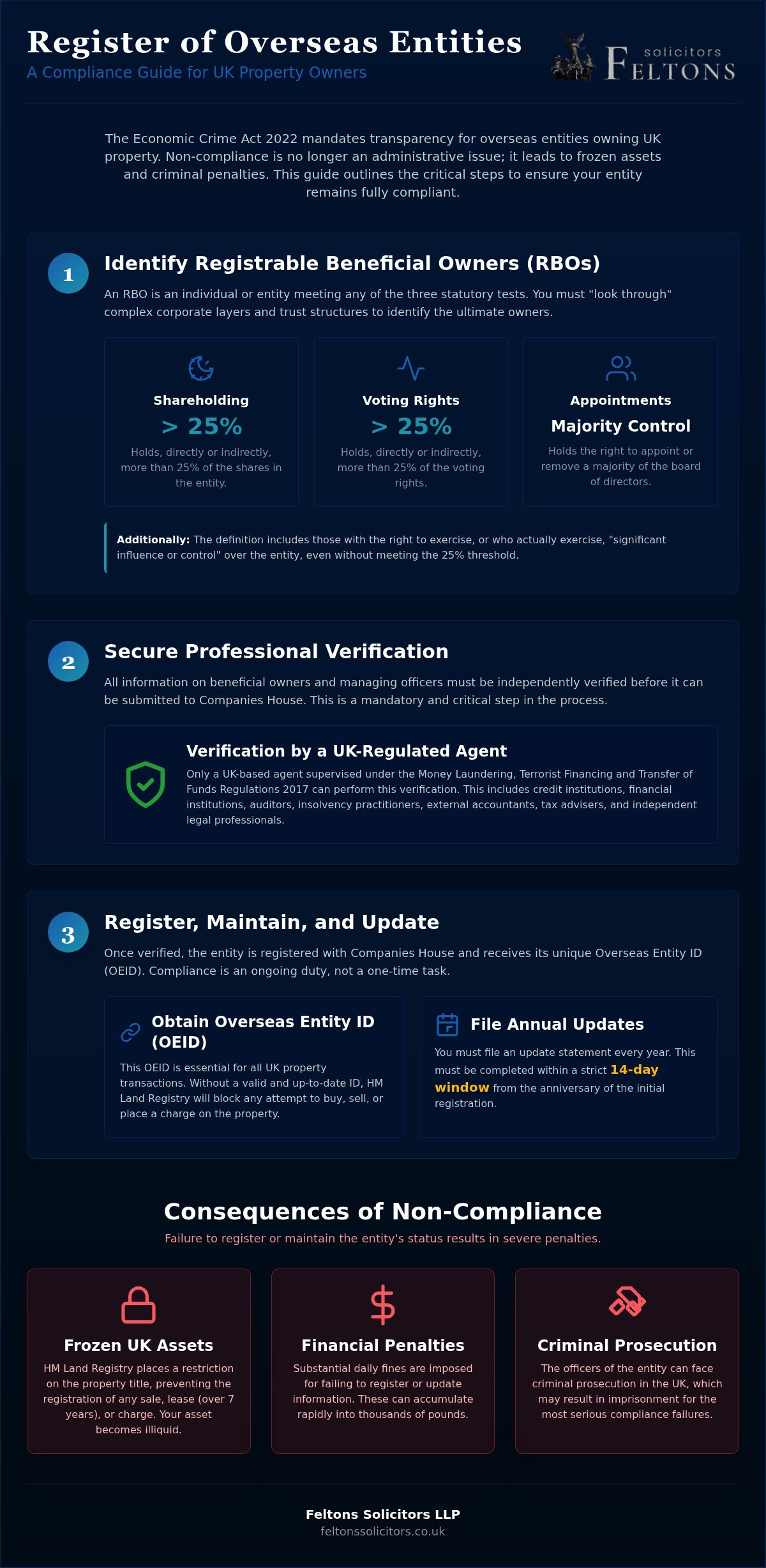
A simple filing error on the Register of Overseas Entities is no longer just an administrative oversight; in 2026, it’s a direct path to a frozen property portfolio and potential criminal prosecution. This register of overseas entities guidance serves as your definitive roadmap through the increasingly stringent requirements of the Economic Crime Act 2022. Companies House has shifted its focus from encouraging transparency to robust enforcement, making precision more critical than ever before.

We recognise that identifying beneficial owners within multi-layered corporate structures often feels like solving a complex puzzle where the rules are constantly shifting. It’s natural to feel a sense of unease regarding the threat of heavy fines or the difficulty of securing a regulated UK verification agent whilst managing international interests. You deserve a legal partner who provides calm, expert clarity instead of added pressure.

By following this framework, you’ll master the intricacies of the new trust disclosure rules and ensure your property transactions remain seamless and secure. We will examine the registration process, the necessity of professional verification, and the strict 14-day window for your mandatory annual updates. This guide ensures you remain in full compliance, protecting both your reputation and your UK assets.

Key Takeaways

  • Identify registrable beneficial owners with precision by applying the three primary tests and the 25% control threshold.
  • Secure your property interests by obtaining expert register of overseas entities guidance to navigate mandatory verification through a regulated UK professional.
  • Protect your assets from Land Registry blocks and criminal penalties by mastering the strict 14-day filing window for annual update statements.
  • Recognise how a tailored legal approach integrates compliance into your broader property strategy to ensure seamless long-term management.

Understanding the Register of Overseas Entities (ROE) Requirements

The Register of Overseas Entities (ROE) serves as a critical transparency tool within the UK’s legal system. Its primary purpose is to reveal the true owners of UK land held through foreign structures, curbing the use of anonymous offshore vehicles for illicit gains. This requirement was formalised under the Economic Crime (Transparency and Enforcement) Act 2022, which fundamentally altered the compliance obligations for international investors. By creating a public record of beneficial ownership, the government aims to foster a more accountable and secure property market.

An “overseas entity” is broadly defined as any legal person, such as a corporation or partnership, that is governed by the law of a country or territory outside the United Kingdom. If your entity owns, or intends to acquire, qualifying UK property, registration with Companies House is mandatory. Failing to adhere to this register of overseas entities guidance can lead to severe repercussions. Beyond the daily fines that can reach thousands of pounds, officers of the entity face potential imprisonment. We understand how daunting these criminal sanctions appear, yet they are avoidable with a methodical approach to your legal duties.

The Scope of the Legislation in 2026

The current framework is comprehensive, covering various legal structures including foreign companies and limited partnerships. One of the most significant aspects is its retrospective nature. In England and Wales, the rules apply to all land purchased on or after 1 January 1999. Once registered, the entity receives a unique Overseas Entity ID (OEID). This number is the “golden ticket” for any modern property transaction. Without a valid OEID, you cannot complete a purchase, sale, or lease of more than seven years. It’s a simple identifier that carries immense weight in the eyes of the law.

The Interplay with HM Land Registry

Compliance is enforced through a symbiotic relationship between Companies House and HM Land Registry. The Land Registry places a restriction on the title of any property owned by an overseas entity. This restriction effectively freezes the asset. You won’t be able to register a transfer of title, a lease, or a legal charge unless the entity is fully compliant and its registration is up to date. Proactive management is vital. Waiting until a disposal is underway to seek register of overseas entities guidance often leads to costly delays and broken chains in the conveyancing process. A clear status at the Land Registry ensures your property remains a liquid asset rather than a legal burden.

Identifying and Disclosing Registrable Beneficial Owners (RBOs)

Determining who truly holds the reins of a foreign company requires more than a glance at a share certificate. This register of overseas entities guidance prioritises the accurate identification of Registrable Beneficial Owners (RBOs), a process that involves three rigorous statutory tests. An individual or legal entity is typically registrable if they meet any of the following criteria:

  • Holding, directly or indirectly, more than 25% of the shares in the entity.
  • Holding, directly or indirectly, more than 25% of the voting rights.
  • Holding the right, directly or indirectly, to appoint or remove a majority of the board of directors.

Some individuals exert power through “significant influence or control” without holding a formal majority. This often occurs amongst family offices or private equity arrangements where veto rights or bespoke articles of association exist. If your exhaustive search yields no RBOs, you must instead provide details for every “managing officer” of the entity. Following official Companies House guidance is essential to ensure these declarations are legally sound and prevent future disputes with the registrar.

Complex Ownership and Trust Structures

Navigating chains of ownership that span multiple offshore jurisdictions is a common hurdle. You must “look through” each layer until a registrable individual or a “legal entity subject to its own disclosure requirements” is found. When trusts are part of this chain, the level of detail required increases significantly. Trustees, settlors, and even certain beneficiaries must be disclosed. If you find yourself managing a web of international interests, seeking professional legal support can clarify these opaque structures whilst ensuring your privacy is protected where the law permits.

New Rules for Trust Transparency in 2026

The landscape for trust privacy changed fundamentally on 31 August 2025, when the UK government enabled public access to trust information held on the register. Whilst this data isn’t visible on the public search by default, third parties can now apply to Companies House to view specific trust details. The Register of Overseas Entities (Protection and Trusts) Regulations 2026, which came into force in July 2026, further refined how this information is handled and protected. Under these rules, a registrable beneficial owner in the context of a trust is any person who serves as a trustee, settlor, or beneficiary, or who otherwise exercises significant control over the trust’s assets and administration.

The Critical Role of UK-Regulated Verification Agents

The integrity of the UK’s property market depends on the accuracy of the data submitted to Companies House. For this reason, the legislation strictly prohibits self-verification by the overseas entity itself. This register of overseas entities guidance emphasises that an independent, regulated professional must scrutinise every piece of information before it’s submitted. This requirement acts as a safeguard, ensuring that the transparency intended by the Economic Crime Act is actually achieved in practice.

Only “relevant persons” as defined by the Money Laundering Regulations can act as verification agents. This group primarily includes solicitors, accountants, and financial institutions regulated in the UK. Choosing the right partner is a decision that shouldn’t be taken lightly. Verification agents carry significant legal liability; providing false or misleading information is a criminal offence that can lead to unlimited fines or imprisonment. Whilst some high-volume service providers offer basic checks, a boutique law firm provides a superior level of due diligence that protects your corporate reputation and ensures absolute precision.

The Verification Process Step-by-Step

The verification journey follows a methodical three-stage path to ensure compliance. First, your agent gathers original corporate documentation, including certificates of incorporation and registers of members, to trace the ownership chain. Second, the agent conducts comprehensive “know your client” (KYC) and anti-money laundering checks on all identified beneficial owners. Finally, once satisfied, the agent issues a formal verification statement to Companies House using their unique agent assurance code. This structured approach, supported by official UK government guidance, ensures your entity receives its Overseas Entity ID without delay.

Maintaining the Integrity of the Register

Compliance is a recurring commitment rather than a one-off task. You must re-verify your information during every annual update to confirm that the beneficial ownership details remain accurate. If changes occur between filing dates, such as the transfer of shares or a change in trustees, these must be recorded and verified during the next update statement. A methodical approach prevents issues with your agent assurance code, which Companies House can revoke if they suspect negligent or fraudulent verification practices. Staying organised ensures your property assets remain liquid and your legal standing remains beyond reproach.

Register of Overseas Entities Guidance: A Comprehensive Legal Framework for 2026

Managing Annual Update Statements and Removal Procedures

Registration is the initial hurdle, but the legal race continues every year. The statutory duty to file an update statement remains one of the most overlooked aspects of the regime. This register of overseas entities guidance confirms that every entity must submit a statement once every 12 months. The filing window is surprisingly tight. You have exactly 14 days from the anniversary of your initial registration to complete the submission. Missing this deadline is a criminal offence. It can also lead to a daily fine, which accumulates rapidly and creates unnecessary financial strain.

Calculating your filing period is straightforward but requires diligence. Your “update period” is the 12 months following registration or your last update. Even if your ownership structure hasn’t changed a single percentage point, you still have a legal obligation to confirm this fact with Companies House. Staying ahead of this calendar is the only way to ensure your property interests remain protected and your corporate standing remains clear. We often find that clients feel a sense of relief once a reliable tracking system is in place, as it removes the fear of accidental non-compliance.

The Annual Update Checklist

A methodical review is the best defence against compliance failures. Before filing, you should verify that your current list of beneficial owners and managing officers is exhaustive and accurate. Ensure that all personal details, including names and residential addresses, are current. If significant changes in ownership occurred during the year, you must secure fresh verification from a UK-regulated agent before the update can be accepted. This prevents the administrative blocks that can derail future transactions. For expert assistance in managing these recurring duties, you can instruct Feltons Solicitors LLP to handle your annual compliance.

Removal from the Register of Overseas Entities

Many owners wonder what happens when they no longer hold UK property. If your entity has disposed of all qualifying land interests, you may be eligible for removal from the register. This is not an automatic process. You must submit a formal application for removal, which includes a declaration that the entity is no longer a registered owner of any relevant land. Once the application is submitted, Companies House enters a processing period to verify the claim with the Land Registry. Maintaining thorough records of your property disposals is vital during this stage. Even after removal, you should retain your compliance documentation for at least seven years to satisfy any future regulatory enquiries.

For high-net-worth property owners, the Register of Overseas Entities isn’t just an administrative hurdle; it’s a critical component of a broader wealth management and risk mitigation strategy. Large corporate firms often treat these registrations as high-volume, impersonal data entries. In contrast, a boutique firm like Feltons Solicitors LLP offers the discreet, high-standard service that complex international matters require. We provide a calm, steady presence, ensuring that your privacy is respected whilst every regulatory box is ticked with absolute precision. This register of overseas entities guidance is designed to help you move from confusion to complete confidence.

Compliance shouldn’t exist in a vacuum. By aligning your registration with broader residential property law strategies, you ensure that your assets remain liquid and ready for any future transaction. Our team specialises in the intricate details of overseas entity beneficial owner registration, allowing you to focus on your investment goals rather than administrative burdens. This integrated approach prevents the Land Registry blocks and criminal liabilities discussed earlier, providing a seamless experience from the moment of acquisition to the point of disposal.

A Tailored Approach to International Clients

We understand that our international clients operate across different time zones and diverse corporate cultures. Providing effective register of overseas entities guidance requires more than technical knowledge; it demands an appreciation for the human impact of legal work. For South African entrepreneurs, you can learn more about Express Shelf Company to ensure your domestic compliance is managed alongside your UK obligations. We act as a sophisticated guide, handling cross-border communications with the poise and dependability you expect from a trusted advisor. This people-first philosophy ensures that even the most complex or stressful property transactions feel manageable and secure under our care.

Next Steps for Your Overseas Entity

The best time to address your compliance status is before a deadline looms or a property sale is agreed. An initial consultation allows us to identify potential hurdles in your ownership structure, such as missing documentation from a foreign jurisdiction or complex trust arrangements. Whether you need to begin a new registration or submit an urgent annual update statement, our methodical process provides the security you need. Ensure your UK property assets remain secure with expert oversight by contacting our team today to discuss your specific requirements and safeguard your interests for 2026 and beyond.

Securing Your UK Property Interests for 2026

Navigating the UK property market as an international investor requires more than just capital; it demands rigorous adherence to transparency laws that are only becoming more stringent. By prioritising the accurate identification of beneficial owners and respecting the critical role of UK-regulated verification agents, you protect your assets from unnecessary freezes or legal complications. This register of overseas entities guidance provides the foundation for a compliant future, yet the practical application of these rules often requires a more personalised touch to navigate the nuances of international corporate structures.

Feltons Solicitors LLP offers the discreet, high-standard service needed to manage these complex requirements alongside your broader residential and commercial property interests. As regulated legal professionals, we provide the reassurance of absolute precision whilst maintaining the boutique level of care that high-net-worth individuals deserve. You don’t have to face these regulatory shifts alone. Instruct Feltons Solicitors LLP for your Overseas Entity Registration today to ensure your portfolio remains liquid and your reputation remains beyond reproach. We look forward to acting as your trusted advisor in these sensitive matters.

Frequently Asked Questions

What is the Register of Overseas Entities (ROE)?

The Register of Overseas Entities is a public database managed by Companies House to identify the true owners of foreign organisations holding UK property. Established under the Economic Crime Act 2022, it serves as a transparency tool to combat financial crime. Every foreign entity must register to receive a unique ID number. Without this identifier, you’ll find it impossible to buy, sell, or lease land in the United Kingdom.

Which overseas entities are required to register with Companies House?

Any legal person, such as a corporation or partnership, governed by laws outside the UK is considered an overseas entity. If your organisation owns or plans to acquire UK land, registration is a statutory requirement. This applies retrospectively to land purchased in England and Wales since January 1999. Identifying your entity type correctly is the first step in ensuring your property portfolio remains compliant with current transparency regulations.

What happens if an overseas entity fails to register its beneficial owners?

Failure to register results in a complete freeze on your property assets at HM Land Registry. You won’t be able to sell, lease, or charge the land until the entity is compliant. Beyond these civil restrictions, non-compliance is a criminal offence. The entity and its officers may face unlimited fines or prison sentences. These penalties are designed to ensure that transparency is not treated as an optional administrative task.

How often does an overseas entity need to update its registration?

Overseas entities must submit an update statement to Companies House every 12 months. This is mandatory even if your beneficial ownership structure has remained entirely unchanged since the last filing. You have a narrow 14-day window from the anniversary of your registration to complete this duty. This register of overseas entities guidance stresses the importance of punctuality, as missing this deadline can lead to immediate criminal prosecution and significant daily fines.

Can I sell my UK property if my overseas entity is not registered?

You cannot complete a property sale if your entity is not correctly registered. The Land Registry will block the transfer of title, meaning the buyer cannot become the legal owner. This often results in breached contracts and significant financial loss. It’s vital to verify your status well before a sale is agreed. Ensuring your registration is active avoids the stress of a last-minute scramble that could jeopardise your entire transaction.

Who can act as a verification agent for the Register of Overseas Entities?

Only UK-regulated professionals, such as solicitors, accountants, or financial institutions, can act as verification agents. These individuals must have a valid assurance code from Companies House to submit your data. Choosing a law firm provides a higher level of security, as solicitors are bound by strict professional standards. This ensures your data is verified with the precision required to satisfy the registrar and protect you from the consequences of inaccurate submissions.

Is information on the Register of Overseas Entities available to the public?

Most details on the register, including names and the nature of control, are visible to the public via Companies House. However, sensitive data like residential addresses and full dates of birth are kept private. Recent changes in 2025 mean that trust information is now accessible to the public upon application. If an individual faces a serious risk of harm, they can apply for their information to be protected from public disclosure entirely.

What is a “registrable beneficial owner” in the context of UK land?

A registrable beneficial owner is anyone who meets the 25% threshold for shares or voting rights in an entity. It also includes those who can appoint or remove the majority of the board of directors. This register of overseas entities guidance also covers individuals who exercise significant influence or control through other means. Correctly identifying these individuals is essential for a valid registration and requires a thorough analysis of your entity’s corporate governance.