
Land Registry Overseas Entity ID Requirements: A 2026 Checklist

Land Registry Overseas Entity ID Requirements: A 2026 Checklist

An Overseas Entity ID is a registration reference, not a green light for a UK property transaction. The land registry overseas entity ID requirements involve registering the entity with Companies House and checking that its details support the Land Registry application. An ID alone does not resolve inconsistencies or fill gaps in the information needed for a transaction.

To assess whether the rules apply, look at the entity’s legal status, its UK land interests and the activity proposed. Companies House registration and a Land Registry application are separate steps, so check that the relevant details align before documents are prepared. Doing this early can help identify issues before they affect an application.

This 2026 checklist explains when an Overseas Entity ID may be needed, what information to prepare and what to review before an application is made. It also covers how to check registration details and where legal support can help. Feltons Solicitors LLP advises on overseas entity registration and complex property transactions, helping clients coordinate registration information and conveyancing documents.

Key Takeaways

  • Start by reviewing the entity’s UK land interests and proposed transaction to establish which requirements may apply.
  • Use the land registry overseas entity ID requirements checklist to organise the registration and transaction details before applying.
  • Compare the entity’s legal name, form and identifying information across Companies House records and transaction documents.
  • Check that registration details are current, then review the property title restriction and transaction type before preparing the Land Registry application.
  • A solicitor can help coordinate ownership information, entity records and conveyancing documents when the transaction or ownership structure is complex.

What does a Land Registry overseas entity ID prove?

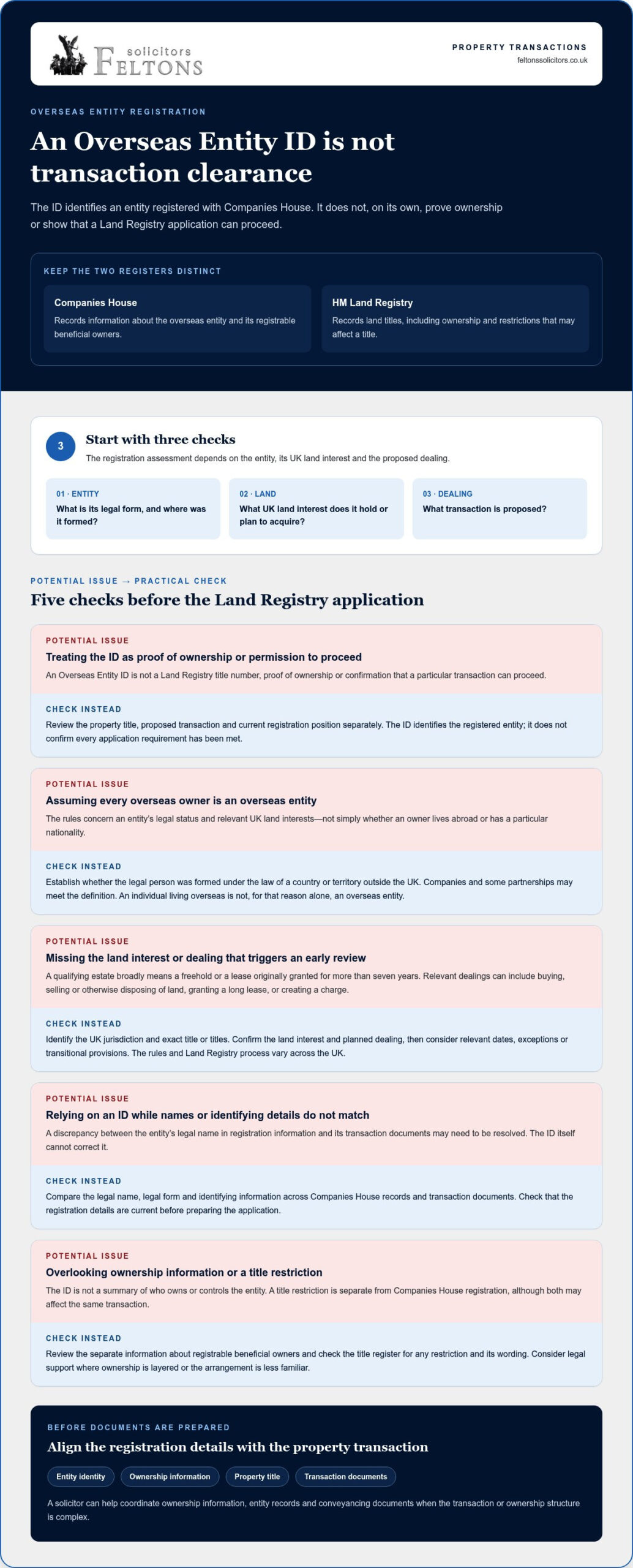
An Overseas Entity ID is the reference issued by Companies House when an overseas entity is entered on the Register of Overseas Entities. It identifies the registered entity. It is not a Land Registry title number, proof of ownership or confirmation that a particular property transaction can proceed.

The two registers serve different purposes. Companies House records information about the overseas entity and its registrable beneficial owners. HM Land Registry records land titles, including ownership and restrictions that may affect a title. An ID may be necessary for a property transaction, but it does not show that every registration or application requirement has been met. Check the title, proposed transaction and current registration position separately.

Which overseas entities are within the registration rules?

An overseas entity is a legal person formed under the law of a country or territory outside the UK. Companies and some partnerships may meet this definition. The rules concern the entity’s legal status and relevant UK land interests, not simply whether an owner lives abroad or has a particular nationality.

An individual who lives overseas is not, for that reason alone, an overseas entity. However, an individual may be a beneficial owner of an entity, which is a separate part of the registration analysis. The entity’s legal form and the law under which it was formed can affect whether the rules apply. Less familiar arrangements and layered ownership structures may need case-specific legal analysis before a transaction proceeds.

What is the difference between an entity ID and an owner’s details?

The ID is a reference for the registered entity. It is not a summary of the people who own or control it, and it does not replace the information required about registrable beneficial owners. Those details are assessed separately as part of the registration process.

Beneficial ownership analysis looks at relevant information about people or legal entities that own or exercise control over the overseas entity. The assessment depends on the structure and applicable rules. An ID alone does not establish that ownership information is complete, current or suitable for the transaction.

  • Entity identity: the overseas entity’s legal name and form.
  • Entity reference: the Overseas Entity ID issued after registration.
  • Ownership and control: the separate information required about registrable beneficial owners.

When checking the land registry overseas entity ID requirements, keep these elements distinct. A mismatch between the entity’s legal name in registration information and its transaction documents may need to be resolved. The ID itself cannot correct that discrepancy. Feltons Solicitors advises on overseas entity registration and complex property transactions, helping clients align ownership information with conveyancing documents.

Who needs an overseas entity ID for a UK property transaction?

Start with three questions: what kind of entity is involved, what interest in UK land does it hold or plan to acquire, and what transaction is proposed? Under the overseas entities regime, a legal entity governed by the law of a country or territory outside the UK may need to register if it owns or seeks to acquire a qualifying estate. Broadly, this means a freehold or a lease originally granted for more than seven years. The rules and Land Registry process vary across the UK, so identify the relevant jurisdiction before assessing the transaction.

This is a starting point, not a universal answer. The land registry overseas entity ID requirements can depend on the property interest, transaction date, title and applicable exemptions or transitional provisions. The regime also covers certain earlier acquisitions, with relevant dates varying across the UK. Review the transaction and title rather than relying on a general summary.

Which property dealings should prompt an early eligibility check?

Check the position early if an overseas entity is buying a qualifying estate, selling or otherwise disposing of relevant land, granting a long lease, or creating a charge over it. The effect of the rules depends on the dealing and circumstances. Having an ID does not automatically satisfy every Land Registry requirement.

Review the property title alongside the Companies House registration. A restriction on a title is a Land Registry entry that can limit registration of specified dispositions unless its stated condition is met. It is separate from registration on the Register of Overseas Entities, although both may affect the same transaction.

  • Identify the relevant UK jurisdiction and exact title or titles.
  • Confirm whether the entity owns or proposes to acquire a freehold or qualifying lease.
  • Describe the planned dealing, such as a transfer, lease or charge.
  • Review the title register for a restriction and note its wording.
  • Check relevant dates and whether an exception or transitional provision may apply.

How can ownership structures change the assessment?

Look beyond the name shown on the title. An overseas entity may be owned through several companies, or control may be exercised through arrangements that are not obvious from a simple ownership chart. Registration analysis must identify any registrable beneficial owners under the applicable tests. Shareholders and directors are not automatically decisive in every case.

Trust arrangements need particular care. Depending on the facts and rules, trustees and other people connected with a trust may be relevant to the ownership or control assessment. The treatment differs between structures. Record the chain of ownership and control, and flag trusts, intermediate entities or disputed control for legal analysis before preparing documents.

Where the structure or title raises questions, overseas entity registration and conveyancing support can help align the ownership analysis with the proposed property dealing and its Land Registry requirements.

What information should you check before relying on an overseas entity ID?

Review the details before relying on the ID in a property transaction. A valid-looking reference could be linked to the wrong entity, or the records may no longer reflect its legal name or ownership structure. The land registry overseas entity ID requirements are one part of the check: compare the Companies House record with the title and transaction documents.

Consistent records make it easier to show that the registered entity, property title and application documents refer to the same legal person. Differences in spelling, legal form or identifying details may need an explanation or correction. Deal with discrepancies early rather than waiting until the application is being prepared.

How should the entity’s registration details be checked?

Start with the Companies House Register of Overseas Entities. Find the entity and compare its record with the proposed transfer, lease or charge. Check the exact legal name and form, then confirm that the Overseas Entity ID belongs to that entity, not another group company with a similar name. Review the registration details for changes since the ID was issued.

Check the entity’s current position as well as its original registration. Overseas entities must file an annual update statement within 14 days of each registration anniversary, even if there have been no changes. Review the Companies House record for the latest filing and the next update date. Confirm the evidence and checking process required for the particular application against current Companies House and HM Land Registry guidance.

What owner and control information may need attention?

Compare the ownership and control information on the register with the entity’s current structure. Trace intermediate companies and consider whether changes in ownership, control or relevant personal details have been reflected in the required filings. Investigate missing or inconsistent entries rather than assuming they are immaterial. Trust arrangements may also require careful analysis. The people and information relevant to the disclosure depend on the circumstances and applicable rules.

  1. Match the entity: compare the exact legal name, legal form and identifying details across the Companies House record and transaction documents.
  2. Check the ID: confirm it is recorded against the entity that will be party to the transaction.
  3. Review current status: check registration details, the latest update statement and its next due date.
  4. Compare ownership: review beneficial owner and control information against the current structure, noting changes or uncertainties.
  5. Check the property records: examine the relevant HM Land Registry title information and ensure the application documents address any restriction.
  6. Organise supporting material: keep relevant records together and submit sensitive information only through the appropriate official process.

For complex structures, a solicitor can help reconcile entity records, beneficial ownership information and conveyancing documents before an application is lodged. This review can identify inconsistencies early and clarify which points need further attention under the current rules. In addition, individuals managing cross-border assets should keep abreast of broader statutory obligations, taking note of any recent hmrc tax warning regarding financial compliance and reporting.
Land Registry Overseas Entity ID Requirements: A 2026 Checklist

How do overseas entity ID requirements affect a Land Registry application?

Companies House registration and a Land Registry application are separate steps. Companies House records the overseas entity and issues its Overseas Entity ID. HM Land Registry deals with the property title and applications to register transactions. Having an ID does not, by itself, establish that an application meets the requirements for the title or the particular dealing.

The land registry overseas entity ID requirements need to be considered alongside the title register, transaction and supporting documents. A restriction on the title may specify conditions that must be satisfied before a disposition can be registered. Its wording matters. Do not assume that the same evidence or process applies to every sale, lease, charge or other dealing.

What should be checked on the title and application?

Begin with the current title information and identify any restriction referring to an overseas entity. Compare the registered proprietor and transaction parties with the Companies House details. A group may have several overseas companies with similar names, so confirm that the ID belongs to the legal entity named in the transaction and title records.

Next, establish which Land Registry application and evidence are appropriate for the transaction. Requirements can depend on the title, restriction and nature of the disposition. Check the current HM Land Registry guidance, forms and evidence standards rather than reusing documents from a different matter. The September 2026 version of Practice Guide 78 may require evidence that an overseas entity has existed continuously since it was first registered as proprietor. Assess whether that point is relevant to the title and application.

  • Read the restriction on the title and note the condition it sets.
  • Match the entity named on the title and in transaction documents to its Companies House record and ID.
  • Identify the transaction type and the application being made.
  • Check current Land Registry guidance for the applicable evidence and filing requirements.

What can happen if the ID or application details do not match?

An inconsistency may prompt HM Land Registry to raise questions or requisitions, or delay consideration of the application. The outcome depends on the issue and relevant rules. An administrative difference is not necessarily the same as a substantive eligibility or compliance problem, but it should be explained or corrected through the appropriate process.

For example, if a transfer names “Northstar Holdings Ltd” but the title or Companies House record uses a different legal name, the application may need clarification or supporting evidence. The mismatch could be a naming discrepancy, or it could indicate that the ID for a different entity has been supplied. These situations require different responses, so investigate the cause rather than making assumptions.

Where a restriction, ownership structure or supporting evidence raises questions, get legal support with your Land Registry application to coordinate registration details and conveyancing documents before submission.

A checklist helps organise the facts, but it cannot replace advice on the specific entity, title and transaction. The land registry overseas entity ID requirements involve separate Companies House and Land Registry processes. A solicitor can bring the records together, identify gaps in ownership information and assess how a title restriction applies to the proposed dealing.

Coordination is especially useful when registration details and conveyancing documents were prepared at different times or by different parties. For example, a change to an entity’s legal name or control structure may need to be reflected in relevant records and considered alongside the transaction documents. Legal review can identify what needs attention and which steps apply, without assuming a particular outcome or timetable.

When is tailored legal advice particularly useful?

Consider transaction-specific advice if ownership runs through several entities, a trust is involved, the entity’s details have changed, or the transaction is time-sensitive. These circumstances can raise questions that a general checklist cannot resolve by itself.

A solicitor can review the entity and ownership information alongside the title restriction and planned dealing. This joined-up assessment can help distinguish a record discrepancy from a wider eligibility or compliance issue, and clarify what to address before an application is prepared. Feltons Solicitors advises on overseas entity registration and complex property transactions, bringing registration and conveyancing considerations into the same discussion.

What should you have ready for an initial discussion?

You do not need to resolve every issue before seeking advice. A concise set of core details helps focus the discussion and identify what further information may be needed.

  • Entity details: the exact legal name, legal form and jurisdiction in which the entity is formed.
  • Registration reference: the Companies House Overseas Entity ID, if one has been issued, and any known update or record changes.
  • Property information: the relevant title number or title details, together with a copy of the title register if available.
  • Transaction outline: a short description of the proposed purchase, sale, lease, charge or other dealing, including any key dates.
  • Ownership and control: a simple outline of the ownership chain, any trusts, changes in control and unresolved questions.

Keep supporting documents organised, but avoid sending sensitive ownership material through informal or insecure channels. Appropriate handling depends on the information and why it is being provided.

For broader background on identifying the people connected with an overseas entity, the Overseas Entity Beneficial Owner Registration guide can help explain the ownership side of the checklist. For a UK property transaction, Feltons Solicitors can discuss how the registration position, title details and conveyancing documents fit together.

Put the next property step on a clear footing

Before the transaction moves further, turn your checklist into a working file. Record unanswered questions, identify who can provide the missing information and keep relevant documents together. This gives everyone involved a clearer basis for addressing registration and application issues as they arise.

The land registry overseas entity ID requirements can intersect with ownership structures and conveyancing documents in ways that call for a transaction-specific review. That assessment can help you identify what needs attention next, rather than relying on assumptions about how a previous matter was handled.

Feltons assists with overseas entity registration, residential and commercial conveyancing, and complex property transactions. Discuss your overseas entity and property registration requirements with Feltons to consider the appropriate next steps for your matter.

With the relevant details organised and issues identified, you can move forward with greater clarity about the registration and application requirements.

Frequently Asked Questions

What is a Land Registry overseas entity ID?

It is the reference Companies House issues after registering an overseas entity on its Register of Overseas Entities. The ID identifies the entity in that register. It is not a property title number or confirmation that every requirement for a particular transaction has been met. For example, an entity’s ID does not explain whether a restriction on a title affects a proposed transfer. Check the current rules and application requirements for the specific property and transaction.

Does an overseas entity need an ID to buy UK property?

An overseas entity may need to register and obtain an ID before a relevant property transaction can proceed, depending on its circumstances and the applicable rules. The land registry overseas entity ID requirements are not a single test that applies identically to every buyer. Establish the entity’s legal status, the property interest being acquired and whether an exception may be relevant. The title and current Companies House guidance can help identify the checks needed.

Can an overseas entity sell UK property without an ID?

That depends on the title, proposed sale and rules that apply to the entity. A restriction on the title may affect whether HM Land Registry can register a disposition, but its wording and any relevant exception need to be considered in context. Review the title register and current Land Registry guidance before progressing. A conveyancing solicitor can assess whether the entity’s registration position and sale documents address the relevant requirements.

What information is needed to apply for an overseas entity ID?

Registration generally requires information about the overseas entity and, where applicable, its registrable beneficial owners or managing officers. The details depend on the entity’s legal form and ownership arrangements. For example, a structure involving intermediate companies may require tracing ownership and control rather than considering only the immediate shareholder. Check the latest Companies House guidance before preparing the application, particularly if trusts or unusual control arrangements are involved.

Is an overseas entity ID the same as a Companies House number?

No. An Overseas Entity ID relates specifically to registration on the Register of Overseas Entities. It is distinct from other Companies House identifiers and from a Land Registry title number, which relates to a property title. For a transaction, use the precise reference requested and compare it with the entity’s official register entry. Similar names or numbers within a corporate group make this check particularly important. Do not assume one identifier can replace another.

What happens if the overseas entity ID is incorrect on a Land Registry application?

An incorrect or inconsistent ID may lead HM Land Registry to ask for clarification or raise a requisition, and could delay registration depending on the circumstances. Compare the application against the entity’s Companies House record to establish whether the error is a typing mistake or relates to a different entity. If the application has already been submitted, establish the appropriate correction process promptly. Where completion arrangements are time-sensitive, seek advice on the specific application.

Do beneficial owners need their own overseas entity ID?

No. The Overseas Entity ID identifies the registered entity, not each beneficial owner. However, registration may require information about registrable beneficial owners and other relevant people, depending on the ownership structure and applicable tests. For example, an individual who controls an entity through another organisation may need to be considered as part of the ownership analysis. Keep the entity’s reference separate from disclosure information and review complex arrangements carefully.

How long does it take to get an overseas entity ID?

There is no fixed timeframe that applies to every application. Processing can vary, and the completeness of the submission, verification requirements and complexity of the ownership structure may affect progress. Check current Companies House service information when planning, and allow time to address questions or correct information before a property transaction reaches a critical stage. If timing could affect contractual or completion arrangements, seek advice based on the transaction’s circumstances.

Removing Overseas Entities: UK Land Registry Guide 2026

Removing Overseas Entities: UK Land Registry Guide 2026

A property sale doesn’t, by itself, remove an overseas entity from the relevant land register or from Companies House. If you’re searching for “removing overseas entity from land registry”, first identify which record needs changing: the property title records ownership, while Companies House maintains the Register of Overseas Entities.

It’s easy to assume one removal application will update both records. In practice, the order matters. The overseas entity must have disposed of its UK property, and the relevant land register must show the new ownership before the entity can apply to leave the Register of Overseas Entities. If a title update is still pending or the entity’s information is out of date, the application may be delayed or rejected.

This guide explains how the two processes fit together, which eligibility checks to complete and what information and verification may be needed before applying. It also covers common filing issues and how to prepare for them. Where ownership records or international details add complexity, legal support can help coordinate the property and Companies House requirements.

Key Takeaways

  • “Land Registry removal” can mean changing a property title or leaving the Register of Overseas Entities. Identify which record needs updating.
  • For removing overseas entity from land registry records, complete the disposal and ensure the relevant title shows the new ownership before applying to Companies House.
  • Check all relevant property titles and bring the entity’s Register of Overseas Entities information up to date before preparing the removal application.
  • Resolve outstanding title registrations, inconsistent details, incomplete updates and missing verification to help avoid preventable delays.
  • Coordinated legal advice can help align conveyancing and Companies House steps, particularly where multiple titles or jurisdictions are involved.

Removing an overseas entity from the Land Registry: which register do you mean?

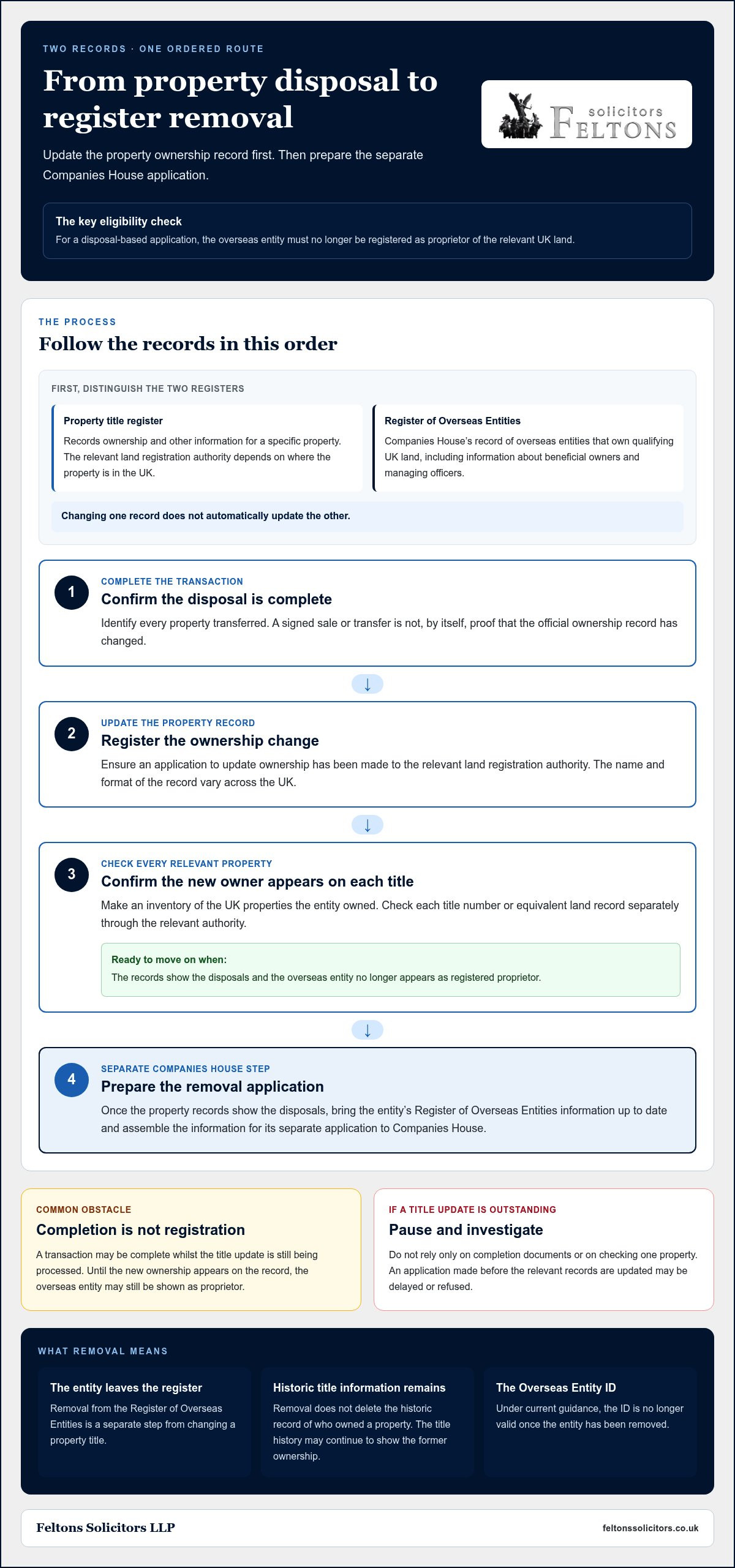
“Land Registry removal” can refer to two different processes: changing the ownership details recorded for a property, or removing an overseas entity from a Companies House register. The processes are connected, but changing one record doesn’t automatically update the other.

Two registers, two purposes

  • Property title register: records the registered ownership and other information for a specific property. The relevant land registration authority maintains it, and the responsible authority depends on where the property is in the UK.
  • Register of Overseas Entities: Companies House’s record of overseas entities that own qualifying UK land, including information about their beneficial owners and managing officers. Companies House is the UK’s registrar of companies; you can find further background on Companies House.

A completed transfer followed by an updated property title changes the ownership record for that property. It does not remove the former owner from the Register of Overseas Entities. That requires a separate application to Companies House, once the eligibility conditions are met. Keeping the two records distinct helps you complete the steps in the right order.

What does removing an overseas entity from the register mean?

Removal means taking the entity off the Register of Overseas Entities, not deleting the historic record of who owned a property. The title history may continue to show the entity’s previous ownership, and information on the public register may remain viewable after removal. Removal also affects the entity’s Overseas Entity ID: under current guidance, the ID is no longer valid once the entity has been removed. Don’t assume the entity can rely on that ID for a future UK land transaction.

When may an overseas entity apply for removal?

For a disposal-based application, the central eligibility test is that the entity is no longer registered as proprietor of relevant UK land. It isn’t enough for a sale or transfer to be signed, or for the parties to consider the transaction complete. The ownership records for the relevant land must reflect the disposal before the entity applies to leave the Companies House register.

This distinction matters when a transaction has completed but the title update is still being processed. Until the register shows the new owner, the public record may still identify the overseas entity as proprietor, creating an obstacle to removal. Check each relevant title rather than relying only on completion documents.

The entity’s registration history also helps explain its reporting obligations and the information held on the register. Feltons’ overseas entity registration guide explains the registration framework for UK property owners. Before preparing a separate Companies House removal application, confirm that each relevant title has been updated.

Before applying to remove an overseas entity, update the property title records

Start with the property records, not the Companies House removal form. Confirm that the completed disposal has been recorded for every relevant property where the overseas entity was registered as proprietor. A signed transfer or sale agreement is evidence of the transaction, but it doesn’t show, by itself, that the public ownership record has changed.

Use this sequence to prepare:

  1. Complete the disposal. Confirm that the transaction has completed and identify each property transferred.
  2. Register the ownership change. Ensure an application to update ownership has been made to the relevant land registration authority. The name and format of the record vary across the UK.
  3. Check every relevant title. Review each title or equivalent land record separately, including properties held under different title numbers.
  4. Prepare for removal. Once the records show the disposals, assemble the information for the separate Companies House application.

The order matters. If an overseas entity applies before the relevant ownership records have been updated, Companies House may be unable to confirm that it meets the removal conditions. The application could be delayed or refused. Resolve the title position first rather than relying on a signed transfer or the parties’ understanding that the sale has completed.

How do you confirm the new owner is recorded?

Make an inventory of the UK properties the entity owned, then identify the title number or equivalent land record for each one. Check the current record through the relevant land registration authority for the property’s jurisdiction. Confirm that the overseas entity no longer appears as the registered proprietor. Checking one property doesn’t confirm the position for the others.

Keep the stages distinct: conveyancing completion concerns the transaction between the parties, while registration updates the official ownership record. The application to register a transfer may still be outstanding after completion. Check the current record before moving to the next stage.

What if a property transfer has not appeared on the register?

Pause the removal application and investigate the outstanding registration. Review the transfer and completion documents, the registration application and any correspondence about requisitions or missing information. This can help establish whether the application is still being processed or whether something needs attention before the title can be updated.

For wider context on ownership records and conveyancing, Feltons’ residential property law guide explains key aspects of residential property transactions. Where several titles or jurisdictions are involved, Feltons’ conveyancing and overseas entity legal support can help coordinate the property records and Companies House steps.

Applying to Companies House After Title Updates

Once the relevant property records reflect the disposals, make the next application to Companies House, not to the land registration authority. These are separate stages: the title update records who owns the property, while Companies House considers whether the overseas entity can be removed from the Register of Overseas Entities.

Before filing, use current Companies House guidance to check the online application route, who is eligible to submit it and what authentication is required. Procedures can change, so don’t rely on an old form or instructions from an earlier filing. Confirm that the entity’s register information is accurate and up to date.

What information should be ready before filing?

Prepare the entity’s identifying details and Overseas Entity ID, then compare the information held by Companies House with the entity’s current records. Check the names and details of beneficial owners and managing officers, including whether any changes need to be reported. The current form and guidance specify what information to supply.

Where information has changed, verification is a key preparation step. Under current requirements, changes to an entity’s information, including new beneficial owners or managing officers, must be verified by a UK-regulated agent no more than three months before the removal application is made. Allow time to organise the evidence and confirm that it relates to the information being filed.

Establish who will submit the application and what evidence of authority to act is required under the current process. A clear file can bring together the entity’s details, relevant ownership information, verification evidence and confirmation that property records have been updated. This helps identify gaps between the conveyancing position and the Companies House filing before submission.

What happens after Companies House receives the application?

Companies House reviews the application against its requirements. It may seek clarification or further information if details are incomplete, inconsistent or need supporting evidence. Respond carefully to any request, and don’t assume that submitting the form means removal has already taken effect.

Removal doesn’t necessarily make information already available on the public register disappear. Treat the application as a change in the entity’s registration status, not as a request to erase its history. Consider what information remains accessible and make sure the entity understands the practical consequences before proceeding.

The Overseas Entity ID is no longer valid after removal. The entity should consider this consequence before applying, especially if it may need to undertake a later transaction involving UK land. For anyone removing overseas entity from land registry records, careful preparation means checking the title position, information and verification together, then following the current Companies House application guidance.

Removing Overseas Entities: UK Land Registry Guide 2026

Common delays when removing an overseas entity from property records

A removal application can be held up when the entity’s property records don’t align with the information filed with Companies House. Use this issue-and-response check to identify what needs attention before submitting.

  • A transfer is still awaiting registration. Check the application status and any correspondence about outstanding requirements. Resolve the registration issue and confirm the current title position before relying on the disposal for a removal application.
  • One property still shows the entity as proprietor. The eligibility test applies across the relevant UK land held by the entity, not just the property most recently sold. Review every property and title, including properties in different parts of the UK. A private sale agreement does not override a public record that still names the entity as registered proprietor.
  • Entity details do not match across records. Compare the entity’s name and identifying details in the property records with its Companies House information and supporting documents. Resolve discrepancies before filing so the application can be assessed against consistent information.
  • Beneficial owner or managing officer details are out of date. Compare the register information with current details and identify any required update. Check Companies House guidance for the applicable verification rules and deadlines. Under current requirements, changes to entity information must be verified by a UK-regulated agent no more than three months before a removal application.
  • An update statement or verification evidence is missing. Establish whether required updates are complete and gather the relevant evidence before applying. An incomplete compliance record or insufficient verification may mean more work is needed before the removal application is ready.

Can an overseas entity be removed if one property is still registered to it?

Generally, no. If a relevant UK property record still lists the entity as proprietor, the entity may not meet the removal eligibility test, even if it has sold its other properties. Resolve the remaining ownership position first, either by completing a disposal or addressing an outstanding title registration. The public proprietor record is central; a contract or private agreement alone does not change it.

What if the entity’s details or verification information have changed?

Check the information held for the entity and relevant people against current records before submission. Changes to beneficial owners or managing officers can affect what needs updating and verifying. Use the latest Companies House guidance to confirm the requirements at the time of filing, rather than relying on old verification documents or a previous application.

There is an additional coordination point if the entity owns or has owned land in more than one UK jurisdiction. England and Wales, Scotland, and Northern Ireland have distinct land registration systems, so the record and process for checking each title may differ. Keep a property-by-property schedule showing the jurisdiction, title reference and current registered proprietor. This helps prevent an overlooked title from undermining an otherwise complete application.

Where multiple titles, inconsistent records or international ownership details make the checks difficult to coordinate, Feltons can assist with overseas entity and property transaction advice to help clarify the next steps.

Coordinating a property disposal with a separate Companies House application can become more involved when the entity has several UK properties, multiple titles or land in different jurisdictions. Legal support can help bring the transaction documents, title position and entity information together, so unresolved issues can be identified before an application is submitted.

Feltons Solicitors advises on overseas entity registration, complex property transactions, and residential and commercial conveyancing. This combination is relevant when work involves both property records and the Register of Overseas Entities. Advice can be tailored to the ownership arrangements and records involved, including where the property history or jurisdiction adds complexity.

What can a solicitor help you coordinate?

A solicitor can review the disposal documents alongside the status of the related title registration, helping establish whether the public record reflects the transaction. They can also help organise entity information and identify inconsistencies or outstanding matters that may need resolution before filing. For multiple properties, this means considering the relevant titles together rather than treating one completed sale as the whole picture.

Where ownership arrangements or jurisdictional requirements are complex, tailored advice can clarify which records and transaction details need attention. This is practical coordination, not a promise that Companies House will accept an application or that a particular result or timescale can be achieved.

What should you prepare for an initial discussion?

A concise file helps make the circumstances easier to assess. Gather the core identification details and documents available, even if you’re unsure which items will be most relevant. The following information provides a useful starting point:

  • Entity details: the overseas entity’s registered name and Overseas Entity ID.
  • Property information: addresses and title references for relevant UK properties, with the jurisdiction of each property noted.
  • Disposal records: signed transfer or sale documents, completion information and correspondence about registration of the ownership change.
  • Title evidence: current title records, equivalent land records or correspondence showing the status of any outstanding registration.
  • Register changes: details of beneficial owners or managing officers who have changed since the entity’s latest filing, alongside any related update or verification information.

You don’t need to resolve every uncertainty before seeking advice. A clear account of what has been sold, what still appears in the property records and what information has changed can focus the discussion on the next steps. This is particularly useful where the entity’s portfolio spans England and Wales, Scotland or Northern Ireland, as each has its own land registration system.

If you’re considering removing overseas entity from land registry records and need to coordinate the property and Companies House aspects, discuss your property records and proposed application with Feltons. Bring the disposal history and available title information so the position can be considered in context.

Make your next step a coordinated one

The point where a disposal, a title update and a register filing meet is often where a tailored legal review can be useful. If you’re considering removing overseas entity from land registry records, bring the property history and the entity’s current position together before deciding how to proceed. A clear view of the matter can help identify outstanding questions and prepare for the next stage.

Feltons advises on overseas entity registration, complex property transactions, and residential and commercial conveyancing. The firm provides pragmatic guidance to domestic and international clients, shaped around the records and ownership arrangements involved.

For advice on your circumstances, discuss your overseas entity and property records with Feltons’ solicitors. A focused conversation can help you establish a practical way forward.

Frequently Asked Questions

Can I remove an overseas entity from the Land Registry after selling a UK property?

You may be able to apply for removal from the Register of Overseas Entities after a sale, once the entity is no longer registered as proprietor of any relevant UK land. A completed sale doesn’t necessarily mean the ownership record has changed. For example, if the buyer’s registration is still pending, the public title may continue to show the seller. Check the relevant records before making a separate Companies House application.

Is the Register of Overseas Entities the same as the Land Registry?

No. The Register of Overseas Entities is maintained by Companies House and records overseas entities that own qualifying UK land, along with relevant ownership information. A property title register records ownership and other details for an individual property. The registers serve different purposes and are updated through separate processes. Changing a property title does not itself change the entity’s status on the Companies House register.

How do I apply to remove an overseas entity from the register?

Apply to Companies House using its current removal process, once the entity meets the eligibility requirements. Before starting, gather its name and Overseas Entity ID, confirm the position of all relevant property records, and review entity and beneficial ownership details for accuracy. Check the latest Companies House instructions for the application route, who may submit it, authentication and any verification evidence required. Requirements should be checked at the time of filing.

What happens if an overseas entity applies before the property title is updated?

If the title still identifies the overseas entity as proprietor, Companies House may be unable to confirm that the entity is eligible for removal. The application could be delayed or refused, leaving the entity to resolve the registration issue and consider what further filing is needed. Check for outstanding correspondence about the title application, such as a request for additional information, before submitting the removal application.

Does removal from the Register of Overseas Entities erase the entity’s public information?

No. Removal changes the entity’s status on the register; it does not necessarily erase information already available about its registration or history. The entity should also consider the effect on its Overseas Entity ID: current guidance says the ID is no longer valid after removal. This matters if the entity may later be involved in a UK land transaction, so consider the consequences before applying.

Can an overseas entity apply for removal if it still owns another UK property?

Generally, no, if it remains registered as proprietor of relevant UK land. Selling one property does not meet the eligibility test if another qualifying property is still registered to the entity. This can be easy to overlook where property is held across different jurisdictions or under separate titles. Check the entity’s full UK property portfolio and resolve any remaining ownership position before applying to Companies House.

Do Scotland and Northern Ireland use the same property register as England and Wales?

No. The UK does not have one single property title register covering all four nations. England and Wales, Scotland, and Northern Ireland have distinct land registration systems, so the relevant authority, record and process depend on where each property is situated. If an entity has held land in more than one jurisdiction, identify and check the corresponding record for every property rather than relying on a search in one system.

Child Maintenance Solicitors: A Guide for UK Parents

Child Maintenance Solicitors: A Guide for UK Parents

A child maintenance figure can look straightforward until you question whether the income or care arrangements behind it are accurate. If you’re considering child maintenance calculation solicitors UK, it helps to understand what the Child Maintenance Service (CMS) assesses and where a solicitor’s role begins.

It’s understandable to feel uncertain when a calculation may affect your child’s day-to-day support, particularly if you and the other parent disagree about the information used. The CMS can calculate and, where needed, collect maintenance. A solicitor does not make or change that assessment, but legal advice may help you understand your options and approach a dispute calmly.

This guide explains the main factors in a CMS calculation, including the paying parent’s income, the number of children, shared care and responsibility for other children. It also compares a CMS assessment with a private, family-based arrangement and sets out practical steps to consider if information or circumstances are disputed. The aim is to help you decide what to do next.

Key Takeaways

  • Understand the information that may shape a CMS calculation, including income and the number of children in the case.
  • Compare a family-based arrangement with a CMS assessment, and consider whether clear communication makes a private agreement workable.
  • If a figure seems wrong, identify the specific concern and gather relevant records before deciding how to raise it.
  • Distinguish inaccurate information from disagreement about how the rules have been applied, as each may call for a different next step.
  • Learn when child maintenance calculation solicitors UK may help clarify disputed circumstances, explain your options and support a proportionate way forward.

Child maintenance calculations in the UK: what the figure is meant to reflect

Parents generally want a fair, understandable contribution towards the costs of raising their child. Child maintenance is financial support paid for a child by a parent who lives apart from them. Parents may agree an amount privately, or use the relevant statutory service for an assessment and, where needed, help managing payments.

An online calculator can provide a useful starting point, but it is not necessarily a formal assessment or final decision. The result depends on the information entered and the rules the calculator applies. If details such as income or overnight care are incomplete or incorrect, the estimate may not reflect the family’s circumstances. A formal assessment follows the applicable process and uses information considered by the relevant service.

Who may need to make or receive child maintenance payments?

Usually, one parent pays maintenance and the other receives it on the child’s behalf, often because the child lives with them for more of the time. The paying parent’s contribution is intended to support the child’s everyday costs. Each family’s care arrangements are different, so a parent’s role as payer or recipient does not, by itself, give the full picture.

Parental responsibility and maintenance are both relevant to a child’s welfare, but they are distinct issues. Paying maintenance does not decide contact, where a child lives or other parenting decisions. Equally, disagreement about time spent with a child does not automatically determine what maintenance is due. Keeping these questions separate can help parents use the appropriate process for each concern.

Which UK service or rules may apply?

The relevant service and procedure can depend on where the child lives within the UK. Different services and procedures apply in different parts of the country. Where parents or children live in different parts of the UK, establish which rules apply before relying on a general online estimate.

The CMS is the statutory service that can assess maintenance and, depending on the arrangement, support collection. It does not perform the same function as a solicitor. A solicitor can advise a parent on the process, the significance of disputed circumstances and practical options, but does not operate the CMS or decide its assessment. For background on the organisation’s history and role, the Child Maintenance Group (CMG) overview provides additional context.

Parents searching for child maintenance calculation solicitors UK may be trying to resolve more than a maths question. Family-law advice can help clarify the relevant procedure when family circumstances, the information being considered or the available next steps are unclear. The aim is to identify the right route, rather than assume every disagreement needs the same response.

How the Child Maintenance Service calculation works

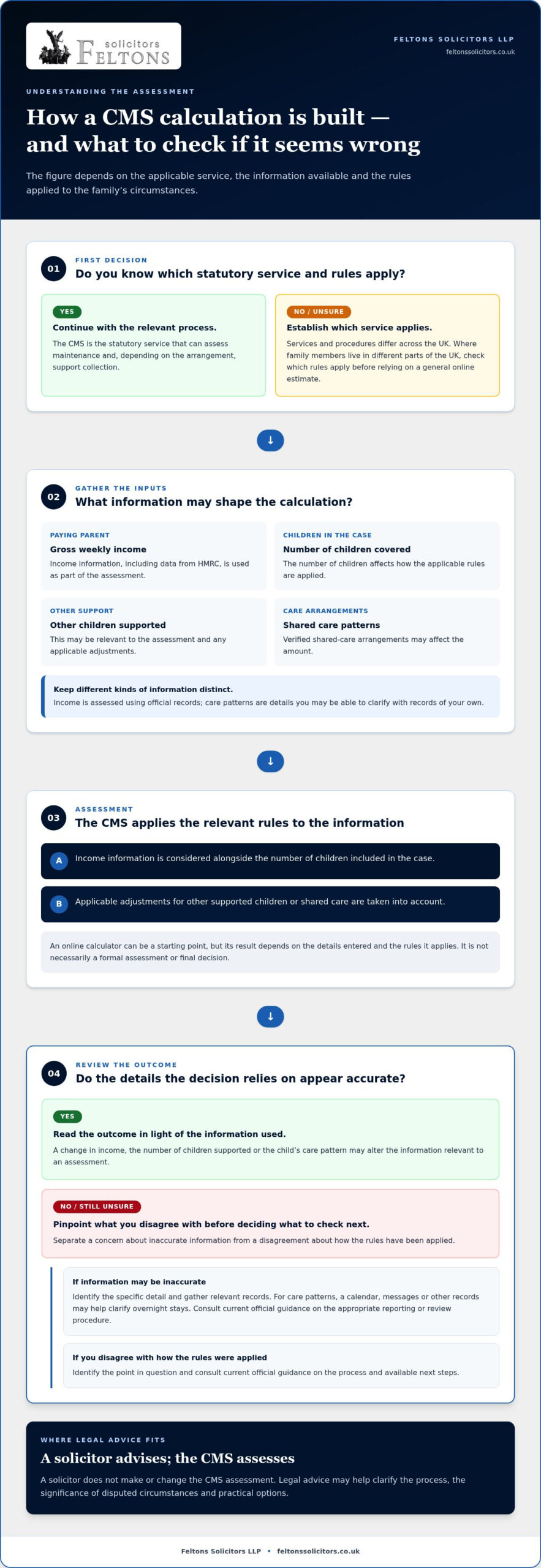
The CMS follows a structured process rather than simply dividing a child’s costs between parents. The result depends on the service’s rules and the information available about income, children and care arrangements. Keeping a clear record of those details can help you understand what a calculation reflects and identify anything that may need checking.

  1. Establish the applicable service. Confirm which statutory service and rules apply to the family’s circumstances. Procedures can differ across the UK, so a general online estimate may not reflect the relevant process.
  2. Gather information. The service needs details about the paying parent’s income and the children covered by the case. Information about other children they support and the child’s care arrangements may also be relevant.
  3. Assess the inputs. The CMS uses income information, including data from HMRC, as part of its assessment. It applies the relevant rules to the case, taking account of the number of children and any applicable adjustments for other supported children or shared care.
  4. Review the decision. Read the outcome and check whether the details it relies on appear accurate. If circumstances or information are disputed, identify the issue and consult current official guidance on the appropriate reporting or review procedure.

In short, a CMS calculation can depend on the paying parent’s gross income, the number of children in the case, support for other children and verified shared-care arrangements. For an authoritative explanation of the process and current rules, consult the Child Maintenance Service (CMS) official guidance.

Which income and family details can affect the figure?

The service assesses income under the rules that apply to the case. Gross weekly income is a key input, and the number of children included in the calculation can affect how the rules are applied. Distinguish information you know directly, such as care patterns, from income figures assessed using official records.

Other children supported by the paying parent may also be relevant. Shared care can affect the amount, but the service needs reliable information about the arrangement. If parents remember overnight stays differently, a calendar, messages or other records may help clarify the pattern. Don’t assume an informal estimate has already taken these factors into account.

What can change after an initial calculation?

A change in income, the number of children supported or the child’s care pattern may alter the information relevant to an assessment. An online estimate is not the same as a CMS decision, however, and a change in circumstances does not by itself confirm how or when an official figure will be adjusted.

Make a note of what has changed and when, then check the current CMS process for reporting changes or requesting a review. Procedures can change, so avoid relying on outdated advice about deadlines or review routes. If the facts are contested or the next step is unclear, tailored family-law advice can help you understand your options and approach the issue proportionately. This may be especially useful when the information behind the figure is disputed.

CMS assessment, private agreement or solicitor advice: how to tell them apart

These routes serve different purposes. A family-based arrangement lets parents agree how to provide support; a CMS assessment applies statutory rules; solicitor advice helps a parent understand their position and options. A calculator can give an estimate, but it cannot explain every legal or factual concern, such as whether the information entered accurately reflects income or care.

Route What it does Points to consider
Family-based arrangement Parents agree the amount, payment method and practical details directly. Flexible, but depends on clear communication and an arrangement both parents can manage.
CMS assessment The Child Maintenance Service assesses maintenance under the applicable rules and may arrange collection. The outcome depends on the information and rules used. A calculator estimate is not itself a formal decision.
Solicitor advice A solicitor can help explain relevant facts, documents and options. A solicitor does not operate the CMS or set its figure.

When might a family-based arrangement suit both parents?

A direct agreement may work when parents can discuss the child’s needs and reach a practical understanding without undue pressure. They can agree an amount and payment approach that fits their circumstances, then keep a written record of what they’ve decided, when payments are due and how they’ll revisit the arrangement if circumstances change.

Flexibility has limits. If communication involves intimidation, pressure or serious conflict, negotiating privately may not feel safe or workable. A private agreement is not automatically the right route simply because it seems straightforward. The child’s needs and each parent’s circumstances matter.

What can a solicitor add to a CMS calculation?

Legal advice can help make a complicated concern more precise. For example, a parent might be unsure whether income information is complete, whether care details have been recorded correctly or what a decision means. A solicitor can help organise relevant documents, identify questions to raise and explain available options, without promising that an assessment will change.

The distinction matters: the CMS makes its assessment under the rules it applies, while a solicitor advises on the parent’s circumstances and possible next steps. Child maintenance calculation solicitors UK may be relevant when facts are disputed or a parent needs help understanding how maintenance fits alongside wider family finances. Feltons’ guide to divorce and financial arrangements provides related context for parents considering the financial issues that can arise around separation.

Child Maintenance Solicitors: A Guide for UK Parents

What to do if a child maintenance calculation seems wrong

A figure that doesn’t match your understanding of the family’s circumstances can be worrying. Before responding, pinpoint what seems wrong and distinguish a factual error from disagreement about how the rules have been applied. These concerns may need different routes, and the right procedure depends on the decision and the jurisdiction involved.

Work through the concern methodically:

  • Identify the issue. Is the income information inaccurate, has a care arrangement been misunderstood, or do you disagree with how the rules were applied?
  • Gather relevant records. Collect documents that relate directly to the point, rather than sending a large bundle of unrelated material.
  • Check the stated facts. Compare the decision or correspondence with your own records and note any specific difference.
  • Consider the proper route. Check current official guidance for the relevant service and decision before raising a concern or requesting a review.

Don’t assume every concern is an appeal, or that an online estimate can be challenged in the same way as a formal decision. Procedures, review routes and any time limits can depend on the decision and where the case is handled. Verify these details using current official guidance before taking action. No particular outcome can be guaranteed, but a clear explanation supported by relevant records can make the issue easier to understand.

What information should you organise before raising a concern?

Bring together income records relevant to the point in question, CMS correspondence and details of the child’s care arrangements. If the concern relates to a change, note what happened and when, then create a concise timeline of events and decisions. Keep original documents accessible and work from copies where possible. Choose evidence that directly supports the issue, such as records of care dates if overnight arrangements are disputed.

A focused record helps separate what you know from what you believe may have happened. For example, note the income figure shown in the decision, the figure you think is incorrect and the document that supports your concern. This makes it easier to explain the discrepancy and keep attention on the question that needs answering.

How can parents manage communication during a disagreement?

Keep messages factual, respectful and centred on the child’s needs. Confirm important discussions in writing, including what was agreed or remains unresolved, and retain copies of relevant correspondence. Avoid mixing a maintenance concern with disagreements about contact or other parenting decisions. If direct discussion feels unsafe, pressured or unproductive, you don’t have to resolve the issue through informal negotiation alone.

Separate legal advice can help you understand the available options and prepare a clear account of the disagreement. Broader financial questions can also arise around separation, including issues addressed in Feltons’ divorce and financial arrangements guidance. Tailored advice may help where the facts are contested or the appropriate next step is unclear.

If you need help making sense of disputed information or your options, discuss your child maintenance concerns with Feltons.

How child maintenance calculation solicitors can help you decide what comes next

Tailored legal advice may be useful if the information behind a calculation is disputed, family circumstances are complex or you’re unsure which route to take. A solicitor can help you understand the process, organise relevant facts and consider proportionate next steps. They do not make the CMS assessment, and seeking advice does not guarantee that the CMS will reach a different decision.

The value is clarity. You may be better able to distinguish a factual concern, such as care details that do not match your records, from a question about how the rules apply. That can help you decide whether to seek clarification, explore another available route or take no further step for now.

What should you expect from an initial legal discussion?

A useful discussion starts with your concern and priorities. You may be asked which decision or estimate you’re looking at, which facts you believe are inaccurate, what records you have and what outcome you hope to achieve. Bringing relevant correspondence and a short timeline can keep the conversation focused on the issue that matters to you.

The discussion can then consider available routes and practical points, including what information may be relevant and what questions remain unanswered. Advice should be tailored to your circumstances and explain uncertainty plainly. It is an opportunity to understand your options, not a promise of a particular result or a commitment to challenge every assessment.

When is it sensible to seek advice?

Consider advice if a disagreement continues despite attempts to clarify the facts, income information is difficult to understand or you’re uncertain about the meaning or implications of a formal decision. It may also help when care arrangements or wider family finances make the issue harder to assess. Early guidance can help you understand your options before taking a further step, particularly when timing or the correct procedure needs checking against current official guidance.

For parents searching for child maintenance calculation solicitors UK, the aim should be a practical understanding of the individual situation, not an assumption that legal advice will alter the CMS figure. Feltons provides family-law advice tailored to individual circumstances and can help you consider a measured way forward.

If you’re unsure how to proceed, discuss your family-law circumstances with Feltons.

Choose a practical next step for your family

Before taking action, decide what you most need clarity on: the information behind a figure, the route available to you or how a maintenance concern fits alongside wider financial decisions after separation. Focusing on that question can help keep the next conversation constructive and centred on what will support your child.

Parents looking for child maintenance calculation solicitors UK may value advice that considers the detail of their circumstances rather than treating every disagreement alike. Feltons provides advice on divorce and financial arrangements, with a pragmatic approach tailored to individual needs. Legal advice can help you understand your options, but it cannot guarantee a different CMS decision.

If you’d like to consider your position and possible next steps, discuss your family-law circumstances with Feltons. A clear, measured conversation can help you move forward with greater confidence.

Frequently Asked Questions

How is child maintenance calculated in the UK?

For a CMS assessment, the amount is based mainly on the paying parent’s gross weekly income and the number of children covered by the case. The applicable rate also depends on the income band, with adjustments possible for other children the paying parent supports and shared care. For example, an assessment may differ from an online estimate if the income information or overnight-care details entered into the calculator do not match the records considered by the service.

Can a solicitor calculate child maintenance for me?

A solicitor can help you understand an estimate and the information that may affect it, but only the relevant statutory service makes a CMS assessment. Advice may be useful if you’re unsure how income records, care details or other family circumstances fit the rules. Parents looking for child maintenance calculation solicitors UK should expect practical guidance on options and evidence, not a guarantee that the CMS will set or change a particular figure.

Does shared care reduce child maintenance?

It can. Under CMS rules, a reduction may apply when the paying parent cares for the child overnight for a qualifying number of nights. For example, the shared-care reduction begins at 52 nights a year. Daytime visits alone do not count towards an overnight total, so keep a clear record of nights spent with each parent if the care pattern is disputed. The applicable reduction depends on the relevant rules and the verified arrangement.

Can parents agree a different amount from the CMS calculation?

Parents can make a private family-based arrangement that differs from a CMS estimate if both freely agree and the arrangement is workable. They might agree how regular payments will be made or how particular child-related costs will be shared. A private agreement is generally not enforceable in the same way as a formal order. If circumstances change or payments stop, parents may need to reconsider how maintenance is arranged.

What can I do if I think the child maintenance calculation is wrong?

First identify whether the problem is a factual error, such as an income figure that appears inconsistent with a payslip, or a concern about how the rules were applied. Keep the decision letter and records that relate directly to the issue. Then check the current review or challenge route for the service and jurisdiction involved. Procedures and deadlines can vary, so don’t rely on an estimate or general advice for a formal decision.

Does a new partner’s income affect child maintenance?

A new partner’s income is not usually included as the paying parent’s income in a CMS calculation. The assessment focuses on the paying parent’s financial information under the applicable rules. However, family circumstances can still matter in other ways. For example, the rules may take account of other children supported in the paying parent’s household. If a new household arrangement affects the facts of your case, check how the relevant service treats it.

How often can child maintenance be reviewed?

A CMS case is normally reviewed annually. Between reviews, a change in the paying parent’s income may lead to a reassessment if it meets the applicable threshold. Under current rules, a change of 25% or more can trigger recalculation. Other relevant changes may also need to be reported. As review rules can change and procedures depend on the service handling the case, check current official guidance before relying on a particular timetable.