

A child maintenance figure can look straightforward until you question whether the income or care arrangements behind it are accurate. If you’re considering child maintenance calculation solicitors UK, it helps to understand what the Child Maintenance Service (CMS) assesses and where a solicitor’s role begins.
It’s understandable to feel uncertain when a calculation may affect your child’s day-to-day support, particularly if you and the other parent disagree about the information used. The CMS can calculate and, where needed, collect maintenance. A solicitor does not make or change that assessment, but legal advice may help you understand your options and approach a dispute calmly.
This guide explains the main factors in a CMS calculation, including the paying parent’s income, the number of children, shared care and responsibility for other children. It also compares a CMS assessment with a private, family-based arrangement and sets out practical steps to consider if information or circumstances are disputed. The aim is to help you decide what to do next.
Key Takeaways
- Understand the information that may shape a CMS calculation, including income and the number of children in the case.
- Compare a family-based arrangement with a CMS assessment, and consider whether clear communication makes a private agreement workable.
- If a figure seems wrong, identify the specific concern and gather relevant records before deciding how to raise it.
- Distinguish inaccurate information from disagreement about how the rules have been applied, as each may call for a different next step.
- Learn when child maintenance calculation solicitors UK may help clarify disputed circumstances, explain your options and support a proportionate way forward.
Child maintenance calculations in the UK: what the figure is meant to reflect
Parents generally want a fair, understandable contribution towards the costs of raising their child. Child maintenance is financial support paid for a child by a parent who lives apart from them. Parents may agree an amount privately, or use the relevant statutory service for an assessment and, where needed, help managing payments.
An online calculator can provide a useful starting point, but it is not necessarily a formal assessment or final decision. The result depends on the information entered and the rules the calculator applies. If details such as income or overnight care are incomplete or incorrect, the estimate may not reflect the family’s circumstances. A formal assessment follows the applicable process and uses information considered by the relevant service.
Who may need to make or receive child maintenance payments?
Usually, one parent pays maintenance and the other receives it on the child’s behalf, often because the child lives with them for more of the time. The paying parent’s contribution is intended to support the child’s everyday costs. Each family’s care arrangements are different, so a parent’s role as payer or recipient does not, by itself, give the full picture.
Parental responsibility and maintenance are both relevant to a child’s welfare, but they are distinct issues. Paying maintenance does not decide contact, where a child lives or other parenting decisions. Equally, disagreement about time spent with a child does not automatically determine what maintenance is due. Keeping these questions separate can help parents use the appropriate process for each concern.
Which UK service or rules may apply?
The relevant service and procedure can depend on where the child lives within the UK. Different services and procedures apply in different parts of the country. Where parents or children live in different parts of the UK, establish which rules apply before relying on a general online estimate.
The CMS is the statutory service that can assess maintenance and, depending on the arrangement, support collection. It does not perform the same function as a solicitor. A solicitor can advise a parent on the process, the significance of disputed circumstances and practical options, but does not operate the CMS or decide its assessment. For background on the organisation’s history and role, the Child Maintenance Group (CMG) overview provides additional context.
Parents searching for child maintenance calculation solicitors UK may be trying to resolve more than a maths question. Family-law advice can help clarify the relevant procedure when family circumstances, the information being considered or the available next steps are unclear. The aim is to identify the right route, rather than assume every disagreement needs the same response.
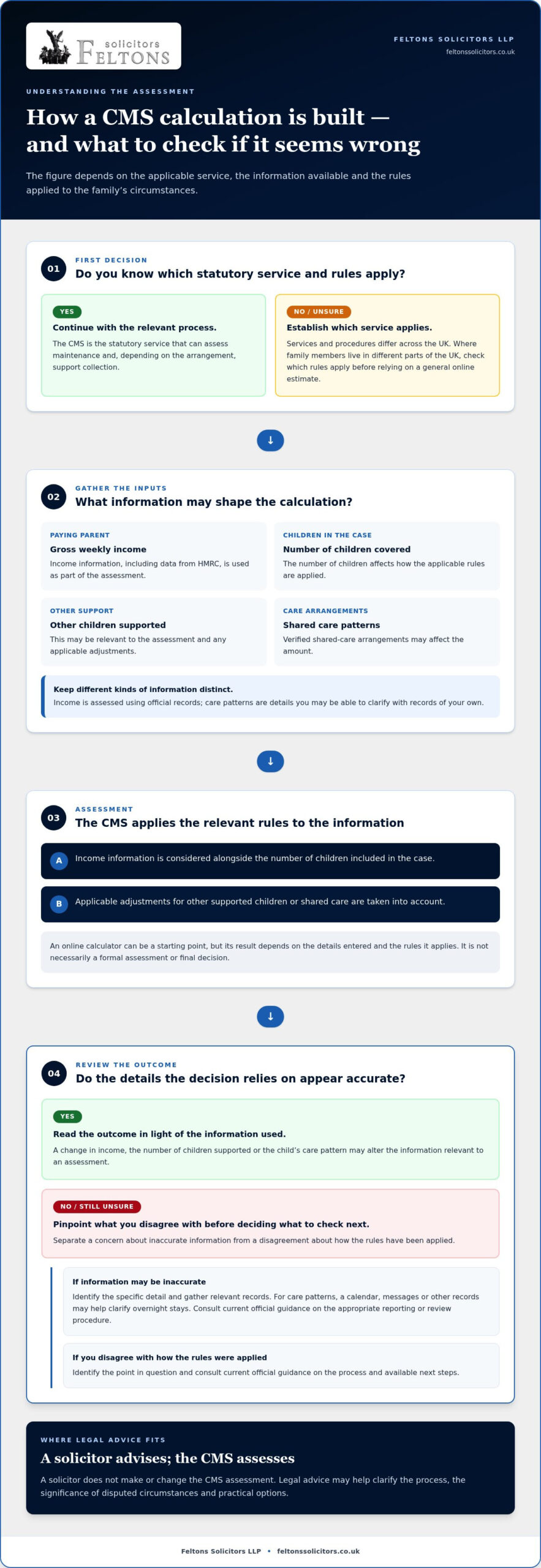
How the Child Maintenance Service calculation works
The CMS follows a structured process rather than simply dividing a child’s costs between parents. The result depends on the service’s rules and the information available about income, children and care arrangements. Keeping a clear record of those details can help you understand what a calculation reflects and identify anything that may need checking.
- Establish the applicable service. Confirm which statutory service and rules apply to the family’s circumstances. Procedures can differ across the UK, so a general online estimate may not reflect the relevant process.
- Gather information. The service needs details about the paying parent’s income and the children covered by the case. Information about other children they support and the child’s care arrangements may also be relevant.
- Assess the inputs. The CMS uses income information, including data from HMRC, as part of its assessment. It applies the relevant rules to the case, taking account of the number of children and any applicable adjustments for other supported children or shared care.
- Review the decision. Read the outcome and check whether the details it relies on appear accurate. If circumstances or information are disputed, identify the issue and consult current official guidance on the appropriate reporting or review procedure.
In short, a CMS calculation can depend on the paying parent’s gross income, the number of children in the case, support for other children and verified shared-care arrangements. For an authoritative explanation of the process and current rules, consult the Child Maintenance Service (CMS) official guidance.
Which income and family details can affect the figure?
The service assesses income under the rules that apply to the case. Gross weekly income is a key input, and the number of children included in the calculation can affect how the rules are applied. Distinguish information you know directly, such as care patterns, from income figures assessed using official records.
Other children supported by the paying parent may also be relevant. Shared care can affect the amount, but the service needs reliable information about the arrangement. If parents remember overnight stays differently, a calendar, messages or other records may help clarify the pattern. Don’t assume an informal estimate has already taken these factors into account.
What can change after an initial calculation?
A change in income, the number of children supported or the child’s care pattern may alter the information relevant to an assessment. An online estimate is not the same as a CMS decision, however, and a change in circumstances does not by itself confirm how or when an official figure will be adjusted.
Make a note of what has changed and when, then check the current CMS process for reporting changes or requesting a review. Procedures can change, so avoid relying on outdated advice about deadlines or review routes. If the facts are contested or the next step is unclear, tailored family-law advice can help you understand your options and approach the issue proportionately. This may be especially useful when the information behind the figure is disputed.
CMS assessment, private agreement or solicitor advice: how to tell them apart
These routes serve different purposes. A family-based arrangement lets parents agree how to provide support; a CMS assessment applies statutory rules; solicitor advice helps a parent understand their position and options. A calculator can give an estimate, but it cannot explain every legal or factual concern, such as whether the information entered accurately reflects income or care.
| Route | What it does | Points to consider |
|---|---|---|
| Family-based arrangement | Parents agree the amount, payment method and practical details directly. | Flexible, but depends on clear communication and an arrangement both parents can manage. |
| CMS assessment | The Child Maintenance Service assesses maintenance under the applicable rules and may arrange collection. | The outcome depends on the information and rules used. A calculator estimate is not itself a formal decision. |
| Solicitor advice | A solicitor can help explain relevant facts, documents and options. | A solicitor does not operate the CMS or set its figure. |
When might a family-based arrangement suit both parents?
A direct agreement may work when parents can discuss the child’s needs and reach a practical understanding without undue pressure. They can agree an amount and payment approach that fits their circumstances, then keep a written record of what they’ve decided, when payments are due and how they’ll revisit the arrangement if circumstances change.
Flexibility has limits. If communication involves intimidation, pressure or serious conflict, negotiating privately may not feel safe or workable. A private agreement is not automatically the right route simply because it seems straightforward. The child’s needs and each parent’s circumstances matter.
What can a solicitor add to a CMS calculation?
Legal advice can help make a complicated concern more precise. For example, a parent might be unsure whether income information is complete, whether care details have been recorded correctly or what a decision means. A solicitor can help organise relevant documents, identify questions to raise and explain available options, without promising that an assessment will change.
The distinction matters: the CMS makes its assessment under the rules it applies, while a solicitor advises on the parent’s circumstances and possible next steps. Child maintenance calculation solicitors UK may be relevant when facts are disputed or a parent needs help understanding how maintenance fits alongside wider family finances. Feltons’ guide to divorce and financial arrangements provides related context for parents considering the financial issues that can arise around separation.
What to do if a child maintenance calculation seems wrong
A figure that doesn’t match your understanding of the family’s circumstances can be worrying. Before responding, pinpoint what seems wrong and distinguish a factual error from disagreement about how the rules have been applied. These concerns may need different routes, and the right procedure depends on the decision and the jurisdiction involved.
Work through the concern methodically:
- Identify the issue. Is the income information inaccurate, has a care arrangement been misunderstood, or do you disagree with how the rules were applied?
- Gather relevant records. Collect documents that relate directly to the point, rather than sending a large bundle of unrelated material.
- Check the stated facts. Compare the decision or correspondence with your own records and note any specific difference.
- Consider the proper route. Check current official guidance for the relevant service and decision before raising a concern or requesting a review.
Don’t assume every concern is an appeal, or that an online estimate can be challenged in the same way as a formal decision. Procedures, review routes and any time limits can depend on the decision and where the case is handled. Verify these details using current official guidance before taking action. No particular outcome can be guaranteed, but a clear explanation supported by relevant records can make the issue easier to understand.
What information should you organise before raising a concern?
Bring together income records relevant to the point in question, CMS correspondence and details of the child’s care arrangements. If the concern relates to a change, note what happened and when, then create a concise timeline of events and decisions. Keep original documents accessible and work from copies where possible. Choose evidence that directly supports the issue, such as records of care dates if overnight arrangements are disputed.
A focused record helps separate what you know from what you believe may have happened. For example, note the income figure shown in the decision, the figure you think is incorrect and the document that supports your concern. This makes it easier to explain the discrepancy and keep attention on the question that needs answering.
How can parents manage communication during a disagreement?
Keep messages factual, respectful and centred on the child’s needs. Confirm important discussions in writing, including what was agreed or remains unresolved, and retain copies of relevant correspondence. Avoid mixing a maintenance concern with disagreements about contact or other parenting decisions. If direct discussion feels unsafe, pressured or unproductive, you don’t have to resolve the issue through informal negotiation alone.
Separate legal advice can help you understand the available options and prepare a clear account of the disagreement. Broader financial questions can also arise around separation, including issues addressed in Feltons’ divorce and financial arrangements guidance. Tailored advice may help where the facts are contested or the appropriate next step is unclear.
If you need help making sense of disputed information or your options, discuss your child maintenance concerns with Feltons.
How child maintenance calculation solicitors can help you decide what comes next
Tailored legal advice may be useful if the information behind a calculation is disputed, family circumstances are complex or you’re unsure which route to take. A solicitor can help you understand the process, organise relevant facts and consider proportionate next steps. They do not make the CMS assessment, and seeking advice does not guarantee that the CMS will reach a different decision.
The value is clarity. You may be better able to distinguish a factual concern, such as care details that do not match your records, from a question about how the rules apply. That can help you decide whether to seek clarification, explore another available route or take no further step for now.
What should you expect from an initial legal discussion?
A useful discussion starts with your concern and priorities. You may be asked which decision or estimate you’re looking at, which facts you believe are inaccurate, what records you have and what outcome you hope to achieve. Bringing relevant correspondence and a short timeline can keep the conversation focused on the issue that matters to you.
The discussion can then consider available routes and practical points, including what information may be relevant and what questions remain unanswered. Advice should be tailored to your circumstances and explain uncertainty plainly. It is an opportunity to understand your options, not a promise of a particular result or a commitment to challenge every assessment.
When is it sensible to seek advice?
Consider advice if a disagreement continues despite attempts to clarify the facts, income information is difficult to understand or you’re uncertain about the meaning or implications of a formal decision. It may also help when care arrangements or wider family finances make the issue harder to assess. Early guidance can help you understand your options before taking a further step, particularly when timing or the correct procedure needs checking against current official guidance.
For parents searching for child maintenance calculation solicitors UK, the aim should be a practical understanding of the individual situation, not an assumption that legal advice will alter the CMS figure. Feltons provides family-law advice tailored to individual circumstances and can help you consider a measured way forward.
If you’re unsure how to proceed, discuss your family-law circumstances with Feltons.
Choose a practical next step for your family
Before taking action, decide what you most need clarity on: the information behind a figure, the route available to you or how a maintenance concern fits alongside wider financial decisions after separation. Focusing on that question can help keep the next conversation constructive and centred on what will support your child.
Parents looking for child maintenance calculation solicitors UK may value advice that considers the detail of their circumstances rather than treating every disagreement alike. Feltons provides advice on divorce and financial arrangements, with a pragmatic approach tailored to individual needs. Legal advice can help you understand your options, but it cannot guarantee a different CMS decision.
If you’d like to consider your position and possible next steps, discuss your family-law circumstances with Feltons. A clear, measured conversation can help you move forward with greater confidence.
Frequently Asked Questions
How is child maintenance calculated in the UK?
For a CMS assessment, the amount is based mainly on the paying parent’s gross weekly income and the number of children covered by the case. The applicable rate also depends on the income band, with adjustments possible for other children the paying parent supports and shared care. For example, an assessment may differ from an online estimate if the income information or overnight-care details entered into the calculator do not match the records considered by the service.
Can a solicitor calculate child maintenance for me?
A solicitor can help you understand an estimate and the information that may affect it, but only the relevant statutory service makes a CMS assessment. Advice may be useful if you’re unsure how income records, care details or other family circumstances fit the rules. Parents looking for child maintenance calculation solicitors UK should expect practical guidance on options and evidence, not a guarantee that the CMS will set or change a particular figure.
Does shared care reduce child maintenance?
It can. Under CMS rules, a reduction may apply when the paying parent cares for the child overnight for a qualifying number of nights. For example, the shared-care reduction begins at 52 nights a year. Daytime visits alone do not count towards an overnight total, so keep a clear record of nights spent with each parent if the care pattern is disputed. The applicable reduction depends on the relevant rules and the verified arrangement.
Can parents agree a different amount from the CMS calculation?
Parents can make a private family-based arrangement that differs from a CMS estimate if both freely agree and the arrangement is workable. They might agree how regular payments will be made or how particular child-related costs will be shared. A private agreement is generally not enforceable in the same way as a formal order. If circumstances change or payments stop, parents may need to reconsider how maintenance is arranged.
What can I do if I think the child maintenance calculation is wrong?
First identify whether the problem is a factual error, such as an income figure that appears inconsistent with a payslip, or a concern about how the rules were applied. Keep the decision letter and records that relate directly to the issue. Then check the current review or challenge route for the service and jurisdiction involved. Procedures and deadlines can vary, so don’t rely on an estimate or general advice for a formal decision.
Does a new partner’s income affect child maintenance?
A new partner’s income is not usually included as the paying parent’s income in a CMS calculation. The assessment focuses on the paying parent’s financial information under the applicable rules. However, family circumstances can still matter in other ways. For example, the rules may take account of other children supported in the paying parent’s household. If a new household arrangement affects the facts of your case, check how the relevant service treats it.
How often can child maintenance be reviewed?
A CMS case is normally reviewed annually. Between reviews, a change in the paying parent’s income may lead to a reassessment if it meets the applicable threshold. Under current rules, a change of 25% or more can trigger recalculation. Other relevant changes may also need to be reported. As review rules can change and procedures depend on the service handling the case, check current official guidance before relying on a particular timetable.