

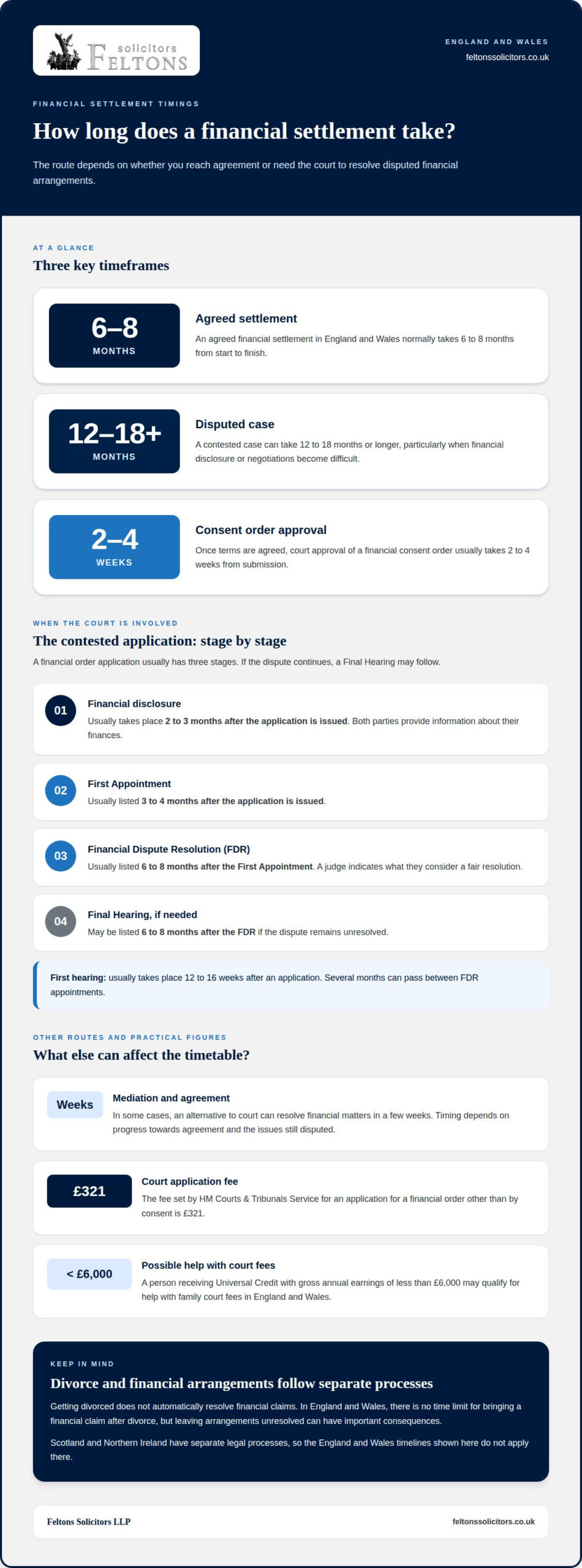
An agreed financial settlement in England and Wales normally takes 6 to 8 months from start to finish. If you’re asking how long a divorce financial settlement takes, a disputed case can take 12 to 18 months or longer, particularly if financial disclosure or negotiations become difficult. Once terms are agreed, court approval of a consent order usually takes 2 to 4 weeks from submission.
The divorce timetable and the financial process are separate, so getting divorced doesn’t automatically resolve claims between you. In England and Wales, there’s no time limit for bringing a financial claim after divorce, but leaving arrangements unresolved can have important consequences. This article explains what affects timing, how consent orders and court disputes fit into the process, and what to consider if you need to claim after divorce.
Key Takeaways
- Identify whether an agreed order or a court application is likely to shape your route, as each follows a different process.
- Understand how full financial disclosure and disagreements over property, pensions or maintenance can affect progress.
- Learn why recording arrangements in a binding order matters, including when a financial claim is considered after divorce.
- Find out when support with divorce and financial arrangements can help you address complex issues and move towards a clear outcome.
How long will it take to get my financial settlement?
An agreed settlement may take less time than court proceedings, where disclosure, hearings and unresolved issues affect progress. In England and Wales, a first court hearing usually takes place 12 to 16 weeks after an application.
-
How a solicitor can advise on an agreement or court route
Ask a solicitor to assess whether negotiation, mediation or a court application suits your circumstances. If you agree, the terms can be recorded in a consent order. If disputes remain, you may need to apply for a financial order and attend court hearings. The court process usually has three stages, including a Financial Dispute Resolution (FDR) appointment, where a judge indicates what they consider a fair resolution.
Scotland and Northern Ireland have separate legal processes, so the timelines for England and Wales do not apply there. The route and progress depend on local procedure and whether both parties reach agreement.
-
How a solicitor can explain court fees and division factors
Ask for the relevant court fee and likely stages to be explained before proceedings begin. HM Courts & Tribunals Service sets the fee for an application for a financial order, other than by consent (fees order 5.4), at £321. A person receiving Universal Credit with gross annual earnings of less than £6,000 may qualify for help with family court fees in England and Wales, according to HM Courts & Tribunals Service.
The court considers matters under section 25 of the Matrimonial Causes Act 1973, including the parties’ financial circumstances and needs. It gives priority to minor children’s interests, including their accommodation. A parent’s housing needs can therefore form part of the court’s assessment.
-
Estimate mediation and consent order times
Allow time for mediation discussions to identify and resolve outstanding issues. In some cases, an alternative to court can resolve financial matters in a few weeks. The timing depends on progress towards agreement and the issues that remain disputed.
Once both parties agree, court approval of a financial consent order usually takes 2 to 4 weeks from submission. A contested application takes longer: the first hearing is usually 12 to 16 weeks after the application, and several months can pass between FDR appointments. If an application proceeds, the court fee for a financial order other than by consent is £321.
Types of financial orders
Choose the order that reflects the arrangements you have agreed or the issue still in dispute. In England and Wales, the order sought shapes the application and the court process.
-
Identify the relevant financial order
Ask a solicitor to identify which financial order matches the outcome you need. The Matrimonial Causes Act provides for periodical payments, including monthly child or spousal maintenance, under section 23(1)(a), and lump sum orders under section 23(1)(c). Property transfer orders are provided for under section 24, while pension-sharing orders are provided for under section 25A.
Consider whether the arrangements need to cover income, capital, a home or pensions. A consent order can record terms you both accept. If agreement is not possible, you may need to apply to the court.
-
How a solicitor can apply for a consent order
Once you and your former spouse have agreed on the financial arrangements, ask your solicitor to prepare the application. The proposed order and supporting statement should clearly reflect the agreed terms. A court can approve a consent order without either party attending a hearing, provided the documents and order are in order.
Consent orders have been submitted through an online court portal since April 2022. Aim to have the order considered before applying for the final order, so your financial arrangements are addressed as part of the divorce process.
- Allow time for each stage if the order is contested. A financial order application usually has three stages: financial disclosure, a First Appointment and a Financial Dispute Resolution (FDR) appointment. Disclosure usually takes place 2 to 3 months after the application is issued, and the First Appointment is usually listed 3 to 4 months after issue.
If the dispute remains, an FDR is usually listed 6 to 8 months after the First Appointment. A Final Hearing may then be listed 6 to 8 months after the FDR. Contested proceedings can take 12 to 18 months or more, particularly if a spouse is unwilling to disclose their financial position. A solicitor can explain the application route and the statement required for the order.
Financial disclosure and disputes over property, pensions or maintenance
Complete financial disclosure so negotiations or a court application can address the assets, income and needs involved. In contested proceedings, financial disclosure is usually exchanged 2 to 3 months after the application is issued.
-
Identify assets and financial details
Ask your solicitor to build a clear picture of the finances, including property, savings, debts, income and pensions. Full and frank financial disclosure from both spouses helps show what is available and where figures differ. Include assets held individually as well as jointly, so discussions consider the complete financial position.
Where children need accommodation, their needs may affect how the court assesses proposed arrangements. Identify disputed figures early, such as a property value or pension entitlement, rather than treating an unresolved estimate as agreed.
-
How a solicitor can help gather financial documentation
Provide documents to support each figure in the financial statement. These may include bank statements, mortgage details, property information, pension valuations, payslips and evidence of regular outgoings. Your solicitor can organise the material and identify gaps or inconsistencies that may delay full disclosure.
For example, discussions about a pension may pause while you wait for a current Cash Equivalent Transfer Value. Pension providers can take many months to provide that figure, affecting when both parties can assess proposals.
-
How a solicitor can help complete Form E
In court proceedings, Form E sets out each party’s financial circumstances for the court process. A judge may direct both parties to complete it by a deadline. Work with your solicitor to ensure the figures and supporting documents give a consistent account of income, assets, pensions, liabilities and needs.
For an agreed consent order, Form D81 provides a summary of the parties’ financial positions. Keep its figures consistent with the proposed arrangements and supporting information, so the court can consider the order alongside the statement.
-
Address property, pension and maintenance disputes
Ask your solicitor to identify precisely what remains disputed: the home’s value, how a pension should be divided, or the level of maintenance. Each issue may require further documents, valuation evidence or negotiation before the parties can decide on terms.
Family law considers financial needs and, where relevant, children’s welfare. If disclosure is incomplete or pension information is outstanding, resolution may take longer because proposals need to reflect the available evidence.
Claiming a financial settlement after divorce
Divorce and financial arrangements are separate matters in England and Wales. A divorce final order does not, by itself, record how assets or income will be divided.
- Establish whether financial claims were resolved. Check whether a court order dealt with the marriage’s finances, rather than relying only on an informal agreement. A binding order can set out arrangements and dismiss each party’s financial claims, providing finality. Without an order, financial claims may remain possible after divorce, even if you have been separated for some time.
- Get advice before making decisions about a later claim. In England and Wales, there is no time limit for bringing a financial claim after divorce. However, the outcome depends on the circumstances, including the parties’ finances and needs. The court’s approach is discretionary, not an automatic division of assets. A former spouse’s income, housing needs and the needs of any children can affect the issues considered.
- Consider the timing of the final order. Financial arrangements can be addressed before the divorce is finalised. According to the Ministry of Justice, a conditional order may not be made final before the end of the period of 6 weeks from the making of the conditional order. A financial order takes effect only after the final order, or decree absolute under the former process. Timing the financial order and divorce steps can therefore matter.
- Clarify what any existing order covers. Review whether it deals with property, pensions and maintenance, rather than assuming that child maintenance resolves every financial claim. If circumstances have changed since separation, such as income or housing needs, explain that history when obtaining legal advice. A solicitor can assess whether a claim remains open and which financial arrangements need addressing.
For advice on your circumstances and a possible financial claim, speak to a solicitor about your financial arrangements.
Feltons Solicitors LLP: Divorce and Financial Arrangements
Feltons Solicitors LLP advises on divorce and financial arrangements, including resolving financial claims and recording agreed terms in a consent order. Consider seeking legal support if discussions have stalled, financial disclosure is incomplete, or you are unsure whether a previous order gives you a clean break.
A solicitor can assess the issues affecting your circumstances, explain the available routes and guide you through preparing financial arrangements. This can be particularly useful where property, pensions, maintenance or children’s needs make agreement more complex. If you are considering a claim after divorce, advice can clarify whether financial issues remain unresolved and what steps may be appropriate.
Contact Feltons Solicitors LLP to discuss your divorce and financial arrangements.
Take the next step towards clear financial arrangements
You may be asking, “How long does a divorce financial settlement take?” The answer can help you plan, but it should not be the only factor in deciding what to do next. Consider what you need to resolve, what information is outstanding, and which decisions could affect your financial security after divorce.
Another question is, “How long does a divorce financial settlement take if discussions do not reach agreement?” If negotiations have stalled or you are unsure about the effect of a proposed arrangement, legal advice can help you understand your options and prepare for the next discussion. The right next step depends on your priorities and the issues still open.
For guidance tailored to your circumstances, contact Feltons Solicitors LLP. A clear understanding of the choices ahead can help you move forward with greater confidence.
Frequently Asked Questions
Can I get divorced without sorting out the finances first?
Yes. In England and Wales, a divorce can be finalised before financial arrangements are agreed. However, the divorce itself does not resolve financial claims between former spouses. For example, an informal agreement about a home or savings does not provide the same finality as a binding court order. Before applying for the final order, consider whether financial claims and any necessary protections remain unresolved.
Who gets what in a divorce settlement in the UK?
There is no automatic rule that each spouse receives half of everything. In England and Wales, the court considers the circumstances and financial needs of both parties, rather than applying a community-property system. The family home, savings, pensions, debts and each person’s income may all be relevant. Children’s needs can also affect the arrangements, including decisions about housing.
Why do I need a court order?
A court order can make agreed financial terms binding and provide finality by dismissing each spouse’s financial claims. Without one, an informal agreement may not prevent a former spouse from making a claim later. An order can cover matters such as property, a lump sum or pension sharing, so its terms should reflect the financial issues the parties intend to resolve.
How does the court decide who gets what?
In England and Wales, the court considers the factors set out in section 25 of the Matrimonial Causes Act 1973. These include each party’s financial resources, needs and responsibilities. The court also gives priority to the interests of minor children, including their accommodation. It assesses the circumstances as a whole, so the outcome depends on the evidence and needs, not a fixed split.
How long will it take?
The timetable depends mainly on whether you reach agreement and how quickly financial information is provided. An agreed settlement process commonly takes 6 to 8 months, while a contested case may take 12 to 18 months or longer. Court listing gaps, property valuations and pension information can affect progress. If mediation helps resolve the issues, an alternative to court can take a few weeks in some cases.
How much will a divorce cost?
Court fees are separate from solicitor fees. HM Courts & Tribunals Service lists a fee of £321 for an application for a financial order other than by consent. A consent order application has a separate court fee of £53. Solicitor fees depend on the work involved and the complexity of the financial issues.