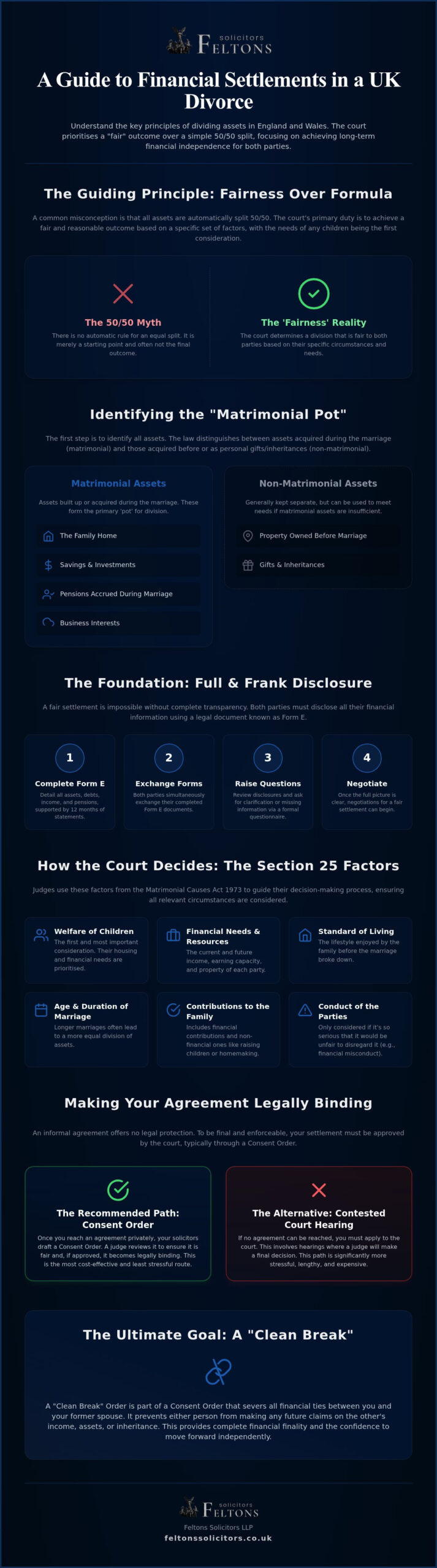

Finalising your divorce dissolves your legal marriage, but it does not extinguish your financial liabilities. Without a sealed court order, an ex-spouse can pursue claims against your property, pension wealth, or business equity years into the future. When speaking with Feltons Solicitors LLP or specialist family practitioners, people often share the same justified anxiety: the fear of losing assets they spent a lifetime building, alongside confusion over why a divorce decree alone leaves them unprotected.
You deserve clarity and certainty as you plan your next chapter. This guide explains how courts assess fairness under English law, how matrimonial property is divided, and how to achieve an enforceable clean break settlement that permanently safeguards your personal wealth. From the division of substantial pension pots to the practical benefits of resolving disputes outside a contentious courtroom, here is how you can resolve your financial arrangements calmly, pragmatically, and decisively.
Key Takeaways
- Securing a court-approved consent order is the only method to achieve a true clean break and permanently terminate your ex-spouse’s financial claims.
- Judges evaluate the division of matrimonial property using statutory Section 25 criteria, prioritising the housing needs of minor children above equal sharing.
- Accurately dividing complex holdings like private company shares, high-value pensions, and property portfolios requires specialist valuation methods to prevent post-separation tax penalties.
- Partnering with experienced divorce financial settlement solicitors london ensures full financial disclosure via Form E, protecting personal wealth from future claims without unnecessary court conflict.
- Proactive negotiation and alternative dispute resolution offer a discreet, cost-effective pathway to resolve finances while preserving long-term estate planning integrity.
The Fundamentals of a Financial Settlement: Securing a Clean Break
A matrimonial financial settlement legally resolves the division of capital, real estate, pension entitlements, and ongoing income following the breakdown of a marriage. Many individuals mistakenly assume that obtaining a final divorce order concludes their financial ties. In reality, ending the legal marriage leaves every financial claim open between former spouses. A financial remedy order approved by the court provides absolute legal finality.
Informal arrangements or verbal pacts offer no lawful protection. Even if you draft a private written contract, it remains unenforceable within family law jurisdiction without judicial endorsement. Under the Matrimonial Causes Act 1973, the family court retains overarching supervisory power over marital property. Judges must review every proposed split to confirm it is fair, reasonable, and capable of satisfying both parties’ independent housing and living needs.
Why Finalising Your Divorce Does Not End Financial Claims
A conditional order and subsequent final order dissolve only the marriage contract. They do not dismiss statutory financial rights. Without an explicit, legally binding dismissal order, your former spouse can lodge claims against your wealth ten, twenty, or thirty years later. This exposure applies to future inheritances, lottery windfalls, and post-divorce business equity. Securing a sealed court order remains the only way to achieve authentic, permanent independence.
Consent Orders Versus Financial Remedy Orders: Understanding the Instruments
Choosing the correct legal mechanism depends entirely on whether you and your spouse can reach an agreement. Working with specialist divorce financial settlement solicitors london allows you to pursue an amicable resolution first, converting negotiations into a watertight judicial order.
- Consent Orders: A mutually agreed draft order submitted alongside Form D81, detailing current and proposed asset distributions. A judge reviews this paperwork administratively without requiring either party to attend court.
- Contested Financial Remedy Orders: Court-imposed determinations issued by a judge following formal litigation when private negotiations fail.
- Clean Break Provisions: Clauses within an order that permanently terminate all capital, income, and pension claims, ensuring neither party can request spousal maintenance in the future.
While ongoing spousal maintenance suits situations with significant income disparities or young children, modern family jurisprudence actively favours clean break outcomes wherever capital resources suffice. Experienced divorce financial settlement solicitors london construct these arrangements to balance immediate liquidity with comprehensive long-term asset ring-fencing.
Section 25 Criteria: How Family Courts Assess Fair Asset Division
When determining financial settlements under the Matrimonial Causes Act 1973, English courts operate from an initial benchmark of equal division. However, this equal starting point frequently yields to ensure equitable living outcomes for both individuals. As set out in the GOV.UK guidance on dividing money and property, the primary duty of the court is the welfare of any dependent child under eighteen. Section 25 gives judges broad discretion to achieve substantive fairness over mathematical parity.
To establish what is truly fair, judges examine each family’s unique economic fabric rather than applying a rigid numerical formula. Instructing experienced divorce financial settlement solicitors london helps ensure your position is framed persuasively against every statutory consideration.
Assessing Needs, Earning Capacity, and Standards of Living
The court evaluates each party’s capital, current income, and realistic future earning capacity. Where one spouse paused a lucrative career to handle domestic care or child-rearing duties, the law recognises that contribution as equal to that of the primary financial earner. Factors that directly shape court awards include:
- Housing and Capital Requirements: Securing suitable, secure accommodation for children and the primary residential parent.
- Duration of Marriage and Age: Longer marriages naturally foster deeper financial interdependence, whereas shorter unions without children often justify a swift return to pre-marital status.
- Standard of Living: The lifestyle enjoyed during the marriage serves as a guiding guidepost, tempered by the economic reality of funding two separate households from a single pool of wealth.
Matrimonial Versus Non-Matrimonial Property
Family law draws a sharp distinction between matrimonial assets generated through joint efforts and non-matrimonial holdings brought into the union. Matrimonial assets typically include the family residence, joint savings, business equity created during the partnership, and pensions built during the cohabitation period. These are subject to the sharing principle.
Conversely, non-matrimonial property encompasses pre-owned assets, inheritances received independently, and gifts from external family members. Following landmark Supreme Court precedent, non-matrimonial wealth is generally insulated from sharing unless required to meet the other party’s basic reasonable needs. If you need bespoke guidance on structuring your holdings or navigating property adjustments, consulting specialists at Feltons Solicitors LLP provides the clarity needed to protect your legitimate entitlements.
Division of Complex Wealth: Real Estate, Pensions, and Private Businesses
High-value matrimonial estates present unique structural hurdles. When marital wealth spans substantial real estate portfolios, defined benefit pension funds, and private commercial enterprises, applying a clean division requires deep technical precision. Rather than treating all capital uniformly, courts and instructing divorce financial settlement solicitors london must evaluate the distinct liquidity, taxation, and long-term utility of each holding.
The Matrimonial Home: Mesher Orders, Buyouts, and Immediate Sale
The matrimonial residence carries intense personal sentiment alongside substantial equity. Couples generally face three practical routes to resolve ownership:
- Immediate Open-Market Sale: Realising total net proceeds to fund the independent rehousing of both individuals.
- Equity Buyout: One spouse refinances the property to purchase the other’s legal share and secure a release from mortgage covenants.
- Mesher Orders: Postponing the sale of the family home until a triggering event occurs, such as the youngest child completing secondary education or reaching age eighteen.
Executing an equity transfer or property sale demands meticulous legal implementation. Coordinating your family settlement alongside an experienced residential property law firm guarantees that deeds, Land Registry charges, and conveyancing processes align with the court order.
Pensions on Divorce: Sharing Orders Versus Capital Offsetting
Pension funds frequently equal or eclipse the capital tied up in real estate. Despite this, they remain widely overlooked during direct negotiations. Under current Pension Advisory Group guidelines, standard Cash Equivalent Transfer Values (CETVs) often fail to reflect the true value of defined benefit or public sector schemes. Specialist actuarial reports are vital to achieve genuine parity of retirement income.
Parties typically divide retirement assets through Pension Sharing Orders, which carve out an exact percentage of a fund into a new, independent plan for the receiving spouse. Alternatively, pension offsetting permits one spouse to retain greater real estate equity or liquid savings in exchange for waiving rights to the other’s pension pot. As highlighted in the GOV.UK guide to dividing money and property on divorce, older Pension Attachment Orders have fallen out of common practice because they tie your financial future to your former spouse’s eventual retirement date.
Valuing and Protecting Private Business Interests and Company Shares
Private company shareholdings demand forensic evaluation. Judges avoid dismantling viable commercial ventures to satisfy personal capital divisions. Jointly instructed forensic accountants evaluate sustainable earnings, net asset values, and latent corporation or capital gains tax liabilities. Settlement structures must protect commercial cash flow, using staged lump sums, dividend extractions, or structured share buybacks rather than forcing an immediate operational sale.
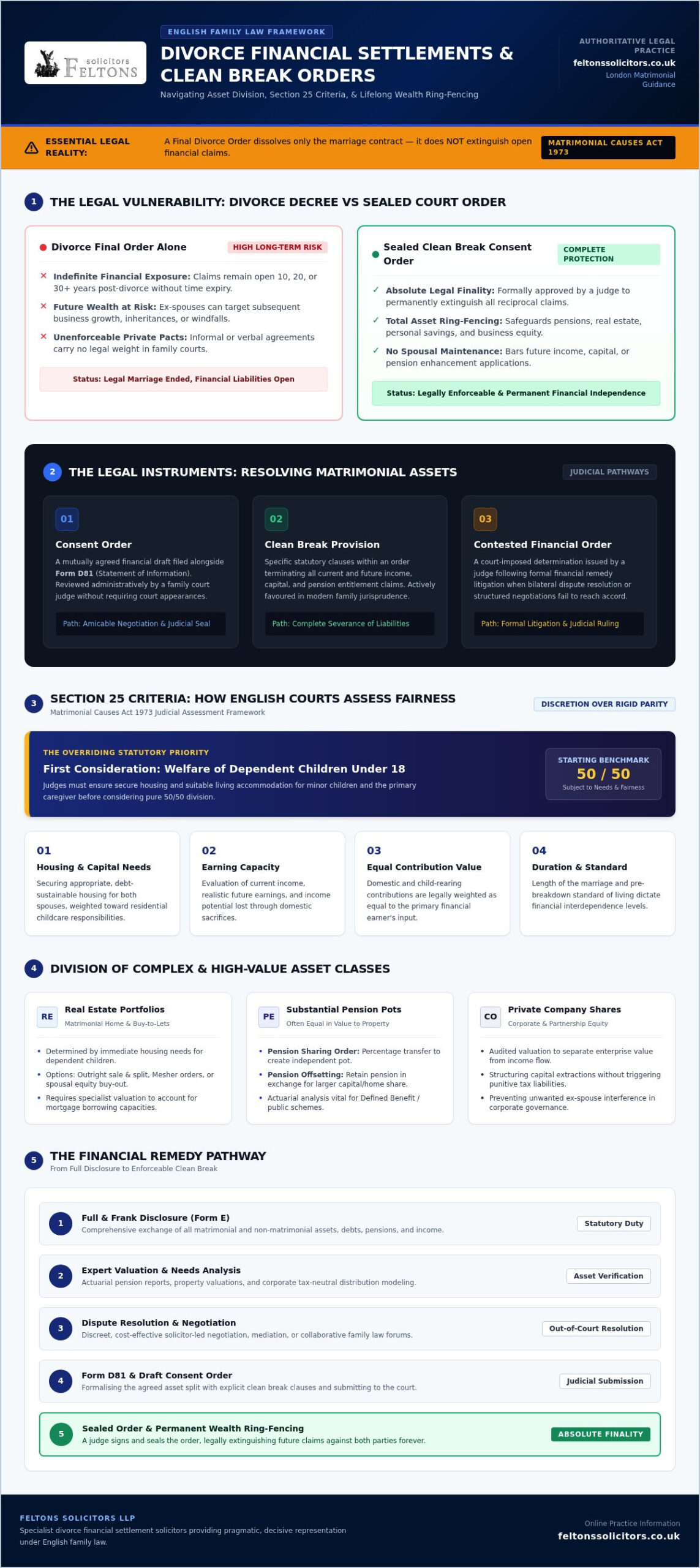
The Financial Remedy Process: From Form E Full Disclosure to Consent Order
Securing an enforceable financial settlement demands a structured, transparent legal procedure. Whether resolving arrangements privately or through judicial intervention, the process follows a predictable sequence. Completing these formal stages protects your capital while eliminating the risk of future legal challenges.
- Exchange Formal Disclosure: Both spouses complete Form E, setting out their worldwide capital, liabilities, business assets, and pensions with documentary proof.
- Instruct Joint Experts: Appoint independent specialists to value shared real estate, unquoted business shares, and complex defined benefit pensions.
- Conduct Structured Negotiations: Explore constructive proposals through solicitor correspondence, mediation, or private dispute resolution sessions.
- Ratify the Agreement: Draft a formal consent order and submit it to the court alongside Form D81 for final judicial sealing.
The Importance of Full and Frank Financial Disclosure
Every matrimonial settlement rests upon absolute financial honesty. You must disclose every domestic bank balance, offshore holding, share option, and trust benefit. Attempting to conceal wealth or understate company valuations carries severe legal consequences. Under long-standing precedent, the court will readily overturn sealed orders where a spouse committed fraudulent or deliberate non-disclosure. Judges also impose punitive adverse costs orders against deceptive parties. Engaging a qualified divorce and financial arrangements lawyer ensures your financial statement is meticulously prepared, defending you against unfair scrutiny while actively uncovering any hidden spousal wealth.
Out-of-Court Resolutions: Mediation, Collaborative Law, and Private FDRs
Resolving your finances does not require an acrimonious courtroom battle. Before issuing proceedings, parties must ordinarily attend a Mediation Information and Assessment Meeting (MIAM) to explore constructive dialogue. For complex or high-value estates, Private Financial Dispute Resolution (Private FDR) hearings have become the preferred option. A hired specialist barrister or retired judge evaluates the evidence and delivers an evaluative settlement recommendation in complete privacy. This private forum avoids the lengthy delays and public disclosure associated with open family courts.
Navigating Court Proceedings: First Directions and Final Hearings
When alternative methods cannot resolve entrenched disputes, the court timetable governs proceedings:
- First Directions Appointment (FDA): The preliminary procedural hearing where a judge reviews disclosure, orders questionnaire answers, and authorises expert valuations.
- Financial Dispute Resolution (FDR): The core negotiation hearing where the presiding judge offers an informal view on the likely outcome, strongly urging parties to settle without trial.
- Final Contested Hearing: A formal trial where witnesses undergo cross-examination and the judge imposes a legally binding financial order.
If you face complex negotiations or wish to initiate an orderly asset split, instruct reputable divorce financial settlement solicitors london to protect your wealth. Reach out directly to Feltons Solicitors to discuss your circumstances with our discreet private client team.
Strategic Next Steps: Safeguarding Your Future with Specialist Legal Counsel
Resolving complex marital assets requires steady judgment alongside technical mastery. Retaining specialist legal counsel ensures your financial position remains robustly insulated without escalating interpersonal tension. A comprehensively drafted financial agreement does far more than resolve present-day division; it protects your future wealth, insulates commercial enterprise, and preserves inheritance for children across generations.
Decisive advice taken early in the separation process brings profound relief. It clarifies enforceable statutory rights, establishes realistic expectations, and replaces emotional panic with orderly strategy. Instructing top-tier divorce financial settlement solicitors london ensures that every settlement term is framed to deliver complete, permanent security.
Aligning Property, Wills, and Estate Planning After Separation
A financial separation cannot occur in an administrative vacuum. Comprehensive wealth protection demands synchronising your family law arrangements with property ownership changes and succession plans. Key legal steps to undertake alongside your financial agreement include:
- Severing the Joint Tenancy: Converting joint ownership of the matrimonial property into a tenancy in common prevents your share from passing automatically to your estranged spouse under survivorship rules if you die before the divorce finalises.
- Executing an Immediate Will Update: Separation alone does not alter the provisions of an existing will. Until a final divorce order is sealed, an estranged spouse retains their legal status as a primary beneficiary unless you rewrite your testamentary documents.
- Revising Beneficiary Nominations: Updating death-in-service benefits and pension expression-of-wish forms ensures accumulated funds flow directly to your intended recipients.
Coordinating with our private client team on your broader estate planning needs guarantees that newly negotiated capital distributions remain fully protected against future tax burdens or inheritance disputes.
Choosing a Pragmatic and Authoritative Legal Advocate
The solicitor you choose fundamentally shapes the tone and efficiency of your separation. While high-volume practices often adopt aggressive stances that inflate costs and prolong disputes, a boutique law firm prioritises tailored personal attention, strict discretion, and pragmatic dispute resolution. You need an advisor who pairs unflinching resolve to protect your balance sheet with a commitment to resolving disagreements outside contentious courtrooms whenever feasible.
Early consultation with dedicated divorce financial settlement solicitors london gives you the strategic foundation required to negotiate with quiet confidence. Taking control of your assets today ensures your post-divorce future begins on solid, independent ground.
Taking Confident Steps Towards Lasting Financial Independence
Achieving a fair matrimonial settlement is fundamentally about protecting your future autonomy. While a final divorce order dissolves the marriage, only a court-sealed consent order provides absolute finality through an enforceable clean break. Whether unravelling complex real estate holdings, valuing private company shares, or dividing pensions, precision and transparent financial disclosure remain paramount. Engaging reputable divorce financial settlement solicitors london ensures that your hard-earned assets receive the meticulous protection they require.
Founded in 2010, Feltons Solicitors combines proven expertise in high-stakes financial remedies with cross-practice capabilities in property conveyancing and estate planning. Our boutique practice prioritises discreet negotiation and constructive dispute resolution outside contentious court settings, providing tailored personal care at every stage. Arrange a confidential consultation with Feltons Solicitors today to safeguard your wealth and step forward into your next chapter with complete clarity.
Frequently Asked Questions
Can my spouse claim money or assets acquired after we separated?
Yes, your former spouse can make a financial claim against assets you acquire after separating, provided you have not obtained a sealed clean break order. While judges distinguish between joint marital wealth and post-separation accrual, non-matrimonial gains remain vulnerable if your ex-spouse has unmet housing or maintenance needs. Obtaining formal advice from divorce financial settlement solicitors london ensures your post-separation income and newly acquired property remain protected against delayed claims.
Is a divorce financial settlement automatically fifty-fifty in England and Wales?
No, a financial settlement is not automatically split fifty-fifty. While English law treats equality as an initial starting point, judges depart from an even division to achieve genuine fairness. The primary concern is always meeting the reasonable housing and income needs of dependent children and their primary caregiver. Disparities in earning capacity, marriage length, and health frequently justify an unequal asset distribution in favour of the financially weaker party.
What happens if my former partner refuses to disclose all their financial assets?
Both parties have an absolute legal duty to provide full and frank financial disclosure. If your partner hides accounts, conceals business interests, or refuses to complete Form E, the court can issue penal orders compelling disclosure. Judges often draw adverse inferences against uncooperative spouses, assuming they hold the suspected wealth. The court may also order them to pay your legal costs or overturn any fraudulent agreement reached without transparency.
Do I need a financial consent order if we already agree on asset division?
Yes, an informal agreement holds no binding legal power in family court. Even if you divide property and savings amicably, either spouse can resurrect financial claims decades later without a court-approved order. Drafting a formal consent order and submitting it alongside Form D81 turns your mutual arrangement into a legally enforceable clean break. Instructing divorce financial settlement solicitors london ensures the document is watertight and properly sealed by a judge.
How are pensions divided during a divorce settlement?
Pensions are typically divided using Pension Sharing Orders, which transfer a designated percentage of one spouse’s pension fund into a separate scheme for the other. Alternatively, pension offsetting allows one party to retain more home equity or savings instead of claiming retirement funds. Courts follow Pension Advisory Group guidance, instructing independent actuaries on complex defined benefit schemes to ensure the settlement achieves genuine equality of future retirement income.
Can a finalised financial consent order ever be overturned or reopened?
A finalised financial consent order is rarely overturned because the court prioritises legal certainty. However, a judge can set an order aside if one party concealed material wealth, committed fraud, or exerted undue coercion. Orders may also be reopened under very narrow circumstances if an unforeseen event occurs shortly after the order that undermines the entire basis of the settlement, such as a sudden death or substantial unexpected windfall.
How long does it typically take to obtain a financial consent order?
If both spouses agree on terms, obtaining a financial consent order usually takes between two and four months. This timeframe covers drafting the agreement, compiling the Form D81 statement, and awaiting judicial review. The paperwork can only be lodged after the court pronounces the conditional divorce order. If negotiations break down and formal court proceedings become necessary, resolving the financial remedy through a full trial can take twelve to eighteen months.