

Expert Solicitors for International Property Buyers: Navigating the UK Market

Expert Solicitors for International Property Buyers: Navigating the UK Market

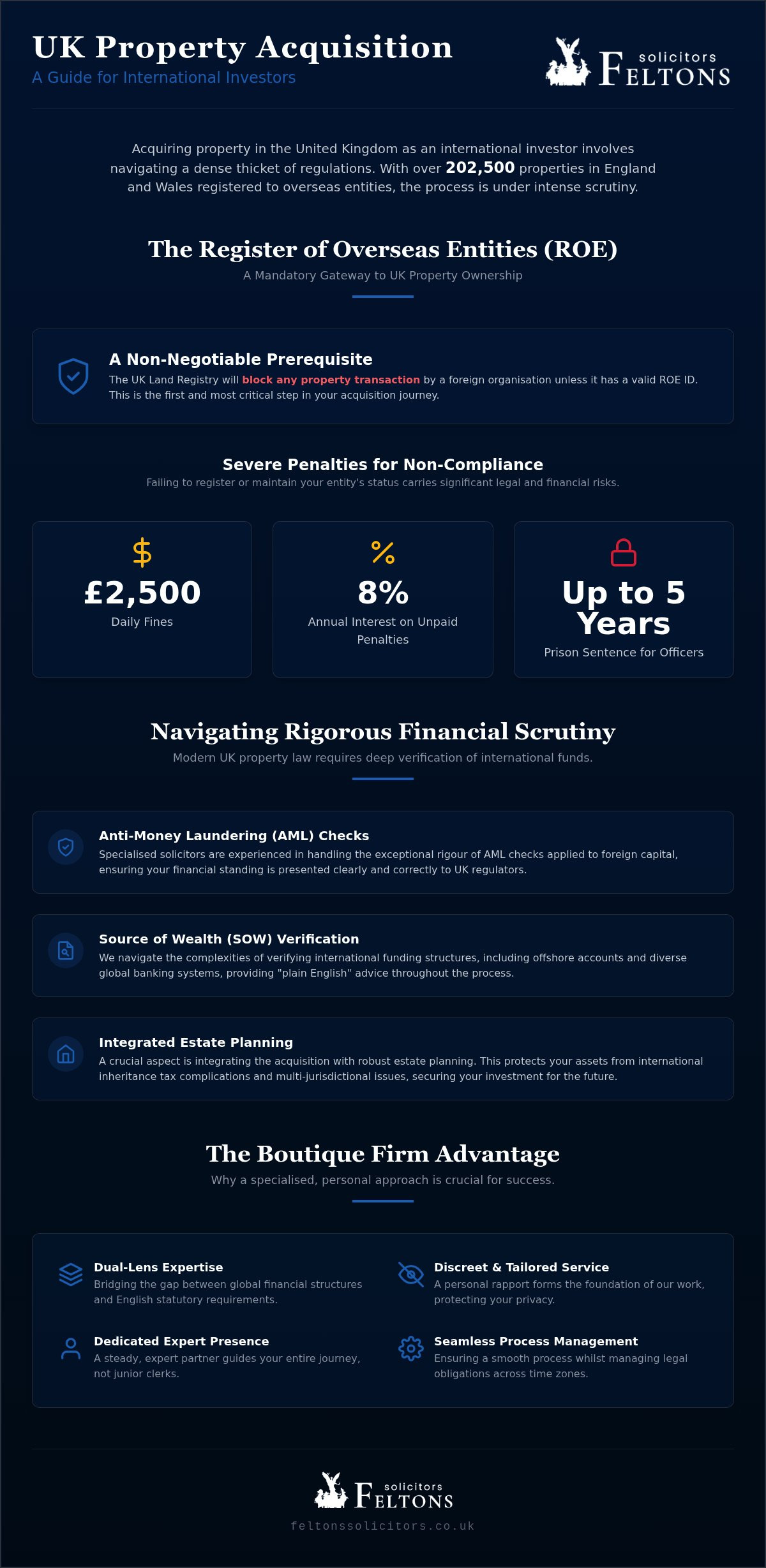
Did you know that failing to update the Register of Overseas Entities can lead to daily fines of up to £2,500 and even criminal prosecution for entity officers? For many global investors, the dream of owning a piece of the UK market can quickly feel overshadowed by a dense thicket of regulatory requirements. You likely recognise that the process involves much more than a simple transaction; it requires managing strict anti-money laundering checks and public registration of beneficial owners across different time zones. Partnering with specialist solicitors for international property buyers ensures these hurdles don’t become roadblocks.

This article provides the clarity you need to master the legal complexities of UK property acquisition. We’ll guide you through the nuances of international conveyancing and the vital steps for overseas entity registration. You’ll learn how to achieve a seamless transaction whilst maintaining full compliance with Companies House and HMRC. By the end, you’ll understand how to secure your assets through proper estate planning and navigate the latest Stamp Duty surcharges. We’ve outlined the path to a secure, successful acquisition that respects both your time and your privacy.

Key Takeaways

  • Understand why the evolving UK regulatory landscape requires specialised knowledge to navigate complex source of wealth and anti-money laundering requirements successfully.
  • Learn about the mandatory Register of Overseas Entities (ROE) and the significant legal risks involved if registration isn’t completed correctly before your transaction.
  • Discover how to integrate your property acquisition with robust estate planning to protect your assets from international inheritance tax complications and multi-jurisdictional issues.
  • Engaging expert solicitors for international property buyers ensures your conveyancing process remains seamless whilst managing legal obligations across different time zones and jurisdictions.
  • Explore the benefits of a discreet, boutique approach that prioritises personal connection and professional integrity throughout your UK investment journey.

Why International Property Buyers Require Specialist UK Solicitors

The UK property market has evolved into a meticulously regulated environment. For non-residents, the acquisition process is no longer a straightforward financial exchange. It’s a complex legal journey. Standard firms often find themselves ill-equipped to handle the specific scrutiny applied to foreign capital. This is where specialist solicitors for international property buyers become indispensable. They don’t just process paperwork; they manage the intricate layers of compliance that define modern property law.

Understanding the UK conveyancing process is fundamental, but for international clients, the legal transfer of ownership is only half the story. Specialist firms bridge the gap between global financial structures and English statutory requirements. Whether you’re acquiring a residential penthouse or a commercial retail unit, your legal representative must possess a dual-lens expertise. Feltons acts as a sophisticated guide, ensuring that every transaction aligns with both current legislation and your long-term investment goals.

Navigating the Regulatory Landscape in 2026

By 2026, Anti-Money Laundering (AML) checks have become exceptionally rigorous. Standard conveyancing firms frequently struggle with international Source of Wealth (SOW) requirements because they lack experience with diverse global banking systems. We provide “plain English” advice to help you manage the following hurdles:

  • Verification of complex international funding structures and offshore accounts
  • Compliance with updated Law Society property information forms (TA6 and TA7)
  • Digital identity verification and electronic signatures across different jurisdictions

This approach combines traditional professional integrity with the modern efficiency required for high-stakes deals. With approximately 202,568 residential properties in England and Wales registered to overseas addresses, the demand for nuanced, expert oversight has never been higher. We ensure that your background and financial standing are presented clearly to satisfy UK regulators without compromising your privacy.

The Advantage of Boutique Legal Representation

Choosing a boutique firm means moving away from the impersonal, high-volume processing found in larger practices. We prioritise a discreet, tailored service where personal rapport is the foundation of our work. You won’t be passed between junior clerks. Instead, you’ll benefit from a steady, expert presence throughout your acquisition journey. This “people-first” philosophy ensures the human impact of your investment is never forgotten. It’s about providing a calm, dependable environment where your privacy is protected and your interests are championed by dedicated solicitors for international property buyers.

The Register of Overseas Entities: A Vital Compliance Step

Compliance with the Register of Overseas Entities (ROE) is no longer a peripheral concern; it’s a mandatory gateway for any foreign organisation wishing to own UK land. Since the implementation of the Economic Crime (Transparency and Enforcement) Act 2022, the Land Registry will not register a transfer of title unless the overseas entity has a valid ROE ID. This requirement adds a significant layer of due diligence that many traditional firms aren’t prepared to handle. Experienced solicitors for international property buyers recognise that securing this registration is the first critical step in any successful acquisition.

Failing to comply with these regulations carries severe penalties. You could face daily fines of up to £2,500, whilst unpaid penalties may attract interest at 8% per annum. In extreme cases of non-compliance, entity officers may face criminal prosecution and prison sentences of up to five years. We act as your steady partner; we ensure that every detail is verified according to The Law Society’s Conveyancing Protocol to protect your investment and your reputation.

Who Must Register as an Overseas Entity?

The Register of Overseas Entities is the mandatory public record for foreign-owned UK land. Any company, partnership, or trust formed outside the UK must register if it holds or intends to acquire property. The process requires identifying the “beneficial owners”—typically individuals who hold more than 25% of the shares or voting rights, or who exercise significant control. Identifying these individuals in multi-layered corporate structures requires a methodical and orderly legal mindset. Our role is to unpick these complexities, ensuring that your registration is accurate and compliant with Companies House standards.

The Verification Process Explained

Verification is the most rigorous part of the process. A regulated UK solicitor must verify the identity of all beneficial owners before the application is submitted. You’ll need to provide original or certified incorporation documents, proof of address, and government-issued identification. This isn’t a one-time task; overseas entities must file an annual update statement every 12 months, due within 14 days of the anniversary of their initial registration. The statutory fee for this update is currently £134.

Managing these deadlines whilst overseeing a global portfolio can be taxing. For a deeper dive into these requirements, you may find our guide on Overseas Entity Beneficial Owner Registration: A Guide for UK Property Owners in 2026 helpful. If you are managing a complex corporate structure, our team can assist with the Registration of Overseas Entities to ensure your purchase remains on track. We provide a calm, discreet service that prioritises your privacy whilst ensuring full transparency where the law demands it.

Strategic Asset Protection and Estate Planning for Non-Residents

Acquiring a UK asset shouldn’t be viewed in isolation. It’s a significant financial commitment that carries immediate implications for your global estate. The standard Inheritance Tax (IHT) rate in the UK is 40% on the value of assets above the nil-rate band of £325,000. This threshold is currently frozen until April 2031. For non-residents, the legal landscape shifted on 6 April 2025 with the introduction of a residency-based system. If you’ve been a UK resident for fewer than 10 of the last 20 tax years, you’re generally only liable for IHT on your UK-situated assets. However, long-term residents may find their worldwide assets under scrutiny. Specialist solicitors for international property buyers provide the discreet guidance necessary to navigate these thresholds whilst protecting your family’s future.

The transparency requirements for these assets have also tightened. As of 31 August 2025, trust information on the Register of Overseas Entities became publicly accessible. This makes it vital to structure your holdings with both compliance and privacy in mind. We act as a sophisticated guide, helping you understand how these public records intersect with your need for confidentiality and secure asset protection.

Wills and Trusts for International Buyers

Relying on a foreign will to cover a UK house is a high-risk strategy. English probate courts often require extensive documentation to validate overseas testamentary documents; this can lead to months of delays and mounting legal costs. A separate UK will, specifically drafted for your local assets, ensures a smoother transition for your heirs. Family trusts also offer a robust layer of security. They can help manage how assets are passed down whilst providing a degree of long-term stability. For a comprehensive look at these strategies, read A Complete Guide to Estate Planning: Protecting Your Legacy in 2026.

Managing Contentious Probate and Disputes

Multi-jurisdictional estates are naturally prone to conflict. Differences in legal systems or family expectations can quickly escalate into formal disputes. Preparing for these possibilities requires a solicitor who is as comfortable with litigation as they are with conveyancing. Feltons manages these sensitive matters with quiet confidence. We prioritise pragmatic advice that seeks to resolve issues before they reach a courtroom. Our “people-first” philosophy means we understand that behind every financial arrangement is a human story. We act as a steady presence, ensuring that your estate is managed with professional integrity and personal rapport. By involving solicitors for international property buyers early, you can build a defensive structure that minimises the risk of future family discord.
Expert Solicitors for International Property Buyers: Navigating the UK Market

The Conveyancing Process: From Instruction to Completion

The instruction phase marks the beginning of a rigorous verification period. Unlike high-volume firms that treat clients as mere file numbers, boutique solicitors for international property buyers prioritise a personal connection from the outset. We meticulously verify your source of funds and overseas identity to satisfy stringent UK anti-money laundering regulations. This methodical approach ensures the transaction rests on a solid legal foundation before you move toward the exchange of contracts. It’s a process that requires patience and precision to avoid the pitfalls of non-compliance.

The exchange of contracts represents the point of no return. For international clients, this stage involves managing legal obligations across different jurisdictions and time zones. Once completion is reached, we handle the intricacies of Stamp Duty Land Tax (SDLT) filings. It’s vital to account for the 2% non-resident surcharge and the 5% additional dwelling surcharge, which increased on 31 October 2024. We then finalise the registration at the Land Registry. This ensures your title is secure and fully compliant with current UK property law, providing you with peace of mind in a complex market.

Residential vs Commercial Conveyancing

Commercial acquisitions often require more extensive due diligence into planning permissions, business rates, and environmental reports than residential purchases. For those investing in residential flats, understanding leasehold enfranchisement and extensions is essential to protecting the long-term value of the asset. Our role is to unpick these nuances, ensuring you aren’t caught out by hidden costs or restrictive covenants. You can find more detail on these processes in our guide to Navigating Residential Property Law: A Comprehensive Guide for UK Homeowners.

Overcoming Common Transactional Hurdles

International bank transfers and currency fluctuations can create significant stress during the final stages of a purchase. We act as a steady, calm presence, liaising directly with property developers and overseas agents to ensure funds arrive exactly when needed. Our communication remains deliberate and reassuringly paced, shielding you from the frantic energy of high-pressure sales environments. If you require expert guidance through these cross-border logistical challenges, our team offers tailored Residential and Commercial Conveyancing services designed specifically for the global investor. We ensure your journey from initial instruction to final completion is as seamless and secure as possible.

Feltons Solicitors LLP operates on a “people-first” principle. Whilst technical legal proficiency is the baseline for any firm, we believe the human impact of a property acquisition is paramount. Our role as solicitors for international property buyers is to act as a calm, steady presence amidst the complexities of the UK market. We provide more than just transactional support; we offer a partnership rooted in high-end reliability and personal rapport. This approach ensures that you aren’t just another file in a high-volume system, but a valued client receiving tailored, boutique care.

Discretion is a cornerstone of our practice. High-net-worth investors and international entities require a level of privacy that larger, factory-style firms often struggle to maintain. We prioritise your confidentiality throughout every stage of the process, from the initial identity checks to the final Land Registry filings. By combining traditional professional integrity with a forward-thinking methodology, we deliver a service that feels both grounded and current. Our pragmatic approach ensures that sound judgment is applied to every cross-border matter, protecting your interests with quiet confidence and poise.

A Tailored Experience for Every Client

We have intentionally moved away from dense, archaic legalese. Instead, we favour a contemporary, “plain English” approach that remains formal and respectful. This ensures you are fully informed without being overwhelmed by inaccessible terminology. Our nationwide expertise serves a diverse global clientele, providing the worldly experience necessary to handle international-scale matters whilst maintaining a deeply rooted commitment to high professional standards. This reliability provides the peace of mind essential for secure asset protection and long-term investment success.

Next Steps: Securing Your UK Property Investment

Beginning the instruction process from abroad doesn’t have to be a source of stress. Early engagement with solicitors for international property buyers is the most effective way to ensure a seamless transition. By involving us before you commit to a purchase, we can advise on the initial due diligence and compliance requirements that often delay transactions. This proactive stance helps avoid the administrative roadblocks and legal hurdles associated with complex cross-border acquisitions.

We invite you to contact Feltons for a confidential consultation regarding your acquisition. Our team is ready to act as your sophisticated guide, ensuring your UK property investment is built on a foundation of legal excellence and personal connection. Whether you are navigating a residential purchase or a complex commercial portfolio, we provide the steady hand and expert insight required to secure your assets with confidence.

Securing Your Future in the UK Property Market

Successfully acquiring property in the UK as an overseas investor requires a delicate balance of financial ambition and legal precision. Success depends on mastering mandatory requirements like the Register of Overseas Entities whilst ensuring your acquisition is supported by robust estate planning. Standard conveyancing is no longer sufficient in a landscape defined by rigorous compliance and shifting tax residency rules. By partnering with specialist solicitors for international property buyers, you ensure that every regulatory hurdle is cleared with poise and professional integrity.

Feltons Solicitors LLP provides the discreet, boutique service high-net-worth individuals require. We offer pragmatic legal advice tailored to the nuances of international jurisdictions, acting as your steady partner through every stage of the process. Our specialist expertise in the Registration of Overseas Entities ensures your portfolio remains compliant and your privacy is respected. Don’t leave your investment to chance in an increasingly transparent world. We invite you to instruct Feltons Solicitors for your international property acquisition today. Your journey toward a secure and successful UK property portfolio starts with a single, informed conversation.

Frequently Asked Questions

Do I need to be in the UK to buy property with a solicitor?

No, you don’t need to be physically present in the UK to complete a purchase. Digital reforms implemented in 2026, including electronic signatures and AI-assisted conveyancing, allow for entirely remote transactions. Your solicitors for international property buyers will manage the process via secure digital platforms. You’ll need to provide verified identification from your home jurisdiction, but the actual transfer of title is handled electronically through the Land Registry.

What is the Register of Overseas Entities and does it apply to me?

The Register of Overseas Entities is a mandatory public record for foreign companies and trusts owning UK land. It applies if you intend to buy property through an offshore entity. Failure to register results in daily fines of up to £2,500 and prevents the Land Registry from transferring the property title. We specialise in this registration, ensuring your beneficial owners are correctly identified and verified according to the latest statutory requirements.

How long does the conveyancing process take for international buyers?

While a standard transaction might take 8 to 12 weeks, international buyers should prepare for a longer timeline. The additional layers of due diligence, such as verifying overseas source of wealth and completing ROE registration, can add several weeks to the process. We provide a steady, methodical flow to keep the transaction moving, but time zone differences and cross-border bank transfers naturally require more deliberate coordination than domestic deals.

Can I buy UK property through an offshore company or trust?

Yes, you can acquire property through an offshore company or trust provided you comply with transparency laws. You must register with Companies House as an overseas entity before the purchase completes. This involves disclosing beneficial owners who exercise significant control. As specialist solicitors for international property buyers, we guide you through these requirements, ensuring your corporate structure remains compliant whilst protecting your assets through proper legal oversight and discreet management.

What are the Stamp Duty (SDLT) implications for non-UK residents?

Non-UK residents face specific Stamp Duty Land Tax surcharges that significantly impact the total cost of acquisition. A 2% surcharge applies to all residential purchases by non-residents. Additionally, if you already own property elsewhere, a 5% surcharge for additional dwellings applies, which was increased on 31 October 2024. These are cumulative, meaning an overseas buyer of a second home could pay 7% above the standard residential rates, making early financial planning essential.

Do I need a UK will if I only own one property in the country?

Yes, a UK will is strongly recommended even for a single property to avoid complex legal hurdles. Relying on a foreign will often leads to probate disputes and significant delays in the English courts. A dedicated UK will ensures your property passes to your heirs efficiently and can help manage Inheritance Tax liabilities. Our estate planning services provide a discreet way to secure your legacy and avoid the pitfalls of multi-jurisdictional inheritance issues.

How do solicitors verify my source of wealth from abroad?

Solicitors verify your wealth through a combination of bank statements, certified identification, and documents proving the origin of your capital. This might include evidence of a business sale, inheritance, or investment dividends. We use secure digital verification tools to streamline this process. Our approach is pragmatic and thorough, ensuring we meet strict anti-money laundering regulations whilst respecting your privacy and providing a high standard of personal connection during the verification phase.

What is the difference between residential and commercial property law for investors?

Residential law focuses on individual rights, leasehold enfranchisement, and extensions, whereas commercial property law involves more complex due diligence. Commercial transactions require detailed investigations into planning permissions, business rates, and environmental liabilities. Investors must also consider different VAT implications and structural requirements for commercial units. We offer comprehensive support across both sectors, helping you understand the specific legal obligations and asset protection strategies relevant to your chosen investment class.

Leasehold Extension for Overseas Landlords: A Guide to Protecting UK Assets in 2026

Leasehold Extension for Overseas Landlords: A Guide to Protecting UK Assets in 2026

What if the most significant threat to your UK investment isn’t the property market itself, but a ticking clock you can’t see from thousands of miles away? Managing a leasehold extension for overseas landlords often feels like a delicate balancing act between complex legal reforms and the strict requirements of the Register of Overseas Entities. It’s natural to feel a sense of urgency as your asset approaches the 80-year mark, especially whilst navigating different time zones and evolving UK legislation. We understand that your priority is a seamless process that protects your capital without requiring your constant, physical presence in the UK.

This guide will show you how to secure a valid lease extension that restores your property’s marketability whilst ensuring full compliance with Land Registry and ROE standards. You will discover how the 2024 reforms have simplified the landscape, including the abolition of marriage value and the introduction of the 990-year standard term. We will provide a clear, methodical preview of the steps required to manage these changes, allowing you to maintain your portfolio with the quiet confidence that your interests are fully protected and your legal obligations are met.

Key Takeaways

  • Understand why the 80-year “Marriage Value” threshold remains a critical financial deadline for protecting your property’s long-term market value.
  • Discover how a leasehold extension for overseas landlords now provides a standardised 990-year term and reduced ground rents under the 2024 reforms.
  • Identify the mandatory compliance steps required to synchronise your lease extension with the Register of Overseas Entities (ROE).
  • Learn how the abolition of the two-year ownership rule enables new international investors to initiate the extension process immediately upon purchase.
  • Explore the methodical process of instructing specialist UK solicitors to manage professional valuations and legal filings whilst you are based abroad.

Protecting Asset Value: Why Overseas Landlords Must Prioritise Lease Extensions

A leasehold extension is a vital legal mechanism that allows you to add a significant number of years to your existing UK property lease whilst simultaneously reducing your ground rent to a “peppercorn” or zero rate. For any investor managing a portfolio from afar, a leasehold extension for overseas landlords isn’t merely a paperwork exercise; it’s a strategic move to safeguard the capital value of your asset. The foundation for these rights was established through legislation like the Leasehold Reform Act 1967, which first empowered leaseholders to secure their long-term interests against the freeholder’s interest.

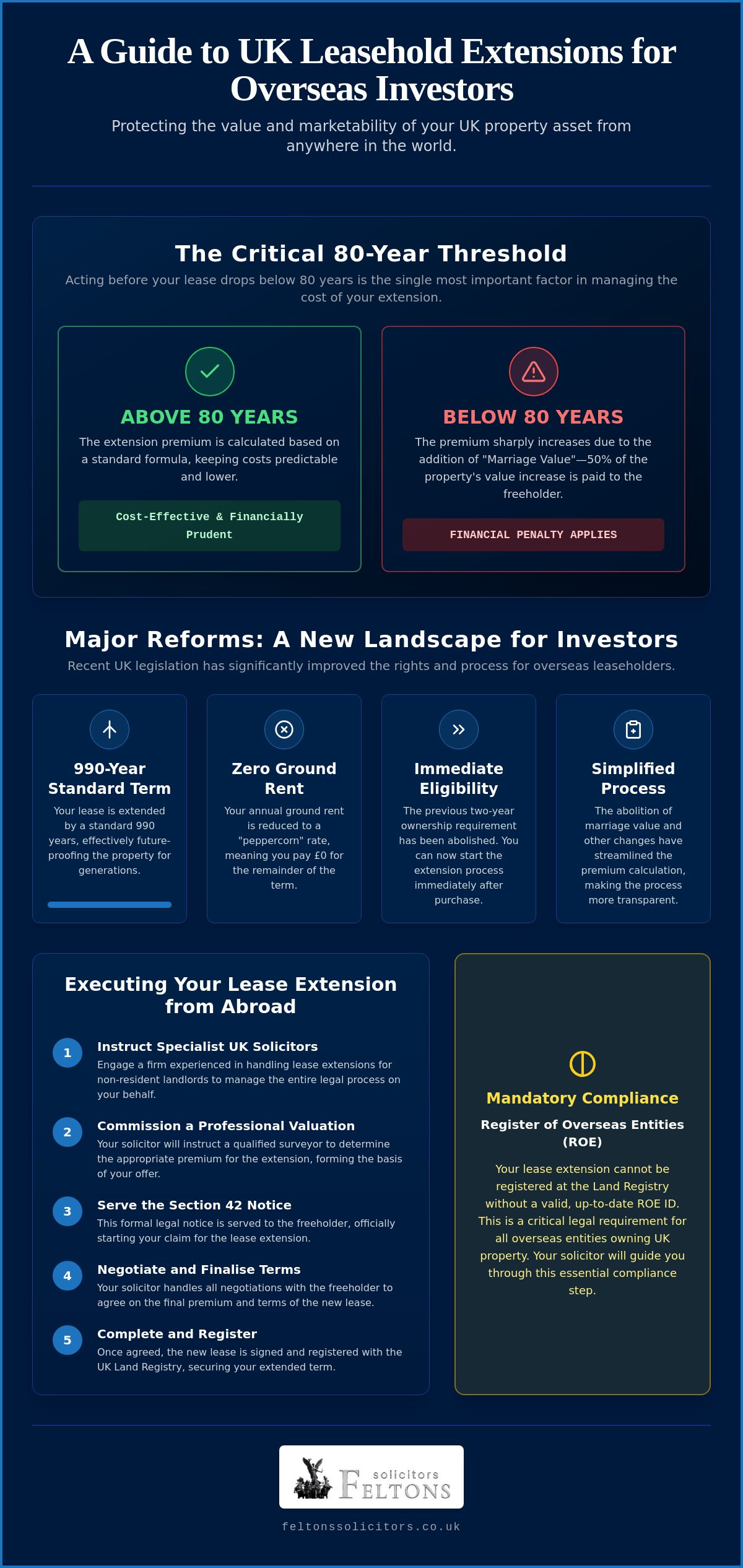
The 80-year mark is often described as a “cliff” because of its dramatic financial consequences. Once a lease drops below this threshold, the cost of extending it rises sharply due to the introduction of marriage value. For landlords living abroad who may not be tracking their lease documents on a weekly basis, missing this date can result in a bill that is tens of thousands of pounds higher than it would’ve been just a few months prior. Acting early is the most effective way to keep your premium predictable and your investment profitable.

Marketability is another pressing factor that demands attention. Most UK high-street lenders are hesitant to offer mortgages on properties with fewer than 85 years remaining on the lease. If you decide to sell or refinance your investment, a short lease significantly shrinks your pool of potential buyers to cash-only investors. This lack of competition inevitably drives down the sale price, making your asset far less liquid than it should be.

As we move through 2026, the UK property market is defined by increased transparency and stricter regulatory scrutiny. A long lease acts as a defensive shield against market volatility, ensuring your property remains a “clean” asset in the eyes of lenders and buyers alike. By securing a 990-year extension now, you effectively future-proof the property for generations, removing the need for any further legal intervention during your lifetime.

The Financial Risk of Diminishing Leases

The price you pay for an extension, known as the premium, is dictated largely by the unexpired term of your lease. The fewer years remaining, the higher the cost you’ll face. Marriage value is the increase in property value following an extension, 50% of which is owed to the landlord. By initiating the process before the lease hits that 80-year mark, you bypass this specific charge entirely, ensuring the extension remains a cost-effective management task rather than a financial burden.

Marketability and Global Portfolios

Maintaining a “clean” asset is vital for those managing a global portfolio where UK property serves as key collateral. International banks are becoming increasingly forensic when reviewing leasehold interests, and they’ve shown a clear preference for assets with long-term stability. A leasehold extension for overseas landlords ensures that the property remains a robust piece of collateral, capable of supporting further investment or providing a secure exit strategy when you choose to sell. It’s about maintaining the same high standard for your UK assets that you expect from your investments elsewhere in the world, which includes ensuring that commercial premises are managed by specialists like DLT Cleaning Services Ltd to meet modern hygiene and compliance benchmarks.

The Leasehold Reform, Housing and Urban Development Act 1993 remains the foundation for leasehold extension for overseas landlords, though its provisions have been significantly enhanced by the Leasehold and Freehold Reform Act 2024. While the 1993 Act established the right to a 90-year extension, the standard term has now been increased to a substantial 990 years. Perhaps the most significant hurdle removed for international investors is the two-year ownership rule. Since February 2025, you can initiate an extension immediately upon purchasing a property, ensuring your capital is protected from day one.

The formal process begins with a Section 42 Notice. This document serves as the “starting gun” for your legal claim, setting out your proposed premium and the terms of the new lease. It’s a precise legal instrument that requires expert handling to avoid being declared invalid by the freeholder. According to official government guidance on lease extensions, the statutory route also ensures your ground rent is reduced to a “peppercorn” rate. This essentially means your ground rent becomes zero for the duration of the new lease, removing a recurring expense that can otherwise complicate property management from abroad.

Qualifying as an Overseas Tenant

To qualify, your property must be held under a “long lease,” which is defined as a lease originally granted for more than 21 years. If you hold your UK assets through an offshore Special Purpose Vehicle (SPV), you are still eligible to exercise these rights, provided the entity is correctly registered with Companies House. For investors managing these types of complex international structures, Brown Hamilton Partners offers the accounting expertise necessary to ensure your global financial reporting remains seamless. Certain exceptions apply, such as properties owned by the National Trust or specific charitable housings. Ensuring your entity is compliant with the latest UK standards is a prerequisite for a smooth claim.

Statutory vs. Informal Extensions

You may find freeholders offering “informal” or private deals. These can seem attractive because they often appear faster or cheaper initially. However, they lack the legal safeguards of the statutory route. Private deals frequently include hidden clauses, such as future ground rent hikes or shorter extension terms that don’t solve the long-term value issue. The statutory route offers the highest level of security for landlords who aren’t physically present in the UK to monitor their freeholder’s behaviour.

In 2026, the timeline for a statutory extension typically spans six to twelve months. While this requires patience, the result is a legally robust asset that meets all modern lending criteria. If you’re unsure which route best suits your portfolio, seeking professional leasehold extension advice can provide the clarity needed to make an informed decision.

The Register of Overseas Entities (ROE): A Crucial Hurdle for Leasehold Extensions

The Economic Crime (Transparency and Enforcement) Act 2022 introduced a significant layer of administration that fundamentally changed how a leasehold extension for overseas landlords is executed. By 2026, the Register of Overseas Entities (ROE) has become a central pillar of UK property law. Any foreign company or entity owning land in the UK must register with Companies House to obtain a unique Overseas Entity ID. Without this ID, your property is effectively frozen. You cannot sell, lease, or, crucially, complete a statutory lease extension. The registration acts as a digital passport for your asset, and without it, the legal doors to the Land Registry remain firmly shut.

The Land Registry acts as the gatekeeper in this process. When your solicitor submits the new lease for registration, the Land Registry cross-references the application with the ROE. If your entity is not registered, or if your annual update is overdue, the application will be rejected. This “Land Registry block” is a common point of failure for many international investors who assume their property rights are independent of corporate filings. To understand the specifics of these filings, you can refer to Overseas Entity Beneficial Owner Registration for a detailed look at the 2026 requirements.

The Link Between ROE and the Land Registry

The registration of a lease extension is technically a “disposition” of land. Under the rules detailed in HM Land Registry Practice Guide 28, the Registrar is prohibited from registering most dealings by an overseas entity unless that entity is compliant with its ROE obligations. If you serve a Section 42 notice whilst your entity is non-compliant, you risk the entire transaction being deemed void. This doesn’t just delay the process; it can lead to significant financial loss if you miss a critical valuation window or a leasehold deadline.

Common Pitfalls in Overseas Registration

Discrepancies in entity names are a frequent cause of rejection. If the name on your original lease differs even slightly from the name registered on the ROE, the Land Registry will likely raise a requisition. Additionally, all information submitted to the ROE must be verified by a UK-regulated agent. This verification is not a one-time task. It must be refreshed annually to keep the entity “active.” For those managing a leasehold extension for overseas landlords, ensuring this compliance is up to date is the first and most vital step in any 2026 property strategy. It’s the foundation upon which your legal claim is built, ensuring your investment remains liquid and secure.

Leasehold Extension for Overseas Landlords: A Guide to Protecting UK Assets in 2026

Step-by-Step Guide: Executing a Lease Extension from Abroad

Executing a leasehold extension for overseas landlords requires a methodical approach that accounts for the physical distance between you and your asset. The process is inherently procedural, but when managed correctly, it can be completed with minimal disruption to your daily life. Your first priority is instructing a specialist UK solicitor who possesses deep experience in international property law and the specific nuances of the 2026 regulatory environment. This legal partner acts as your anchor in the UK, managing the flow of documents and ensuring all statutory deadlines are met with precision.

Once your legal representative is in place, the next step involves a professional valuation. A specialist surveyor will assess your property to determine the “premium,” which is the capital sum you will pay the freeholder to secure the extension. With this figure established, your solicitor will serve the Section 42 Tenant’s Notice. This formal document triggers the legal process and protects your right to the extension from the moment it’s served. The freeholder then has a two-month window to respond with a Counter-Notice, after which your surveyors will negotiate the final premium and lease terms.

The final stages involve the drafting and approval of the new lease, followed by the completion of a deed of substitution. This ensures any existing mortgage is correctly transferred to the new, longer lease. Finally, your solicitor will update the Land Registry records. This step is where your prior compliance with the Register of Overseas Entities becomes critical, as the Land Registry will not finalise the update without a valid Overseas Entity ID.

Remote Identity Verification and AML

Modern legal practice has evolved to support international clients through secure digital ID platforms. These tools allow you to satisfy stringent Anti-Money Laundering (AML) checks from your smartphone, removing the need for international travel. In some instances, you may still require a Notary Public in your home jurisdiction to witness specific signatures on physical documents. A forward-thinking solicitor will coordinate this process, providing clear instructions to ensure your local notary meets UK Land Registry standards.

Managing the Financial Transaction

Handling the transfer of the premium and associated legal costs is managed through secure solicitor client accounts, providing a transparent audit trail for your records. You must also account for any Stamp Duty Land Tax (SDLT) implications, though many extensions fall below the payment threshold. To ensure you aren’t paying more than necessary, it is vital to work with a leasehold enfranchisement expert who can accurately challenge any inflated figures proposed by the freeholder. If a freeholder becomes uncooperative or disputes the premium, engaging experienced dispute resolution solicitors can help you resolve the conflict efficiently without the cost and stress of protracted court proceedings. If you are ready to begin this process, we invite you to contact our team for a professional consultation to discuss your specific property requirements.

At Feltons Solicitors LLP, we’ve built our reputation on providing a sophisticated, boutique service that prioritises the individual needs of international clients. Managing a leasehold extension for overseas landlords requires more than just technical proficiency; it demands a partner who understands the logistical and emotional weight of international asset management. We act as your steady, professional presence in the UK, ensuring that every detail of your property interests is handled with the discreet care you expect. Our philosophy is people-first, which means we focus on managing your stress and providing clarity whilst we handle the complex legal paperwork behind the scenes.

Our expertise is specifically tailored to bridge the gap between traditional leasehold law and the modern requirements of the Economic Crime (Transparency and Enforcement) Act 2022. We understand that your property doesn’t exist in a vacuum. It’s part of a wider financial picture that includes corporate registrations and international compliance. By synchronising these elements, Feltons Solicitors LLP prevents the administrative delays that often plague standard property transactions. You can rely on us to be your eyes and ears on the ground, providing regular, concise updates that respect your time and your privacy.

Why a Specialist Property Law Firm Matters

Precise drafting is the cornerstone of a secure lease. A poorly constructed document can lead to future disputes or difficulties during a sale, especially if the freeholder attempts to insert restrictive clauses. As a dedicated Residential Property Law Firm, we have the experience necessary to identify these risks early. If a freeholder becomes uncooperative or contentious, our litigation and dispute resolution team at Feltons Solicitors LLP is ready to defend your interests, ensuring the statutory process remains on track. We provide the following benefits to our international clients:

  • Direct access to senior solicitors with experience in high-value UK property portfolios.
  • Comprehensive management of both the lease extension and the Register of Overseas Entities (ROE) filings.
  • Transparent communication and secure digital platforms for remote document handling.
  • A methodical approach to valuation negotiations to protect your capital.

Begin Your Lease Extension Today

The year 2026 represents a critical window for action. With the full implementation of the 2024 reforms now in effect, including the abolition of marriage value and the move to 990-year terms, there’s never been a more advantageous time to secure your UK assets. Waiting for further market shifts or legislative tweaks only risks the unexpired term of your lease dropping further. Feltons Solicitors LLP offers bespoke estimates that reflect the specific nuances of your property and corporate structure, providing you with a clear roadmap for the months ahead. To protect your investment and ensure full compliance, contact Feltons Solicitors LLP for expert guidance on your overseas leasehold extension.

Future-Proofing Your UK Property Portfolio for 2026 and Beyond

Securing your UK investment involves more than just monitoring market prices; it requires a proactive approach to the legal health of your assets. As we’ve explored, a leasehold extension for overseas landlords is the most effective way to eliminate ground rent and restore long-term value whilst staying ahead of the 80-year threshold. By aligning your property rights with the latest Register of Overseas Entities requirements, you transform a potentially depreciating asset into a secure, liquid component of your global portfolio.

Feltons Solicitors LLP provides the calm, authoritative guidance necessary to manage these processes from anywhere in the world. Our specialist focus on ROE verification and leasehold enfranchisement ensures that your extension is legally robust and fully compliant with current Land Registry standards. We act as your trusted partner on the ground, offering the discreet, boutique service that complex international matters demand. Secure your UK property value with Feltons Solicitors LLP today. Taking action now provides the certainty that your investment remains protected and your legal obligations are met with professional precision.

Frequently Asked Questions

Can I extend my UK lease if I live in another country?

Yes, you have the same statutory rights to a leasehold extension for overseas landlords as a resident of the UK. Your physical location doesn’t impact your eligibility, provided you hold a “long lease” originally granted for a term of more than 21 years. The process is designed to be handled by your UK legal representative, allowing you to exercise your rights from any jurisdiction.

Do I need to visit the UK to sign the lease extension documents?

No, you don’t need to travel to the UK at any stage of the process. Modern law firms use secure digital ID verification platforms to satisfy Anti-Money Laundering requirements remotely. For documents that require a physical signature, you can use a Notary Public in your home country to witness the signing, after which the papers are couriered to your solicitor in the UK.

How does the Register of Overseas Entities affect my lease extension?

The Register of Overseas Entities (ROE) acts as a mandatory compliance gatekeeper for your transaction. If your property is held in the name of an overseas company, the Land Registry will not register your new lease unless that entity has a valid Overseas Entity ID from Companies House. You must ensure your entity is not only registered but that your annual verification statements are fully up to date before serving your notice.

Is the two-year ownership rule still in effect for overseas landlords in 2026?

No, the requirement to have owned the property for two years was abolished in February 2025. This means you can initiate a leasehold extension for overseas landlords immediately after completing your property purchase. This reform is particularly beneficial for international investors who wish to modernise their lease terms and remove ground rent obligations from the very start of their ownership.

What happens if my UK lease has less than 80 years remaining?

If your lease drops below 80 years, you should prioritise an extension to protect the property’s marketability and mortgageability. Whilst the 2024 reforms abolished “marriage value” fees that previously made short-lease extensions much more expensive, a lease with fewer than 80 years still presents a significant hurdle for UK lenders. Extending your lease ensures the asset remains liquid and maintains its full capital value in a competitive market.

Can my overseas company extend the lease on a commercial property?

Yes, overseas companies can extend leases on commercial properties, although the statutory framework differs from that of residential flats. Commercial extensions are often handled via a negotiated “non-statutory” route. Regardless of the property type, your company must be correctly registered on the ROE to ensure the Land Registry can legally process and record the new lease variation.

How much does a solicitor charge for an overseas leasehold extension?

Legal fees for an international extension depend on the complexity of your corporate structure and whether the freeholder disputes the premium. Costs typically cover the drafting of the new lease, the service of formal notices, and the necessary identity and ROE compliance checks. We recommend requesting a bespoke estimate that accounts for your specific entity type and the number of properties involved in your claim.

What is a Section 42 notice and who serves it?

A Section 42 notice is the formal legal document that officially triggers your statutory claim for a lease extension. It is served by your UK solicitor to the freeholder and sets out your proposed premium and the terms of the new lease. Serving this notice is a critical step because it “fixes” the valuation date, ensuring that any subsequent changes in the property market don’t affect the price you pay for the extension.