

Commercial Property Solicitor: Strategic Legal Guidance for UK Business Assets in 2026

Commercial Property Solicitor: Strategic Legal Guidance for UK Business Assets in 2026

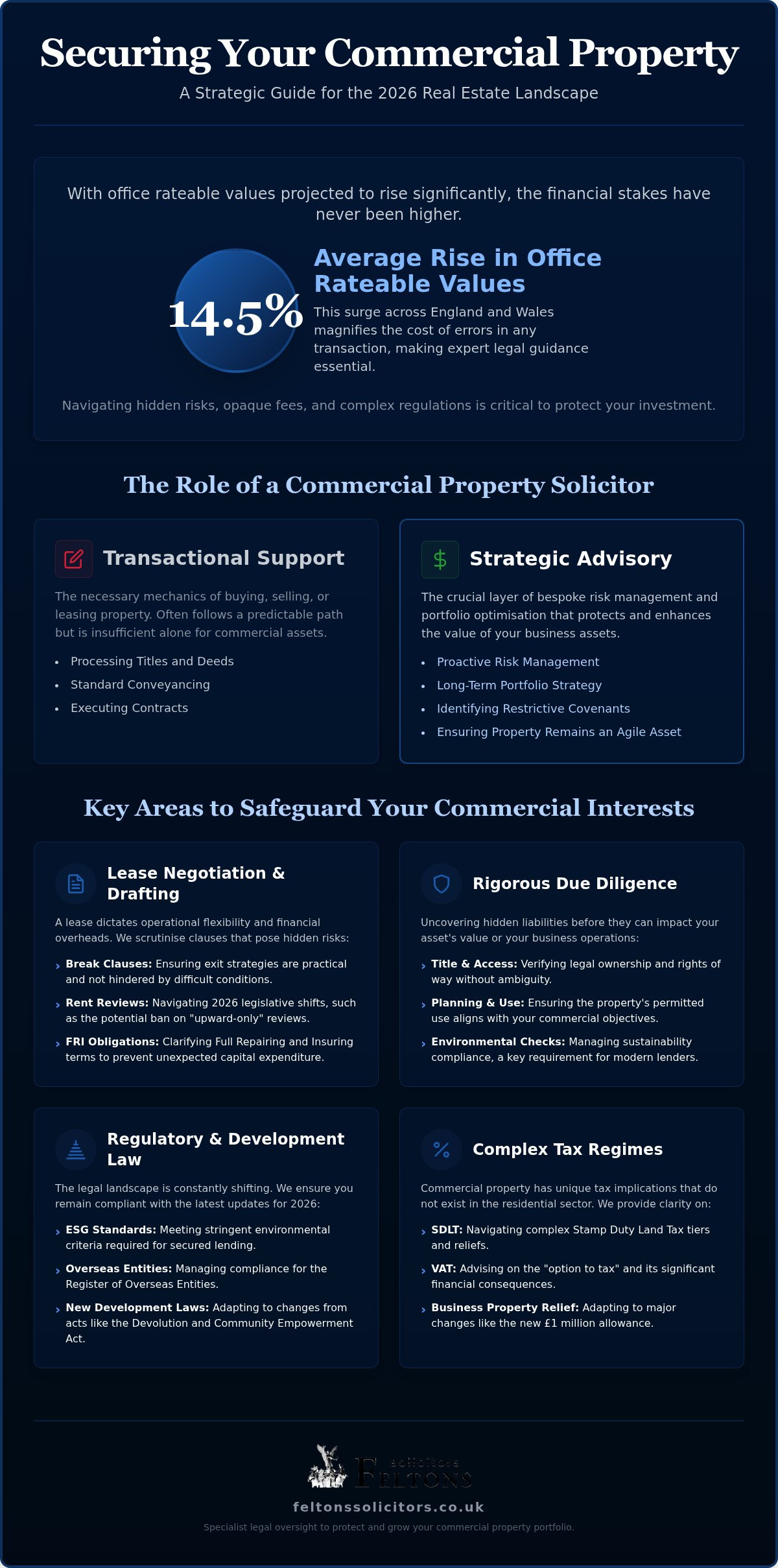
With office rateable values rising by an average of 14.5% across England and Wales in 2026, the margin for error in your next real estate transaction has never been thinner. You likely recognise that whilst property remains a cornerstone of business growth, the legal path to securing it is increasingly fraught with hidden risks. It’s understandable to feel uneasy about opaque fee structures or the slow transaction speeds that so often cause promising deals to collapse at the final hurdle.

Securing a commercial property solicitor who offers a blend of sophisticated authority and pragmatic, “people-first” advice is the most effective way to protect your interests. Our focus is on providing the strategic guidance necessary to navigate a complex 2026 landscape, ensuring you don’t miss restrictive covenants that could stifle your future operations. By the end of this article, you’ll understand how to secure favourable lease terms under the latest regulations, minimise your business liability, and adapt to significant shifts like the new £1 million allowance for Business Property Relief. We will examine the essential steps to managing your assets with confidence, ensuring every transaction serves your broader commercial objectives.

Key Takeaways

  • Understand how a commercial property solicitor functions as a discreet advisor to manage complex risks that extend far beyond standard conveyancing.
  • Identify the pivotal lease clauses that safeguard your operational freedom and protect your business from unforeseen financial commitments.
  • Discover the rigorous due diligence steps necessary to reveal hidden liabilities before they can impact the value of your commercial assets.
  • Navigate the latest 2026 regulatory updates, including essential compliance for the Register of Overseas Entities and new development laws.
  • Learn why a boutique legal partnership offers the tailored expertise and personal connection needed to support a growing property portfolio.

What is a Commercial Property Solicitor and Why Does Your Business Need One?

A commercial property solicitor acts as far more than a legal processor for titles and deeds. While residential conveyancing often follows a predictable, formulaic path, commercial transactions are governed by complex English land law principles that require a bespoke approach to risk management. Your business assets represent significant capital and operational exposure. Treating their acquisition or lease as a mere administrative task is a dangerous oversight. In 2026, where office rateable values have surged by an average of 14.5% across England and Wales, the financial consequences of a poorly negotiated contract are immediate and severe.

Commercial law involves unique mechanisms such as the Landlord and Tenant Act 1954, which provides security of tenure for business occupiers. Without this protection, a business could be forced to relocate at the end of a lease term, losing years of accumulated goodwill and local brand recognition. Specialist legal oversight is non-negotiable because commercial property carries distinct tax regimes, including complex SDLT tiers and the “option to tax” for VAT, which don’t exist in the residential sector. You need a partner who understands that a deal delayed by slow due diligence is often a deal lost.

The Distinction Between Transactional and Advisory Support

Legal support is traditionally viewed as transactional, focusing on the mechanics of buying, selling, or leasing assets. However, the true value of a commercial property solicitor lies in advisory oversight. This includes ongoing portfolio management and identifying restrictive covenants that could stifle your business growth or prevent a future change of use. If you plan to exit the business in five years, your lease must allow for a clean break or assignment without prohibitive conditions. We ensure your property remains an agile asset rather than a restrictive liability that hinders your long-term strategy.

Safeguarding Commercial Interests in 2026

The regulatory environment has shifted significantly this year. With the English Devolution and Community Empowerment Act 2026 introducing potential bans on upward-only rent reviews, your legal advice must ensure new leases reflect these modern standards. Beyond the lease itself, we manage environmental and sustainability compliance, which is increasingly a prerequisite for secured lending. Lenders in 2026 are more stringent; they require proof that assets meet evolving ESG standards before releasing funds. A commercial property solicitor serves as a definitive shield against operational disruption, ensuring that legal technicalities never compromise your business’s momentum.

A commercial lease is far more than a simple occupancy agreement; it’s a complex financial instrument that dictates your business’s overheads and operational flexibility for years. Relying on generic templates often leaves tenants exposed to “hidden” costs that only surface during a dispute or at the point of exit. Instructing a commercial property solicitor ensures that every clause is tailored to your specific industry requirements rather than a landlord-biased standard. Adhering to RICS professional standards provides a baseline for fair management, but bespoke legal drafting is what secures your business’s unique interests.

Critical Lease Terms to Review

The financial impact of a lease is often found in the fine print of its various mechanisms. Break clauses are essential for maintaining agility, yet they are frequently conditional on “vacant possession” or “absolute compliance,” terms that can be difficult to satisfy in practice. Rent review clauses also require careful scrutiny, especially following the 2026 legislative shifts regarding upward-only reviews. Understanding Full Repairing and Insuring (FRI) obligations is equally vital, as these can lead to unexpected capital expenditure for structural repairs. For those navigating the complexities of long-term property rights, speaking with leasehold enfranchisement experts can help clarify your options for securing more permanent control over your premises.

Lease Renewals and Assignments

The Landlord and Tenant Act 1954 provides a statutory right to renew your lease, which is a cornerstone of business continuity in the UK. However, landlords can oppose renewal on specific grounds, such as an intention to redevelop the site. If you plan to sell your business, the ability to assign the lease to a buyer is critical. A commercial property solicitor will negotiate “reasonable” consent requirements to ensure your exit strategy isn’t blocked by a landlord’s refusal. Finally, managing dilapidations at the end of a term is a significant financial risk. Early legal advice on terminal schedules can prevent costly litigation and ensure a smooth transition out of the property. If you’re entering new negotiations, a detailed contract review can identify these risks before you sign.

Strategic Acquisitions and Disposals: Managing Transactional Risk

Strategic acquisitions require a methodical approach that transcends simple price negotiation. In a market where office rateable values have shifted significantly, the true value of a deal is often found in the quality of the underlying title and the absence of hidden liabilities. A commercial property solicitor manages the entire transaction lifecycle, from the initial review of heads of terms to the final registration at the Land Registry. Whilst the RICS Code for Leasing Business Premises focuses on fairness in tenancies, acquisitions demand a more aggressive focus on risk mitigation and long-term operational efficiency.

The Due Diligence Framework

Due diligence is the foundation of any secure purchase. It involves a rigorous investigation into title history, planning permissions, and building regulation compliance. We scrutinise Commercial Property Standard Enquiries (CPSEs) to uncover issues such as unauthorised alterations, boundary disputes, or pending litigation. Environmental searches are particularly critical in 2026, as contaminated land liabilities can stay with the owner regardless of when the damage occurred. For mixed-use developments, where a commercial unit sits beneath residential flats, you must also consider navigating residential property law to manage the distinct rights of residential tenants, such as the right of first refusal.

Financing and Secured Lending

Securing capital is often the most time-sensitive element of a transaction. We work closely with commercial lenders to satisfy their specific requirements, handling the complex legal charges and debentures over your property assets. If your financing timeline is tight, having a commercial property solicitor who understands the lender’s perspective prevents delays that could jeopardise the deal. We ensure the legal structure of your purchase supports your borrowing needs, allowing for a seamless transition from offer to ownership. This includes verifying that the property’s insurance and repair obligations align with the bank’s security requirements, protecting both your capital and your relationship with the lender.
Commercial Property Solicitor: Strategic Legal Guidance for UK Business Assets in 2026

Specialist Complexities: Overseas Entities and Development Law

The intersection of international investment and UK property law has become significantly more regulated. For international investors, compliance with the Register of Overseas Entities (ROE) is no longer a peripheral concern but a central pillar of asset management. Failing to maintain accurate records on the ROE can result in severe penalties and, crucially, prevents any dealing with the property at the Land Registry. A commercial property solicitor with specialist expertise in this area ensures your international structure remains transparent and compliant with the latest 2026 standards.

Registering Overseas Entities for UK Property

Registration is a multi-stage process that requires meticulous attention to detail. It is not merely an administrative filing; it is a legal declaration of ownership structure. The process typically follows three critical stages:

  • Identification: Pinpointing beneficial owners as defined by the Economic Crime (Transparency and Enforcement) Act, ensuring all “shadow” interests are correctly categorised.
  • Verification: All information must be verified by a UK-regulated agent before submission to Companies House.
  • Annual Compliance: Managing the mandatory annual updates to ensure the entity’s status remains “active” and deal-ready.

For a more detailed breakdown of these requirements, see our guide on overseas entity beneficial owner registration.

Property Development and Site Assembly

Development projects require a different legal architecture. Site assembly involves the delicate process of merging multiple parcels of land, often requiring the negotiation of complex infrastructure and utility easements. We draft option agreements and conditional contracts that provide the flexibility developers need during the planning phase. Protecting future value is equally important. Overage agreements ensure that if a site’s value increases significantly post-development, the original seller receives a fair share of the uplift, while the developer’s margins remain protected. This methodical approach protects your capital while allowing for ambitious growth.

When preparing a site for development, ensuring physical security is as important as the legal framework; specialists like Romford Fencing Ltd can provide the trade-grade materials needed to secure your assets during the transition.

Even with the best drafting, disputes can arise. Whether it’s a disagreement over service charges or a challenge to leasehold enfranchisement rights, we prioritise mediation and pragmatic negotiation to avoid the prohibitive costs of litigation. Our role is to act as a discreet partner, resolving issues quietly and efficiently so your focus remains on your business operations. If you are managing international assets or planning a new development, our commercial legal team is ready to provide the discreet, high-standard support your portfolio requires.

Choosing the Right Commercial Property Solicitor for Your Portfolio

Selecting a commercial property solicitor is a consequential decision that directly impacts your business’s bottom line and operational security. High-volume “conveyancing factories” often rely on automated processes that struggle to account for the nuances of a complex commercial deal. Within the 2026 regulatory framework, where oversight of overseas entities and environmental compliance is more rigorous than ever, a tick-box approach is insufficient. You need a partner who possesses deep commercial awareness and understands how a property asset fits into your broader industry objectives.

The right legal advisor acts as a sophisticated guide, identifying risks before they become liabilities. Direct partner access is essential. It ensures that your transaction is handled by an expert who can navigate the intricacies of the Landlord and Tenant Act 1954 or the complexities of a mixed-use development with poise. Communication should be steady and reassuring, providing you with the clarity needed to make informed decisions under pressure. If a firm cannot explain a restrictive covenant’s impact on your future exit strategy in plain English, they may lack the commercial depth your portfolio requires.

The Feltons Difference: Pragmatic and People-First

Feltons Solicitors LLP was established in 2010 by Paula Felton with a commitment to providing a boutique, high-standard service that prioritises personal connection. We don’t view transactions as mere files; we see them as the foundation of your business’s future. Our “people-first” philosophy means we focus on building long-term advisory relationships, offering a calm and steady presence amongst the stresses of a property acquisition or disposal. Whether you are a national developer or an international investor, our advice remains pragmatic and tailored to your specific needs. We maintain transparent fee structures to address the common industry pain point of opaque legal costs, ensuring you can manage your capital with confidence.

Next Steps for Your Property Transaction

Moving forward with a new lease or purchase requires methodical preparation to avoid the delays that cause deals to collapse. Before your initial consultation, ensure you have your Heads of Terms, proof of identity, and any relevant financing details organised. This allows your commercial property solicitor to begin the due diligence process immediately, protecting your position in a competitive market. When you are ready to instruct, look for a firm that combines traditional professional integrity with modern efficiency. Your property assets deserve a discreet partner who values privacy and personal rapport as much as technical excellence. Secure your business assets today and contact Feltons Solicitors LLP for a consultation to discuss your requirements.

The 2026 property market presents both significant challenges and unique opportunities for businesses. We have discussed how a dedicated commercial property solicitor moves beyond simple paperwork to provide the strategic foresight required for complex lease negotiations and regulatory compliance. By focusing on bespoke drafting and rigorous due diligence, you can ensure your property assets remain agile and protected against shifts in business rates and inheritance tax allowances. Success in this environment relies on identifying risks early and maintaining a clear path for future growth.

Feltons Solicitors LLP provides a calm, steady presence throughout the lifecycle of your property assets. Our boutique service model guarantees direct partner involvement and specialist expertise in areas such as Overseas Entity registration, whilst our national reach ensures we can support your interests across the UK. We combine traditional professional integrity with a “people-first” philosophy to deliver results that respect both your time and your commercial objectives. Instruct Feltons Solicitors for your commercial property transaction to secure the high-standard, discreet guidance your business deserves.

Frequently Asked Questions

Do I really need a solicitor for a commercial lease renewal?

Yes, instructing a solicitor is essential to protect your statutory rights under the Landlord and Tenant Act 1954. Missing strict deadlines can result in the loss of your right to remain in the premises. Professional oversight ensures your new lease reflects 2026 market standards and doesn’t include restrictive clauses that could hinder your future business agility or exit strategy.

How much are commercial property solicitor fees in 2026?

Fees are determined by the transaction’s complexity and the value of the asset involved. Rates typically track service producer price inflation, which saw a modest increase in early 2026. Most firms provide a combination of fixed fees for standard conveyancing and hourly rates for bespoke advisory work. We recommend requesting a transparent, individualised quote to ensure your legal budget aligns with your specific objectives.

What is the Register of Overseas Entities and does it apply to me?

The Register of Overseas Entities (ROE) requires foreign organisations holding UK land to declare their beneficial owners to Companies House. It applies to you if you are a non-UK legal entity that owns, or intends to acquire, property in the United Kingdom. This regulation is a critical compliance point in 2026, ensuring transparency and allowing for legal dealings at the Land Registry.

How long does a commercial property purchase typically take?

A standard commercial purchase usually takes between eight and twelve weeks from the approval of heads of terms to final completion. Timelines depend heavily on the depth of due diligence required and the speed of financing approvals. Complex site assemblies or transactions involving overseas entities may take longer due to the additional verification and compliance stages required by current regulations.

Can a commercial solicitor help with property disputes or litigation?

Yes, a commercial property solicitor provides vital support for litigation and dispute resolution. Whether you are facing a disagreement over service charges, dilapidations, or leasehold enfranchisement, we prioritise pragmatic negotiation to avoid the costs of court. If mediation fails, we provide the professional authority needed to handle formal proceedings and protect your business interests effectively.

What is the difference between a commercial lease and a licence to occupy?

A commercial lease grants exclusive possession of a property for a fixed term, creating a formal legal interest in the land. In contrast, a licence to occupy is merely a personal permission to use the space and offers no security of tenure. Choosing the wrong structure can leave your business vulnerable to sudden eviction or unexpected financial liabilities.

Do you handle commercial conveyancing for international clients?

We provide comprehensive support for both national and international clients from our London office. Our boutique approach allows a commercial property solicitor to act as a discreet partner for complex matters, including the registration of overseas entities. We manage the entire lifecycle of your UK assets, ensuring compliance with local regulations whilst maintaining a personal connection regardless of your location.

What happens if I don’t register my overseas entity correctly?

Failing to register correctly results in severe restrictions that effectively freeze your property assets. You’ll be unable to sell, lease, or charge the land at the Land Registry until compliance is met. Additionally, non-compliance can lead to significant daily fines and potential criminal prosecution for the entity’s officers, making accurate registration a non-negotiable priority for any international investor.


Collective Enfranchisement: A Complete Guide to Buying Your Freehold in 2026

Collective Enfranchisement: A Complete Guide to Buying Your Freehold in 2026

If you feel like a tenant in a home you supposedly own, you aren’t alone. With over 4.9 million leasehold properties in England, many homeowners face the same frustrations of escalating ground rents and a total lack of control over building insurance or maintenance. It is a distressing position to be in, especially when a diminishing lease makes your property increasingly difficult to sell. However, the legal right to collective enfranchisement offers a powerful solution, allowing you and your neighbours to join forces and purchase the freehold of your building outright.

We understand that the prospect of challenging a landlord can feel daunting, but taking this step is often the most effective way to future-proof your investment. This guide provides a clear, professional roadmap for navigating the current legal landscape in 2026. You will discover how to abolish ground rent, grant yourselves 999-year leases, and finally assume the authority your home deserves. From understanding the latest legislative updates to managing the coordination of your fellow leaseholders, we have outlined everything you need to know to secure your building’s future with confidence.

Key Takeaways

  • Understand the eligibility criteria, including the 50% participation rule, to determine if your building qualifies for a freehold purchase.
  • Learn how collective enfranchisement allows you to abolish ground rent entirely and grant yourselves 999-year leases to maximise property value.
  • Discover the importance of a formal participation agreement and specialist professional guidance in coordinating neighbours and meeting strict legal requirements.
  • Identify common procedural errors, such as missing statutory deadlines, that could potentially void your claim and cause unnecessary delays.
  • Gain a clear roadmap for taking full management control of your building, from insurance to maintenance, ensuring long-term security for your investment.

What is Collective Enfranchisement and Who is Eligible?

Collective enfranchisement is the statutory right that empowers leaseholders to join forces and purchase the freehold of their building. This process transforms your relationship with your home, moving you from the position of a tenant to a co-owner of the entire structure. For a deeper understanding of the legal framework and its origins, exploring What is Collective Enfranchisement? offers a useful foundation for this legal right. To trigger this process, at least 50% of the qualifying tenants in the block must participate. If the building contains only two flats, both owners must agree to the purchase to proceed.

The building itself must meet specific structural and usage criteria. It must be a self-contained building, or a self-contained part of a building, containing at least two flats. A critical factor is the proportion of commercial space within the premises. Currently, the non-residential floor area, such as shops or offices, must not exceed 25% of the total internal floor area. If your building’s commercial footprint is larger than this threshold, it won’t qualify under the rules applicable in 2026.

The Impact of the Leasehold and Freehold Reform Act 2024

The legal landscape in 2026 is significantly more accessible due to recent legislative shifts. On 31 January 2025, the government abolished the two-year ownership requirement for participants. This change means you can now participate in a claim from the very day you complete your property purchase. These reforms reflect a clear shift in favour of the leaseholder, simplifying the path to ownership and removing many of the traditional hurdles that previously protected landlords. Whilst there’s ongoing discussion about increasing the commercial limit to 50%, the 25% rule remains the active standard for claims initiated today.

Buildings That Do Not Qualify

Whilst the right is broad, certain properties remain exempt from the collective enfranchisement process. National Trust properties and specific Crown lands are protected from these claims. You might also find yourself ineligible if you live in a converted house with a resident freeholder, provided the building contains no more than four units and the freeholder has lived there as their only or principal residence for at least twelve months. Certain charitable housing trusts are also exempt, ensuring their property portfolios remain intact for their social purposes.

To qualify as an individual, you must hold a long lease. This is defined as a lease originally granted for a term of more than 21 years. It doesn’t matter if you live in the flat or if it’s an investment property; as long as you meet the “long lease” definition, you’re generally eligible to participate. This inclusivity ensures that a wide range of homeowners can take control of their building’s management and long-term financial health.

The Financial Benefits: Why Buying the Freehold Makes Sense in 2026

Undertaking collective enfranchisement is often the single most effective way to protect your property’s long-term market value. By removing the external freeholder, you eliminate the burden of escalating ground rents, which have become a significant point of concern for both mortgage lenders and prospective buyers. Once the freehold is secured, participating members can grant themselves “peppercorn” lease extensions, typically for a term of 999 years. This effectively removes the “ticking clock” of a diminishing lease, making the property far more attractive to future purchasers who prioritise “Share of Freehold” status.

Management control provides another direct financial advantage. Instead of being tied to the freeholder’s choice of expensive insurance providers or maintenance contractors, you gain the authority to tender these services yourself. This often leads to a marked reduction in annual service charges and better quality of care for the building’s infrastructure. If you’re unsure about the initial requirements for your block, reviewing The Collective Enfranchisement Process can help your group understand the preparatory steps needed to secure these savings.

Calculating the Premium and the End of Marriage Value

The premium is the price you pay the landlord for the freehold, determined by specialist surveyors who assess the loss of ground rent and the reversionary value of the building. Marriage value is the potential increase in value when a lease is extended or the freehold is bought. Whilst the Leasehold and Freehold Reform Act 2024 contains provisions to abolish marriage value for leases under 80 years, as of August 2026, these specific changes have not yet been implemented. This makes accurate professional valuation essential to ensure your group doesn’t overpay during negotiations whilst the older valuation rules remain in force.

Understanding the Total Cost of Enfranchisement

Budgeting for the project requires looking beyond the premium itself. Participating leaseholders are responsible for their own legal and valuation fees, as well as the landlord’s “reasonable” professional costs. Under current 2026 regulations, the rule requiring each side to bear their own costs is not yet in force, so the freeholder’s expenses remain a factor in your final budget. Many groups choose to distribute these costs through a formal participation agreement to ensure financial transparency amongst neighbours. For those seeking a tailored legal assessment of these potential costs, professional guidance can help streamline the process and prevent unexpected disbursements.

The Collective Enfranchisement Process: A Step-by-Step Roadmap

The foundation of a successful collective enfranchisement claim is the early and effective coordination of your group. Before any legal notices are served, we recommend drafting a formal participation agreement. This contract binds your neighbours to the project, ensuring everyone contributes their share of the costs and remains committed throughout the process. Once the group is aligned, you’ll need to instruct a specialist valuer to estimate the premium and a solicitor to manage the complex legal requirements. These professionals provide the steady guidance needed to navigate the statutory timetable without missing critical deadlines.

The formal process begins with the service of a Section 13 Initial Notice on the freeholder. This document triggers a strict legal timetable, giving the landlord at least two months to respond with a Counter-Notice. This response will either accept your right to buy or dispute it, often proposing a higher premium than your initial offer. It’s during this phase that the expertise of your legal team becomes invaluable, as they’ll handle the nuances of the landlord’s response and prepare for the negotiation stage.

Forming a Right to Enfranchise (RTE) Company

Most leaseholders choose to form a limited company to hold the freehold title. This structure provides a clear framework for ownership, where each participating leaseholder typically holds one share. Appointed directors from amongst the residents then oversee the building’s management post-completion, ensuring every decision reflects the collective’s best interests. When calculating the financial viability of this structure, it’s worth noting the availability of Stamp Duty Land Tax relief, which can provide substantial savings for collective claims.

Negotiation and the First-tier Tribunal

Following the Counter-Notice, there’s a statutory period for price negotiations. Your valuer will work to find a middle ground with the landlord’s surveyor, focusing on a fair market price. If an agreement isn’t reached within the required timeframe, an application can be made to the First-tier Tribunal (Property Chamber) to determine the premium. Once the price is settled, the process concludes with the TR1 transfer form and registration at HM Land Registry. This final step officially transfers the building’s ownership to your group, marking the beginning of your full control over the property.

Collective Enfranchisement: A Complete Guide to Buying Your Freehold in 2026

Common Pitfalls and How to Avoid Them

Success in collective enfranchisement depends on meticulous attention to detail. Because this is a statutory process, the law is exceptionally rigid regarding timelines and documentation. Missing a statutory deadline by a single day, such as the window to apply to a tribunal after receiving a Counter-Notice, is often enough to void the entire Section 13 Notice. This forces the group to wait twelve months before they can legally serve a new notice, during which time property values may rise or lease terms may shorten further.

Inaccurate information is another frequent hurdle. Every participant’s name and property description must match the Land Registry records exactly. If a notice is served with even a minor clerical error, a landlord may successfully challenge the validity of the claim in court. We also advise that all participants have their portion of the premium and professional fees secured in a dedicated account before the process begins. If a neighbour loses their funding mid-way, the remaining group may struggle to cover the shortfall, potentially leading to a costly withdrawal. Withdrawing from the project after the notice has been served usually triggers a requirement to pay the landlord’s “reasonable” legal and valuation costs up to that point.

If you are concerned about procedural errors or require a specialist review of your enfranchisement claim, professional oversight is the most reliable way to safeguard your investment.

Dealing with Missing or Absent Landlords

It is a common misconception that a missing freeholder prevents you from buying the freehold. If the landlord cannot be found after “reasonable” enquiries, your group can apply to the County Court for a Vesting Order. This legal mechanism allows the court to sign the transfer documents on the landlord’s behalf. The premium is then paid into court, where it is held in a special account should the freeholder eventually come forward to claim it.

Managing Non-Participating Tenants

Whilst you only need 50% of qualifying tenants to proceed, managing those who choose not to join requires careful financial planning. The participating group must “buy out” the entire freehold, including the portions related to the flats of non-participants. This increases the initial cost for those taking part. Crucially, non-participants do not receive the benefits of the project; they will not be granted 999-year leases and must continue paying ground rent to the new resident-owned company.

How Feltons Solicitors Facilitates Your Path to Freehold Ownership

Securing the freehold of your block is a significant legal undertaking that requires a steady, experienced hand. At Feltons Solicitors LLP, we act as a calm presence throughout the entire process, positioning ourselves as dedicated leasehold enfranchisement experts who prioritise your long-term property interests. We understand that the coordination of multiple neighbours can be complex. We provide the structured support necessary to keep your project moving forward. Our team manages every detail, from the initial drafting of participation agreements to the final registration of your new ownership at HM Land Registry.

We pride ourselves on a “people-first” philosophy. Whilst the technicalities of property law are paramount, we never lose sight of the human impact our work has on your home life and financial security. Our pragmatic approach focuses on resolving disputes with landlords efficiently, ensuring that your collective enfranchisement claim doesn’t become bogged down in unnecessary litigation. We translate complex legal requirements into plain English, giving you the confidence to make informed decisions for your building’s future.

Our National Property Law Expertise

Our experience extends across the country, handling claims for buildings ranging from small residential blocks to large, mixed-use developments. Mixed-use properties often present unique challenges, particularly regarding the 25% commercial floor space limit mentioned earlier in this guide. We possess the specialist knowledge required to handle both residential and commercial conveyancing aspects of these transactions. To ensure you pay a fair premium, we work in seamless integration with qualified surveyors, providing a unified strategy that protects your group from overvaluation or procedural delays.

Take the First Step Toward Building Control

Early legal consultation is vital for a successful collective claim. Many pitfalls, such as missing statutory deadlines or serving notices with incorrect tenant information, can be avoided with professional oversight from the outset. We assist your group in the formal formation and administration of your RTE Company, ensuring the structure is robust and ready to hold the freehold title. If you’re ready to abolish ground rent and take full management control, we invite you to contact our specialist team to discuss your building’s eligibility and begin your journey toward ownership.

Secure Your Property’s Future with Confidence

Buying your freehold is more than a legal transaction; it’s a strategic move to reclaim control and protect your home’s market value. By navigating the collective enfranchisement process, you can finally eliminate ground rent and secure the long-term stability of a 999-year lease. Whilst the 2026 legal landscape offers significant advantages for leaseholders, the strict statutory deadlines and complex coordination required amongst neighbours make expert oversight essential to a successful outcome.

At Feltons Solicitors, our specialist leasehold enfranchisement team provides the pragmatic and discreet legal advice needed to handle even the most intricate claims. With national UK coverage, we act as your sophisticated guide from the initial participation agreement to final registration. If you are ready to transition from leaseholder to freeholder, contact Feltons Solicitors for expert guidance on your collective enfranchisement claim. Taking this step today ensures your building remains a well-managed, high-value asset for years to come.

Frequently Asked Questions

How many tenants need to participate in collective enfranchisement?

At least 50% of the qualifying tenants in the building must participate. If the building has only two flats, both owners must join the claim. This threshold ensures the collective has the legal mandate to force the sale. It’s a critical first step in the collective enfranchisement process to confirm your group meets this statutory requirement amongst your neighbours before serving any formal notices.

Can a landlord refuse collective enfranchisement?

No, a landlord cannot refuse if the building and the tenants meet the statutory eligibility criteria. Whilst they can dispute the premium or the boundaries of the land being purchased, they cannot simply say no to the right itself. If a landlord attempts to obstruct a valid claim, the matter can be referred to the First-tier Tribunal (Property Chamber) for a legally binding determination.

How long does the collective enfranchisement process take?

The process typically takes between nine and twelve months from the service of the Initial Notice to final completion. This timeline accounts for the statutory response periods, valuation negotiations, and the legal work required for the transfer of title. If the case proceeds to a tribunal due to a dispute over the premium, the timeframe can extend significantly beyond a year.

Do I still have to pay service charges after buying the freehold?

Yes, you’ll still need to contribute to the cost of maintaining and insuring the building. The difference is that you and your fellow participants, usually through an RTE company, will now control how that money is spent. You gain the authority to choose contractors and insurance providers directly, which often results in more competitive rates and better service quality than a third-party landlord provides.

What happens to the ground rent once we own the freehold?

Ground rent is effectively abolished for all participating leaseholders once the freehold purchase is complete. Your group can grant yourselves new 999-year leases at a peppercorn rent, which means no money is actually paid. This removes the financial burden of escalating fees and makes your property far more attractive to future buyers and mortgage lenders who are increasingly wary of high ground rents.

Can we buy the freehold if some neighbours don’t want to join?

Yes, you can proceed as long as at least 50% of the qualifying tenants participate. The participating group will need to cover the cost of the entire freehold, including the portions attributed to the non-participating flats. Those who don’t join will remain leaseholders; they’ll pay their ground rent and service charges to your new resident-owned company instead of the old landlord.

What is the difference between Right to Manage and Collective Enfranchisement?

Right to Manage (RTM) allows leaseholders to take over the management of their building without buying the freehold. Collective enfranchisement is a more permanent solution where you actually purchase the ownership of the building and land. Whilst RTM gives you control over service charges and maintenance, enfranchisement also allows you to abolish ground rent and extend your own leases to 999 years.

Will buying the freehold increase the value of my flat?

Buying the freehold typically increases a property’s value by making it a Share of Freehold asset. This status is highly desirable because it removes the risks associated with short lease terms and escalating ground rents. Prospective buyers and lenders view these properties as more secure investments, often leading to a higher sale price and a faster transaction when you eventually decide to move.

Conveyancing Solicitors in London: Expert Property Guidance for 2026

Conveyancing Solicitors in London: Expert Property Guidance for 2026

In the 2026 London property market, a standard administrative approach to legal work is no longer enough to guarantee a successful completion. Finding the right conveyancing solicitors london requires looking beyond high-volume firms that often struggle with the intricacies of modern leasehold reform. You likely feel the pressure of shifting completion timelines and the frustration of waiting days for a simple update from a case handler you’ve never met. It’s a significant investment; the lack of transparency in the legal process can make an already complex transaction feel overwhelming.

This guide provides a sophisticated roadmap for navigating these complexities, offering the boutique care and direct solicitor access required for a smooth, stress-free move. We will explore the latest 2026 Stamp Duty rates, the impact of the draft Commonhold and Leasehold Reform Bill, and how pragmatic legal advice can prevent unnecessary delays. Whether you’re navigating a high-value freehold or a complex leasehold extension, our focus remains on providing the quiet confidence and expert guidance you need to secure your property with total peace of mind.

Key Takeaways

  • Understand the vital role of a solicitor in identifying title defects that could otherwise devalue your property investment.
  • Learn how tailored due diligence protects you from future liabilities amongst varying residential and commercial property types.
  • Discover why choosing boutique conveyancing solicitors london avoids the pitfalls of high-volume firms by prioritising direct access to experienced legal partners.
  • Gain insight into specialist areas such as leasehold enfranchisement and the mandatory Registration of Overseas Entities for international owners.
  • Explore how a pragmatic, people-first philosophy helps you manage complex legal structures whilst avoiding unnecessary delays.

The London property market in 2026 is defined by a paradox: while technology has accelerated the initial stages of a sale, the legal complexities involved in securing a valid title have never been more demanding. Many prospective buyers ask What is conveyancing? at the start of their journey. In essence, it is the legal transfer of property title from one party to another. However, for conveyancing solicitors london, the process is far more than a simple administrative handover. It is a rigorous investigation into the legal integrity of a property to ensure your investment is protected.

A solicitor’s primary duty is to identify “title defects” that could significantly devalue a property or restrict its future use. These might include unresolved planning breaches, restrictive covenants, or complex rights of way. Whilst high-volume firms might overlook these nuances in a rush to meet quotas, a boutique firm prioritises a people-first approach. This ensures that every potential liability is scrutinised before you are legally committed. In 2026, completion timelines have remained sensitive to broader economic shifts, even with the stability suggested by Prime Minister Andy Burnham’s current property tax policies, making early and thorough legal oversight essential.

The Legal Framework of a Property Transaction

Accurate title registration with the Land Registry forms the bedrock of English property law. This state-backed register provides a definitive record of ownership, but it relies on the precision of the data submitted by your legal team during the application process. The transaction reaches its pivotal moment at the “Exchange of Contracts.” This is the point of legal commitment where the buyer and seller are bound to the deal; pulling out after this stage incurs significant financial penalties. Modern transactions also require meticulous Stamp Duty Land Tax (SDLT) compliance. With rates remaining consistent since the April 2025 adjustments, your solicitor must ensure that all tax obligations are calculated correctly to avoid future penalties from HMRC.

Why 2026 Demands Proactive Legal Oversight

The shift towards digital-first conveyancing has improved data sharing, yet it often removes the human element from the equation. At Feltons, we balance modern delivery with personal service. Complex chain-linked transactions, which are common amongst London properties, require sound judgment and constant communication to reach a successful conclusion. Pragmatic advice is the most effective tool for avoiding the common pitfalls that stall property sales. By anticipating delays and managing expectations, conveyancing solicitors london can navigate the intricacies of the 2026 market with steady, professional authority.

While residential transactions focus on securing a personal home, commercial acquisitions involve complex layers of business risk and long-term liability. Expert conveyancing solicitors london must navigate these differences with precision. For a seller, understanding the seller’s legal process is essential for a smooth handover. For a buyer, thorough due diligence is the only way to ensure that a property doesn’t come with hidden financial burdens. This scrutiny protects you from future liabilities amongst varying property types, whether you’re purchasing a South London flat or a commercial retail unit.

A typical transaction follows a structured path. It begins with the initial instruction and identity checks, moving through the drafting of contracts and the review of search results. Once the mortgage offer is secured and enquiries are satisfied, the exchange of contracts takes place. Momentum is maintained through clear communication between solicitors, lenders, and estate agents. This avoids the “black hole” of silence that often plagues high-volume firms. If you value this level of direct, personal communication, you might consider how our team can support your next move with tailored legal care.

Residential Property Law for Homeowners

Buying a home in 2026 requires a clear understanding of your tenure. Freehold ownership is generally straightforward, but leasehold properties involve ongoing relationships with freeholders and management companies. With the draft Commonhold and Leasehold Reform Bill progressing, professional advice is vital to understand how these changes affect your specific lease. Our residential property law firm guide details these nuances further. Essential searches for any purchase include:

  • Local authority enquiries to check for planning restrictions or nearby developments.
  • Water and drainage searches to confirm utility connections and public sewer layouts.
  • Environmental reports to identify potential land contamination or flood risks.

Commercial Property: Buying vs Leasing

Commercial transactions demand a different legal mindset. Developers and business owners must scrutinise “Heads of Terms” before they are formalised into a contract. These documents outline the core agreement but often lack the legal protections required in the final deed. Lease renewals also require careful timing to protect statutory rights of occupation under the Landlord and Tenant Act. Experienced conveyancing solicitors london ensure that your commercial interests are prioritised during these negotiations. Should disputes arise, Feltons provides the expertise in litigation and dispute resolution necessary to protect your investment and maintain your business continuity.

The choice of legal representation often boils down to a fundamental question of value versus price. In a market saturated with “quick quotes” and automated portals, the risk of falling into a “conveyancing factory” is real. These high-volume, low-fee models rely on processing hundreds of files simultaneously, often delegating critical tasks to junior staff or clerical teams. This approach frequently leads to the very delays and communication breakdowns that property buyers dread most. Referring to the UK government’s guide to conveyancing highlights the procedural necessity of the work, but it cannot account for the quality of the legal relationship.

Choosing boutique conveyancing solicitors london ensures that your transaction is handled with the bespoke care it deserves. At Feltons Solicitors LLP, we maintain a status as a discreet partner for high-net-worth and private clients who require more than just administrative processing. We believe that traditional professional integrity should remain at the heart of every deal. In a world increasingly dominated by automated chatbots and offshore call centres, the value of direct access to an experienced solicitor cannot be overstated. It is the difference between being a file number and being a valued client.

The Risk of Being “Just a Number”

When a firm is overstretched, the human impact of a property transaction is often forgotten. High-volume firms are prone to clerical errors and missed deadlines because their case handlers are managing impossible workloads. A dedicated solicitor can spot potential issues much earlier. This proactive oversight doesn’t just save time; it can save thousands of pounds in aborted costs if a deal is fundamentally flawed. During the high-pressure atmosphere of completion week, having a calm advisor who provides empathetic reassurance is invaluable. You deserve a partner who answers the phone.

Sound Judgment and Individualised Attention

Every property transaction is unique. Whether you’re a first-time buyer or an experienced developer, your legal strategy should be tailored to your specific goals. Feltons provides a steady, calm presence that guides you through even the most complex litigation or disputes. Our individualised attention means we understand the nuances of your situation, allowing us to offer pragmatic advice that avoids common pitfalls. For sensitive or high-value matters, this level of discreet legal support is a necessity for protecting your privacy and your assets. We prioritise your peace of mind amongst the noise of the London market.

Conveyancing Solicitors in London: Expert Property Guidance for 2026

Specialist Expertise: Leasehold Extensions and Overseas Entity Registrations

London’s property landscape is uniquely global. This international character demands a level of legal proficiency that extends far beyond the standard exchange of contracts, which is why instructing experienced conveyancing solicitors london is a strategic necessity for international buyers. For many owners, the long-term security of their investment relies on niche areas of property law that standard high-volume firms often overlook. At Feltons, we provide the specialist expertise required to manage these complexities, positioning ourselves as a discreet partner for clients with sophisticated portfolios.

Leasehold Enfranchisement and Extensions

Maintaining the length of a lease is vital for preserving a property’s market value. As a lease shortens, the cost of extending it increases, and the property becomes harder to mortgage. This is why proactive action is essential. Our leasehold enfranchisement experts provide clear, step-by-step guidance on how to secure your property rights. Beyond individual extensions, we also assist flat owners with collective enfranchisement. This process allows a group of leaseholders to buy the freehold of their building together, giving them total control over management and service charges. Acting early avoids the complications of “marriage value” and ensures your asset remains attractive to future buyers.

Registration of Overseas Entities for UK Property

The legal environment for international investors has shifted significantly with the introduction of the Register of Overseas Entities (ROE) at Companies House. Any overseas entity that owns or intends to buy UK property must now be registered. Non-compliance isn’t merely an administrative oversight; it can lead to severe criminal penalties and prevent you from selling or charging the property in the future. The requirement for transparency is absolute, and the legal consequences of failing to update the register annually are significant.

A critical part of this process is the “verification service.” Beneficial owners must have their identity verified by a UK-regulated professional before registration can be completed. We manage this intersection of property law and international compliance with meticulous attention to detail. Our guide on overseas entity beneficial owner registration offers comprehensive compliance support for those navigating these requirements. Highly specialised conveyancing solicitors london are essential when your transaction involves these international or long-term leasehold elements. We act as your sophisticated guide, ensuring that every regulatory hurdle is cleared with quiet confidence. If you require assistance with a complex registration or a lease extension, contact Feltons Solicitors LLP today for expert guidance.

The Feltons Approach: Pragmatic Advice for a Smooth Completion

The final stage of any property transaction is where the strength of your legal partner is truly tested. A successful completion isn’t merely the result of administrative processing; it’s the outcome of meticulous preparation and sound judgment. As conveyancing solicitors london, we recognise that our role is to act as a steady, calm presence amidst the inevitable pressures of a move. Our philosophy at Feltons Solicitors LLP is built on the belief that modern efficiency doesn’t have to come at the expense of traditional professional values. We combine the latest digital delivery methods with the discreet, high-standard service that our clients expect.

Even amongst the most complex litigation or disputes, our “sophisticated guide” persona helps you navigate the legal landscape with quiet confidence. We prioritise personal rapport and direct communication, ensuring you’re never left waiting for an update during a critical phase. This people-first approach means we understand the human impact of the work we do. Whether you’re moving into a new family home or expanding a commercial portfolio, our goal is to provide pragmatic advice that keeps your transaction moving forward without unnecessary delays.

A Trusted Advisor for Every Step

Property transactions often coincide with other significant life events that require expert legal oversight. Our firm provides a holistic service that extends beyond the immediate sale or purchase. We frequently assist clients with related matters such as estate planning and the drafting of wills to ensure their new assets are fully protected. Similarly, our broad expertise in divorce and financial arrangements allows us to manage property transfers with the sensitivity and discretion they require. Established in 2010 by Paula Felton, our firm offers a mark of stability and heritage that provides our clients with total peace of mind.

Next Steps: Securing Your Property Transaction

Instructing your solicitor early is the most effective way to protect your timeline. By engaging conveyancing solicitors london before an offer is even accepted, you allow us to begin the necessary due diligence immediately. This proactive approach reduces the risk of the transaction stalling during the critical early stages. To expedite the “Know Your Customer” (KYC) and anti-money laundering checks required in 2026, you should have the following documents ready:

  • Valid photographic ID, such as a current passport or driving licence.
  • Proof of address, typically a recent utility bill or bank statement.
  • Evidence of the source of funds, including bank statements or gift letters where applicable.

Choosing Feltons Solicitors LLP means choosing a partner that values your time and your privacy. We provide the professional authority of a large firm with the empathetic care and individualised attention of a boutique practice. If you’re preparing for a property move in 2026, we invite you to organise a consultation with our team to discuss your specific requirements and secure a smooth, stress-free completion.

The 2026 property market presents unique challenges that require a shift from standard administrative processing to a more tailored legal strategy. We’ve explored how direct access to experienced solicitors protects you from the pitfalls of high-volume firms, particularly when navigating the shifting landscape of leasehold reform and the mandatory Registration of Overseas Entities. Whether you’re managing a residential purchase or a complex commercial acquisition, the value of a discreet partner who prioritises your privacy and peace of mind is paramount.

Choosing the right conveyancing solicitors london ensures that your transaction is handled with high-end reliability and the pragmatic advice needed for a successful completion. At Feltons Solicitors LLP, we combine our expertise in complex property law with a boutique approach that puts your needs first. Our focus remains on delivering a smooth, stress-free experience through every stage of the legal process.

If you’re ready to move forward with quiet confidence, we invite you to instruct Feltons Solicitors for your property transaction today. Your journey toward a successful completion starts with the right legal support.

Frequently Asked Questions

How much are conveyancing fees for a London property in 2026?

Conveyancing fees in London are determined by the specific complexity of your transaction and the value of the property involved. Whilst industry averages provide a baseline, a bespoke quote from conveyancing solicitors london will account for variables such as leasehold requirements or shared ownership supplements. It’s essential to ensure your quote is transparent and includes all necessary disbursements to avoid unexpected costs during the final stages of your move.

How long does the conveyancing process typically take from offer to completion?

A typical property transaction in 2026 takes between 8 and 12 weeks to reach completion from the point an offer is accepted. This timeline is heavily influenced by the length of the property chain and the speed at which local authority searches are returned. Instructing a proactive legal team early helps maintain momentum and ensures that any potential title defects are identified and resolved before they cause significant delays.

What is the difference between a conveyancer and a solicitor?

The primary difference lies in the breadth of legal training and the scope of services provided. A solicitor is a fully qualified lawyer who can handle a wide range of legal issues, including complex litigation and estate planning, whereas a licensed conveyancer is a specialist in property law only. Choosing a solicitor provides the added security of comprehensive legal oversight should your transaction involve unexpected disputes or related family law matters.

Do I need a specialist solicitor for a leasehold property extension?

Specialist legal guidance is highly recommended for leasehold extensions because the process involves strict statutory deadlines and complex valuation calculations. Handling an extension incorrectly can lead to the loss of your right to extend or significantly higher costs. Experienced conveyancing solicitors london understand the nuances of the 2024 Reform Act and the draft 2026 Bill, ensuring your property’s long-term value is protected through precise legal execution.

What happens if a property dispute arises during the conveyancing process?

If a dispute arises, your solicitor will first attempt to find a pragmatic resolution through negotiation to keep the transaction on track. Should the matter escalate, a firm with expertise in litigation can provide the formal representation needed to protect your interests. Having a steady, professional advisor ensures that issues regarding boundary lines or restrictive covenants are handled with the necessary authority to reach a successful conclusion.

Can Feltons Solicitors help with the registration of an overseas entity?

Feltons Solicitors LLP provides a dedicated verification and registration service for the Register of Overseas Entities at Companies House. This is a critical requirement for any international entity owning or purchasing UK property to avoid severe criminal penalties. We act as a sophisticated guide for international clients, ensuring all beneficial owner information is verified and submitted in full compliance with current UK transparency laws.

What are the most common reasons for property completions to be delayed?

Completions are most frequently delayed by slow communication within a property chain or complications with mortgage offers. Technical issues, such as unresolved enquiries regarding leasehold management packs or slow local search turnarounds, also play a significant role. Choosing a boutique firm that prioritises direct solicitor access can mitigate these risks, as potential hurdles are identified and addressed much earlier in the legal process than in high-volume models.

Is it possible to complete a property transaction entirely remotely in 2026?

Property transactions in 2026 can be conducted almost entirely remotely through secure digital portals and electronic signature technology. This modern delivery allows for efficient document sharing and identity verification regardless of your physical location. Whilst most of the process is digital, some high-value transactions or specific lender requirements may still necessitate the physical posting of certain original deeds or a face-to-face verification meeting to ensure total security.