
Boundary dispute mediation solicitors in the UK: finding your boundary

Boundary dispute mediation solicitors in the UK: finding your boundary

The line on your title plan may not be the legal boundary. Most registered properties in England and Wales are subject to the general boundaries rule, so the plan usually indicates the boundary’s general position rather than fixing it precisely. Boundary dispute mediation solicitors in the UK can help you assess deeds and other evidence, then explore mediation before court proceedings.

It’s understandable to expect a clear answer from the Land Registry plan, especially when a fence or wall appears to mark the divide. But the legal position may depend on how title documents, historic features and conditions on the ground fit together.

This article explains what title plans and deeds can show, what evidence may help establish a boundary, and how mediation works. It also covers when a surveyor’s input may be useful, how to record an agreement, and why court costs make litigation a route to consider carefully rather than an automatic first step.

Key Takeaways

  • Treat the title plan as a guide to the boundary’s general position, then compare it with deeds and evidence from the land itself.
  • Gather relevant documents and photographs before deciding whether expert input could help clarify the dispute.
  • Consider negotiation or mediation as a route to agreement before court proceedings, which can bring substantial costs.
  • Make any agreed boundary clear in the documents and plan, so uncertainty is less likely to arise again when a property is sold.
  • Where an expert is involved, their role is to assist the tribunal impartially, not simply to support the party paying for their report.

Court costs and unreasonable refusal to mediate

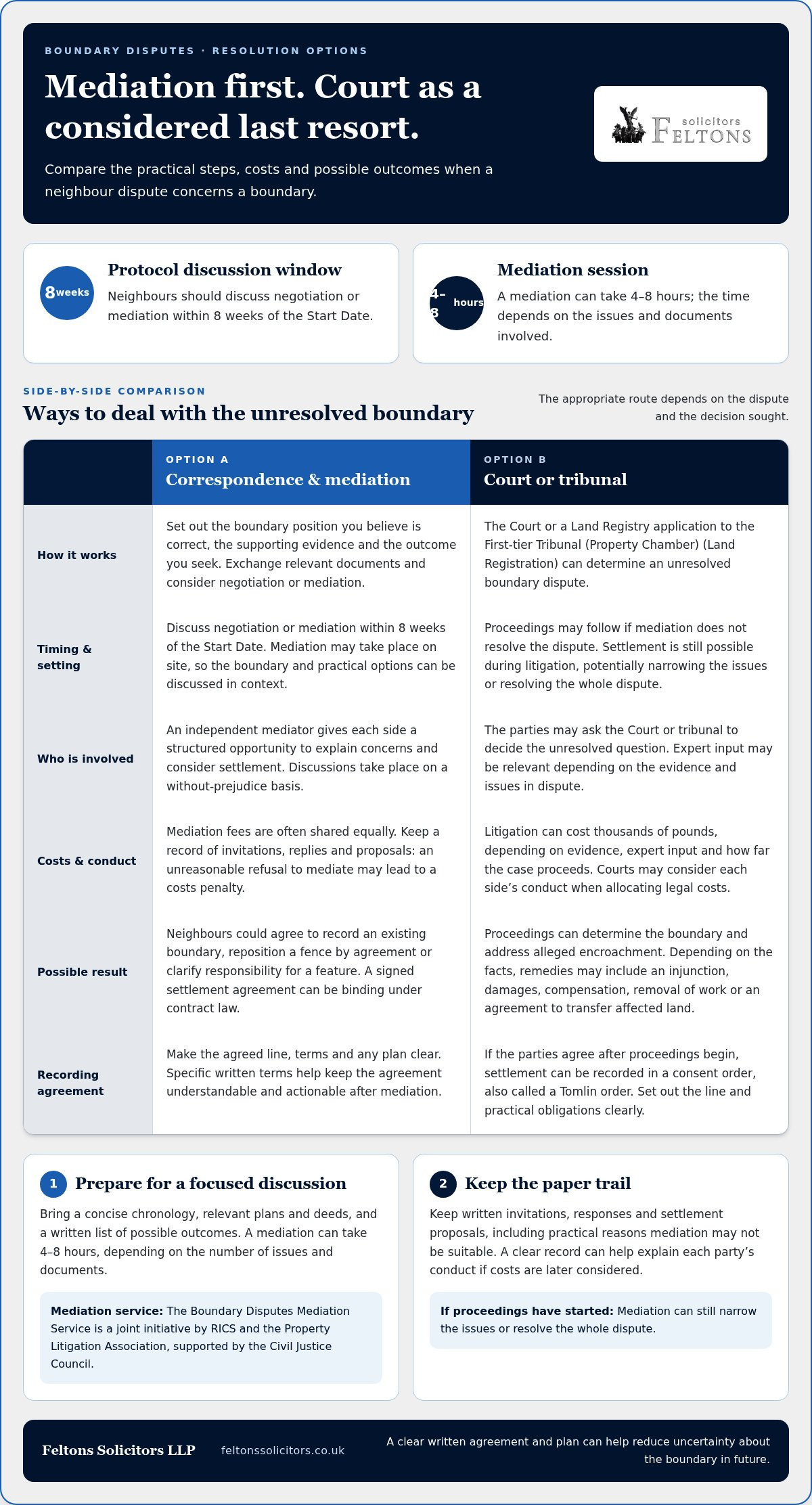
Mediation is recommended before court, and boundary proceedings should be a last resort after the parties have tried alternative dispute resolution. A party who unreasonably refuses mediation may face a costs penalty, even if they later succeed on the boundary question. Courts can consider each side’s conduct when deciding who should bear the legal costs, so a clear written invitation and a reasoned response matter.

In Huntley v Armes, cited by the Court of Appeal (Civil Division) as [2010] EWCA Civ 396, the dispute concerned a strip measuring 14 inches. The case is a reminder that a small area can still lead to formal proceedings and cost consequences. Keep records of proposals, replies and any practical reasons mediation may not be suitable; those details can help explain your conduct if a judge later considers costs.

The Boundary Disputes Protocol identifies the Court or a Land Registry application to the First-tier Tribunal (Property Chamber) (Land Registration) as routes for determining an unresolved boundary dispute. The appropriate route depends on the nature of the dispute and the decision sought. A solicitor can advise on the process, evidence and remedies relevant to your rights before you make an application.

Starting proceedings does not rule out settlement. The parties can mediate during litigation, potentially narrowing the issues or resolving the whole dispute. If they agree, the settlement can be recorded in a consent order, also called a Tomlin order, once proceedings have begun. Set out the agreed line and practical obligations clearly, rather than relying on an informal conversation or ambiguous sketch.

Where the dispute involves building work near a shared wall, distinguish boundary questions from party-wall issues. The Party Wall Act 1996 concerns building work affecting shared structures between two properties, according to UK Parliament. UK Parliament also identifies a 3 metre provision as a frequently misunderstood component of the Party Wall etc Act 1996. That provision should not be treated as deciding ownership of a disputed strip of land.

Court proceedings can determine the boundary and address alleged encroachment. Depending on the facts, possible remedies include an injunction, damages, compensation, removal of work or an agreement to transfer affected land. If construction is still under way, prompt advice may preserve more practical options. Planning permission or building regulations approval does not itself give a neighbour ownership of, or a right to build on, your land.

Before escalating, organise the title documents, photographs and a concise chronology of events. Identify the outcome you want, such as confirming the boundary, stopping work or recording an agreement. Then consider whether negotiation or mediation could achieve that outcome without a final hearing. If the other party declines, keep a record of their reasons and your response; the courts may consider that conduct when allocating costs.

Alternative dispute resolution

Mediation is one route to a practical agreement, alongside focused correspondence and expert discussions. If it fails, the parties can still pursue litigation, which can cost thousands of pounds depending on the evidence, expert input and issues in dispute. A solicitor handling boundary dispute mediation in the UK can help assess which route best fits the unresolved points.

Correspondence and mediation

Start with a clear letter setting out the boundary position you believe is correct, the evidence supporting it and the outcome you seek. Neighbours can then exchange relevant documents and consider whether negotiation or mediation could resolve the difficult points. Under the Boundary Disputes Protocol, they should discuss negotiation or mediation within 8 weeks of the Start Date.

Mediation gives each side a structured opportunity to explain its concerns and consider a settlement with an independent mediator. Discussions take place on a without-prejudice basis, and mediation fees are often shared equally. Boundary mediations can take place on site, helping everyone discuss the precise line and practical options in context.

The Boundary Disputes Mediation Service is a joint initiative by RICS and the Property Litigation Association, supported by the Civil Justice Council. A mediation can take 4-8 hours, though the time depends on the number of issues and documents involved. Prepare a concise chronology, relevant plans and deeds, and a written list of possible outcomes before the meeting. For neighbours considering boundary dispute mediation in the UK, this preparation helps keep discussion focused on achievable terms.

Keep proposals specific. Neighbours might, for example, agree to record an existing boundary, reposition a fence by agreement or clarify responsibility for a feature. A signed settlement agreement can be binding under contract law. Make its terms and any plan clear, so the agreement remains understandable and actionable after mediation ends.

Options after unsuccessful mediation

The Boundary Disputes Protocol identifies the Court or the First-tier Tribunal (Property Chamber) (Land Registration), by way of a Land Registry application, as routes for determining an unresolved boundary dispute. The next step depends on what remains disputed, the available evidence and the decision needed.

Litigation can cost thousands of pounds. The expense depends on how much evidence must be gathered, whether expert reports are needed and how far the case proceeds. Court proceedings may also result in a costs decision, so keep mediation invitations, responses and settlement proposals to show how each party approached dispute resolution.

When legal advisers are instructed after the initial 8-week period, the Protocol says they should consider whether further negotiation or mediation is appropriate and inform the other party within 2 weeks of appointment. For advice on the legal route and next steps, explore dispute resolution support.

A boundary solicitor reviews title documents and evidence, explains the issues and advises on practical next steps. To find a specialist near you, look for experience in property disputes and boundary evidence, rather than relying on distance alone.

Finding the legal boundary

Start by comparing the Land Registry title plan with the deeds and physical features on the ground. Most registered properties in England and Wales follow the general boundaries rule, so a title plan usually indicates a boundary’s general position rather than its precise measurement. A line on the plan may represent several metres on the ground, so it may not settle a disagreement by itself.

Check whether the official copies record a boundary agreement or formal boundary determination. These can be exceptions to the general guide shown by a title plan. Ordnance Survey maps physical features, not legal boundaries, and its mapping is not precise enough to establish ownership on its own.

Legal and surveying advice

An initial legal assessment brings the available documents together and identifies what remains disputed. A solicitor can compare the title plan, deeds, correspondence and neighbours’ accounts, then advise whether negotiation, a boundary agreement or further evidence may help. This also clarifies the outcome you are seeking, such as confirming the existing line or resolving a claim over land.

If comparing documents does not resolve the position, a specialist surveyor can interpret measurements, historic features and how plans relate to the ground. Consider carefully whether that expertise is needed before instructing an expert, since involving one too early can add considerable expense. The key question is whether a surveyor’s independent analysis would answer an unresolved point.

Risks of moving a fence or wall

Moving a fence does not automatically change the legal boundary or transfer ownership. If a neighbour’s new fence appears to cross the line, moving it back before establishing the boundary can escalate the dispute and complicate a later settlement. Record its location with dated photographs and preserve relevant correspondence before taking physical action.

A solicitor can assess the evidence and explain how a proposed change might affect the parties’ positions. If the dispute concerns building work, distinguish ownership from planning permission or building regulations approval. Those approvals do not themselves give someone ownership of, or a right to build on, neighbouring land.

Boundary litigation can become costly, particularly if the parties need expert reports or a court determination. The eventual expense depends on the issues, evidence and how far proceedings progress, so an early assessment can identify what needs clarification before litigation is considered. Record any settlement clearly, with an accurate plan, to reduce the risk of the same uncertainty returning when either property is sold.
Boundary dispute mediation solicitors in the UK: finding your boundary

Gathering evidence and interpreting title deeds

Build a clear record before discussing the boundary with the other owners. Comparing title documents with historic features and evidence from the ground can help identify where accounts differ.

Land Registry plans and boundary evidence

Use the Land Registry title plan as one part of the evidence, not as a precise survey. Most registered properties in England and Wales are subject to the general boundaries rule, so a plan usually shows the boundary’s general position. A line may represent several metres on the ground.

Compare the plan with the physical features it may relate to, such as a wall, hedge or old fence line. Ordnance Survey maps show physical features rather than legal boundaries, so they cannot settle ownership by themselves. Record any difference between the mapped line and what you see on site.

Evidence used to establish a boundary

Gather documents and observations that may explain how the boundary was created and treated over time. Useful material can include title plans, conveyance documents, dated photographs, correspondence between owners and details of historic features on the land. Keep each item in date order and note what it shows.

Boundary disputes can involve deeds 150 years old. Pre-registration deeds may contain a plan or a detailed written description, and those details can be compared with the present layout. A surveyor can help interpret measurements, historic features and the relationship between documents and conditions on the ground.

Make a short chronology of events, including when a fence was installed, repaired or moved, and when either party first objected. Label photographs with their dates and viewpoints. If a previous owner discussed the boundary, preserve letters or messages and identify anyone who witnessed the conversation.

The Boundary Disputes Protocol sets out practical steps for exchanging material. Neighbours should assemble and exchange relevant documents within 4 weeks of the Start Date. After identifying the First Conveyance, parties should exchange documentary evidence and identify proposed witnesses within 3 weeks.

These steps help both parties see which points are agreed and which remain disputed. For example, documents might establish the original line, while photographs show that a later fence was placed elsewhere. Discuss the difference before deciding whether further expert evidence is needed.

Keep the evidence organised in a shared schedule: list each document, its date, its source and the point it supports. Separate direct evidence, such as a deed plan, from interpretation, such as what a physical feature may indicate. This helps owners discuss the same material and consider whether a boundary agreement or further assessment could resolve the disagreement.

Boundary disputes

Boundary disputes can involve a fence, a wall, building work or long occupation of disputed land. Procedures differ across the UK: the Boundary Disputes Protocol and Land Registry routes discussed here concern England and Wales, not Scotland or Northern Ireland.

Start by defining the issue and the outcome you want. Is the disagreement about the boundary’s position, ownership of a strip, responsibility for a shared feature or construction crossing the line? These questions can overlap, but may require different evidence and remedies. For example, an extension built across a boundary raises questions about the land occupied and whether work should stop or be removed.

Long use of land can also complicate a claim. In England and Wales, a new-style adverse possession claim may rely on a condition in Schedule 6 paragraph 5 of the Land Registration Act 2002. That makes it important to distinguish a claim based on occupation from a disagreement about interpreting a deed. Gather evidence of how the land was used and who controlled it, then identify the specific basis of each party’s position.

A surveyor’s role is to provide independent evidence on physical features, measurements and how documents relate to conditions on the ground. The Boundary Disputes Protocol says expert instructions should follow CPR Part 35.3, according to the Civil Procedure Rule Committee. Under that rule, the expert’s duty to help the tribunal overrides obligations to the person instructing or paying them. Their opinion should address the issue, not advocate for either neighbour.

Before commissioning expert work, set out the question the surveyor must answer and the material they need. If the parties jointly appoint an expert, agree the instruction and provide relevant documents consistently. A concise report focused on the disputed line can help narrow complex disagreements. If litigation follows, a boundary surveyor may need to prepare a CPR-compliant expert report for the court.

Possible outcomes depend on the claim. They may include an agreed boundary, an injunction, damages, compensation, removal of encroaching work or a formal transfer of affected land. A boundary agreement can record where the existing legal boundary lies, but cannot be used to give or sell land to a neighbour. If ownership of land is changing, the parties may need a formal transfer instead.

Set out the unresolved issue, evidence and outcome you want before choosing the next step. Discuss your boundary dispute and the legal options available for resolving it.

Feltons Solicitors LLP: Divorce and Financial Arrangements

Feltons Solicitors LLP provides residential and commercial conveyancing when resolving a boundary issue involves a formal transfer of land. A boundary agreement records where the existing legal boundary lies; it cannot itself give or sell land to a neighbour. If a proposed settlement changes ownership, conveyancing support can help with the property transaction involved.

Before taking that step, establish whether the agreement confirms the existing line or transfers part of a title. Keeping that distinction clear helps ensure the paperwork reflects what both owners have agreed. For help with a property transaction arising from a boundary settlement, contact Feltons Solicitors LLP.

Take a considered next step

A boundary disagreement can affect more than the line on a plan. It may shape how neighbours use their gardens, maintain shared features and approach future property decisions. Before agreeing a way forward, set out the outcome you need and consider how the agreement will be recorded and understood by future owners.

Solicitors handling boundary dispute mediation in the UK can help you assess the legal issues and identify a practical route towards resolution. Feltons Solicitors LLP also advises on divorce and financial arrangements, wills, probate and estate planning, and residential and commercial conveyancing. Conveyancing may be relevant if resolving the dispute involves transferring part of a title.

If you’re ready to discuss your circumstances and possible next steps, contact Feltons Solicitors LLP. A clear starting point can help you approach the dispute with greater confidence.

Frequently Asked Questions

Establishing where the boundary actually is?

Compare the registered title, any filed deeds and the history of the disputed strip, rather than relying on a fence line alone. Note where fixed features sit and whether earlier photographs or conveyancing records show a different arrangement. A useful first step is to mark the disputed section on a copy of the plan, then list the documents or observations that support each neighbour’s position. This focuses discussions on evidence, not assumptions.

How long will it take to resolve a dispute?

There is no single timetable for a boundary dispute: the time depends on the issues, available documents and whether an agreement is reached. A mediation can sometimes resolve the dispute in 4-8 hours, but preparing for it and recording an agreement take additional time. If parties need expert reports or a court decision, the process will involve further steps. Set a practical aim for each stage, such as exchanging documents or narrowing disputed points.

Is the mediation outcome binding?

A settlement recorded in an agreement signed by both parties is binding, and a formal settlement agreement can be enforced under contract law. Before signing, make sure the written terms match the decision reached: identify the boundary clearly, describe any agreed work or responsibilities, and attach a plan both parties understand. If court proceedings have already begun, the settlement may be recorded in a consent order, also called a Tomlin order.

What happens if an agreement cannot be reached?

If mediation does not produce an agreement, the parties can continue negotiating or seek a formal decision through court proceedings or an application to the First-tier Tribunal (Property Chamber) (Land Registration). The next step depends on the unresolved issue and the decision needed. Before proceeding, list the points that are agreed, those still contested and the evidence supporting each position. This can help keep any later application focused.

What if the neighbour has used the land for years?

Long occupation can be relevant, but it does not by itself resolve a boundary disagreement. In England and Wales, a neighbour’s use of land may raise an adverse possession issue, even where the registered title appears to include that land. Record how the area has been occupied, maintained or enclosed, and whether permission was given. Dates, historic photographs and correspondence can help distinguish a long-standing arrangement from a later change in position.

Who can apply for mediation?

Either neighbour can propose mediation, and both parties need to participate for a jointly agreed settlement to emerge. A written proposal can identify the disputed area, the outcome sought and the documents each side should bring. The Boundary Disputes Protocol says neighbours should discuss whether to negotiate or mediate within 8 weeks of its Start Date. Legal advisers can also consider whether further mediation is appropriate when instructed later.

Who pays the fees?

Mediation fees are often shared equally between the parties, though they can agree another arrangement. Clarify who will pay which share before arranging the session, and establish how separate expenses, such as expert input, will be handled. Keep a written record of that agreement. If the dispute later reaches court, a judge may also consider whether either party unreasonably refused mediation when deciding costs.

How much do UK boundary dispute solicitors charge, and what are typical costs?

Solicitor fees depend on the case and are provided after a quote request; the main cost factors include the work required, the complexity of the dispute, the evidence and whether expert reports or court proceedings are involved. Boundary disputes can run into thousands of pounds to resolve legally, with litigation generally adding further stages and expense. Mediation may help contain costs, but its suitability depends on what remains disputed.

Party Wall Dispute Legal Advice: When to Get Help

Party Wall Dispute Legal Advice: When to Get Help

The most useful first step in a party wall dispute may not be a formal legal letter. If you’re unsure whether the Party Wall etc. Act 1996 applies, or building work is about to begin without agreement, it’s understandable to feel you need to act quickly. Sound party wall dispute legal advice can help you clarify your options and risks before the disagreement escalates, without treating every concern as a court case.

This article explains how to check the position and what to do if work has started or you haven’t received a clear response. You’ll learn which documents to gather, how a party wall surveyor’s role differs from a solicitor’s, and when each may be useful. It also explains how to approach the next step proportionately, keep a clear record and protect your position. Legal advice can help you understand your rights and routes forward, but it doesn’t replace a surveyor’s role in the Act’s dispute process. If you’re considering a solicitor, first confirm they can assist with your particular issue.

Key Takeaways

  • Check whether the proposed work may fall within the Party Wall etc. Act 1996 before treating the matter as a general boundary disagreement.
  • Keep copies of notices, plans and correspondence. Then check what work is planned and whether the relevant notice and response steps have been followed.
  • A party wall surveyor deals with the statutory process; a solicitor can help explain legal options and wider dispute-resolution risks. One does not automatically replace the other.
  • Use party wall dispute legal advice to clarify your position, understand possible next steps and decide whether specialist input is proportionate.
  • Before instructing an adviser, ask about their relevant experience, the scope of help they can provide, the likely process and the information they’ll need from you.

A party wall disagreement is not simply any dispute between neighbours about building work. It concerns work that may fall within the Party Wall etc. Act 1996, the framework for specified work in England and Wales. A statutory party wall matter may arise when work covered by the Act affects a shared wall, a boundary structure or nearby land, and the owners need to follow the relevant procedure.

A party wall dispute concerns the statutory process for specified building work; a general boundary dispute concerns where ownership or the property line lies. The issues can overlap, but they are not interchangeable. The Act does not apply to every renovation or neighbour disagreement, so the nature and location of the proposed work matter. The Party Wall etc. Act 1996 offers background on the legislation, but the particular facts still need to be assessed.

What kinds of work can raise a party wall issue?

Depending on the circumstances, the Act may apply to work directly affecting a party wall or structure, building a wall at the boundary, or certain excavations near a neighbouring building. Calling a project an extension or loft conversion doesn’t establish whether the Act applies. The plans, the properties’ positions and the details of the work all matter.

Check the proposed work and property circumstances before assuming that a notice is or isn’t required. If the scope is unclear, a qualified party wall professional can assess the building work and its relationship to the Act.

Is this a party wall matter or another property dispute?

A boundary disagreement concerns the location or ownership of the dividing line. A party wall issue concerns specified work and the procedure that may govern it. Concerns about damage, access to land or nuisance may raise separate legal questions, even when they relate to the same building project.

One situation can therefore call for more than one kind of input. A party wall surveyor may be relevant to the Act’s process, while a solicitor may help assess wider legal rights or dispute-resolution options. Party wall dispute legal advice can help identify which questions need attention, but a short online description cannot determine your rights. Keep the plans and correspondence together, and seek advice based on the full circumstances before taking a position.

How the party wall process works: notices, responses and awards

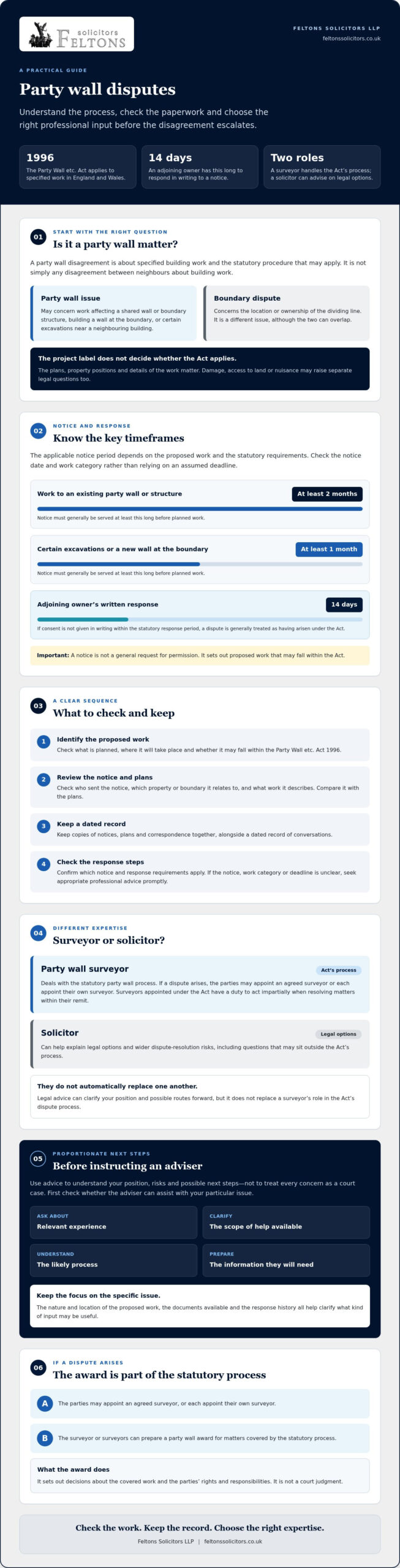
The process depends on the proposed work and whether the relevant notice has been served. A notice is not a general request for permission. It sets out proposed work that may fall within the Party Wall etc. Act 1996. The applicable notice period and response timetable depend on the proposed work and the statutory requirements that apply.

For example, the research for this guide confirms that notice for work to an existing party wall or structure must generally be served at least two months before work is planned, while notice for certain excavations or a new wall at the boundary must generally be served at least one month beforehand. An adjoining owner has 14 days to respond in writing. Check the notice date and work category carefully, and seek advice if either is unclear.

What should an owner do after receiving a party wall notice?

Start by checking who sent the notice, what work it describes and which property or boundary it relates to. Compare it with any plans you’ve received, then keep copies of the documents together with a dated record of conversations and correspondence. GOV.UK’s Party walls and building work guidance provides practical information about the process.

Don’t rely on an assumed deadline or respond without checking what the notice requires. The relevant period may depend on the notice and the work involved. If you’re unsure how to respond, obtain appropriate professional advice promptly.

What happens if an adjoining owner dissents or does not respond?

If the adjoining owner doesn’t consent in writing within the statutory response period, a dispute is generally treated as having arisen under the Act. The parties may then appoint an agreed surveyor, or each appoint their own surveyor. Surveyors appointed under the Act have a duty to act impartially when resolving matters within their remit.

Where the statutory process applies, the surveyor or surveyors can prepare a party wall award. This document sets out decisions about the covered work and the parties’ rights and responsibilities. It isn’t a court judgment, although it is legally binding. An award may be appealed to the county court within 14 days of service.

The sequence depends on the circumstances. If a notice wasn’t served, the Act’s surveyor procedure may not be available, and the appropriate route can differ. Party wall dispute legal advice may help clarify wider legal options, but it doesn’t replace a surveyor’s role in the statutory process. For related property or dispute questions, you can ask Feltons Solicitors about its property and dispute resolution services and whether it can assist with your specific issue.

Party wall surveyor or solicitor: which advice do you need?

The right professional depends on the question you need answered. A party wall surveyor deals with matters within the Party Wall etc. Act 1996 process, while a solicitor can advise on legal rights, how the Act may apply and wider dispute-resolution options. Their roles differ. Instructing a solicitor doesn’t automatically replace a surveyor appointed under the Act.

Use this comparison to identify a sensible first question:

Your concern Professional who may help Suitable first question
How proposed work should be dealt with under the Act, or what an award should address Party wall surveyor “Does this work fall within your remit under the Act?”
Uncertainty about legal rights, alleged damage, access or possible court action Solicitor, subject to confirming relevant experience and service scope “Can you advise on this issue, and what documents do you need to assess it?”
Questions about both the statutory process and wider legal rights Potentially both, with each professional’s role agreed clearly “Which parts of the matter can you advise on, and who should address the others?”

When is a party wall surveyor usually the relevant professional?

A surveyor is generally the relevant professional for resolving matters within the Act’s procedure, including considering the works and preparing or dealing with a party wall award. Surveyors appointed under the Act must act impartially in that process, rather than simply advocate for the person who appointed them. Before proceeding, check the surveyor’s appointment, precise remit and how the statutory role applies to your circumstances.

A surveyor’s role doesn’t automatically extend to deciding who owns a disputed strip of land, interpreting every property agreement or resolving all questions about access. Those issues may need separate legal input.

When may party wall dispute legal advice be useful?

Legal advice may help if you’re unsure how the legislation applies, damage is alleged, access is contested or someone threatens legal proceedings. A solicitor can review the documents, explain potential options and risks, and help you understand whether the issue extends beyond the surveyor-led process. Seeking advice doesn’t mean you’ve committed to going to court. Early clarity may help you consider proportionate ways forward.

Consider seeking advice promptly if a deadline is approaching, an injunction is raised or the impact on your property could be substantial. Feltons Solicitors handles property law and litigation and dispute resolution matters, but its available information doesn’t confirm a dedicated party wall service. Establish whether the firm can assist with your specific issue before instructing it.

Party Wall Dispute Legal Advice: When to Get Help

Party Wall Disputes: Practical Steps Before Escalation

A calm, organised response can help you understand what has happened before taking a formal step. First preserve the available records, clarify the work and check whether any notice or party wall award exists. Then consider whether a surveyor, solicitor or both may be appropriate. This isn’t about conceding a point; it’s about making decisions with a clearer picture of the facts.

Which documents and evidence should you gather?

Bring the key information together in one place. Keep original documents unchanged, and note when you received or created each item. Useful records may include:

  • Party wall notices, plans, schedules of condition and any award.
  • Letters, emails and messages exchanged with the neighbour, building owner or surveyor.
  • Dated photographs showing the property before work, visible changes or damage.
  • A factual timeline of what you observed, when it happened and who you contacted.

Separate what you’ve personally seen from what you suspect or have been told. For example, record when a crack appeared and where it is, rather than assuming what caused it. For wider background on property matters, Feltons’ residential property law guide may provide useful context.

How can you communicate without making the dispute worse?

Keep messages courteous, concise and focused on the work and the information you need. You could ask for a copy of the relevant notice or plans, or request clarification about what work is planned and when. Avoid unsupported allegations or statements that could be read as accepting responsibility or confirming a legal position. If you’re uncertain, get advice before making substantive admissions or assurances.

Don’t obstruct access or try to stop building work yourself without first checking your position. Equally, don’t assume that silence or an informal conversation resolves the issue. Keep a copy of each communication and note any reply.

Seek prompt, case-specific advice if work is underway and you’re concerned that a procedural step may have been missed, if damage is alleged, or if someone raises urgent court action. Party wall dispute legal advice can help assess legal options and risks, while a party wall surveyor may be needed for matters within the Act’s process. To ask whether the firm can assist with your particular property or dispute issue, contact Feltons Solicitors about its services.

Choose an adviser based on the issue you need resolved, not simply the fact that neighbours disagree. A party wall surveyor may be the appropriate professional for matters within the Act’s procedure; a solicitor may be able to advise on wider legal rights or dispute-resolution options. Before instructing anyone, explain the particular concern and confirm that it falls within their experience and service scope.

What should you ask before instructing a solicitor?

Ask whether the firm can advise on your specific party wall issue and any connected property dispute. Confirm who would handle the matter, what work the proposed instruction covers and how you’ll receive updates. You can also ask what documents are needed to assess your position, what the possible next steps might be, and how costs will be explained before you decide whether to proceed.

Useful questions include:

  • Have you dealt with issues of this type, and can you advise on the particular facts?
  • Would the matter require input from a party wall surveyor as well as a solicitor?
  • What information or documents do you need before advising on options and risks?
  • How will the scope of work, likely timescales and costs be set out?

Costs, timescales and prospects depend on the documents, the work involved and the points in dispute. An adviser should explain the basis of any estimate and what could affect it, rather than promise a particular outcome.

When might a dispute need a more formal route?

Court action isn’t the automatic next step. A disagreement may be addressed through the relevant surveyor process or another proportionate route, depending on the facts. However, unresolved questions about legal rights, alleged property damage or an urgent risk may justify discussing formal options with a solicitor. Seek advice promptly if proceedings are threatened or a deadline may affect your choices.

Feltons Solicitors handles property law and dispute resolution matters, but the available information doesn’t confirm that the firm accepts party wall instructions. Confirm whether it can assist with your specific issue, and ask what legal work it could undertake. Party wall dispute legal advice should help you understand options and risks, not assume that litigation is inevitable or replace the surveyor’s statutory role.

If you’d like to establish whether the firm can help with your circumstances, discuss your property dispute with Feltons.

Take a measured next step with confidence

A party wall concern is easier to assess when you separate the statutory process from wider property questions. Check the proposed work and any notices, preserve relevant records, and identify what remains unresolved. A party wall surveyor may be relevant to matters under the Act, while a solicitor can help explain legal options and risks beyond the surveyor’s remit.

Good party wall dispute legal advice doesn’t mean court action is inevitable. It can help you understand the available routes and decide what is proportionate to your situation. The right next step depends on the documents, the work and the specific issues involved.

Feltons Solicitors provides property law and conveyancing services and handles litigation and dispute resolution. The firm’s available information doesn’t confirm a dedicated party wall service, so ask whether it can assist with your particular issue before instructing. For a discussion about your circumstances, discuss your property dispute with Feltons. A clear understanding of your options can help you move forward calmly.

Frequently Asked Questions

Does every party wall dispute need a solicitor?

No, not every party wall matter requires a solicitor. Where the statutory process applies, a party wall surveyor may deal with matters within that process. A solicitor may be useful if there are wider questions about legal rights, alleged damage, access or possible court action. Party wall dispute legal advice can help clarify your options, but check that the solicitor can advise on your particular circumstances.

Can I stop my neighbour’s building work because I dispute it?

Disagreeing with your neighbour doesn’t automatically give you the right to stop their work. Don’t obstruct the work or access without first checking your legal position. If you believe work that may require notice has started without the proper process, or there’s an immediate risk to your property, seek prompt, case-specific advice. The appropriate remedy depends on the facts and may involve the courts rather than the Act’s surveyor procedure.

What happens if I disagree with a party wall award?

A party wall award is legally binding unless it’s successfully challenged. If you disagree, get advice promptly: an appeal must be made to the county court within 14 days of the award being served. Don’t assume that raising concerns with a surveyor pauses this period. Gather the award and related correspondence, and ask an adviser to explain whether your grounds and circumstances justify an appeal.

Do I need a party wall surveyor or a solicitor?

Choose according to the issue. A party wall surveyor deals with matters within the Act’s statutory process, including preparing or dealing with an award. A solicitor may advise on legal rights and wider disputes, such as alleged damage or threatened proceedings. You may need input from both, but a solicitor doesn’t automatically replace a surveyor appointed under the Act. Confirm each professional’s role and scope before instructing them.

Who pays for party wall dispute legal advice?

Don’t assume that party wall process costs and solicitor fees are treated the same way. In most cases, the building owner who initiates the work is responsible for the costs of the Act’s process, including the adjoining owner’s surveyor fees. A solicitor’s fees are separate, so ask the solicitor to explain who would be responsible for their costs and whether any recovery may be possible in your circumstances.

Does the Party Wall etc. Act 1996 apply throughout the UK?

No. The Party Wall etc. Act 1996 applies in England and Wales, not throughout the whole UK. If the property is in Scotland or Northern Ireland, don’t assume that this Act or its procedure applies. The relevant rules depend on where the property is and what work is proposed. Check the position with a suitably qualified professional before relying on a notice, deadline or process described for England and Wales.

What documents should I take to a party wall solicitor?

Take the party wall notice, plans, any award and correspondence with your neighbour, building owner or surveyor. Include dated photographs and a short timeline of events, especially if you’re concerned about damage or work changing. Keep original records unaltered, and distinguish what you’ve observed from what you suspect. If you don’t have every document, take what’s available and ask the solicitor what else is needed to assess the issue.

Right to Light Dispute Solicitors: A Practical Guide

Right to Light Dispute Solicitors: A Practical Guide

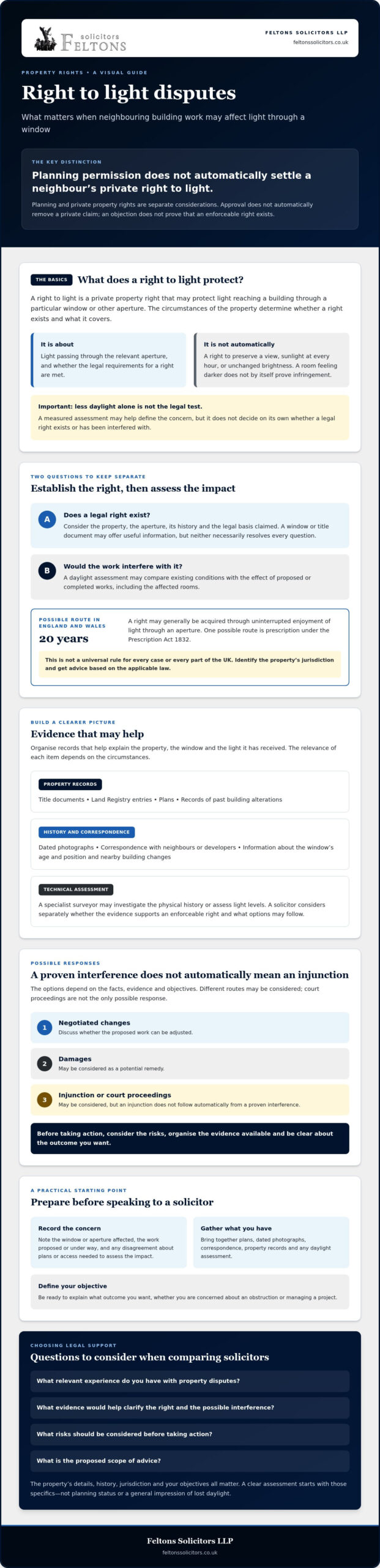
Could a building with planning permission still interfere with a neighbour’s legal rights? Yes. Planning permission and a private right to light are separate matters. If you’re looking for right to light dispute solicitors UK, start by establishing whether a legal right exists and how the proposed or completed work may affect it.

It’s understandable to be concerned if a new development may darken your home or put a project at risk. But a general loss of daylight doesn’t automatically mean a right to light has been infringed. A legal right may generally be acquired through 20 years of uninterrupted enjoyment of light through a specific window. The property’s details and history matter.

This guide explains how a right to light differs from general access to daylight, what property records and survey evidence may help clarify your position, and what early steps to consider. It also covers possible remedies, the risks of taking action and how to choose legal support suited to your objectives, whether you’re concerned about an obstruction or managing a project.

Key Takeaways

  • Check how a right may have arisen and whether the relevant legal rules apply to your property and jurisdiction.
  • Plans, dated photographs, correspondence and a daylight assessment may help clarify the extent of any interference.
  • A proven interference doesn’t automatically lead to an injunction. Negotiated changes, damages or court proceedings may be considered.
  • Before taking action, organise the evidence you have and note the outcome you want to achieve.
  • When comparing right to light dispute solicitors UK, ask about relevant property dispute experience, the evidence needed, potential risks and the proposed scope of advice.

What is a right to light dispute, and when can it affect your property?

A neighbouring extension or redevelopment can cause concern if it may make a home or workplace darker, or affect a project’s design. The key question isn’t simply whether less daylight will reach the property. It’s whether a legal right to light exists and whether the proposed work would interfere with it.

A right to light is a private property right that may protect light passing through a particular window or other aperture. It relates to light reaching a building through that opening, not to a general entitlement to an open outlook. For a useful starting overview, see What is a right to light. The existence and scope of any right depend on the property’s circumstances. A window, or a noticeable change in brightness, doesn’t by itself prove an enforceable claim.

What does a right to light protect?

The relevant factors include the property that may benefit, the aperture through which light is received, and the history or legal basis of the claimed right. A neighbour generally can’t claim a right to preserve a view, sunlight at every hour or unchanged brightness. The assessment is more specific than a subjective impression that a room feels darker. It considers the effect on light through the relevant aperture and whether the legal requirements are met.

Rules also depend on where the property is situated. The legal framework in England and Wales should not automatically be applied across the whole UK. Identify the relevant jurisdiction before relying on a particular route or rule, and seek advice based on it.

When does a neighbouring project become a dispute?

A dispute may arise during an extension, redevelopment or other building work that changes the relationship between neighbouring buildings. A developer may receive an objection from an adjoining owner, or a resident or business may find that proposed plans could reduce light to a room. A measured assessment may help define the concern, but it doesn’t settle the legal question on its own.

Planning and private rights are separate considerations. Planning permission doesn’t automatically remove a neighbour’s private claim, and a planning objection or approval doesn’t determine whether a right to light exists. Planning approval isn’t a complete answer for a developer, while an objection doesn’t establish that a neighbour has an enforceable right.

If you’re considering right to light dispute solicitors UK, first establish the property’s jurisdiction and the nature of the concern. Record which window or aperture may be affected, what work is proposed or under way, and any disagreement about the plans or access needed to assess the impact. These details provide a clearer basis for advice than planning status or a general impression of lost daylight.

How is a right to light established and the impact assessed?

Consider two questions separately: has the property acquired a right to light, and would the neighbouring work interfere with it? The answer depends on the property’s history, the relevant aperture, the location and the evidence. A title entry or technical report may help, but neither should be treated in isolation as a final answer.

The legal route also depends on jurisdiction. In England and Wales, one possible route is prescription under the Prescription Act 1832, which generally requires 20 years of uninterrupted enjoyment of light through an aperture. That isn’t a universal rule for every part of the UK or every case. The Law Commission’s report on Rights to Light provides further background, but advice should be based on the law applying to the property and the facts.

What evidence can help establish the right?

Start by gathering material that helps trace the property and the light it has received. This may include title documents, Land Registry entries, plans, dated photographs, records of past building alterations and correspondence with neighbours or developers. The age and position of a window, changes to nearby buildings and the period for which light has passed through the aperture may all be relevant. Documents can offer useful clues, but a register entry may not resolve every issue about the right’s existence or scope.

A specialist surveyor may help investigate the physical history or assess light levels. That technical work is separate from the legal question: a solicitor considers whether the evidence supports an enforceable right and what options may follow.

How is loss of light assessed?

A daylight assessment can compare existing conditions with the effect of proposed or completed works. It may examine the affected rooms, the windows or other apertures, and how the obstruction changes the light reaching them. BRE guidance can inform technical assessment, but it isn’t an automatic test of legal entitlement. A measured reduction alone doesn’t establish that a right exists or has been infringed.

Entitlement and interference therefore require a case-specific assessment of the property’s jurisdiction, the claimed legal route, the aperture and its history, the available records, the survey evidence, the affected rooms and the actual or predicted change in light.

If you’re considering right to light dispute solicitors UK, ask how legal and survey evidence will be considered together. You can also ask Feltons Solicitors about property dispute support and confirm whether the firm accepts this type of instruction and can advise in the relevant jurisdiction.

What can happen in a right to light dispute: negotiation, damages or an injunction?

A proven interference with a right to light doesn’t automatically mean building work will be stopped or altered by court order. The appropriate response depends on the evidence, the stage of the project, the practical effect on the affected property and the parties’ conduct. Remedies and court procedures can also vary by jurisdiction, so check the applicable law before relying on general guidance.

Planning permission and private rights answer different questions. Permission from a local authority doesn’t, by itself, resolve a neighbour’s private claim. Equally, an objection to a development doesn’t prove that a right has been infringed. A developer and an affected owner may need to address planning matters and private property issues separately.

Can a court stop building work?

An injunction may be sought to prevent or restrain interference, but it isn’t automatic. A court’s decision will depend on the facts, including the strength of the evidence, the timing of the application, the parties’ conduct and the practical consequences of the order requested. Stopping work part-way through a development may have different implications from seeking changes before construction begins. There’s no guaranteed outcome or simple formula that replaces case-specific advice.

In England and Wales, decisions including Coventry v Lawrence and the 2025 case Cooper & Ors v Ludgate House Ltd inform the approach to injunctions and damages. Their application depends on the circumstances and current law. A solicitor can help assess the evidence, urgency and potential consequences before a party commits to court proceedings.

When might negotiation or damages be considered?

Early discussion may identify a practical change before positions harden. Depending on the project and evidence, options could include altering a design, reducing or repositioning part of a proposed structure, agreeing terms or considering compensation. A negotiated resolution may help avoid the uncertainty and relationship strain of litigation, but it needs to reflect each party’s objectives and legal position.

Damages may be considered in some cases instead of, or as part of, other relief. Whether that is appropriate depends on the facts and applicable law, not simply on a measured reduction in light. The RICS Rights of Light Professional Standard can help readers understand professional surveying practice, although it doesn’t determine the legal remedy.

Before choosing a route, weigh the outcome you want, the urgency, the strength of the available evidence, proportionality and your relationship with the neighbour. If you’re consulting right to light dispute solicitors UK, ask them to explain the realistic options, risks and decision points rather than assuming that a court will order a particular result.

Right to Light Dispute Solicitors: A Practical Guide

Preparing for a Right to Light Solicitor: First Steps

A clear, organised account of the concern can make an initial legal discussion more useful. Identify the property and the window or other aperture you believe may be affected. Note whether work is proposed, under way or complete, then gather the records you already have. If building work is imminent, seek advice promptly rather than waiting to assemble every document.

Keep dated photographs taken from your own property, relevant plans, correspondence and any available information about the proposed or completed work. Don’t enter neighbouring land without permission or confront those carrying out the work. An early legal review may help clarify what evidence is missing and which options to explore, although it can’t guarantee an informal resolution.

What should you gather before speaking to a solicitor?

Use this checklist to organise what you have. You don’t need to decide whether it proves a claim before seeking advice:

  • Property details: ownership or title documents, plans and information identifying the relevant windows or apertures.
  • Work and light: dated photographs, planning materials and details of the neighbouring work, where available.
  • Communications: letters, emails or messages exchanged with neighbours, the developer or other relevant parties.
  • Timeline and objectives: key dates, past changes to either property, upcoming project deadlines and what you hope to achieve.

Keep originals where possible and organise copies by date. For broader context on property matters, see this residential property law guide.

What should you ask a prospective solicitor?

Ask whether the firm accepts right to light instructions and what experience it has with relevant property disputes. As the applicable law depends on the property’s jurisdiction, confirm that the firm can advise on the law that applies to your situation.

Use the discussion to understand the proposed scope before deciding whether to proceed. Useful questions include:

  • What further legal or survey evidence may be needed?
  • What routes to resolution could be considered, and what risks or key decision points should I understand?
  • How will fees, disbursements and the work covered be explained before I agree to proceed?

If you’re comparing right to light dispute solicitors UK, look for clear, practical advice that addresses your objectives as well as the evidence. Feltons Solicitors handles property law and litigation and dispute resolution. Contact Feltons to discuss your property dispute enquiry and confirm whether the firm accepts this type of instruction and can advise in the relevant jurisdiction.

Choosing right to light dispute solicitors UK and next steps

The right solicitor should help you understand both the legal position and the practical choices available, not simply confirm that a dispute may exist. Look for relevant property dispute experience, clear explanations and a realistic approach to evidence, risks and possible routes to resolution. As the law can depend on the property’s jurisdiction, check that the firm can advise on the rules that apply to your case.

How do you assess whether a solicitor is the right fit?

Ask how they would investigate whether a right exists, assess the alleged impact and consider the other party’s position. Their answer should explain how legal advice and any survey evidence fit together, without promising a particular outcome. Check who would manage the matter, how they’ll keep you informed and how you’ll be involved in key decisions.

Discuss your priorities openly. An urgent concern about imminent work may call for different early steps from a dispute where a design change or negotiated resolution remains possible. Before agreeing a scope, ask the solicitor to explain the proposed work, evidence needs, alternatives, risks, likely decision points, fees and any disbursements. Clear expectations make it easier to decide whether the approach suits your objectives.

What happens after your initial enquiry?

An initial enquiry may involve checking the relevant jurisdiction, whether the firm can accept the instruction, any conflicts of interest and the information available. The firm may also need to clarify what work you’re asking it to undertake. No next step or outcome should be assumed until those points and the facts have been reviewed.

After that review, possible next steps might include identifying missing documents, seeking further technical evidence, contacting the other party or considering formal proceedings. The appropriate route depends on the circumstances. Keep the distinction between legal rights in view: a right to light dispute isn’t the same as a leasehold enfranchisement matter. Feltons’ leasehold enfranchisement guide covers a separate area of property law.

Feltons Solicitors handles property law and litigation and dispute resolution, but its acceptance of right to light instructions and the jurisdictions it can advise on should be confirmed. If you’re comparing right to light dispute solicitors UK, ask direct questions about relevant experience and scope before deciding. You can contact Feltons to discuss your circumstances and establish whether the firm may be able to assist.

Take a measured next step with your property dispute

A right to light concern calls for more than assuming that a darker room means a legal claim, or that planning permission settles the issue. Establish whether a legal right exists, gather evidence about the affected aperture and the impact of the work, then consider proportionate options. An injunction isn’t automatic, and negotiation or damages may be relevant depending on the facts and applicable law.

Choosing right to light dispute solicitors UK means looking for clear advice on evidence, risks, alternatives and costs, alongside confirmation that the firm accepts this type of instruction and can advise in the relevant jurisdiction. Feltons Solicitors provides property law and conveyancing services, as well as litigation and dispute resolution for domestic and international clients. Confirm directly whether it can assist with your specific right to light matter.

To discuss your circumstances and establish whether Feltons may be able to help, contact Feltons Solicitors about your property dispute. A clear understanding of your options can help you decide your next step with greater confidence.

Frequently Asked Questions

Is a right to light legally protected in the UK?

A right to light may be protected as a private property right, but it doesn’t automatically apply to every window or property. Whether one exists depends on the property’s circumstances and how the right may have been acquired. The legal rules also differ across the UK, so don’t assume that the law in England and Wales applies elsewhere. A solicitor can review the relevant title documents, property history and jurisdiction.

Can my neighbour build an extension that blocks my light?

Your neighbour may be able to build, but planning permission doesn’t by itself settle whether the work interferes with a private right to light. The answer depends on whether a right exists, the effect of the extension and the available evidence. Review any plans you can access and seek advice promptly, especially if work is due to begin. A concern doesn’t automatically mean the neighbour must stop building.

How do I prove that I have a right to light?

Evidence may include title documents, property history, plans showing the affected window or other aperture, and records of how long light has passed through it. Photographs and correspondence may also help establish the background. A surveyor’s technical assessment can measure changes in light, but that alone doesn’t determine whether a legal right exists or has been infringed. The applicable legal route depends on the property’s circumstances and jurisdiction.

Does planning permission override a right to light?

No. Planning permission and private property rights address separate issues. A planning decision doesn’t automatically extinguish or resolve a private right to light claim, and raising a private claim doesn’t establish whether the project complies with planning requirements. Consider both matters separately before relying on either process. If a development may affect your property, seek advice on the planning position and any potential private rights relevant to your circumstances.

Can I get an injunction for a right to light dispute?

An injunction may be sought in some disputes, but reduced light doesn’t guarantee that a court will grant one. The court considers the evidence, circumstances and appropriate remedy. Depending on the case, early negotiation, design changes or damages may also be relevant. Before taking action, discuss the urgency, likely impact and practical consequences with a solicitor. Only a review of the specific facts can help assess the options, without predicting the court’s decision.

How long does a right to light dispute take to resolve?

There’s no reliable single timeframe for resolving a right to light dispute. Early discussions may progress differently from a case requiring survey evidence, court proceedings or urgent decisions about building work. Timing depends on the parties’ responses, the complexity of the evidence and the jurisdiction. Ask a solicitor to identify likely stages and any immediate deadlines after reviewing the facts. If work is imminent, explain that at the outset.

What should I take to a right to light solicitor?

Take any title documents, plans, dated photographs, relevant correspondence and information about proposed or completed works. A timeline of events can help, along with details of the rooms or apertures affected, your practical objectives and any deadlines. Don’t delay an initial enquiry just because some documents are missing. A solicitor can review what’s available and explain what further information or technical evidence may be needed to assess your position.