
Contested Probate Lawyers UK: A Guide to Resolving Estate Disputes in 2026

Contested Probate Lawyers UK: A Guide to Resolving Estate Disputes in 2026

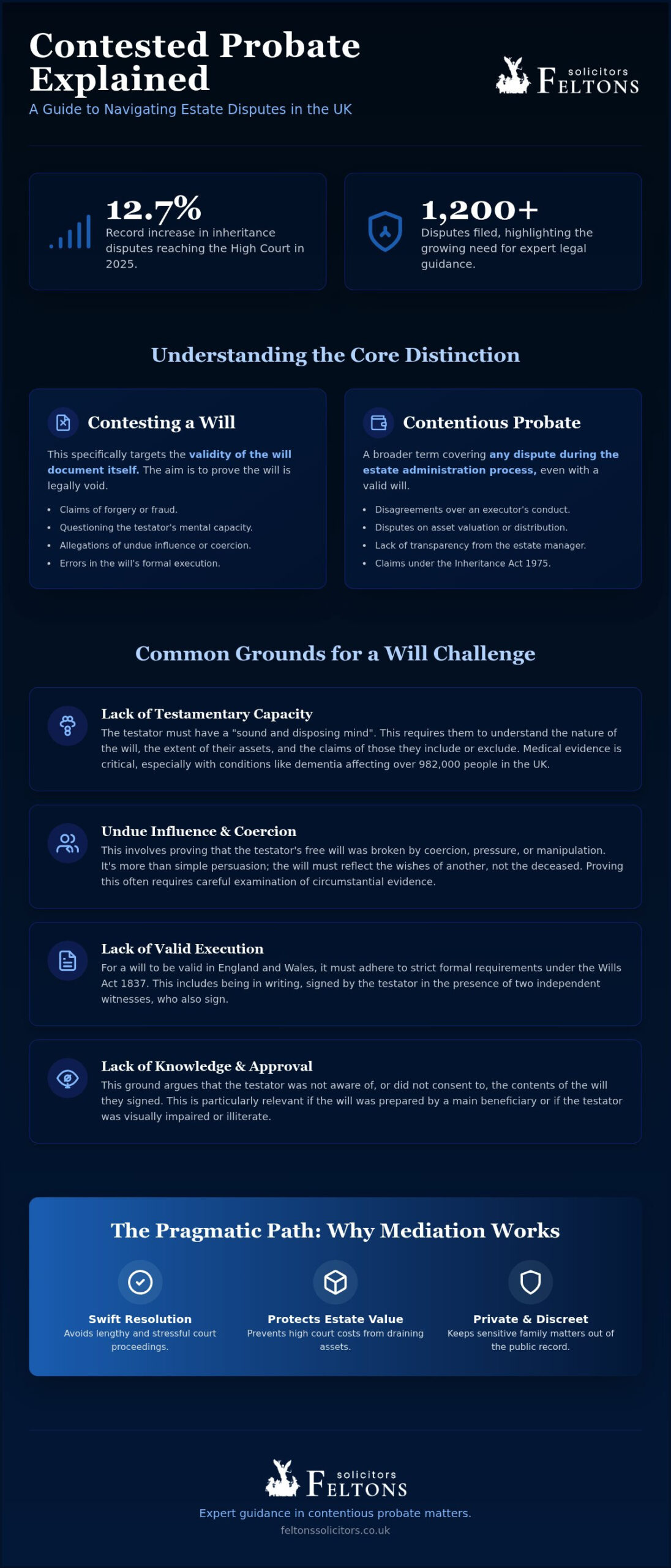
With over 1,200 inheritance disputes reaching the High Court in 2025, a record 12.7% increase from the previous year, estate litigation is no longer a rarity in the UK. Facing a legal challenge during a time of grief is incredibly draining, especially when family tensions rise and the fear of mounting costs begins to overshadow your inheritance. You’re likely looking for clarity amongst complex laws and a way to ensure the deceased’s wishes are truly honoured. Engaging experienced contested probate lawyers uk can provide the steady, professional presence you need to manage these sensitive matters with precision and care.

We understand that your priority is a fair outcome that doesn’t exhaust the estate’s value in court fees. Whether you’re seeking the removal of an incompetent executor or challenging the validity of a will, this guide outlines the essential steps for a resolution in 2026. You’ll learn how to navigate strict time limits and why mediation is often the most pragmatic path to a swift, private settlement. By focusing on strategic discretion, you can protect your interests whilst preserving what matters most.

Key Takeaways

  • Understand the vital distinction between challenging a will’s validity and disputing the probate process itself to ensure your legal strategy is accurately targeted.
  • Learn about the legal requirements for testamentary capacity and why securing medical evidence early is essential for a robust claim.
  • Explore how experienced contested probate lawyers uk utilise mediation to resolve disputes swiftly whilst preventing high court costs from draining the estate’s value.
  • Gain clarity on the “costs follow the event” rule and how to navigate the financial risks associated with inheritance litigation in 2026.
  • Discover the benefits of a pragmatic, people-first approach that focuses on achieving a fair distribution of assets through discreet and professional negotiation.

Understanding Contested Probate in the UK

Contentious probate refers to any legal disagreement arising during the administration of a deceased person’s estate. It’s a broad term that encompasses far more than just arguments over a final testament. Whilst many people use “contesting a will” and “contested probate” interchangeably, they represent distinct legal challenges that require different strategic approaches. Seeking the guidance of contested probate lawyers uk early in the process is a pragmatic way to protect the estate’s value and ensure your interests are professionally represented during a sensitive time.

Contested Probate vs. Contesting a Will

Contesting a will specifically targets the validity of the document itself. This might involve claims of forgery, lack of testamentary capacity, or undue influence during the document’s creation. In contrast, contentious probate covers a wider range of issues, such as the conduct of an executor or disagreements over how assets are being managed and distributed. Both areas require specialist estate planning knowledge to navigate the nuances of the law effectively. Understanding which path your dispute falls under is the first step toward a resolution.

When Does an Estate Administration Become Contentious?

Disputes often begin with subtle red flags that suggest the administration isn’t proceeding as it should. You might notice a lack of transparency from the person managing the estate or experience unexplained delays in receiving basic information. Common triggers include the discovery of unexpected beneficiaries or the realisation that significant assets appear to be missing from the inventory. In many instances, a claimant might feel they were unfairly excluded from a will, leading them to seek relief under the Inheritance (Provision for Family and Dependants) Act 1975.

Disagreements amongst beneficiaries regarding the valuation of unique assets, such as property or private business interests, can also stall the process. If a resolution isn’t immediately visible, a “caveat” can be lodged at the Probate Registry. This formal notice prevents the court from issuing a Grant of Probate, effectively pausing the administration whilst the dispute is settled. This is often a necessary safeguard to ensure that assets aren’t distributed incorrectly whilst legal questions remain unanswered. Expert contested probate lawyers uk can help you determine if a caveat is the right tool for your specific situation.

Taking legal action isn’t about being aggressive; it’s about ensuring the deceased’s true intentions are honoured and that the estate is handled with integrity. Early intervention often prevents minor misunderstandings from escalating into costly, long-term litigation.

Common Grounds for Contesting Probate and Wills

For a will to be legally binding in England and Wales, it must adhere to strict formalities. It must be in writing, signed by the testator, and witnessed by two independent adults. Beyond these technicalities, the testator’s mental state and intentions are equally critical. If you suspect these standards weren’t met, consulting professional legal advisors can help clarify your options. One often overlooked ground is “Knowledge and Approval,” which requires proof that the deceased truly understood and consented to the specific contents of the will. This is particularly relevant if the document was drafted by a beneficiary or if the testator had significant sensory impairments.

Lack of Testamentary Capacity and Undue Influence

Under the criteria established in Banks v Goodfellow (1870), a testator must understand the nature of their will, the extent of the assets they are distributing, and the moral claims of those they are excluding. Capacity disputes often hinge on medical evidence; with 982,000 people in the UK currently living with dementia, medical records have become the cornerstone of many modern claims. Expert contested probate lawyers uk use these records to determine if the testator possessed a “sound and disposing mind” at the moment of execution.

Undue influence represents a different challenge. Legally, there is a sharp distinction between “influence,” which is common in families, and “undue influence,” which involves coercion that breaks the testator’s free will. Proving this requires showing that the will does not reflect the deceased’s actual wishes, but rather the demands of another. Because coercion often happens behind closed doors, these cases require a meticulous review of circumstantial evidence and witness testimony.

Inheritance Act 1975: Reasonable Financial Provision

Even a valid will can be challenged if it fails to make “reasonable financial provision” for certain individuals. Under the Inheritance (Provision for Family and Dependants) Act 1975, spouses, civil partners, children, and those financially dependent on the deceased can bring a claim. The court’s assessment of “reasonable” varies. For a spouse, the standard is usually higher than for other dependants, who are typically limited to provision for their maintenance. Specialist support from contested probate lawyers uk is often the most effective way to quantify these claims and negotiate a fair settlement.

Time is the most significant factor here. Claims must be filed within six months of the Grant of Probate. Missing this deadline often means losing the right to claim entirely. If you’re considering a challenge, the first step is often stopping a probate application by entering a caveat. This provides the necessary time to investigate the grounds for your dispute without the estate being distributed prematurely.

Resolving an inheritance dispute requires a methodical approach that balances legal rigour with emotional sensitivity. Whilst the image of a dramatic courtroom battle is common, the reality of modern estate litigation in the UK is far more measured. The process typically begins with a formal Letter of Claim, which clearly outlines the legal grounds for the challenge and the evidence supporting it. If the dispute involves the circumstances under which a will was drafted, Challenging a will often involves requesting a “Larke v Nugus” statement from the original drafting solicitor to gain clarity on the deceased’s intentions.

In situations where family members are at an impasse, appointing a professional executor can be a pragmatic solution. These neutral third parties manage the estate administration with total impartiality, ensuring that assets are protected whilst the underlying legal issues are resolved. This step often prevents the “pot” of assets from being diminished by ongoing conflict. Expert contested probate lawyers uk act as sophisticated guides through these stages, ensuring every procedural requirement is met whilst maintaining a focus on a swift resolution.

The Role of Mediation and Alternative Dispute Resolution

Over 95% of UK probate disputes are settled through Alternative Dispute Resolution (ADR) before they ever reach a full court hearing. Mediation is the most common form of ADR; it involves a neutral third party facilitating a private discussion between the parties to reach a mutually acceptable agreement. This approach is highly effective for high-value estates where privacy is paramount. Unlike a court trial, which is a matter of public record, mediation allows sensitive financial and family details to remain confidential. It is a discreet way to reach a settlement that respects the deceased’s legacy whilst providing beneficiaries with a certain, final outcome.

Entering a Caveat: Preventing the Grant of Probate

A caveat is a powerful procedural tool that prevents the Probate Registry from issuing a Grant of Probate. It essentially pauses the administration of the estate, giving parties time to investigate potential claims. Once a caveat is in place, the person seeking the Grant can issue a “Warning.” This requires the person who entered the caveat to file an “Appearance” within eight days to explain their interest in the estate. Entering a caveat without merit can lead to cost penalties, so it’s a step that should only be taken with the advice of contested probate lawyers uk. When used correctly, it ensures the estate isn’t distributed whilst legitimate questions remain unanswered.
Contested Probate Lawyers UK: A Guide to Resolving Estate Disputes in 2026

One of the most persistent myths in estate litigation is that the estate always pays the legal fees. In reality, the court follows the general principle that costs follow the event. This means the unsuccessful party is typically ordered to pay a significant portion of the winner’s legal costs. For this reason, contested probate lawyers uk place immense value on early, pragmatic risk assessments. Whilst the court has discretion to order costs from the estate, this is usually reserved for cases where the deceased’s own actions, such as an ambiguous will, caused the litigation. If the court finds a claim was brought without merit, the individual claimant may be held personally liable for the expenses.

Resolving a dispute is rarely an overnight process. A straightforward claim settled via mediation might conclude within six to nine months. However, if a case proceeds to a full High Court trial, the timeline can easily extend to eighteen months or two years. These delays often stem from the time required to gather medical records, witness statements, and expert reports. If you are concerned about the financial implications of a dispute, speaking with our litigation and dispute resolution experts can provide the clarity you need to proceed with confidence.

Assessing the Merits of Your Claim

Before a claim is issued, a solicitor will often make a “Larke v Nugus” request. This allows for the collection of information from the professional who drafted the will, providing vital insight into the testator’s intentions and the circumstances of the signing. This evidence is a cornerstone of any merit assessment. We also evaluate the proportionality of the claim; it is rarely in a client’s interest to pursue a dispute where the projected legal costs outweigh the potential inheritance. A pragmatic early assessment ensures that your resources are focused on achievable, fair outcomes rather than speculative legal battles.

Time Limits and the Statute of Limitations

As previously noted, claims under the Inheritance Act 1975 must be brought within six months of the Grant of Probate. However, other claims have different windows. For example, a claim for a share of a person’s estate under a will or the rules of intestacy typically has a twelve-year limit. Despite these longer statutory periods, the court does not look favourably on those who stand idly by. If you wait several years whilst the estate is distributed and assets are spent, the court may strike out your claim under the doctrine of laches. Urgency is essential to preserve the estate’s assets and ensure witnesses’ memories remain fresh. Seeking counsel immediately upon discovering a potential dispute is the most effective way to safeguard your position.

Why Feltons Solicitors for Contentious Probate Matters

Choosing the right contested probate lawyers uk is a decision that impacts both your financial future and your family’s long-term harmony. Feltons Solicitors LLP, established in 2010 by Paula Felton, combines modern legal delivery with traditional professional values. We position ourselves as a discreet partner for those facing sensitive family matters, providing a boutique level of care that prioritises personal connection over high-volume processing. This people-first philosophy remains at the heart of our practice, guiding every case we handle, whether we are assisting with complex probate litigation or divorce and financial arrangements.

A Discreet and Pragmatic Approach to Disputes

We act as a steady, calm presence during what is often one of the most stressful periods of a client’s life. Our approach is rooted in the belief that litigation should be a tool for resolution, not an end in itself. By focusing on bespoke, tailored solutions, we ensure that the specific nuances of your situation are understood and addressed. We don’t believe in a one-size-fits-all methodology. Instead, we serve as a sophisticated guide, weighing the human impact of every legal strategy alongside its technical merits. This pragmatic mindset helps us avoid unnecessary conflict whilst securing the best possible outcome for our clients. As a trusted advisor, we value your privacy and personal rapport, ensuring that every step taken is in your best interests.

National Expertise for Complex Estates

Whilst we maintain a boutique feel, our experience is global in scope. We possess the worldly expertise necessary to handle complex, high-value disputes for both national and international clients. This includes resolving matters involving overseas entities, intricate trust structures, and unique asset portfolios that require a sophisticated level of legal analysis. We are fully equipped to represent your interests in any UK court or mediation centre, providing a consistent standard of high-end reliability regardless of your location. Our firm is deeply rooted and community-conscious, yet we have the reach to handle international-scale matters with ease. We understand that high-net-worth estates often involve cross-border complications that demand a higher standard of service. We invite you to contact us for a confidential consultation to discuss the unique complexities of your estate dispute and how we can help you navigate them with confidence.

Securing Your Inheritance with Strategic Guidance

Navigating an inheritance dispute requires more than just legal knowledge; it demands a partner who understands the delicate balance between protecting assets and preserving family relationships. By identifying grounds for a claim early and utilising procedural tools like caveats, you can ensure the estate is managed with integrity. Whilst the prospect of litigation is daunting, the rise in mediation offers a private, cost-effective alternative to the public courtroom.

As a boutique firm established in 2010, Feltons Solicitors LLP provides the high-end, tailored support necessary for complex litigation. We are specialists in dispute resolution with a national reach, yet we maintain a people-first philosophy that prioritises your personal well-being. Our team acts as a sophisticated guide, helping you assess the merits of your case whilst avoiding unnecessary expenditure. If you are facing an estate disagreement, engaging experienced contested probate lawyers uk is the most pragmatic step toward a fair distribution.

Contact Feltons Solicitors today for discreet, professional advice on your probate dispute. We are here to provide the steady, reliable presence you need to resolve these matters with confidence.

Frequently Asked Questions

What is the difference between contested probate and contesting a will?

Contesting a will specifically challenges the document’s legal validity, such as claims of forgery or lack of capacity. Contested probate is a broader term covering any dispute during the estate administration, including the conduct of executors or the valuation of assets. Experienced contested probate lawyers uk can assist with both, ensuring that either the document itself or the subsequent distribution process adheres to strict legal standards.

How long do I have to contest probate in the UK?

The time limit depends entirely on the type of claim you’re bringing. For claims under the Inheritance Act 1975, you must file within six months of the date the Grant of Probate is issued. Challenges to a will’s validity technically have no statutory limit, but waiting too long can be fatal. If the assets have already been distributed amongst beneficiaries, the court may refuse to hear your case.

Can an executor be removed if they are not acting properly?

Yes, the court has the authority to remove an executor who is found to be incompetent, dishonest, or causing significant delays. This usually requires an application under Section 50 of the Administration of Justice Act 1985. You must provide evidence that the estate’s welfare is at risk. Replacing a difficult executor with a neutral professional is often a pragmatic way to ensure the deceased’s wishes are finally honoured.

Who pays the legal costs in a contested probate case?

The general rule in UK litigation is that costs follow the event, meaning the unsuccessful party usually pays the winner’s legal fees. It is a common misconception that the estate always covers these expenses. If a claim is found to be without merit, the individual bringing the challenge may be held personally liable. Consulting contested probate lawyers uk for a merit assessment is vital to avoid significant financial risk.

Do I have to go to court to resolve an inheritance dispute?

No, the vast majority of inheritance disputes are resolved through Alternative Dispute Resolution without ever reaching a courtroom. Mediation is a highly successful method where a neutral third party helps all sides reach a private settlement. This approach is often preferred because it’s faster, less expensive, and keeps sensitive family financial details off the public record. It allows for a more flexible and empathetic resolution than a judge’s ruling.

Can I contest a will if I was left out of it entirely?

You can bring a claim if you fall into a specific category of eligible persons under the Inheritance Act 1975. This includes spouses, civil partners, children, and anyone who was being financially maintained by the deceased. The court will examine whether the will made reasonable financial provision for your needs. These cases are complex and require a detailed review of your financial position and your relationship with the deceased.

What happens to the estate whilst probate is being contested?

The administration of the estate is typically paused to ensure assets aren’t distributed whilst their ownership is in question. Entering a caveat is the standard procedural step to stop the Grant of Probate from being issued. In some instances, the court might appoint a professional administrator to manage assets like property or investments. This prevents the estate’s value from diminishing whilst the parties work toward a final legal resolution.

What is a Larke v Nugus statement and do I need one?

A Larke v Nugus statement is a formal response from the solicitor who prepared the will, detailing the circumstances of its execution. It’s an essential piece of evidence if there are concerns about the testator’s mental capacity or potential undue influence. Your legal advisor will request this statement early in the dispute. It provides a clear, professional account that often helps determine the merits of a claim before formal litigation begins.

Commercial Litigation Solicitor London: Expert Dispute Resolution in 2026

Commercial Litigation Solicitor London: Expert Dispute Resolution in 2026

What if the most successful outcome for your business dispute never involves stepping foot inside a courtroom? It’s a natural reaction to feel overwhelmed by the prospect of escalating legal costs and the intricate maze of the Civil Procedure Rules. You’ve worked hard to build your brand, and the thought of a public, drawn-out battle is understandably stressful. Most business leaders simply want a resolution that allows them to move forward without sacrificing their reputation or their bottom line.

Securing an expert commercial litigation solicitor is the first step toward regaining control. This guide provides a comprehensive look at navigating disputes in 2026, offering the pragmatic advice needed to manage risks discreetly and effectively. We’ll explore the latest solicitor guideline hourly rates, recent court fee adjustments, and the shifting trends in alternative dispute resolution. By the end of this article, you’ll have a clear understanding of the costs involved and a strategic plan to protect your commercial interests with quiet confidence. At Feltons Solicitors LLP, our goal is to provide the steady, professional guidance required to resolve conflicts whilst keeping your business objectives firmly in sight.

Key Takeaways

  • Understand that commercial litigation encompasses both formal court proceedings and the strategic legal advice provided long before a claim is issued.
  • Learn why early neutral evaluation is a vital tool for assessing the strength of your case and determining the most effective legal strategy.
  • Discover how an experienced commercial litigation solicitor london can demystify the litigation lifecycle, using the Pre-Action Protocol to achieve early resolution.
  • Explore the advantages of Alternative Dispute Resolution (ADR) and mediation as sophisticated, cost-effective methods for reaching creative settlements outside of court.
  • Gain insight into the value of a boutique legal partnership, which prioritises direct access to senior solicitors and a highly personalised, “people-first” approach.

What is Commercial Litigation and When is it Necessary?

Commercial litigation is the formal legal process of resolving disputes between business organisations or individuals within a commercial context. It’s a broad and often misunderstood field. Whilst many people associate the term with high-stakes trials and courtroom drama, it’s actually a much more nuanced discipline. It encompasses the strategic, high-standard advice given long before a claim is ever issued. A commercial litigation solicitor london acts as a discreet partner, working to protect your business interests whilst seeking the most pragmatic path forward. Their role is to provide a calm, steady presence during what can be an incredibly stressful period for any company director or business owner.

The Scope of Business Disputes

Disputes are often the result of broken promises or misaligned expectations. In 2026, the landscape of commercial conflict continues to evolve, but several core triggers remain constant. These conflicts can stall growth and drain resources if not handled with precision. Common areas of dispute include:

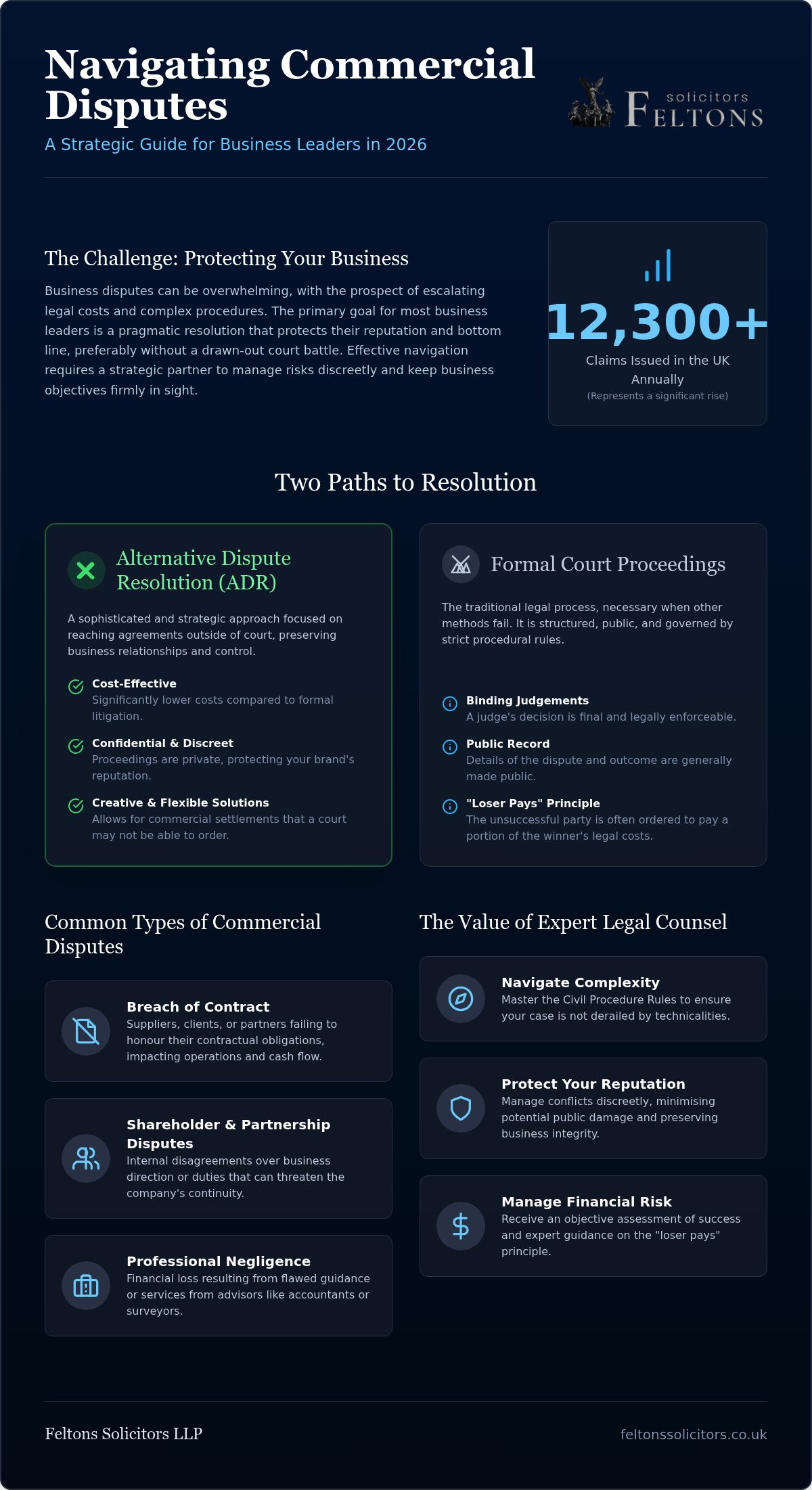
  • Breach of contract: These claims involve suppliers, clients, or service providers who fail to honour their contractual obligations, which can directly impact your cash flow.
  • Shareholder and partnership disputes: Internal disagreements can be particularly damaging. They often threaten the very continuity of the business and require a “people-first” approach to resolve.
  • Professional negligence: When an advisor, such as an accountant or surveyor, provides flawed guidance, the resulting financial loss can be severe.

Why Businesses Seek Specialist Legal Representation

The complexity of the English legal system shouldn’t be underestimated. Navigating the procedural hurdles of the High Court or understanding the specific functions of a What is a Commercial Court? requires specialist expertise. It isn’t just about knowing the law; it’s about mastering the Civil Procedure Rules to ensure your case isn’t derailed by technicalities. An experienced commercial litigation solicitor london ensures that every step taken is methodical and orderly.

Specialist representation provides an essential, objective perspective. When you’re in the middle of a conflict, it’s difficult to assess the merits of your position without bias. An expert provides a realistic view of your chances of success. They also manage the significant financial risks involved. With the “loser pays” principle in the UK, a failed claim can result in heavy cost orders. A trusted advisor manages this process discreetly, minimising potential reputational damage and ensuring that any resolution allows the business to move forward with its integrity intact.

In 2026, the UK commercial landscape is increasingly active. Recent data shows that over 12,300 claims were issued in the most recent annual reporting period, representing a significant rise from previous years. Successfully managing these conflicts requires more than just legal knowledge; it demands a strategic approach that prioritises your company’s long-term health. One of the most effective tools for achieving this is early neutral evaluation. This process involves an independent expert providing a non-binding assessment of the case, allowing an experienced commercial litigation solicitor london to refine your strategy before significant costs are incurred.

Contractual and Tortious Claims

Most disputes originate from contractual failures or disagreements over professional obligations. Under the Sale of Goods Act, a breach of contract is defined as a failure by the seller to provide goods that are of satisfactory quality, fit for purpose, or exactly as described. Beyond these statutory protections, businesses often grapple with misrepresentation, where a party is induced into a contract by false statements. These can range from negligent oversights to deliberate fraud. We also see frequent cases of tortious interference, where a third party intentionally damages your business relationships or induces a breach of contract. These matters require a methodical investigation to protect your commercial standing and recover lost revenue.

Property and Leasehold Disputes

Commercial litigation frequently overlaps with property law, as business premises are often a company’s most significant asset. Whether you’re dealing with dilapidations at the end of a tenancy or complex lease renewals, the stakes are high. Engaging with a commercial property law firm ensures that your physical assets don’t become a financial liability. We also see a rise in disputes involving leasehold enfranchisement experts, particularly regarding commercial ground rents and service charge disagreements. Instructing a commercial litigation solicitor london ensures that these property-based conflicts are handled with the same rigour as any other corporate dispute.

A sensitive but increasingly common area involves business assets within an estate. Contentious probate occurs when the distribution of a deceased partner’s shares or property is challenged by beneficiaries or third parties. Managing these disputes requires a “people-first” philosophy to ensure the business remains operational whilst the legal issues are resolved. Understanding The Litigation Process is the first step toward a pragmatic resolution. If you’re concerned about a potential conflict, consulting a specialist in litigation and dispute resolution can provide the calm, expert guidance needed to protect your interests.

The Litigation Process: A Step-by-Step Guide for Businesses

The prospect of litigation often feels like entering a labyrinth without a map. However, the process is highly structured and designed to encourage resolution at every stage. A commercial litigation solicitor london serves as your navigator, ensuring you understand the implications of each procedural step before it’s taken. By demystifying the lifecycle of a claim, we can reduce the anxiety of the “unknown” and allow you to focus on your core business operations.

From Pre-Action to Trial

The journey begins long before a judge is involved. The Pre-Action Protocol is a mandatory stage where parties exchange detailed information to explore settlement options. It’s a vital opportunity for early resolution that can save significant time and capital. If a settlement isn’t reached, the formal process follows a methodical path:

  • 1. Pre-action correspondence: Issuing a formal Letter of Claim that outlines the legal basis for the dispute and the remedy sought.
  • 2. Issuing and serving: Filing the Claim Form and Particulars of Claim with the court to officially start proceedings.
  • 3. Defence and Counterclaim: The defendant’s opportunity to respond to the allegations or bring their own claims against the claimant.
  • 4. Disclosure: A critical phase where both sides must share relevant documents. You have a strict legal duty to preserve all evidence, including emails and digital records, from the moment a dispute is anticipated.
  • 5. Trial and enforcement: The final hearing where a judge makes a binding decision. If successful, your commercial litigation solicitor london will then manage the enforcement of the judgment to ensure you receive what is owed.

Managing Costs and Risks

In English and Welsh law, the general rule is that the “loser pays” a significant portion of the winner’s legal costs. This principle makes thorough risk assessment paramount from the outset. To mitigate financial exposure, many businesses utilise After the Event (ATE) insurance, which provides a safety net for legal disbursements and the opponent’s costs if the claim is unsuccessful. It’s also vital to remember that approximately 90% of commercial cases settle before reaching a full trial. One of the most effective strategies for achieving this is the “Part 36 offer”. This is a formal settlement offer that carries heavy cost penalties for the party that rejects it and then fails to beat it at trial. It’s a powerful tool for exerting pressure and securing a pragmatic, discreet resolution.

Commercial Litigation Solicitor London: Expert Dispute Resolution in 2026

Resolving Disputes Outside of Court: ADR and Mediation

While the court process is robust, it isn’t always the most efficient way to settle a business conflict. Alternative Dispute Resolution (ADR) has evolved into a sophisticated suite of tools designed to bypass the adversarial nature of the High Court. For many businesses, the goal isn’t just to “win” a legal battle; it’s to find a pragmatic resolution that allows operations to continue without distraction. An experienced commercial litigation solicitor london will often recommend ADR as a primary strategy to protect your interests whilst keeping costs manageable.

The English judiciary now places a heavy emphasis on these methods. Under the Civil Procedure Rules, there is a clear expectation that parties will explore ADR before proceeding to a full trial. Refusing to engage in mediation without a valid reason can result in severe cost penalties, even for the winning party. Beyond avoiding sanctions, ADR offers the invaluable benefit of confidentiality. Court hearings are generally public, but ADR takes place behind closed doors. This discretion is essential for protecting your brand reputation and ensuring that sensitive commercial data remains private.

The Benefits of Mediation

Mediation is perhaps the most flexible form of ADR. It involves a neutral third party who facilitates a discussion between the disputing sides. Unlike a judge, a mediator doesn’t impose a decision; instead, they help the parties reach a voluntary agreement. This process allows for creative solutions that a court simply cannot provide, such as restructuring a future business relationship or adjusting contract terms. The advantages for a company are clear:

  • Preserving relationships: Mediation focuses on finding common ground, which is vital for maintaining long-term partnerships that might otherwise be destroyed by aggressive litigation.
  • Speed of resolution: Mediation can often be organised and concluded within weeks, whereas the court timetable can stretch for years.
  • Greater control: You remain in the driving seat of the final settlement rather than leaving the outcome to a judge’s discretion.

Arbitration and Expert Determination

For more technical or international matters, other forms of ADR may be more appropriate. Arbitration is frequently used in cross-border disputes, as the resulting awards are often easier to enforce internationally than court judgments. It offers a more formal structure than mediation but remains private. Expert determination is another useful tool, particularly for disagreements involving complex financial valuations or technical specifications. In these cases, an independent expert in the relevant field makes a binding decision. Choosing the right path requires a steady hand and a deep understanding of your commercial objectives. If you are facing a business conflict and require a tailored approach, our specialists in litigation and dispute resolution can guide you through the ADR process with quiet confidence.

Instructing Feltons Solicitors: A Boutique Approach to Litigation

Choosing the right legal partner is a strategic decision that goes beyond technical ability. Large, high-volume firms often lack the personal touch required for sensitive business matters. At Feltons Solicitors LLP, we offer a sophisticated blend of professional authority and empathetic reassurance. As a boutique commercial litigation solicitor london, we prioritise a “people-first” philosophy. This ensures that whilst the technical legal work is paramount, the human impact on your business and its stakeholders is never forgotten.

Instructing a commercial litigation solicitor london with a boutique focus ensures your case receives the individualised attention it deserves. We position ourselves as a calm, steady presence in the face of complex or stressful situations. Our firm projects an image of high-end reliability, providing the discreet, high-standard service that modern businesses require to resolve disputes without unnecessary public exposure.

Pragmatic Advice Tailored to Your Business

Our approach is rooted in providing a steady hand during turbulent times. We act as a trusted advisor, moving beyond mere service provision to become a partner in your success. One of our core commitments is the use of plain English. We believe that accessible legal advice is essential for making informed decisions. By stripping away dense legalese, we ensure you have a clear understanding of the risks and costs involved at every stage. This transparency builds the quiet confidence needed to navigate even the most stressful litigation.

Direct access to senior solicitors is a cornerstone of our service. You won’t be passed between junior associates; instead, you’ll benefit from the direct oversight of experienced professionals who understand the nuances of your industry. This methodical and orderly mindset reflects our commitment to traditional professional integrity whilst embracing modern efficiency. We focus on pragmatic resolutions that allow your business to move forward, rather than getting bogged down in unnecessary procedural battles.

Experience Across Multiple Jurisdictions

Whilst we maintain the personal rapport of a boutique firm, our experience is global in scale. From our London-based hub, we handle both national and international dispute resolution with high-end reliability. Established in 2010 by Paula Felton, our firm has the worldly experience necessary to manage cross-border matters. We ensure that your interests are protected regardless of where the conflict originates, providing a seamless service for international clients; for example, those requiring specialised criminal defence in Chile can rely on the technical proficiency of Abogado Penal Temuco in the Araucanía Region.

We possess the sophisticated expertise required to handle complex, international-scale matters whilst remaining human and accessible. This dual capability, being deeply rooted and community-conscious yet possessing a global outlook, is what defines the Feltons Solicitors LLP difference. We combine modern efficiency with traditional values to deliver results that protect both your reputation and your bottom line. To discuss your requirements, contact Feltons Solicitors LLP for a discreet consultation.

Securing Your Business’s Future Through Strategic Resolution

Resolving a commercial dispute is rarely just about the legal technicalities; it’s about protecting the future of your enterprise. We’ve explored how the litigation lifecycle is designed to encourage settlement and why methods like mediation offer a discreet, cost-effective alternative to the courtroom. Whether you’re facing a breach of contract or a complex property disagreement, the right strategy prioritises your commercial objectives whilst managing the inherent risks of the UK legal system.

Partnering with a specialist commercial litigation solicitor london ensures you have a steady, experienced guide by your side. Since 2010, Feltons Solicitors has provided high-standard legal support with a pragmatic, people-first approach that addresses both domestic and international challenges. We combine the depth of experience found in larger firms with the personal connection and senior-level access of a boutique practice. If you’re ready to move past a conflict and refocus on growth, instruct Feltons Solicitors for expert commercial litigation support. You don’t have to face these complexities alone; professional, discreet guidance is just a consultation away.

Frequently Asked Questions

What is the difference between commercial litigation and dispute resolution?

Dispute resolution is an umbrella term for any method used to settle a conflict, whereas commercial litigation refers specifically to the formal process of resolving disputes through the court system. Litigation is just one path within the wider dispute resolution landscape. An expert commercial litigation solicitor london will often use alternative methods like mediation or negotiation first to achieve a pragmatic result without the need for a full trial.

How much does a commercial litigation solicitor cost in the UK?

Can I resolve a business dispute without going to court?

Most commercial disputes are successfully resolved without a court hearing through negotiation or Alternative Dispute Resolution (ADR). Mediation is a highly effective tool that allows parties to reach a voluntary settlement with the help of a neutral third party. These private methods are generally faster and less expensive than traditional litigation, and they provide businesses with greater control over the final outcome and their public reputation.

How long does a typical commercial litigation case take to conclude?

The timeline for a commercial case varies based on its complexity, but many matters take between 12 and 24 months to reach a final trial. Simpler claims may be resolved within months through the Pre-Action Protocol or early settlement negotiations. However, complex cases involving international jurisdictions or extensive document disclosure usually require a longer period to ensure all evidence is meticulously prepared and reviewed by the court.

What happens if I lose a commercial litigation case?

If you lose a case, the court usually orders you to pay a substantial portion of the winning party’s legal costs. This “loser pays” rule is a fundamental part of the legal system in England and Wales. You’ll also be responsible for your own legal fees and any financial judgment awarded against you. To mitigate these risks, many clients utilise insurance products or strategic settlement offers like a Part 36 offer during the process.

Is commercial mediation legally binding?

Mediation is a non-binding process until the parties involved reach a consensus and sign a formal settlement agreement. Once this written agreement is signed by both sides, it becomes a legally binding contract that can be enforced in court. This allows businesses to find creative, flexible solutions to their problems whilst ensuring that the final resolution has the full weight of the law behind it.

What are the most common reasons for commercial disputes in 2026?

Breach of contract remains the primary driver of commercial conflict in 2026, frequently involving supply chain failures or payment disagreements. There is also a documented increase in ESG-related litigation and disputes arising from the implementation of artificial intelligence. Other common triggers include shareholder disagreements, professional negligence claims, and property-based conflicts such as commercial lease renewals and service charge disputes that impact business continuity.

Can Feltons Solicitors handle international commercial litigation?

Feltons Solicitors possesses the worldly experience necessary to handle complex international matters from our London hub. Established in 2010, the firm has a proven track record in both national and international dispute resolution. We act as a discreet partner for clients across various jurisdictions, providing the high-standard, pragmatic advice expected of a leading commercial litigation solicitor london while maintaining a highly personalised boutique approach that prioritises your specific business objectives.

Personal Injury Solicitors: A Comprehensive Guide to Compensation Claims in 2026

Personal Injury Solicitors: A Comprehensive Guide to Compensation Claims in 2026

The most effective personal injury litigation is a restorative journey, not just a financial transaction. When you’ve suffered an injury, the physical pain is often compounded by the weight of financial uncertainty and the confusing jargon of legal proceedings. It’s natural to feel overwhelmed by “No Win, No Fee” terms or the worry that you’ll be treated as just another file in a high-volume claim factory. Choosing the right personal injury solicitors shouldn’t add to your stress; it should be the moment you finally feel heard.

We understand that you’re looking for more than just a settlement; you’re looking for a way to rebuild your life. This guide provides the expert clarity you need to handle these complexities, ensuring you secure the compensation and support you deserve. We’ll examine the latest 2026 legal updates, including the 18th edition of the Judicial College Guidelines and the shifting landscape of the small claims track. By the end of this article, you’ll have a clear roadmap for your claim, from understanding the latest Solicitors Regulation Authority transparency rules to finding a boutique partner who puts your recovery at the centre of the process.

Key Takeaways

  • Understand the legal principle of “Duty of Care” and how identifying a breach is the essential first step in securing your compensation.
  • Learn why complex occupational conditions like silicosis require a specialist litigation approach compared to standard injury claims.
  • Discover how professional personal injury solicitors calculate General and Special Damages to ensure your settlement covers both physical pain and future financial security.
  • Explore the step-by-step process of evidence gathering, from medical assessments to witness statements, to build a robust and viable case.
  • Recognise the benefits of a boutique, partner-led service that offers pragmatic guidance tailored to your specific circumstances rather than high-volume processing.

What is a Personal Injury Claim and Who Can Benefit?

Understanding what is a personal injury claim starts with the concept of Tort law. In the United Kingdom, this legal framework allows an individual to seek a remedy for a civil wrong that has caused them harm. Whilst many associate these cases solely with physical accidents, the scope is much broader. It encompasses psychological trauma and long-term occupational illnesses, such as silicosis, which are often more complex than standard accident claims. The core objective is simple: to restore you, as far as money can, to the position you would have occupied had the injury never occurred. Engaging expert personal injury solicitors ensures that your case is treated with the focus of a boutique firm, rather than being processed through a high-volume claim factory.

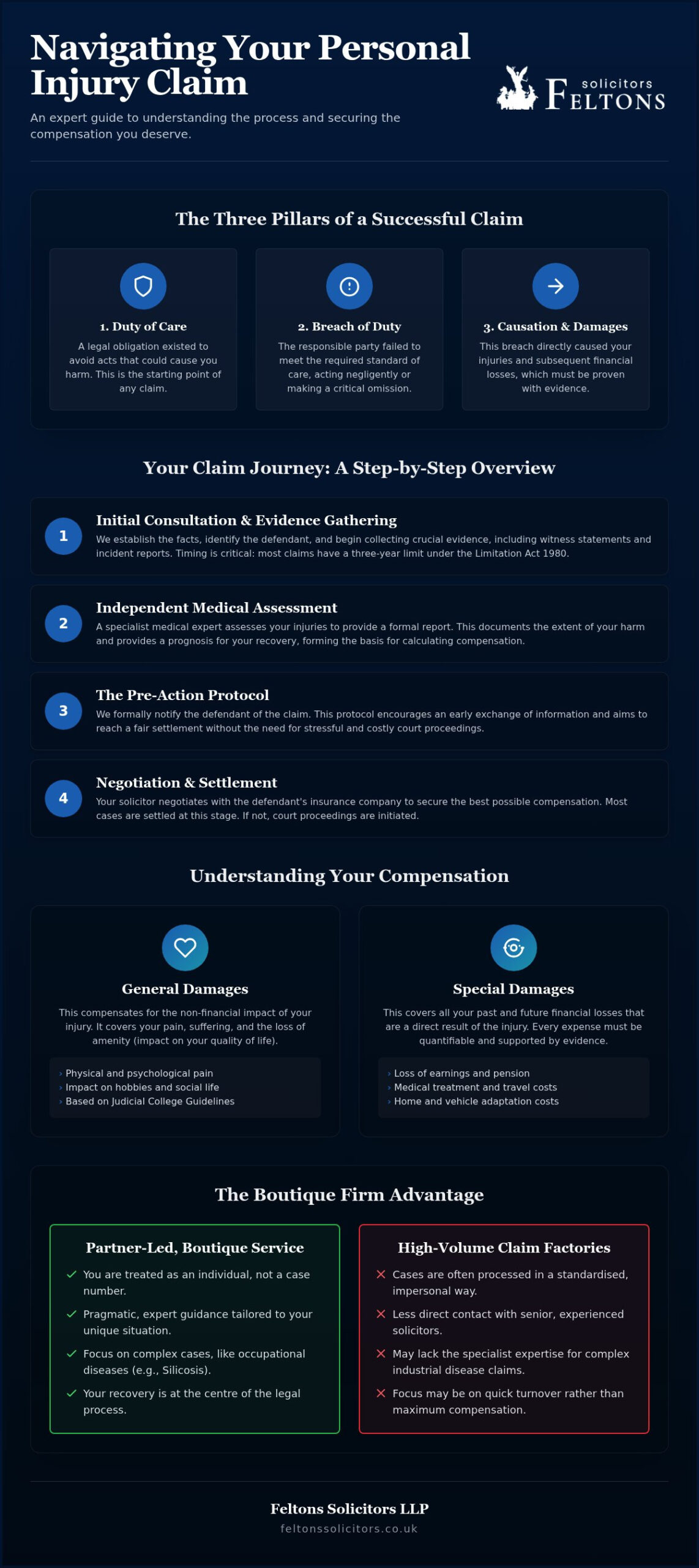
At the heart of every case lies the principle of the “Duty of Care”. This is a legal obligation to avoid acts or omissions that could reasonably be foreseen to cause harm to others. When a person or organisation fails to meet this standard, they have breached their duty. However, a breach alone isn’t enough for a claim. You must also prove that this failure directly caused your injuries and subsequent financial losses. This link between the breach and the harm is known as causation, and it’s the foundation upon which every successful claim is built.

The Legal Basis for Compensation

Proving negligence requires a methodical approach. Your personal injury solicitors must establish four key elements: duty, breach, causation, and damages. Most cases begin under the Pre-Action Protocol. This set of rules encourages parties to exchange information early and settle disputes without the need for a stressful court hearing. It’s a pragmatic way to ensure transparency from the outset and provides a structured path toward a fair settlement.

Timing is critical. Under the Limitation Act 1980, most claimants have a three-year window from the date of the accident or the “date of knowledge” of an injury to issue court proceedings. For occupational diseases that develop over decades, this clock often starts only when a medical professional provides a formal diagnosis. Missing these deadlines can permanently bar you from seeking the compensation you deserve, so early legal advice is vital.

Who Can You Claim Against?

Liability can rest with various parties depending on where the incident occurred. Identifying the correct defendant is essential for a successful outcome:

  • Employers: They have a statutory duty to provide a safe working environment, making them responsible for workplace accidents or failures in occupational health.
  • Public authorities and private landowners: These entities are accountable for maintaining safe premises, such as pavements or shopping centres, under the Occupiers’ Liability Act.
  • Road users and insurance companies: This is the most common category, covering RTA claims where a driver’s negligence has caused harm to others.

In every instance, the aim is to hold the responsible party to account whilst securing the financial support you need for your recovery. Whether you’re dealing with a local council or a multinational corporation, the legal principles remain focused on your restoration.

Specialist Personal Injury Claims: Silicosis and Occupational Diseases

Occupational diseases demand a distinct legal strategy compared to sudden physical accidents. Whilst a trip or fall is immediate, industrial illnesses often simmer for decades before symptoms emerge. This long latency period means that personal injury solicitors must act as investigators, tracing exposure back through a claimant’s entire working history. It’s a complex process. It requires more than just legal knowledge; it requires a deep understanding of industrial processes and medical pathology to prove exactly when and where the damage occurred.

Silicosis has become a focal point of high-stakes litigation, often cited as the “new asbestos” within the UK construction and stone masonry sectors. The damage is often irreversible. Unlike a one-off incident, silica dust exposure is a cumulative harm that permanently scars the lung tissue. We focus on these intricate matters, providing the partner-led attention that high-volume firms often struggle to maintain. This boutique approach ensures that the human impact of your diagnosis is never overshadowed by the technicalities of the law.

Understanding Silicosis and Silica Dust Exposure

Stone masons and construction workers are frequently exposed to respirable crystalline silica (RCS) when cutting or grinding materials like engineered stone. Employers have a strict legal duty under the Control of Substances Hazardous to Health (COSHH) regulations to suppress dust and provide adequate respiratory protective equipment. If they failed to do so, even thirty years ago, they may be held liable. For those who have lost a loved one to this condition, our guide on Silicosis Claim After Death: A Legal Guide for Bereaved Families in 2026 explains the specific steps for seeking justice on behalf of an estate.

Other Occupational Lung Diseases

Beyond silicosis, we handle claims for occupational asthma, COPD, and pleural thickening. These respiratory conditions often involve multiple past employers, some of whom may no longer exist. Our role involves tracking down historical insurers and securing expert medical evidence from leading chest physicians to support your case. This meticulous approach ensures that every contributor to your condition is held accountable. If you believe your health has been impacted by industrial negligence, reaching out to specialist personal injury solicitors can help you understand your options for a secure future.

The Personal Injury Claim Process: Step-by-Step

The journey from injury to compensation is a methodical build, rather than a sprint. It begins with an initial consultation where the merits of your case are scrutinized. Unlike high-volume firms that might use automated checklists, boutique personal injury solicitors provide a partner-led review to assess the viability of your claim. This stage is about more than just legal theory; it’s about understanding the specific ways your life has been altered and identifying a clear path toward restoration.

Once the merits are established, your legal team begins the formal process of notification. A Letter of Claim is sent to the defendant, outlining the allegations of negligence and the nature of your injuries. Under the current Pre-Action Protocol, the defendant generally has three months to investigate and provide a reasoned response regarding liability. This structured exchange of information is designed to keep the process transparent and moving toward a resolution without unnecessary delays.

Gathering Vital Evidence

Evidence is the bedrock of any successful litigation. Whilst your personal recollection is important, the legal strength of your case relies on objective documentation that leaves little room for dispute. This involves a three-pronged approach:

  • Medical Expert Reports: We instruct independent specialists to assess your injuries. Their professional opinion provides the basis for valuing your pain, suffering, and loss of amenity.
  • Special Damages Documentation: This involves a meticulous record of financial losses. You should retain every receipt, invoice, and travel log related to your injury, as these form the basis of your financial recovery.
  • Liability Evidence: Photographs of the accident scene, witness statements, and CCTV footage are gathered early to ensure the facts remain clear before memories fade or scenes change.

Settlement Negotiations and Court

Most people fear a confrontational day in court, but the reality is quite different. The vast majority of claims settle through negotiation long before a trial date is set. A key tool in this process is the “Part 36” offer. This is a formal settlement offer that carries significant cost consequences if rejected. If a defendant refuses a reasonable Part 36 offer and you later achieve a better result at trial, they may be ordered to pay additional interest and higher legal costs. It’s a pragmatic mechanism that encourages both sides to be realistic.

If the defendant denies liability or offers an inadequate settlement, the case may progress toward litigation. Even then, the focus remains on reaching an agreement. Litigation is a tool to apply pressure and ensure the defendant takes your claim seriously. Throughout this process, your solicitors act as a steady guide, ensuring you’re informed of every risk and opportunity so you can make decisions with confidence.

Personal Injury Solicitors: A Comprehensive Guide to Compensation Claims in 2026

Calculating Compensation and “No Win, No Fee” Explained

Securing a fair settlement requires a meticulous breakdown of how the injury has impacted both your health and your finances. Professional personal injury solicitors categorise these losses into two distinct areas: General Damages and Special Damages. Whilst the former addresses the intangible impact of the injury, the latter focuses on the quantifiable financial strain you have endured. This dual approach ensures that your compensation package is comprehensive, covering every facet of your recovery journey.

General Damages, often referred to as compensation for Pain, Suffering, and Loss of Amenity (PSLA), are calculated based on the severity of your condition and the length of your recovery. Special Damages, by contrast, aim to reimburse you for out-of-pocket expenses. This includes lost earnings, prescription costs, and even the value of care provided by family members. For complex cases involving long-term conditions, we also factor in future losses, such as diminished pension contributions or the cost of ongoing private medical treatment.

How Much is My Claim Worth?

To estimate the value of PSLA, we look to the 18th edition of the Judicial College Guidelines, published in April 2026. This latest update included an approximate 8.26% inflationary uplift across most injury brackets. For instance, a moderate ankle injury now carries a recommended range between £18,150 and £35,130. These figures serve as a starting point, but the final award depends on the specific nuances of your medical evidence.

The total award can be adjusted through the principle of “contributory negligence”. If the defendant proves that you were partially responsible for the incident or failed to mitigate your losses, the court may reduce your compensation by a corresponding percentage. Our role is to build a robust case that minimises these arguments and protects your full entitlement.

Demystifying No Win, No Fee

Access to justice should never be limited by your immediate financial situation. Most claims are handled via a Conditional Fee Agreement (CFA), commonly known as “No Win, No Fee”. This arrangement means that if your case is unsuccessful, you don’t pay your solicitor’s fees. To provide total protection against the defendant’s legal costs, we typically arrange “After the Event” (ATE) insurance, ensuring you face no personal financial risk during the litigation.

If you win, the solicitor’s success fee is capped by law at 25% of the compensation awarded for PSLA and past financial losses. This cap does not apply to damages for future losses, ensuring the bulk of your long-term support remains intact. Transparency is a core value of our boutique service. Following the Solicitors Regulation Authority warning notice in January 2026, we prioritise clear, plain-English explanations of all costs from the outset. If you’re ready to discuss the specifics of your case, you can speak with our expert personal injury solicitors today for a straightforward assessment of your claim.

Why Choose a Boutique Firm for Your Personal Injury Claim?

High-volume law firms often prioritise turnover, treating legal matters as a series of administrative tasks. At Feltons, we reject this “claim factory” model in favour of a boutique service that puts your recovery first. Since our establishment in 2010 by Paula Felton, our focus has remained on providing pragmatic, straightforward advice that cuts through unnecessary legal jargon. We understand the emotional weight an injury carries. It’s not just a legal file, but a significant life event that requires empathy and discretion.

Our deep-rooted expertise in dispute resolution is a significant advantage in complex personal injury settlements. It allows us to anticipate the defendant’s tactics and negotiate from a position of quiet confidence. When you choose Feltons as your personal injury solicitors, you’re partnering with a firm that values personal rapport as much as technical excellence. We believe that the human impact of our work is just as important as the technical legal outcome.

The Value of Personalised Legal Support

The most significant benefit of a boutique firm is the level of direct access you receive. You won’t be passed between junior paralegals or anonymous case handlers. Instead, you’ll have a consistent point of contact who understands every nuance of your journey. This personal connection is especially vital in high-value or complex litigation, where a tailored strategy can make the difference between an average settlement and one that truly secures your future. We take the time to listen, ensuring that sensitive family-related injury matters are handled with the worldly experience and privacy they deserve. This standard of dedicated, partner-led representation is one we share with other specialist practices internationally, including the D’Intino Law Firm, LLC in Philadelphia, who provide tailored legal support for personal injury and criminal defence matters.

Getting Started with Feltons

Taking the first step shouldn’t feel like a commitment you’re not ready to make. We offer a free, no-obligation initial assessment to discuss the viability of your claim and explain your options in plain English. This is a chance for you to experience our “people-first” philosophy before deciding how to proceed. We believe in transparency, so you’ll know exactly where you stand from the very first conversation.

If you’re currently unhappy with your current firm, you aren’t stuck. Many clients find that high-volume firms don’t provide the level of care they need, particularly in specialist areas like silicosis claims. We can handle the entire process of transferring your files, making the transition seamless and stress-free. Your recovery deserves the focus of dedicated personal injury solicitors who see you as a person, not a statistic. Contact our team today to organise your consultation and begin the journey toward the restoration you deserve.

Securing Your Path to Restoration

Restoring your quality of life after an injury requires more than just a legal settlement; it demands a partnership based on trust and expert guidance. We’ve explored how the 2026 legal landscape prioritises transparency and how a methodical approach to General and Special Damages ensures your long-term security. Whether you’re handling a straightforward accident or a complex occupational disease, the focus should always remain on your individual recovery rather than high-volume processing.

Choosing the right personal injury solicitors is the most critical decision you’ll make during this journey. At Feltons, we bring decades of combined legal experience and specialist silicosis litigation expertise to every case we handle. Our partner-led boutique service ensures you receive the discreet, high-standard care you deserve. We treat every client as an individual, never as a case number.

If you’re ready to take the next step, we invite you to contact Feltons Solicitors for a confidential discussion about your claim. We are here to provide the steady, professional support necessary to navigate these complexities with confidence. You don’t have to face this transition alone.

Frequently Asked Questions

How long do I have to make a personal injury claim in the UK?

You generally have three years from the date of the accident or the “date of knowledge” of your injury to start a claim. For occupational diseases that develop slowly over time, this period begins only when you first receive a formal medical diagnosis. If the claim involves a child, the three-year limit doesn’t start until their 18th birthday, giving them until they are 21 to take action.

Can I still claim if the accident was partly my fault?

Yes, you can still seek compensation even if you were partially responsible for the incident. This legal principle is known as contributory negligence, and it results in your final settlement being reduced by a percentage that reflects your share of the blame. For example, if you are found to be 25% at fault for not wearing a seatbelt, you would still receive 75% of the total damages awarded.

What is the average payout for a personal injury claim?

There is no fixed “average” payout because every settlement is calculated based on your unique physical and financial circumstances. Expert personal injury solicitors use the Judicial College Guidelines to value the “pain and suffering” element, whilst financial losses like lost wages are calculated separately. A minor injury might settle for several thousand pounds, whereas life-altering conditions can result in settlements exceeding £500,000 to cover long-term care.

Do I have to go to court to win my personal injury case?

It’s highly unlikely that you’ll need to attend a court hearing to resolve your case. Most claims are settled through structured negotiations or formal “Part 36” offers long before a trial date is ever set. Court proceedings are typically a last resort used only when the defendant entirely denies liability or refuses to offer a settlement that reflects the true extent of your losses.

Can I make a claim for an injury that happened years ago?

You can make a claim for an older injury if you only recently became aware that it was caused by someone else’s negligence. This “date of knowledge” rule is particularly vital for industrial diseases like silicosis, where symptoms often appear decades after the initial exposure. If you are within three years of receiving that medical diagnosis, a claim is usually still viable despite the time passed.

How much will a personal injury solicitor charge me?

Most personal injury solicitors operate on a “No Win, No Fee” basis, which means you don’t pay any legal fees upfront. If your claim is successful, the solicitor’s success fee is capped by law at 25% of your compensation for pain and past financial losses. If the case is lost, you’re protected from paying the solicitor’s fees, provided you’ve acted honestly and followed their professional advice throughout.

Can I claim compensation for an illness caused by my former workplace?

Yes, you’re entitled to claim for illnesses caused by hazardous working conditions, even if you left that employment many years ago. Employers have a statutory duty to protect your health and are required by law to hold insurance to cover such claims. We specialise in tracing these historical insurers to ensure you receive the financial support you deserve for respiratory conditions or other industrial diseases.

What happens if the person or company responsible for my injury has gone bust?

You can still pursue a claim if a company has ceased trading because the compensation is usually paid by the insurers they held at the time of the incident. In road accidents involving untraced or uninsured drivers, the Motor Insurers’ Bureau (MIB) acts as a safety net to provide the necessary payout. Even if a defendant has gone bust, the mandatory insurance they held remains accessible to satisfy your claim.