
Professional Probate Executors: 2026 Estate Guide

Professional Probate Executors: 2026 Estate Guide

What if the kindest gift you could leave your family isn’t a larger inheritance, but the freedom from having to manage it? Whilst many people instinctively appoint a spouse or child to handle their estate, the reality of modern probate is increasingly fraught with personal liability and complex tax hurdles. Appointing professional executors for probate ensures that your final wishes are carried out with clinical precision; this choice shields your loved ones from the administrative burden and potential legal pitfalls that often surface during asset distribution.

It’s natural to feel anxious about the legal weight of an estate, especially with the 2026 probate application fee increase to £526 and the continued freezing of inheritance tax thresholds until 2031. You want to ensure your legacy is handled fairly and efficiently without sparking family disputes. This guide explores how a professional executor acts as a steady, impartial guide through the probate process. You’ll discover how to safeguard your assets against costly errors, manage the latest regulatory shifts, and ultimately provide your family with the stress-free transition they deserve.

Key Takeaways

  • Understand why lay executors face significant personal financial liability for administrative errors and how professional oversight mitigates these risks.
  • Learn how appointing professional executors for probate maintains family harmony by providing an impartial, third-party perspective amongst beneficiaries.
  • Discover essential strategies for managing complex estates, including high-net-worth portfolios and assets held across international jurisdictions.
  • Explore how to properly organise your Will by naming a professional firm as a sole or co-executor to ensure efficient estate administration.
  • Identify the benefits of bespoke professional support whilst navigating contentious probate disputes to protect your legacy’s integrity.

Being named in a Will is often seen as a mark of trust, but the role carries a heavy legal burden. To understand What is an Executor, one must look beyond the title to the fiduciary duty it entails. An executor is legally tasked with identifying every asset, settling all outstanding debts, and ensuring the remaining inheritance reaches the correct beneficiaries. If there is no Will, the role shifts to an “administrator” under the rules of intestacy. Although the terminology differs, the weight of the responsibility remains equally significant.

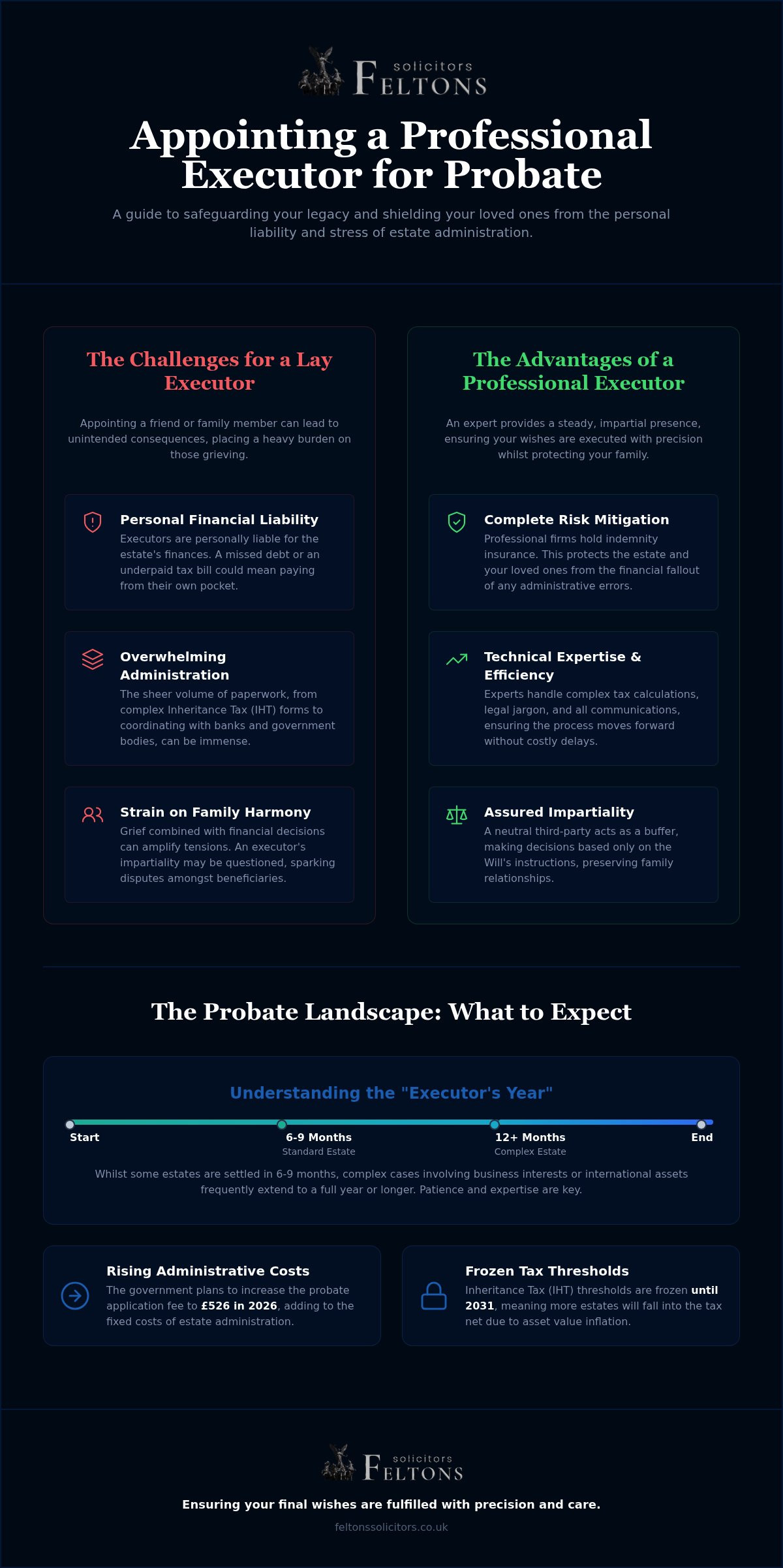
Whilst many family members expect the process to conclude within a few weeks, the reality is far more methodical. In 2026, a straightforward estate administration typically takes between six and nine months; however, more complex cases frequently extend to a full year. This “Executor’s Year” is a standard window. Beneficiaries often become restless during this time, putting immense pressure on the person in charge to speed up a process that is governed by strict legal timelines.

The Personal Liability of a Lay Executor

Choosing a friend or relative as a “lay executor” can lead to unintended financial catastrophe. Executors are personally liable for the estate’s finances. If a debt is missed or a creditor isn’t properly notified, the executor may have to pay that debt from their own pocket. Asset valuation is another high-risk area. If HMRC determines that an estate was undervalued, resulting in underpaid inheritance tax, the penalties can be severe. This is where professional executors for probate provide a critical safety net. Unlike a family member, a professional firm carries professional indemnity insurance. This protects the estate and the individuals involved from the fallout of honest administrative errors.

Administrative Burden and Legal Jargon

The sheer volume of paperwork is often what overwhelms lay executors. Filing inheritance tax (IHT) forms requires absolute precision; even a small discrepancy can trigger a lengthy investigation. Beyond the tax office, an executor must coordinate with banks, pension providers, and various government bodies. Each institution has its own set of requirements and specific jargon. Using professional executors for probate allows families to step back from this logistical maze. A professional guide translates complex legal requirements into plain English. They ensure every communication is handled with the necessary expertise and authority to move the process forward without unnecessary delay.

Key Advantages of Appointing a Professional Executor for Probate

Appointing a professional to manage an estate is often a decision rooted in the desire for stability. Whilst a family member may have the best intentions, they rarely possess the technical breadth required to navigate the intricacies of modern estate law. Professional executors for probate offer a level of sophisticated oversight that extends far beyond simple administration. They provide a steady, impartial presence that ensures the deceased’s wishes are executed with absolute fidelity, protecting both the assets and the family’s long-term relationships.

Maintaining Family Harmony Through Impartiality

Grief can often amplify existing family tensions, making the distribution of assets a potential flashpoint for conflict. A professional executor acts as a neutral buffer, standing apart from the emotional history of the beneficiaries. By serving as an independent arbiter, they ensure that every decision is based on legal requirement and the specific instructions left in the Will, rather than personal bias or perceived favouritism. This objective stance is vital for resolving disagreements amongst siblings or other relatives before they escalate into costly and damaging litigation. It allows family members to focus on their personal recovery whilst leaving the difficult conversations to a trusted, third-party expert.

Professional Expertise and Technical Accuracy

Modern estates are rarely straightforward. They often involve a complex tapestry of trusts, lifetime gifts, and business interests that require specialised handling to avoid unnecessary tax leakage. Professionals meticulously calculate any capital gains tax liabilities arising from asset appreciation between the date of death and the eventual sale or distribution. This technical precision ensures the estate doesn’t overpay inheritance tax or fall foul of HMRC’s increasingly stringent reporting standards. For those seeking a tailored approach to these sensitivities, exploring Wills, Probate, and Estate Planning services can provide the necessary clarity and security.

Beyond tax planning, professional firms offer essential continuity of service. Unlike an individual executor who may fall ill, move abroad, or become overwhelmed by their own personal circumstances, a professional firm provides a permanent, reliable point of contact. This ensures the probate process remains on track regardless of external factors. Their specialised knowledge also facilitates efficient asset recovery, particularly when dealing with diverse portfolios or discreet financial information that might be overlooked by a layperson. Meticulous record-keeping remains the cornerstone of this service, providing a transparent and indisputable trail for the final estate accounts.

Whilst a family member may successfully manage a straightforward estate involving a single property and a few bank accounts, the stakes rise sharply when assets become diverse. Complexity in probate isn’t merely about the size of the estate; it’s about the technical nature of the holdings. High-net-worth individuals often leave behind a tapestry of business interests, high-value collections, and intricate trust structures that require a level of precision far beyond the scope of a layperson. In these scenarios, professional executors for probate serve as essential architects of the administration process, ensuring that every thread is untangled without compromising the estate’s value.

Estates with International or Business Assets

Managing assets across borders introduces a layer of bureaucratic difficulty that can stall probate for years. International tax jurisdictions have their own reporting requirements, and coordinating with foreign legal teams is a full-time commitment. For property owners, the Registration of Overseas Entities is a critical regulatory hurdle that must be cleared to ensure the lawful transfer or sale of UK land. A professional executor possesses the global perspective necessary to handle these filings whilst maintaining business continuity. If the deceased owned a company, the executor must step in to ensure operations remain stable, salaries are paid, and the transition of ownership respects both the company’s articles of association and the deceased’s final wishes.

Protecting the Legacy of High-Net-Worth Individuals

Wealthy estates often involve unique assets such as intellectual property, private equity, or significant art and jewellery collections. These require specialised valuation and bespoke protection strategies that go beyond standard administrative tasks. Effective estate planning relies on the executor’s ability to implement complex tax-saving measures, such as navigating the £2.5 million cap on Business and Agricultural Property Relief that came into effect in April 2026. Professional executors provide the discreet, high-standard service required to manage these sensitive financial arrangements, protecting the legacy from both fiscal drag and public scrutiny.

The presence of minor beneficiaries or long-term trusts adds further responsibility. A professional executor acts as a steady hand, managing these funds with a “people-first” philosophy whilst adhering to strict fiduciary duties. This level of care is particularly vital in cases of “contentious probate,” where a Will is being challenged. Having an impartial expert at the helm ensures that the estate remains protected from the high costs of litigation, allowing for a resolution that honours the deceased’s intentions whilst safeguarding the inheritance for future generations.
Professional Probate Executors: 2026 Estate Guide

The Appointment Process: How to Organise Professional Executorship

Organising the future of an estate begins with a clear, proactive decision. Appointing professional executors for probate is most effectively handled during the initial Will-writing process. This allows the chosen firm to understand the testator’s intentions from the outset, ensuring a seamless transition when the time comes. Many individuals prefer to name a professional firm as a co-executor alongside a family member. This hybrid approach provides the best of both worlds; the family member remains involved in the sentimental aspects of distribution whilst the professional manages the complex legal and financial liabilities.

Openly discussing this choice with your family is vital for managing expectations. Transparency prevents surprises during an already emotional period and allows you to explain why you have sought professional oversight to protect their inheritance. It is also the appropriate time to consider fee structures. Professional fees are paid directly from the estate’s assets, and most firms offer either a fixed fee or a percentage-based cost. Solicitors commonly charge between 1% and 5% of the estate’s value for full administration, depending on the complexity of the assets involved.

Choosing the Right Professional Partner

Selecting the right partner requires a careful comparison between boutique law firms and large, impersonal probate providers. A boutique firm prioritises personal connection and ensures you know exactly who is handling the case. When interviewing potential firms, ask about their direct experience with estates similar to yours. You are looking for a “sophisticated guide” who possesses the worldly experience to handle complex matters whilst remaining human and accessible. For expert assistance in establishing a secure foundation for your estate, you can contact Feltons Solicitors to discuss your requirements.

The Transition: From Lay Executor to Professional Support

If a death has already occurred and the named lay executors feel overwhelmed, there are legal pathways to transfer the responsibility. A lay executor can choose to formally “renounce” their role or have “Power Reserved” to them, allowing a solicitor to take over the heavy lifting. This process ensures the administration continues without delay whilst keeping the family informed at every stage. Crucially, professional executors can be appointed even if not originally named in the Will. This flexibility provides essential relief for families who realise, after the fact, that the administrative burden is greater than they can safely manage alone.

Feltons Solicitors: Expert Professional Executor Services for Peace of Mind

Feltons Solicitors LLP stands as a calm, steady presence in the often-turbulent landscape of estate administration. Unlike larger, high-volume firms that may treat probate as a purely transactional process, our boutique approach prioritises personal connection and discreet, high-standard service. We understand that behind every legal file is a family navigating a significant life transition. By acting as professional executors for probate, we provide the pragmatic, sound judgment necessary to protect your legacy whilst offering the empathetic reassurance your loved ones require.

Our team possesses specific expertise in handling complex litigation and contentious probate disputes. This depth of experience is vital. It’s especially important when an estate faces challenges from creditors or disagreements amongst beneficiaries. We act as a sophisticated guide, using our worldly experience to navigate these high-stakes matters with quiet confidence. Whether the estate involves straightforward domestic assets or complex international interests, our commitment remains the same: to provide a methodical, orderly process that respects both the letter of the law and the human impact of our work.

Why Feltons is the Preferred Choice for UK Estates

Our “people-first” philosophy ensures that technical excellence never comes at the expense of accessibility. Established in 2010 by Paula Felton, the firm has built a reputation for combining traditional professional integrity with a modern, efficient methodology. We don’t rely on dense, archaic legalese; instead, we communicate in plain English to ensure all parties feel informed and supported. This balance makes us the preferred choice for those who value both the security of a highly skilled expert and the rapport of a trusted advisor. We handle both national and international matters with the same level of tailored attention, ensuring that no detail is overlooked in the pursuit of a stress-free probate process.

Getting Started with Your Estate Protection

Protecting your legacy begins with a confidential consultation. Whether you are in the initial stages of Will-writing or require immediate support following a death, our team is ready to provide the necessary guidance. We maintain a transparent approach to fees and service levels, ensuring there are no surprises during the administration. By choosing professional executors for probate, you ensure your estate is in the hands of a sophisticated advisor who values privacy and personal rapport. Your final wishes deserve the precision of a professional and the care of a partner who understands the weight of your legacy. We invite you to reach out and discover how our bespoke service can provide the peace of mind you and your family deserve.

Securing Your Family’s Future with Expert Precision

Navigating the complexities of probate doesn’t have to be a burden you carry alone. As we have explored, the transition of an estate involves significant legal liabilities and the potential for family friction; however, these risks are effectively managed through the use of professional executors for probate. By choosing a partner who balances technical excellence with a people-first philosophy, you ensure that your assets are distributed exactly as intended whilst protecting your loved ones from the weight of administrative error.

Feltons Solicitors provides a boutique level of care that prioritises high-end reliability and personal connection. Our expertise in handling both national and complex international estate matters allows us to act as a discreet, sophisticated guide for your legacy. Whether you’re managing high-value business interests or simply want to ensure a smooth transition for your children, we offer the steady presence needed during difficult times. Secure your legacy with Feltons Solicitors—contact our expert probate team today. Taking this step now provides the ultimate peace of mind for the future.

Frequently Asked Questions

What is a professional executor and do I really need one?

A professional executor is a qualified specialist, such as a solicitor or trust corporation, named in a Will to manage the administration of an estate. Whilst not a legal requirement, you may find their involvement essential if your estate includes complex business interests, overseas property, or if there is a high risk of family conflict. Appointing an expert ensures that your final wishes are carried out with impartial precision and technical accuracy.

How much do professional executors charge for probate in the UK?

Professional fees are generally paid from the estate’s assets rather than by the beneficiaries personally. Solicitors commonly charge a percentage of the total estate value, often ranging between 1% and 5% for full administration services. Some boutique firms may offer fixed-fee arrangements for specific tasks, providing clarity and helping families manage the overall costs of the probate process more effectively.

Can I appoint a professional executor if I have already started the probate process?

Yes, it is entirely possible to bring in professional support even if you have already begun the administration. If a lay executor feels overwhelmed by the complexity or time commitment, they can choose to renounce their role or have power reserved to them. This allows a solicitor to step in and handle the remaining legal and financial requirements, ensuring the estate is settled correctly and efficiently.

What happens if a professional executor makes a mistake during administration?

Professional executors carry professional indemnity insurance, which provides a robust layer of protection that lay executors simply do not have. If a financial error occurs during the administration, this insurance covers the loss, protecting the beneficiaries’ inheritance. This is a significant advantage over appointing a friend or relative, who would be personally liable for any mistakes made with the estate’s taxes or debts.

Can a family member be a co-executor with a professional solicitor?

Naming a family member as a co-executor alongside a professional solicitor is a very popular choice for many testators. This hybrid approach allows your loved ones to stay involved in the personal and sentimental decisions of the estate whilst the professional handles the technical filings and tax calculations. It provides a balance of personal connection and high-end legal reliability.

How long does it take for a professional executor to finish probate?

A professional executor typically completes a straightforward estate administration within six to nine months. However, the timeline can extend to a year or more for complex estates involving international assets or business interests. Their expertise often helps to avoid the common delays associated with incorrect HMRC filings, which can significantly slow down the process for those less experienced in probate law.

Is it possible to remove an executor if the beneficiaries are unhappy?

Removing an executor is a serious legal step that usually requires an application to the court if the individual refuses to step down. Beneficiaries must provide evidence of serious misconduct, such as a breach of fiduciary duty, financial mismanagement, or a total breakdown in communication that prevents the estate from being administered. Simply being unhappy with the executor’s personality is rarely sufficient grounds for removal.

What is the difference between a professional executor and a probate solicitor?

A professional executor is legally responsible for the entire estate, whereas a probate solicitor is often hired by a lay executor to provide specific legal advice. When you appoint professional executors for probate, they take on the full personal liability and administrative burden. They act as the primary decision-maker, ensuring that every legal duty is met from the initial valuation through to the final distribution of assets.

Lasting Power of Attorney Solicitor London: Securing Your Future with Professional Expertise

Lasting Power of Attorney Solicitor London: Securing Your Future with Professional Expertise

Did you know that over 50,000 Lasting Power of Attorney applications were rejected by the Office of the Public Guardian in the 2023/24 period alone? It is a staggering figure that highlights how easily a well-intentioned DIY approach can fail when it matters most. You likely feel a sense of anxiety regarding your future autonomy. The fear of being locked out of your own bank accounts or leaving your family to navigate painful disputes is a heavy burden to carry. We understand that you want more than just a standard document; you want the certainty that your voice will be heard even if you can no longer speak for yourself.

By partnering with an expert lasting power of attorney solicitor, such as those at Feltons Solicitors LLP, you can safeguard your welfare and assets through a professionally drafted agreement that stands up to legal scrutiny. This article will explain how to navigate the 2023 legislative changes and protect your complex business interests whilst ensuring your wishes are respected. We will show you how professional expertise transforms a complex legal requirement into a bespoke insurance policy for your independence and long-term peace of mind.

Key Takeaways

  • Consult a lasting power of attorney solicitor London to ensure your legal deed is robust and “future-proofed” against potential challenges.
  • Navigate the Powers of Attorney Act 2023 and understand how new digital processes and identity checks work to protect your interests.
  • Recognise the critical role of a Certificate of Capacity in providing a higher level of legal security than a standard DIY application.
  • Apply a practical framework for appointing attorneys by evaluating their specific expertise in financial management versus personal welfare.
  • Avoid common drafting errors and conflicting instructions that frequently result in the Office of the Public Guardian rejecting applications.

The Importance of a Specialist Lasting Power of Attorney Solicitor

A Lasting Power of Attorney (LPA) is a vital legal deed that grants you the autonomy to choose who will manage your affairs if you ever lose the ability to do so yourself. Whilst the government provides online forms for a DIY approach, these generic templates often lack the nuance required for complex personal or financial circumstances. Engaging a specialist lasting power of attorney solicitor London ensures that your document is not merely a formality but a robust legal shield. Professional drafting is particularly crucial amongst individuals with blended families, international assets, or intricate business interests where standard clauses might lead to ambiguity or conflict.

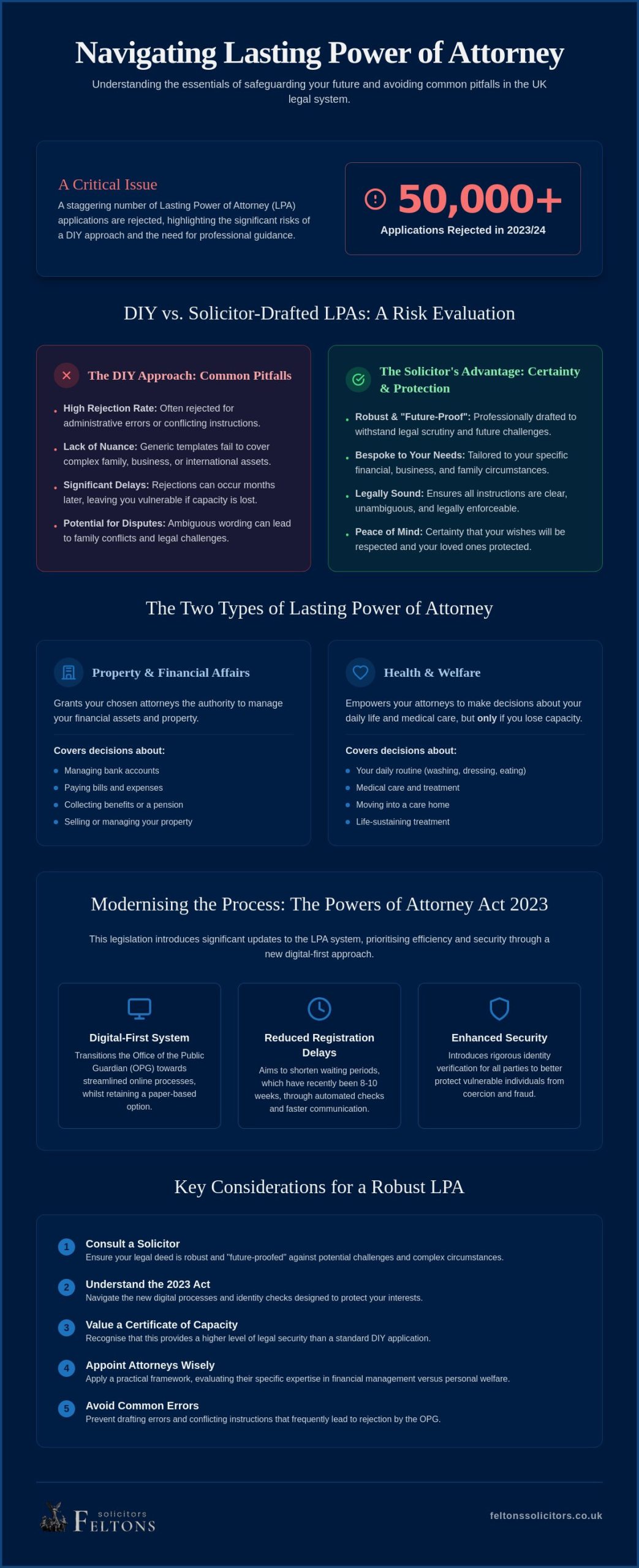
The risk of a DIY application is significant. In the 2023/24 period, over 50,000 applications were rejected by the Office of the Public Guardian (OPG) due to administrative errors or conflicting instructions. These rejections often occur months after the paperwork was submitted, leaving families in a precarious position if the donor has lost capacity in the interim. A solicitor acts as a safeguard, ensuring that every preference and instruction is legally sound and “future-proof” against potential challenges from disgruntled parties or financial institutions.

The Mental Capacity Act 2005 and Your Rights

The legal framework for LPAs is grounded in the Mental Capacity Act 2005, which establishes a clear presumption of capacity. This means you are assumed to have the right to make your own decisions unless it is proven otherwise. Mental capacity is the ability to make and communicate specific decisions at the time they need to be made. By creating an LPA, you exercise your right to self-determination before any crisis occurs. The OPG remains a vigilant overseer, monitoring the behaviour and actions of your appointed attorneys to ensure they act in your best interests and to prevent financial abuse or neglect.

Property and Financial Affairs vs. Health and Welfare

There are two distinct types of LPA, each serving a unique purpose. The Property and Financial Affairs LPA allows your attorneys to manage bank accounts, pay bills, and sell property. In contrast, the Health and Welfare LPA only becomes active if you lose capacity, covering decisions about your daily routine, medical care, and life-sustaining treatment. Many clients choose to register both documents simultaneously to provide a seamless safety net. These documents are also a fundamental component of a comprehensive estate planning strategy, ensuring that your financial legacy and personal dignity remain protected under the guidance of a lasting power of attorney solicitor London.

Modernising the Process: The Powers of Attorney Act 2023

The legal landscape for safeguarding your future changed significantly on 18 November 2023 with the implementation of the Powers of Attorney Act. This legislation represents the most significant update to the system in years, transitioning the Office of the Public Guardian towards a digital-first methodology. While the traditional paper-based route remains available for those who require it, the new framework prioritises efficiency and security through modern technology. Engaging a lasting power of attorney solicitor London is essential to navigate these digital transitions, ensuring that technical convenience doesn’t compromise the legal integrity of your deed.

One of the primary drivers behind this modernisation is the need to reduce registration delays. In recent years, applicants have frequently faced waiting periods of 8 to 10 weeks for their documents to be processed. The 2023 Act aims to streamline this by automating administrative checks and allowing for faster communication between the OPG and legal professionals. However, a digital system introduces new complexities regarding electronic signatures and online submission protocols. We provide the steady guidance needed to manage these digital hurdles whilst maintaining the traditional professional rigour your affairs deserve.

Enhanced Security and Fraud Prevention

The 2023 Act introduces rigorous identity verification requirements for all parties involved in the creation of an LPA. These measures are designed to protect vulnerable donors from coercion and financial abuse, which are growing concerns in an increasingly digital world. As your solicitor, we act as a neutral third party during the digital sign-off process, providing a level of human scrutiny that an automated system cannot replicate. For those who prefer traditional methods or lack digital access, the UK Government guidance on LPAs confirms that paper-based options will be maintained, ensuring accessibility remains a priority for all citizens.

Business LPAs: Protecting Your Commercial Interests

Many business owners mistakenly believe their personal Property and Financial Affairs LPA covers their commercial interests. This is rarely the case. If you’re a director or sole trader, your personal attorneys may not have the legal standing or the professional expertise to manage your company’s daily operations. A specific Business LPA ensures that your company can continue to pay staff, manage VAT, and meet contractual obligations if you’re incapacitated. We carefully align these documents with your company’s articles of association to avoid legal gridlock. If you’re concerned about commercial continuity, seeking guidance from Feltons Solicitors LLP can provide the tailored strategy your business requires.

DIY vs. Solicitor-Drafted LPAs: Evaluating the Risks

Choosing to manage your own legal affairs might seem like a cost-effective solution, especially with basic digital tools available online. However, the true value of a lasting power of attorney solicitor London lies in the professional rigour they bring to a document that must function perfectly under extreme pressure. Unlike a computerised form, a solicitor provides a Certificate of Capacity. This professional verification confirms you understand the implications of the deed and aren’t acting under duress. It’s the most effective way to prevent future legal challenges from those who might question your mental state at the time of signing.

Professional advice also helps you navigate complex family dynamics. A computer cannot sense tension between siblings or identify the risk of a future dispute. We act as a neutral observer, ensuring your choices are truly yours and that your attorneys are suitable for their roles. This human element is what prevents the family friction that often leads to costly litigation. While the initial registration fee is fixed, the cost of a solicitor is an investment in preventing thousands of pounds in future court costs for your family.

Common Pitfalls in Self-Administered Applications

One of the most frequent errors in self-administered applications involves the choice between “jointly” and “jointly and severally” appointments. If you choose “jointly”, your attorneys must agree on every single decision; if one dies or loses capacity, the entire LPA fails. A “Jointly and Severally” clause is the most flexible way for attorneys to act, as it allows them to make decisions both together and independently. Many DIY applicants also fail to appoint replacement attorneys correctly. Without these backups, your affairs could grind to a halt, forcing your family to apply for a costly and intrusive Deputyship order through the Court of Protection.

The Value of Bespoke Preferences and Instructions

Generic forms often lack the space for the nuanced instructions that define a person’s true wishes. You might have specific views on ethical investment portfolios or very particular care home preferences that a tick-box form cannot capture. A solicitor ensures your attorneys have the explicit legal authority to manage complex arrangements, such as the power to find a will or oversee family trusts effectively. These tailored instructions turn a standard document into a bespoke roadmap for your future care, ensuring your lifestyle and values are maintained even if you cannot advocate for them yourself.

Lasting Power of Attorney Solicitor London: Securing Your Future with Professional Expertise

A Framework for Choosing and Appointing Your Attorneys

Selecting the individuals who will hold legal authority over your life is a decision that requires a balance of emotional trust and practical assessment. It’s not simply about who you love most, but who possesses the specific temperament and skills to execute your wishes under pressure. To ensure your future is in capable hands, we recommend following a structured framework for selection and appointment.

  • Step 1: Assess Specific Skills. Financial management requires a level of fiscal literacy that may differ from the empathy and medical understanding needed for health and welfare decisions.
  • Step 2: Consider Geography and Availability. An attorney who lives locally and has the time to visit banks or attend medical consultations is often more effective than one living abroad.
  • Step 3: Conduct Transparent Discussions. Ensure your chosen individuals fully understand the legal responsibilities and are genuinely willing to accept the burden when the time comes.
  • Step 4: Appoint a Professional Certificate Provider. This neutral party verifies your understanding and freedom from pressure, providing a vital layer of security.
  • Step 5: Formally Register with the OPG. Registration ensures the document is legally active and ready for immediate use, avoiding delays during a crisis.

By applying this methodical approach, you can feel confident that your autonomy is protected by a team capable of honouring your legacy. If you require assistance in vetting potential representatives, a lasting power of attorney solicitor London can provide the objective perspective necessary to avoid future family conflict.

The Vital Role of the Certificate Provider

The Certificate Provider is a critical safeguard that many DIY applicants overlook or treat as a mere formality. This person must certify that you understand the purpose of the LPA and that no one is forcing you into the arrangement. While certain acquaintances can fill this role, engaging a lasting power of attorney solicitor London is often the most robust choice. We have a professional duty to ensure you aren’t being coerced, acting as a primary defence against the predatory creation of legal deeds. This professional sign-off makes the document significantly harder to challenge in the future.

Managing Multiple Attorneys and Substitutes

Appointing multiple attorneys can prevent a single person from having total control, but it also carries the risk of deadlock. When appointing children or siblings, it’s essential to structure their decision-making to maintain family harmony whilst ensuring efficiency. We often advise on the inclusion of replacement attorneys to “future-proof” the document. This ensures that if a primary attorney dies or loses capacity themselves, your LPA remains valid and functional for decades to come. To begin securing your future with professional rigour, contact Feltons Solicitors LLP for a discreet consultation.

Feltons Solicitors LLP: Discreet, Professional Guidance for Your Future

Feltons Solicitors LLP operates as a boutique practice, providing a sophisticated blend of professional authority and empathetic care. As a leading lasting power of attorney solicitor London, we understand that these documents are deeply personal reflections of your values and wishes. We aren’t a high-volume processing firm. Instead, we offer a calm, steady presence to help you navigate sensitive family and financial decisions with quiet confidence. Our extensive experience in complex probate and private client matters allows us to foresee potential issues that standard services might overlook.

We believe in total transparency and cost certainty. To support this, we provide fixed-fee options for LPA drafting and registration, ensuring you understand the investment from the very first consultation. Our “people-first” philosophy ensures your individual needs remain at the centre of our advice. We take the time to listen to your specific concerns, whether they involve protecting a family business, managing international assets, or ensuring your medical preferences are honoured. We don’t just process paperwork; we build lasting partnerships based on trust and discretion.

Our Tailored Approach to Powers of Attorney

Our approach goes beyond simple form-filling to provide strategic advice on asset protection and long-term welfare. For clients with high-net-worth or commercial interests, our expertise as a lasting power of attorney solicitor London ensures that your business assets are never at risk due to legal ambiguity. You’ll have direct access to senior solicitors who value privacy and personal rapport. This high-standard service is designed for those who require a methodical and orderly legal mindset applied to their most private affairs.

Secure Your Legacy Today

Waiting for a health crisis is the most common mistake in estate planning. Once capacity is lost, it’s too late to create an LPA, leaving your family to face the stress and significant expense of the Court of Protection. Creating these documents now provides the peace of mind that comes from knowing your affairs are in capable, trusted hands. It’s about taking control of your future whilst you have the clarity to do so. We invite you to experience a more personal level of legal care. Contact Feltons Solicitors LLP today for a discreet consultation regarding your Lasting Power of Attorney. Our team is ready to act as your sophisticated guide in securing your autonomy and your legacy.

Securing your future is a responsibility that requires more than just filling in a form. It demands a methodical approach to ensure your autonomy remains intact during life’s most challenging moments. By choosing a lasting power of attorney solicitor London, you avoid the administrative failures that stall so many applications and gain a document tailored to your specific financial and personal circumstances. We’ve seen how the 2023 legislative shifts and the nuances of “jointly and severally” appointments require professional rigour to be truly effective.

Feltons Solicitors LLP offers the quiet confidence and expertise of an SRA-regulated boutique firm with over 15 years of experience. We specialise in high-net-worth and complex international estates, providing every client with direct access to senior partners. This personal connection ensures your privacy is respected whilst your legacy is fortified against future challenges. You deserve the peace of mind that comes from knowing your affairs are in the hands of a trusted advisor.

Secure your future with a professionally drafted Lasting Power of Attorney from Feltons Solicitors LLP. We’re here to provide the steady guidance you need to move forward with certainty.

Frequently Asked Questions

What happens if I lose capacity and do not have a Lasting Power of Attorney?

Your family will likely need to apply to the Court of Protection for a Deputyship order to manage your affairs. This process is significantly more expensive and time-consuming than creating an LPA, often costing upwards of £3,000 in legal fees plus ongoing annual supervision charges. During the months it takes to secure this order, your bank accounts could be frozen, leaving your loved ones unable to pay for your care or household bills.

Can I change my mind after a Lasting Power of Attorney has been registered?

You can revoke your LPA at any time as long as you still have the mental capacity to make that decision. To do this, you must draft a “Deed of Revocation” and send it to the Office of the Public Guardian (OPG) along with the original document. If you wish to change your attorneys rather than cancel the document entirely, you’ll need to end the current LPA and register a new one.

How much does a solicitor typically charge for an LPA in 2026?

Professional fees for drafting and advice vary depending on the complexity of your estate and whether you’re registering both types of LPA. In addition to the solicitor’s fee, there is a mandatory government registration fee of £92 per document payable to the OPG. Engaging a lasting power of attorney solicitor London ensures that these costs are an investment in preventing much higher litigation or Deputyship expenses in the future.

To further secure your estate, it is often recommended to have a professionally drafted Will in place; click here to learn more about Aiker Wills and Trusts and their document preparation services.

Can my spouse automatically make decisions for me without an LPA?

No, your spouse or next of kin does not have an automatic legal right to manage your finances or dictate your medical care. Financial institutions often freeze joint accounts if one holder loses capacity and there is no registered LPA in place. Without this legal deed, your spouse may be “locked out” of the decision-making process regarding your life-sustaining treatment or the sale of your shared home.

What is the difference between an Ordinary Power of Attorney and a Lasting Power of Attorney?

An Ordinary Power of Attorney is a temporary measure that is only valid while you still have mental capacity, often used if you are hospitalised or working abroad. A Lasting Power of Attorney is specifically designed to “last” beyond the point where you can no longer make decisions for yourself. It’s a permanent safeguard that provides continuity of care and financial management when you are at your most vulnerable.

Can I appoint a professional, such as a solicitor, to be my attorney?

You can appoint a professional attorney to manage your Property and Financial Affairs, which is a common choice for those with complex business interests or no suitable family members. A lasting power of attorney solicitor London can act as your attorney, providing a neutral and expert presence to ensure your assets are managed with professional integrity. Please note that professionals rarely act as attorneys for Health and Welfare decisions.

How long does the registration process with the OPG take currently?

The registration process typically takes between 8 and 10 weeks from the date the application is received by the OPG. While the Powers of Attorney Act 2023 has introduced digital reforms to improve efficiency, these timeframes haven’t yet seen a significant reduction. It’s vital to start the process early to ensure the documents are ready for use before they are actually needed.

Does an LPA cover my assets and property held outside of England and Wales?

An LPA drafted in England and Wales isn’t automatically recognised in foreign jurisdictions or even in Scotland and Northern Ireland. If you own property abroad, you may need to create a separate Power of Attorney in that specific country or obtain a certificate under the Hague Convention on the International Protection of Adults. We recommend seeking specialist advice if your estate includes international assets to ensure total protection.

What is a Family Trust? A Comprehensive Guide to Protecting Your Legacy in 2026

What is a Family Trust? A Comprehensive Guide to Protecting Your Legacy in 2026

If your family home and savings have grown in value whilst the tax thresholds have remained frozen, how much of your hard-earned legacy will actually reach your children? Many people begin their estate planning journey by asking what is a family trust when they realise that the standard Inheritance Tax nil-rate band is staying at £325,000 until at least 2031. It’s a valid concern. You’ve worked hard to build your wealth, and the thought of it being diminished by tax or mismanaged by future generations is understandably unsettling.

We believe that protecting your family’s future requires more than just a simple document; it requires a strategy that balances control with flexibility. This guide will help you discover how a family trust can safeguard your assets, manage inheritance tax, and provide for your loved ones with professional legal clarity. We’ll examine the specific roles within a trust, how to shield assets from external threats, and provide a clear framework to help you choose between a Will and a Trust for your estate.

Key Takeaways

  • Understand the fundamental legal structure of a trust and the crucial distinction between holding a legal title and possessing a beneficial interest.
  • Gain clear insight into what is a family trust by exploring how a bespoke Trust Deed serves as a precise rulebook for your family legacy.
  • Compare the flexibility of Discretionary Trusts with the structured security of Interest in Possession Trusts to determine the most suitable path for your beneficiaries.
  • Learn how a robust trust structure can shield your family wealth from external threats such as divorce, remarriage, or the risks of managing sudden wealth.
  • Follow a methodical framework to audit your current assets and align your estate planning with your specific long-term protection goals.

Understanding the Core Concept: What is a Family Trust in the UK?

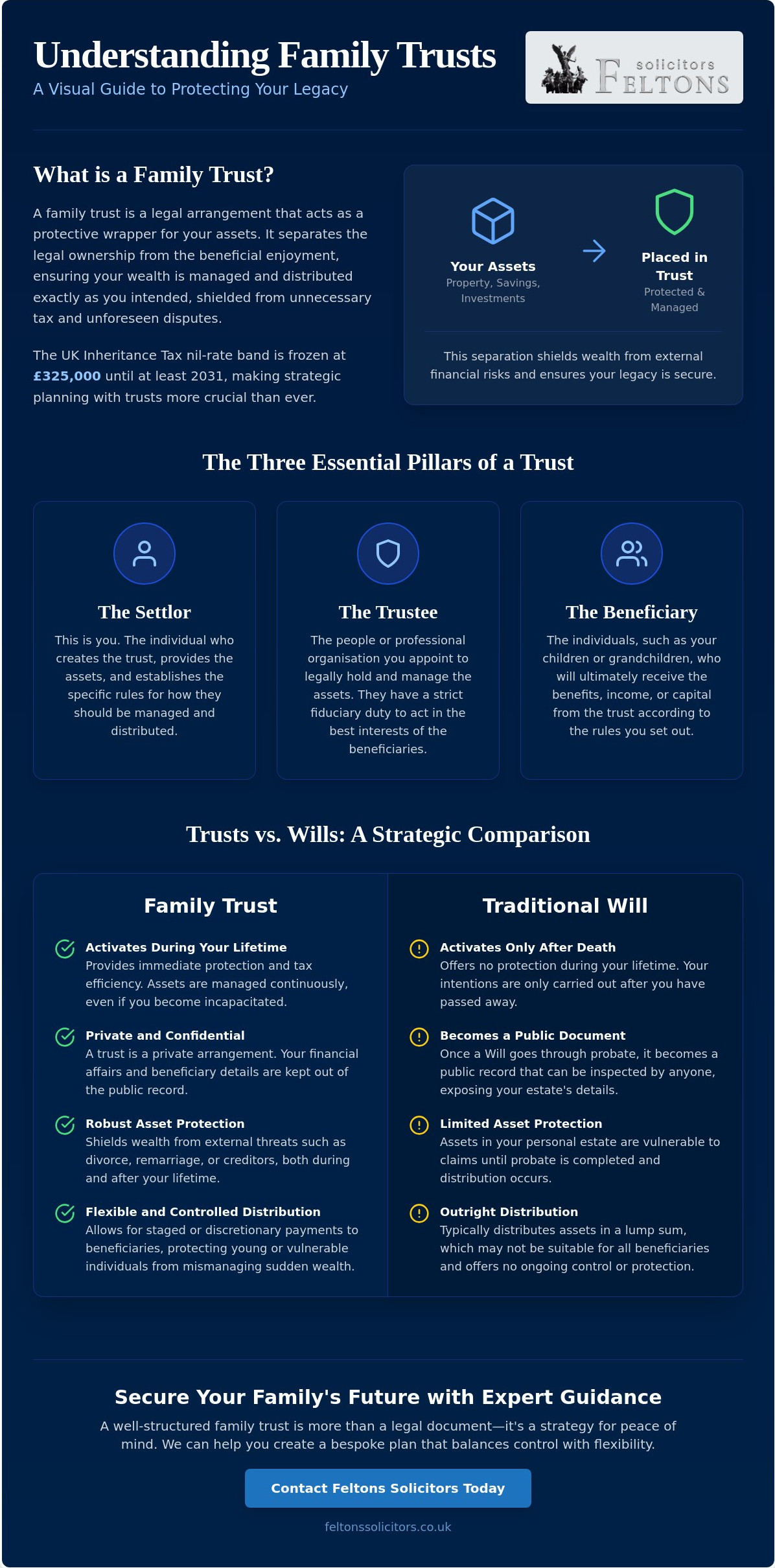
At its most fundamental level, a family trust is a legal arrangement where assets are held by individuals or a professional body for the benefit of others. Whilst it might sound complex, the core principle is straightforward: it’s a way to ensure your wealth is managed exactly as you intended, even when you’re no longer there to oversee it. For those exploring what is a family trust, it’s helpful to view it as a protective wrapper that sits around your assets, shielding them from unnecessary tax or unforeseen family disputes. Understanding the Core Concept of trusts requires looking at how English law distinguishes between legal and beneficial ownership.

When you transfer an asset into a trust, you separate the “legal title” from the “beneficial interest”. The trustees hold the legal title; they’re the registered owners on paper and responsible for the day-to-day administration. However, they don’t own the assets for themselves. The beneficial interest belongs to your beneficiaries, who have the right to enjoy the income or capital according to the rules you’ve set out. This distinction is the engine that drives asset protection, as the assets are no longer technically part of your personal estate.

The Three Essential Pillars of a Trust

Every trust relies on three distinct roles to function effectively and provide the security your family deserves:

  • The Settlor: This is you. You’re the individual who provides the assets, whether that’s property, cash, or investments, and establishes the specific rules for how they should be handled.
  • The Trustee: These are the people or professional organisations you appoint to manage the trust. They have a fiduciary duty to act in the best interests of the beneficiaries and must follow the instructions in your Trust Deed.
  • The Beneficiary: These are the individuals, such as your children or grandchildren, who will ultimately receive the benefits, income, or assets from the trust.

Trusts vs Wills: Which is Right for Your Estate?

Understanding what is a family trust involves comparing it to other legal instruments. Choosing between a Will and a trust often depends on when you want your legacy plan to begin. A traditional Will only takes effect upon your death, whereas a trust can be established during your lifetime to provide immediate protection and tax efficiency. Because trusts can operate whilst you’re still alive, they offer a level of continuity that a Will simply cannot match.

Privacy is another significant factor. When a Will goes through probate, it becomes a public document that anyone can inspect. In contrast, a family trust is a private arrangement, keeping your financial affairs and the details of your beneficiaries away from the public eye. Integrating these structures into your broader estate planning strategy ensures that your family remains supported through a discreet, high-standard service that values both modern efficiency and traditional integrity.

The Mechanics of Asset Protection: How a Trust Structure Operates

Establishing the legal boundaries of a trust requires more than just intent; it requires a formal Trust Deed. This document serves as the precise rulebook for your family legacy, detailing how assets are administered, managed, and eventually distributed. Once this framework is in place, the process of conveyance begins, where assets move from your individual name into the trust’s legal title. This transition is what creates the protective barrier, ensuring that when people ask what is a family trust, they see it as a functional entity separate from their personal estate. This separation is the primary mechanism that shields your wealth from various forms of financial risk.

Trustees are bound by a strict fiduciary duty, requiring them to act with absolute integrity and in the best interests of the beneficiaries at all times. This legal obligation is the cornerstone of the trust’s reliability, ensuring that the assets are managed with sound judgment and professional care. Whilst the Trust Deed acts as the rigid legal instrument, a “letter of wishes” provides the necessary nuance. This confidential document offers personal guidance to your trustees, helping them understand your values and the specific needs of your loved ones. It is a vital tool for ensuring that the human side of your legacy remains intact, even within a formal, highly organised legal structure.

Choosing Your Trustees Wisely

Selecting the right individuals to manage these assets is a decision that requires careful thought and a long-term perspective. Many settlors opt for a combination of trusted family members and professional advisors who understand the specific Tax Implications in 2026. Professional trustees bring an objective perspective that can prevent family friction during stressful times, whilst family members provide continuity and personal context. At Feltons Solicitors LLP, we often recommend this balanced approach to maintain both personal connection and high-standard professional integrity. If you are uncertain about the right choice for your family, our estate planning specialists can provide a tailored consultation.

Managing Trust Assets

A family trust can hold a diverse range of assets, from investment portfolios and cash savings to the family home itself. When a primary residence is involved, the transfer process must align perfectly with residential property law to ensure the asset protection is legally absolute and compliant with Land Registry requirements. Beyond the initial setup, understanding what is a family trust requires a commitment to ongoing administration. Trustees are responsible for annual reporting and must ensure the trust is registered with the HMRC Trust Registration Service (TRS) within 90 days of creation. This methodical oversight is essential for maintaining the trust’s validity and protecting the assets from external threats over the coming decades.

Common Types of Family Trusts and Their Tax Implications in 2026

Selecting the right structure is as important as understanding what is a family trust in the first place. For families in 2026, the choice usually settles on one of three main vehicles, each offering a different balance of control, protection, and tax efficiency. With the Inheritance Tax (IHT) nil-rate band frozen at £325,000 until April 2031, your choice of trust type will significantly impact how much of your estate is subject to the 20% entry charge on transfers exceeding this threshold. Following official guidance on trusts is essential to ensure your chosen path aligns with HMRC’s evolving regulations.

Discretionary Trusts: Flexibility and Control

This is arguably the most versatile option for families with complex or changing needs. In a discretionary trust, the trustees have the power to decide which beneficiaries receive income or capital, how often payments are made, and what conditions must be met. It’s a powerful tool for protecting wealth from a beneficiary’s potential divorce or bankruptcy, as the assets don’t technically belong to the individual until the trustees make a distribution. When people ask what is a family trust, they’re often looking for the specific flexibility provided by this discretionary structure.

This flexibility comes with specific tax considerations. Most discretionary trusts are subject to the “relevant property” regime, which includes a periodic charge of up to 6% on the trust’s value above the nil-rate band every 10 years, alongside “exit charges” when assets are distributed. From April 6, 2026, families with business interests must also account for the new £1 million cap on Business Property Relief (BPR). For trusts created on or after October 30, 2024, this cap applies immediately from April 2026, potentially increasing the tax burden on high-value business assets.

Interest in Possession: Balancing Immediate Needs

Often used in the context of second marriages, an Interest in Possession trust allows a “Life Tenant” (often a surviving spouse) to receive income from the trust assets for the rest of their life. Upon their death, the capital passes to the “Remainderman”, who is typically a child from a first marriage. This ensures the spouse is provided for whilst the underlying inheritance is legally ring-fenced for the next generation. In 2026, these trusts remain a popular choice for those wanting to manage immediate family requirements without losing control over the final destination of the family’s wealth.

Bare Trusts: Direct and Simple

A Bare Trust is the most straightforward arrangement. The assets are held in the name of a trustee, but the beneficiary has an absolute right to both the capital and income. These are frequently used for minor children or grandchildren, where assets are held until the child reaches 18. Once the beneficiary reaches the age of majority, they can demand the assets be transferred to them directly. Whilst they lack the long-term protection of other structures, they’re often favoured for their simplicity and the fact that they’re generally treated as the beneficiary’s own assets for tax purposes.

What is a Family Trust? A Comprehensive Guide to Protecting Your Legacy in 2026

Strategic Benefits: Why Families Choose Trusts Over Simple Wills

Whilst a Will is a foundational document, it often lacks the protective depth required for modern family structures. Many families now look beyond simple probate planning to ask what is a family trust because they require a solution that manages assets across generations with more flexibility. In 2026, the notion that trusts are reserved for the elite is outdated. As property values rise against frozen tax thresholds, these structures have become a pragmatic tool for any homeowner seeking to preserve control over their hard-earned legacy and ensure high-end reliability for their heirs.

When exploring what is a family trust, many families prioritise the concept of “bloodline protection”. If an estate is left directly to a spouse via a Will, those assets are technically at risk if that spouse later remarries or faces legal claims. A trust ensures that whilst the survivor is fully supported, the underlying capital is ring-fenced for your children or grandchildren. This prevents your wealth from being inadvertently diverted to a new partner’s family, providing a sense of security and continuity that a standard Will cannot offer in a blended family scenario. For estates where disputes arise during administration, engaging complex probate solicitors can provide the specialist guidance needed to resolve contentious matters and protect beneficiaries’ interests.

Asset Protection in Divorce and Litigation

A robust trust structure acts as a discreet shield, separating family wealth from the personal liabilities of beneficiaries. Because the assets are managed by trustees, they are often less vulnerable to claims during a beneficiary’s relationship breakdown or personal litigation. As a specialist divorce and financial arrangements lawyer at Feltons Solicitors LLP can confirm, it is always best to establish these protections proactively. Setting up a trust during a period of stability ensures your family’s future remains secure and dependable, rather than reacting to a crisis after it has already begun.

Providing for Vulnerable Beneficiaries

Trusts are also essential for supporting family members who may be unable to manage a large inheritance independently. This includes individuals with disabilities, where a direct gift might affect their eligibility for essential state support. By using a trust, you ensure they receive tailored care and financial stability managed by responsible trustees. Similarly, this structure protects beneficiaries who may struggle with financial management or addiction issues. This people-first approach ensures your wealth serves its true purpose: providing a stable future amongst unpredictable life events. A comprehensive estate plan should also consider appointing a lasting power of attorney solicitor London families trust to ensure that, should you lose mental capacity, your chosen trustees and attorneys can act seamlessly without interruption to your family’s financial arrangements. To begin your journey, contact Feltons Solicitors LLP for a consultation focused on your unique family dynamics.

Establishing Your Legacy: The Path to Creating a Family Trust

Moving from the theoretical understanding of what is a family trust to the practical implementation of one requires a clear, methodical roadmap. The journey begins with identifying your primary objectives, which often involve a sophisticated blend of tax mitigation, asset ring-fencing, and long-term control. At Feltons Solicitors LLP, we start by helping you define exactly what success looks like for your family. Whether you are focused on the upcoming 2026 changes to Business Property Relief or seeking to protect a vulnerable relative, your goals will dictate the specific architecture of the trust structure.

The second stage involves a comprehensive audit of your assets to identify which holdings are suitable for transfer. This is a delicate balancing act that requires professional insight into your current liquidity and future needs. Once the assets are identified, the focus shifts to drafting the Trust Deed with absolute legal precision. This document is the definitive authority on how your wealth is managed, and it must be robust enough to withstand future scrutiny. The final step is the formal conveyance of assets into the trust and ensuring the arrangement is registered with the HMRC Trust Registration Service (TRS), a vital compliance step for modern estate management. Where an estate involves significant business interests or cross-border assets, the expertise of complex probate solicitors may also be required to navigate the intricate administration process alongside your trust structure.

The Importance of Professional Drafting

Attempting to use generic DIY templates for such a complex legal arrangement carries significant risks, including the potential for costly litigation or unintended tax consequences. Feltons Solicitors LLP provides the specialised expertise necessary to ensure your trust is resilient and tailored to your family’s specific nuances. We ensure that your trust works in perfect harmony with your broader estate plan, which often involves finding a will for other family members to eliminate any contradictions. A cohesive strategy also means ensuring that a professionally appointed lasting power of attorney solicitor in London has documented your wishes regarding financial and health decisions, so your trustees can act with full legal authority if you lose capacity before the trust is fully administered. A cohesive strategy is the only way to guarantee that your last wishes are carried out with high-end reliability and professional integrity.

Next Steps with Feltons Solicitors LLP

When you are ready to move forward, our initial consultation provides a calm, steady space to discuss your financial landscape. We take a boutique, people-first approach, ensuring that your family’s unique dynamics are respected throughout the process. You can expect clear, pragmatic advice that avoids dense legalese in favour of practical solutions tailored to your national requirements. Our role as your trusted advisor is to guide you through the complexities of what is a family trust whilst providing the worldly experience necessary to handle even the most intricate estate matters. By choosing a partner that values both modern efficiency and traditional professional integrity, you can secure a legacy that truly stands the test of time.

Securing Your Family Legacy for 2026 and Beyond

Protecting your wealth requires a shift from static planning to a more dynamic, protective framework. You’ve seen how trusts safeguard assets against divorce, manage complex inheritance tax rules, and provide for vulnerable beneficiaries with absolute precision. Deciding what is a family trust for your specific needs is the first step toward ensuring your children and grandchildren are truly provided for. A well-structured trust doesn’t just manage money; it preserves your family values across generations, which often includes the lifelong care of family pets; to prepare for their future health needs, you can check out London Veterinary Surgeries for expert advice on feline healthcare costs.

At Feltons Solicitors, we’ve been helping families since 2010. We blend traditional values with modern delivery to provide boutique, people-first legal expertise. As specialists in complex estate planning and financial arrangements, we ensure your legacy remains robust against future challenges. We’re here to act as your calm, steady presence through every stage of the planning process.

Secure your family’s future with a bespoke trust consultation at Feltons Solicitors. Your legacy is more than just a list of assets; it’s the foundation for your family’s future. We look forward to helping you build it with confidence and care.

Frequently Asked Questions

Is a family trust better than a Will for inheritance tax?

A family trust can be more effective than a Will for Inheritance Tax (IHT) planning because it allows you to remove assets from your personal estate whilst you’re still alive. With the nil-rate band frozen at £325,000 until April 2031, placing assets in trust can mitigate the impact of fiscal drag on your wealth. However, you must consider the 20% entry charge on transfers exceeding your available allowance and potential periodic charges every ten years.

Can I be a trustee of my own family trust in the UK?

You can certainly be a trustee of your own family trust in the UK, and many settlors choose this path to maintain direct involvement in management. Acting as a trustee allows you to oversee the distribution of assets according to your original intent. We often suggest appointing at least one other trustee, perhaps a professional body, to provide continuity and impartial judgment if your circumstances change.

What assets can I put into a family trust?

You can place a wide variety of assets into a trust, including your residential home, cash savings, stocks, shares, and land. When considering what is a family trust for business owners, it’s vital to note that from April 6, 2026, a £1 million cap applies to 100% Business Property Relief. Assets exceeding this value will only receive 50% relief, making the timing of your transfer a critical factor in your strategy.

How much does it cost to maintain a family trust annually?

The annual maintenance costs for a trust depend on its complexity and the type of assets held within the structure. You should account for the cost of preparing annual accounts, filing trust tax returns with HMRC, and periodic legal reviews to ensure compliance with changing regulations. Professional fees for these administrative tasks are a necessary investment to maintain the trust’s protective wrapper and ensure high-end reliability.

Can a family trust be challenged in court after I die?

A family trust can be challenged in court, though it’s generally more difficult to overturn than a traditional Will. Challenges usually arise from claims of mental incapacity, undue influence, or under the Inheritance (Provision for Family and Dependants) Act 1975. Using a professionally drafted Trust Deed and a clear letter of wishes provides a robust defence, ensuring your legacy remains exactly as you intended.

Do I still have control over my house if I put it in a trust?

You can still live in and manage your home if it’s placed in a trust, provided the Trust Deed is drafted with a right to occupy or an Interest in Possession. Whilst the legal title moves to the trustees, your beneficial interest allows you to remain in the property. This arrangement provides security for your residence whilst ensuring the capital is legally ring-fenced for the next generation.

What is the Trust Registration Service (TRS) and do I need to register?

The Trust Registration Service (TRS) is a central HMRC register designed to improve transparency, and most UK trusts must register within 90 days of being established. Failing to register can lead to financial penalties and administrative complications for your trustees. Understanding what is a family trust in 2026 involves recognising these ongoing compliance duties as a standard part of modern, methodical estate management.

Can a family trust protect my assets from care home fees?

A family trust can protect assets from care home fee assessments, but only if it’s established for genuine estate planning reasons well in advance of needing care. If a local authority deems the transfer was made primarily to avoid fees, they may invoke deliberate deprivation of assets rules. Timing and intent are the two most critical factors, which is why we recommend establishing these structures whilst you’re in good health.