

Divorce Financial Settlements: The Definitive Guide to Protecting Your Assets in 2026

Divorce Financial Settlements: The Definitive Guide to Protecting Your Assets in 2026

Finalising your divorce dissolves your legal marriage, but it does not extinguish your financial liabilities. Without a sealed court order, an ex-spouse can pursue claims against your property, pension wealth, or business equity years into the future. When speaking with Feltons Solicitors LLP or specialist family practitioners, people often share the same justified anxiety: the fear of losing assets they spent a lifetime building, alongside confusion over why a divorce decree alone leaves them unprotected.

You deserve clarity and certainty as you plan your next chapter. This guide explains how courts assess fairness under English law, how matrimonial property is divided, and how to achieve an enforceable clean break settlement that permanently safeguards your personal wealth. From the division of substantial pension pots to the practical benefits of resolving disputes outside a contentious courtroom, here is how you can resolve your financial arrangements calmly, pragmatically, and decisively.

Key Takeaways

  • Securing a court-approved consent order is the only method to achieve a true clean break and permanently terminate your ex-spouse’s financial claims.
  • Judges evaluate the division of matrimonial property using statutory Section 25 criteria, prioritising the housing needs of minor children above equal sharing.
  • Accurately dividing complex holdings like private company shares, high-value pensions, and property portfolios requires specialist valuation methods to prevent post-separation tax penalties.
  • Partnering with experienced divorce financial settlement solicitors london ensures full financial disclosure via Form E, protecting personal wealth from future claims without unnecessary court conflict.
  • Proactive negotiation and alternative dispute resolution offer a discreet, cost-effective pathway to resolve finances while preserving long-term estate planning integrity.

The Fundamentals of a Financial Settlement: Securing a Clean Break

A matrimonial financial settlement legally resolves the division of capital, real estate, pension entitlements, and ongoing income following the breakdown of a marriage. Many individuals mistakenly assume that obtaining a final divorce order concludes their financial ties. In reality, ending the legal marriage leaves every financial claim open between former spouses. A financial remedy order approved by the court provides absolute legal finality.

Informal arrangements or verbal pacts offer no lawful protection. Even if you draft a private written contract, it remains unenforceable within family law jurisdiction without judicial endorsement. Under the Matrimonial Causes Act 1973, the family court retains overarching supervisory power over marital property. Judges must review every proposed split to confirm it is fair, reasonable, and capable of satisfying both parties’ independent housing and living needs.

Why Finalising Your Divorce Does Not End Financial Claims

A conditional order and subsequent final order dissolve only the marriage contract. They do not dismiss statutory financial rights. Without an explicit, legally binding dismissal order, your former spouse can lodge claims against your wealth ten, twenty, or thirty years later. This exposure applies to future inheritances, lottery windfalls, and post-divorce business equity. Securing a sealed court order remains the only way to achieve authentic, permanent independence.

Consent Orders Versus Financial Remedy Orders: Understanding the Instruments

Choosing the correct legal mechanism depends entirely on whether you and your spouse can reach an agreement. Working with specialist divorce financial settlement solicitors london allows you to pursue an amicable resolution first, converting negotiations into a watertight judicial order.

  • Consent Orders: A mutually agreed draft order submitted alongside Form D81, detailing current and proposed asset distributions. A judge reviews this paperwork administratively without requiring either party to attend court.
  • Contested Financial Remedy Orders: Court-imposed determinations issued by a judge following formal litigation when private negotiations fail.
  • Clean Break Provisions: Clauses within an order that permanently terminate all capital, income, and pension claims, ensuring neither party can request spousal maintenance in the future.

While ongoing spousal maintenance suits situations with significant income disparities or young children, modern family jurisprudence actively favours clean break outcomes wherever capital resources suffice. Experienced divorce financial settlement solicitors london construct these arrangements to balance immediate liquidity with comprehensive long-term asset ring-fencing.

Section 25 Criteria: How Family Courts Assess Fair Asset Division

When determining financial settlements under the Matrimonial Causes Act 1973, English courts operate from an initial benchmark of equal division. However, this equal starting point frequently yields to ensure equitable living outcomes for both individuals. As set out in the GOV.UK guidance on dividing money and property, the primary duty of the court is the welfare of any dependent child under eighteen. Section 25 gives judges broad discretion to achieve substantive fairness over mathematical parity.

To establish what is truly fair, judges examine each family’s unique economic fabric rather than applying a rigid numerical formula. Instructing experienced divorce financial settlement solicitors london helps ensure your position is framed persuasively against every statutory consideration.

Assessing Needs, Earning Capacity, and Standards of Living

The court evaluates each party’s capital, current income, and realistic future earning capacity. Where one spouse paused a lucrative career to handle domestic care or child-rearing duties, the law recognises that contribution as equal to that of the primary financial earner. Factors that directly shape court awards include:

  • Housing and Capital Requirements: Securing suitable, secure accommodation for children and the primary residential parent.
  • Duration of Marriage and Age: Longer marriages naturally foster deeper financial interdependence, whereas shorter unions without children often justify a swift return to pre-marital status.
  • Standard of Living: The lifestyle enjoyed during the marriage serves as a guiding guidepost, tempered by the economic reality of funding two separate households from a single pool of wealth.

Matrimonial Versus Non-Matrimonial Property

Family law draws a sharp distinction between matrimonial assets generated through joint efforts and non-matrimonial holdings brought into the union. Matrimonial assets typically include the family residence, joint savings, business equity created during the partnership, and pensions built during the cohabitation period. These are subject to the sharing principle.

Conversely, non-matrimonial property encompasses pre-owned assets, inheritances received independently, and gifts from external family members. Following landmark Supreme Court precedent, non-matrimonial wealth is generally insulated from sharing unless required to meet the other party’s basic reasonable needs. If you need bespoke guidance on structuring your holdings or navigating property adjustments, consulting specialists at Feltons Solicitors LLP provides the clarity needed to protect your legitimate entitlements.

Division of Complex Wealth: Real Estate, Pensions, and Private Businesses

High-value matrimonial estates present unique structural hurdles. When marital wealth spans substantial real estate portfolios, defined benefit pension funds, and private commercial enterprises, applying a clean division requires deep technical precision. Rather than treating all capital uniformly, courts and instructing divorce financial settlement solicitors london must evaluate the distinct liquidity, taxation, and long-term utility of each holding.

The Matrimonial Home: Mesher Orders, Buyouts, and Immediate Sale

The matrimonial residence carries intense personal sentiment alongside substantial equity. Couples generally face three practical routes to resolve ownership:

  • Immediate Open-Market Sale: Realising total net proceeds to fund the independent rehousing of both individuals.
  • Equity Buyout: One spouse refinances the property to purchase the other’s legal share and secure a release from mortgage covenants.
  • Mesher Orders: Postponing the sale of the family home until a triggering event occurs, such as the youngest child completing secondary education or reaching age eighteen.

Executing an equity transfer or property sale demands meticulous legal implementation. Coordinating your family settlement alongside an experienced residential property law firm guarantees that deeds, Land Registry charges, and conveyancing processes align with the court order.

Pensions on Divorce: Sharing Orders Versus Capital Offsetting

Pension funds frequently equal or eclipse the capital tied up in real estate. Despite this, they remain widely overlooked during direct negotiations. Under current Pension Advisory Group guidelines, standard Cash Equivalent Transfer Values (CETVs) often fail to reflect the true value of defined benefit or public sector schemes. Specialist actuarial reports are vital to achieve genuine parity of retirement income.

Parties typically divide retirement assets through Pension Sharing Orders, which carve out an exact percentage of a fund into a new, independent plan for the receiving spouse. Alternatively, pension offsetting permits one spouse to retain greater real estate equity or liquid savings in exchange for waiving rights to the other’s pension pot. As highlighted in the GOV.UK guide to dividing money and property on divorce, older Pension Attachment Orders have fallen out of common practice because they tie your financial future to your former spouse’s eventual retirement date.

Valuing and Protecting Private Business Interests and Company Shares

Private company shareholdings demand forensic evaluation. Judges avoid dismantling viable commercial ventures to satisfy personal capital divisions. Jointly instructed forensic accountants evaluate sustainable earnings, net asset values, and latent corporation or capital gains tax liabilities. Settlement structures must protect commercial cash flow, using staged lump sums, dividend extractions, or structured share buybacks rather than forcing an immediate operational sale.
Divorce Financial Settlements: The Definitive Guide to Protecting Your Assets in 2026

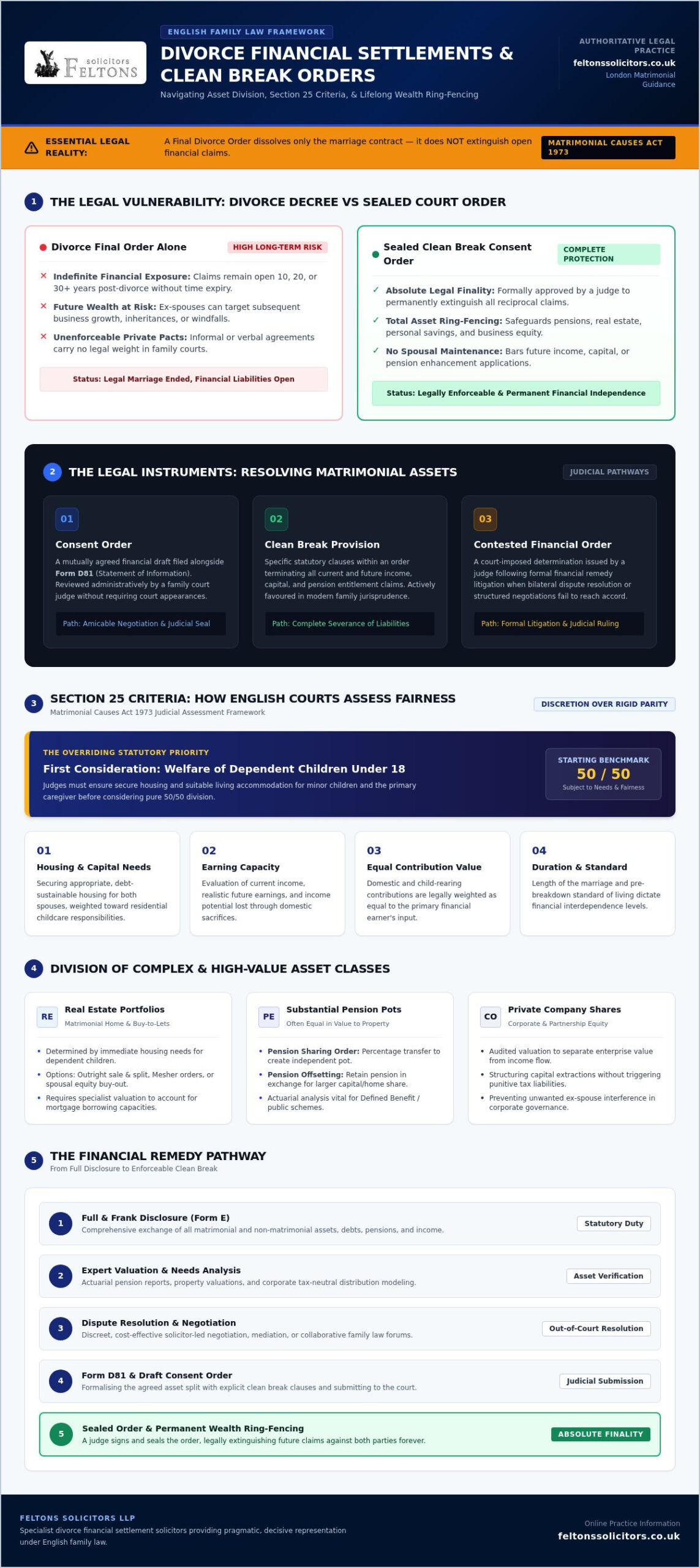
Securing an enforceable financial settlement demands a structured, transparent legal procedure. Whether resolving arrangements privately or through judicial intervention, the process follows a predictable sequence. Completing these formal stages protects your capital while eliminating the risk of future legal challenges.

  1. Exchange Formal Disclosure: Both spouses complete Form E, setting out their worldwide capital, liabilities, business assets, and pensions with documentary proof.
  2. Instruct Joint Experts: Appoint independent specialists to value shared real estate, unquoted business shares, and complex defined benefit pensions.
  3. Conduct Structured Negotiations: Explore constructive proposals through solicitor correspondence, mediation, or private dispute resolution sessions.
  4. Ratify the Agreement: Draft a formal consent order and submit it to the court alongside Form D81 for final judicial sealing.

The Importance of Full and Frank Financial Disclosure

Every matrimonial settlement rests upon absolute financial honesty. You must disclose every domestic bank balance, offshore holding, share option, and trust benefit. Attempting to conceal wealth or understate company valuations carries severe legal consequences. Under long-standing precedent, the court will readily overturn sealed orders where a spouse committed fraudulent or deliberate non-disclosure. Judges also impose punitive adverse costs orders against deceptive parties. Engaging a qualified divorce and financial arrangements lawyer ensures your financial statement is meticulously prepared, defending you against unfair scrutiny while actively uncovering any hidden spousal wealth.

Out-of-Court Resolutions: Mediation, Collaborative Law, and Private FDRs

Resolving your finances does not require an acrimonious courtroom battle. Before issuing proceedings, parties must ordinarily attend a Mediation Information and Assessment Meeting (MIAM) to explore constructive dialogue. For complex or high-value estates, Private Financial Dispute Resolution (Private FDR) hearings have become the preferred option. A hired specialist barrister or retired judge evaluates the evidence and delivers an evaluative settlement recommendation in complete privacy. This private forum avoids the lengthy delays and public disclosure associated with open family courts.

Navigating Court Proceedings: First Directions and Final Hearings

When alternative methods cannot resolve entrenched disputes, the court timetable governs proceedings:

  • First Directions Appointment (FDA): The preliminary procedural hearing where a judge reviews disclosure, orders questionnaire answers, and authorises expert valuations.
  • Financial Dispute Resolution (FDR): The core negotiation hearing where the presiding judge offers an informal view on the likely outcome, strongly urging parties to settle without trial.
  • Final Contested Hearing: A formal trial where witnesses undergo cross-examination and the judge imposes a legally binding financial order.

If you face complex negotiations or wish to initiate an orderly asset split, instruct reputable divorce financial settlement solicitors london to protect your wealth. Reach out directly to Feltons Solicitors to discuss your circumstances with our discreet private client team.

Resolving complex marital assets requires steady judgment alongside technical mastery. Retaining specialist legal counsel ensures your financial position remains robustly insulated without escalating interpersonal tension. A comprehensively drafted financial agreement does far more than resolve present-day division; it protects your future wealth, insulates commercial enterprise, and preserves inheritance for children across generations.

Decisive advice taken early in the separation process brings profound relief. It clarifies enforceable statutory rights, establishes realistic expectations, and replaces emotional panic with orderly strategy. Instructing top-tier divorce financial settlement solicitors london ensures that every settlement term is framed to deliver complete, permanent security.

Aligning Property, Wills, and Estate Planning After Separation

A financial separation cannot occur in an administrative vacuum. Comprehensive wealth protection demands synchronising your family law arrangements with property ownership changes and succession plans. Key legal steps to undertake alongside your financial agreement include:

  • Severing the Joint Tenancy: Converting joint ownership of the matrimonial property into a tenancy in common prevents your share from passing automatically to your estranged spouse under survivorship rules if you die before the divorce finalises.
  • Executing an Immediate Will Update: Separation alone does not alter the provisions of an existing will. Until a final divorce order is sealed, an estranged spouse retains their legal status as a primary beneficiary unless you rewrite your testamentary documents.
  • Revising Beneficiary Nominations: Updating death-in-service benefits and pension expression-of-wish forms ensures accumulated funds flow directly to your intended recipients.

Coordinating with our private client team on your broader estate planning needs guarantees that newly negotiated capital distributions remain fully protected against future tax burdens or inheritance disputes.

Choosing a Pragmatic and Authoritative Legal Advocate

The solicitor you choose fundamentally shapes the tone and efficiency of your separation. While high-volume practices often adopt aggressive stances that inflate costs and prolong disputes, a boutique law firm prioritises tailored personal attention, strict discretion, and pragmatic dispute resolution. You need an advisor who pairs unflinching resolve to protect your balance sheet with a commitment to resolving disagreements outside contentious courtrooms whenever feasible.

Early consultation with dedicated divorce financial settlement solicitors london gives you the strategic foundation required to negotiate with quiet confidence. Taking control of your assets today ensures your post-divorce future begins on solid, independent ground.

Taking Confident Steps Towards Lasting Financial Independence

Achieving a fair matrimonial settlement is fundamentally about protecting your future autonomy. While a final divorce order dissolves the marriage, only a court-sealed consent order provides absolute finality through an enforceable clean break. Whether unravelling complex real estate holdings, valuing private company shares, or dividing pensions, precision and transparent financial disclosure remain paramount. Engaging reputable divorce financial settlement solicitors london ensures that your hard-earned assets receive the meticulous protection they require.

Founded in 2010, Feltons Solicitors combines proven expertise in high-stakes financial remedies with cross-practice capabilities in property conveyancing and estate planning. Our boutique practice prioritises discreet negotiation and constructive dispute resolution outside contentious court settings, providing tailored personal care at every stage. Arrange a confidential consultation with Feltons Solicitors today to safeguard your wealth and step forward into your next chapter with complete clarity.

Frequently Asked Questions

Can my spouse claim money or assets acquired after we separated?

Yes, your former spouse can make a financial claim against assets you acquire after separating, provided you have not obtained a sealed clean break order. While judges distinguish between joint marital wealth and post-separation accrual, non-matrimonial gains remain vulnerable if your ex-spouse has unmet housing or maintenance needs. Obtaining formal advice from divorce financial settlement solicitors london ensures your post-separation income and newly acquired property remain protected against delayed claims.

Is a divorce financial settlement automatically fifty-fifty in England and Wales?

No, a financial settlement is not automatically split fifty-fifty. While English law treats equality as an initial starting point, judges depart from an even division to achieve genuine fairness. The primary concern is always meeting the reasonable housing and income needs of dependent children and their primary caregiver. Disparities in earning capacity, marriage length, and health frequently justify an unequal asset distribution in favour of the financially weaker party.

What happens if my former partner refuses to disclose all their financial assets?

Both parties have an absolute legal duty to provide full and frank financial disclosure. If your partner hides accounts, conceals business interests, or refuses to complete Form E, the court can issue penal orders compelling disclosure. Judges often draw adverse inferences against uncooperative spouses, assuming they hold the suspected wealth. The court may also order them to pay your legal costs or overturn any fraudulent agreement reached without transparency.

Do I need a financial consent order if we already agree on asset division?

Yes, an informal agreement holds no binding legal power in family court. Even if you divide property and savings amicably, either spouse can resurrect financial claims decades later without a court-approved order. Drafting a formal consent order and submitting it alongside Form D81 turns your mutual arrangement into a legally enforceable clean break. Instructing divorce financial settlement solicitors london ensures the document is watertight and properly sealed by a judge.

How are pensions divided during a divorce settlement?

Pensions are typically divided using Pension Sharing Orders, which transfer a designated percentage of one spouse’s pension fund into a separate scheme for the other. Alternatively, pension offsetting allows one party to retain more home equity or savings instead of claiming retirement funds. Courts follow Pension Advisory Group guidance, instructing independent actuaries on complex defined benefit schemes to ensure the settlement achieves genuine equality of future retirement income.

Can a finalised financial consent order ever be overturned or reopened?

A finalised financial consent order is rarely overturned because the court prioritises legal certainty. However, a judge can set an order aside if one party concealed material wealth, committed fraud, or exerted undue coercion. Orders may also be reopened under very narrow circumstances if an unforeseen event occurs shortly after the order that undermines the entire basis of the settlement, such as a sudden death or substantial unexpected windfall.

How long does it typically take to obtain a financial consent order?

If both spouses agree on terms, obtaining a financial consent order usually takes between two and four months. This timeframe covers drafting the agreement, compiling the Form D81 statement, and awaiting judicial review. The paperwork can only be lodged after the court pronounces the conditional divorce order. If negotiations break down and formal court proceedings become necessary, resolving the financial remedy through a full trial can take twelve to eighteen months.

Business Asset Valuation in Divorce: A 2026 Guide

Business Asset Valuation in Divorce: A 2026 Guide

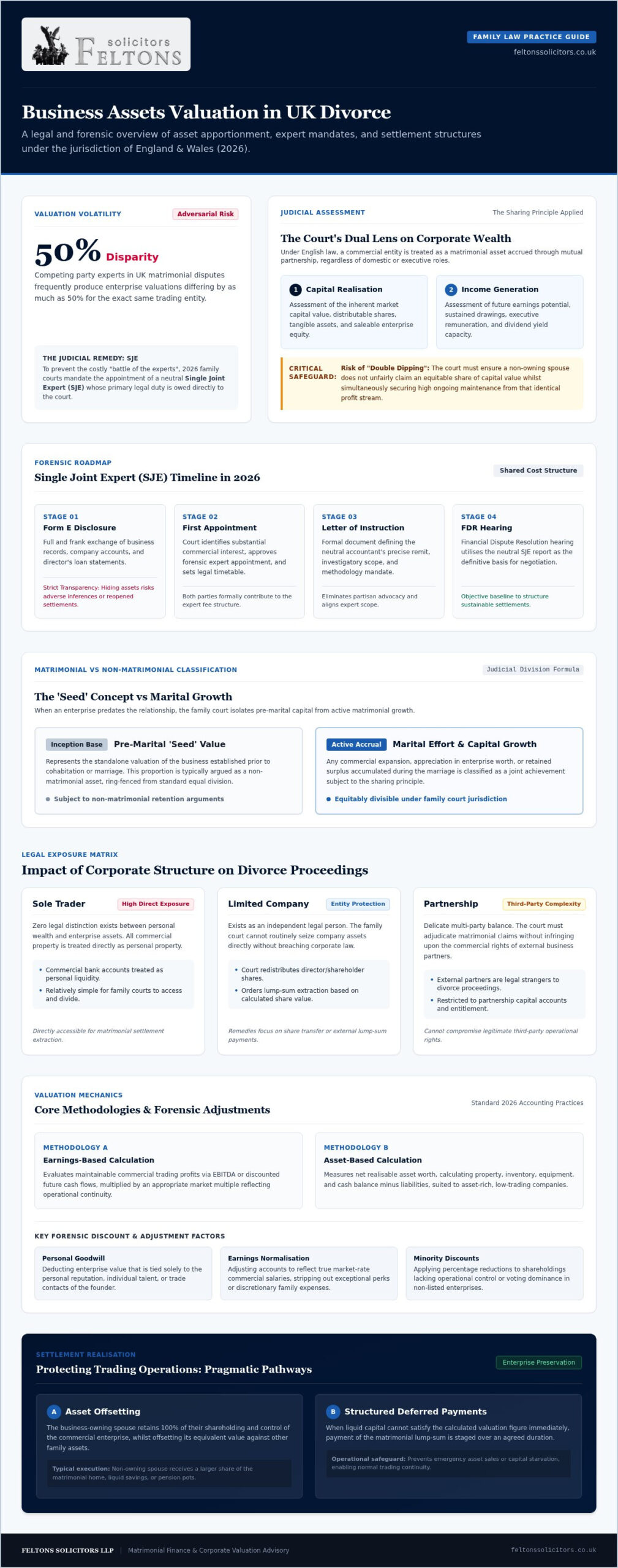
Did you know that competing valuation experts in UK matrimonial cases often produce figures that differ by as much as 50% for the same company? You’ve spent years, perhaps decades, building your enterprise from the ground up, so it’s entirely natural to feel a sense of dread that a legal process might dismantle your life’s work. The prospect of business assets valuation in divorce often brings more questions than answers, particularly when technical terms like “personal goodwill” and “earnings normalisation” enter the conversation.

We understand that you need more than just a spreadsheet; you require a strategy that respects the reality of your operations. This guide provides the clarity you need to protect your commercial interests whilst ensuring a settlement that is both fair and legally robust. We’ll explore the latest 2026 valuation methodologies, the critical role of forensic accountants, and the practical steps you can take to ensure your business continues to trade successfully long after your financial arrangements are finalised.

Key Takeaways

  • Understand why the court classifies your company as a matrimonial asset and how it balances current capital value against future income potential.
  • Navigate the role of the Single Joint Expert to ensure the business assets valuation in divorce is conducted with the forensic precision required for a fair settlement.
  • Compare earnings-based and asset-based methodologies to anticipate which calculation best reflects your firm’s commercial reality and industry standing.
  • Identify critical valuation challenges, such as minority shareholding discounts and the risk of “double dipping” into your income stream.
  • Explore pragmatic settlement options like asset offsetting and structured payments that allow you to protect your business’s continuity whilst meeting your legal obligations.

Why Business Assets Are Central to Divorce Financial Settlements

In England and Wales, the court treats a business as much more than a career; it’s a significant matrimonial asset. Whether you are a majority shareholder or a silent partner, your interest in a company is a tangible piece of the matrimonial pot. The court’s primary objective is to achieve a fair outcome, which often starts with an equal split of assets accrued during the marriage. This is known as the sharing principle. It assumes that both parties contributed equally to the family’s wealth, even if one spouse was the sole driver of the business whilst the other managed the household.

Understanding business valuation principles is vital because the court views your company through two distinct lenses. It sees a capital asset with an inherent market value and a reliable source of future income. This dual nature often complicates the business assets valuation in divorce, as the court must ensure that one spouse doesn’t receive an unfair advantage by claiming both a share of the capital and high maintenance payments based on the same profit stream.

Transparency is the foundation of this process. Every party must provide full and frank financial disclosure via Form E. This document requires you to list all business interests, including recent accounts and director’s loan statements. Attempting to obscure the true value of a company doesn’t just damage trust. It can lead to the court drawing adverse inferences or even reopening settlements years later if they discover assets were hidden.

Matrimonial vs Non-Matrimonial Business Assets

Distinguishing between assets built during the marriage and those established before the wedding is a complex task. If you started your company before you met your spouse, you might argue it’s a non-matrimonial asset. However, if the business grew significantly during your years together, the court often views that active growth as a joint achievement. The ‘seed’ of a business represents its pre-marital inception value, whereas the current valuation reflects the total marital effort and capital growth subject to court division.

The Impact of Business Structure on Divorce

Your company’s legal structure dictates how the court approaches the valuation and eventual settlement. Different entities offer different levels of protection and complexity:

  • Sole traders: There is no legal distinction between your personal finances and your business. The court treats all business assets as your personal property, making them relatively easy to access during a settlement.
  • Limited companies: The business is a separate legal entity. Whilst the court cannot usually seize company assets directly, it can redistribute your shares or order you to pay a lump sum based on their value.
  • Partnerships: These are particularly delicate. The court must balance your spouse’s claims against the legal rights of your business partners, who are considered strangers to the divorce proceedings.

The Process of Valuing a Business: How It Works in 2026

Securing an accurate valuation is rarely a matter of simple arithmetic. In the UK court system, the preferred method for establishing the worth of a company is the appointment of a Single Joint Expert (SJE). This individual is a neutral forensic accountant who owes a primary duty to the court rather than to either spouse. By 2026, the courts have become increasingly strict about the use of SJEs to prevent the “battle of the experts” that previously inflated legal costs and extended litigation timelines. This impartial approach ensures that the business assets valuation in divorce remains grounded in objective data rather than partisan advocacy.

The timeline for this process usually begins after the first exchange of financial disclosure (Form E). Once the court identifies that a business interest exists, it will set a deadline for the expert’s report, typically falling between the First Appointment and the Financial Dispute Resolution (FDR) hearing. Whilst the fees for a high-calibre forensic accountant represent a significant investment, instructing a single expert allows both parties to share the cost. It also provides a stable foundation for negotiations. If you’re concerned about how an expert might interpret your company’s books, seeking expert guidance on divorce and financial arrangements early can help you prepare for the disclosure phase.

Instructing the Single Joint Expert (SJE)

The success of a valuation depends heavily on the “Letter of Instruction.” This document defines the expert’s remit, including which valuation methods they should use and which specific assets they must investigate. Both legal teams must agree on this letter to ensure the expert has full access to the necessary financial records. If you believe the final report contains factual errors or flawed assumptions, your solicitor can submit written questions to the SJE under Part 25 of the Family Procedure Rules. However, successfully challenging an SJE’s conclusion usually requires proving a significant oversight or a departure from established business valuation principles.

Information the Valuer Will Require

A forensic accountant doesn’t just look at a single tax return. They typically require at least three to five years of statutory accounts to identify trends, along with current management accounts and future order books to assess the company’s trajectory. They will also look for “add-backs,” such as personal expenses run through the business, to determine the true maintainable earnings. A mere snapshot of today’s balance sheet is insufficient for a 2026 divorce settlement because it fails to account for the long-term sustainability of the company’s earnings or the impact of shifting market conditions on future cash flow.

Common Methodologies for Business Asset Valuation

Selecting the appropriate methodology is often the most contentious phase of the financial remedy process. In the Family Court of England and Wales, the standard applied is typically “Fair Value” rather than “Open Market Value.” Whilst market value reflects what a third party might pay in a hypothetical sale, fair value accounts for the ongoing benefit the business provides to the owner as a going concern. This distinction is vital; it ensures the valuation reflects the reality of the business’s worth to the family unit, even if there’s no immediate intention to sell.

For most trading companies, an earnings-based approach is the gold standard. This involves calculating the company’s maintainable earnings, often expressed as EBITDA (Earnings Before Interest, Taxes, Depreciation, and Amortisation), and applying a specialised “multiple” based on industry benchmarks. In contrast, for property investment firms or businesses with significant tangible holdings, an asset-based valuation is more appropriate. This focuses on the Net Asset Value (NAV), adjusting the balance sheet to reflect the current market value of all holdings minus liabilities. If you hold a minority stake, the valuer might use a dividend-based approach, focusing on the actual income stream you receive rather than the total value of a company you cannot control.

The complexity of these calculations is why business assets valuation in divorce requires such a methodical approach. It’s not just about the numbers on the page; it’s about how those numbers translate into a sustainable settlement.

Understanding Goodwill: Personal vs Corporate

Goodwill represents the value of a business beyond its tangible assets. However, the court makes a sharp distinction between corporate goodwill, which is tied to the brand and systems, and personal goodwill, which is tied to your individual reputation. If the business cannot function or be sold without your specific skills, that personal goodwill is often excluded from the divisible capital pot. A high level of personal goodwill can significantly lower the final capital valuation, as it suggests the business has limited transferable value to a third party.

Liquidity and the Ability to Pay

A high “paper value” doesn’t always translate to cash in the bank. The court is acutely aware that stripping a business of its working capital to fund a divorce settlement could cripple its future. Valuers will assess the company’s liquidity and its capacity to borrow against its assets to facilitate a buyout. Balancing these competing needs is a core part of our Guide to Divorce and Financial Arrangements, which helps business owners navigate the tension between asset division and commercial survival.

Business Asset Valuation in Divorce: A 2026 Guide

Challenges and Objections in Business Valuations

Even with the appointment of a Single Joint Expert, the path to a final financial order is often blocked by complex legal objections. A report provides a figure, but it doesn’t always provide a solution that feels equitable to both parties. One of the most significant pitfalls in business assets valuation in divorce is the “double dip.” This occurs when a spouse claims a share of the business’s capital value, which is calculated based on future earnings, and then requests spousal maintenance from those same earnings. Courts in 2026 are increasingly vigilant about this, as it effectively forces the business owner to pay out on the same profit stream twice. Successfully navigating this requires a legal team that can distinguish between capitalised income and maintainable dividends.

Beyond the double-dipping trap, the argument of “special contribution” remains a frequent but rarely successful tactic. Unless the business owner can prove they possess a “genius” quality that generated exceptional wealth, the court almost always adheres to the sharing principle. Similarly, the treatment of director’s loan accounts can create friction. If you have borrowed money from your company, that debt is an asset of the business but a liability for you personally. Forensic accountants will scrutinise these accounts to ensure they aren’t being used to artificially deflate the value of the matrimonial pot.

The Minority Shareholder Discount

A common point of confusion is why a 10% shareholding isn’t simply worth 10% of the company’s total value. In the world of private companies, a minority stake lacks “control” and “marketability,” meaning the shareholder cannot force a sale or dictate dividend policy. Forensic accountants often apply a discount, which can range from 25% to over 50% depending on the level of influence the shares provide. However, an exception often exists for “quasi-partnerships.” These are small companies that function like partnerships despite their corporate structure, where the court may decide that no discount should be applied because the parties always intended to share equally.

Addressing Allegations of Financial Non-Disclosure

Attempting to hide assets or run personal “lifestyle” expenses through the company books is a high-risk strategy that usually backfires. Forensic accountants are trained to spot anomalies, such as family holidays or school fees categorised as business expenses, and they will “add back” these sums to the company’s profit. If the court finds that you have been less than transparent, it has the power to draw “adverse inferences.” This means the judge can assume your business is worth significantly more than you claim. To ensure your disclosure is handled with the necessary precision and discretion, you should instruct a specialist solicitor for your financial arrangements at the earliest opportunity.

Protecting Your Business and Negotiating the Settlement

Once the business assets valuation in divorce is finalised, the focus shifts from calculation to implementation. The court generally follows the “Golden Egg” principle. It prefers not to kill the goose that lays the golden eggs. If a business provides the income necessary to support both parties and their children, judges are often reluctant to order a sale that would destroy that income stream. Instead, they look for creative ways to satisfy the non-owning spouse’s claims whilst ensuring the company remains a viable trading entity.

One of the most effective tools is offsetting. This involves the business owner “trading” their share of other matrimonial assets, such as the family home or liquid savings, in exchange for retaining full ownership of the company. If there isn’t enough equity elsewhere to achieve a clean break, a structured settlement may be negotiated. This allows for a lump sum to be paid in instalments over several years, protecting the company’s cash flow whilst providing the other spouse with their fair share over time. These arrangements require careful drafting to ensure they are legally binding and enforceable.

Alternatives to Selling the Business

Pension offsetting is another sophisticated route, where one party keeps their pension intact whilst the other retains the business interests. Whilst transferring shares to a spouse is technically possible, it’s often fraught with commercial risk. Becoming “accidental” business partners after a divorce can lead to operational deadlock and further litigation. For future protection, a well-drafted shareholders’ agreement or a pre-nuptial agreement can define exactly how a business should be valued and divided. This forward-thinking approach is a key part of A Complete Guide to Estate Planning, which ensures your commercial legacy remains secure.

Why Expert Legal Representation is Essential

Feltons Solicitors LLP acts as your sophisticated guide through these high-stakes negotiations. We provide the calm, steady presence needed when personal emotions collide with complex commercial interests. Our team prioritises a people-first philosophy, ensuring that whilst the technical aspects of the business assets valuation in divorce are precise, the human impact of the settlement is never forgotten.

To begin the process with professional support, your next step should be a discreet consultation to review your business structure and disclosure requirements. We’ll help you navigate the complexities of asset protection with the quiet confidence that comes from years of expertise in complex financial litigation. Protecting what you’ve built requires more than just a lawyer; it requires a partner who values your privacy and understands the nuances of your industry.

Securing Your Commercial Legacy

The complexities of business assets valuation in divorce require a balance of forensic accuracy and strategic foresight. Navigating the transition from identifying matrimonial assets to finalising a settlement involves understanding the nuances of the Single Joint Expert process and the “Golden Egg” principle. By prioritising transparency and selecting the correct valuation methodology, you can ensure your company remains a viable entity whilst meeting your legal obligations. This approach protects your life’s work from unnecessary disruption and provides a stable foundation for the future.

Feltons Solicitors provides a boutique level of care combined with national expertise in complex financial arrangements. Our specialists offer the discreet and professional legal guidance necessary to resolve high-stakes disputes with quiet confidence. We act as your sophisticated guide through every stage of the negotiation, ensuring the human impact of our work is never forgotten. Secure your business’s future with Feltons Solicitors and move forward with a resolution that respects your commercial achievements. You don’t have to navigate these complexities alone; your interests are in capable hands.

Frequently Asked Questions

Will I have to sell my business to pay my ex-spouse in a divorce?

It is rare for a court to order the sale of a business if it provides the primary income for the family. Judges prefer to keep the “golden egg” intact to ensure ongoing maintenance and financial stability. Instead, you might offset the business value against other assets like the family home or arrange a structured payout over several years. This allows the business to continue trading whilst satisfying the legal requirements of the settlement.

How long does a forensic valuation of a business usually take?

A forensic valuation typically takes between four and twelve weeks to complete once the expert has all the necessary data. This timeline depends on the complexity of your company structure and the speed at which you provide financial records. Delays often occur if there are gaps in the statutory or management accounts. It is vital to start this process early in the financial remedy proceedings to avoid pushing back your court dates.

What happens if my business is currently making a loss?

A loss-making business still has a value for divorce purposes, though it may be calculated differently. If the company is not profitable, the valuer might use an asset-based approach, focusing on the Net Asset Value (NAV) of its equipment, property, or stock. In some cases, a business might have “hope value” if it possesses unique intellectual property or a market position that suggests a return to profitability in the near future.

Can I use my own accountant to value the business for the court?

The court usually requires a Single Joint Expert (SJE) to ensure an impartial valuation that both parties can trust. Whilst your own accountant understands your books, they are not considered independent by the court. However, working with an established firm of chartered accountants like Stewart Accounting Services can help you prepare your disclosure and review the SJE’s findings. Ultimately, the formal business assets valuation in divorce must be conducted by a neutral forensic specialist appointed under a joint letter of instruction.

Is the value of my business based on what I started with or what it is worth now?

The court considers the current value of the business, but it also looks at what the business was worth at the date of marriage. Any growth that occurred during the years you were together is typically seen as a matrimonial asset. If the business was established long before the wedding, you may be able to argue that the initial “seed” value should be excluded from the pot, though this depends on the length of the marriage.

How much does a forensic business valuation cost in 2026?

Fees for a forensic accountant vary significantly based on the size and complexity of the enterprise. For a standard small-to-medium enterprise, costs generally start in the thousands and are typically shared between both parties as a joint disbursement. More complex cases involving international assets or multiple subsidiaries will naturally attract higher fees. You should discuss these costs with your solicitor early on to ensure they are proportionate to the overall value of the matrimonial estate.

What is ‘double dipping’ and how can it be avoided in my settlement?

Double dipping is a common error where the same income stream is used twice in a settlement. This happens when a business is valued based on its future earnings to create a capital lump sum, and those same earnings are then used to calculate spousal maintenance. To avoid this, your legal team must ensure that the valuation and the maintenance calculations are adjusted so the business owner isn’t paying out on the same profit twice.

Can my spouse claim a share of a business I inherited?

Inherited businesses are often viewed as non-matrimonial assets, but they aren’t automatically protected. If the business was used to fund the family’s lifestyle or if your spouse’s financial needs cannot be met by other assets, the court may choose to include it in the settlement. The longer the marriage and the more the business was integrated into your joint finances, the more likely it is that your spouse will have a valid claim.