
Dispute Resolution Solicitors: A Comprehensive Guide to Resolving Legal Conflicts in 2026

Dispute Resolution Solicitors: A Comprehensive Guide to Resolving Legal Conflicts in 2026

The most successful legal outcome isn’t the one won in a courtroom; it’s the one that never reaches it. When a conflict arises, whether it’s a commercial disagreement or a sensitive private matter, the immediate instinct is often one of dread. You’re likely worried about escalating legal fees, the exhausting stress of formal proceedings, and the uncertainty of where you’ll stand when the dust settles. It’s a heavy burden to carry. Engaging experienced dispute resolution solicitors is the first step toward reclaiming control and finding a path forward that prioritises your interests over unnecessary litigation.

We understand that you’re seeking a way to resolve your situation with as little friction as possible. This guide provides a clear understanding of the UK dispute resolution process in 2026, showing you how to protect your legal position whilst avoiding the drain of a protracted court battle. We’ll explore the latest updates to the Civil Procedure Rules and the strategic use of alternative methods to help you reach a swift, cost-effective resolution. By the end, you’ll have the clarity needed to make informed decisions and ensure minimal disruption to your life or business.

Key Takeaways

  • Understand why prioritising interests over ego is the key to avoiding unnecessary court battles and achieving a swifter resolution.
  • Discover the distinct advantages of Alternative Dispute Resolution (ADR) pathways compared to the formal litigation process.
  • Learn how to recognise the critical point when instructing dispute resolution solicitors becomes essential to protect your legal and financial position.
  • Gain a clear overview of Pre-Action Protocols and strategic cost management to ensure your case remains focused and efficient.
  • Explore the benefits of a discreet, partner-led approach for navigating complex legal conflicts with poise and professional integrity.

What is Dispute Resolution and Why Does it Matter?

At its heart, dispute resolution is the structured process of resolving a legal disagreement between two or more parties. It’s a field that encompasses everything from informal negotiations to high-stakes international arbitration. For most, the term “legal conflict” evokes images of a crowded courtroom and a judge’s gavel. However, in the modern legal environment, the courtroom is often the last place any party wants to be. Avoiding court has become the primary objective for both individuals and businesses, as they seek to preserve resources and maintain control over the outcome.

Experienced dispute resolution solicitors act as much more than just litigators. They are negotiators, tacticians, and calm voices in the middle of a storm. They look beyond the immediate legal technicalities to understand the human and commercial realities behind a conflict. This is why early intervention is so critical. A minor disagreement over a contract or a boundary can quickly spiral into a ruinous battle if left unchecked. By instructing dispute resolution solicitors at the outset, you can often de-escalate the situation before positions become entrenched and costs become prohibitive.

The Core Objectives of Modern Conflict Resolution

When we approach a dispute, the focus remains on achieving a resolution that serves your broader life or business goals. Protecting commercial interests and personal reputations is paramount. A public court battle can cause lasting damage that a private settlement avoids. We also aim to minimise the financial impact. Legal fees and potential damages can be substantial; our role is to find the most cost-effective path whilst ensuring your legal position is robust. Finally, we seek finality. A clear, binding agreement allows all parties to move forward without the shadow of ongoing litigation hanging over them.

Civil Procedure Rules and the Duty to Settle

The UK legal system has undergone significant shifts, and by 2026, the emphasis on cooperation is stronger than ever. The Civil Procedure Rules (CPR) explicitly expect parties to attempt to resolve their issues before a trial. This isn’t just a suggestion; it’s a formal duty. The courts now have robust powers to penalise parties who unreasonably refuse to engage in settlement discussions or Alternative Dispute Resolution (ADR). If you ignore an invitation to mediate without a valid reason, you may find yourself facing severe cost sanctions, even if you eventually win your case. The 2026 framework prioritises efficiency, ensuring that the court’s limited resources are reserved only for those disputes that truly cannot be resolved through dialogue.

Exploring the Pathways: ADR vs Litigation

Selecting the most appropriate route for your conflict is a pivotal decision. It’s not merely a choice between court and no court; it’s about matching the process to your desired outcome. Alternative Dispute Resolution (ADR) serves as a broad umbrella for various methods designed to settle disagreements outside the traditional judicial system. In contrast, litigation is the formal, adversarial process where a judge decides the case. While the court system remains the backbone of Civil justice in England and Wales, ADR offers a level of flexibility that courtrooms simply cannot match. It allows parties to set their own pace, choose their adjudicators, and keep proceedings entirely private.

The choice of pathway depends heavily on the nature of the dispute and the parties involved. Some conflicts require the rigid, predictable structure of a court schedule to ensure progress. Others benefit from the creative, interest-based solutions that only ADR can provide. Experienced dispute resolution solicitors assess these variables at the outset to recommend a strategy that balances speed, cost, and the likelihood of a favourable result.

Common ADR Methods: Mediation, Arbitration, and Negotiation

Mediation is perhaps the most recognisable form of ADR. Here, a neutral third party helps both sides find common ground. It’s a voluntary process, and the mediator doesn’t impose a decision; they facilitate a conversation. Arbitration, however, is more structured. It involves a private judge who delivers a binding decision, often used in complex commercial contracts where privacy is essential. Expert Determination is a refined tool for technical or financial disputes. In this scenario, a specialist in a specific field, such as a surveyor or accountant, provides a final ruling on a narrow, technical issue.

When Litigation Becomes Necessary

Despite the myriad benefits of ADR, litigation remains an essential tool in any legal arsenal. Sometimes, you need the weight of a court order to protect your position immediately. If a party is hiding assets or refusing to stop a damaging behaviour, an injunction may be the only viable solution. Litigation is also necessary when the other side refuses to engage in good faith or ignores invitations to settle. In these instances, top commercial litigation firms UK provide the robust representation needed to advance your position through the courts. Our role as dispute resolution solicitors is to ensure that if court becomes unavoidable, your case is prepared with meticulous detail. If you are facing a deadlock, reaching out for a professional assessment of your options at Feltons Solicitors is a sensible first step toward resolution.

Identifying When to Instruct Dispute Resolution Solicitors

Determining the exact moment to involve legal counsel is a strategic decision that can alter the entire trajectory of a conflict. Often, parties wait until a formal claim arrives or a relationship has completely fractured before seeking help. However, the “point of no return” usually occurs much earlier, typically when direct dialogue ceases to be productive and positions begin to entrench. Recognising this shift allows you to engage dispute resolution solicitors before a manageable disagreement evolves into a costly, high-stakes battle. Early instruction provides the opportunity to set the tone of the interaction, ensuring your rights are asserted with clarity and poise from the outset.

Attempting to resolve complex legal issues without professional guidance carries significant risks. In the current legal environment, procedural missteps can be difficult to rectify. Missing a specific deadline in a Pre-Action Protocol or failing to disclose a relevant document can weaken your position before you even reach a mediator’s table. Beyond the technicalities, dispute resolution solicitors provide a vital layer of objectivity. Conflict is inherently emotional; it clouds judgment and often leads to decisions based on frustration rather than logic. A solicitor acts as a steady, rational guide, removing emotional bias to focus on the most pragmatic and beneficial outcome. This specialist perspective is particularly vital for sensitive family matters, such as when you require the expertise of contentious probate solicitors to navigate estate disagreements with discreet authority.

Complexity and High-Value Disagreements

When the financial or legal risks are substantial, the margin for error disappears. High-value disputes often involve intricate contractual layers or multi-jurisdictional elements that require a sophisticated understanding of international law. For these matters, the personalised care of a boutique firm is invaluable. Unlike high-volume practices, a boutique firm provides a tailored, high-standard service where your matter receives the concentrated attention of experienced partners. This ensures that every detail of a complex claim is scrutinised, protecting you from unforeseen liabilities that could arise in large-scale litigation.

Protecting Assets and Reputation

Maintaining privacy is often as important as the financial settlement itself. One of the most significant advantages of early legal involvement is the protection of legal professional privilege, which ensures that sensitive discussions remain confidential. This is essential for preventing private details from entering the public court record, where they could damage a personal brand or a corporate reputation. Whether you are dealing with a business breach or need a divorce and financial arrangements lawyer to secure your future, the goal is to resolve the matter quietly and efficiently, allowing you to move forward with your reputation intact.

Dispute Resolution Solicitors: A Comprehensive Guide to Resolving Legal Conflicts in 2026

Strategy and Costs: Navigating the Process whilst Protecting Your Interests

A successful resolution begins with a defined roadmap. Without a clear strategy from the outset, legal matters often suffer from “mission creep,” where the scope of the disagreement expands and costs spiral out of control. Your dispute resolution solicitors should work with you to identify core objectives early on. This involves a rigorous risk assessment to weigh the potential costs of legal representation against the value of the claim. If the legal fees are likely to eclipse the eventual settlement, a different, more conciliatory approach is required. Efficiency is the hallmark of a sophisticated legal partner.

Understanding Pre-Action Protocols is a fundamental part of this strategy. These are the mandatory steps you must take before issuing a formal claim in the UK courts. They’re designed to encourage the exchange of information and facilitate settlement without the need for litigation. In 2026, the courts expect strict adherence to these protocols. Failing to follow them leads to significant cost penalties, even if your underlying legal argument is sound. You must also organise your evidence meticulously. Well-ordered documentation, from emails to contracts, allows your legal team to build a robust case quickly, reducing the billable hours required to sort through chaotic records.

Funding Options and Cost Management

Managing the financial aspect of a dispute requires transparency and planning. Most dispute resolution solicitors offer a range of fee structures to suit different needs. Hourly rates are standard for complex, unpredictable matters, whilst fixed fees may be available for specific stages of a case. In certain circumstances, conditional fee agreements might be appropriate. You should also check your existing insurance policies; many business and home insurance products include legal expenses insurance that covers a significant portion of your costs. Budgeting for the long term whilst seeking a swift resolution ensures you don’t feel forced to settle prematurely due to financial pressure.

The Importance of Pragmatic Advice

Adopting a “win at all costs” mentality is often the most expensive strategy a party can pursue. It leads to entrenched positions and protracted battles that benefit no one. Pragmatic advice focuses on finding a middle ground that satisfies your core objectives without the unnecessary drain of a trial. In the context of UK law in 2026, pragmatic advice is the application of legal expertise to achieve a commercially or personally viable result that prioritises the client’s long-term stability over a symbolic courtroom victory. If you’re looking for a strategy that protects your capital and your peace of mind, consider instructing Feltons Solicitors to handle your matter with discreet authority.

Professional Support for Complex Disputes

Feltons Solicitors LLP stands as a calm, steady presence for those facing the intricate complexities of modern litigation. We combine the efficiency of modern delivery with the traditional professional integrity that has defined the legal sector for generations. Our dispute resolution solicitors understand that every conflict is unique, requiring a bespoke strategy rather than a one-size-fits-all approach. By prioritising a “people-first” philosophy, we ensure that the human impact of legal work is never overlooked. Whether we are handling a domestic boundary disagreement or a multi-jurisdictional commercial claim, our focus remains on providing a sophisticated guide through complex legal waters.

Our boutique structure allows for a dedicated, partner-led approach, fostering a level of personal rapport and trust that larger, high-volume firms often struggle to maintain. You won’t be passed between junior associates; instead, you’ll benefit from the direct expertise of senior practitioners who have been resolving complex matters since Feltons was established in 2010. This ensures that your case is handled with discreet authority and the worldly experience necessary to manage international-scale disputes with poise. We believe that high-end reliability shouldn’t come at the cost of accessibility.

Tailored Solutions for Individuals and Businesses

We adapt our methodology to the specific emotional or commercial needs of the client. For a business, this might mean a focus on technical legal precision and market reputation. For an individual, it often involves providing an empathetic, reassuring presence amongst the stress of personal conflict. We strive to make even the most complex litigation accessible and understandable, stripping away unnecessary legalese to provide clear, actionable guidance. This methodical flow is designed to help you feel supported and in capable hands throughout the entire process.

A Discreet Partner for Your Legal Journey

Privacy is a cornerstone of our service. In high-stakes resolution, the value of keeping sensitive information out of the public domain cannot be overstated. Professional dispute resolution isn’t just about winning a case; it’s an investment in your future security and peace of mind. To begin assessing your situation with a trusted advisor, you can contact Feltons Solicitors LLP for a confidential discussion. Taking this step allows us to review your options and develop a pragmatic path forward that protects your interests whilst minimising disruption to your life or business.

Securing Your Future Through Strategic Resolution

Navigating a legal conflict requires more than just a firm grasp of the law; it demands a clear strategy that prioritises your long-term stability over the exhaustion of a courtroom battle. By understanding the pathways of Alternative Dispute Resolution and the importance of early, pragmatic intervention, you can protect your assets and your reputation whilst avoiding unnecessary costs. The transition from conflict to resolution is often found in the middle ground, where professional guidance removes emotional bias and focuses on a commercially or personally viable path forward.

Since being established in 2010, Feltons Solicitors LLP has acted as a sophisticated guide for clients facing complex national and international litigation. Our boutique approach ensures you receive partner-led expertise and a personal level of care that high-volume firms simply cannot match. If you are ready to move past a disagreement with confidence and poise, you can instruct Feltons Solicitors LLP for expert dispute resolution support. Choosing the right dispute resolution solicitors is a vital investment in your future security, allowing you to focus on what matters most whilst we handle the complexities of your case with discreet authority. You don’t have to face these challenges alone.

Frequently Asked Questions

How long does the dispute resolution process typically take in the UK?

The duration of a dispute depends heavily on the chosen method and the complexity of the issues involved. Whilst mediation can often be concluded in a single day, formal litigation in the UK courts may take anywhere from 12 to 18 months to reach a final hearing. Adhering to Pre-Action Protocols is essential, as these structured steps are designed to encourage early settlement and reduce the overall timeframe.

Do I have to go to court if I hire a dispute resolution solicitor?

Hiring dispute resolution solicitors does not mean you will end up in court; in fact, the opposite is often true. The vast majority of legal conflicts are resolved through negotiation or Alternative Dispute Resolution (ADR) before they ever reach a judge. A solicitor’s primary role is to act as a strategist and negotiator, finding the most efficient way to settle the matter whilst protecting your legal position.

What is the difference between mediation and arbitration?

The fundamental difference lies in who makes the final decision. In mediation, a neutral third party helps the disputing parties reach their own mutually agreeable solution. In arbitration, the parties appoint a private judge, known as an arbitrator, who hears the evidence and makes a binding decision that both sides must follow. Mediation is facilitative and voluntary, whilst arbitration is adjudicative and formal.

How much will it cost to resolve my legal dispute?

The total cost is determined by the complexity of the dispute and the time required to reach a resolution. Most firms offer varied fee structures, including hourly rates for ongoing matters or fixed fees for specific stages of a case. It is important to conduct a cost-benefit analysis early on to ensure that the pursuit of a claim remains commercially viable relative to the potential settlement value.

Can I resolve a dispute myself without a solicitor?

Whilst you can represent yourself in straightforward small claims, instructing dispute resolution solicitors is highly recommended for complex or high-value matters. The UK legal system involves strict procedural rules and Pre-Action Protocols that can be difficult for a layperson to navigate. A professional ensures that your evidence is presented effectively and that you don’t inadvertently weaken your position through procedural errors or missed deadlines.

What happens if the other party refuses to negotiate or use ADR?

If the other party refuses to engage in good faith, you may be left with no choice but to initiate formal litigation. However, the UK courts take a dim view of parties who unreasonably refuse to attempt ADR. Under the Civil Procedure Rules, a judge has the power to impose significant cost sanctions on a party who has blocked settlement discussions, even if that party eventually wins the case.

Is a settlement reached in mediation legally binding?

A settlement reached during a mediation session is not automatically binding until it is formalised in writing. Once the parties have agreed on the terms, a “Settlement Agreement” is drafted and signed by all involved. At this point, the document becomes a legally binding contract that can be enforced through the courts if one side fails to uphold their obligations or attempts to reopen the dispute.

What should I bring to my first meeting with a dispute resolution solicitor?

To make the most of your initial consultation, you should prepare a clear chronology of events and gather all relevant documentation. This includes signed contracts, key emails, and any formal letters of claim you have received. Bringing these materials allows your solicitor to assess the strength of your position quickly and provide pragmatic advice on the best route forward, ensuring your time is used efficiently.

Stone Masonry Silicosis Claims: A Guide to Seeking Legal Redress in 2026

Stone Masonry Silicosis Claims: A Guide to Seeking Legal Redress in 2026

In May 2026, a jury awarded $17.45 million to a stone worker diagnosed with silicosis, a landmark figure that highlights the shifting legal landscape for stone masonry silicosis claims. If you’re a mason or fabricator facing a similar diagnosis, you’re likely grappling with the fear of financial instability and the overwhelming complexity of medical evidence. It’s a heavy burden to carry, especially when you’re focused on your health and your family’s wellbeing.

We understand that seeking legal redress feels daunting, particularly when questioning if a former employer is still liable for your condition. This specialist guide is designed to help you navigate the process of securing compensation with confidence. You’ll gain a clear understanding of how to obtain essential funds for private medical treatment and loss of earnings. We’ll examine the 2026 regulatory updates, the process of gathering robust evidence, and the steps required to hold negligent employers accountable through a tailored, professional approach.

Key Takeaways

  • Understand the specific legal obligations employers have under COSHH regulations to protect stone masons from hazardous respirable crystalline silica.
  • Learn how to distinguish between high-volume “claims factories” and boutique firms that provide the partner-led, discreet attention your case deserves.
  • Navigate the procedural journey of stone masonry silicosis claims, including how to secure the specialist medical evidence required for a successful outcome.
  • Discover the pathways to securing vital compensation for private medical treatment and loss of earnings to protect your family’s financial future.
  • Gain insights into why a bespoke legal strategy is essential for addressing the modern risks associated with engineered stone and high-silica materials.

Understanding Stone Masonry Silicosis in the Modern Industry

Silicosis is a devastating, irreversible, and entirely preventable occupational lung disease. It occurs when respirable crystalline silica particles are inhaled, causing deep-seated damage to the lungs. For decades, the condition was largely associated with traditional quarrying. Today, however, stone masons and fabricators represent the primary group at risk. To understand the clinical background of this condition, one might ask, What is Silicosis? Essentially, it is a condition where the body’s natural defences are overwhelmed by microscopic dust, leading to permanent respiratory impairment.

As we move through 2026, the legal landscape is shifting. We’re witnessing a sharp rise in stone masonry silicosis claims linked specifically to modern engineered materials. While natural granite contains roughly 30% silica, engineered stone often contains upwards of 90%. This concentration makes the dust significantly more hazardous. Recent regulatory shifts, such as stricter exposure limits and bans on dry-cutting practices, reflect a growing national awareness of this industrial health crisis. For many masons, the danger was hidden in plain sight for years.

The Rise of Engineered Stone and Quartz Claims

The popularity of quartz worktops has fundamentally changed the risk profile for workshop masons and kitchen fitters. In many environments, workers were encouraged to use dry-cutting techniques to speed up production or installation. This created clouds of highly concentrated silica dust. Unlike natural stone, the synthetic resins in engineered products can alter how the dust behaves when inhaled, often leading to more rapid disease progression. This has triggered a surge in litigation against manufacturers and employers who failed to implement adequate dust suppression or provide suitable respiratory protective equipment (RPE).

Recognising the Signs of Occupational Exposure

One of the most distressing aspects of this condition is the latency period. Symptoms can take years or even decades to manifest. This means you might only feel the effects long after you’ve left the trade. You should be vigilant for specific indicators of lung damage:

  • A persistent, dry cough that does not clear.
  • Shortness of breath, even during light activities.
  • Unexplained fatigue and recurring chest pain.

Fibrosis is the permanent scarring and thickening of lung tissue caused by the inflammatory response to trapped crystalline silica particles. Because the damage is cumulative, historical exposure often forms the basis of successful stone masonry silicosis claims. If you worked in a workshop without proper ventilation or water-fed tools, your health may have been compromised. This remains true regardless of how many years have passed since you were last on the tools.

The legal foundation for stone masonry silicosis claims rests upon the clear statutory duties of the employer. Under the Health and Safety at Work etc. Act 1974, every employer has a non-delegable responsibility to ensure the health and safety of their workforce. This isn’t a mere suggestion; it’s a strict legal obligation. Regarding respirable crystalline silica, the Control of Substances Hazardous to Health (COSHH) Regulations provide a specific framework for protection that employers must follow to the letter.

Employers are required to implement a hierarchy of control to manage risks. This typically involves engineering controls such as Local Exhaust Ventilation (LEV) and wet-cutting methods to suppress dust at the source. If these measures are insufficient, the employer must provide high-standard respiratory protective equipment (RPE) that’s properly maintained and face-fit tested. Many workers were told that “dust is just part of the trade,” but this is a dangerous misconception. The law has long established employer responsibilities for silica exposure as a critical safety priority. If your workshop was thick with white dust, it’s likely a breach of duty occurred.

Breach of Duty in the Stone Workshop

Proving negligence often involves identifying specific failures in the working environment. We look for evidence that dry-cutting was permitted without adequate water suppression or that LEV systems were poorly maintained. Employers are also legally bound to conduct regular risk assessments and provide health surveillance for those at risk. If your employer didn’t offer regular lung function tests or X-rays, they’ve failed in their duty of care. These surveillance records, or the lack thereof, become vital components in building a robust case for compensation.

Claiming Against Former or Defunct Employers

Many masons worry that because their former employer has ceased trading, they’ve lost their right to seek redress. This isn’t the case. Most stone masonry silicosis claims are made against the employer’s liability insurance policy that was active at the time of your exposure. We specialise in tracing these insurers, even for companies that disappeared decades ago. It’s also vital to stay mindful of the silicosis claim time limits uk to ensure your right to compensation is protected. If you’re unsure about your former employer’s status, our team can provide a discreet preliminary assessment of your work history to identify potential avenues for a claim.

Choosing the Right Solicitor: Boutique vs. High-Volume Firms

When you’re facing a life-altering diagnosis, the most common concern is whether you’ll receive genuine personal attention or simply be passed to a call centre. Many high-volume “claims factories” operate on a model of high turnover and low-touch interaction. In these environments, your case might be managed by junior staff who lack the specific technical knowledge required for stone masonry silicosis claims. This approach can lead to missed details in your work history or an undervalued settlement that doesn’t account for your long-term care needs.

At Feltons, we provide a boutique alternative where partner-led expertise is the standard. We believe that complex litigation requires a bespoke strategy rather than a standardised template. This means you’ll have a direct line to a senior solicitor who understands the intricacies of the stone masonry industry. We prioritise personal rapport and discreet, high-standard service, ensuring you feel supported throughout what is often a stressful and emotional journey.

The Value of Specialist Silicosis Expertise

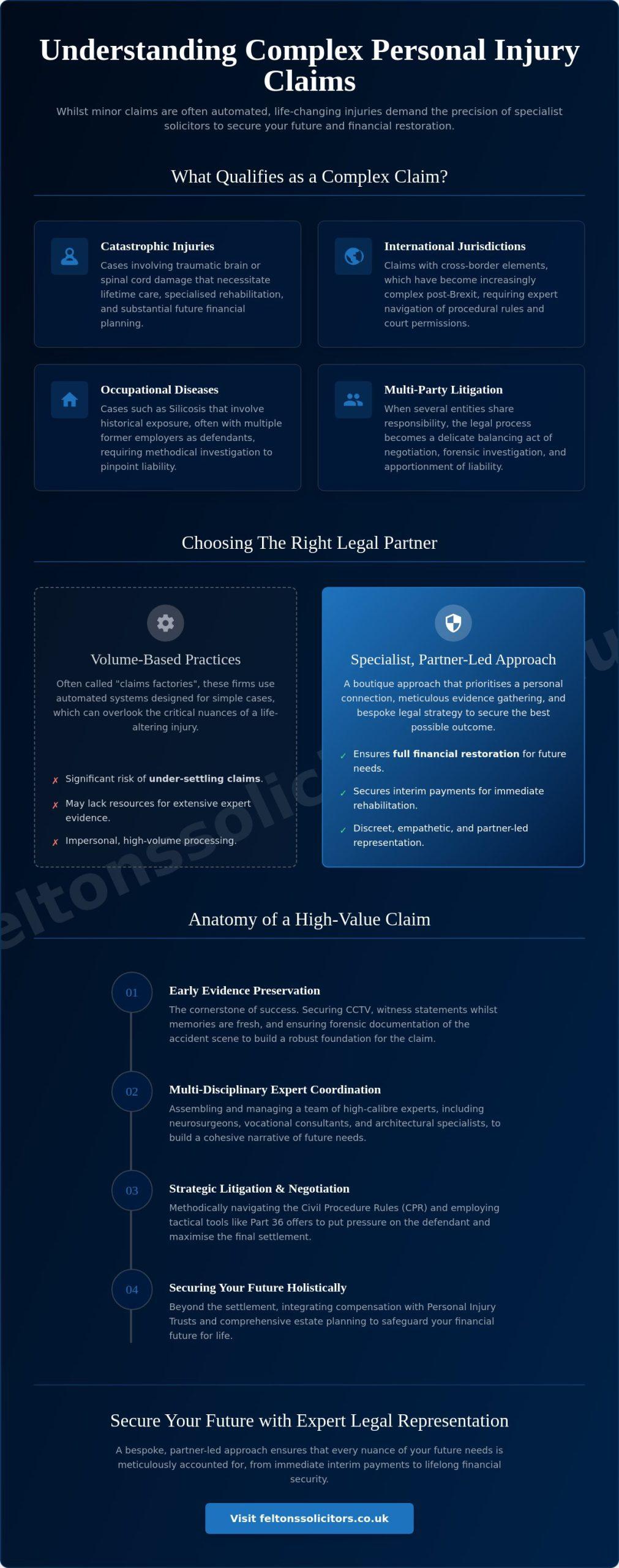
Industrial disease litigation is fundamentally different from general personal injury work. It requires a deep understanding of how microscopic dust interacts with human biology and the specific ways employers often fail to meet safety standards. The health risks of crystalline silica are severe, often involving progressive lung damage that requires expert quantification. We collaborate with leading independent medical consultants to precisely measure your loss of lung capacity and future medical requirements. As complex personal injury claims solicitors, we possess the worldly experience necessary to handle high-value matters whilst maintaining a human, accessible touch.

Evaluating Fee Structures: No Win No Fee

We understand that financial instability is a major worry when you’re unable to work. To remove the barrier to justice, we typically operate on a No Win No Fee basis, formally known as a Conditional Fee Agreement (CFA). This means that if your claim isn’t successful, you don’t pay our legal fees. It’s a simple, transparent arrangement designed to share the risk and provide you with peace of mind. We’re committed to financial clarity from the very first consultation. You’ll receive a detailed explanation of any “success fees” or costs that may be deducted from your final award, ensuring there are no hidden surprises at the end of the process. This methodical approach reflects our commitment to professional integrity and your financial security.

Stone Masonry Silicosis Claims: A Guide to Seeking Legal Redress in 2026

The Claims Process: From Diagnosis to Compensation

Securing justice for an occupational illness requires a steady, methodical approach. We begin with a discreet initial consultation to perform a merit assessment of your work history. This involves identifying specific periods of exposure and the employers involved. Once we establish a viable path forward, we move to gathering comprehensive medical evidence. This isn’t just a GP note; it involves reports from independent consultants who specialise in occupational lung disease to quantify the exact extent of your condition. This structured approach ensures we’re following the correct silicosis litigation process uk from the outset.

The next phase involves tracing the relevant employer liability insurance policies. This is a critical step, especially for stone masonry silicosis claims where companies may have changed names or ceased trading years ago. After tracing, we issue a formal Letter of Claim. This document outlines the allegations of negligence and the statutory breaches identified. The final stage is negotiation. Whilst many cases settle out of court, we possess the worldly experience to proceed to litigation if an insurer refuses to acknowledge the reality of your exposure or the severity of your diagnosis.

Building a Robust Evidence Portfolio

Success depends on the quality of the evidence we assemble. We require your HMRC employment history to verify exactly where and when you worked. Medical records provide the clinical timeline, but witness statements from former colleagues often prove the daily reality of a dusty workshop. In complex cases, we may instruct occupational hygienists. These experts reconstruct historical workshop conditions to prove that ventilation was inadequate or that safety protocols were ignored. If you’re ready to begin this process, you can speak with a specialist partner for a confidential review of your evidence.

What Can You Claim For?

Compensation is divided into two primary categories. General damages cover your pain, suffering, and the loss of amenity caused by the disease. This acknowledges the human impact on your quality of life. Special damages address the financial consequences. This includes lost earnings from the past and projected losses for the future, along with the costs of private medical treatment, specialist equipment, and home care. We also consider “Smith v Manchester” awards. This specific type of compensation accounts for the “handicap on the labour market” faced by workers who can no longer compete for jobs on an equal footing due to their respiratory health. We ensure every facet of your financial future is protected.

Feltons Solicitors: Your Trusted Partner in Silicosis Litigation

Feltons Solicitors provides a calm, steady presence for those facing the life-altering impact of occupational lung disease. We don’t operate as a high-volume processing centre. Instead, we offer a boutique service where every client receives personal partner attention. This ensures that the technical legal work remains paramount whilst never forgetting the human impact of the situation. We provide national coverage, supporting stone masons and their families across the United Kingdom with pragmatic, discreet advice tailored to their specific circumstances.

When handling stone masonry silicosis claims, we position ourselves as your sophisticated guide. You’ll never be passed to a junior paralegal or a call centre operative. Our specialists possess the worldly experience necessary to manage complex, high-value litigation with professional integrity. We handle the intricate details of your case, from tracing historical insurance policies to gathering expert medical testimony. This methodical approach allows you to focus on your health and your family’s wellbeing whilst we secure the funds necessary for your future care.

Support for Families and Bereaved Dependants

It’s a painful reality that some workers only receive a diagnosis in the advanced stages of the disease, or a family may seek help after a loved one has passed. We provide empathetic support for bereaved dependants, helping them secure the financial stability their loved one would have provided. This process often includes pursuing Statutory Bereavement Awards and dependency claims for lost income and domestic services. If you find yourself in this difficult position, you can learn more about the process of making a silicosis claim after death through our specialist guide. We handle these matters with the utmost discretion and respect for your privacy.

Next Steps: Securing Your Future

The first step towards securing legal redress is a confidential, professional consultation. It’s vital to act promptly. In the UK, a three-year limitation period typically applies, starting from the date you first became aware that your respiratory condition was linked to your work history. Waiting too long can jeopardise your right to seek compensation. We handle the entire burden of the litigation process, acting as a trusted advisor from the initial assessment through to the final settlement. Our people-first philosophy ensures that your personal rapport with your solicitor is valued throughout. Starting the process is straightforward; a confidential phone call to our specialist team will provide you with a clear, methodical assessment of your potential for a claim.

Securing Your Health and Financial Legacy in 2026

We’ve explored the critical importance of holding employers accountable for safety breaches and the necessity of gathering precise medical evidence to support your recovery. Successfully managing stone masonry silicosis claims requires more than just general legal knowledge; it demands a partner who understands the specific risks of engineered stone and the nuances of industrial disease litigation. By prioritising partner-led expertise over high-volume processing, you ensure your case receives the meticulous attention it deserves.

Feltons Solicitors provides specialist silicosis litigation expertise with a focus on boutique, partner-led service. Whether you’re seeking funds for private medical treatment or looking to protect your family’s future through loss of earnings recovery, our national UK representation ensures you have access to high-standard legal care regardless of your location. We’re committed to acting as your sophisticated guide through every stage of the process, ensuring that the human impact of your condition is never overlooked.

You don’t have to face these complexities alone. If you’re ready to take the next step, you can contact Feltons Solicitors for a discreet consultation on your silicosis claim. We’re here to help you hold negligent parties accountable and secure the resources you need for the road ahead. Your future health and security are our primary concern.

Frequently Asked Questions

What is the time limit for making a stone masonry silicosis claim in the UK?

The standard limitation period is three years from the “date of knowledge” of your condition. This is typically the date you received a formal medical diagnosis or the point at which you reasonably suspected your lung issues were linked to your work history. Because evidence can become harder to secure over time, it’s vital to seek legal advice as soon as you become aware of a potential link.

Can I still claim if the stone masonry company I worked for has gone bust?

Yes, you can still pursue compensation even if your former employer is no longer in business. Claims are made against the employer’s liability insurance policy that was in place at the time of your exposure. We specialise in tracing these historical insurers, ensuring that the insolvency of a company doesn’t prevent you from receiving the redress you deserve.

How much compensation am I likely to receive for a silicosis diagnosis?

Compensation amounts are highly individual and depend on the severity of your respiratory impairment, your age, and the resulting financial impact. A successful claim covers general damages for pain and suffering, alongside special damages for lost earnings and the cost of future care. We provide a bespoke valuation for every client to reflect the unique human and financial impact of their diagnosis.

Will I have to go to court to win my silicosis claim?

Most stone masonry silicosis claims are settled through expert negotiation with insurers without the need for a full court hearing. Whilst we prepare every case with the thoroughness required for litigation, our goal is to secure a fair settlement as efficiently as possible. If an insurer refuses to acknowledge their liability, we possess the worldly experience to represent your interests in court with quiet confidence.

Can I claim compensation if I was a smoker but also exposed to silica dust?

Smoking does not bar you from seeking compensation if you were exposed to hazardous dust in a negligent workplace. Specialist medical consultants can distinguish between the effects of smoking and the specific industrial damage caused by silica particles. Whilst an award might be adjusted to reflect different health factors, the employer remains responsible for the damage caused by their failure to provide a safe environment.

What happens if I discover a loved one died from silicosis after they passed away?

If a post-mortem or medical review reveals that silicosis contributed to a loved one’s death, their estate and dependants can initiate a claim. This process can secure a Statutory Bereavement Award and provide essential financial support for those left behind. We guide families through these sensitive matters with a discreet, people-first approach to ensure their long-term security is established.

Can I claim if I was self-employed whilst working as a stone mason?

You may still have a valid claim if your working conditions were effectively controlled by the company that hired you. Many sub-contractors are considered “employees” for health and safety purposes if the hiring firm provided the tools, materials, and specific instructions for the work. We can assess your historical contracts to determine if the hiring company breached their duty of care toward you.

How long does a typical silicosis litigation process take in the UK?

A typical claim usually takes between 18 and 24 months to reach a conclusion, depending on the complexity of the medical evidence. Cases involving multiple former employers or disputed liability may take longer to resolve thoroughly. We provide a steady, reassuring pace throughout the process, ensuring you’re updated on every milestone whilst we build the robust evidence portfolio necessary for success.

Collective Enfranchisement Solicitors: A How-To Guide for Buying Your Freehold in 2026

Collective Enfranchisement Solicitors: A How-To Guide for Buying Your Freehold in 2026

The building you call home should be your greatest asset, not a source of mounting anxiety. You have likely felt the frustration of rising service charges and the looming worry of a lease dipping toward that 80-year threshold. It is often difficult to organise neighbours, and the fear of hidden legal costs can keep many leaseholders stuck in a cycle of poor maintenance and diminishing property value. Partnering with experienced collective enfranchisement solicitors is the first step toward turning that shared frustration into a valuable, self-managed asset.

We understand that the legal landscape in 2026 feels complex, especially with the phased implementation of the Leasehold and Freehold Reform Act 2024. These reforms provide a significant opportunity to gain total control over your building and eventually secure 990-year leases with zero ground rent. This guide provides a clear blueprint for navigating the enfranchisement process, from understanding the updated 50% non-residential limits to managing group strategy. You will discover how to successfully secure your freehold and increase your property’s market value whilst avoiding the common pitfalls of property litigation. We will explain exactly how to move from leaseholder to freeholder with confidence and professional support.

Key Takeaways

  • Understand how collective enfranchisement empowers you to take full control of your building’s management and eliminate escalating service charges.
  • Learn the updated eligibility criteria for 2026, including the expanded 50% non-residential limit that makes buying the freehold possible for more mixed-use blocks.
  • Discover why instructing specialist collective enfranchisement solicitors is essential for navigating strict statutory deadlines and ensuring a smooth transition of ownership.
  • Identify how a robust Participation Agreement protects your group’s financial interests and ensures the stability of your claim from start to finish.
  • Master the strategic steps required to secure 990-year leases and zero ground rent, significantly increasing the long-term value of your home.

What is Collective Enfranchisement and Why Buy Your Freehold?

Collective enfranchisement isn’t just a legal procedure; it’s a fundamental shift in how you own your home. Essentially, it’s the right for a group of leaseholders to join forces and purchase the freehold of their building. This process transforms you from a tenant into a part-owner of the land your building sits on. For many, the catalyst is a history of opaque service charges, skyrocketing insurance premiums, or neglected communal areas. When you research What is Collective Enfranchisement, you quickly realise it’s about reclaiming autonomy over your living environment and your long-term financial security.

A lease is often described as a ‘wasting asset’ because its value diminishes as the term gets shorter. By buying the freehold, you and your neighbours can grant yourselves new leases, typically for 999 years, effectively stopping the clock on depreciation. It removes the stress of future extensions and makes your property far more attractive to buyers who might otherwise be wary of a lease dropping towards the 80-year mark. Instructing collective enfranchisement solicitors early in the process ensures the transition of the title is handled with the poise and professional integrity required to protect your investment.

The Core Benefits of Owning the Freehold

Owning the freehold changes the daily reality of living in a flat. You gain direct control over contractors, roof repairs, and insurance providers. This often leads to immediate savings by cutting out the freeholder’s profit margins or inflated management fees. Beyond finances, there’s the freedom to permit pets or approve internal alterations without paying for ‘licence to alter’ permissions. You transition from asking for permission to making decisions.

Statutory Rights Under the 1993 Act

The legal framework is the Leasehold Reform, Housing and Urban Development Act 1993. This legislation provides a structured route to force a sale, even if the freeholder is reluctant. Engaging collective enfranchisement solicitors ensures every notice is served correctly and that the freeholder cannot use delay tactics. The law is designed to protect your right to ownership, provided the process is followed with precision.

Eligibility Criteria: Does Your Building Qualify in 2026?

Before embarking on the journey toward ownership, it’s essential to confirm that your building meets the specific legal requirements. The process begins with understanding your leasehold property structure. To qualify, the building must be a self-contained block of flats or a part of a building that is capable of independent management. This means it must have its own vertical division and be able to function without relying on services from an adjacent structure. If your block shares communal heating or structural components with another building, the eligibility assessment becomes more nuanced.

One of the most significant shifts in 2026 is the expanded eligibility for mixed-use buildings. Previously, if more than 25% of the internal floor area was used for non-residential purposes, the building was disqualified. However, the Leasehold and Freehold Reform Act 2024 has increased this limit to 50%. This change allows leaseholders in buildings with substantial commercial space, such as shops or offices on the lower floors, to finally take control. Additionally, at least 50% of the total number of flats in the building must agree to participate in the purchase. If you live in a block of ten flats, you need at least five neighbours to commit to the claim.

Another core requirement involves the status of the tenants themselves. At least two-thirds of the flats in the building must be held by ‘qualifying tenants’. These are leaseholders whose original lease term was for more than 21 years. If you are unsure whether your block meets these thresholds, seeking advice from collective enfranchisement solicitors early on can prevent costly missteps. The team at Feltons Solicitors LLP can help you audit your building’s eligibility before you begin formal negotiations.

Defining the ‘Qualifying Tenant’

A qualifying tenant can be an individual or a company. However, if a single person or entity owns more than two flats in the building, they are excluded from being a qualifying tenant for the purposes of the claim. It’s also important to remember that the two-year ownership rule was abolished in early 2025. You can now participate in a collective enfranchisement claim from the day you complete your property purchase, regardless of how long the previous owner held the title. Your current lease length doesn’t affect your right to participate; even those with very short leases can be part of the group.

Common Eligibility Pitfalls to Avoid

Buildings with complex flying freeholds or those owned by specific charitable housing trusts can present unique challenges. In some cases, the freeholder may be exempt from the statutory process if the property is part of a charitable mission. Identifying these exemptions requires a methodical review of the title deeds and the freeholder’s status. Missing these details can lead to a claim being rejected at the first hurdle, which is why collective enfranchisement solicitors conduct thorough initial searches as part of the due diligence process.

The Collective Enfranchisement Process: A Step-by-Step Guide

Successfully purchasing a freehold is as much about group dynamics as it is about legal precision. Whilst the statutory route provides a clear framework, the process requires a methodical approach to ensure every participant remains committed and every deadline is met. Unlike a voluntary negotiation, which relies on the landlord’s whims, the statutory process under the 1993 Act grants you the power to compel a sale. This journey begins with internal organisation and ends with the transfer of the title to a company owned by you and your neighbours.

The first critical step involves organising your group and establishing a formal Participation Agreement. This document is a legally binding contract that governs the behaviour of the participants, securing financial commitments and outlining how decisions will be made. Without this, the claim is vulnerable if a neighbour decides to withdraw at a late stage. Once the group is secure, collective enfranchisement solicitors will help you form a ‘Nominee Purchaser’ company. This entity is specifically designed to hold the freehold title on behalf of the participating leaseholders, ensuring a professional structure for future building management.

Following the company formation, your legal team will serve the Section 13 Notice on the freeholder. This formal document triggers the legal timetable and sets out the proposed price for the freehold. If the freeholder agrees to the terms, the process moves toward completion. However, if an agreement on the premium cannot be reached through negotiation, an application to the First-tier Tribunal may be necessary to determine a fair price. In 2026, the fees for such an application are typically £200, with an additional £300 for a hearing, representing a modest cost for securing a fair valuation.

The Role of the Specialist Valuer

You should never serve a Section 13 Notice without a professional valuation. A specialist valuer provides a realistic estimate of the premium, ensuring your opening offer is neither too high nor so low that it risks being deemed unrealistic. By 2026, the abolition of ‘marriage value’ has significantly simplified these calculations, making the process more transparent for buildings with leases under 80 years. Understanding how these valuations are constructed is just as important for individual leaseholders; a detailed lease extension estimate can help each participant appreciate the financial stakes before the group commits to the collective purchase. Your valuer and collective enfranchisement solicitors work in tandem to counter the freeholder’s opening demands, using market data to protect your financial interests.

Serving the Section 13 Notice

The Section 13 Notice is the most important document in the claim. It must include precise details of the participating flats, the proposed premium, and the details of the Nominee Purchaser. Any technical error can lead to the notice being declared invalid, which may prevent you from starting a new claim for twelve months. The landlord is given a minimum of two months to respond with a Counter-Notice. If they fail to respond by the stated deadline, the group can apply to the court for a Vesting Order, allowing the purchase to proceed on the terms set out in your initial notice.

Collective Enfranchisement Solicitors: A How-To Guide for Buying Your Freehold in 2026

Mitigating Risks: Participation Agreements and Group Management

Whilst the legal framework provides the statutory right to buy, the human element often presents the greatest challenge to a successful claim. Collective enfranchisement requires a group of neighbours to act as a single, disciplined unit for several months. The most significant risk to any claim is a participant dropping out at a late stage. If one person withdraws, the remaining group is often left to cover the financial shortfall, which can jeopardise the entire project. This is why establishing a robust Participation Agreement is the most critical step you can take before serving any formal notice.

A Participation Agreement is a legally binding contract between the leaseholders that governs the group’s behaviour and financial obligations. It provides a safety net, ensuring that everyone is committed to the same goals and understands their share of the costs. Specialist collective enfranchisement solicitors will tell you that a claim’s success often rests on the strength of this internal contract. It prevents stalemates during negotiations by defining exactly how decisions are made, whether by a simple majority or a dedicated committee. Without this structure, a single dissenting voice can halt progress during a critical negotiation window.

What Should Your Participation Agreement Include?

A well-drafted agreement should leave no room for ambiguity. It must clearly outline the following provisions:

  • Defaulting members: Clear consequences for participants who fail to pay their share of the premium or legal fees on time.
  • Lease valuations: The mechanism for granting new 999-year leases to participants at a peppercorn rent, whilst ensuring non-participants remain on their current terms.
  • Future management: How the building will be managed once the freehold is acquired, including the appointment of directors for the Nominee Purchaser company.
  • Cost sharing: A precise breakdown of how the purchase price and the freeholder’s reasonable legal costs will be divided amongst the group.

Managing Apathy and Non-Participants

It’s common to encounter neighbours who want the benefits of a freehold purchase but are unwilling or unable to contribute to the costs. In these cases, the participating group must decide whether to ‘carry’ the cost of the non-participant’s flat to secure the building. For those who cannot join the collective purchase, they still retain their individual tenant lease extension rights, which can be pursued separately. Furthermore, if your freeholder is ‘missing’ or ‘untraceable’, your collective enfranchisement solicitors can apply for a Vesting Order through the county court, allowing the purchase to proceed even in their absence.

Managing a group claim requires a steady, poised hand to ensure all stakeholders remain aligned. If you are ready to formalise your group’s commitment, you should contact our enfranchisement team to draft a Participation Agreement tailored to your building’s specific needs.

Why Specialist Collective Enfranchisement Solicitors are Vital

The legal journey of buying your freehold is paved with rigid statutory deadlines that leave no room for error. If a single notice is served incorrectly or a counter-proposal deadline is missed by just one day, the law can treat the claim as ‘deemed withdrawn’. This doesn’t just stall your progress; it often prevents the group from serving a new notice for another twelve months, during which time property values may rise and leases grow shorter. Instructing specialist collective enfranchisement solicitors is the only way to ensure these procedural traps are avoided. At Feltons Solicitors LLP, we provide the poised, steady guidance required to manage the many moving parts of a group claim, ensuring your interests remain protected from the initial audit to the final transfer of title.

Our approach combines modern efficiency with the traditional professional integrity you expect from a trusted advisor. We understand that behind the legal filings are homeowners seeking peace of mind and financial security. Our methodology is deeply pragmatic; we aim to avoid unnecessary litigation through skilled negotiation, whilst remaining prepared to defend your rights at a tribunal if the freeholder’s demands are unreasonable. We act as the central hub for your claim, coordinating between specialist valuers, dozens of participants, and the freeholder’s legal team to keep the process moving at a reassuring pace.

Avoiding Costly Technical Errors

A common pitfall in these claims is the incorrect structuring of the ‘Nominee Purchaser’ company. This entity must be fit for purpose not just for the purchase, but for the long-term management of the building. We ensure the Articles of Association are drafted to reflect the internal agreements of the group, preventing future disputes amongst the owners. Additionally, we navigate the increasingly complex Land Registry requirements, including the registration of overseas entities where a participant or the freeholder is based abroad. As Leasehold enfranchisement experts, we handle these technical hurdles with a level of precision that general practice firms often lack.

The Feltons Approach: Boutique Care for Complex Claims

The final stage of the process involves complex conveyancing to transfer the freehold title and the simultaneous creation of new, 999-year leases for every participant. This ensures that your ‘wasting asset’ is officially transformed into a secure, long-term investment. Feltons Solicitors LLP provides a boutique level of care that prioritises personal connection, ensuring you aren’t just another file in a high-volume system. If you’re ready to take the first step toward building autonomy, we invite you to contact us for a consultation. We will assess your building’s eligibility and provide a clear, methodical path toward successfully buying your freehold in 2026.

Take Control of Your Building’s Future Today

The transition from a passive leaseholder to an empowered freeholder is one of the most effective ways to protect your long-term investment. By consolidating your group’s interests and leveraging the 2026 reforms, you can finally eliminate the uncertainty of third-party management and the financial drain of ground rents. As we have explored, success requires more than just meeting eligibility criteria; it demands a disciplined approach to group strategy and a thorough understanding of the statutory framework. This shift in ownership doesn’t just lower your annual outgoings; it fundamentally changes the nature of your property from a wasting asset to a permanent, self-governed home.

The path to property independence is significantly smoother when guided by specialist collective enfranchisement solicitors who understand the nuances of the current legal landscape. Feltons Solicitors LLP has provided this level of expert guidance since 2010, offering pragmatic and jargon-free advice on a national scale. We take pride in our boutique approach, ensuring that your building’s specific challenges are met with tailored solutions and professional integrity. Our role is to act as your steady advisor, managing the complex coordination between valuers and participants whilst you focus on the future of your community.

Secure your property’s future with Feltons Solicitors LLP to discuss how we can help you achieve full building autonomy. With the right professional partnership, the vision of a self-managed, ground-rent-free building is entirely within your reach.

Frequently Asked Questions

How many tenants do we need to buy the freehold?

You need at least 50% of the total number of flats in your building to participate in the claim. For example, in a block of ten flats, at least five leaseholders must join together to trigger the legal process. It’s also required that at least two-thirds of the total flats in the building are owned by qualifying tenants. This ensures the group has a sufficient collective interest to compel the freeholder to sell.

Can the freeholder refuse to sell the freehold to us?

No, the freeholder cannot refuse the sale if your building and the participating group meet the statutory eligibility criteria. The law grants you a legal right to purchase the freehold under the 1993 Act. Whilst a landlord might challenge the validity of your initial notice or the proposed price, they cannot simply reject the purchase itself. Expert collective enfranchisement solicitors ensure your claim is structurally sound to prevent such challenges from succeeding.

How much does collective enfranchisement cost on average?

The total cost depends on the premium payable for the freehold and the professional fees involved in the claim. You’ll be responsible for your own legal and valuation fees, as well as the freeholder’s reasonable legal and valuation costs. Since the abolition of marriage value in 2024, the premium for buildings with leases under 80 years has become more predictable. A specialist valuer can provide a detailed estimate before you formally commit to the process.

What is a Participation Agreement and do we really need one?

A Participation Agreement is a legally binding contract between the participating leaseholders that governs the group’s financial and procedural commitments. You absolutely need one to protect the group if an individual decides to withdraw or fails to pay their share of the costs. It establishes a clear framework for decision-making and cost-sharing, preventing the claim from collapsing due to internal disputes. It’s the foundation of a secure and professional group strategy.

Does buying the freehold automatically extend my lease?

Buying the freehold doesn’t automatically extend your lease, but it gives your group the power to do so once the purchase completes. Most groups choose to grant themselves new 999-year leases at a peppercorn rent immediately after acquiring the title. This process is handled by your collective enfranchisement solicitors as part of the final conveyancing stage. It effectively removes the ‘wasting asset’ nature of your property and increases its long-term market value.

Can we buy the freehold if some tenants don’t want to join in?

Yes, you can proceed with the purchase as long as at least 50% of the flats in the building participate. Those who don’t join will remain as leaseholders, but their landlord will change from the current freeholder to the new Nominee Purchaser company owned by you and your neighbours. Non-participants won’t benefit from the new 999-year leases or the removal of ground rent unless they negotiate a separate deal with your group later.

What happens if we can’t agree on a price with the freeholder?

If negotiations reach a stalemate, you can apply to the First-tier Tribunal (Property Chamber) to determine the fair premium. As of July 2026, the application fee is £200, with a hearing fee of £300. The Tribunal acts as an independent body that reviews evidence from both sides’ valuers to set a final price. Most cases are settled through negotiation before reaching this stage, but the Tribunal remains a vital safety net for leaseholders.

How long does the collective enfranchisement process take?

The entire process typically takes between nine and twelve months from the service of the initial notice to final completion. This timeline accounts for the statutory response periods, valuation negotiations, and the final conveyancing work. If the case proceeds to a Tribunal, the timeline can extend by several months depending on the court’s availability. Staying organised and responding to your solicitor’s requests promptly is the best way to keep the claim moving efficiently.