
Commercial Property Solicitors: A Strategic Guide to Buying vs Leasing in 2026

Commercial Property Solicitors: A Strategic Guide to Buying vs Leasing in 2026

Choosing between a freehold purchase and a long-term lease in 2026 is no longer a simple matter of accounting; it’s a defining strategic move for your business’s future agility. You might feel the pressure of this decision, particularly with the fear of being locked into an inflexible agreement whilst the market evolves, or perhaps you’re uncertain about the true costs of ownership amidst shifting regulations. It’s a complex environment where the right choice depends entirely on your specific objectives and risk appetite.

Our commercial property solicitors understand that your premises must serve as a catalyst for growth rather than a financial burden. This guide offers the clarity you need to navigate current complexities, including the implications of the Registration of Overseas Entities and the recent ban on upward-only rent reviews. We’ll compare the long-term value of purchasing at today’s mortgage rates, which can be as low as 5.5% for strong applicants, against the tactical benefits of leasing. By the end of this article, you’ll have a clear framework to determine which path best supports your five-year expansion plan.

Key Takeaways

  • Understand why your commercial property choice is a fundamental pillar of your business’s financial health and long-term stability in 2026.
  • Partnering with experienced commercial property solicitors ensures you navigate the acquisition of freehold assets with clarity whilst building capital appreciation.
  • Discover how to prioritise operational flexibility through leasing and why the Landlord and Tenant Act 1954 remains essential for your security of tenure.
  • Learn to navigate 2026 regulatory changes, such as the Registration of Overseas Entities, to avoid hidden costs and ensure compliance.
  • Identify the critical differences between upfront capital requirements and long-term financial commitments to align your premises with your strategic exit plan.

Your choice of business premises is more than a logistical necessity; it’s a fundamental pillar of your company’s financial health. In 2026, the UK commercial real estate market is estimated to reach a value of USD 157.62 billion. This growth brings both opportunity and intricate regulatory hurdles that require more than just a cursory glance at a contract. You need to ensure that every square foot of your workspace aligns with your long-term exit or expansion plans.

Engaging experienced commercial property solicitors transforms legal oversight from an administrative hurdle into a strategic advantage. They provide a calm, steady presence whilst you make decisions that will affect your balance sheet for years to come. Whether you’re considering the security of a freehold or the flexibility of a lease, your legal advisor ensures the structure of the deal mirrors your business’s five-year trajectory. They act as pragmatic partners, identifying risks in the fine print that could otherwise stifle your future growth.

The UK market is currently witnessing a significant shift between the desire for long-term security and the need for operational agility. With the English Devolution and Community Empowerment Act 2026 introducing a ban on upward-only rent reviews, leasing has become a more dynamic prospect for many businesses. However, the stability of ownership remains a powerful draw for those looking to build equity. Before committing to a specific site, it’s vital to understand the foundational nuances of what is commercial property and how different classifications impact your tax liabilities and operational rights.

Defining Your Business Objectives

Your specific objectives must dictate your legal requirements. A retail business might prioritise high-footfall locations with restrictive user clauses, whilst an industrial firm focuses on long-term environmental compliance and the 2026 EPC reforms. You must balance immediate cash flow needs against the potential for capital appreciation. Our commercial property solicitors help you assess whether you need total operational control or if your capital is better deployed elsewhere in the business.

The Legal Risks of Inadequate Planning

Attempting to manage lease negotiations or property acquisitions without specialist oversight is a high-risk strategy. Poorly structured agreements can severely diminish your business’s valuation when the time comes to sell or seek investment. Hidden costs, such as those arising from the new five-tier business rates multiplier introduced in April 2026, can quickly erode profit margins. Professional representation ensures these details are scrutinised and settled before they become liabilities, protecting your interests in even the most complex disputes.

Purchasing Commercial Property: Building Long-Term Equity

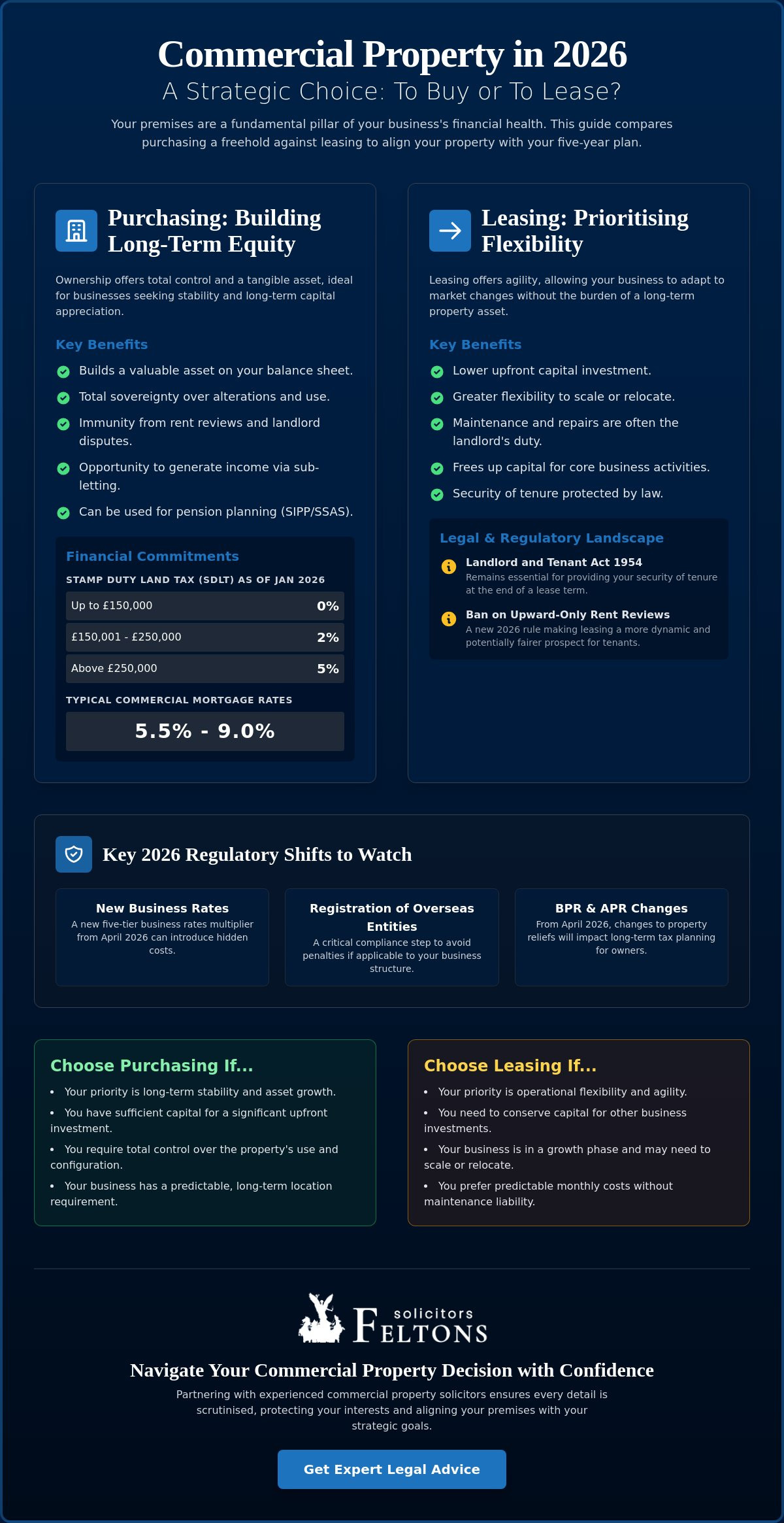
Starting the journey of acquisition requires a clear understanding of the financial landscape. For freehold purchases in England and Northern Ireland, Stamp Duty Land Tax (SDLT) is a primary consideration. As of January 2026, rates are 0% for the portion of the value up to £150,000, 2% from £150,001 to £250,000, and 5% on the portion above £250,000. When paired with commercial mortgage rates that currently range from 5.5% to 9%, ownership represents a significant capital commitment but one that builds a tangible asset on the balance sheet.

The acquisition process begins with the negotiation of the heads of terms. Expert commercial property solicitors then move through the due diligence phase, conducting environmental searches and title investigations. This methodical approach ensures that by the time you reach completion, every potential liability has been identified and mitigated. Engaging specialist commercial property solicitors is particularly vital when navigating the new Business Property Relief (BPR) and Agricultural Property Relief (APR) changes taking effect from 6 April 2026, which may impact your long-term tax planning. If you are involved in development activity, understanding the legal support for property developers available in 2026 is equally essential to managing site acquisition and compliance risks effectively.

The Benefits of Owning the Freehold

Ownership grants you total sovereignty over your premises. You’re no longer subject to the whims of a landlord or the uncertainty of rent reviews. This control allows you to repurpose the space as your business evolves or even sub-let surplus areas to generate additional revenue. Many business owners utilise commercial property as a vehicle for pension planning through a SIPP or SSAS, providing tax-efficient growth. It’s a classic example of the pros and cons of real estate investment, where the initial capital outlay is offset by long-term security and appreciation.

Complexities for International Clients

For entities based outside the UK, the legal landscape has become significantly more rigorous. The Registration of Overseas Entities is now a mandatory requirement for any non-UK company looking to buy, sell, or lease land. Failing to register beneficial owners can lead to severe penalties and prevent the registration of the property at HM Land Registry. We facilitate this verification process, ensuring that international investors remain compliant with UK law whilst protecting their privacy. If you’re managing an international portfolio, our team can provide the bespoke legal support needed to secure your UK assets.

Leasing Commercial Premises: Prioritising Operational Flexibility

Leasing remains the preferred choice for agile businesses that prioritise liquidity and the ability to scale. In an era where hybrid business models are expanding, the flexibility to move premises without the burden of selling a freehold asset is invaluable. However, this flexibility is only as strong as the legal framework supporting it. Experienced commercial property solicitors ensure that your lease isn’t just a permission to occupy, but a strategic tool that protects your operational interests.

One of the most critical protections for any tenant is the Landlord and Tenant Act 1954. This legislation provides “security of tenure,” giving you a statutory right to renew your lease at the end of the term. Without this protection, you could find your business forced to relocate at a moment’s notice, losing both your location and your local goodwill. When weighing up these options, consulting the RICS guide on buying vs. leasing provides an excellent foundation for understanding the different financial impacts on your business.

Negotiating Favourable Lease Terms

The “Break Clause” is your most powerful exit strategy. It allows you to terminate the lease on a specific date, provided certain conditions are met. We work to ensure these conditions aren’t overly restrictive, such as requiring “vacant possession” which can be a legal minefield. Rent reviews also require careful scrutiny. Whilst the English Devolution and Community Empowerment Act 2026 has introduced a ban on upward-only rent reviews for many new leases, older agreements or specific renewals may still carry these risks. Ensuring you have the right to assign or sub-let the property is equally vital; it allows you to move premises without being penalised for the remaining lease term.

Tenant Obligations and Maintenance

Most commercial agreements are Full Repairing and Insuring (FRI) leases. This means you, as the tenant, are responsible for all repairs and insurance costs. It’s a significant liability that often leads to “dilapidations” claims at the end of the lease, where landlords demand payment for perceived damage or wear. Challenging unfair service charges or maintenance demands requires a methodical legal approach. Our commercial property solicitors help you document the property’s condition at the start to mitigate these future costs. If you’re approaching the end of a term, engaging commercial lease renewal solicitors is the best way to secure your future on favourable terms.
Commercial Property Solicitors: A Strategic Guide to Buying vs Leasing in 2026

Comparing the Two Paths: Buying vs Leasing

Deciding between these two paths requires a pragmatic assessment of your business’s current lifecycle. Whilst ownership offers the allure of stability, the agility of a lease can be a more effective shield against economic shifts. Our commercial property solicitors provide the necessary distance to evaluate these options objectively, ensuring your choice isn’t clouded by short-term market sentiment. It’s about matching the legal structure of your premises to the operational pulse of your company.

Control and flexibility represent two sides of the same coin. Ownership grants you the sovereignty to modify your premises without seeking external permission, which is ideal for businesses with specific industrial or branding requirements. However, this control comes with the full weight of statutory compliance, including the 2026 EPC reforms and fire safety regulations. Leasing offers a lighter touch, allowing you to pivot your location as market demands shift, but it introduces the risk of leasehold litigation, particularly regarding dilapidations or service charge disputes. Deciding which asset behaviour suits your current phase is a task where commercial property solicitors offer invaluable perspective.

Financial Considerations

Purchasing a property is a significant Capital Expenditure (CAPEX) that can fundamentally strengthen your balance sheet. This asset can then be leveraged to improve borrowing capacity for future ventures, providing a level of financial depth that a lease cannot match. In contrast, leasing is treated as an Operational Expenditure (OPEX), which preserves your liquid cash for core business activities like hiring or product development. Regarding tax, VAT is usually charged at the standard rate of 20% on commercial property transactions unless the building is exempt or the ‘option to tax’ has not been exercised. Your solicitor will clarify these tax treatments early in the process to prevent unexpected cash flow hurdles.

The “Exit” Factor

Liquidity varies significantly between the two models. Selling a freehold can be a lengthy process depending on market conditions, whilst assigning a lease requires finding a suitable replacement tenant who meets the landlord’s criteria. For many business owners, the property is a legacy asset that requires careful integration into wills, probate, and estate planning. Ensuring a smooth succession or transfer of property interests is vital to protect the business’s continuity and your family’s future security. If you’re ready to define your property strategy, contact Feltons Solicitors LLP for a consultation tailored to your commercial goals.

Why Feltons Solicitors LLP is Your Trusted Commercial Property Partner

Choosing the right premises is a milestone that requires more than just a legal signature; it demands a partnership with a firm that understands the commercial pulse of your industry. Feltons Solicitors LLP offers a refined alternative to the high-volume, impersonal approach often found in larger practices. We position ourselves as your sophisticated guide, providing a calm and steady presence whilst you navigate the high-stakes decisions of property acquisition or lease negotiation. Our commercial property solicitors prioritise your specific business objectives, ensuring that every legal safeguard we implement serves your broader five-year expansion or exit strategy. We provide a boutique level of care that ensures your transaction is handled with the sound judgment and individualised attention it deserves.

Our expertise extends beyond the immediate transaction to offer a holistic view of your legal health. We recognise that for many business owners, property interests are deeply intertwined with personal wealth and family security. This is why our team provides comprehensive support across multiple disciplines, from complex domestic conveyancing to asset protection in divorce. By considering how your commercial holdings impact your wider estate, Feltons Solicitors LLP ensures that your business remains a resilient asset, regardless of what the future holds. Our ability to bridge the gap between established professional heritage and forward-thinking methodology makes us a dependable partner for the modern entrepreneur.

A People-First Philosophy

Technical legal competence is the baseline of our service, but our true value lies in our people-first philosophy. We prioritise building a personal rapport and maintaining a discreet, high-standard service that respects your time and privacy. When you work with Feltons Solicitors LLP, you aren’t passed between junior staff; you have direct access to experienced commercial property solicitors who take the time to explain nuances in plain English. We maintain a poised and dependable presence even during complex litigation or stressful disputes, ensuring you feel supported and in capable hands throughout the process.

Next Steps: Securing Your Business Future

The most effective way to mitigate risk is through early legal intervention. Before you commit to heads of terms or engage in formal negotiations, a consultation with our team can identify potential hurdles that might otherwise stall your progress. We provide a methodical and orderly approach to your property needs, ensuring that your premises act as a catalyst for growth rather than a financial constraint. Contact Feltons Solicitors LLP today to arrange a confidential discussion about your commercial requirements and discover how our tailored advice can secure your business’s future in an evolving market.

Defining Your Strategic Path in the 2026 Property Market

Your property strategy shouldn’t be an afterthought; it’s a deliberate decision that dictates your company’s resilience. Throughout this guide, we’ve explored how balancing immediate agility with long-term asset building requires more than just financial forecasting. It demands the foresight of commercial property solicitors who can translate market trends into robust legal protections. By aligning your premises with your corporate exit or expansion goals, you turn a physical space into a strategic advantage.

Established in 2010 by Paula Felton, our firm provides the boutique service and direct solicitor access that modern businesses require. We bring specialist expertise in modern requirements, including the Registration of Overseas Entities, ensuring your domestic or international portfolio is managed with precision. We invite you to discuss your commercial property strategy with Feltons Solicitors LLP today. Securing your future starts with a methodical approach to the present, and we’re ready to guide you through every complexity the 2026 market presents.

Frequently Asked Questions

Do I need a commercial property solicitor for a small lease?

You should always engage a solicitor for a small lease because the financial liabilities often far outweigh the annual rent. Even a short-term agreement can include “Full Repairing and Insuring” obligations that make you responsible for structural repairs or roof maintenance. Professional oversight ensures you don’t inadvertently sign a personal guarantee that puts your private assets at risk if the business faces challenges.

What is the difference between a freehold and a leasehold in commercial property?

Freehold ownership grants you total sovereignty over the land and building for an indefinite period, whereas a leasehold provides the right to occupy the premises for a fixed term. As a freeholder, you avoid rent reviews and landlord restrictions but carry the full burden of maintenance. Leaseholders benefit from lower upfront costs and greater flexibility but must comply with the terms of the lease and pay ongoing rent.

How long does a commercial property purchase typically take in 2026?

A commercial property purchase typically takes between eight and twelve weeks from the receipt of the draft contract to completion. This timeline can vary based on the complexity of the due diligence required, such as environmental reports or structural surveys. In 2026, delays are occasionally seen during the verification of overseas entities or when securing financing at current market rates, so early preparation is essential.

Can I change the use of a commercial building after I buy it?

You can often change the use of a commercial building, but it’s usually subject to obtaining planning permission from the local authority. Whilst the “Use Classes Order” allows some flexibility between similar types of businesses, restrictive covenants in the title deeds may still prohibit specific activities. It’s vital to have your solicitor check these title restrictions before you commit to the purchase to ensure your intended business model is permitted.

What are the hidden costs of leasing a commercial property?

Hidden costs often include end-of-lease dilapidations claims, service charge contributions for communal areas, and building insurance premiums. Many tenants are also surprised to find that Stamp Duty Land Tax (SDLT) is sometimes payable on the “net present value” of a new lease if the rent is sufficiently high. These expenses can significantly impact your operational budget if they aren’t accurately forecast during the negotiation stage.

What is a “Section 25 Notice” in commercial property law?

A Section 25 Notice is a formal document served by a landlord to either end a commercial tenancy or propose terms for a new lease. This notice is a critical part of the Landlord and Tenant Act 1954, which governs your security of tenure. If you receive one, you must act quickly to protect your right to remain in the premises or negotiate favourable renewal terms.

Do commercial property solicitors handle disputes as well as transactions?

Most commercial property solicitors handle both transactional work and the resolution of property-related disputes. This dual expertise is invaluable because a solicitor who understands how litigation arises is better equipped to draft contracts that prevent it. Whether you’re facing a service charge disagreement or a breach of covenant, having a legal partner who understands your transaction’s history provides a significant advantage.

How does the Registration of Overseas Entities affect my property purchase?

The Registration of Overseas Entities requires any non-UK company to register its beneficial owners with Companies House before it can buy or sell UK land. In 2026, this is a mandatory compliance step; without a valid Overseas Entity ID, the Land Registry will not register your ownership. This process adds an extra layer of due diligence to the transaction that your commercial property solicitors must manage to ensure completion isn’t delayed.


High Net Worth Divorce Solicitors: Navigating Complex Financial Settlements in 2026

High Net Worth Divorce Solicitors: Navigating Complex Financial Settlements in 2026

The assumption that a marriage automatically entitles a spouse to half of your pre-marital wealth is no longer the legal certainty it once was. Following the landmark 2025 Supreme Court decision in Standish v Standish, the distinction between matrimonial and non-matrimonial property has become a critical battleground for wealth preservation. When your estate includes private businesses, international trusts, or overseas property, the standard administrative process of a no-fault divorce is rarely sufficient. Engaging specialised high net worth divorce solicitors is no longer just about legal representation; it’s about strategic financial protection in an era where the family courts are facing record delays and evolving precedents.

You likely feel a profound sense of responsibility to protect the assets you’ve built, whilst fearing that a public court battle could expose your private financial affairs. We understand that high-value separations require a level of discretion and technical precision that goes beyond the ordinary. This guide provides a comprehensive roadmap for securing a fair financial order that respects pre-marital contributions and manages complex international interests. You’ll learn how to navigate current Capital Gains Tax rates, the benefits of private dispute resolution, and the specific ways your business and trusts are treated under 2026 regulations.

Key Takeaways

  • Learn how recent legal precedents provide a clearer framework for ring-fencing pre-marital wealth and non-matrimonial assets during a high-value separation.
  • Understand the specific risks and protections associated with international trusts, overseas property, and the potential for the court to “pierce the corporate veil” in financial settlements.
  • Discover why high net worth divorce solicitors are vital for securing accurate valuations of private businesses whilst ensuring your financial affairs remain strictly confidential.
  • Gain insights into the mandatory disclosure process and how private dispute resolution can help you avoid the significant delays currently facing the UK family court system.
  • See how an integrated legal strategy-combining family, property, and probate expertise-provides a more robust defence for your long-term financial security.

Defining High Net Worth Divorce: Why Substantial Assets Require Specialist Expertise

High net worth divorce is defined less by a specific figure and more by the intricate architecture of the assets involved. While the Financial Conduct Authority (FCA) categorises a high net worth individual as someone with an annual income of £300,000 or net assets exceeding £3 million, the legal reality in 2026 is that any case involving liquid assets over £1 million requires a specialist approach. Standard divorce procedures are designed for the “average” estate. They often lack the technical tools required to unpick international trusts, private equity holdings, or multi-jurisdictional tax liabilities. When your financial security depends on the valuation of a private company or the protection of inherited wealth, the standard administrative track is rarely sufficient.

In these high-value cases, the court moves beyond the basic “needs” of the parties. When assets far exceed what is required for housing and maintenance, the focus shifts to the “sharing principle.” While the “yardstick of equality” remains the starting point for matrimonial property, departures from a 50/50 split are common. This is particularly true following the 2025 Standish v Standish ruling, which reinforced the protection of non-matrimonial assets. Identifying which assets are subject to the sharing principle and which should be ring-fenced is a task that requires the steady hand of experienced high net worth divorce solicitors.

The Threshold of Complexity: When is a Divorce “High Net Worth”?

Complexity is the true marker of a high-value settlement. It isn’t just about the size of the bank balance; it’s about the presence of family trusts, offshore entities, and private business interests. Using non-specialist solicitors for such matters carries significant risk. A lack of expertise in corporate structures or the 2026 Capital Gains Tax rates, which sit at 18% or 24% depending on income, can lead to settlements that look fair on paper but are financially flawed in practice. Specialist high net worth divorce solicitors ensure that every asset is correctly categorised and valued before any negotiation begins.

The Importance of Discretion and Privacy

For many clients, the fear of public exposure is as significant as the fear of financial loss. While the UK family court system has moved toward greater transparency, financial remedy proceedings remain fundamentally private. However, the risk of sensitive details entering the public domain still exists, especially in high-profile divorce settlements where the press may take an interest. Protecting your anonymity requires a proactive strategy. We often utilise Reporting Restriction Orders to prevent the publication of identifying financial data. Boutique firms prioritise this level of discretion, acting as a shield between your private life and the public eye.

Managing Complex Asset Structures: Trusts, Overseas Entities, and Corporate Interests

High-value settlements often involve assets that exist far beyond the reach of a standard bank statement. For many clients, the bulk of their wealth is tied up in private limited companies, commercial property portfolios, or sophisticated trust arrangements. These structures require a forensic level of scrutiny. A primary challenge for high net worth divorce solicitors is determining which of these assets are truly “matrimonial” and which can be protected as non-matrimonial wealth. Whilst the 2025 Standish v Standish ruling provides clearer boundaries for ring-fencing inherited assets, the way these funds have been managed during the marriage-for example, if they were used to purchase a family home-can complicate their legal status.

Corporate interests present a unique hurdle. Under English law, a company is a separate legal person. However, the family court possesses the power to “pierce the corporate veil” in specific circumstances. If a business structure is being used as a “sham” to hide personal wealth or if one spouse maintains absolute control over the company’s liquidity, a judge may treat the business assets as personal property. Accurate valuation is essential here. We work alongside forensic accountants to ensure that the “true” value of a private limited company is established, accounting for future earnings and tax liabilities rather than just the balance sheet. If you are concerned about how your business interests will be treated, seeking advice on divorce and financial arrangements early in the process is a prudent step.

The Impact of the Register of Overseas Entities (ROE)

The intersection of property law and divorce disclosure has become increasingly complex since the introduction of the Register of Overseas Entities. Any overseas entity owning UK land must now be registered with Companies House. During a divorce, failure to comply with ROE requirements can stall a financial settlement indefinitely. If a property is held by an unregistered offshore entity, it cannot be sold or transferred to a spouse as part of a court order. Our team provides specialised expertise in the registration of overseas entities, ensuring that international property holdings are fully compliant and ready for inclusion in a final financial order.

Trusts: Nuptial vs. Non-Nuptial Settlements

Trusts are often the most contentious element of a high-value divorce. The court distinguishes between “nuptial” trusts, which were created for the benefit of the couple or their children, and “non-nuptial” trusts, such as those established by previous generations.

  • Nuptial Trusts: The court has broad powers to vary these settlements to meet the needs of a spouse.
  • Non-Nuptial Trusts: These are harder to reach, but the court may still consider them a “resource” if a spouse has a history of receiving regular distributions.

Protecting a family trust from being liquidated requires a strategy that demonstrates the trust was never intended to be part of the shared matrimonial pot.

Strategic Asset Protection: Balancing Fair Distribution with Wealth Preservation

Many clients approach a separation with a singular, pressing concern: the fear of losing half of everything they have spent a lifetime building. Whilst an equal division of matrimonial assets is the standard starting point in English law, it’s not an unbreakable rule. Experienced high net worth divorce solicitors focus on shifting the narrative from a simple 50/50 split to a nuanced argument for wealth preservation. This involves a rigorous analysis of the sharing principle versus the genuine financial needs of the other party. In cases of exceptional wealth, we may also explore the “special contribution” argument. This applies when the extraordinary business acumen or stellar contribution of one spouse is so significant that it justifies a departure from an equal division.

Strategic protection often rests on the validity of Pre-Nuptial and Post-Nuptial agreements. As of June 2026, the UK government is engaged in a major consultation regarding the legal status of these documents, with potential legislation on the horizon. Even before these reforms, the courts place significant weight on agreements that were entered into freely and with full financial disclosure. If an agreement is deemed fair and meets the basic needs of both parties, it serves as a powerful shield for pre-acquired wealth and inherited assets. It provides a level of certainty that the standard court process cannot guarantee.

Ringfencing Non-Matrimonial Assets

Protecting assets acquired before the marriage or through inheritance requires meticulous evidence. The primary risk in high-value cases is “mingling.” This occurs when non-matrimonial funds are transferred into joint accounts or used to purchase a shared family home. Once assets are mixed with family finances, they often lose their protected status and become part of the matrimonial pot. We assist clients in tracking the origin of their wealth through historical financial records. By clearly identifying pre-marital property and family gifts during the disclosure process, we can build a robust case for these assets to be ringfenced and excluded from the final settlement.

Business Protection Strategies

A forced sale of a family business or a mandatory transfer of shares is rarely a desirable outcome. To avoid this, we often utilise a strategy called “offsetting.” Instead of liquidating corporate interests, the other spouse may receive a larger portion of other matrimonial assets, such as liquid cash, property, or pension pots. This preserves the operational integrity of the business whilst satisfying the court’s requirement for a fair distribution. Forensic accountants are essential in this process. They provide a valuation that accounts for the illiquidity of shares and the 2026 Capital Gains Tax rates, ensuring the settlement is based on realistic, post-tax figures rather than mere book value.

High Net Worth Divorce Solicitors: Navigating Complex Financial Settlements in 2026

The Path to Resolution: Disclosure, Valuation, and Negotiated Settlements

Achieving a fair financial order depends entirely on the transparency of the information provided at the start of the process. In English law, this is known as “full and frank” financial disclosure. For clients with complex portfolios, this stage is often the most demanding. It requires a meticulous gathering of evidence for assets that may be illiquid or held in opaque structures. If a spouse attempts to hide assets or provides misleading information, the court can issue “set-aside orders” years after the divorce is finalised, effectively reopening the entire settlement. Professional high net worth divorce solicitors act as a safeguard here, ensuring that your own disclosure is unimpeachable whilst rigorously testing the validity of the information provided by your spouse.

The valuation of non-liquid assets, such as private equity holdings or interests in family trusts, requires more than just a cursory glance at a balance sheet. We instruct expert witnesses, including forensic accountants, tax advisors, and actuaries, to provide a precise picture of your wealth. These experts account for the 2026/27 Capital Gains Tax rates of 18% and 24%, ensuring that the net value of an asset reflects the reality of its eventual sale or transfer. Without this level of technical detail, you risk a settlement based on “paper wealth” that doesn’t account for the significant tax liabilities attached to high-value assets. This forensic approach is essential for identifying the true liquidity available for a settlement.

Navigating the Form E for High Net Worth Individuals

Filling out the Form E is a complex task when your income is derived from multiple sources or offshore interests. Specific care must be taken with Section 2.13, which covers “other assets,” including digital currencies, fine art, or interests in unquoted companies. The duty of disclosure is an absolute legal obligation that remains in force until a final order is sealed. Failing to account for potential CGT liabilities or the true value of an executive pension pot can lead to a settlement that is fundamentally skewed. If you require assistance with complex filings, our team at Feltons Solicitors LLP specialises in divorce and financial arrangements for sophisticated estates.

Mediation and Arbitration: A Discreet Alternative

With family court delays currently averaging 74 weeks from application to final order, many individuals are turning to private dispute resolution. Arbitration, in particular, offers a level of discretion and efficiency that the public court system cannot match. You have the flexibility to choose an arbitrator with specific expertise in complex financial structures, ensuring your case is handled by someone who understands the nuances of HNW wealth. This private “judge” provides a binding decision in a fraction of the time, allowing you to secure a clean break without the stress of a protracted public battle. Experienced high net worth divorce solicitors facilitate these out-of-court settlements, maintaining a robust legal position whilst prioritising your privacy and time.

Feltons Solicitors LLP: A Bespoke Approach to High-Value Divorce and Financial Arrangements

Large, high-volume law firms often struggle to provide the granular attention that a multi-million pound estate demands. Feltons Solicitors LLP operates as a boutique practice, where direct partner access isn’t a luxury but a standard part of our service. This ensures that your strategy is shaped by seniority and experience from the very first consultation. As high net worth divorce solicitors, we recognise that wealth is rarely static; it’s a living entity of businesses, properties, and trusts that requires a steady, sophisticated guide to manage effectively. Established in 2010 by Paula Felton, our firm provides a calm, steady presence, ensuring that even the most stressful financial negotiations are handled with quiet confidence.

Our strength lies in our multidisciplinary strength. Because we also specialise in commercial conveyancing, litigation, and the registration of overseas entities, we don’t need to outsource the technical elements of your settlement. We understand the mechanics of property transfers and corporate structures from the inside out. This integrated perspective allows us to anticipate hurdles in asset division that a general family law firm might overlook. We pride ourselves on delivering polished, professional advice that remains accessible, favouring plain English over dense, archaic legalese.

Integrated Legal Support for HNW Families

A financial order is only the first step in securing your post-divorce life. The actual transfer of high-value property or the restructuring of corporate holdings requires precise legal execution. Our residential and commercial conveyancing teams work alongside our family department to streamline these transitions. Simultaneously, a divorce automatically alters your inheritance position. It’s vital to review your Wills and Estate Planning to ensure your assets remain protected for future generations. By managing these adjacent legal needs under one roof, we provide a seamless service that protects your interests across all sectors of the law.

Securing Your Future with Pragmatic Advice

We prioritise long-term financial stability over the fleeting satisfaction of a courtroom win. Our focus is on achieving a fair settlement that preserves your core assets and provides a clean break. We understand the human impact of these proceedings. Whilst we are robust high net worth divorce solicitors when protecting your balance sheet, we remain approachable and supportive partners throughout the process. Our national reach and experience with international complexities mean you receive elite-level representation with the personal touch of a boutique firm. If you are ready to move forward, Contact Feltons Solicitors LLP for a discreet consultation on your financial arrangements.

Securing Your Financial Legacy with Confidence

Navigating the complexities of high-value divorce in 2026 requires a legal partner who understands the intricate intersection of family law, corporate governance, and international property regulations. As we’ve explored, achieving a fair settlement involves more than just an administrative division; it requires the strategic ringfencing of non-matrimonial wealth and the precise valuation of illiquid assets. By choosing high net worth divorce solicitors who prioritise discretion and technical precision, you can navigate these challenges without sacrificing your long-term financial security or personal privacy.

Established in 2010 by Paula Felton, Feltons Solicitors LLP provides the boutique, partner-led service necessary to handle high-stakes litigation and complex overseas entity registration. We offer a calm, steady presence during a period of significant change, ensuring that your private affairs remain protected whilst you secure a clean break. Our commitment to pragmatic, “plain English” advice ensures you remain in control of the process at every stage. We are here to help you protect what you’ve built and provide a stable foundation for your future.

Secure a Discreet Consultation with Our High Net Worth Divorce Specialists

Frequently Asked Questions

What qualifies as a high net worth divorce in the UK?

High net worth divorce is defined by the complexity and scale of the marital estate rather than a single statutory figure. Whilst the Financial Conduct Authority identifies individuals with £3 million in net assets or an annual income of £300,000 as high net worth, family courts generally apply this label to cases with over £1 million in liquid assets. These cases are distinguished by the presence of diversified portfolios, including private businesses, trusts, and international property, which require a specialised legal approach beyond standard procedure.

Can I protect my business from my spouse during a divorce?

You can often protect a business from a forced sale or share transfer through a strategy known as offsetting. This involves providing your spouse with a larger share of other matrimonial assets, such as the family home or liquid cash, to preserve the operational integrity of the company. The court’s primary goal is fairness, and if a business was established before the marriage or through inherited wealth, there are strong legal arguments for ringfencing its value, provided the other party’s needs are met.

How are offshore assets and trusts treated in a UK divorce settlement?

Offshore assets and trusts are treated as financial resources and must be fully disclosed during proceedings. The family court has the power to vary “nuptial” trusts created for the benefit of the family or to treat trust distributions as an available resource if a spouse has a history of receiving funds. Compliance with the Register of Overseas Entities is also vital, as unregistered properties cannot be legally transferred or sold as part of a final financial order.

What happens if my spouse hides assets during the financial disclosure process?

Hiding assets is a serious breach of the absolute duty of “full and frank” disclosure and can lead to severe legal penalties. If non-disclosure is discovered, the court may issue “set-aside orders” to reopen a settled case, award a higher percentage of the known assets to the other spouse, or issue cost orders against the non-disclosing party. Forensic accountants are often employed to trace missing funds and ensure the settlement is based on the true extent of the marital wealth.

How long does a high net worth divorce typically take to resolve?

A high-value divorce typically takes between 12 and 18 months to reach a final financial settlement, even though the administrative divorce process has a minimum timescale of 26 weeks. Significant delays in the public court system mean that financial remedy applications currently face an average wait of 74 weeks for a final order. Experienced high net worth divorce solicitors often recommend private arbitration or mediation to bypass these delays and achieve a faster, more discreet resolution.

Is a Pre-Nuptial Agreement legally binding in a high net worth divorce?

Pre-Nuptial Agreements are not yet strictly binding in English law, but they are highly influential and often decisive if they meet specific criteria. Following the 2010 Radmacher ruling, courts will generally uphold an agreement if it was entered into freely, with full financial disclosure and independent legal advice, provided the outcome is fair. With a government consultation on the legal status of these agreements underway in 2026, their role in wealth preservation is becoming increasingly central.

Will I have to sell the family home in a high-value divorce?

Selling the family home is not a requirement if there is sufficient liquidity in the rest of the estate to satisfy both parties’ housing needs. In high net worth cases, it’s common for one spouse to retain the property whilst the other receives a balancing payment from business interests, savings, or pension pots. The court prioritises the needs of any children involved, but it also respects the practicalities of maintaining high-value assets where an alternative settlement is possible.

Why should I choose a boutique law firm over a large national practice?

Choosing a boutique firm ensures you receive a partner-led service where your financial strategy is managed by a senior expert rather than a junior associate. This model offers a level of discretion, personal rapport, and tailored attention that high-volume national practices often struggle to provide. For complex estates, high net worth divorce solicitors at boutique firms offer the technical focus and integrated property expertise required to manage sophisticated international interests effectively.

Commercial Litigation Firms UK: 2026 Trend Analysis and Selection Guide

Commercial Litigation Firms UK: 2026 Trend Analysis and Selection Guide

In 2026, the traditional “big firm” model for commercial disputes is increasingly becoming a liability for businesses seeking agility and cost-certainty. As the UK legal market surpasses a £40 billion valuation, the criteria for selecting commercial litigation firms UK have shifted from sheer size to strategic precision. You likely feel the pressure of escalating costs and the potential for conflicts of interest within multi-service giants, especially as the new Practice Direction 51ZH pilot mandates greater transparency for court documents by default.

We understand that facing a complex dispute is inherently stressful, particularly when the landscape is shifting under your feet with new AI regulations and the updated Arbitration Act 2025. This guide provides an expert analysis of the current litigation environment to help you secure a partner who prioritises your commercial interests over billable hours. We will explore why boutique, partner-led firms are often better equipped to handle modern challenges, from navigating the nuances of third-party funding to meeting the latest Civil Justice Council requirements for AI disclosure in the Business and Property Courts.

Key Takeaways

  • Understand how emerging trends like ESG claims and AI-driven e-disclosure are reshaping the strategies of commercial litigation firms UK wide.
  • Learn why boutique firms often provide a more agile, conflict-free alternative to global giants for complex shareholder and corporate disputes.
  • Discover how proactive contract drafting and strategic risk management can prevent costly courtroom battles before they begin.
  • Identify the essential criteria for selecting a legal partner who prioritises partner-led service and pragmatic, commercial outcomes.
  • Gain insight into the latest 2026 regulatory shifts, including the Practice Direction 51ZH pilot, and how they impact your litigation strategy.

The Evolving Landscape of Commercial Litigation in the UK (2026)

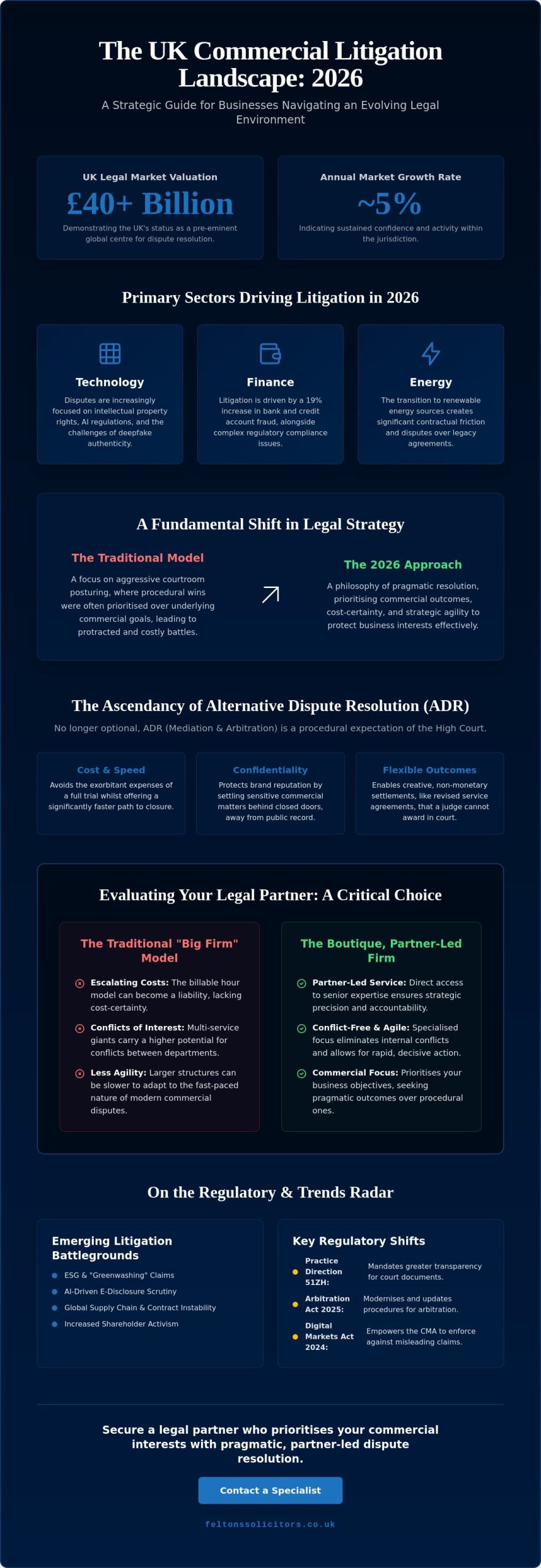
Commercial litigation is the engine of the corporate legal system. It encompasses high-stakes disputes that threaten the stability of a business, typically involving complex contracts, shareholder disagreements, or failures in corporate governance. In 2026, the United Kingdom maintains its position as the pre-eminent global centre for dispute resolution. Whilst Brexit introduced significant regulatory shifts, the fundamental reliability of UK company law continues to attract international litigants. Recent data indicates that the UK legal market is growing at a rate of approximately 5% annually, valued at over £40 billion, proving that the jurisdiction’s authority remains unshaken amongst global competitors.

The approach taken by leading commercial litigation firms UK wide has transitioned from traditional, aggressive courtroom posturing toward a philosophy of pragmatic resolution. This shift reflects a growing demand for legal partners who prioritise commercial outcomes over procedural wins. Today, the sectors driving the most significant volume of litigation include Technology, where intellectual property and deepfake authenticity disputes are rife; Finance, dealing with the fallout of bank and credit account fraud which saw a 19% increase recently; and Energy, as the transition to renewables creates friction in legacy agreements.

Key Drivers of Commercial Disputes in 2026

Current disputes are often born from the fragility of global supply chains. Contractual instability has led to a surge in breach-of-contract claims as businesses struggle with unpredictable logistics and rising costs. Additionally, shareholder activism has reached new heights. Investors are increasingly using corporate governance challenges to hold boards accountable for their strategic decisions. These disputes are further shaped by recent regulatory updates that have tightened the requirements of the pre-action phase. Evidence gathering is now a digital-first endeavour, and businesses must be prepared for the scrutiny of their internal communications much earlier in the process than in previous years.

The Increasing Role of Alternative Dispute Resolution (ADR)

The High Court no longer views mediation as an optional extra; it’s now a procedural expectation. Arbitration and mediation are actively encouraged before a trial date is even considered. From a cost-benefit perspective, ADR often proves superior to traditional litigation. It avoids the exorbitant expenses of a full trial whilst offering a faster path to closure. Strategic agility is the hallmark of a modern resolution. For many of our clients, the most compelling advantage is confidentiality. Settling a sensitive commercial matter behind closed doors protects a brand’s reputation in a way a public courtroom never can. By opting for ADR, companies can craft settlements that include non-monetary components, such as revised service agreements, which a judge simply cannot award in court.

The 2026 litigation outlook suggests that Environmental, Social, and Governance (ESG) factors are no longer just corporate talking points; they’ve become high-stakes legal battlegrounds. For commercial litigation firms UK wide, the focus has shifted toward defending or pursuing claims related to “greenwashing” and supply chain ethics. Regulators like the Competition and Markets Authority (CMA) now wield significant enforcement powers under the Digital Markets, Competition and Consumers Act 2024. This allows them to take a much tougher stance on misleading environmental claims, often leading to reputational damage that far outweighs the immediate financial penalty.

Third-party litigation funding continues to evolve as well. Following the government’s commitment to reverse the impact of the Supreme Court’s PACCAR decision, the funding market has regained a sense of stability. This provides businesses with more options to pursue legitimate claims without straining their own balance sheets. If you’re currently facing a dispute that requires this level of strategic foresight, seeking pragmatic dispute resolution can help you manage these emerging risks effectively.

ESG: Moving Beyond Compliance to Litigation

Boards of directors are finding themselves personally scrutinised. In 2026, it’s increasingly common for leadership teams to be held accountable for ESG misstatements that mislead investors. Group action claims are also on the rise, particularly against multinational corporations regarding the actions of their overseas subsidiaries. When choosing a legal partner, it’s vital to identify a firm that understands these specific regulatory nuances and can offer a steady hand during high-profile scrutiny. The focus is no longer just on avoiding fines, it’s about protecting the long-term integrity of the brand.

AI and the Future of Evidence Management

The AI revolution is fundamentally altering e-disclosure. The Civil Justice Council’s consultation, which concluded in April 2026, has already influenced how AI is used to generate or review witness statements in the Business and Property Courts. Predictive coding now allows for the management of massive data sets with a level of precision that human review simply cannot match. This technological leap is also dismantling traditional fee structures. Many commercial litigation firms UK are moving away from purely hourly billing for document review, opting instead for fixed-price models that reflect the efficiency of AI-led discovery. Whilst this reduces costs, it also demands rigorous data security to protect sensitive commercial information amidst digital disclosure processes.

Evaluating Litigation Firms: Boutique Specialism vs. Global Giants

Choosing between a global powerhouse and a specialized boutique is one of the most critical decisions a business leader faces when a dispute arises. Whilst the “Magic Circle” and large international firms possess an undeniable depth of resources, they are frequently hamstrung by the “Conflict of Interest” problem. These multi-service giants often represent major financial institutions or multinational conglomerates on the advisory side. Consequently, they are often legally or commercially prohibited from acting against those same entities in a dispute. For a business seeking to challenge a major bank or a dominant market player, this lack of independence can be a significant hurdle.

Specialist commercial litigation firms UK wide have gained prominence by offering a “conflict-free” model. By focusing exclusively on litigation and dispute resolution, these firms maintain the independence required to pursue robust claims against any adversary, regardless of their size. Whilst global firms are essential for “mega-litigation” requiring hundreds of lawyers for massive document reviews, boutique firms provide the strategic agility and senior-level focus that complex commercial matters often demand. They operate without the heavy corporate overheads of their larger counterparts, allowing for a more direct alignment with the client’s commercial goals.

The Value of Partner-Led Instruction

In high-volume firms, cases are frequently delegated to junior associates or trainees to maximize leverage. This can lead to a disconnect between the initial strategy and the daily execution of the case. Boutique firms offer a distinct advantage: direct and consistent access to senior partners. Your matter isn’t just another file in a processing system; it’s a priority handled by an expert with decades of experience. This personal rapport ensures that the solicitor understands the human impact of the dispute, leading to more nuanced and effective representation. A partner-led approach means that tactical decisions are made with the benefit of seasoned judgment, rather than through a checklist of procedural steps.

Fee Structures and Value for Money

Transparency in billing is a hallmark of a modern, client-focused firm. Whilst traditional hourly rates still exist, many commercial litigation firms UK are embracing more flexible arrangements. These include fixed-fee stages, capped fees, or contingent structures that share the risk of the outcome. Evaluating the ROI of legal advice isn’t just about the final bill; it’s about the value secured in the settlement. High-end advice that secures a pragmatic resolution early in the process often proves far more cost-effective than a cheaper, protracted battle that ends in an uncertain trial. When reviewing potential partners, look for a firm that provides clear, “plain English” breakdowns of costs and focuses on achieving a result that protects your bottom line.

Commercial Litigation Firms UK: 2026 Trend Analysis and Selection Guide

Strategic Risk Management: Avoiding the Courtroom

The most effective litigation strategy often ensures that a trial never takes place. Whilst courtrooms provide finality, they also introduce significant costs and public scrutiny. Leading commercial litigation firms UK now prioritise “dispute avoidance” through proactive contract drafting. By embedding clear “dispute clauses” into your agreements, you define the path of resolution before a conflict even exists. This might include mandatory cooling-off periods or specific escalations to senior management, preventing minor disagreements from spiralling into expensive legal battles.

Early Neutral Evaluation (ENE) has become a vital component of this preventative approach. In an ENE, an independent third party, often a retired judge or senior barrister, provides a non-binding assessment of the case’s merits. This provides a “reality check” that can be incredibly persuasive during negotiations. It also helps manage reputational risk. As discussed in our analysis of the 2026 pilot scheme for public access to court documents, once a claim is filed, your sensitive commercial data may enter the public domain. Resolving a matter privately through litigation and dispute resolution expertise ensures your brand remains protected from unnecessary exposure.

The Pre-Action Protocol: A Strategic Opportunity

The pre-action phase is not just a procedural hurdle; it is a strategic opportunity. A well-crafted “Letter of Claim” does more than state your case. It sets a tone of quiet confidence and professional authority. By presenting a robust, evidence-backed position early, you can often force a favourable settlement before the High Court even becomes involved. Failing to engage meaningfully at this stage is a common pitfall. The courts are increasingly willing to impose cost penalties on parties that bypass these protocols, regardless of the eventual outcome of the case. Detailed engagement here demonstrates that you are prepared for a battle but prefer a pragmatic resolution.

Mediation as a Commercial Tool

2026 has seen a surge in “mandatory” mediation considerations within the UK justice system. Preparing for mediation requires a different mindset than preparing for trial. It is a commercial negotiation, not a legal argument. To ensure a win, you must identify your “Best Alternative to a Negotiated Agreement” (BATNA) and understand the other party’s commercial pressures. However, a sophisticated guide also knows when to walk away. If the other side is not acting in good faith or offers a resolution that compromises your core interests, litigation remains the necessary path to protect your business. Successful mediation is about finding a solution that allows both parties to return to their core operations without the shadow of a pending trial; many firms find that the structured approach of Echelon Facilitation is invaluable for ensuring these negotiations remain aligned with their ultimate business objectives.

Feltons Solicitors: Pragmatic Dispute Resolution for 2026

Feltons Solicitors LLP occupies a unique space within the legal market. Whilst many commercial litigation firms UK wide prioritise volume and high-speed processing, we focus on depth, discretion, and individualized attention. We combine modern, efficient delivery with the traditional professional integrity that high-stakes disputes demand. Our commitment to “Plain English” advice ensures that you’re never lost in a sea of dense, archaic legalese. Instead, we focus on the practical, commercial outcomes that matter most to your business’s survival and growth.

A dispute is often a source of significant stress for any business owner. Our role is to act as a calm, steady presence in the face of these challenges. We don’t believe in aggressive posturing for its own sake. We develop customised strategies that align legal action with your broader business goals. Whether it’s a contract breach, a shareholder disagreement, or a complex international matter, we bring the same level of quiet confidence and methodical precision to every case. Our “people-first” philosophy means we never forget the human impact of the technical legal work we perform.

Our Litigation Philosophy

We understand the evolving landscape of 2026. This includes the rise of ESG-related claims and the complexities introduced by AI-driven disclosure. We help you navigate the new Practice Direction 51ZH pilot with a focus on protecting your privacy whilst meeting the court’s transparency requirements. By choosing Feltons Solicitors LLP, you aren’t just hiring a solicitor; you’re securing a discreet partner who values personal rapport over high-volume turnover. Our expertise extends across various industry sectors, from technology to finance. We provide the worldly experience necessary to handle complex matters with the strategic agility of a boutique firm. This ensures that tactical decisions are made with seasoned judgment and a focus on long-term brand integrity.

Seamless Integration of Expertise

A commercial dispute rarely exists in a vacuum. It often involves property rights, asset protection, or private client considerations. At Feltons Solicitors LLP, our litigation team works alongside our experts in residential and commercial conveyancing, leasehold enfranchisement, and estate planning. This integration allows us to anticipate risks that a single-discipline firm might overlook. For example, a dispute involving the registration of overseas entities requires a nuanced understanding of both litigation and property law. We also maintain a robust network of specialist barristers and expert witnesses, ensuring you have access to the finest minds in the UK legal system. Our goal is to provide a high-standard service that handles complex matters with the personal care of a trusted advisor.

Discuss your dispute with a senior partner at Feltons Solicitors LLP.

Securing Strategic Clarity for Your Commercial Disputes

The legal environment in 2026 demands more than just technical proficiency; it requires a partner who can navigate the complexities of AI-driven disclosure and the rising tide of ESG claims with quiet confidence. Choosing amongst commercial litigation firms UK wide often involves a balance between the vast resources of global giants and the strategic agility of a boutique specialist. A partner-led approach ensures that your case is never delegated to junior staff, whilst a conflict-free model protects your ability to pursue robust resolutions against any adversary.

Established in 2010, Feltons Solicitors LLP provides the high-end reliability and worldly experience required for both domestic and complex international litigation. Our “people-first” philosophy ensures that whilst we handle the technical intricacies of the law, we never lose sight of the commercial impact on your business. We prioritise pragmatic, “Plain English” advice designed to protect your interests and secure a resolution that allows you to move forward. You don’t have to navigate these stressful situations alone. Contact Feltons Solicitors LLP for a discreet consultation regarding your commercial dispute and take the first step toward a steady, professional resolution.

Frequently Asked Questions

What are the primary costs involved in UK commercial litigation?

The primary costs include court filing fees, solicitor and barrister fees, expert witness disbursements, and the technical expenses associated with AI-driven e-disclosure. You should also account for potential adverse costs, which are the legal fees of the opposing party that you may be ordered to pay if your claim is unsuccessful. Modern firms often provide staged cost estimates to help you manage your budget throughout the proceedings.

How long does a typical commercial dispute take to reach trial in 2026?

A typical commercial dispute usually takes between 12 and 24 months to reach a full trial in the High Court. This timeframe accounts for the mandatory pre-action protocols, the exchange of evidence, and the extensive digital disclosure phase. Whilst this is the standard duration for complex matters, cases involving urgent injunctions or summary judgments can often be resolved much faster depending on the court’s availability.

Can I use third-party funding for my commercial litigation case?

You can use third-party funding to cover your legal expenses in exchange for the funder receiving a portion of the settlement or damages awarded. Following the government’s commitment to reverse the impact of the PACCAR decision, the market for litigation funding remains a stable and viable option for UK businesses. It’s a strategic tool that allows you to pursue high-value claims without putting your company’s immediate cash flow at risk.

What is the difference between mediation and arbitration in the UK?

Mediation is a confidential, non-binding negotiation facilitated by a neutral third party to help both sides reach a voluntary settlement. In contrast, arbitration is a private, formal process where an arbitrator makes a legally binding decision that is final and enforceable. Whilst mediation focuses on finding a pragmatic compromise, arbitration is governed by the Arbitration Act 2025 and serves as a private alternative to a public court trial.

How do I switch commercial litigation firms if I am unhappy with my current representation?

You have the right to switch commercial litigation firms UK wide at any stage of your proceedings if you feel your current representation isn’t aligned with your goals. The process involves formally instructing a new firm and providing written authority to your existing solicitors to transfer your files. It’s important to review your current engagement letter first to understand any obligations regarding outstanding fees before the file transfer occurs.

What happens if we win the case? Can we recover all our legal costs?

Winning a case doesn’t automatically mean you will recover every penny spent on legal fees. In the UK, the “loser pays” principle typically allows the successful party to recover approximately 60% to 70% of their reasonable costs when assessed on a “standard basis.” The court has broad discretion and will consider the behaviour of both parties, including whether you meaningfully engaged in mediation or other forms of dispute resolution.

Is my commercial dispute confidential if it goes to the UK High Court?

Most proceedings in the UK High Court are public, meaning that hearings are open and court documents can often be accessed by third parties. Under the Practice Direction 51ZH pilot, which runs until December 2027, transparency has increased with many documents being publicly accessible by default through the CE-File system. If confidentiality is a primary concern for your business, you should explore arbitration or private settlement options before a claim is issued.

What is the role of an expert witness in commercial litigation?

An expert witness provides independent, technical evidence to assist the court on specialised matters that fall outside the judge’s expertise, such as forensic accounting or climate attribution science. Their overriding duty is to the court rather than the party paying their fees. Experienced commercial litigation firms UK will select experts who can provide clear, “plain English” explanations of complex data whilst remaining resilient under cross-examination.