

A trust dispute can quickly widen into an inheritance or family matter. Contentious probate concerns disputes about wills, estates and inheritance, while trust litigation can involve a trust’s validity or administration, trustee decisions and beneficiaries’ rights. Contentious trust litigation lawyers in the UK help people understand these issues and consider how to address them.
If you’re facing conflict after a death or a disagreement over a trust, it may not be clear which legal route applies. The right approach depends on what is disputed, who is affected and what outcome is sought.
This article explains contentious probate and how inheritance claims, trust changes and trustee applications may be addressed. It also explores how trusts can intersect with divorce and family disputes, including those involving family farms or landed estates, and what to consider before deciding on a next step.
Key Takeaways
- Contentious probate can involve challenges to a will or inheritance, disputes over estate administration, and questions about a trust’s validity or management.
- For an inheritance claim, identify your relationship to the deceased, the provision you believe is inadequate and the evidence relevant to your circumstances.
- Trustees may seek a variation, directions or the court’s blessing; the trust’s terms and the interests affected help shape the appropriate route.
- Concerns about a trustee’s conduct can lead to an application for removal or other court directions, depending on the issue and the evidence.
- In divorce and family disputes, distinguish trust assets from resources a court may consider, and assess how family farms or landed estates affect the wider dispute.
What is Contentious Probate?
Contentious probate concerns disputes about a deceased person’s estate, will, inheritance or trust. Trust litigation can also involve questions about validity, administration, disclosure and trustee conduct.
Trust and Court of Protection disputes
Trust disputes may arise when beneficiaries, trustees or protectors question whether a trust is valid, whether its terms were followed or whether decisions were properly considered. Allegations can include mistake, sham arrangements, lack of capacity or undue influence. Court of Protection disputes may intersect with trusts when decisions about a person’s property and financial affairs affect trust interests. Start by identifying the decision being challenged, the people involved and the documents that explain the dispute.
Onshore and offshore trusts can add jurisdictional and disclosure issues, particularly where assets, trustees and beneficiaries are in different places. In Dawson-Damer v Grampian Trust Co Ltd, the Privy Council considered the adequacy of trustee deliberation in 2025, in [2025] UKPC 32, according to the Judicial Committee of the Privy Council. In Equity Trust (Jersey) Ltd v Halabi, it considered a trustee’s right of indemnity in 2022, in [2022] UKPC 36, according to the Judicial Committee of the Privy Council.
Trust and probate lawyers handle disputes over trust validity, trustee decisions, inheritance, estate administration, disclosure and allegations such as fraud or undue influence. An Inheritance Act claim is a separate route for seeking provision from an estate, not a general challenge to trust administration.
Negotiation and alternative dispute resolution
Negotiation allows parties to exchange proposals, often after clarifying the trust deed, accounts and disputed decisions. Mediation adds an independent facilitator who helps identify common ground and possible terms. These approaches can help parties explore a resolution without a court determination, particularly when preserving family relationships or managing a family estate is important.
Before discussions, define the issues, gather relevant records and decide what outcome would address the concern. If the dispute spans jurisdictions, map the parties and assets involved before agreeing on a process. Prevention also depends on clear trust documents, careful records of trustee deliberations and timely communication when beneficiaries raise concerns.
Which UK law firms are highly rated for contentious trust litigation? No single UK-wide rating identifies one firm as best for every dispute. Compare relevant trust litigation experience, reported casework, professional credentials and client feedback with the issues in your case.
How do the rules and procedures for trust litigation differ in Scotland and Northern Ireland? Scotland and Northern Ireland have distinct legal systems and court procedures from England and Wales. The trust’s location, its assets and the parties involved can affect which law and process apply.
How much do contentious trust litigation solicitors charge in the UK? Fees depend on the case and are provided after a quote request; key cost factors include complexity, evidence, the number of parties and whether proceedings are needed.
Can I use a no-win, no-fee or conditional fee agreement for a UK trust dispute? A conditional fee agreement is a possible funding structure, not an automatic entitlement. Its written terms explain when fees are payable and how the arrangement addresses the outcome.
What qualifications and experience should I look for in a trust litigation lawyer? Look for a solicitor with relevant contentious trust and probate experience, knowledge of the court process involved and a clear approach to evidence, strategy and costs. Cross-border disputes require attention to the different jurisdictions involved.
What are the risks and likely costs of losing a UK trust litigation case? Potential exposure includes your own legal expenses, an adverse costs order and court or expert expenses. The amount depends on the dispute, the steps taken and the costs orders made.
Inheritance Act claims
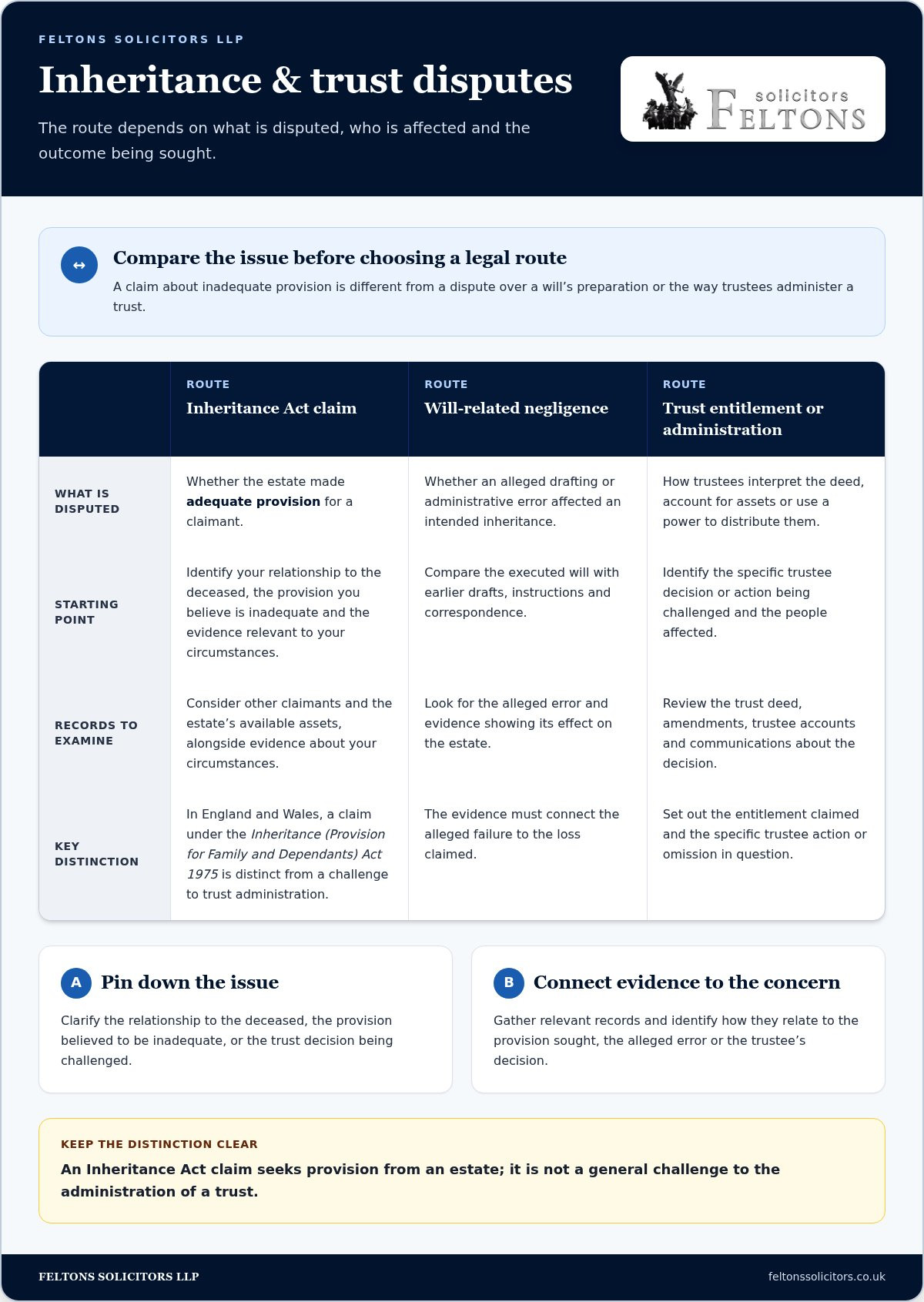
Inheritance claims may concern whether an estate made adequate provision, how a will should be interpreted or a beneficiary’s entitlement under a trust. The appropriate route depends on the facts, the parties’ relationship and the decision in dispute.
In England and Wales, claims under the Inheritance (Provision for Family and Dependants) Act 1975 are distinct from challenges to a trust’s administration. In Amnir & Ors v Bala & Ors, the High Court considered competing Inheritance Act claims in [2023] EWHC 1054 (Ch), according to the Judiciary of England and Wales. The case illustrates why identifying other claimants and the estate’s available assets matters.
Claims involving wills and professional negligence
A will-related negligence claim may arise when an alleged drafting or administrative error affects an intended inheritance. Compare the executed will with earlier drafts, instructions and correspondence, then identify the alleged error and its effect on the estate. For example, a beneficiary may question whether a gift was omitted or recorded differently from the deceased’s instructions. The evidence must connect the alleged failure to the loss claimed.
Beneficiary claims and trust entitlements
A beneficiary may dispute how trustees interpret the trust deed, account for assets or exercise a power to distribute them. Review the deed, amendments, trustee accounts and communications about the decision. Set out the entitlement claimed and the specific action or omission being challenged. If beneficiaries have competing claims, identify each person’s interest and the practical effect of the proposed outcome on the trust.
Time limits for trust and inheritance claims
There is no single time limit for every trust or inheritance claim in England and Wales. The applicable deadline depends on the legal basis of the claim and the event from which time runs. An Inheritance Act claim, a challenge to estate administration and a claim alleging breach of trust may each require separate deadline analysis. Establish the claim type, key dates and procedural position before deciding what to do next.
Gather the death date, grant documents, trust records and any relevant correspondence into a chronology. For a claim under the Act 1975, record when the estate was administered and which decisions affect the claimant. Prompt legal assessment helps identify the governing time limit and any action needed to protect the claim.
Trustee removal and breach of trust claims require a clear account of the conduct being challenged. A beneficiary may allege that a trustee failed to follow the deed, put personal interests first or misapplied trust property. Distinguish an alleged breach from disagreement with a decision, then match each allegation to accounts, resolutions or correspondence. A fiduciary duty claim also requires attention to the trustee’s role and the benefit or loss said to have followed.
For a practical next step, organise the will, trust deed and estate records before seeking wills and probate advice. A concise chronology can help clarify whether the issue concerns inheritance, professional negligence, beneficiary rights or trustee conduct.
Trust variation and declarations of trust
A trust deed explains how trustees must manage assets and beneficiaries’ interests. If its wording or practical effect creates difficulty, the issue may call for rectification, variation or a declaration clarifying existing rights.
Trust deed rectification and variation
Rectification addresses an alleged error in the deed’s wording; variation seeks to change its terms. The distinction matters. Gather the signed deed, earlier drafts and correspondence, then establish whether the dispute concerns what the document was meant to say or how it should operate now. A drafting discrepancy, for example, may point towards rectification, while changed family circumstances may prompt consideration of variation.
Capacity and the interests of affected individuals are central practical considerations. A specialist review should map each relevant clause against the proposed change, identify who benefits or loses, and explain the evidence supporting the request. Hudson v Hathaway (2022) is discussed in connection with whether an electronic signature can create a trust of land, illustrating why the form and execution of a document may matter.
Trust variation applications
A variation application asks for trust terms to be changed, rather than simply clarified. Trustees may seek the court’s directions or blessing when a proposed course raises uncertainty or affects beneficiaries. Prepare a concise account of the requested change, why it is proposed, who would be affected and which trust provisions are involved.
For a trust intended to provide for a family, explain how the proposed terms address current circumstances and the trust’s purpose. Set out the existing arrangement alongside the proposed one, then describe the effect on each interest. This comparison helps trustees and the court assess the practical consequences, including any disagreement between beneficiaries.
Declarations of trust
A declaration can ask the court to clarify rights or obligations that already exist under a trust. It does not necessarily seek new terms. Identify the precise question, such as how a clause should be interpreted or whether a named individual has an interest in particular property.
Collect the deed, related property documents and relevant communications before defining the issue. Hudson v Hathaway (2022) shows how questions about a trust of land may turn on the document said to create it, including its signature. Keep the requested declaration narrow enough to resolve the actual uncertainty.
Before choosing a route, trustees and beneficiaries can organise the evidence into three groups: the trust instrument and amendments; records of trustee actions; and material explaining the proposed change or disputed interpretation. This helps distinguish an alleged drafting mistake from a disagreement about administration.
If a variation affects several beneficiaries, record each person’s position and the practical impact on their interest. A proposed change that appears helpful to one person may alter another’s expected provision. Comparing those effects clearly can guide discussions and help trustees decide whether directions or a court application are appropriate.
For trustees, a reasoned record of deliberations can show how relevant factors were weighed. For beneficiaries, a precise account of the clause, decision or document in dispute helps focus the response. The suitable route depends on whether the concern is the deed’s wording, its current operation or the meaning of existing rights.
Trustee removal and trustee applications
A trustee application can seek directions, address alleged misconduct or ask the court to remove a trustee. The evidence should connect the concern to the trust’s administration and the interests affected.
Trustee fiduciary duties
Trustees must administer a trust for its proper purposes and consider relevant factors when making decisions. A beneficiary challenging conduct should identify the decision, the trust provision involved and the alleged harm. Unexplained payments or a failure to account for trust assets, for example, may raise questions about administration. Separate documented facts from suspicion before deciding what remedy to seek.
In Earl of Yarmouth v Ragley Trust Co Ltd, the High Court (Chancery Division) considered trustee removal in 2025, in [2025] EWHC 1099 (Ch), according to the Judiciary of England and Wales. The decision is a relevant example of a court considering removal, rather than a rule that every disagreement justifies it.
Removing trustees and executors
Removal may be considered if a trustee’s conduct, inability to act or conflict creates a practical problem for the trust. An application should explain how the issue affects proper administration, rather than simply describe a breakdown in personal relations. Identify the trustee’s actions, the resulting difficulty and whether another measure could address it.
Build the evidence from the trust deed, accounts, trustee resolutions and correspondence. A clear chronology can show when concerns arose and how the trustee responded. For example, compare a disputed distribution with the deed’s terms and the recorded reasons for the decision. These documents help distinguish an alleged breach from dissatisfaction with the outcome.
Executors administer an estate under a will, while trustees manage assets under a trust. The roles can overlap, but the concern may require different evidence and remedies. For a probate dispute, identify the executor’s act relating to the estate; for a trust dispute, focus on the deed, trust property and trustee decisions. This distinction helps direct an application at the right person and issue.
Before applying, define the order sought and its practical purpose. A request for directions may clarify how trustees should proceed; an application for removal seeks to change who administers the trust. Consider affected beneficiaries, any proposed replacement and the records needed to support the request. Explaining the alternatives considered gives the court a clearer account of the dispute.
For a trust or estate dispute, legal advice can help organise documents, assess the alleged breach and identify a proportionate next step. A focused account of the conduct, evidence and impact is more useful than a general accusation against a trustee or executor.
Trusts, divorce and family law
A trust can become a point of dispute during divorce or another family disagreement, particularly when relatives share control of property. The key is to distinguish the trust’s legal ownership and terms from the resources practically available to each person.
Start by identifying the trust’s structure, trustees, beneficiaries and the source of its assets. A discretionary trust, for example, may leave distribution decisions to trustees, while a fixed entitlement may be set out directly in the deed. The trust’s label alone does not explain how it operates. Review the deed, amendments, accounts and distribution history to understand who controls the assets and how decisions are made.
In divorce financial arrangements, a trust may be relevant to the wider financial picture, but its existence alone does not establish that a spouse can demand trust property. Consider whether a spouse is a beneficiary, whether distributions have been made and what access or influence they have over trustee decisions. Organise the evidence around these questions rather than relying on assumptions about the word “trust”.
Family farms and landed estates can make the analysis more involved. A farm may include a home, working land, business assets and property held through a trust, with relatives having different interests. Prepare a clear asset map showing ownership, occupation, income and decision-making. This helps distinguish a beneficiary’s potential interest from an asset owned directly by a spouse or another family member.
Trust disputes may also arise alongside claims about family and dependants after a death. Executors administer the deceased’s estate, while trustees manage trust property under its terms. Where roles overlap, identify who made each decision. Keep separate records for estate administration, trust distributions and family arrangements. This can clarify whether the issue concerns an inheritance claim, a trustee decision or the financial consequences of a separation.
A practical first step is to build a chronology of key events: trust creation, later amendments, marriage or separation, distributions and any disputed decision. Add the relevant documents beside each event, then note what outcome each person seeks. For a private client matter involving a family or a rural estate, this organised picture helps solicitors assess connected trust, property and relationship issues without conflating them.
If trust assets are complicating a separation or family financial discussion, discuss divorce and financial arrangements with a solicitor who can consider the related issues together.
Feltons Solicitors LLP: Divorce and Financial Arrangements
Feltons Solicitors LLP can help with divorce and financial arrangements where family finances are affected by a trust or inheritance dispute. Advice can help distinguish issues arising from separation from those concerning an estate or trust. Where a death or will raises connected questions, the firm’s Wills, Probate, Trusts and Estate Planning service may also be relevant.
Consider speaking to a solicitor when a financial settlement involves trust interests, family property or an expected inheritance. Gather relevant documents, such as financial records, trust information and the will, to make the issues clear.
Contact Feltons Solicitors LLP to discuss your circumstances.
Choose a clear next step for your dispute
Turn the concern into a focused plan: identify the decision or document in dispute, gather key records and decide which outcome matters most. This gives a solicitor a practical starting point and keeps discussions centred on the issues that need resolving.
When choosing contentious trust litigation lawyers in the UK, consider whether your matter also involves separation, estate administration or property ownership. Feltons Solicitors LLP offers Divorce and Financial Arrangements, Wills, Probate, Trusts and Estate Planning, and residential and commercial conveyancing. These services may be relevant when a family dispute connects with financial arrangements, an estate or property.
For guidance on the next step in your circumstances, contact Feltons Solicitors LLP. A clear account of the issue can help begin a measured discussion about the available route forward. You can approach the process one issue at a time, with a better understanding of what needs attention and why.
Frequently Asked Questions
How do I find a specialist contentious trust litigation solicitor in England and Wales?
Look for a solicitor whose experience matches the dispute, such as trustee conduct, trust interpretation or beneficiary rights. When speaking with contentious trust litigation lawyers in the UK, ask how they would approach your issue, what documents they need and how they explain options and costs. If assets or trustees are overseas, ask how they approach cross-border issues. A focused initial discussion can help you assess whether their experience and communication style suit your needs.
What steps are involved in resolving a contentious trust dispute, from mediation to court?
Start by defining the issue and gathering the trust deed, relevant accounts and correspondence. The parties can then exchange their positions and explore settlement through negotiation or mediation, recording proposals clearly. If they do not reach agreement, court proceedings may be considered. The dispute is presented through formal documents and evidence, and the court determines the issues before it. The appropriate route depends on the disagreement, the parties involved and the outcome sought.
Which UK law firms are highly rated for contentious trust litigation?
No single UK-wide rating identifies one firm as best for every dispute. Compare relevant trust litigation experience, reported casework, professional credentials and client feedback with the issues in your case.