
What if divorce discussions could focus on practical family arrangements rather than preparing for court? The collaborative divorce process in the UK gives each partner their own collaboratively trained lawyer, with negotiations taking place in structured meetings involving both partners and both lawyers. It relies on honest financial disclosure and a shared commitment to reach an agreement. If negotiations fail, both partners must instruct new lawyers to continue their cases.
It’s understandable to want a clear picture of the process before deciding whether it feels right for your family. This guide explains how collaborative law can help resolve issues arising from separation, what can affect the cost, and what happens during preparation meetings, including how an Anchor Statement can keep discussions focused on your priorities. You’ll also learn what the Participation Agreement means, how an agreement can become legally binding, and why this route may not suit every situation.
Key Takeaways
- Understand what drives the overall cost, including the complexity of your finances and the work needed to reach agreement.
- Learn why the collaborative process requires both partners to change lawyers if negotiations break down.
- See how preparation meetings and an Anchor Statement can help keep discussions connected to your priorities.
- Explore when collaborative law may help resolve separation-related family issues, and what makes the approach suitable.
How Much Will It Cost to Go Through Collaborative Divorce?
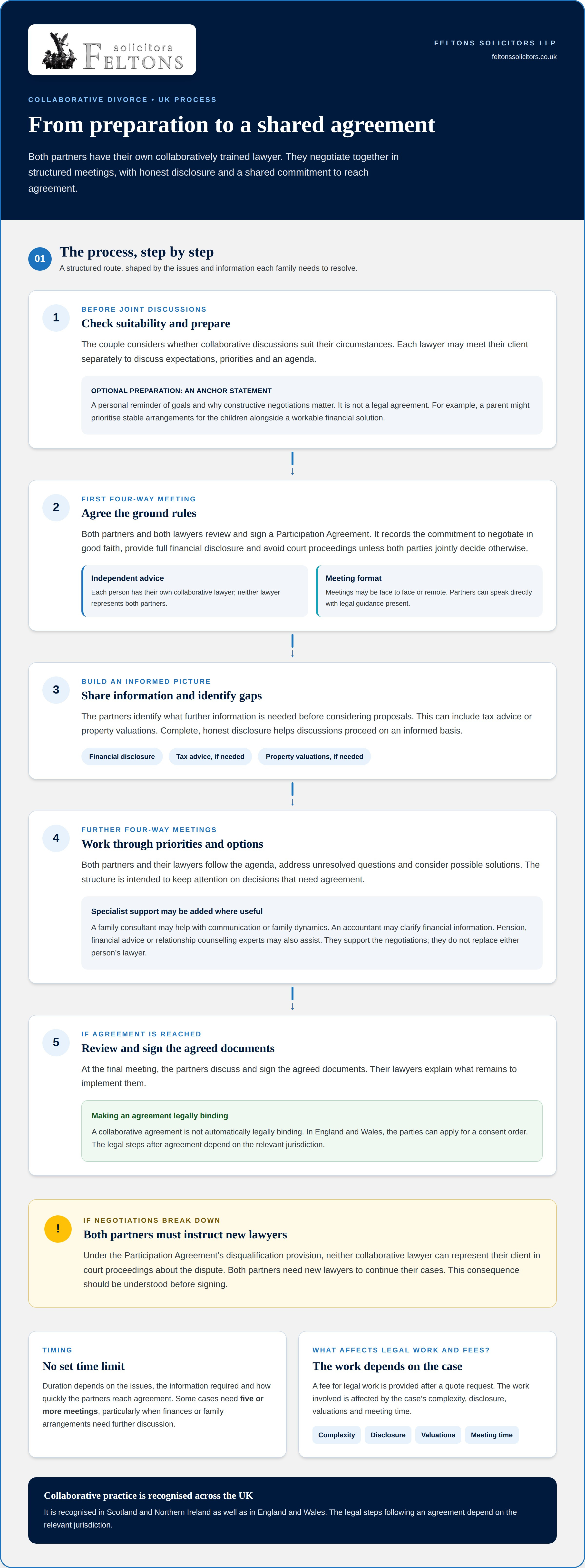
The collaborative divorce process in the UK brings each partner and their lawyer together to negotiate a family agreement. At the first four-way meeting, the parties review and sign a Participation Agreement, committing to full financial disclosure and good-faith negotiations. They agree not to start court proceedings unless they jointly decide otherwise. The approach depends on both partners being willing to work towards a fair, practical solution.
The fee for legal work depends on the case and is provided after a quote request; complexity, disclosure, valuations and meeting time affect the work involved. Some cases need five or more meetings, particularly where finances or family arrangements require further discussion. In England and Wales, 103,592 divorces were granted in 2020, according to the Office for National Statistics. That figure gives context, but does not indicate the cost of collaborative negotiations.
The process begins with an assessment of whether collaborative discussions suit the couple’s circumstances. Lawyers then prepare for the first joint meeting, where the parties identify any missing information, such as tax advice or property valuations. Further meetings address priorities and work towards agreed terms. There is no set time limit: the duration depends on the issues, the information required and how quickly the parties reach agreement.
Collaborative practice is recognised in Scotland and Northern Ireland as well as in England and Wales. The approach centres on each partner having a lawyer and negotiating together, though the legal steps that follow an agreement depend on the relevant jurisdiction. A collaborative agreement is not automatically legally binding. In England and Wales, parties can apply for a consent order to make their agreement legally binding, according to the Ministry of Justice. At the final meeting, the agreed documents are discussed and signed, and the lawyers explain what remains to implement them.
The requirement to change lawyers if the process fails
Each partner instructs a separate lawyer trained in collaborative practice. The lawyers advise their own clients and work with one another rather than against each other. They do not jointly represent both parties. This distinction matters: each person receives independent legal advice while taking part in shared negotiations about separation, finances or arrangements for children.
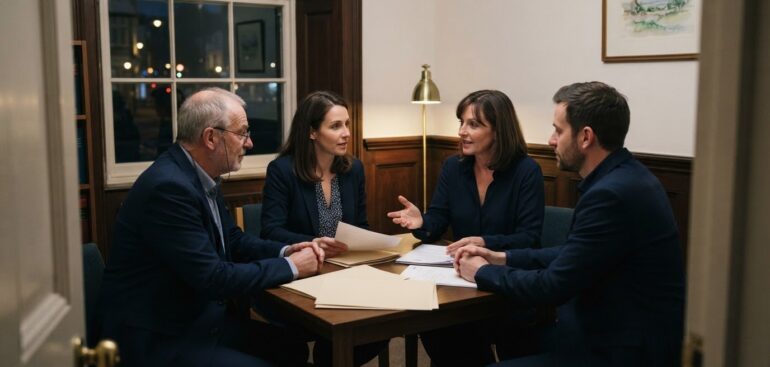
Discussions usually take place in four-way meetings attended by both partners and both collaborative lawyers. The parties can speak directly, raise concerns and consider possible solutions with legal guidance present. Meetings may be face to face or remote. Lawyers can share relevant advice with the other partner and lawyer, supporting open discussion rather than a series of letters between representatives.
The Participation Agreement records the commitment to negotiate in good faith and avoid court proceedings unless both parties agree otherwise. It also sets out what happens if negotiations end without agreement: neither collaborative lawyer can represent their client in court proceedings about the dispute. Both partners must find new lawyers to continue their cases. This is known as the disqualification provision. It gives each side a clear reason to work towards an agreement, but the parties should understand this consequence before signing.
Additional professionals may contribute specialist support where the issues call for it. A family consultant can help address communication or family dynamics, while an accountant may clarify financial information. Pension, financial advice or relationship counselling experts may also assist both partners. These professionals support the negotiations; they don’t replace either person’s collaborative lawyer. If you’re considering separation arrangements, legal advice on divorce and financial arrangements can help you understand the issues involved.
Preparation meetings and Anchor Statements
Preparation helps each person identify what matters before joint discussions begin. Collaborative solicitors can use this groundwork to shape focused meetings around the couple’s priorities.
Collaborative meetings and negotiations
Before the first joint meeting, collaborative lawyers may meet their clients separately to discuss expectations, priorities and an agenda. This gives each person time to explain concerns privately and receive legal advice from a solicitor trained in collaborative practice. Clients may also prepare an Anchor Statement setting out their goals and why they chose this process. For example, a parent might prioritise stable arrangements for the children alongside a workable financial solution.
An Anchor Statement is a personal reminder, not a legal agreement. If a discussion becomes emotive, it can help the parties return to their stated preferences and the reasons they wanted constructive negotiations. At joint meetings, both partners and their lawyers work through the agenda, identify unresolved questions and consider possible options. This structure keeps attention on decisions that need agreement, rather than letting one difficult topic dominate every discussion.
Transparency, advice and disclosure
Transparency means sharing complete and honest information about assets so negotiations can proceed on an informed basis. At the first four-way meeting, the parties review the Participation Agreement and identify any further information needed, such as tax advice or property valuations. These requests help clarify the financial picture before either person considers proposals. Without full disclosure, discussions may rely on incomplete assumptions, making a practical agreement harder to reach.
Each partner’s solicitor provides independent legal advice, helping them understand their options and the implications of proposals. Relevant advice may also be shared with the other partner and lawyer, supporting informed discussion. A qualified financial or tax professional may be involved when specialist input is needed. The lawyers can help the parties revisit their priorities, including children’s needs, as new information emerges. Preparation does not determine the outcome; it gives negotiations a clearer, more considered starting point.
Collaborative law as a way to resolve family issues
Collaborative family law is a form of dispute resolution that aims to reach agreements through discussion rather than contested court proceedings. It can address financial and children-related issues after separation, as well as arrangements in nuptial or cohabitation agreements. Unmarried parents may also use it to discuss arrangements for their children. The central idea is to find a workable resolution shaped around the family’s circumstances.
This approach can help couples discuss practical decisions while keeping the focus on solutions rather than conflict. For parents, that may mean considering their children’s needs alongside financial arrangements. The lawyers guide negotiations, while the parties retain control over the outcome. Neutral professionals, such as family consultants or accountants, can contribute when family dynamics or financial information need specialist input. Their role is to inform discussions, not decide the result.
Collaborative practice depends on both people being willing to participate honestly and consider each other’s priorities. It may be unsuitable where domestic abuse prevents one person from taking part on an equal footing, or where a fixed position leaves no room for meaningful negotiation. A practitioner assesses whether the approach fits the client’s needs and objectives. This matters because a process built on direct participation cannot work well if one person cannot speak freely.
Mediation offers a different setting: its meetings involve the mediator and both partners, whereas collaborative discussions include each partner’s lawyer. The methods share a focus on resolution, but the support and structure differ. Collaborative law can also address family agreements before or outside divorce, giving couples a way to discuss issues early. There is no fixed timetable; the parties can set an agenda around their priorities and circumstances. For guidance on a family dispute, discuss your resolution options.
Feltons Solicitors LLP: Divorce and Financial Arrangements
Feltons Solicitors LLP advises on divorce and financial arrangements when you’re considering collaborative discussions or need guidance on your next steps. Legal advice can help you understand the issues, consider financial arrangements and assess what may happen if negotiations do not reach agreement. If talks break down, the collaborative lawyers cannot represent either party in court proceedings, so advice on how to proceed becomes particularly relevant.
Support can also help you understand how an agreement may be formalised and what remains to put its terms into effect. The right approach depends on your circumstances, including the issues to resolve and whether both partners can participate openly. For a considered discussion of your divorce and financial arrangements, contact Feltons Solicitors LLP.
Choose a route that fits your family
Choosing the collaborative divorce process in the UK is a decision about how you want difficult family matters handled, not simply how to formalise separation. Consider whether you and your former partner can share information, take part in structured discussions and remain open to workable options. Your priorities may include financial security, arrangements for children or constructive communication. Being clear about what matters most can make an initial legal discussion more focused.
It’s also sensible to consider what you would need if negotiations did not produce an agreement. Understanding the implications of each route early can help you make a considered choice, rather than treating the process as a commitment without alternatives. Legal advice can help you assess your circumstances and the practical consequences of the options available. You can also identify questions about documenting any eventual agreement and putting its terms into effect.
If you’re ready to discuss your situation, contact Feltons Solicitors LLP. A measured first conversation can help you choose a way forward that reflects your family’s needs.
Frequently Asked Questions
What is Collaborative Law?
Collaborative Law gives separating couples a way to negotiate family arrangements with support from their own lawyers. It can address more than divorce finances: couples may use it to discuss children’s arrangements or matters connected with cohabitation and nuptial agreements. The parties shape the outcome themselves, with legal advice to help them assess options and understand how proposed terms affect their circumstances.
How does it avoid going to court?
Both partners agree to negotiate outside court and take part in structured discussions, rather than asking a judge to decide unresolved issues during the process. Their written commitment gives discussions a clear framework. If negotiations fail, the collaborative lawyers cannot represent either partner in court proceedings about the dispute. The parties must instruct new lawyers if they decide to pursue that route.
What are the benefits?
The process gives separating partners space to develop arrangements around their family’s priorities, rather than leaving every decision to a court. For example, parents can discuss practical arrangements for their children alongside financial matters. Discussions are intended to remain confidential, and an outcome shaped by the parties can support communication between parents after separation. The approach depends on both people participating openly and considering workable proposals.
What happens after an agreement is reached through Collaborative Law?
The parties’ agreed terms are recorded in writing and discussed with their lawyers, who explain what remains to implement them. An agreement reached through collaborative family law is not automatically legally binding. In England and Wales, parties can apply for a consent order to make their agreement legally binding, according to the Ministry of Justice. The order can formalise agreed financial arrangements through the court.
What is Collaborative Law, and how does it differ from traditional litigation?
Collaborative Law is a negotiated approach in which each partner receives legal advice while working towards a shared resolution. In litigation, unresolved issues are put before a court, where a judge decides them. Collaborative discussions give the parties a more direct role in developing solutions, including arrangements for children or finances. The approaches differ in who shapes the outcome and how disagreements are resolved.
What is needed to make the process work?
The process requires both partners to disclose relevant information fully and honestly, engage in good-faith discussions and remain willing to consider practical options. Trust matters because each person must be able to negotiate using the information shared. Collaborative practice may not be appropriate where domestic abuse prevents one partner from participating on an equal footing, or where fixed positions leave no room for meaningful discussion.