

A fair divorce settlement in England and Wales isn’t automatically a 50/50 split. Equal division may be a starting point, but the outcome depends on both parties’ resources, needs, responsibilities and circumstances. Understanding how to get a fair financial settlement in divorce means looking at the whole financial picture, including property, savings, income and pensions.
It’s understandable to want a clear rule for what each person should receive. In practice, fairness involves more than whose name is on an asset or who earned more; the court also considers the needs of any child of the family under 18 years old, as UK Parliament explains.
This article explains what can make a settlement fair, how a financial order can formalise arrangements, and why full financial disclosure and reliable evidence matter during negotiations. It also covers the options available if agreement proves difficult, so you can understand the next steps.
Key Takeaways
- Assess fairness across the full financial picture, including needs, responsibilities and assets, rather than relying on an automatic equal split.
- Understand how a court order can formalise agreed arrangements and what the court process involves if agreement remains out of reach.
- See how clear financial disclosure and relevant evidence can support more informed settlement discussions.
- Explore mediation and legal support as routes for resolving financial issues and putting an agreement into effect.
What is a financial order?
A financial order is a court order setting out how a divorcing couple’s finances will be divided or supported. In England and Wales, it can formalise an agreement or resolve disputes when the couple cannot agree.
Applying for a financial order with legal support
Applying means asking the court to decide financial arrangements when negotiations have not resolved every issue. The Ministry of Justice states that the rules for applying are in Part 9 of the Family Procedure Rules. A solicitor can explain the application, organise the financial information and advise on proposals before going to court.
For a financial dispute resolution appointment, an applicant must write to the court at least 7 days beforehand, explaining settlement efforts. A solicitor can also review an existing order after divorce, assess the concern and evidence, and advise whether an application to challenge or change it is available.
Types of court orders
Financial orders set out different ways to divide property, capital, pensions and ongoing payments. Under Section 23 (1)(c) of the Matrimonial Causes Act, a court can make a lump sum order; Section 24 allows a transfer of property order.
Other possible outcomes include the sale of property, pension sharing, periodical payments, secured maintenance and pension attachment. The appropriate order depends on the finances and the arrangement sought. If a spouse lives abroad, a solicitor can consider the proposed order, the country involved and practical enforcement, as procedures depend on the jurisdiction.
Formalising an agreement with a court order
A consent order turns agreed financial arrangements into a court order. It can cover money and property. Pension sharing arrangements generally require a formal court order rather than a private agreement.
A consent order is not approved automatically. A judge must be satisfied that the agreement is fair, and the application can be filed at the conditional order stage. A solicitor can prepare the proposed terms and supporting financial information, helping you seek a clear, court-approved outcome.
Finances on Divorce: What is a Fair Settlement?
A fair outcome depends on both parties’ circumstances, resources and needs, rather than a fixed division. UK Parliament says the court considers the welfare of any child of the family under 18 years old; children’s housing needs can therefore affect how finances are divided.
Mediation and out-of-court help
Financial mediation is a structured discussion with an impartial mediator, giving a couple a way to explore proposals without asking a judge to decide. Working with independent dispute resolution services such as Conflict Manager can help identify areas of agreement, such as property, income and pensions, and clarify what remains unresolved.
Other ways to reach an agreement outside court include solicitor negotiations and arbitration. A solicitor can help prepare proposals, explain the financial disclosure needed and assess whether suggested terms reflect your circumstances. If you reach agreement, you can consider formalising it in a financial order.
When mediation may be unsuitable
Mediation may be inappropriate if domestic abuse has occurred or one party is trying to dispose of assets. In these circumstances, a joint discussion may not provide a safe or balanced way to negotiate.
Reliable disclosure and meaningful participation from both people are essential to settlement discussions. A solicitor can consider your concerns and explain other routes, including negotiation or asking the court to resolve outstanding disputes.
Collaborative law and negotiation
Collaborative law is a negotiation process in which each person has legal support while working towards an agreement outside court. A solicitor can help you assess proposals, identify practical options and negotiate terms that take account of housing needs, income and pension resources.
For example, you might discuss whether one person can remain in the family home and how that would fit alongside each person’s other assets. Mediation or solicitor-led negotiation can help narrow disagreements. Legal advice can clarify the implications before you decide whether to accept the terms.
Court fees and legal costs
Court fees and legal costs depend on the route taken, the complexity of the finances and the work involved. A straightforward agreement needing limited legal input differs from contested proceedings involving extensive disclosure or unresolved property and pension issues.
Ask your solicitor to explain which work is included in any estimate and how additional negotiations or court hearings may affect costs. Court fees are separate from legal fees, and help with court fees may be available for eligible applicants. Legal support with financial arrangements can help you understand the options for your circumstances.
Preparing evidence for settlement negotiations
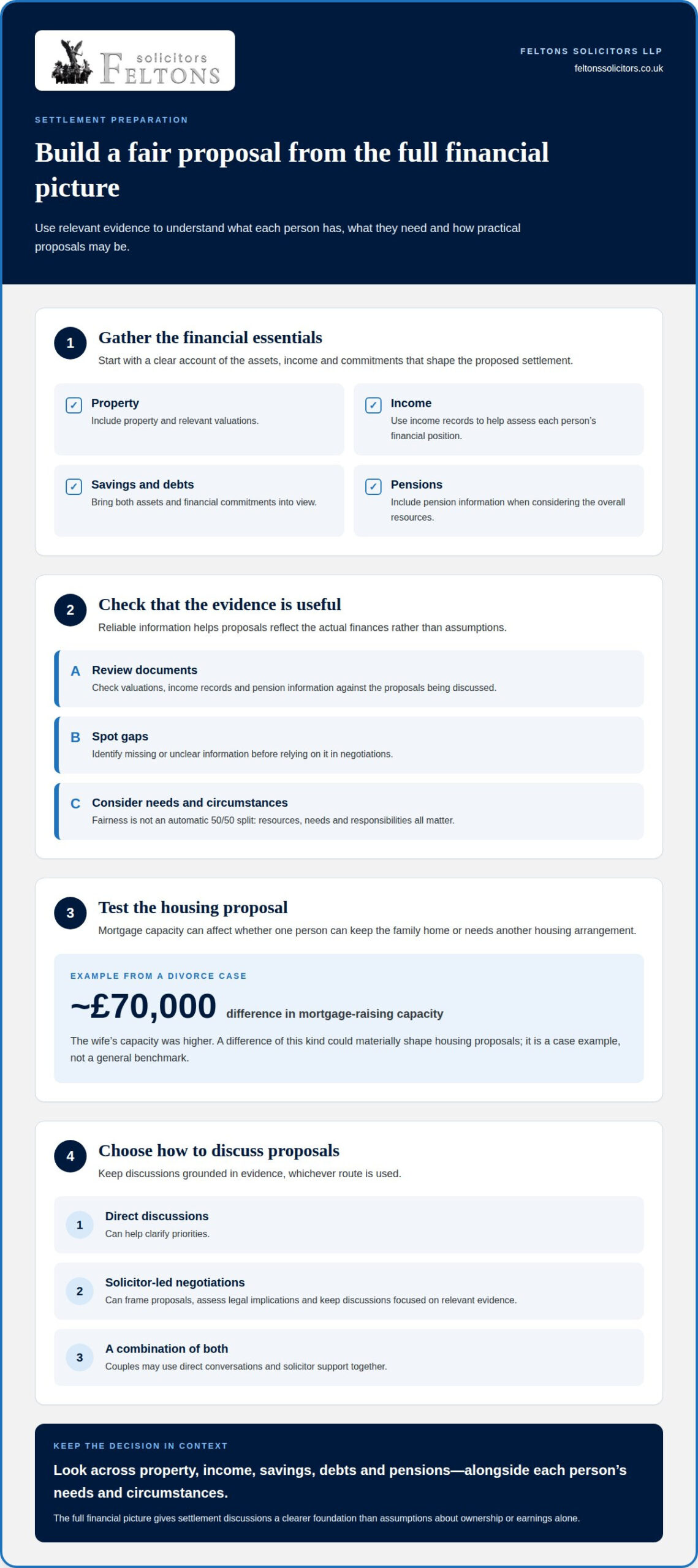
Strong evidence helps both parties assess proposals against the actual matrimonial finances, rather than assumptions. A solicitor can organise information about property, income, savings, debts and pensions, then identify which decisions need discussion. For example, mortgage capacity can affect whether one partner can keep the home or needs another housing arrangement. Grounding proposals in the full financial picture is central to how to get a fair financial settlement in divorce.
Legal support helps turn documents into a practical negotiating position. A solicitor can review valuations, income records and pension information, highlight gaps, and explain how each item may affect sharing. In one divorce case, the parties’ mortgage-raising capacities differed by about £70,000, with the wife’s higher. That difference could materially shape housing proposals.
Couples may negotiate directly, through their solicitors, or using both approaches. Direct conversations can clarify priorities, while solicitors can frame proposals, assess their legal implications and keep discussions focused on relevant evidence. If your former partner makes an offer, legal advice can help you judge whether it is workable or overlooks an asset or future need.
Before responding to an offer, a solicitor can compare the proposed division with the available financial information. Consider whether pension sharing, property, savings and liabilities have all been addressed. Clear records also help explain why a counter-proposal is reasonable, rather than relying on conflicting recollections.
Agreeing without legal advice risks overlooking assets, accepting unclear terms or misunderstanding the effect on future claims. An informal arrangement may not provide the protection of a court-approved consent order. Independent advice helps you understand the proposed outcome before deciding whether to formalise it.
For anyone considering how to get a fair financial settlement in divorce, evidence-based proposals provide a clearer basis for informed decisions. If negotiations stall, a solicitor can help define the disputed issues and consider whether mediation or a financial order is the appropriate next step. The aim is to support decisions based on the available information, not simply to press for a particular percentage.
Financial disclosure
Financial disclosure sets out each person’s assets, income and liabilities, helping establish what is available for settlement. This information is important when assessing proposals against needs such as housing and ongoing commitments.
Disclosure and asset valuation
Disclosure means sharing relevant financial information so the couple can accurately assess their finances. It helps identify what may need to be divided and supports realistic discussions about meeting each person’s needs.
Property, savings, investments, debts and pensions all contribute to the financial picture. For example, a home’s value and outstanding mortgage help establish its equity, while pension information can show whether one person has substantially greater retirement provision. Legal support can help identify missing details and clarify how an asset should be valued.
Using Form E
Form E is a financial disclosure form used in court proceedings to set out a person’s financial position. If a dispute goes to court, the court may order both parties to complete it by a specified deadline.
Legal support with Form E can help organise figures and supporting documents into a clear account. A solicitor can review information about property, income, savings, debts and pensions, and identify inconsistencies before proposals are considered. This structured approach helps the parties and court assess the available resources consistently.
Hidden assets and refused disclosure
If a spouse hides assets or refuses to disclose finances, settlement discussions may be based on an incomplete picture. This makes it harder to assess whether a proposal fairly reflects the available assets, including savings, investments and pension provision.
A solicitor can identify gaps or inconsistencies in the information and advise on raising them during negotiations. If the dispute proceeds to court, the court may order both parties to complete Form E by a set deadline. This can bring relevant financial information into the process and support informed decisions about reaching an agreement.
Clear disclosure gives negotiations a stronger factual basis. For legal support with financial disclosure, obtain advice on organising the information and addressing gaps.
Feltons Solicitors LLP: Divorce and Financial Arrangements
Feltons Solicitors LLP provides legal support with divorce and financial arrangements, helping you address financial questions during separation. Seek advice if disclosure is incomplete, negotiations have stalled or you need clarity before accepting proposed terms.
Legal support can help you understand the financial information, assess how proposals relate to your circumstances and needs, and work towards arrangements that can be formalised appropriately. If the settlement includes a property transfer, residential conveyancing may also be needed to put the agreement into effect.
Each case calls for careful attention to its financial details and personal circumstances. If you would like to discuss your situation and the legal support available, contact Feltons Solicitors LLP.
Make your next decisions with clarity
A settlement shapes more than the immediate separation. It can affect where you live, how you manage future commitments and which financial arrangements need attention next. Understanding how to get a fair financial settlement in divorce helps you make considered decisions for life after separation, rather than focusing only on reaching an agreement quickly.
As financial arrangements take shape, consider whether other legal matters also need attention. A major change in family circumstances may raise questions about wills and estate planning, while an agreed property transfer may involve conveyancing. Feltons Solicitors LLP offers Wills, Probate, and Estate Planning, alongside Residential and Commercial Conveyancing, for clients whose next steps extend beyond the settlement.
Take time to consider the advice you need and the decisions still ahead. For guidance tailored to your divorce and financial arrangements, contact Feltons Solicitors LLP. A clear, informed next step can help you move forward with greater confidence.
Frequently Asked Questions
How does the court decide who gets what?
In England and Wales, the court weighs the parties’ financial resources, needs, responsibilities, ages, earning capacities and marriage length. Section 25 of the Matrimonial Causes Act 1973 sets out factors the court considers, including the welfare of any child of the family under 18. For example, different housing needs or pension provision can affect how assets are allocated, even where both parties contributed to the marriage.
Step 2 – How can I find out what is a fair settlement?
Assess fairness by comparing each person’s needs with the resources available, rather than starting with a percentage alone. Consider likely housing costs, income, debts and future pension provision alongside property and savings. A solicitor can review the figures and explain how proposals could work in practice, such as one person keeping the home while the other receives a different asset.
Does fair mean a 50/50 split?
No. An equal division may be a starting point, but it is not automatic in England and Wales. A different division may be appropriate if one person has greater housing needs, particularly as the main carer of children, or if the parties’ resources and responsibilities differ. The court considers the overall circumstances, not just equal shares of individual assets.
How can a solicitor help you reach a realistic settlement?
A solicitor can assess whether a proposal reflects the financial information and each person’s practical needs. For example, they can examine whether a proposed home transfer is workable alongside mortgage capacity, savings and pension arrangements. They can also communicate offers, explain their implications and narrow disputed points, keeping discussions focused on possible outcomes rather than assumptions or a single headline figure.
What can the court order?
The court can make orders for a lump sum, property sale or transfer, pension sharing, or ongoing maintenance. The type of order depends on the issue to be resolved. A property transfer, for instance, may determine who keeps the home, while a pension-sharing order addresses pension provision. A financial order can combine arrangements rather than treating each asset or payment separately.
What is the usual financial split in a divorce?
There is no single usual split for every divorce in England and Wales. An equal division can be a reference point, but housing needs, children’s welfare, income, pensions and available assets may lead to a different outcome. For example, an equal division of property may not meet the housing needs of a child’s primary carer, so the wider financial arrangement matters.