

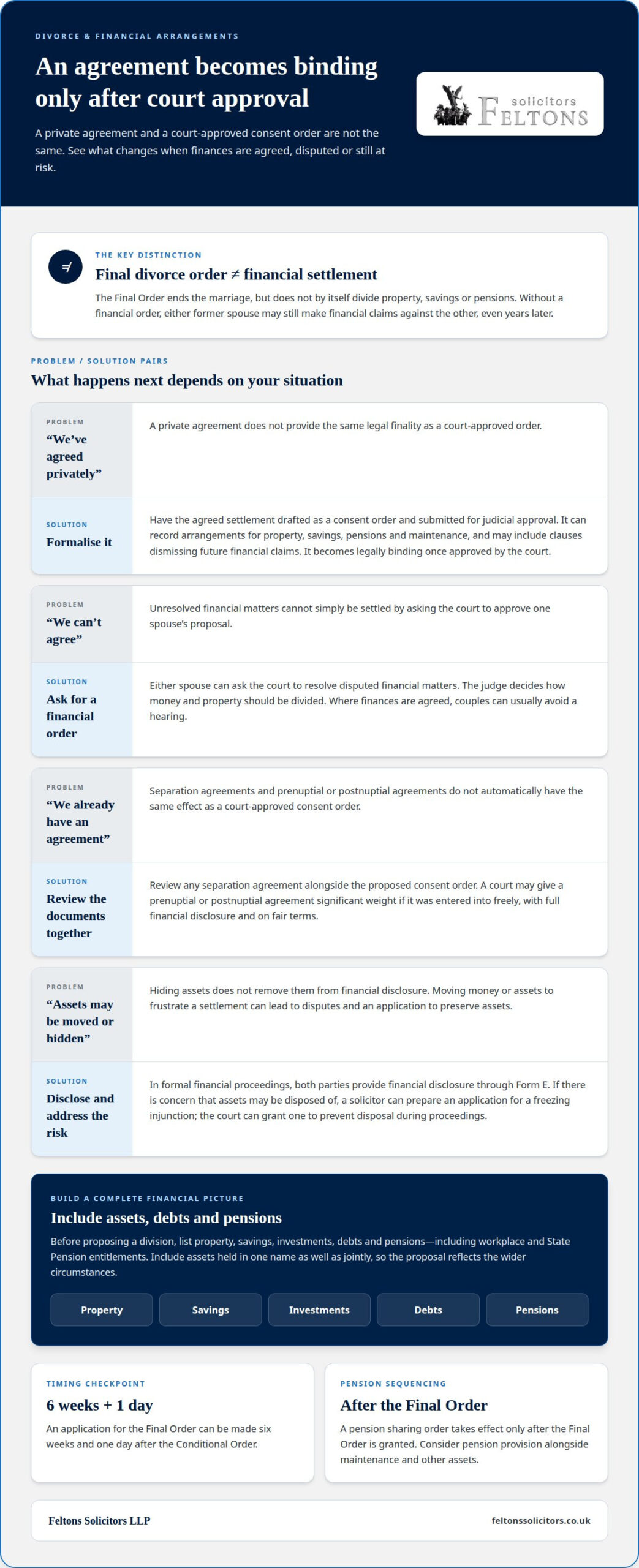
What if your divorce is final, but your financial arrangements aren’t? In England and Wales, the Final Order ends the marriage but does not, by itself, divide property, savings or pensions. Securing finances before the final divorce order means agreeing a financial settlement and, if you reach agreement, asking the court to approve it in a consent order.
It’s understandable to assume that being divorced closes the financial chapter. It may not: without a financial order, either former spouse can still make financial claims against the other, even years later. The timing matters too. According to the Ministry of Justice, you can apply for a final divorce order six weeks and one day after the conditional order.
This guide explains how the Final Order affects financial claims and what to consider when arranging your home, mortgage, pensions and maintenance. You’ll also learn how a consent order can make an agreement legally binding, helping you approach the next step with greater clarity.
Key Takeaways
- Understand why a final divorce order ends the marriage but does not, on its own, settle financial claims.
- Learn how a court-approved consent order can turn an agreed financial settlement into a binding arrangement.
- See what to consider when deciding how to deal with the family home, mortgage and equity.
- Explore when spousal maintenance or a clean break may fit your circumstances, and what each can mean for future claims.
What is a final divorce order?
In England and Wales, the final divorce order ends the marriage but doesn’t divide property, savings or pensions. It was previously called a decree absolute. The no-fault divorce process includes a 20-week reflection period after the application is made, according to the Ministry of Justice.
Either spouse may transfer or sell assets, but hiding assets does not remove them from financial disclosure in formal proceedings. Withdrawing money or moving assets to frustrate a settlement can lead to disputes and an application to the court to preserve assets. Where complex or concealed wealth is suspected, asset tracing specialists such as International Investigative Group can assist legal teams in locating undisclosed accounts to ensure full financial transparency.
- Resolve the full financial picture before applying. List property, savings, investments, debts and pensions, including workplace and State Pension entitlements. In formal financial proceedings, both parties provide financial disclosure through Form E. Include assets held in one name as well as jointly, so the proposed division reflects the wider circumstances.
- Address the family home and its ownership. Identify whether the property is held as joint tenants and how the settlement proposes to deal with it. The agreement should cover who remains, whether the home will be sold, and responsibility for mortgage payments. A transfer or sale can also have tax consequences, so include timing in the plan.
- Consider pension shares and maintenance together. A pension sharing order takes effect only after the final divorce order is granted. Pension attachment and pension sharing are court orders used to address pension benefits. Maintenance may provide regular support for children or living expenses; consider how it fits alongside pension provision and other assets.
- Review tax, inheritance and death benefits. Capital Gains Tax reliefs for transfers between spouses end when the final order is granted. The Finance Act 2023 provides an exemption window of up to three tax years after the end of the tax year in which the couple separates. Divorce also affects will provisions: section 18A of the Wills Act 1837 automatically revokes provisions for an ex-spouse unless otherwise specified. Consider inheritance claims and pension death benefits as part of the settlement.
- Take legal advice before finalising the timing. The Ministry of Justice says an application for the final order can be made six weeks and one day after the conditional order. A court can grant a freezing injunction to prevent assets being disposed of during proceedings. Advice can help assess whether applying now could affect pension arrangements, tax treatment or unresolved claims.
Consent orders and making an agreement legally binding
Decide whether to formalise an agreed settlement or ask the court to resolve disputed financial matters. The right route depends on what you and your spouse can agree.
Reach an agreement or seek a financial order with legal support
Set out the proposed division of assets and identify any unresolved issues. Solicitors can organise financial information, clarify the points in dispute and help negotiate a settlement. If you cannot reach agreement, either spouse can ask the court for a financial order. The judge then decides how money and property should be divided, rather than simply approving one spouse’s proposal.
Make the financial agreement legally binding with a consent order
Ask for an agreed settlement to be drafted as a consent order and submitted for judicial approval. The order can record arrangements for property, savings, pensions and maintenance, and may include clauses dismissing future financial claims. It becomes legally binding once approved by the court. Couples who agree on their finances can usually avoid a hearing, but a private agreement alone does not provide the same legal finality.
Review existing agreements with a solicitor
Have any separation agreement reviewed alongside the proposed consent order. An informal agreement between spouses may not provide the same legal finality as a court-approved order. Prenuptial and postnuptial agreements are not automatically binding in England and Wales, although a court may give them significant weight if they were entered into freely, with full financial disclosure and on fair terms. A solicitor can assess how the documents fit together before the settlement terms are submitted.
Consider court applications and fees with a solicitor
If you suspect assets may be disposed of, a solicitor can prepare an application for a freezing injunction, which the court can grant to prevent assets being disposed of during proceedings. The application should explain the concern and identify the assets at risk. For interim maintenance or help with legal fees, it should set out the immediate financial need and the circumstances for the court to consider.
Financial remedy application and solicitor fees depend on the case and are given after a quote request. Complexity, financial disclosure, negotiations and court work affect the cost. A solicitor’s review of financial arrangements can help clarify which application fits the dispute.
Dividing home equity and mortgage responsibilities
Agree how the family home, its equity and ongoing payments fit into the financial settlement. Housing needs, ownership and mortgage obligations all affect the arrangements.
-
Assess home equity and housing arrangements with legal advice
Establish the property’s likely sale value and subtract the outstanding mortgage to estimate equity. Citizens Advice gives the example of a £250,000 home with a £200,000 mortgage, leaving £50,000 before selling costs. Three separate valuations can help estimate a realistic sale price. Then consider whether one spouse can afford to keep the home, or whether a sale better meets both parties’ needs.
A Mesher order may postpone one person’s share until a specified event, such as the youngest child reaching 18 or completing specified education, up to age 21. Include housing needs and any pension sharing in the wider settlement, rather than treating the house as the only asset.
-
Review your rights to remain in the home with a solicitor
Clarify who can remain in the matrimonial home while financial arrangements are unresolved. The Family Law Act 1996 is relevant to a non-owning spouse’s right to remain in the family home until financial matters are resolved. A separating parent may also be able to stay with children until the youngest reaches 18, or finishes secondary education, before a sale. Ownership, housing needs and the proposed settlement affect the practical arrangements.
-
Get advice before changing joint financial arrangements
Before changing access to joint bank accounts or credit cards, or altering mortgage arrangements, consider how this could affect household payments and the proposed division. A change does not, by itself, settle responsibility for joint debt: divorced spouses remain jointly liable unless a financial order provides otherwise. Removing access or changing payment arrangements does not necessarily release either spouse from existing responsibilities.
Include mortgage payments and other agreed household commitments in settlement discussions. A clear record of who pays what helps solicitors consider these arrangements alongside home equity and any future sale or transfer.
Spousal maintenance and clean breaks
Consider whether ongoing support or a clean break better suits your finances after marriage. Full financial disclosure helps make that decision practical.
-
Provide financial disclosure
Give complete financial disclosure in formal proceedings, using Form E to set out your financial position. Include income, property, savings, investments, debts and pension information, whether held individually or jointly. Accurate disclosure helps both spouses assess the available assets and each person’s needs. Omissions can leave important details unresolved and weaken the proposed settlement.
-
Consider spousal maintenance
Assess whether one spouse needs regular payments towards living expenses after the marriage. The court can consider maintenance alongside property, pensions and other financial arrangements. For example, childcare responsibilities may limit one person’s ability to earn, making a clean break unsuitable at that point. A nominal maintenance order, such as £1 a year, can preserve the possibility of seeking more if circumstances change.
Set out the proposed amount, payment frequency and duration in the financial arrangements. These details help distinguish ongoing support from a one-off transfer of assets.
-
Set out clean break provisions
Decide whether the settlement should end future financial claims between you. A clean break order prevents either former spouse from making future financial claims against the other. Without a financial order, claims may remain possible even years after the divorce is finalised. The order should therefore address relevant assets and maintenance, rather than assuming the divorce automatically closes every financial matter.
Check that a clean break reflects both parties’ needs before agreeing to it. If continuing support is needed, the terms should deal with that rather than ending claims prematurely. Discuss how maintenance and clean-break provisions can be structured in your financial arrangements.
Feltons Solicitors LLP: Divorce and Financial Arrangements
Feltons Solicitors LLP can help you address financial arrangements before the Final Order, whether you have reached agreement or still have unresolved issues. Its divorce and financial arrangements service can help prepare and review settlement terms covering property, mortgages, pensions, savings and maintenance.
Legal support can help you decide whether to seek a consent order, assess the effect of a clean break, or work through disputed financial disclosure. If arrangements involve ownership or transfer of a home, residential conveyancing may also be relevant. Wills, probate and estate planning can help address related questions about inheritance and will provisions after divorce.
For guidance on your circumstances and the next steps for your financial settlement, contact Feltons Solicitors LLP.
Take the next step with a clear plan
Securing finances before the final divorce order is an opportunity to shape a workable financial future, not simply complete paperwork. Before moving ahead, consider whether the proposed arrangements reflect the life you’ll need to manage afterwards, including financial responsibilities that may continue after the divorce.
A useful next step is to review the proposed terms as a whole. A decision about one asset can affect other arrangements, so the practical consequences matter as much as the wording. Legal advice can help identify gaps, clarify priorities and ensure the approach reflects your circumstances before you commit.
You don’t need to resolve every question alone. If you’d like support considering your financial arrangements and the steps ahead, contact Feltons Solicitors LLP for advice. A measured conversation can help you move forward with greater clarity and confidence.
Frequently Asked Questions
Once I am divorced, my spouse cannot make any financial claims against me. Is this true?
No. Divorce alone doesn’t necessarily end financial claims between former spouses. If you remarry before securing a financial order, section 28(3) of the Matrimonial Causes Act 1973 may prevent certain claims, including claims for spousal maintenance or property. Don’t assume the final divorce order settles finances automatically; the effect depends on whether a financial order has dealt with the relevant claims.
What is a fair outcome when you get divorced?
A fair outcome depends on both spouses’ circumstances, not simply an equal division of each asset. The court’s financial decisions are considered under section 25 of the Matrimonial Causes Act 1973. Relevant practical questions include each person’s housing needs, income, resources and responsibilities for children. For example, keeping the family home may matter more to a parent providing day-to-day care than receiving an equivalent share of other assets.
What should you do next to secure your finances before the final divorce order?
Start by identifying what remains unresolved, then organise the information you need to make decisions. A useful working record includes ownership of each asset, any borrowing attached to it, regular household commitments and proposed arrangements for children. Use this overview to identify disputed points and decide which need professional advice. Do not treat an informal promise about a transfer or payment as the final word on your finances.
Why does timing matter?
Timing affects both the divorce process and the steps available for financial arrangements. A financial order can only be submitted after the Conditional Order has been granted, so the legal stages need to be sequenced correctly. Remarrying before securing an order may also affect certain claims. If a proposed settlement includes a pension or property transfer, consider the timing and its potential consequences before applying for the Final Order.
How can a solicitor help protect your money and assets before a final divorce order in England and Wales?
A solicitor can identify gaps in financial information, assess proposed settlement terms and explain the legal options for unresolved issues. If there is a risk that assets may be disposed of, a solicitor can prepare an application for a freezing injunction for the court to consider. They can also help ensure arrangements for property, debt, maintenance and pensions work together, rather than leaving one issue to undermine another.
What is a financial consent order and why is it needed to make a divorce settlement binding?
A financial consent order is a proposed court order recording financial terms agreed by divorcing spouses. The judge must approve it before it becomes binding. Its terms can set out how assets will be divided and whether future claims are dismissed. This gives the agreement formal legal force, unlike a private separation agreement, which does not provide the same finality.