

A lifetime gift can still affect inheritance tax, even after it has left your hands. In the UK, a gift that doesn’t qualify for another exemption is generally excluded from your estate if you survive seven years after making it. According to HMRC, taper relief applies only when the total value of gifts made in the seven years before death exceeds the £325,000 inheritance tax threshold. Sound lifetime gift tax planning legal advice starts with understanding what you gave, when you gave it and whether you continued to benefit from it.
It’s understandable to think that giving money or property away settles the tax question. The rules depend on the type of gift and the circumstances, so timing alone may not tell the whole story.
This guide explains what counts as a lifetime gift, how the seven-year rule and taper relief work, and which exemptions may apply. It also explains when lifetime gift tax planning legal advice can help you assess the effect of a gift on your estate and plan with greater clarity.
Key Takeaways
- Identify whether a transfer is a lifetime gift, as its form and any benefit you retain can affect how it is treated for inheritance tax.
- Use the seven-year rule to understand when a gift may still be considered in inheritance tax calculations.
- Check whether an exemption may apply before assuming a gift will be taxable; the conditions can depend on how and when it was made.
- Review gifts as part of your wider estate plan, particularly when making substantial transfers or giving regularly from income.
Potentially Exempt Transfers and the seven-year rule
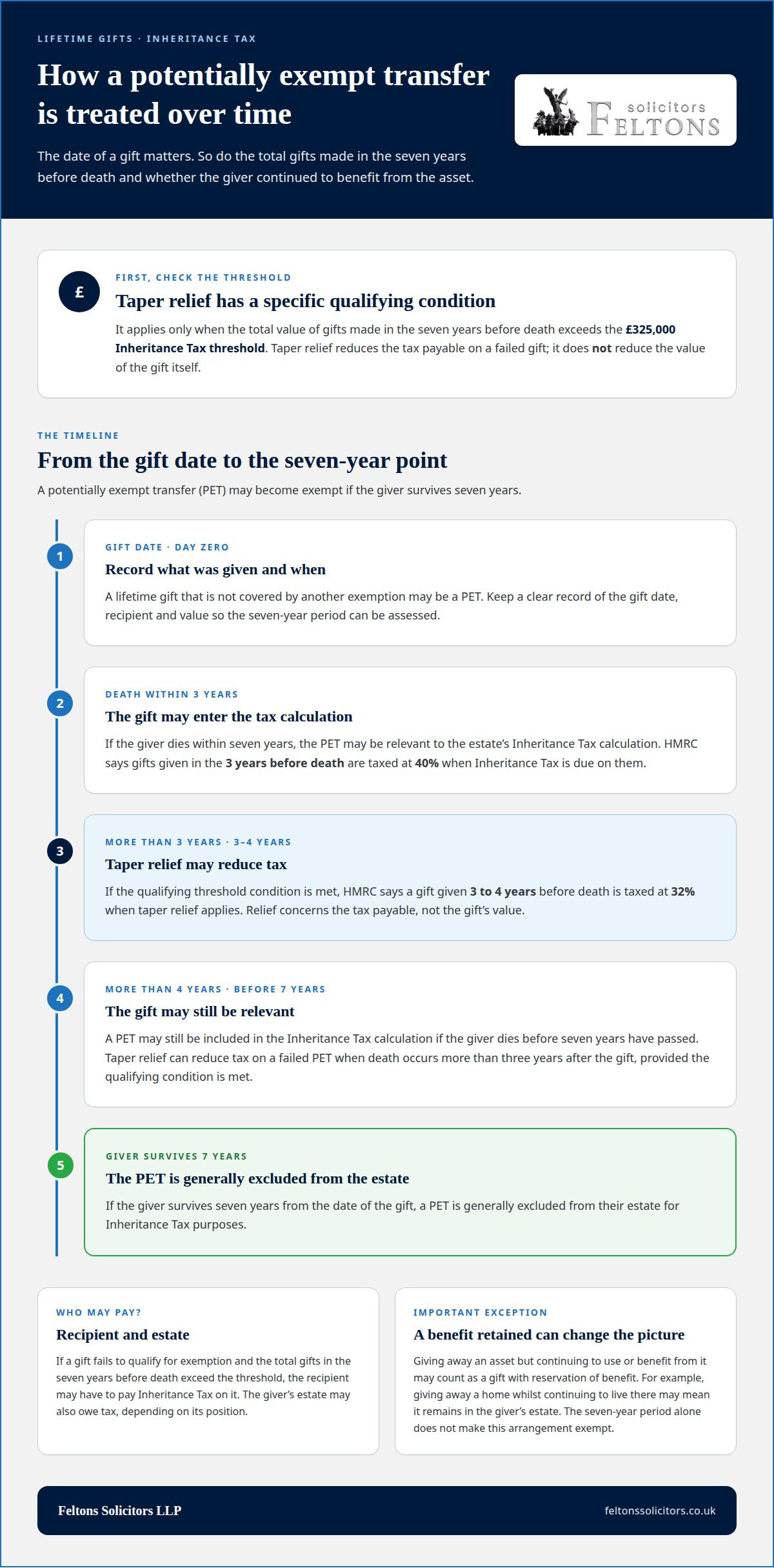
A potentially exempt transfer (PET) is a lifetime gift that may become exempt from Inheritance Tax if the giver survives seven years. If they die sooner, the gift may be included when calculating tax.
The seven-year rule
Under the seven-year rule, a PET is generally excluded from the giver’s estate if they survive seven years from the date of the gift. If they die within that period, the gift may be relevant to the estate’s Inheritance Tax calculation. A cash gift to a family member, for example, may be treated differently from a transfer covered by another exemption. Keep a clear record of the gift date when considering the seven-year period.
Taper relief and failed gifts
Taper relief reduces the Inheritance Tax payable on a failed PET when the giver dies more than three years after making it. It does not reduce the value of the gift itself. HM Revenue & Customs says taper relief applies only if gifts made in the 7 years before death exceed the £325,000 Inheritance Tax threshold. HM Revenue & Customs says taper relief taxes a gift at 32% when given 3 to 4 years before the giver’s death, if relief applies. The relevant period runs from the date of the gift to the giver’s death, not by tax year.
Inheritance tax payment responsibility
If a gift fails to qualify for exemption, the recipient may have to pay Inheritance Tax on it when the total gifts made in the seven years before death exceed the threshold. This is assessed after the giver’s death, when the estate and lifetime gifts are considered together. It may affect a family member who received a substantial gift but no funds to cover a later tax bill. The giver’s estate may also owe tax, depending on its position.
Gifts with reservation of benefit
A gift with reservation of benefit occurs when someone gives away an asset but continues to use or benefit from it. For example, giving away a home while continuing to live there may mean the property remains in the giver’s estate for Inheritance Tax purposes. Simply surviving the seven-year period does not make this arrangement exempt. A solicitor can consider how the gift works in practice, including who uses the asset and whether the giver retains a benefit. This distinction matters when a transfer is intended to reduce the estate’s taxable value.
Lifetime Giving and Inheritance Tax Planning: Is Now the Time to Act?
Lifetime gifts may reduce an estate’s value, but exemptions and the effect on your own finances also matter. Your estate plan should consider gifts, assets and future needs together.
Reducing an estate’s value
A lifetime gift transfers wealth out of your estate, which may reduce the value considered for Inheritance Tax. HM Revenue & Customs says an individual can give away £3,000 worth of gifts each tax year without those gifts being added to the value of their estate. Gifts outside an exemption may also leave the estate’s value if the giver survives seven years. Record the date, recipient and value of each transfer so the estate’s position can be established.
Gifting and inheritance tax exemptions
Exemptions allow some gifts to be made without adding them to the estate for Inheritance Tax, provided their conditions are met. HM Revenue & Customs says an individual can give as many gifts of up to £250 per person as they want each tax year, provided they haven’t used another allowance on the same person. Other exemptions may apply to qualifying gifts between spouses or civil partners, certain wedding gifts, and regular gifts from surplus income. For the last exemption, gifts must be regular, come from income rather than capital, and leave enough income to maintain the giver’s usual standard of living.
Advice from an inheritance tax solicitor
A solicitor can help assess how proposed giving fits your estate plan, including the nature of the assets and any benefit you retain. This can be particularly useful before transferring property, making substantial gifts, or relying on regular gifts from surplus income. From 6 April 2027, most unused pension funds and pension death benefits are due to be included in a person’s estate for Inheritance Tax purposes. Reviewing gifts alongside pensions and other assets helps clarify the wider picture. Estate planning advice can help you consider those connected decisions.
Inheritance tax rates and allowances
The UK nil-rate band is £325,000, and the standard Inheritance Tax rate is 40% on the part of an estate above the applicable threshold. HM Revenue & Customs says gifts given in the 3 years before the giver’s death are taxed at 40% when Inheritance Tax is due on them. The nil-rate band and Residence Nil Rate Band are fixed at their current rates until 2030. The amount due depends on the estate’s value and which allowances apply, so the figures should be considered alongside gifts and the estate’s other assets.
Legal advice and annual gifting reviews
An annual review helps keep gifting records and estate planning aligned as circumstances change. The tax year runs from 6 April to 5 April, so timing can affect which year an allowance applies to.
Annual and other gift exemptions
The annual exemption can be used alongside certain other exemptions, but each gift must meet the relevant conditions. Any unused annual exemption can be carried forward for one tax year only, and the current year’s allowance is used first. Reviewing your records can show whether an exemption has been used and help avoid counting the same gift twice.
Wedding or civil partnership gifts have separate limits: up to £5,000 for a child, £2,500 for a grandchild or great-grandchild, and £1,000 for another person. The gift must be made before or at the ceremony, and the event must take place for the exemption to apply. These amounts can be used alongside the annual exemption in the same tax year.
Annual and small-gift allowances
Small gifts and regular payments from income need careful records, not just a note of the amount transferred. To qualify as normal expenditure out of income, regular gifts must be made regularly, come from income rather than capital, and leave enough income for the giver to maintain their usual standard of living. Keep records of income, spending, dates and recipients. They can help executors explain the pattern to HMRC.
An annual gifting review can bring these records together, assess how each transfer fits your estate plan, and consider whether an asset has other tax consequences. Lifetime gift tax planning legal advice can help you review changes in income and expenditure and assess whether regular gifts qualify as payments from surplus income. A yearly review can also help you understand which records support your position and how your plans reflect your current circumstances.
Taper relief
Taper relief reduces Inheritance Tax on some lifetime gifts when the giver dies within seven years. Its effect depends on how long the giver survived after making the gift.
How taper relief works
Taper relief reduces the tax payable on a failed gift; it doesn’t reduce the gift’s value. It applies after the giver has survived more than three years, and the rate falls as more time passes. The relevant bands are 3 to 4 years, 4 to 5 years, 5 to 6 years, and 6 to 7 years. The rate of taper relief generally decreases as the time between the gift and the giver’s death increases. These reductions matter only where Inheritance Tax is due on the gift.
For example, the 4-to-5-year band applies a 24% rate, whilst the 6-to-7-year band applies 8%. Taper relief is therefore not an automatic exemption: the value of the gift, other gifts and available reliefs all affect whether tax is payable. A gift’s date and value are useful records when calculating the period and potential liability.
Agricultural and business property reliefs are separate from taper relief. They concern the treatment of qualifying agricultural or business assets, not the time elapsed since a gift. If a transfer involves a farm, business or partnership interest, identifying the asset and its ownership is an important step in understanding which reliefs may be relevant. The potential tax position depends on the asset and the conditions that apply.
Possible changes to taper relief
A proposal discussed in the UK could extend the seven-year Inheritance Tax rule to 10 years. This would affect the period in which lifetime gifts could be brought into account, but it is not itself a change to taper relief rates. For individuals planning transfers, the distinction matters: a longer period could alter which gifts fall within the rule, while taper relief concerns tax due on qualifying gifts. Estate planning should account for the rules that apply when a gift is made and the giver dies.
For advice on how gifts, assets and reliefs fit together, discuss estate planning with a solicitor.
Feltons Solicitors LLP: Wills, Probate, and Estate Planning
Feltons Solicitors LLP can help you consider lifetime gifts as part of your wider Wills, Probate, and Estate Planning. This may be useful when you’re weighing a substantial transfer, reviewing your estate plan or considering how gifts could affect the arrangements you want in place. Advice can bring together your wishes, assets and the practical consequences of giving, rather than treating each gift as an isolated decision.
Legal support can also help when changes in your family or finances prompt you to revisit your plans, or when you need to understand how your estate may be administered. Feltons Solicitors LLP can discuss options relevant to your circumstances and help you consider appropriate planning.
For guidance on lifetime gifts and estate planning, contact Feltons Solicitors LLP.
Make your next estate-planning decision with clarity
A useful next step is to turn your intentions into a plan that can be understood and administered. Consider who you want to benefit, which assets you may give, and how those choices fit with your wider financial and family arrangements. Clear records of your decisions can also help those responsible for your estate understand the context later.
Legal advice for lifetime gift tax planning can help you assess how a proposed transfer fits alongside your will and other arrangements. Feltons Solicitors LLP offers Wills, Probate, and Estate Planning, as well as Divorce and Financial Arrangements and Residential and Commercial Conveyancing. These services may be relevant when gifts connect with family changes, property or the wider administration of an estate.
For support considering your circumstances and next steps, contact Feltons Solicitors LLP for advice. A considered plan can help you move forward with greater confidence.
Frequently Asked Questions
What counts as a lifetime gift?
A lifetime gift is money, property or another asset you give to someone while you’re alive. It can include a cash transfer to a relative, handing over investments or transferring ownership of a home. Selling an asset for less than its full market value may also have gifting implications. If you continue to benefit from an asset after giving it away, that retained use can affect its Inheritance Tax treatment.
What allowances are available and how much can I gift?
HM Revenue & Customs says you can give away £3,000 worth of gifts each tax year without adding them to your estate’s value. You can also make as many gifts of up to £250 per person as you want each tax year, provided you haven’t used another allowance on that person. Unused annual exemption can be carried forward for one tax year only. The amount you can give is not capped, but gifts may have tax consequences.
What are the benefits of lifetime gifting?
Lifetime gifting lets you support people while you’re alive, whether by helping a family member with education costs or contributing towards a major purchase. Depending on the gift and the rules that apply, it may also reduce the value of your estate for Inheritance Tax. Giving can make your intentions clear during your lifetime, but consider your future income and financial security before transferring assets.
What can I do now?
Start by making a clear record of gifts already made, including the recipient, asset, date and value. If you make regular gifts from surplus income, gather information about your income and expenditure to show how those payments fit your finances. Then review your will and wider estate plan alongside any proposed transfer. A solicitor can help you assess how these elements work together.
What should I consider before making a gift?
Consider whether you can afford to give the asset away, whether you’ll still use or benefit from it, and whether the transfer has tax consequences beyond Inheritance Tax. Giving away a home but continuing to live there may mean it remains part of your estate for Inheritance Tax purposes. In England, a local authority may also treat a gift as deliberate deprivation of assets when assessing care-funding contributions.
Why make lifetime gifts?
People make lifetime gifts to provide practical help, pass on wealth or put estate plans into effect while they can explain their wishes. A gift may also reduce the estate’s eventual value for Inheritance Tax if the relevant conditions are met. The decision should balance the recipient’s needs with your future security. For example, regular support from income differs from giving away capital you may later need.