

A silicosis diagnosis may support a compensation claim when evidence links the illness to workplace silica dust and shows that an employer failed in its duty of care. In England and Wales, the usual time limit is three years from when a person first became aware they had silicosis, according to The National Archives. Industrial dust exposure compensation claims can also involve industrial benefits, and understanding how the routes relate is an important part of deciding what to do next.
Silicosis is a long-term lung disease caused by inhaling fine crystalline silica dust. Its effects can emerge years after exposure, so it is understandable to be unsure how past work, a later diagnosis and the legal deadline fit together.
This article explains how silica exposure happens, what evidence may support a claim and how time limits apply. It also explains how a civil claim relates to industrial benefits, including when payments through one route may affect compensation through another.
Key Takeaways
- Learn how workplace silica dust exposure and an employer’s failure to control risks may shape a compensation claim.
- See which medical and work-history records can help connect silicosis to past employment.
- Understand the usual three-year time limit in England and Wales, which runs from when you first become aware of the illness.
- Explore how a civil claim may relate to industrial benefits, including a lump-sum route under the Workers Compensation Act 1979.
How does workplace silica dust exposure happen?
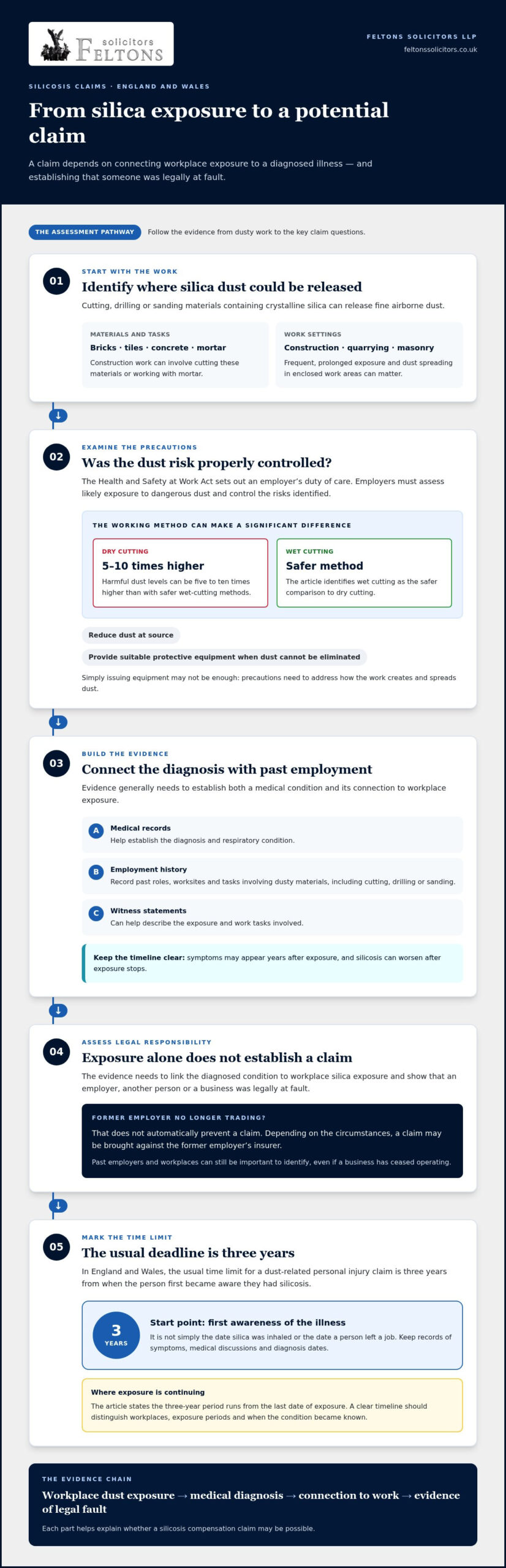
Silica dust is released when materials containing crystalline silica are cut, drilled or sanded. In construction, cutting bricks, tiles and concrete or working with mortar can release airborne dust. Construction, quarrying and masonry can involve frequent, prolonged exposure, with fine particles inhaled during routine tasks, particularly when dust spreads through an enclosed work area. Repeated workplace exposure can lead to silicosis.
The Health and Safety at Work Act sets out employers’ duty of care to protect employees from workplace harm. Employers must assess likely exposure to dangerous dust and control the risks they identify. Practical precautions include reducing dust at source and providing suitable protective equipment when dust cannot be eliminated. Simply issuing equipment is not enough: precautions must address how the work creates and spreads dust.
For example, a worker cutting engineered stone without effective dust controls may face avoidable exposure. Dry cutting can expose workers to harmful dust levels five to ten times higher than safer wet-cutting methods. This illustrates why the method of work matters when assessing whether an employer took appropriate precautions. Continued silica exposure despite avoidable risks may be relevant to whether the employer breached its duty of care.
A silicosis claim needs evidence linking the diagnosed condition to workplace silica exposure and showing that the employer failed in its duty of care. Start by recording past roles, worksites and tasks involving dusty materials. Employment records and details of cutting, drilling or sanding can help establish where exposure occurred. Medical evidence can then help connect that exposure with the respiratory condition.
A former employer’s closure does not automatically prevent a claim. In the UK, a silicosis claim may still be possible even if the employer is no longer trading. Depending on the circumstances, a claim may be brought against the former employer’s insurer. Identify past employers and workplaces, even if the business has since ceased operating.
When might a silicosis compensation claim be possible?
A claim depends on evidence linking an industrial disease to workplace exposure and establishing legal responsibility. The type of dust, medical diagnosis and work history all help explain that link.
Silicosis and lung damage
Silicosis is a long-term lung disease caused by inhaling fine crystalline silica particles. The particles scar and harden lung tissue, gradually reducing lung function. Chronic silicosis usually follows prolonged exposure, while accelerated silicosis can develop after five to 10 years of higher exposure. Acute silicosis can develop within a few weeks after exposure to very high concentrations. Cutting, drilling or sanding silica-containing materials can release the dust.
Symptoms can include persistent coughing, breathlessness during activity and chest tightness, and may appear years after exposure. Silicosis can worsen after exposure stops, and there is no known cure. Silica exposure can also be linked to lung cancer and chronic obstructive pulmonary disease (COPD). The diagnosed condition matters when assessing a claim.
Claim evidence and eligibility
Evidence generally needs to establish both a medical condition and its connection to work. Medical records, employment history and witness statements can help show the diagnosis, exposure and tasks involved. A specialist can assess how the records fit together, including whether the illness was caused by silica dust or another industrial exposure.
In the UK, compensable industrial dust exposure can include exposure to silica, asbestos and other workplace dusts, chemicals or vapours linked to respiratory illness. A claim depends on evidence that the exposure caused the condition and that an employer or another person or business was legally at fault.
Workers with a respiratory illness linked to workplace exposure can pursue a claim if legal fault is established. A claim may also be made on behalf of someone too ill to act, someone lacking mental capacity, or a person who has died from the illness.
If you have breathing difficulties, seek medical assistance, then gather medical records, employment details and witness accounts. These can help establish the diagnosis, exposure history and potential responsibility.
The risks include difficulty proving exposure, causation or fault. Industrial disease claims are often pursued through conditional fee agreements, commonly called no win no fee arrangements; the agreement’s terms explain any fees payable. For help assessing evidence, consider specialist silicosis claim advice.
Time limits for claims
In England and Wales, the usual deadline is three years from first awareness of silicosis, according to The National Archives (legislation.gov.uk). This date can matter even if symptoms develop gradually or exposure happened years earlier.
The three-year claim time limit
For a dust-related personal injury claim in England and Wales, the usual time limit is three years from when the person first became aware they had silicosis. The relevant starting point is awareness of the illness, not simply the date silica particles were inhaled or the worker left a job. Keep records of symptoms, medical discussions and diagnosis dates to help establish the timeline.
Silicosis may develop long after workplace exposure, so the gap between dusty work and diagnosis does not, by itself, determine the deadline. Where exposure is continuing, the stated period is three years from the last date of exposure. A clear timeline should distinguish each workplace, exposure period and when the condition became known.
Time limits in England and Wales
The three-year period applies to personal injury claims, including those involving silicosis. Identifying the relevant awareness date can be difficult if symptoms came before diagnosis or medical understanding developed over time. Note when you first learned that your respiratory condition was linked to workplace silica exposure, alongside diagnosis and employment records.
Do not assume the diagnosis date is decisive in every case. Records showing when the illness was identified and connected with exposure can help clarify the chronology. Delay may affect whether a claim can proceed, so it is important to review the dates and evidence promptly.
Scotland and Northern Ireland have their own limitation rules, so do not assume the England and Wales three-year period applies there. Identify where the relevant exposure and claim arose, then establish the applicable deadline before deciding what to do next.
As a practical first step, create a dated record of dusty roles, the last exposure date, symptoms and medical appointments. If silica exposure is ongoing, record when it stops. This helps distinguish the exposure timeline from the later period when an injury may develop or be diagnosed, and supports assessment of the employer’s duty of care.
Civil claims and industrial benefits
A civil claim and an industrial benefit are separate routes for people affected by occupational silicosis. Receiving a benefit does not necessarily rule out a civil claim, but payments can affect the final damages calculation. Industrial dust exposure compensation claims may therefore require consideration of both routes.
A civil claim considers whether workplace exposure caused the illness and whether an employer or another person or business was legally at fault. Compensation can reflect lung scarring and symptoms, as well as financial losses such as lost earnings, care needs, travel and medical treatment. Keep evidence of these losses with records of exposure and diagnosis.
State benefits are another consideration. Silicosis and pneumoconiosis are prescribed diseases for State benefit claims. The Workers Compensation Act 1979 provides a route to claim a lump sum for silicosis, or for a dependent whose loved one has died of silicosis, according to The National Archives (legislation.gov.uk).
Where a person receives industrial disablement benefit or a lump sum through the Workers Compensation Act, that money is deducted from compensation awarded in a civil claim under the routes described. This adjustment prevents the same loss from being compensated twice. Keep award letters and payment records so the amounts can be accurately considered alongside the civil claim.
Silicosis can progress, so evidence should also describe its current impact and possible future effects. Provisional damages may preserve the opportunity to seek further damages if a more serious condition develops later. A claim can be brought for someone too ill to act, someone lacking mental capacity, or a person who has died; a dependent may also have a lump-sum route under the 1979 Act. A person exposed while self-employed is not eligible for industrial disablement benefit under the route described here. These details can shape how industrial dust exposure compensation claims are assessed alongside benefits.
Silicosis claims can involve historic exposure, several employers and detailed medical evidence. Settlement may take up to three years, or longer depending on liability and the claimant’s condition. To discuss how a civil claim and benefits may relate, seek advice on a silicosis claim.
In Scotland and Northern Ireland, a civil claim considers whether workplace exposure caused the illness and whether an employer or another party was legally at fault; industrial benefits are a separate route. Industrial disablement benefit or a lump sum under the Workers Compensation Act 1979 may be deducted from civil damages to avoid compensating the same loss twice.
Feltons Solicitors LLP: Divorce and Financial Arrangements
Feltons Solicitors LLP handles Personal Injury and Silicosis Claims for people seeking advice after workplace silica exposure. The firm can advise if you have a diagnosis, questions about whether employer negligence contributed, or uncertainty about how a civil claim relates to industrial benefits. A discussion can help you understand the evidence and issues relevant to your circumstances, including past work and medical records.
Silicosis claims can involve historic exposure and more than one employer, so setting out your work history and diagnosis can help explain the situation. Feltons Solicitors LLP can advise on the legal claim; this section is distinct from its Divorce and Financial Arrangements offering.
Contact Feltons Solicitors LLP to discuss a silicosis claim.
Take a clear next step
A diagnosis can affect more than your health. It may change the work you can do, the support you need at home and the plans you make with family. Describing these practical effects can help ensure they are considered alongside medical evidence in industrial dust exposure compensation claims.
Before seeking advice, note what has changed in daily life, what assistance you need and which work or personal plans have been affected. You do not need to have every detail resolved before discussing your situation. A focused conversation can help identify the key questions and documents that may help answer them.
If you’re ready to discuss your circumstances, contact Feltons Solicitors LLP about your claim. A considered next step can help you approach the legal process with greater clarity and decide how you wish to proceed.
Frequently Asked Questions
What is silicosis?
Silicosis is an occupational lung disease caused by inhaling crystalline silica particles, which can scar lung tissue. It has chronic, accelerated and acute forms, associated with different exposure patterns. Acute silicosis can develop within a few weeks after very high exposure, while chronic disease usually follows prolonged exposure. Possible symptoms include persistent coughing, chest tightness and breathlessness; a medical diagnosis identifies the condition.
Can I claim if my former employer no longer exists?
Yes. A former employer’s closure does not automatically prevent a silicosis claim. Depending on the circumstances, a claim may be brought against the old insurer. Start by noting the employer’s name, the worksite and the tasks that created dust. Old employment papers, payslips or colleague details may help piece together your work history and identify relevant exposure periods.
Can silicosis get worse after exposure has ended?
Yes. Silicosis can continue to progress after silica exposure stops, so leaving dusty work does not necessarily end its effects. If your breathing, stamina or everyday activities change, record when the changes occur and discuss them with your medical team. These updates can help describe how the condition affects daily life, rather than relying only on an earlier account of symptoms.
How Much Compensation Can You Expect?
A claim may account for pain and suffering, lost income, care, travel and medical treatment. For example, reduced ability to work or a need for regular assistance can affect the losses assessed. There is no fixed tariff for every diagnosis.
How long do I have to make a claim?
In England and Wales, the usual limit is three years from when you first became aware of silicosis, according to The National Archives (legislation.gov.uk). Awareness may not match the date you first inhaled dust or stopped working. Note when you received information linking your condition to silica, and keep relevant medical dates together. Scotland and Northern Ireland have different limitation rules.
How might my employer be responsible?
An employer may be responsible if workplace silica exposure caused your illness and the exposure was legally their fault. For example, evidence might show dust-generating work continued without adequate measures to control the risk. The assessment considers working conditions, exposure history and the medical link, not simply whether you handled concrete. Details of tasks, sites and colleagues can help clarify what happened.