Artificial stone silicosis compensation and how exposure occurs

Artificial stone silicosis compensation and how exposure occurs

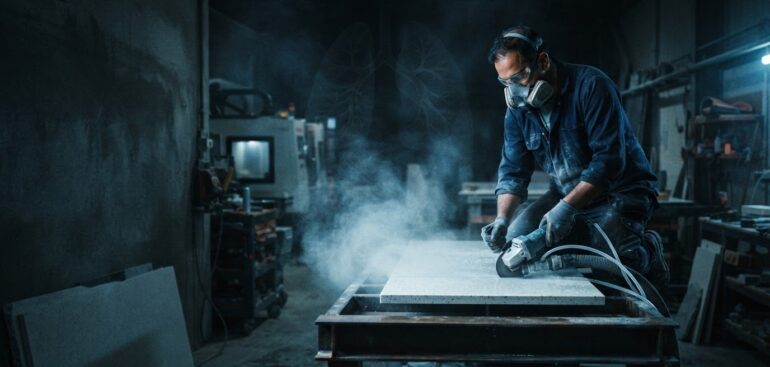
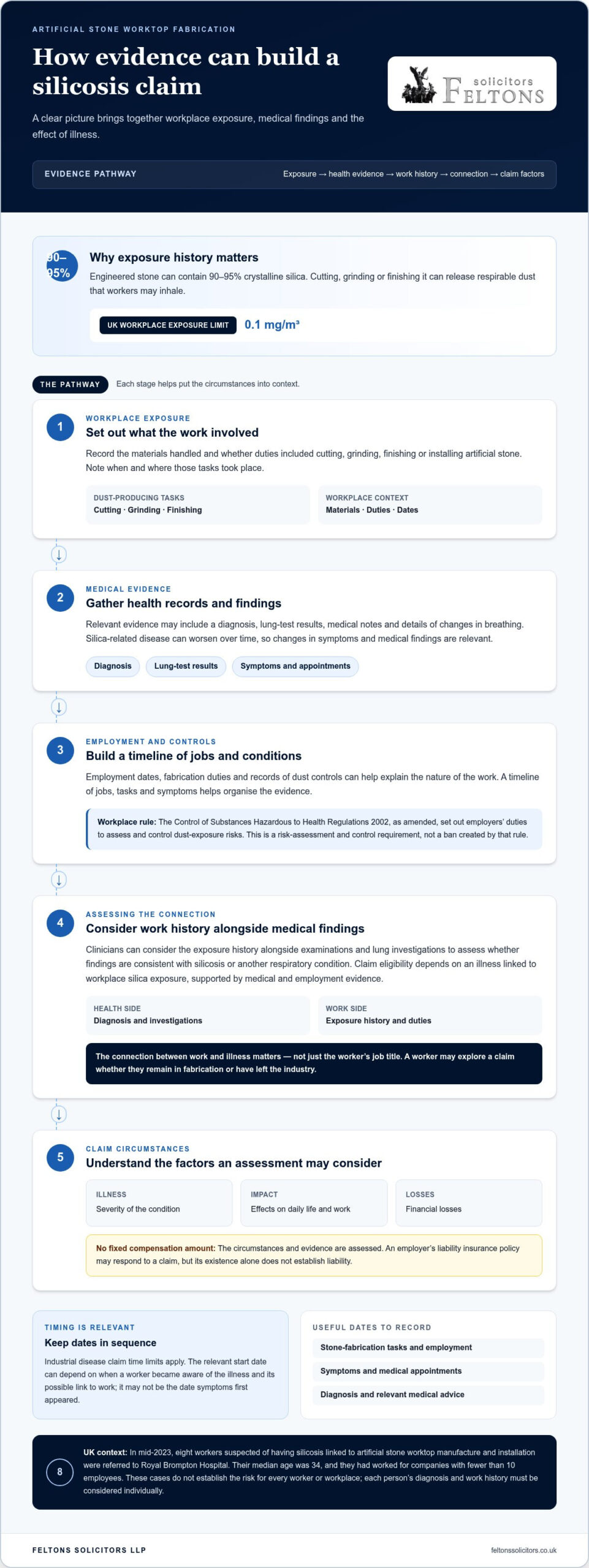
Artificial stone worktop fabrication can expose workers to respirable silica dust when the material is cut, ground or finished. Engineered stone can contain 90-95% crystalline silica, and the UK workplace exposure limit is 0.1 mg/m³, according to the Health and Safety Executive. Questions about artificial stone countertop silicosis compensation depend on the connection between a worker’s illness and their work exposure.

It’s understandable to want clear answers when breathing problems may be linked to work with stone countertops. Silica dust can be difficult to see, but inhaling it can cause serious lung disease.

This guide explains how silica exposure can occur, what silicosis and other respiratory conditions may involve, and what workers in the UK should know about compensation claims. It also explains how specialist legal advice can help assess the evidence and circumstances of a potential claim.

Key Takeaways

  • Understand how fabrication tasks can create inhalable dust and why employers’ risk assessment and control duties matter under the Control of Substances Hazardous to Health Regulations 2002, as amended.
  • Learn how silicosis and other respiratory diseases can affect workers, and why symptoms may need medical assessment.
  • See what reported cases among UK stone workers reveal about the risks and the importance of linking work history with health evidence.
  • Find out how workplace and medical records can help inform a potential compensation claim, and when specialist silicosis claims advice may be useful.

Silica dust exposure during artificial stone worktop fabrication

Fabrication tasks can release respirable crystalline silica, which workers may inhale. Engineered stone can contain 90-95% crystalline silica, and the UK workplace exposure limit is 0.1 mg/m³.

Eligibility for Compensation

Eligibility depends on having an illness linked to workplace silica exposure, supported by medical and employment evidence. Workers who develop silicosis after working with artificial stone may be able to explore a claim, whether they remain in fabrication or have left the industry. An artificial stone countertop silicosis compensation claim considers the connection between work and illness, not just the worker’s job title.

Countertop fabricators may bring claims involving employers’ liability insurance. A relevant policy may respond to a claim, but its existence alone does not establish liability. There is no fixed compensation amount. An assessment may consider the illness’s severity, its effects on daily life and work, and financial losses.

Evidence for a Silicosis Claim

Evidence usually combines medical records with details of work and exposure. Relevant material may include a diagnosis and lung-test results, employment dates, fabrication duties, and records of dust controls. Together, these details can help show what work involved silica and how the illness may relate to it. For an artificial stone countertop silicosis compensation case, a timeline of jobs, tasks and symptoms can help organise the evidence.

Restrictions on Engineered Stone Worktops

The UK workplace rule relevant to fabrication is risk assessment and control, rather than a ban created by that rule. According to the UK legislation register, employers’ duties to assess and control risks from dust exposure are set out in the Control of Substances Hazardous to Health Regulations 2002, as amended. This distinction matters: dust-producing work still requires attention to exposure controls.

Workers can raise unsafe conditions with an employer or report workplace concerns to the Health and Safety Executive. A GP can assess respiratory symptoms. Whether legal advice is free depends on the advice route and funding arrangement, so it is not automatic.

Silicosis and other respiratory diseases

Silica-related illness can develop after inhaling fine dust, and artificial stone silicosis can appear within 2-5 years. Recognising how disease is assessed and how claim timing works can help workers understand their next steps.

Diagnosing Silicosis

Diagnosing silicosis involves assessing lung health alongside a person’s exposure history. Symptoms and test findings need to be considered in the context of work involving silica, including artificial stone fabrication.

A worker should describe tasks such as cutting, grinding or finishing stone, and explain when symptoms began. Clinicians can consider this history alongside examinations and lung investigations to assess whether the findings are consistent with silicosis or another respiratory condition. Silica-related disease can worsen over time, so changes in breathing and medical findings are relevant.

The UK All Party Parliamentary Group for Respiratory Health published Improving Silicosis Outcomes in the UK in January 2023. Its report recommended that the Health and Safety Executive assess the data and technology needed to reduce the workplace exposure limit for silica to 0.05 mg/m³. That recommendation highlights continuing concern about preventing harm, not a diagnostic test or a change to the current limit.

Time Limits for Disease Claims

UK industrial disease claims are subject to a time limit. The relevant start date can depend on when a worker became aware of the illness and its possible link to work. This is important because silicosis may emerge after exposure has ended, making the timing of diagnosis and awareness relevant to a claim.

Keep a record of diagnosis dates, relevant medical appointments and work history, including when stone fabrication tasks took place. These details can help establish the sequence between exposure, symptoms and medical advice. Since the applicable deadline depends on the circumstances, seek legal advice promptly rather than relying on the date symptoms first appeared. A worker considering silicosis claims advice can discuss how the medical and employment history may affect a potential claim.
Artificial stone silicosis compensation and how exposure occurs

Silicosis cases among UK stone workers

Cases identified in the UK show why artificial stone exposure is a live occupational health concern. In mid-2023, eight UK workers suspected of having silicosis linked to artificial stone worktop manufacture and installation were referred to Royal Brompton Hospital in London.

The eight workers had a median age of 34, and had worked for companies with fewer than 10 employees. These details illustrate that suspected work-related disease has affected younger workers and people employed by small businesses. They do not establish the risk for every worker or workplace. Each person’s diagnosis and work history must be considered individually.

If you are concerned about similar exposure, start by listing the jobs you performed and the materials you handled. For example, note whether your work involved cutting, grinding or installing artificial stone, and when those tasks took place. Include any changes in breathing or other symptoms. A clear timeline can help clinicians consider your exposure history alongside medical findings.

A family may pursue a compensation claim after a worker’s death if the evidence supports a connection between the disease and workplace exposure. The case may also require evidence of the family’s losses and the worker’s diagnosis. Employment documents, medical notes and details of fabrication work can help explain the circumstances. The eight referrals to Royal Brompton Hospital underline the importance of preserving relevant records and establishing the worker’s employment and medical history.

These reported UK referrals are a specific example, not a complete count of affected workers. Referrals to one hospital cannot show how many people across the UK have the disease. For anyone who fabricated or installed artificial stone, relevant questions include which tasks created dust, what exposure occurred, and how medical evidence relates to the work. Keeping these details together can make a later assessment clearer.

How are workers diagnosed with silicosis in the UK?

Diagnosing silicosis involves considering a worker’s respiratory symptoms, medical assessment and history of silica exposure. For a countertop fabricator, explaining tasks such as cutting, grinding or finishing artificial stone gives clinicians important occupational context.

Before an appointment, workers can note when they handled stone, which tasks created dust, and when breathing problems began. Describe whether symptoms changed over time and whether similar work continued after they first appeared. A clear account helps clinicians consider possible links between work exposure and lung disease, rather than viewing symptoms in isolation.

Useful details to organise include:

  • Job titles, employers and the periods spent fabricating or installing worktops.
  • Specific tasks, such as dry grinding a stone edge or cutting a slab.
  • Any available records describing materials, dust controls or workplace conditions.
  • Symptoms, their progression and relevant medical appointments or findings.

These details can help build a clear exposure history. For example, an installer who also cut stone should explain both duties, rather than describing only installation work. Records and recollections can be compared with medical findings to clarify the timing and nature of workplace exposure. A diagnosis identifies the health condition; the work history helps explain its possible occupational context.

Keep copies of employment records, medical correspondence and any notes describing fabrication duties. If symptoms affect your work or everyday activities, describe those effects clearly during medical appointments. Accurate details can also help distinguish exposure during artificial stone work from other relevant work or environmental history.

Silicosis diagnosis and compensation involve different questions: medical evidence concerns the illness, while a claim also examines work exposure and its connection to that illness. For guidance on the legal assessment, discuss a potential silicosis claim.

Respiratory physicians diagnosed 210 patients with silicosis in Victoria between May 2019 and December 2022; 22 per cent of the patients in the reported findings were diagnosed with more advanced complicated silicosis. By March 6, 2025, 41 lung transplants had been recorded among engineered stone countertop workers with silicosis in California.

Feltons Solicitors LLP: Divorce and Financial Arrangements

Feltons Solicitors LLP helps workers and families consider potential claims through its Personal Injury and Silicosis Claims service. If a diagnosis may be connected to artificial stone fabrication, legal advice can help organise the medical history, work records and exposure details relevant to assessing the claim.

This support may be useful if you are unsure how workplace exposure could be connected to respiratory illness or what evidence to gather. A solicitor can review the circumstances and explain issues that may affect a claim, including the illness’s impact and relevant losses. Each matter depends on its own evidence and circumstances.

For guidance about a possible silicosis claim, contact Feltons Solicitors LLP or visit feltonssolicitors.co.uk.

Take a considered next step

Deciding whether to pursue artificial stone countertop silicosis compensation can raise wider questions about work, household finances and future planning. Consider what you want advice to address, such as the illness’s impact on everyday life or how a potential claim could affect your family. Knowing your priorities can make an initial legal discussion more focused.

It may help to note the key questions you want answered and gather the information that matters most to you. You do not need to resolve every detail before seeking guidance. A legal discussion can clarify the issues and possible next steps in your circumstances.

For a measured conversation about your situation, contact Feltons Solicitors LLP. Taking that first step can help you approach the decisions ahead with greater clarity.

Frequently Asked Questions

What Is Engineered Stone Silicosis And How Does Exposure Occur?

It is silicosis associated with breathing in respirable crystalline silica released during engineered stone work. Cutting, dry grinding and finishing can create fine airborne particles that enter the lungs. Exposure comes from the dust produced during these tasks, rather than simply being near an intact countertop. Artificial stone silicosis can develop within 2-5 years, so a worker’s exposure history is relevant even if the work has stopped.

What is silicosis caused by artificial stone countertops?

Silicosis is lung disease linked to inhaling silica dust generated while fabricating artificial stone countertops. Fine particles can become embedded in lung tissue and may cause lasting harm. The material becomes a health risk during dust-producing work, such as shaping or finishing a slab. A countertop worker who develops respiratory problems should explain the materials and tasks involved when discussing their health with a clinician.

What symptoms and health risks are linked to engineered stone dust exposure?

Engineered stone dust exposure can be associated with respiratory symptoms and serious lung damage. Artificial stone silicosis may progress to severe lung impairment or failure within 2 to 10 years. Symptoms alone cannot establish that silica caused an illness, but breathing changes after stone work deserve medical attention. Tell the clinician about the work performed, including fabrication tasks, and when symptoms began or changed.

Silicosis Compensation Claims for Workers Exposed to Silica Dust

Silicosis Compensation Claims for Workers Exposed to Silica Dust

A silicosis diagnosis may support a compensation claim when evidence links the illness to workplace silica dust and shows that an employer failed in its duty of care. In England and Wales, the usual time limit is three years from when a person first became aware they had silicosis, according to The National Archives. Industrial dust exposure compensation claims can also involve industrial benefits, and understanding how the routes relate is an important part of deciding what to do next.

Silicosis is a long-term lung disease caused by inhaling fine crystalline silica dust. Its effects can emerge years after exposure, so it is understandable to be unsure how past work, a later diagnosis and the legal deadline fit together.

This article explains how silica exposure happens, what evidence may support a claim and how time limits apply. It also explains how a civil claim relates to industrial benefits, including when payments through one route may affect compensation through another.

Key Takeaways

  • Learn how workplace silica dust exposure and an employer’s failure to control risks may shape a compensation claim.
  • See which medical and work-history records can help connect silicosis to past employment.
  • Understand the usual three-year time limit in England and Wales, which runs from when you first become aware of the illness.
  • Explore how a civil claim may relate to industrial benefits, including a lump-sum route under the Workers Compensation Act 1979.

How does workplace silica dust exposure happen?

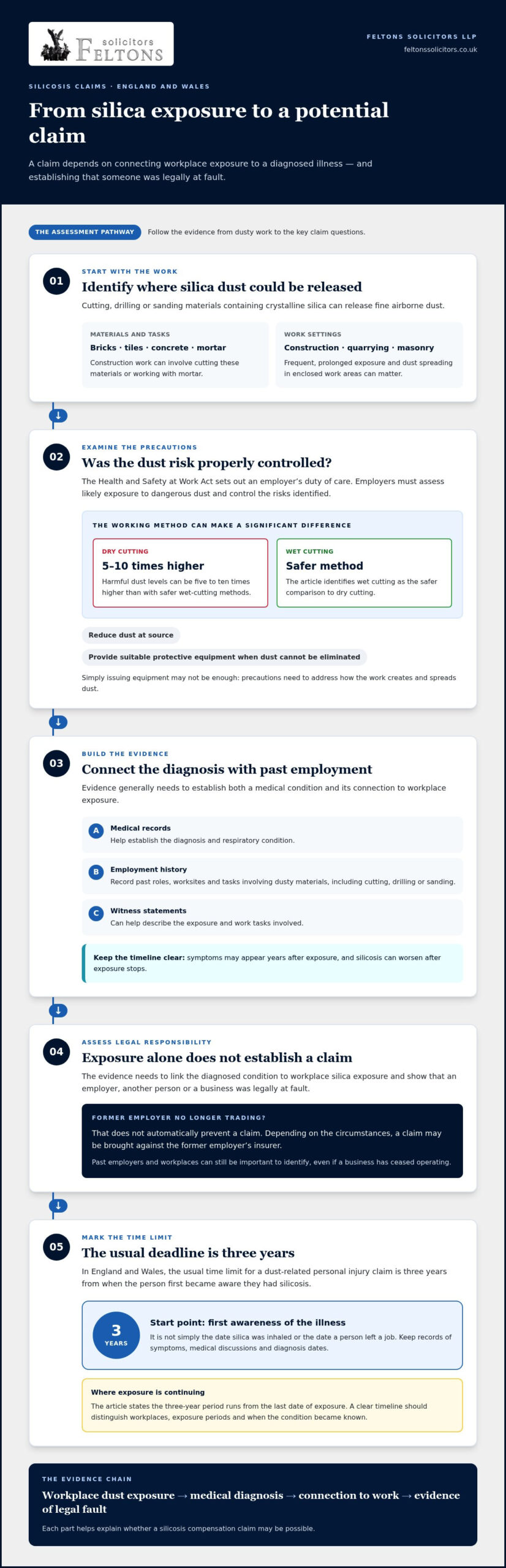
Silica dust is released when materials containing crystalline silica are cut, drilled or sanded. In construction, cutting bricks, tiles and concrete or working with mortar can release airborne dust. Construction, quarrying and masonry can involve frequent, prolonged exposure, with fine particles inhaled during routine tasks, particularly when dust spreads through an enclosed work area. Repeated workplace exposure can lead to silicosis.

The Health and Safety at Work Act sets out employers’ duty of care to protect employees from workplace harm. Employers must assess likely exposure to dangerous dust and control the risks they identify. Practical precautions include reducing dust at source and providing suitable protective equipment when dust cannot be eliminated. Simply issuing equipment is not enough: precautions must address how the work creates and spreads dust.

For example, a worker cutting engineered stone without effective dust controls may face avoidable exposure. Dry cutting can expose workers to harmful dust levels five to ten times higher than safer wet-cutting methods. This illustrates why the method of work matters when assessing whether an employer took appropriate precautions. Continued silica exposure despite avoidable risks may be relevant to whether the employer breached its duty of care.

A silicosis claim needs evidence linking the diagnosed condition to workplace silica exposure and showing that the employer failed in its duty of care. Start by recording past roles, worksites and tasks involving dusty materials. Employment records and details of cutting, drilling or sanding can help establish where exposure occurred. Medical evidence can then help connect that exposure with the respiratory condition.

A former employer’s closure does not automatically prevent a claim. In the UK, a silicosis claim may still be possible even if the employer is no longer trading. Depending on the circumstances, a claim may be brought against the former employer’s insurer. Identify past employers and workplaces, even if the business has since ceased operating.

When might a silicosis compensation claim be possible?

A claim depends on evidence linking an industrial disease to workplace exposure and establishing legal responsibility. The type of dust, medical diagnosis and work history all help explain that link.

Silicosis and lung damage

Silicosis is a long-term lung disease caused by inhaling fine crystalline silica particles. The particles scar and harden lung tissue, gradually reducing lung function. Chronic silicosis usually follows prolonged exposure, while accelerated silicosis can develop after five to 10 years of higher exposure. Acute silicosis can develop within a few weeks after exposure to very high concentrations. Cutting, drilling or sanding silica-containing materials can release the dust.

Symptoms can include persistent coughing, breathlessness during activity and chest tightness, and may appear years after exposure. Silicosis can worsen after exposure stops, and there is no known cure. Silica exposure can also be linked to lung cancer and chronic obstructive pulmonary disease (COPD). The diagnosed condition matters when assessing a claim.

Claim evidence and eligibility

Evidence generally needs to establish both a medical condition and its connection to work. Medical records, employment history and witness statements can help show the diagnosis, exposure and tasks involved. A specialist can assess how the records fit together, including whether the illness was caused by silica dust or another industrial exposure.

In the UK, compensable industrial dust exposure can include exposure to silica, asbestos and other workplace dusts, chemicals or vapours linked to respiratory illness. A claim depends on evidence that the exposure caused the condition and that an employer or another person or business was legally at fault.

Workers with a respiratory illness linked to workplace exposure can pursue a claim if legal fault is established. A claim may also be made on behalf of someone too ill to act, someone lacking mental capacity, or a person who has died from the illness.

If you have breathing difficulties, seek medical assistance, then gather medical records, employment details and witness accounts. These can help establish the diagnosis, exposure history and potential responsibility.

The risks include difficulty proving exposure, causation or fault. Industrial disease claims are often pursued through conditional fee agreements, commonly called no win no fee arrangements; the agreement’s terms explain any fees payable. For help assessing evidence, consider specialist silicosis claim advice.

Silicosis Compensation Claims for Workers Exposed to Silica Dust

Time limits for claims

In England and Wales, the usual deadline is three years from first awareness of silicosis, according to The National Archives (legislation.gov.uk). This date can matter even if symptoms develop gradually or exposure happened years earlier.

The three-year claim time limit

For a dust-related personal injury claim in England and Wales, the usual time limit is three years from when the person first became aware they had silicosis. The relevant starting point is awareness of the illness, not simply the date silica particles were inhaled or the worker left a job. Keep records of symptoms, medical discussions and diagnosis dates to help establish the timeline.

Silicosis may develop long after workplace exposure, so the gap between dusty work and diagnosis does not, by itself, determine the deadline. Where exposure is continuing, the stated period is three years from the last date of exposure. A clear timeline should distinguish each workplace, exposure period and when the condition became known.

Time limits in England and Wales

The three-year period applies to personal injury claims, including those involving silicosis. Identifying the relevant awareness date can be difficult if symptoms came before diagnosis or medical understanding developed over time. Note when you first learned that your respiratory condition was linked to workplace silica exposure, alongside diagnosis and employment records.

Do not assume the diagnosis date is decisive in every case. Records showing when the illness was identified and connected with exposure can help clarify the chronology. Delay may affect whether a claim can proceed, so it is important to review the dates and evidence promptly.

Scotland and Northern Ireland have their own limitation rules, so do not assume the England and Wales three-year period applies there. Identify where the relevant exposure and claim arose, then establish the applicable deadline before deciding what to do next.

As a practical first step, create a dated record of dusty roles, the last exposure date, symptoms and medical appointments. If silica exposure is ongoing, record when it stops. This helps distinguish the exposure timeline from the later period when an injury may develop or be diagnosed, and supports assessment of the employer’s duty of care.

Civil claims and industrial benefits

A civil claim and an industrial benefit are separate routes for people affected by occupational silicosis. Receiving a benefit does not necessarily rule out a civil claim, but payments can affect the final damages calculation. Industrial dust exposure compensation claims may therefore require consideration of both routes.

A civil claim considers whether workplace exposure caused the illness and whether an employer or another person or business was legally at fault. Compensation can reflect lung scarring and symptoms, as well as financial losses such as lost earnings, care needs, travel and medical treatment. Keep evidence of these losses with records of exposure and diagnosis.

State benefits are another consideration. Silicosis and pneumoconiosis are prescribed diseases for State benefit claims. The Workers Compensation Act 1979 provides a route to claim a lump sum for silicosis, or for a dependent whose loved one has died of silicosis, according to The National Archives (legislation.gov.uk).

Where a person receives industrial disablement benefit or a lump sum through the Workers Compensation Act, that money is deducted from compensation awarded in a civil claim under the routes described. This adjustment prevents the same loss from being compensated twice. Keep award letters and payment records so the amounts can be accurately considered alongside the civil claim.

Silicosis can progress, so evidence should also describe its current impact and possible future effects. Provisional damages may preserve the opportunity to seek further damages if a more serious condition develops later. A claim can be brought for someone too ill to act, someone lacking mental capacity, or a person who has died; a dependent may also have a lump-sum route under the 1979 Act. A person exposed while self-employed is not eligible for industrial disablement benefit under the route described here. These details can shape how industrial dust exposure compensation claims are assessed alongside benefits.

Silicosis claims can involve historic exposure, several employers and detailed medical evidence. Settlement may take up to three years, or longer depending on liability and the claimant’s condition. To discuss how a civil claim and benefits may relate, seek advice on a silicosis claim.

In Scotland and Northern Ireland, a civil claim considers whether workplace exposure caused the illness and whether an employer or another party was legally at fault; industrial benefits are a separate route. Industrial disablement benefit or a lump sum under the Workers Compensation Act 1979 may be deducted from civil damages to avoid compensating the same loss twice.

Feltons Solicitors LLP: Divorce and Financial Arrangements

Feltons Solicitors LLP handles Personal Injury and Silicosis Claims for people seeking advice after workplace silica exposure. The firm can advise if you have a diagnosis, questions about whether employer negligence contributed, or uncertainty about how a civil claim relates to industrial benefits. A discussion can help you understand the evidence and issues relevant to your circumstances, including past work and medical records.

Silicosis claims can involve historic exposure and more than one employer, so setting out your work history and diagnosis can help explain the situation. Feltons Solicitors LLP can advise on the legal claim; this section is distinct from its Divorce and Financial Arrangements offering.

Contact Feltons Solicitors LLP to discuss a silicosis claim.

Take a clear next step

A diagnosis can affect more than your health. It may change the work you can do, the support you need at home and the plans you make with family. Describing these practical effects can help ensure they are considered alongside medical evidence in industrial dust exposure compensation claims.

Before seeking advice, note what has changed in daily life, what assistance you need and which work or personal plans have been affected. You do not need to have every detail resolved before discussing your situation. A focused conversation can help identify the key questions and documents that may help answer them.

If you’re ready to discuss your circumstances, contact Feltons Solicitors LLP about your claim. A considered next step can help you approach the legal process with greater clarity and decide how you wish to proceed.

Frequently Asked Questions

What is silicosis?

Silicosis is an occupational lung disease caused by inhaling crystalline silica particles, which can scar lung tissue. It has chronic, accelerated and acute forms, associated with different exposure patterns. Acute silicosis can develop within a few weeks after very high exposure, while chronic disease usually follows prolonged exposure. Possible symptoms include persistent coughing, chest tightness and breathlessness; a medical diagnosis identifies the condition.

Can I claim if my former employer no longer exists?

Yes. A former employer’s closure does not automatically prevent a silicosis claim. Depending on the circumstances, a claim may be brought against the old insurer. Start by noting the employer’s name, the worksite and the tasks that created dust. Old employment papers, payslips or colleague details may help piece together your work history and identify relevant exposure periods.

Can silicosis get worse after exposure has ended?

Yes. Silicosis can continue to progress after silica exposure stops, so leaving dusty work does not necessarily end its effects. If your breathing, stamina or everyday activities change, record when the changes occur and discuss them with your medical team. These updates can help describe how the condition affects daily life, rather than relying only on an earlier account of symptoms.

How Much Compensation Can You Expect?

A claim may account for pain and suffering, lost income, care, travel and medical treatment. For example, reduced ability to work or a need for regular assistance can affect the losses assessed. There is no fixed tariff for every diagnosis.

How long do I have to make a claim?

In England and Wales, the usual limit is three years from when you first became aware of silicosis, according to The National Archives (legislation.gov.uk). Awareness may not match the date you first inhaled dust or stopped working. Note when you received information linking your condition to silica, and keep relevant medical dates together. Scotland and Northern Ireland have different limitation rules.

How might my employer be responsible?

An employer may be responsible if workplace silica exposure caused your illness and the exposure was legally their fault. For example, evidence might show dust-generating work continued without adequate measures to control the risk. The assessment considers working conditions, exposure history and the medical link, not simply whether you handled concrete. Details of tasks, sites and colleagues can help clarify what happened.

Silicosis Claim Time Limits UK: A Guide to Occupational Lung Disease Compensation in 2026

Silicosis Claim Time Limits UK: A Guide to Occupational Lung Disease Compensation in 2026

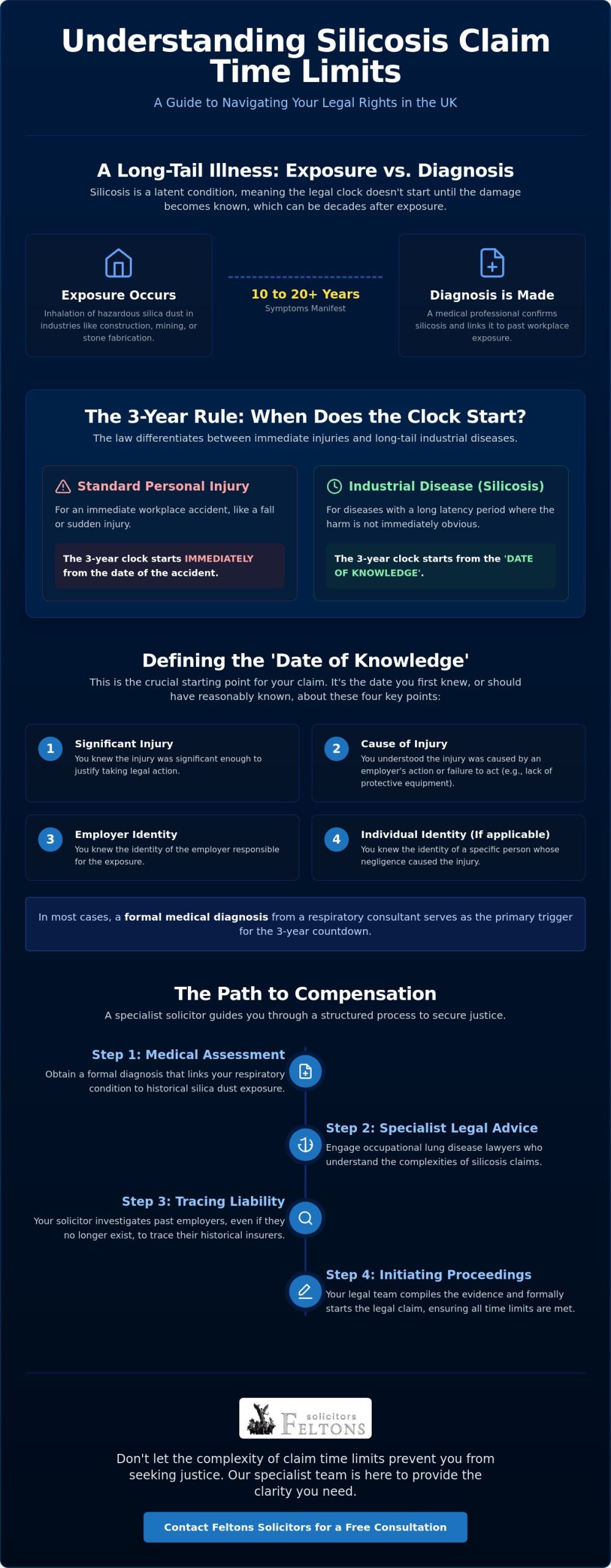
The legal clock for industrial disease doesn’t necessarily start ticking the moment you’re exposed to hazardous silica dust; it starts when you first realise the damage it’s caused. If you’ve recently received a diagnosis, understanding the strict silicosis claim time limits uk courts enforce is the most vital step toward protecting your family’s future. It’s natural to feel anxious that you might be too late to seek justice, especially when your health is a primary concern and the companies you once worked for may no longer exist.

This article provides the clarity you need by explaining how the ‘date of knowledge’ rule creates a fair opportunity for compensation, regardless of when your exposure occurred. We’ll outline the three year limitation period, explain the process of tracing historical insurers, and provide a methodical overview of the current 2026 claim requirements. By the end of this guide, you’ll have a clear, professional path toward the financial support and peace of mind you deserve.

Key Takeaways

  • Understand the standard three-year limitation period and how the ‘date of knowledge’ rule provides a fair starting point for legal action.
  • Learn how silicosis claim time limits uk regulations apply even if your exposure occurred decades ago in industries like mining or construction.
  • Discover how specialist solicitors can trace historical insurers and hold former employers accountable, even if the original company is no longer trading.
  • Identify your legal rights regarding modern silica risks, such as those found in engineered stone fabrication and quartz worktop manufacturing.
  • Explore the benefits of a tailored, boutique legal approach that manages the complexities of litigation whilst you focus on your health and recovery.

Understanding Silicosis Claim Time Limits in the UK

Silicosis is a progressive, irreversible lung condition caused by the inhalation of respirable crystalline silica (RCS) dust. For those seeking a comprehensive overview of silicosis, it’s defined by the scarring of lung tissue which leads to persistent breathing difficulties and a reduced quality of life. Unlike a trip or fall where the injury is immediate and obvious, silicosis often remains latent for decades. This delay creates a unique challenge when navigating silicosis claim time limits uk, as the gap between breathing in the dust and receiving a medical diagnosis can span an entire career.

The Limitation Act 1980 sets the standard legal framework for personal injury in England and Wales. Generally, a claimant has three years to initiate legal proceedings. However, because respiratory diseases are “long-tail” illnesses, the law treats them differently from a sudden workplace accident. In a traumatic injury case, the clock starts immediately. With silicosis, the law recognises that the damage is internal and invisible for years. Therefore, a critical distinction is made between the date of exposure and the date of injury. You aren’t expected to claim for an injury you don’t yet know exists. Instead, the legal focus shifts to when you first became aware that your health had been compromised by your working conditions.

The 3-Year Rule: When Does the Clock Actually Start?

The statutory period for industrial disease doesn’t usually begin on your last day of work. It starts on your “date of knowledge.” This is the point at which a reasonable person would have realised they had a significant injury caused by their employer’s negligence. With the 2026 HSE updated guidelines placing a heavier emphasis on silica exposure reporting in sectors like engineered stone fabrication, the courts are increasingly precise about when this “knowledge” is established. If you’ve been diagnosed with silicosis, the three-year countdown likely began on the day of that medical confirmation.

Why Silicosis Claims Require Specialist Occupational Lung Disease Lawyers

Proving a link between current breathlessness and dust inhaled decades ago is a complex undertaking. Experienced occupational lung disease lawyers are essential for identifying the point of legal liability, especially when multiple employers are involved. They understand the nuances of the Control of Substances Hazardous to Health (COSHH) Regulations 2002 and how these duties applied during your employment. These specialists handle the intricate task of tracing defunct companies and their insurers, ensuring silicosis claim time limits uk are met whilst you focus on your health. This methodical approach transforms a daunting legal hurdle into a structured path toward recovery.

The ‘Date of Knowledge’ Exception for Respiratory Claims

The standard three-year window for personal injury can feel incredibly restrictive for those suffering from industrial diseases. Because symptoms of silica exposure often take 10 to 20 years to manifest, the law provides a vital exception known as the “date of knowledge.” This principle ensures that silicosis claim time limits uk courts apply don’t expire before a claimant even knows they’re unwell. If you’re experiencing persistent coughing or shortness of breath, reviewing NHS information on silicosis symptoms is often the first step toward a formal medical assessment.

For the three-year clock to begin, the law requires that a claimant has “knowledge” of four specific pillars. First, you must know the injury is significant enough to justify legal proceedings. Second, you must understand that the injury was caused by an act or omission, such as a lack of protective equipment at work. Third, you must know the identity of the employer responsible. Finally, if the claim involves a specific individual’s negligence, you must know their identity. Until these factors align, the limitation period typically remains paused.

The ‘date of knowledge’ is the moment a reasonable person would suspect their illness was caused by work.

In most modern cases, a formal medical diagnosis from a respiratory consultant serves as the primary trigger for the countdown. Once a doctor confirms that your lung scarring is directly linked to historical dust exposure, the legal expectation is that you’ll take action. If you’re unsure when your own clock started, speaking with a specialist at Feltons Solicitors LLP can provide the clarity needed to move forward.

What if You Suspected the Link Years Ago?

The courts also consider “constructive knowledge,” which refers to information you should’ve reasonably discovered. If your medical records show you discussed work-related dust with a GP five years ago but didn’t investigate further, an insurer might argue you’re out of time. A specialist solicitor’s role is to argue against an early date of knowledge by proving that your suspicions didn’t constitute definitive legal “knowledge” at that time.

Section 33: The Court’s Power to Overlook the Deadline

Even if the three-year limit has passed, Section 33 of the Limitation Act 1980 grants judges the discretion to allow “out of time” claims. The court weighs the length of your delay against the potential prejudice to the employer. If the evidence is still available and the delay was understandable, this section acts as a vital lifeline for silicosis sufferers who may have missed the initial deadline due to health or personal circumstances.

Identifying Liability in Modern and Historical Exposure

Establishing who’s legally responsible for your illness is as critical as navigating the silicosis claim time limits uk courts require. Under the Control of Substances Hazardous to Health (COSHH) Regulations 2002, employers have a non-negotiable duty to protect their workforce from respirable crystalline silica. This isn’t just about providing a simple dust mask; it’s about a comprehensive hierarchy of control. Negligence often stems from a failure to organise a safe working environment, particularly amongst stone masons and construction workers where the risks are highest. To understand more about structural safety and maintenance in these sectors, visit Composites Construction UK.

The UK is currently facing a rising crisis linked to engineered stone (quartz) worktop fabrication. These materials can contain up to 90% silica, compared to much lower levels in natural stone. If an employer failed to provide “on-tool” water suppression to catch dust at the source or neglected to supply high-grade, face-fitted Respiratory Protective Equipment (RPE), they’ve breached their statutory duty. For those seeking medical context, NHS information on silicosis outlines how this exposure leads to life-altering damage, reinforcing why legal accountability is so vital. If you worked as a mason or fabricator and have received a diagnosis, our dedicated guide to stone masonry silicosis claims explains how to seek legal redress and secure the compensation you’re entitled to.

Tracing Insurers for Companies That No Longer Exist

Many silicosis sufferers worry that they can’t claim because their former employer went bust years ago. This isn’t the case. We use the Employers’ Liability Tracing Office (ELTO) to locate historical insurance policies that were active at the time of your exposure. Even if a business is dissolved, we can often restore the company to the Register of Companies specifically to pursue litigation. The insurer, not the defunct business, pays the compensation, ensuring that silicosis claim time limits uk rules don’t prevent you from accessing the funds you need for care.

Multiple Employers: Who is Responsible for Your Silicosis?

It’s common for workers to have been exposed to dust across several different jobs over a long career. In these instances, liability is usually apportioned between the various employers based on the length and intensity of the exposure at each site. The “material contribution” test is often applied, where we prove that each employer’s negligence contributed significantly to the overall risk of you developing the disease. Handling these multi-defendant cases requires a methodical approach, often involving complex personal injury claims solicitors to ensure every responsible party is held to account. This level of detail is essential for securing a settlement that reflects the true impact on your health and future.

Silicosis Claim Time Limits UK: A Guide to Occupational Lung Disease Compensation in 2026

The Step-by-Step Process of a Silicosis Claim

Initiating a legal challenge for an industrial disease requires a methodical approach and early intervention. Because evidence such as site logs, dust monitoring records, and maintenance files can be lost over time, starting the process whilst information is still accessible is paramount. Reconstructing a work history from several decades ago is a specialist task. By acting promptly, you ensure that the silicosis claim time limits uk courts strictly enforce are not breached, protecting your ability to secure essential financial support. For a detailed breakdown of each stage, our guide to the silicosis litigation process UK provides a comprehensive roadmap for securing compensation in 2026.

Our role involves more than just filing paperwork. We work closely with medical experts to quantify the exact level of your lung impairment and its likely progression. This detailed assessment allows us to negotiate settlements that don’t just cover past losses, but also account for future care requirements and potential loss of earnings. This forward-thinking strategy is designed to provide you and your family with long-term security and peace of mind.

Step 1: The Initial Consultation and Merit Assessment

The journey begins with a detailed review of your employment history and medical diagnosis letters. We carefully assess your “date of knowledge” to ensure your case falls within the necessary silicosis claim time limits uk. At Feltons Solicitors LLP, we offer pragmatic, plain-English advice during this stage. We focus on being a calm, steady presence, helping you understand the strengths of your case without the distraction of dense legalese.

Step 2: Evidence Gathering and Expert Reports

Once we’ve established the merits of your claim, we move into the intensive evidence-gathering phase. This involves instructing a consultant respiratory physician to provide a comprehensive causation report. We also use Subject Access Requests (SARs) to obtain personnel files and seek witness statements from former colleagues who can testify to the dust levels and lack of protective equipment at your former workplace. This robust body of evidence is the foundation of a successful recovery.

Step 3: Letter of Claim and Pre-Action Protocols

We formally notify the defendant or their insurer of the legal action through a Letter of Claim. Under pre-action protocols, they have a specific timeline to investigate and provide a formal response regarding liability. Whilst we prepare every case with the diligence required for a court trial, most claims are settled through professional negotiation. If you’re concerned about your health and want to explore your options, contact Feltons Solicitors LLP for a discreet consultation on your silicosis claim.

Why Specialist Representation Matters for Silicosis Claims

Choosing the right legal partner is as significant as understanding the silicosis claim time limits uk courts mandate. Industrial disease litigation is rarely straightforward, often involving decades of employment history and complex medical pathology. Unlike high-volume firms that may treat these cases as mere statistics, a boutique approach prioritises personal connection and tailored care. We understand that behind every file is a person facing a challenging health journey, which is why our focus remains firmly on providing a supportive, high-standard service through Feltons Solicitors LLP.

Our team manages the heavy lifting of your litigation, allowing you to focus on your medical treatment and well-being. We take responsibility for the exhaustive research required to trace former employers and their insurers, even when businesses have long since closed. This professional oversight ensures that your claim is built on a robust foundation, protecting your family’s future through meticulous preparation. In cases where a condition progresses rapidly, we provide the necessary continuity to ensure a silicosis claim after death can be pursued by bereaved families, honouring the original intent of the legal action.

The Feltons Solicitors LLP Professional Standards

We pride ourselves on a sophisticated blend of traditional professional integrity and modern delivery. Our solicitors act as a calm, steady presence during what can be a stressful and uncertain period. Whilst we maintain a boutique level of care, our reach is national. We represent clients across the UK, ensuring that regardless of where you were exposed to silica dust, you have access to high-end reliability and worldly legal experience. This methodical approach ensures that no detail is overlooked in the pursuit of justice.

Securing Your Financial Future

A successful claim is about more than just a settlement figure; it’s about providing the resources needed for a dignified life. We work methodically to calculate damages for pain, suffering, and loss of amenity (PSLA), ensuring the physical and emotional impact of your condition is fully recognised. Our goal is to recover costs that cover private medical treatment, specialised equipment, and necessary home adaptations. For those who may require professional property modifications, it can be helpful to explore Project-based Installation and Landscaping Fees from Wolverhampton Driveways Ltd to assist with financial planning. If you’re ready to explore your options and ensure you remain within the silicosis claim time limits uk, we invite you to take the first step with a confidential, professional consultation with Feltons Solicitors LLP to discuss your path forward.

Securing Your Path to Justice and Recovery

Navigating a respiratory diagnosis is a significant challenge, but the legal framework exists to ensure you aren’t left without support. We’ve examined how the “date of knowledge” principle provides a vital extension to the standard silicosis claim time limits uk regulations, allowing for claims even decades after initial exposure. By tracing historical insurers and identifying modern liability, you can secure the financial resources necessary for private care and long-term security.

Since 2010, Feltons Solicitors LLP has maintained a national reputation for delivering pragmatic legal advice through a boutique, people-first approach. We provide a calm, steady presence during complex litigation, prioritising the personal connection that high-volume firms often overlook. Our specialist expertise in industrial disease ensures that your family’s future is protected with the highest standards of professional integrity. Speak with our specialist occupational lung disease lawyers today to begin your confidential consultation. You don’t have to face this journey alone; we’re here to provide the sophisticated guidance you deserve.

Frequently Asked Questions

How long do I have to make a silicosis claim in the UK?

The standard limitation period is three years from the date of your diagnosis or the date you first suspected your illness was linked to your work. This is legally referred to as the “date of knowledge.” Because symptoms can take decades to appear, the silicosis claim time limits uk courts apply are designed to ensure that the clock only starts once the injury is actually discovered.

Can I claim if my diagnosis was more than three years ago?

In most circumstances, the three-year deadline is strictly enforced. However, the court has discretionary power under Section 33 of the Limitation Act 1980 to allow a claim to proceed “out of time.” A judge will weigh the reasons for your delay against the availability of evidence. It’s always advisable to have your case reviewed by a specialist to see if an exception might apply to your situation.

What happens if the company I worked for is now insolvent?

You can still seek compensation even if the business you worked for has closed down. Claims are made against the employers’ liability insurance policy that was active at the time of your exposure. We use specialist tracing services to locate these historical insurers, ensuring that a former employer’s insolvency doesn’t prevent you from receiving the financial support you’re entitled to.

Do I need to have a formal diagnosis before I contact a solicitor?

You don’t need a final medical report to begin an initial consultation. If you’re experiencing respiratory symptoms and have a history of working with silica dust, early legal advice is beneficial. We can help you navigate the process of obtaining a formal diagnosis and ensure that the right medical experts are instructed to assess the link between your health and your previous employment.

How much compensation can I expect for a silicosis claim in 2026?

Compensation is calculated based on the severity of your condition and the financial impact on your life. Awards are divided into “general damages” for pain and suffering and “special damages” for financial losses, such as lost earnings and the cost of private care. Every case is unique, and a specialist will provide a methodical valuation based on your specific medical evidence and care requirements.

Can I claim for silicosis if I was a smoker?

Yes, having a history of smoking doesn’t prevent you from pursuing a claim. The legal test is whether silica dust exposure caused or materially contributed to your lung condition. Medical experts are highly skilled at apportioning the cause of respiratory damage, and if it can be proven that workplace dust played a significant role, you’re still eligible to seek compensation for that contribution.

Is there a time limit for a silicosis claim after death?

The limitation period for a claim brought by a bereaved family is usually three years from the date of death. Alternatively, the clock may start from the date the cause of death was confirmed, such as through a post-mortem report. This ensures that families can still seek justice even if the link to silica dust wasn’t fully understood during the sufferer’s lifetime.

Will I have to pay legal fees upfront for an occupational lung disease claim?

Most claims are handled under a “No Win, No Fee” agreement, meaning there are no upfront costs to pay. If your claim is successful, the solicitor’s success fee is legally capped at 25% of the compensation awarded for pain, suffering, and past financial losses. This arrangement ensures that you can access high-quality legal representation without facing financial risk whilst your case is ongoing.