

If a loved one’s life was cut short by an industrial disease they were never properly protected from, does their right to justice simply vanish when they do? Initiating a silicosis claim after death is a path many families hesitate to take, yet it remains one of the most vital ways to honour a legacy and secure your family’s financial future. We understand that the thought of legal action whilst you are still in mourning can feel overwhelming; it’s natural to feel that a claim might be secondary to your grief or even a source of anxiety during such a delicate time.
You deserve to know that you can secure the compensation your loved one was entitled to through a specialised post-mortem process. This article provides a clear, empathetic roadmap for bereaved families navigating the legal landscape in 2026. We will explore the latest HSE regulations on engineered stone, the fixed statutory bereavement award of £15,120, and how a dual-specialist approach integrates estate administration with industrial disease litigation to provide the steady, professional support your family needs right now.
Key Takeaways
- Understand how the Law Reform (Miscellaneous Provisions) Act 1934 enables a silicosis claim after death to proceed as a surviving cause of action for the estate.
- Learn why securing a Grant of Probate or Letters of Administration is a mandatory step before your legal team can formally initiate a fatal injury claim.
- Clarify the three-year limitation period and how the “date of knowledge” rule can affect the timeline for seeking justice.
- Explore the different “heads of loss” that determine your final settlement, including compensation for the deceased’s suffering and future financial dependency.
- Discover the benefits of a boutique legal service that offers direct access to senior solicitors rather than anonymous call centre staff.
Understanding Your Right to Make a Silicosis Claim After Death
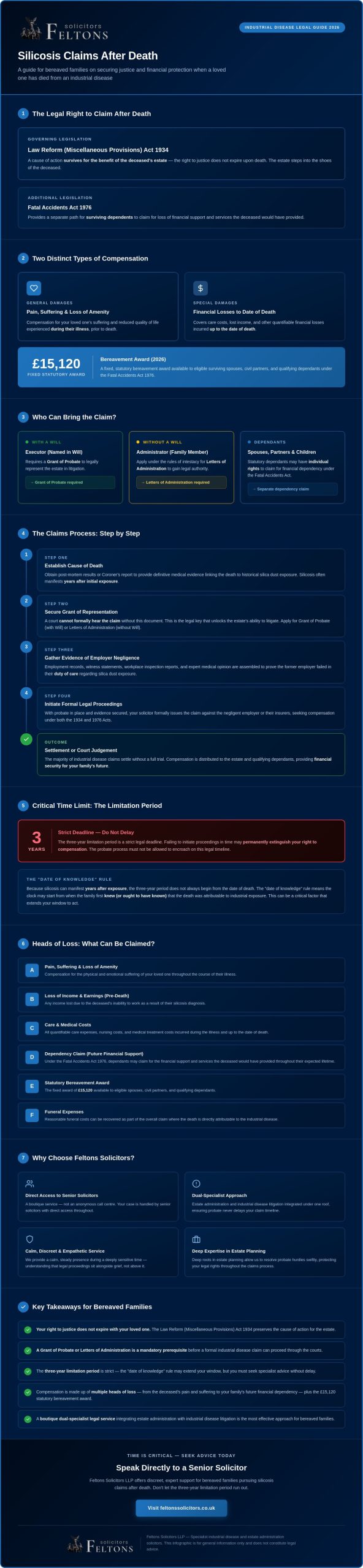
Facing the loss of a family member is a deeply personal journey, often compounded by the knowledge that their illness was preventable. When a loved one passes away due to industrial disease, their legal right to justice does not simply expire. Under the Law Reform (Miscellaneous Provisions) Act 1934, a cause of action survives for the benefit of the deceased’s estate. This means that a silicosis claim after death can be initiated or continued to ensure that the negligence of a former employer is formally recognised and compensated.
Establishing the cause of death is a critical first step in this process. Whilst a clinical diagnosis may have been made during the individual’s lifetime, a post-mortem or a Coroner’s report often provides the definitive medical evidence required to link the fatal condition to historical silica dust exposure. Understanding Silicosis and its progressive nature is essential; the disease often manifests years after the initial exposure, making forensic medical evidence a cornerstone of a successful claim. Families have a fundamental legal right to seek this recognition, even if the exposure occurred decades ago.
The Legal Basis for Post-Mortem Compensation
The law allows the estate to essentially step into the shoes of the deceased. This involves two distinct types of compensation. Firstly, “General Damages” are sought for the pain, suffering, and loss of amenity experienced by your loved one during their illness. Secondly, “Special Damages” cover the financial losses incurred up to the date of death, such as care costs or lost income. Additionally, the Fatal Accidents Act 1976 provides a separate path for surviving dependents to claim for the loss of financial support and services that the deceased would have provided had they lived. Families seeking to understand the broader silicosis litigation process UK courts follow will find that these two legislative frameworks work in tandem to provide comprehensive financial redress.
Who is Eligible to Bring the Claim?
The primary responsibility for initiating a silicosis claim after death rests with the Executor named in the deceased’s Will. If your loved one passed away without a valid Will, a family member must apply for Letters of Administration to become the Administrator of the estate. Both roles grant the legal authority to represent the estate in litigation. Statutory dependents, including spouses, civil partners, and children, may also have individual rights to claim for dependency. We provide a calm, steady presence to help you identify who should lead the claim, ensuring the process is handled with the discreet, high-standard service your family deserves during this sensitive time.
The Essential Role of the Estate and Probate in Silicosis Litigation
A successful silicosis claim after death involves more than just proving industrial negligence. It requires a robust administrative foundation through the probate process. Without a Grant of Probate or Letters of Administration, a legal claim cannot formally proceed through the courts. This serves as the legal key that unlocks the estate’s ability to litigate on behalf of the deceased. We provide a calm, steady hand to guide you through this overlap of probate and litigation, ensuring that the technical requirements don’t become a barrier to justice.
The court’s insistence on a formal Grant of Representation is designed to protect all beneficiaries. Because industrial disease settlements can be substantial, the law requires a verified representative to manage these assets. OSHA’s findings on silica emphasise the severe, often fatal, health consequences of exposure, which underscores why these claims are treated with such gravity by the judiciary. Our approach ensures that the administrative burden of probate doesn’t delay your pursuit of compensation. Our team ensures that the administrative side of probate in 2026 doesn’t hinder the legal timeline, as the three-year limitation period remains a strict deadline.
Securing the Grant of Representation
The Grant of Representation is the collective term for the document that proves you have the authority to deal with the deceased’s assets. If a Will exists, this is a Grant of Probate. If not, the process follows the rules of intestacy, and we assist you in obtaining Letters of Administration. Our deep roots in estate planning allow us to resolve these administrative hurdles swiftly, preventing them from encroaching on your legal rights.
Executor Duties in an Industrial Disease Claim
An Executor’s role extends beyond merely distributing personal belongings. In the context of a silicosis claim after death, you have a fiduciary duty to gather evidence, such as employment records and witness statements, to support the litigation. This responsibility includes protecting the interests of minor children or vulnerable dependents who may rely on the final settlement. It’s a complex balancing act. We act as your discreet partner, ensuring the estate is managed correctly whilst the legal claim progresses towards a resolution. If you are concerned about your legal standing, our expert team is here to offer the high-end reliability your family needs.
Evidence and Time Limits: Navigating the Legal Hurdles
Securing justice for a loved one requires navigating strict procedural timelines. In the United Kingdom, the standard limitation period for personal injury is three years. For a silicosis claim after death, this clock generally begins on the date of passing. This remains true even if the original exposure to silica dust occurred decades earlier in a quarry, construction site, or fabrication workshop. However, the law provides essential flexibility through the “date of knowledge” principle. If the connection between the illness and a former workplace only becomes apparent after a post-mortem or a specialised medical review, the three-year window may start from that later date instead. For a detailed breakdown of how these deadlines are calculated and applied, our guide on silicosis claim time limits UK provides a comprehensive overview of the current 2026 requirements.
The Limitation Period in Fatal Claims
The distinction between a living claimant’s timeline and an estate’s timeline is vital. If your loved one was never aware that their condition was work-related, the estate is granted a fresh three-year period from the date of death to initiate proceedings. You shouldn’t assume it’s too late simply because years have passed since the employment ended. Seeking legal advice immediately is the most reliable way to protect your family’s position. We act as a steady guide, helping you determine exactly when your specific limitation period began.
Proving Negligence After the Fact
Building a case after a person has passed away requires a methodical approach to evidence. We often begin by requesting a complete employment history from HMRC to identify every company your loved one worked for. Even if a former employer has long since ceased trading, we can often trace their historical insurers through the Employers’ Liability Tracing Office. Witness statements from former colleagues are also invaluable for establishing that dust levels were high or that protective equipment was absent. Expert medical testimony remains the final piece of the puzzle. As highlighted by the American Lung Association on Silicosis, the disease has distinct clinical signatures that allow specialists to link it directly to industrial environments. This medical clarity, combined with historical work records, forms the bedrock of a successful claim. We provide the worldly experience necessary to handle these complex matters with the precision they require.
Calculating Compensation: Financial Security for the Family
Quantifying the financial impact of a loss is a delicate task that requires both technical precision and deep empathy. While no sum of money can replace a family member, a successful silicosis claim after death is designed to provide the financial stability your loved one would have wanted for you. The law categorises compensation into several “heads of loss,” ensuring that every facet of the family’s changed circumstances is accounted for, from immediate costs to long-term financial support.
The valuation process begins by looking at the impact on the estate and the surviving dependents. This includes recovering funeral expenses and the costs of any specialised care provided at home before your loved one passed away. By meticulously documenting these outgoings, we ensure that the estate is not left to bear the financial burden of an illness caused by industrial negligence. If you are unsure which expenses can be included, our expert legal team can provide a clear, step-by-step assessment of your specific situation.
The Statutory Bereavement Award
In England and Wales, certain family members are entitled to a fixed sum known as the Statutory Bereavement Award. As of June 2026, this amount remains set at £15,120 for deaths occurring on or after 1 May 2020. This award is available to the surviving spouse or civil partner, or the parents of a deceased minor. It’s important to recognise that this is a “solatium”—a symbolic acknowledgement of grief—and represents only one component of a complex personal injury claim. In many cases, the total settlement value significantly exceeds this fixed sum once other losses are calculated.
Loss of Financial Dependency and Services
The most substantial part of a silicosis claim after death often relates to “loss of dependency.” This calculation aims to replace the financial contribution the deceased would have made to the household. We look at several factors to build a comprehensive picture:
- Future Earnings: The salary and bonuses the deceased would have earned until their expected retirement date.
- Pension Contributions: The loss of employer pension top-ups and the subsequent reduction in the surviving partner’s future income.
- Loss of Services: The tangible value of domestic tasks the deceased performed, such as DIY, gardening, car maintenance, or childcare.
By applying expert forensic accounting, we ensure the settlement accounts for future inflation and the evolving needs of your family. This methodical approach provides the quiet confidence that your future is protected, allowing you to focus on the personal process of healing.
Why Feltons Solicitors is the Right Choice for Your Family
Choosing the right legal partner is a decision that extends beyond technical competence; it is about finding a team that respects the weight of your loss. We maintain a boutique level of care that prioritises personal connection over high-volume processing. We don’t use call centres. Instead, you receive direct access to senior solicitors who possess the worldly experience necessary to navigate complex, international-scale matters whilst remaining deeply rooted in the community they serve. This high-end reliability ensures that your family’s privacy is protected at every stage of the journey.
Handling a silicosis claim after death involves managing both the industrial disease litigation and the intricate details of estate administration. Our dual-specialism in personal injury and probate simplifies this legal journey significantly. By integrating these services, we remove the friction often found when dealing with multiple firms, allowing for a smoother, more efficient path to settlement. Where families also hold international property interests, our expertise in overseas entity beneficial owner registration ensures that all aspects of the estate’s assets are properly managed and legally compliant throughout the claims process. We act as a calm, steady presence, providing the professional authority required to hold former employers and their insurers to account.
A Sophisticated and Empathetic Approach
We handle the delicate nature of fatal claims with poised, quiet confidence. Our role is to act as your sophisticated guide, offering pragmatic advice that avoids unnecessary stress for your family. We understand that whilst the technical legal work is paramount, the human impact is what truly matters. Whether you are dealing with a claim based on historical exposure or a recent diagnosis involving engineered stone, we provide the tailored, high-quality experience you deserve. As modern commercial environments must be designed with the highest safety standards in mind, you can learn more about Excel Business Environments Ltd and their commitment to safe, professional refurbishments. Our expertise allows us to manage complex litigation with a focus on practicality and sound judgment.
Securing Your Family’s Future
Our track record in securing compensation for high-value industrial disease claims demonstrates our ability to challenge even the largest insurers. We organise the entire process, from the initial application for probate to the final settlement negotiation, ensuring maximum ease for you. This methodical approach is designed to make you feel informed, supported, and in capable hands. If you are ready to seek the justice your loved one deserved, we invite you to contact us for a confidential, no-obligation consultation. Together, we can discuss your options and take the first steps towards securing your family’s financial future through a specialised silicosis claim after death.
Securing Justice and Your Family’s Future
Navigating the aftermath of an industrial disease is a deeply personal journey, yet seeking legal redress is a vital way to honour your loved one’s legacy. We’ve explored how a silicosis claim after death integrates the technicalities of probate with the rigour of personal injury litigation to provide a path forward. By addressing both the immediate statutory awards and the long-term loss of dependency, you can establish the financial security your family needs during this transition.
Success in these complex matters relies on a partner who offers more than just legal advice. Our boutique, partner-led service provides national coverage for UK industrial disease claims, combining specialist expertise in both personal injury and probate. We don’t treat our clients as case numbers; we offer a discreet, high-standard presence that prioritises your privacy and peace of mind. You deserve a sophisticated guide who understands the human impact behind the technical work. Families who wish to understand every stage of the formal court process can also benefit from reading our detailed overview of the silicosis litigation process UK solicitors follow when pursuing compensation in 2026.
If you are ready to explore your options, please contact Feltons Solicitors for expert guidance on your silicosis claim. We are here to help you secure the recognition and support your family deserves, ensuring that justice is served with the empathy and authority you require.
Frequently Asked Questions
Can I still make a silicosis claim if my loved one died several years ago?
Yes, you can often still proceed, provided you are within the three-year limitation period. This window typically starts from the date of death. However, if the link between their work and their illness only became clear later, the “date of knowledge” rule might allow a silicosis claim after death to begin even after that three-year anniversary. It’s best to seek a professional review of your timeline as soon as possible.
What is the current statutory bereavement award in the UK for 2026?
The statutory bereavement award in England and Wales is currently fixed at £15,120. This sum applies to deaths occurring on or after 1 May 2020 and has remained at this level through to June 2026. This award is a specific, set payment for a surviving spouse, civil partner, or the parents of a deceased minor, and it’s separate from other compensatory “heads of loss” like loss of dependency.
Do I need to have a Will to start a silicosis claim for a deceased relative?
You don’t strictly need a Will to initiate a claim, but you must have the legal authority to represent the estate. If your loved one didn’t leave a Will, you’ll need to apply for Letters of Administration to become the estate’s Administrator. This Grant of Representation is a prerequisite for any high-value litigation, ensuring that the person leading the claim has the proper legal standing to do so.
How long does a fatal silicosis compensation claim typically take to settle?
Most fatal industrial disease claims reach a settlement within 12 to 24 months. The duration depends on the complexity of the medical evidence and whether the historical insurers admit liability promptly. We maintain a steady, methodical pace to ensure the process remains as stress-free as possible for your family whilst pursuing the full compensation your loved one deserved.
Will I have to pay legal fees if the silicosis claim is unsuccessful?
We generally handle these claims on a “No Win No Fee” basis. This means you won’t pay our legal fees if the claim doesn’t succeed. We’ll explain the specific terms of the agreement during your initial consultation so you have complete clarity. This approach allows families to seek justice without the anxiety of upfront costs or the risk of financial loss if the case fails.
Can I claim if the employer where the silica exposure happened is no longer in business?
Yes, you can still pursue a silicosis claim after death even if the original company has been dissolved. We use specialised tracing services to identify the insurers who provided liability cover at the time of the exposure. These insurance providers remain legally responsible for paying the compensation, regardless of the current status of the former employer’s business.
What documents do I need to provide to start a post-mortem claim?
You should initially provide the death certificate, any medical records relating to the lung condition, and the Grant of Probate or Letters of Administration. An HMRC employment history is also vital for identifying the correct defendants. Any additional evidence, such as witness statements from former colleagues or old training manuals, can significantly strengthen the case for industrial negligence.
Is a post-mortem examination always required for a silicosis claim?
A post-mortem isn’t always mandatory if the medical evidence gathered during your loved one’s lifetime is sufficiently clear. However, in cases where the diagnosis is disputed, a Coroner’s report or post-mortem findings can provide the definitive proof needed to link the disease to silica dust. We can review the available medical files to advise whether such forensic evidence is necessary for your claim.