
Post-Nuptial Agreement Drafting Solicitors: 2026 Guide

Post-Nuptial Agreement Drafting Solicitors: 2026 Guide

Could putting financial decisions in writing bring clarity without deciding the future of your marriage? For couples considering a post-nuptial agreement, that balance matters. Discussions about money can feel sensitive or one-sided, and it’s natural to ask whether an agreement will carry legal weight. In England and Wales, post-nuptial agreements aren’t automatically binding. A court may give one significant weight if it is fair and both parties entered into it freely, with full financial disclosure and independent legal advice. Experienced post nuptial agreement drafting solicitors can help you approach the process carefully and with realistic expectations.

A considered agreement is a financial plan tailored to your circumstances, not a guarantee of a particular court outcome. This 2026 guide explains what an agreement can cover, from property and savings to pensions, business interests and debts. It also sets out what information to prepare, how solicitor-led advice can support clear decisions and what to consider before signing.

Key Takeaways

  • Changes such as an inheritance, growing business interests or a shift in finances may prompt you to revisit financial plans after marriage.
  • Understand how the court’s discretion and the principles in Radmacher v Granatino affect the weight an agreement may carry.
  • See where generic templates can fall short, particularly when assets, family circumstances or future plans are more complex.
  • Prepare a clear picture of your objectives, income, assets, pensions, liabilities and relevant supporting records before drafting begins.
  • Learn what to expect from post nuptial agreement drafting solicitors, from initial discussions and financial disclosure to review and signing.

When are post-nuptial agreement drafting solicitors useful after marriage?

A post-nuptial agreement is a written agreement made after a couple marries or enters a civil partnership. It can set out how they intend to approach their finances if they separate or divorce, including matters such as property, savings, debts or business interests. The Postnuptial agreement overview offers a general introduction, but it isn’t a guide to the law in every jurisdiction. In England and Wales, an agreement can record a couple’s intentions; it can’t guarantee how a court would decide a future financial case.

Post nuptial agreement drafting solicitors can help couples work through their intentions in light of their financial circumstances. Considering an agreement doesn’t mean separation is expected. For some couples, it’s practical planning after a change in circumstances. For others, it creates an opportunity to clarify financial expectations and discuss them openly.

What can prompt a couple to consider an agreement?

A change in finances may lead a couple to revisit arrangements made earlier in their relationship. One partner might receive an inheritance, start or grow a business, or experience a substantial change in income. They may want to record how particular assets or responsibilities should be treated if the relationship later ends.

These are possible reasons to explore an agreement, not a checklist for every couple. Start by identifying what has changed, what each partner wants to clarify and whether both feel able to discuss the subject freely. A focused conversation can help separate shared priorities from assumptions that need further thought.

How is a post-nuptial agreement different from a prenup?

The difference is timing: a prenuptial agreement is made before marriage, while a post-nuptial agreement is made after a marriage or civil partnership has taken place. Either may form part of financial planning, but neither guarantees a particular outcome if the couple separates or divorces.

In both cases, the terms should reflect the couple’s actual circumstances and agreed intentions, rather than generic assumptions. For broader context on the financial issues that can arise if a relationship ends, read this guidance on divorce and financial arrangements.

Family law differs across the UK, so this guide focuses on England and Wales. If your circumstances involve another part of the UK, the applicable law may differ. A solicitor can explain the relevant context and how an agreement may fit into your wider financial planning.

Can a post-nuptial agreement be upheld in England and Wales?

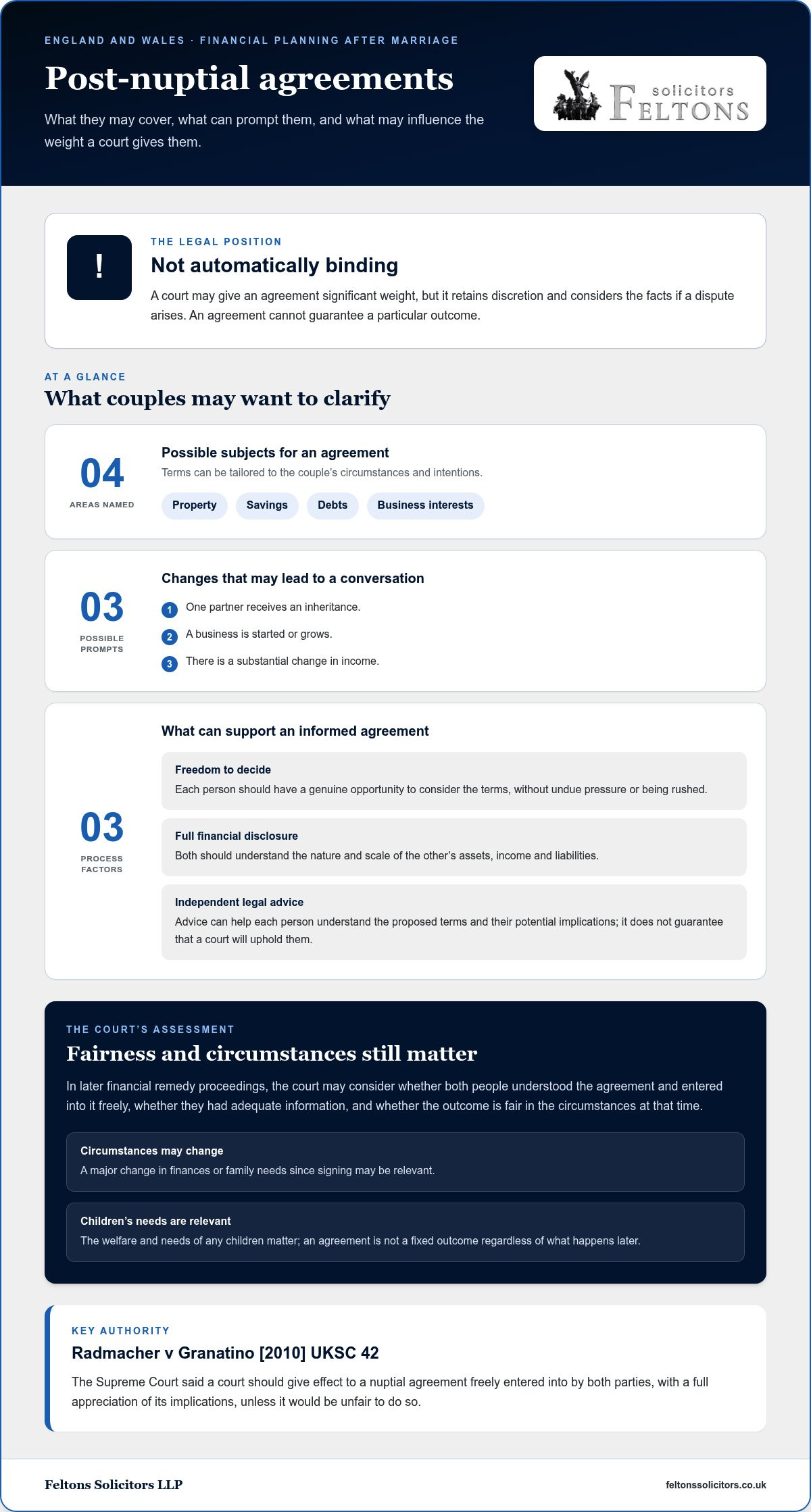
A post-nuptial agreement isn’t automatically legally binding in England and Wales. However, a court may give it significant weight when deciding financial remedy proceedings. The key authority is Radmacher v Granatino [2010] UKSC 42. The Supreme Court said a court should give effect to a nuptial agreement freely entered into by both parties, with a full appreciation of its implications, unless it would be unfair to do so. The Law Commission report on nuptial agreements provides further context on their legal status.

This principle doesn’t promise that a particular agreement or term will be upheld. A court retains discretion and considers the facts when a dispute arises, including whether the agreement was fair at that time and whether circumstances have changed. The needs and welfare of any children are also relevant, so an agreement can’t be treated as a fixed outcome regardless of what happens later.

What factors may influence the weight given to an agreement?

The circumstances in which the agreement was made can matter as much as its wording. Each person should have a genuine opportunity to consider the terms, without undue pressure or being rushed into signing. Full and frank financial disclosure helps both parties understand what they are agreeing to, including the nature and scale of each other’s assets, income and liabilities.

Independent legal advice is an important safeguard. It helps each person understand the proposed terms and their potential implications, but it doesn’t guarantee that a court will uphold the agreement. Post nuptial agreement drafting solicitors can help clarify the issues, record the parties’ intentions and identify points that need careful consideration. The aim is an informed process, not a guaranteed legal result.

Why can’t a solicitor promise a particular result?

If financial remedy proceedings later arise, the court makes its own assessment. It may consider whether each person understood the agreement, entered into it freely and had adequate information, alongside whether the outcome is fair in the circumstances at that time. A major change in finances or family needs since signing may also be relevant.

Careful drafting can support clarity and informed decision-making, but it doesn’t make an agreement automatically binding or remove the court’s discretion. For tailored guidance on how an agreement fits your financial circumstances, explore family law advice on financial arrangements.

Solicitor-drafted agreement or template: what is the difference?

A generic template can provide a starting structure, but it can’t account for how your finances are arranged or what you intend each clause to achieve. Advice-led drafting starts with your circumstances and priorities, then shapes the wording around them. Neither approach guarantees how a court would treat an agreement, and not every couple needs the same provisions.

Consideration Generic template Advice-led drafting
Fit Uses standard wording that may not reflect particular assets, ownership or family circumstances. Considers the couple’s circumstances and identifies where specific terms or further discussion may be needed.
Financial information May provide limited prompts, leaving assumptions about assets, income or liabilities unstated. Uses the financial picture to inform the terms and highlight areas requiring clarity.
Review May not explain how to assess whether the wording reflects both parties’ intentions. Allows the draft to be considered in context, with each person’s position and questions addressed.

Where can a generic template fall short?

Broad wording can blur important differences. For example, a clause referring to “property” may not distinguish a jointly owned home from a property owned by one person, or explain how a mortgage or other liability should be considered. A template may also leave assumptions about a business, shares, inherited assets or changing family circumstances unstated.

This doesn’t mean every template is invalid or unsuitable. The risk is relying on standard language without checking whether it accurately describes the couple’s finances and intentions. If key context is missing, the document may leave room for different interpretations.

What does tailored legal advice add?

Advice can help each person identify their priorities, understand the proposed terms and raise questions before the wording is settled. Since each partner’s circumstances and interests may differ, both should have the opportunity to consider the agreement from their own perspective and receive separate advice. Post nuptial agreement drafting solicitors can help translate agreed intentions into clearer terms and draw attention to unresolved issues rather than obscuring them with general wording.

Inheritance planning may also connect with decisions about how assets are treated in an agreement. For related considerations, see this estate planning guidance. The Law Commission’s report on nuptial agreements provides further background on the legal context. A tailored document isn’t a promise of a particular court outcome; its value lies in recording considered intentions clearly.
Post-Nuptial Agreement Drafting Solicitors: 2026 Guide

What information should you prepare before drafting a post-nuptial agreement?

Good preparation helps turn broad intentions into terms that reflect your finances and priorities. You don’t need to decide every detail alone before seeking advice. Start by gathering a clear picture of your circumstances and noting where you and your spouse agree or need a fuller discussion.

Which financial details and documents may be relevant?

The information needed depends on your circumstances. Records might include property details, bank and investment statements, income information, pension records, details of debts and documents relating to a business or its ownership. Where relevant, note whether an asset is jointly or individually owned and how it was acquired. The aim is an accurate overview, not a standard paperwork list for every couple.

A practical preparation sequence can help:

  1. Set out your objectives. Note what you want the agreement to clarify and which questions remain open.
  2. Gather financial information. List assets, income, pensions, liabilities and business interests, with supporting records where available.
  3. Explain ownership and context. Record how significant assets are held and, where relevant, the source of funds used to acquire them.
  4. Consider day-to-day and future needs. Think about housing, ongoing financial responsibilities and possible changes, such as a new business venture or inheritance.
  5. Review the proposed terms. Read the draft carefully, raise uncertainties and take advice before deciding whether to sign.

How should couples approach terms and future review?

Each person can consider their own priorities and practical needs before discussing how to address them together. For example, think through how housing costs would be managed or what should happen if one partner’s income changes. Listing agreed points separately from unresolved questions can make a sensitive conversation more focused.

You may also wish to discuss whether the agreement should be reviewed after a particular life change or at an agreed point in the future. A review clause can prompt the couple to revisit the terms, but it won’t update them automatically. Any change needs to be considered and properly recorded, with advice tailored to the circumstances at that time.

Post nuptial agreement drafting solicitors can help organise the information, explain issues in plain English and tailor advice and drafting to your circumstances. To discuss your financial arrangements, speak with Feltons about your financial arrangements.

Post-Nuptial Agreements: Instruction to Final Document

A clear, measured process gives both people space to explain their priorities, understand the financial picture and consider the wording before deciding whether to sign. The steps depend on the couple’s circumstances, but the process commonly moves from setting objectives and sharing financial information to advice, drafting, review and completion.

  1. Set out your objectives. Identify what you hope to clarify and which issues need discussion.
  2. Share financial information. Bring together relevant details of assets, income, pensions, liabilities and other interests.
  3. Consider advice. Each person should have the opportunity to understand the proposed terms and their potential implications.
  4. Prepare and review a draft. Instructions and financial information inform the wording. Both parties should read it carefully and raise questions where needed.
  5. Complete the agreement. Before signing, check the final terms and the applicable execution formalities in light of current law and your circumstances.

What happens during the drafting and review stages?

The first draft should reflect the objectives discussed and the financial context provided. During review, check that the language says what you intend, that relevant issues haven’t been overlooked and that unclear or disputed points are addressed. Take time to ask questions. Each person should understand the proposed terms and obtain appropriate advice before completion.

Discussions about money can feel personal. Clear, sensitive communication and appropriate privacy can help keep the focus on practical decisions rather than assumptions about the relationship. Post nuptial agreement drafting solicitors can explain the issues in plain English and tailor advice to the couple’s circumstances, while keeping expectations realistic about the agreement’s potential legal effect.

When should you seek advice about a post-nuptial agreement?

Start early enough to gather financial information, consider the terms and allow each person to obtain independent guidance. A rushed process or pressure to sign can leave one or both parties without a proper opportunity to reflect, undermining confidence in the agreement and how it was reached. If a point remains unresolved, address it before signing rather than treating completion as a formality.

For advice shaped around your objectives and financial circumstances, speak to Feltons about post-nuptial agreement drafting. A solicitor can help you understand the process and prepare carefully, without promising how a court would decide a future dispute.

Take a considered next step with your financial plans

A post-nuptial agreement can set out shared intentions after a change in circumstances, but it can’t guarantee a particular court outcome. Its potential value depends on careful preparation, clear financial information and terms that reflect both parties’ circumstances. Taking time to understand the process and review the draft can help you approach sensitive decisions thoughtfully.

Post nuptial agreement drafting solicitors can help you consider your objectives and the practical issues an agreement may need to address. Feltons advises on divorce and financial arrangements, with pragmatic advice tailored to individual needs. The firm can help you explore your options and take a measured approach.

Discuss post-nuptial agreement drafting with Feltons and take an informed first step towards greater financial clarity.

Frequently Asked Questions

Are post-nuptial agreements legally binding in England and Wales?

No, post-nuptial agreements aren’t automatically legally binding in England and Wales. A court may give an agreement significant weight, particularly where both people entered into it freely, understood its implications and made full financial disclosure. The court retains discretion and may consider fairness, later changes in circumstances and the needs of any children. Careful drafting and independent legal advice can support the process, but neither guarantees that every term will be upheld.

Do both spouses need separate solicitors for a post-nuptial agreement?

Each spouse should have the opportunity to obtain independent legal advice so they can understand the proposed terms and consider their own interests. The same solicitor can’t advise both people on their individual positions. Separate advice can help identify concerns and support informed, voluntary decisions. Post nuptial agreement drafting solicitors can guide each client through the implications of the terms, but independent advice can’t guarantee a particular court outcome.

What should a post-nuptial agreement include?

An agreement may set out how a couple intends to deal with relevant finances if they separate or divorce. Depending on their circumstances, this could include property, savings, pensions, income, debts, business interests and inheritance. It should reflect the couple’s objectives and the financial information available, rather than rely on standard terms that may not fit. Advice can help clarify ownership, responsibilities and points that need further discussion before signing.

Can a post-nuptial agreement protect an inheritance or business?

An agreement can record how a couple intends an inheritance or business interest to be treated if they separate, but it can’t guarantee that a court will follow that intention. The details matter, including ownership, financial disclosure, each person’s needs and later changes in circumstances. For example, a business may change in value or provide income relied on by the family. Tailored advice can help address these factors clearly without promising a legal result.

Can we make a post-nuptial agreement without a solicitor?

You can prepare an agreement without a solicitor, but a generic document may not reflect your finances or make your intentions clear. Independent legal advice can help each person understand the terms, while careful drafting can identify assumptions or unresolved issues. Full financial disclosure and voluntary decision-making are also important considerations. Solicitor involvement may strengthen the preparation, but it doesn’t make an agreement automatically binding or guarantee how a court will treat it.

Can a post-nuptial agreement be changed after it is signed?

Yes, you and your spouse can agree to change the terms, but don’t assume a verbal conversation or informal note updates the agreement. Any variation should be properly documented and considered in light of your current financial circumstances and applicable legal requirements. Independent advice can help each person understand the proposed changes. If circumstances shift, such as a change in income or family responsibilities, review the agreement rather than relying on outdated terms.

Does a post-nuptial agreement cover arrangements for children?

A post-nuptial agreement can record the parents’ intentions about family finances, but it can’t conclusively decide future arrangements for children or bind a court on those matters. If parents separate, decisions concerning a child are assessed in light of the child’s welfare and circumstances at that time. The agreement may include relevant financial intentions, but a court’s consideration of children’s needs remains important. Take advice before including provisions that affect children or family support.

International Prenuptial Agreement Solicitors UK: A Guide for Global Couples in 2026

International Prenuptial Agreement Solicitors UK: A Guide for Global Couples in 2026

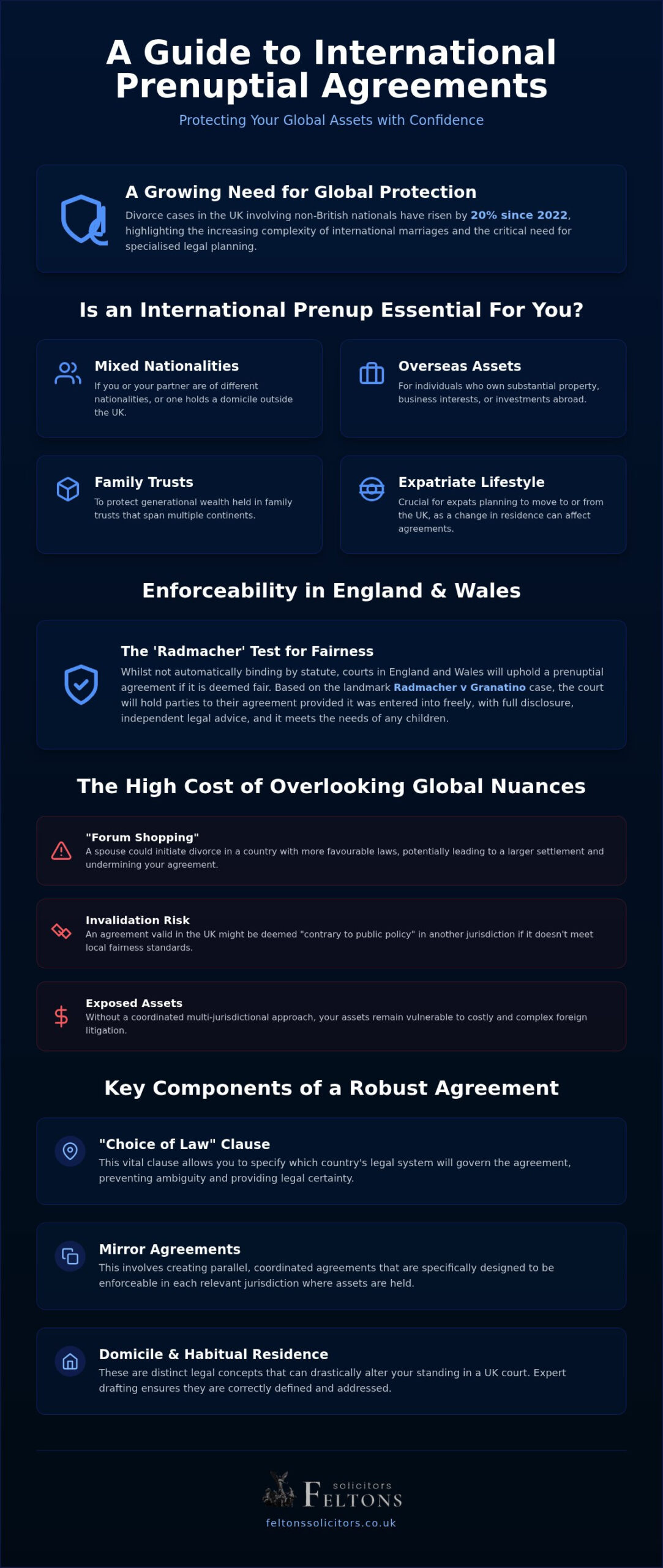
Did you know that divorce cases involving non-British nationals in the UK have risen by 20% since 2022? For couples whose lives, careers, and assets span multiple borders, the excitement of marriage often brings a unique set of logistical anxieties. You might worry about how a property in one country or a business in another would be treated under different legal systems, or feel overwhelmed by the thought of coordinating foreign lawyers. Working with specialist international prenuptial agreement solicitors uk is a pragmatic step to resolve these concerns, ensuring your financial arrangements remain predictable and secure.

This guide provides the expert insight you need to protect your global footprint with confidence. We’ll examine the 2026 proposals for Qualifying Nuptial Agreements and the enduring significance of the Radmacher v Granatino ruling. From understanding jurisdictional nuances to the practicalities of mirror agreements, you’ll learn how to establish a financial foundation that’s both discreet and dependable. Our aim is to provide you with the certainty that your future is managed with the high level of care and professional integrity your situation demands.

Key Takeaways

  • Understand the 2026 legal framework in England and Wales, including how the courts apply the Radmacher v Granatino principles to international marriages.
  • Learn why engaging specialist international prenuptial agreement solicitors uk is vital for coordinating “mirror agreements” that are enforceable across multiple jurisdictions.
  • Gain clarity on how “Choice of Law” clauses and your “Domicile” status directly impact the protection of your global property and inheritance.
  • Discover a methodical, step-by-step drafting process that ensures all foreign legal requirements are met through seamless coordination with overseas experts.
  • Establish a legally robust financial foundation that provides long-term certainty for your assets whilst prioritising discretion and personal rapport.

What is an International Prenuptial Agreement and Why is it Essential?

An international prenuptial agreement is a bespoke legal contract designed for couples whose lives and assets aren’t confined to a single country. When you’re managing a global lifestyle, a standard domestic agreement often falls short because it lacks the specific jurisdictional clauses required to protect properties, trusts, or business interests located across different borders. An international prenuptial agreement is a strategic tool for cross-border asset protection.

Standard UK agreements frequently fail to safeguard overseas property or inheritance because they don’t account for the unique “form” requirements of foreign courts. For instance, a court in France or Dubai might ignore a basic English document if it hasn’t been executed in a specific way or translated correctly. This is where What is a Prenuptial Agreement? becomes a more complex question, as the document must act as a bridge between different legal systems. Without this coordination, you risk your agreement being dismissed precisely when you need it most.

A critical component of these documents is the “Choice of Law” clause. This allows you to specify which country’s legal system should govern the agreement. Without this, you leave your future to the chance of where you happen to be living if the marriage ends. Domicile and habitual residence are distinct legal concepts that can drastically alter your standing in a UK court. Engaging experienced international prenuptial agreement solicitors uk ensures these clauses are drafted with precision, reflecting the current 2026 legal landscape and providing a calm, steady foundation for your marriage.

Who Needs an International Prenup?

Not every couple requires an international approach, but for those with a global footprint, it’s a necessity. You should consider this if you or your partner hold different nationalities or maintain a domicile outside the UK. It’s equally vital for individuals who own substantial property, business interests, or family trusts abroad. Expats planning a move to or from the United Kingdom must also consider how their change in residence affects previous agreements. Identifying these needs early allows international prenuptial agreement solicitors uk to coordinate a robust strategy before the wedding date.

The Risks of Overlooking Jurisdictional Nuances

Ignoring international nuances creates significant legal vulnerability whilst leaving your assets exposed to foreign litigation. One major risk is “forum shopping,” where a spouse might attempt to start divorce proceedings in the country most likely to grant them a larger settlement. Additionally, an agreement drafted in the UK could be deemed “contrary to public policy” in another jurisdiction if it doesn’t meet local fairness standards. For those protecting family wealth that spans generations and continents, these oversights can be incredibly costly. Expert advice on divorce and financial arrangements helps mitigate these risks by providing a coordinated, multi-country strategy.

The Supreme Court decision in Radmacher v Granatino remains the cornerstone of Enforceability in England and Wales as we move through 2026. Whilst prenuptial agreements aren’t yet automatically binding under statute, the courts will hold parties to their bargain if specific criteria are met. The judiciary’s approach is one of quiet respect for autonomy. They’ll rarely interfere with a well-drafted agreement unless it fails to meet the basic needs of a spouse or any children involved. It’s a delicate balance between personal freedom and judicial protection.

Agreements drafted under foreign laws present a unique challenge. English courts won’t simply rubber-stamp a document just because it’s valid in New York or Paris. Instead, they’ll scrutinise whether the process aligned with British standards of fairness. This makes the involvement of international prenuptial agreement solicitors uk essential. They ensure that your multi-jurisdictional strategy doesn’t inadvertently fall foul of local judicial discretion, providing a steady hand through complex cross-border requirements.

The Radmacher Criteria Explained

To carry “decisive weight,” an agreement must satisfy three primary pillars. First, it must be freely entered into. This means no last-minute pressure; ideally, the document should be finalised at least 28 days before the wedding. Second, both parties must have a full appreciation of the implications. This is only possible if each person receives independent legal advice from qualified solicitors. Finally, the agreement must be fair. A court won’t enforce a contract that leaves one party in significant financial hardship whilst the other retains vast wealth. It’s about pragmatic protection, not total exclusion of support.

Financial Disclosure Across Borders

A robust agreement relies on absolute transparency. You must provide a comprehensive schedule of all global assets, from Swiss bank accounts to Californian real estate. Valuing these interests requires a methodical approach, particularly regarding overseas entity beneficial owner registration and complex corporate structures. If you fail to disclose a material asset, the entire agreement could be set aside. This level of detail provides the certainty you need. If you’re unsure how to categorise your international holdings, seeking a discreet consultation with a specialist can help clarify your position and protect your interests.

Distinguishing between domicile and habitual residence is fundamental to your legal standing in the UK. Your domicile is generally where you consider your permanent home, whilst habitual residence is where you actually live and work. These statuses dictate which court has the power to hear a case. A “Choice of Law” clause allows you to specify which country’s rules should apply to the division of your assets, but it isn’t a silver bullet. English courts often prioritise local law if the parties are habitually resident here, especially if applying a foreign law would result in an outcome they deem unfair. This nuance is why consulting international prenuptial agreement solicitors uk is vital; they help you understand The Legal Framework for 2026 and how it impacts your specific circumstances.

A robust protection strategy doesn’t end with the marriage contract. You must integrate these arrangements with broader estate planning to ensure your global legacy remains intact across generations. Co-ordinating your prenup with your will and any existing trusts provides a seamless shield for your wealth, regardless of where your life takes you. It’s about creating a methodical, all-encompassing plan that respects both your current needs and your long-term intentions.

Jurisdiction Shopping and Forum Conveniens

Jurisdiction shopping occurs when one party rushes to file for divorce in a country that offers a more generous financial settlement. Courts use the principle of “forum conveniens” to decide the most appropriate venue for the dispute to be heard. In complex international cases, we may use anti-suit injunctions to prevent a spouse from pursuing litigation in a country that ignores the autonomy of prenuptial contracts. Strategic positioning is key. You want to select a jurisdiction that respects your agreement’s intent whilst providing a predictable, steady outcome for both parties.

Protecting Specific International Assets

Assets in civil law countries, such as France or Spain, are often governed by different marital regimes compared to the common law approach in the UK. For offshore trusts or international shareholdings, we often recommend the use of mirror agreements. These are secondary contracts drafted by local experts in the asset’s location, ensuring the protections in your primary agreement are recognised and enforced locally. Working with international prenuptial agreement solicitors uk allows for this co-ordinated, multi-jurisdictional oversight, ensuring no high-value asset is left vulnerable to foreign legal quirks.

International Prenuptial Agreement Solicitors UK: A Guide for Global Couples in 2026

The drafting process for a cross-border marriage requires a methodical approach that respects the legal nuances of every territory involved. It isn’t a single document but a coordinated strategy. Working with international prenuptial agreement solicitors uk allows you to navigate this journey with quiet confidence, knowing every detail is managed. The process typically follows five essential steps:

  • Step 1: Identify all relevant jurisdictions based on nationality, domicile, and asset location.
  • Step 2: Appoint specialist solicitors in each relevant country to ensure local compliance.
  • Step 3: Draft the primary agreement in the country where you intend to reside.
  • Step 4: Create “Mirror Agreements” that translate the intent into local legal formats.
  • Step 5: Execute and register the documents according to local formalities, such as Notarisation.

What are Mirror Agreements?

Mirror agreements are identical or complementary contracts signed in different countries to ensure your intentions are recognised globally. Relying on a single multi-jurisdictional document is risky. Foreign courts often require specific phrasing or execution methods that an English document might lack. A mirror agreement is safer because it’s drafted by a local expert to meet local standards whilst remaining consistent with your primary English agreement. This dual-layered approach provides the high-standard protection discerning couples require for their global assets.

Working with Foreign Counsel

Your UK solicitor acts as the “lead architect” of your international strategy, overseeing the entire project to ensure nothing is lost in translation. We coordinate with trusted international law firms to provide a seamless service, managing the timeline and costs of multi-jurisdictional drafting on your behalf. This boutique level of care ensures that while the technical legal work is complex, your experience remains straightforward and supportive. It’s about providing a calm, steady presence throughout the coordination of foreign legal advice. If you’re ready to secure your global assets, you can contact our team for a discreet consultation regarding your international financial arrangements.

Securing Your Future with Feltons Solicitors: Discreet International Expertise

Choosing the right legal partner is a decision that balances technical proficiency with personal rapport. At Feltons Solicitors LLP, we provide a sophisticated, boutique service tailored specifically for individuals with global interests. Our worldly experience allows us to manage international-scale matters with a “people-first” philosophy, ensuring that the human impact of your legal arrangements is never overlooked. As specialist international prenuptial agreement solicitors uk, we offer a calm, steady presence during what can often be a complex or stressful period of preparation.

We possess deep expertise in divorce and financial arrangements with a dedicated international focus. Our approach is rooted in pragmatic, discreet advice that prioritises your privacy and future security. We understand that your assets aren’t just numbers on a balance sheet; they represent your hard work, your heritage, and your family’s future legacy. By positioning ourselves as your sophisticated guide, we help you manage the nuances of cross-border law with quiet confidence and traditional professional integrity.

Why a Boutique Firm Suits International Prenups

Discerning couples often find that a boutique firm offers significant advantages over larger, more impersonal practices. You’ll benefit from greater privacy and direct access to senior partners who truly understand the intricacies of your situation. We avoid “off-the-shelf” legal templates, opting instead for bespoke drafting that reflects your unique global footprint. Our streamlined structure also allows us to move quickly and efficiently across different time zones, ensuring that your international strategy remains on track regardless of where your assets or partners are located.

Next Steps: Your Consultation

The first step in securing your financial future is a confidential discussion to review your circumstances. Before our initial meeting, it’s helpful to prepare a comprehensive list of your global assets, including property, business interests, and any existing trusts. We’ll then begin the methodical process of cross-border legal coordination, identifying necessary jurisdictions and liaising with foreign counsel on your behalf. This structured approach provides the high-end reliability you expect from international prenuptial agreement solicitors uk. We invite you to contact Feltons Solicitors LLP for a confidential discussion, where we can begin crafting a robust agreement that protects your interests across every border.

Securing Your Global Legacy for 2026 and Beyond

Navigating the complexities of cross-border marriage requires more than a simple contract. It demands a coordinated strategy that respects the legal nuances of every country where you hold assets. By prioritising procedural fairness and full financial disclosure, you ensure your agreement carries the necessary weight in British courts. Working with expert international prenuptial agreement solicitors uk provides the high-end reliability and discreet guidance essential for managing high-value, multi-jurisdictional arrangements.

We’ve explored how mirror agreements and precise choice of law clauses act as a shield for your wealth, whilst the 2026 legal landscape offers new avenues for certainty. Feltons Solicitors offers a boutique service that combines traditional integrity with modern efficiency, focusing on a personal connection that larger firms often lack. Our specialists provide pragmatic, expert advice for high-net-worth individuals facing international-scale matters with a people-first philosophy.

If you’re ready to establish a robust financial foundation, contact Feltons Solicitors for discreet international prenuptial advice. Our pragmatic approach ensures your global footprint is protected with the care and expertise it deserves. Your future stability starts with a single, confidential conversation.

Frequently Asked Questions

Is an international prenuptial agreement legally binding in the UK?

In England and Wales, prenuptial agreements aren’t yet strictly binding by law, but they carry significant weight in court. Following the Radmacher v Granatino ruling, judges will typically uphold an agreement if it was freely entered into with full financial disclosure. The 2026 proposals for Qualifying Nuptial Agreements (QNAs) aim to provide even greater certainty. Engaging international prenuptial agreement solicitors uk ensures your document meets these evolving standards of fairness and procedural integrity.

Can I include a choice of law clause in my prenuptial agreement?

You can include a choice of law clause to specify which country’s legal system should govern your assets. This is a standard feature in international agreements drafted by specialists. However, English courts retain the discretion to apply English law if you are habitually resident in the UK or if the foreign law produces an outcome deemed unfair. It’s a complex area where pragmatic, expert advice is essential to ensure your intentions are respected across borders.

What happens if we sign a prenup abroad and then move to the UK?

An agreement signed abroad isn’t automatically enforceable in the UK just because it’s valid in its country of origin. If you relocate to the UK, the English courts will scrutinise the document against local standards of fairness and disclosure. To protect your interests, it’s often advisable to have your original agreement reviewed by international prenuptial agreement solicitors uk. They may suggest a mirror agreement or a postnuptial contract to ensure your financial arrangements remain robust under English law.

Do both parties need their own solicitor for an international prenup?

Yes, it’s essential for both parties to receive independent legal advice from separate solicitors. This is a fundamental requirement for an agreement to be considered fair and enforceable in the UK courts. If one party doesn’t have their own representation, the court may conclude they didn’t fully appreciate the implications of the contract. This boutique level of care ensures that both partners are supported and that the final agreement is legally sound in every jurisdiction.

How much does an international prenuptial agreement cost in the UK?

The cost of an international prenuptial agreement varies significantly based on the complexity of your global assets and the number of jurisdictions involved. Factors such as coordinating with foreign counsel, drafting mirror agreements, and the requirement for independent legal advice for both parties will influence the total investment. Because every situation is unique, we provide a tailored approach that reflects your specific needs. We recommend a discreet consultation to discuss the scope of your requirements and obtain a clear fee estimate.

How long before the wedding should we finalise the international prenup?

You should aim to finalise and sign your agreement at least 28 days before your wedding date. This timeframe is a key pillar of enforceability in the UK, as it demonstrates that neither party was under undue pressure or time constraints. Because international agreements involve coordinating with overseas experts and translating complex documents, you should ideally begin the process several months in advance. This steady, methodical approach ensures all legal formalities are met without unnecessary stress.

Can an international prenup protect assets I haven’t acquired yet?

Yes, a well-drafted agreement can protect future assets, including expected inheritances, future business interests, or property you haven’t yet acquired. This is particularly important for high-net-worth individuals who anticipate significant growth in their global wealth. By specifying how these future acquisitions should be treated, you create long-term financial certainty. Our boutique service focuses on bespoke drafting, ensuring your agreement is flexible enough to accommodate your evolving international footprint whilst maintaining its legal integrity.

What is the difference between a prenuptial and a postnuptial agreement internationally?

The primary difference is timing; a prenuptial agreement is signed before the wedding, whilst a postnuptial agreement is executed during the marriage. Internationally, both documents are treated with similar weight by English courts, provided they meet the same criteria for fairness and disclosure. Postnups are often used by couples who move to the UK after marrying abroad or whose financial circumstances change significantly. Both serve as pragmatic tools for asset protection, providing a calm, steady foundation for your shared future.

International Probate Solicitors UK: Navigating Cross-Border Estates in 2026

International Probate Solicitors UK: Navigating Cross-Border Estates in 2026

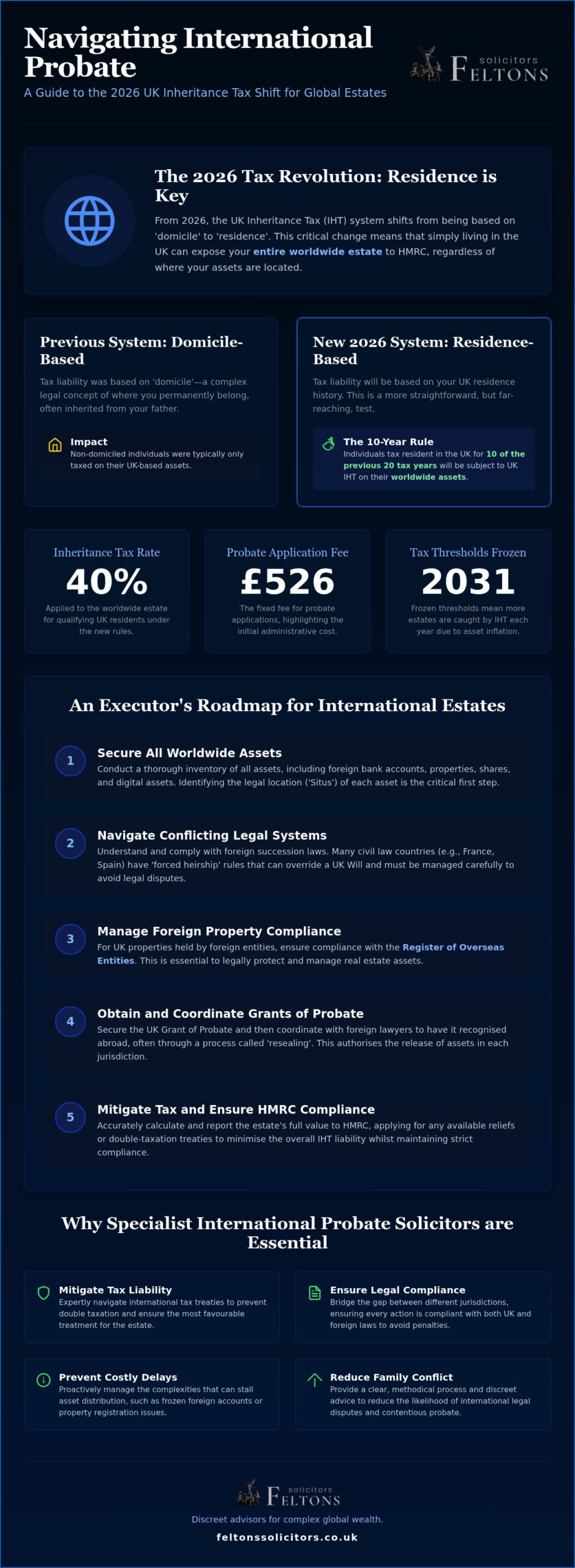
Could your global legacy be dismantled by the very borders you crossed to build it? In 2026, the transition to a residence-based Inheritance Tax system means that simply living in the UK can now expose your worldwide assets to HMRC, regardless of where they’re physically located. Managing these complexities requires the steady hand of experienced international probate solicitors uk. The intersection of foreign succession laws and British tax requirements has never been more intricate, making professional oversight essential for protecting family wealth and ensuring your intentions are honoured.

It’s natural to feel overwhelmed by the conflicting demands of different legal systems or the fear that significant delays will stall the distribution of assets to your beneficiaries. With probate application fees now at £526 and tax thresholds frozen until 2031, the margin for error has vanished. This guide provides a clear, comprehensive roadmap for managing complex cross-border estates, ensuring every foreign asset is legally secured whilst maintaining strict compliance with current 2026 regulations. We’ll examine how to navigate the new residence-based tax landscape, mitigate your total tax liability through expert planning, and streamline the probate process across multiple jurisdictions to provide your family with much-needed stability.

Key Takeaways

  • Grasp how the 2026 shift to a residence-based tax system impacts your global estate and the specific reporting obligations now required by HMRC.
  • Navigate the complexities of foreign property ownership, including the essential steps for the Registration of Overseas Entities to protect your real estate assets.
  • Benefit from the bespoke guidance of international probate solicitors uk to manage the nuances of cross-border administration and ensure seamless asset distribution.
  • Utilise a methodical executor roadmap to accurately secure worldwide assets while identifying the most favourable tax treatments available under current laws.
  • Reduce the likelihood of international legal disputes and contentious probate through discreet, forward-thinking estate management strategies.

What is International Probate? Understanding Cross-Border Estate Administration

International probate is the legal procedure required to manage and distribute an estate when the deceased held assets in more than one country. Unlike a standard domestic probate, which follows a single set of rules, cross-border administration involves a complex conflict of laws between different legal systems. This often occurs in two primary scenarios: a UK resident dies leaving property or bank accounts abroad, or a foreign national passes away leaving assets within the UK. In either case, the process requires international probate solicitors uk to act as a central coordinator, managing various legal threads to ensure a cohesive distribution of the estate.

The role of the UK solicitor is to bridge the gap between jurisdictions. They don’t just handle the UK side; they liaise with foreign legal professionals to ensure that the grant of probate is recognised and that assets are released without unnecessary friction. This coordination is what prevents a cross-border estate from becoming a decades-long administrative burden for the family.

The Legal Complexity of Multiple Jurisdictions

The primary challenge in these cases is the concept of “Situs,” which refers to the legal location of an asset. For example, immovable property like a holiday home is governed by the laws of the country where it stands, whilst movable assets like shares or cash might follow the laws of the deceased’s last residence. Identifying every jurisdiction early is vital. Failing to account for a single foreign bank account can stall the entire process. Experienced international probate solicitors uk must navigate different definitions of “ownership” and “validity” across borders, which significantly increases the administrative burden compared to a UK-only estate.

Why Specialist Expertise is Essential for Cross-Border Estates

Many civil law countries, such as France or Spain, operate under “forced heirship” rules. These regulations dictate that a specific portion of an estate must go to certain relatives, potentially overriding the instructions in a UK Will. Without specialist guidance, executors risk foreign assets being frozen or facing unexpected legal challenges from disgruntled heirs abroad. A dedicated solicitor ensures that the estate remains compliant with international treaties and local requirements, preventing costly delays. At Feltons Solicitors LLP, we provide that boutique level of care, acting as a discreet, trusted advisor to navigate these global complexities whilst protecting the integrity of the deceased’s final wishes.

The distinction between domicile and residence is often the most significant hurdle in cross-border estate administration. Whilst residence describes where you live, domicile is a deeper legal concept reflecting where you truly belong or intend to remain permanently. Since April 2025, the UK has moved to a residence-based system for Inheritance Tax. This means individuals who’ve been UK tax residents for at least 10 out of the previous 20 tax years are now subject to UK IHT on their worldwide assets. For executors, this shift makes the guidance of international probate solicitors uk essential to avoid double taxation or compliance failures with HMRC.

Determining Domicile and Its Impact on Probate

HMRC’s assessment of domicile remains the foundation of any international probate strategy. You typically have a domicile of origin, which is usually the country of your father’s domicile at your birth. However, you can acquire a domicile of choice by moving to a new country with the clear intention of living there permanently. Even if you’ve lived abroad for years, HMRC may still consider you “deemed domiciled” in the UK for tax purposes if you haven’t sufficiently severed those legal ties. This determination dictates whether the 40% Inheritance Tax rate applies only to your UK assets or your entire global estate. Our team at Feltons Solicitors LLP acts as a discreet advisor for complex wealth, ensuring these technical legal frameworks are navigated with precision.

Resealing a Grant vs. Applying for a New Grant

A common point of confusion for foreign executors is whether they need to start the probate process from scratch in the UK. If the deceased was from a country covered by the Colonial Probates Act 1892, the existing foreign grant can often be “resealed”. This process is available for several jurisdictions, including Australia, Canada, New Zealand, and Hong Kong. Resealing is a streamlined administrative procedure where the UK court places its own seal on the foreign document, giving it full legal force here. It’s significantly faster and more cost-effective than a fresh application.

However, for countries not covered by this Act, such as the USA or most of mainland Europe, a full UK Grant of Representation is required. This involves a more rigorous application process, including a detailed account of UK-based assets and liabilities. Experienced international probate solicitors uk can determine which path is necessary, preventing the freezing of assets and reducing distribution delays. Whether your situation requires a simple reseal or a complex new application, a methodical approach ensures that the estate is administered whilst maintaining strict compliance with international treaties.

Managing Foreign Property and the Register of Overseas Entities

Real estate often forms the cornerstone of a cross-border estate, yet it presents unique challenges that differ from liquid assets like cash or shares. When a property is involved, executors must navigate the specific Residential Property Law of the country where the land is situated. This is particularly complex when UK land is held by a foreign company or trust. In such cases, the mandatory Registration of Overseas Entities becomes a critical compliance hurdle. If the deceased was a beneficial owner of an overseas entity that owns UK property, the executor has a legal duty to update the register at Companies House. Failure to do so can freeze the property’s title, preventing any sale or transfer to beneficiaries.

Compliance with the Economic Crime Act

Under the Economic Crime (Transparency and Enforcement) Act 2022, any foreign entity owning UK land must identify its beneficial owners. Probate acts as a trigger for these requirements. Executors must verify the identity of the new beneficial owners or confirm that the deceased’s interest has ceased. This isn’t a task for the layperson. It requires a UK-regulated verification agent to submit the data to Companies House. Professional international probate solicitors uk provide this essential service, ensuring that the estate doesn’t face daily fines or criminal prosecution for non-compliance. These regulations are designed to prevent money laundering, but for an executor, they represent a significant administrative trap that can stall asset distribution for months.

Valuing and Transferring Foreign Real Estate

Securing an accurate valuation of foreign property is the first step in determining the estate’s total value for HMRC. You can’t simply rely on local estate agent estimates. HMRC requires professional valuations that meet their specific criteria, which often means coordinating with surveyors in the country where the property is located. Beyond the valuation, executors must account for local transfer taxes and potential Capital Gains Tax. Each jurisdiction has its own rules for how property passes to heirs. Some countries require a local notary to oversee the transfer, whilst others may have specific “exit taxes” for non-resident beneficiaries. By engaging international probate solicitors uk, you gain a partner who can manage these local professionals, ensuring that the property is either sold or transferred efficiently whilst minimising the tax impact on the final inheritance.

International Probate Solicitors UK: Navigating Cross-Border Estates in 2026

An Executor Roadmap: Steps for Handling International Assets

Managing an estate with global reach requires a disciplined, step-by-step approach to avoid administrative gridlock. While the legal process is complex, the journey often begins with the support of dedicated funeral services like Ashley Edwards to help families through the immediate practicalities of loss. Once these initial arrangements are settled, the first priority for the estate is to conduct a thorough search for all worldwide assets and liabilities. This isn’t always straightforward, as digital accounts, offshore holdings, and foreign life policies can be easily overlooked. Once the inventory is complete, you must determine the deceased’s domicile and the applicable tax regime. This step is critical; it dictates whether HMRC expects a slice of the global pie or just the UK-based assets. Working with international probate solicitors uk ensures this assessment is accurate, preventing costly overpayments or future investigations.

The paperwork for cross-border estates is significantly more demanding than domestic probate. You’ll often need multiple copies of the death certificate, each verified with an Apostille to prove its authenticity to foreign banks and land registries. If the deceased left a Will in a foreign language, it must be translated by a certified professional before the UK Probate Registry will accept it. Organising a comprehensive inventory of global shareholdings is equally vital. Each jurisdiction has its own requirements for transferring securities; missing a single document can stall the distribution process for months. A methodical approach to documentation is the only way to maintain the momentum of the estate administration.

Navigating International Inheritance Tax

Tax is often the greatest source of anxiety for executors. Fortunately, the UK has established Double Taxation Treaties with many countries to ensure you don’t pay tax twice on the same asset. However, claiming this relief isn’t automatic. You must report all foreign assets on the IHT400 form and provide evidence of any tax already paid abroad. This is where professional Estate Planning advice becomes invaluable. It helps you understand the nuances of these treaties and ensures the estate remains compliant whilst protecting the maximum amount of wealth for the beneficiaries. If you’re struggling to manage the complexities of a multi-jurisdictional estate, our team of international probate solicitors uk can provide the steady, expert guidance you need. For tailored support with your cross-border legal matters, contact Feltons Solicitors LLP today.

Why Specialist International Probate Solicitors are Essential

Cross-border estates aren’t just legal puzzles; they’re human stories spanning continents. Managing these requires more than a standard probate application. By engaging international probate solicitors uk, you secure a single point of contact who understands the friction between different legal systems. This central coordination is vital for preventing the misunderstandings that lead to Contentious Probate. When beneficiaries are spread across jurisdictions, the risk of disputes over asset valuation or distribution increases. A specialist firm mitigates this by providing clear, authoritative guidance that respects the laws of every country involved.

Feltons Solicitors LLP brings a unique advantage to this process. We specialise in both Private Client and Property Law, a combination that’s essential when an estate includes high-value UK real estate or complex overseas entities. Many firms treat probate and property as separate silos. We integrate them, ensuring that the registration of overseas entities or the transfer of leasehold property happens alongside the probate application. This prevents the administrative gaps that often cause significant delays for executors.

Discreet Handling of High-Value Estates

Privacy is paramount when dealing with high-value international wealth. Our boutique approach prioritises personal connection over high-volume processing. We understand the sensitive family dynamics that arise when assets are distributed amongst relatives in different tax regimes. By acting as a discreet, trusted advisor, we protect the privacy of your beneficiaries. We ensure that the technical legal work remains invisible to the family, allowing them to focus on their own transition whilst we handle the global complexities with quiet confidence.

Pragmatic Advice for Global Clients

Efficiency is the hallmark of our service. We focus on pragmatic outcomes that avoid protracted legal battles. During what is often a stressful period, we provide a calm, steady presence, guiding you through every HMRC requirement and foreign legal hurdle. Our goal is to secure your assets and distribute them with minimal tax liability. If you’re ready to secure your global legacy, you can instruct us for a comprehensive Probate and Estate Planning review. This ensures your current estate is handled correctly whilst preparing your own affairs for the future. As experienced international probate solicitors uk, we’re here to provide the sophisticated oversight your estate deserves.

Securing Your Global Legacy with Confidence

Managing a cross-border estate in 2026 requires a meticulous balance of legal precision and strategic foresight. As the UK moves towards a residence-based tax system, the importance of accurately determining domicile whilst ensuring compliance with the Registration of Overseas Entities cannot be overstated. These complexities often feel overwhelming. They don’t have to be. By understanding the intersection of private client law and international property requirements, you can protect family wealth and ensure a seamless transition of assets across jurisdictions.

The guidance of international probate solicitors uk provides the steady, professional oversight needed to navigate these global challenges. Feltons Solicitors LLP offers a sophisticated boutique service tailored to the needs of complex global wealth. Our expertise in multi-jurisdictional property and probate ensures that every detail, from foreign tax clearances to beneficial owner registrations, is handled with the utmost discretion and care. We’re here to act as your trusted advisor, providing pragmatic solutions that respect both the law and your family’s privacy. Contact Feltons Solicitors LLP for expert international probate advice today and take the first step towards securing your legacy with peace of mind.

Frequently Asked Questions

Do I need a UK solicitor if the deceased lived abroad but had UK assets?

Yes, if the deceased owned UK property, bank accounts, or shares, you’ll generally need a UK Grant of Probate to release them. UK financial institutions won’t accept foreign grants without a local seal or a fresh application. Engaging international probate solicitors uk ensures that these assets are identified and secured whilst maintaining compliance with local inheritance tax requirements. It’s the most efficient way to prevent assets from being frozen indefinitely.

How long does international probate typically take to complete?

International probate usually takes between 6 and 18 months, depending on the complexity of the jurisdictions involved. Whilst a domestic estate might be settled faster, cross-border cases require coordination with foreign legal professionals and tax authorities. Delays often occur during the valuation of foreign property or when waiting for tax clearances from multiple countries. A methodical approach and early documentation gathering help to keep the process within a predictable and manageable timeframe for the family.

Can I reseal a Grant of Probate from any country in the UK?

No, you can only reseal a Grant of Probate if it was issued in a country covered by the Colonial Probates Act 1892. This includes many Commonwealth jurisdictions such as Australia, New Zealand, Canada, and South Africa. If the deceased lived in a country outside this list, such as the USA or France, you must apply for a fresh UK Grant of Representation. For those managing estates with a US connection, you might check out Coastal Legacy Law to learn more about Florida trusts and elder law. This technical distinction is vital for planning your administrative timeline and overall estate budget.

Having multiple wills is a common strategy to handle assets in different jurisdictions, provided they’re drafted correctly. The primary challenge is ensuring that a newer will doesn’t accidentally revoke an older one in another country. Solicitors must carefully review the revocation clauses in each document. If conflicts arise, legal experts must determine which law takes precedence, often based on the deceased’s domicile or the location of the specific assets being distributed amongst the heirs.

Will I have to pay inheritance tax in both the UK and the foreign country?

You might be liable for tax in both countries, but Double Taxation Treaties usually prevent you from paying twice on the same asset. These treaties allow you to offset tax paid in one jurisdiction against the liability in another. Since the UK moved to a residence-based system in 2025, your worldwide assets may be subject to HMRC’s 40% rate if the deceased met the 10-out-of-20-year residency rule. Professional planning is essential to manage these complex liabilities.

What is an Apostille and why is it needed for international probate?

An Apostille is a certificate that authenticates the signature or seal on a public document, such as a death certificate or a power of attorney. It’s a requirement under the Hague Convention to ensure that documents from one country are legally recognised in another. Without this verification, foreign banks and land registries often won’t accept your UK legal papers. This causes significant administrative hurdles and can indefinitely stall the distribution of the estate to its beneficiaries.

How does the Register of Overseas Entities affect inheriting UK property?

If you’re inheriting UK property held through a foreign company, you must comply with the Register of Overseas Entities. Executors are required to update Companies House regarding any changes in beneficial ownership. Failure to maintain this registration can result in daily fines and prevent the property from being sold or transferred. Specialist international probate solicitors uk can act as verification agents to ensure the estate remains compliant with the Economic Crime Act whilst protecting the property’s legal title.

Can an executor be held personally liable for international tax errors?

Yes, executors carry a heavy burden of personal liability for the accuracy of tax returns submitted to HMRC and foreign authorities. If you fail to report worldwide assets or miscalculate the tax due, you could be held responsible for penalties or unpaid interest out of your own pocket. This financial risk is why many executors seek professional guidance from a boutique firm like Feltons Solicitors LLP to ensure every valuation and tax claim is precise and fully compliant.