
Collective Enfranchisement: A Complete Guide to Buying Your Freehold in 2026

Collective Enfranchisement: A Complete Guide to Buying Your Freehold in 2026

If you feel like a tenant in a home you supposedly own, you aren’t alone. With over 4.9 million leasehold properties in England, many homeowners face the same frustrations of escalating ground rents and a total lack of control over building insurance or maintenance. It is a distressing position to be in, especially when a diminishing lease makes your property increasingly difficult to sell. However, the legal right to collective enfranchisement offers a powerful solution, allowing you and your neighbours to join forces and purchase the freehold of your building outright.

We understand that the prospect of challenging a landlord can feel daunting, but taking this step is often the most effective way to future-proof your investment. This guide provides a clear, professional roadmap for navigating the current legal landscape in 2026. You will discover how to abolish ground rent, grant yourselves 999-year leases, and finally assume the authority your home deserves. From understanding the latest legislative updates to managing the coordination of your fellow leaseholders, we have outlined everything you need to know to secure your building’s future with confidence.

Key Takeaways

  • Understand the eligibility criteria, including the 50% participation rule, to determine if your building qualifies for a freehold purchase.
  • Learn how collective enfranchisement allows you to abolish ground rent entirely and grant yourselves 999-year leases to maximise property value.
  • Discover the importance of a formal participation agreement and specialist professional guidance in coordinating neighbours and meeting strict legal requirements.
  • Identify common procedural errors, such as missing statutory deadlines, that could potentially void your claim and cause unnecessary delays.
  • Gain a clear roadmap for taking full management control of your building, from insurance to maintenance, ensuring long-term security for your investment.

What is Collective Enfranchisement and Who is Eligible?

Collective enfranchisement is the statutory right that empowers leaseholders to join forces and purchase the freehold of their building. This process transforms your relationship with your home, moving you from the position of a tenant to a co-owner of the entire structure. For a deeper understanding of the legal framework and its origins, exploring What is Collective Enfranchisement? offers a useful foundation for this legal right. To trigger this process, at least 50% of the qualifying tenants in the block must participate. If the building contains only two flats, both owners must agree to the purchase to proceed.

The building itself must meet specific structural and usage criteria. It must be a self-contained building, or a self-contained part of a building, containing at least two flats. A critical factor is the proportion of commercial space within the premises. Currently, the non-residential floor area, such as shops or offices, must not exceed 25% of the total internal floor area. If your building’s commercial footprint is larger than this threshold, it won’t qualify under the rules applicable in 2026.

The Impact of the Leasehold and Freehold Reform Act 2024

The legal landscape in 2026 is significantly more accessible due to recent legislative shifts. On 31 January 2025, the government abolished the two-year ownership requirement for participants. This change means you can now participate in a claim from the very day you complete your property purchase. These reforms reflect a clear shift in favour of the leaseholder, simplifying the path to ownership and removing many of the traditional hurdles that previously protected landlords. Whilst there’s ongoing discussion about increasing the commercial limit to 50%, the 25% rule remains the active standard for claims initiated today.

Buildings That Do Not Qualify

Whilst the right is broad, certain properties remain exempt from the collective enfranchisement process. National Trust properties and specific Crown lands are protected from these claims. You might also find yourself ineligible if you live in a converted house with a resident freeholder, provided the building contains no more than four units and the freeholder has lived there as their only or principal residence for at least twelve months. Certain charitable housing trusts are also exempt, ensuring their property portfolios remain intact for their social purposes.

To qualify as an individual, you must hold a long lease. This is defined as a lease originally granted for a term of more than 21 years. It doesn’t matter if you live in the flat or if it’s an investment property; as long as you meet the “long lease” definition, you’re generally eligible to participate. This inclusivity ensures that a wide range of homeowners can take control of their building’s management and long-term financial health.

The Financial Benefits: Why Buying the Freehold Makes Sense in 2026

Undertaking collective enfranchisement is often the single most effective way to protect your property’s long-term market value. By removing the external freeholder, you eliminate the burden of escalating ground rents, which have become a significant point of concern for both mortgage lenders and prospective buyers. Once the freehold is secured, participating members can grant themselves “peppercorn” lease extensions, typically for a term of 999 years. This effectively removes the “ticking clock” of a diminishing lease, making the property far more attractive to future purchasers who prioritise “Share of Freehold” status.

Management control provides another direct financial advantage. Instead of being tied to the freeholder’s choice of expensive insurance providers or maintenance contractors, you gain the authority to tender these services yourself. This often leads to a marked reduction in annual service charges and better quality of care for the building’s infrastructure. If you’re unsure about the initial requirements for your block, reviewing The Collective Enfranchisement Process can help your group understand the preparatory steps needed to secure these savings.

Calculating the Premium and the End of Marriage Value

The premium is the price you pay the landlord for the freehold, determined by specialist surveyors who assess the loss of ground rent and the reversionary value of the building. Marriage value is the potential increase in value when a lease is extended or the freehold is bought. Whilst the Leasehold and Freehold Reform Act 2024 contains provisions to abolish marriage value for leases under 80 years, as of August 2026, these specific changes have not yet been implemented. This makes accurate professional valuation essential to ensure your group doesn’t overpay during negotiations whilst the older valuation rules remain in force.

Understanding the Total Cost of Enfranchisement

Budgeting for the project requires looking beyond the premium itself. Participating leaseholders are responsible for their own legal and valuation fees, as well as the landlord’s “reasonable” professional costs. Under current 2026 regulations, the rule requiring each side to bear their own costs is not yet in force, so the freeholder’s expenses remain a factor in your final budget. Many groups choose to distribute these costs through a formal participation agreement to ensure financial transparency amongst neighbours. For those seeking a tailored legal assessment of these potential costs, professional guidance can help streamline the process and prevent unexpected disbursements.

The Collective Enfranchisement Process: A Step-by-Step Roadmap

The foundation of a successful collective enfranchisement claim is the early and effective coordination of your group. Before any legal notices are served, we recommend drafting a formal participation agreement. This contract binds your neighbours to the project, ensuring everyone contributes their share of the costs and remains committed throughout the process. Once the group is aligned, you’ll need to instruct a specialist valuer to estimate the premium and a solicitor to manage the complex legal requirements. These professionals provide the steady guidance needed to navigate the statutory timetable without missing critical deadlines.

The formal process begins with the service of a Section 13 Initial Notice on the freeholder. This document triggers a strict legal timetable, giving the landlord at least two months to respond with a Counter-Notice. This response will either accept your right to buy or dispute it, often proposing a higher premium than your initial offer. It’s during this phase that the expertise of your legal team becomes invaluable, as they’ll handle the nuances of the landlord’s response and prepare for the negotiation stage.

Forming a Right to Enfranchise (RTE) Company

Most leaseholders choose to form a limited company to hold the freehold title. This structure provides a clear framework for ownership, where each participating leaseholder typically holds one share. Appointed directors from amongst the residents then oversee the building’s management post-completion, ensuring every decision reflects the collective’s best interests. When calculating the financial viability of this structure, it’s worth noting the availability of Stamp Duty Land Tax relief, which can provide substantial savings for collective claims.

Negotiation and the First-tier Tribunal

Following the Counter-Notice, there’s a statutory period for price negotiations. Your valuer will work to find a middle ground with the landlord’s surveyor, focusing on a fair market price. If an agreement isn’t reached within the required timeframe, an application can be made to the First-tier Tribunal (Property Chamber) to determine the premium. Once the price is settled, the process concludes with the TR1 transfer form and registration at HM Land Registry. This final step officially transfers the building’s ownership to your group, marking the beginning of your full control over the property.

Collective Enfranchisement: A Complete Guide to Buying Your Freehold in 2026

Common Pitfalls and How to Avoid Them

Success in collective enfranchisement depends on meticulous attention to detail. Because this is a statutory process, the law is exceptionally rigid regarding timelines and documentation. Missing a statutory deadline by a single day, such as the window to apply to a tribunal after receiving a Counter-Notice, is often enough to void the entire Section 13 Notice. This forces the group to wait twelve months before they can legally serve a new notice, during which time property values may rise or lease terms may shorten further.

Inaccurate information is another frequent hurdle. Every participant’s name and property description must match the Land Registry records exactly. If a notice is served with even a minor clerical error, a landlord may successfully challenge the validity of the claim in court. We also advise that all participants have their portion of the premium and professional fees secured in a dedicated account before the process begins. If a neighbour loses their funding mid-way, the remaining group may struggle to cover the shortfall, potentially leading to a costly withdrawal. Withdrawing from the project after the notice has been served usually triggers a requirement to pay the landlord’s “reasonable” legal and valuation costs up to that point.

If you are concerned about procedural errors or require a specialist review of your enfranchisement claim, professional oversight is the most reliable way to safeguard your investment.

Dealing with Missing or Absent Landlords

It is a common misconception that a missing freeholder prevents you from buying the freehold. If the landlord cannot be found after “reasonable” enquiries, your group can apply to the County Court for a Vesting Order. This legal mechanism allows the court to sign the transfer documents on the landlord’s behalf. The premium is then paid into court, where it is held in a special account should the freeholder eventually come forward to claim it.

Managing Non-Participating Tenants

Whilst you only need 50% of qualifying tenants to proceed, managing those who choose not to join requires careful financial planning. The participating group must “buy out” the entire freehold, including the portions related to the flats of non-participants. This increases the initial cost for those taking part. Crucially, non-participants do not receive the benefits of the project; they will not be granted 999-year leases and must continue paying ground rent to the new resident-owned company.

How Feltons Solicitors Facilitates Your Path to Freehold Ownership

Securing the freehold of your block is a significant legal undertaking that requires a steady, experienced hand. At Feltons Solicitors LLP, we act as a calm presence throughout the entire process, positioning ourselves as dedicated leasehold enfranchisement experts who prioritise your long-term property interests. We understand that the coordination of multiple neighbours can be complex. We provide the structured support necessary to keep your project moving forward. Our team manages every detail, from the initial drafting of participation agreements to the final registration of your new ownership at HM Land Registry.

We pride ourselves on a “people-first” philosophy. Whilst the technicalities of property law are paramount, we never lose sight of the human impact our work has on your home life and financial security. Our pragmatic approach focuses on resolving disputes with landlords efficiently, ensuring that your collective enfranchisement claim doesn’t become bogged down in unnecessary litigation. We translate complex legal requirements into plain English, giving you the confidence to make informed decisions for your building’s future.

Our National Property Law Expertise

Our experience extends across the country, handling claims for buildings ranging from small residential blocks to large, mixed-use developments. Mixed-use properties often present unique challenges, particularly regarding the 25% commercial floor space limit mentioned earlier in this guide. We possess the specialist knowledge required to handle both residential and commercial conveyancing aspects of these transactions. To ensure you pay a fair premium, we work in seamless integration with qualified surveyors, providing a unified strategy that protects your group from overvaluation or procedural delays.

Take the First Step Toward Building Control

Early legal consultation is vital for a successful collective claim. Many pitfalls, such as missing statutory deadlines or serving notices with incorrect tenant information, can be avoided with professional oversight from the outset. We assist your group in the formal formation and administration of your RTE Company, ensuring the structure is robust and ready to hold the freehold title. If you’re ready to abolish ground rent and take full management control, we invite you to contact our specialist team to discuss your building’s eligibility and begin your journey toward ownership.

Secure Your Property’s Future with Confidence

Buying your freehold is more than a legal transaction; it’s a strategic move to reclaim control and protect your home’s market value. By navigating the collective enfranchisement process, you can finally eliminate ground rent and secure the long-term stability of a 999-year lease. Whilst the 2026 legal landscape offers significant advantages for leaseholders, the strict statutory deadlines and complex coordination required amongst neighbours make expert oversight essential to a successful outcome.

At Feltons Solicitors, our specialist leasehold enfranchisement team provides the pragmatic and discreet legal advice needed to handle even the most intricate claims. With national UK coverage, we act as your sophisticated guide from the initial participation agreement to final registration. If you are ready to transition from leaseholder to freeholder, contact Feltons Solicitors for expert guidance on your collective enfranchisement claim. Taking this step today ensures your building remains a well-managed, high-value asset for years to come.

Frequently Asked Questions

How many tenants need to participate in collective enfranchisement?

At least 50% of the qualifying tenants in the building must participate. If the building has only two flats, both owners must join the claim. This threshold ensures the collective has the legal mandate to force the sale. It’s a critical first step in the collective enfranchisement process to confirm your group meets this statutory requirement amongst your neighbours before serving any formal notices.

Can a landlord refuse collective enfranchisement?

No, a landlord cannot refuse if the building and the tenants meet the statutory eligibility criteria. Whilst they can dispute the premium or the boundaries of the land being purchased, they cannot simply say no to the right itself. If a landlord attempts to obstruct a valid claim, the matter can be referred to the First-tier Tribunal (Property Chamber) for a legally binding determination.

How long does the collective enfranchisement process take?

The process typically takes between nine and twelve months from the service of the Initial Notice to final completion. This timeline accounts for the statutory response periods, valuation negotiations, and the legal work required for the transfer of title. If the case proceeds to a tribunal due to a dispute over the premium, the timeframe can extend significantly beyond a year.

Do I still have to pay service charges after buying the freehold?

Yes, you’ll still need to contribute to the cost of maintaining and insuring the building. The difference is that you and your fellow participants, usually through an RTE company, will now control how that money is spent. You gain the authority to choose contractors and insurance providers directly, which often results in more competitive rates and better service quality than a third-party landlord provides.

What happens to the ground rent once we own the freehold?

Ground rent is effectively abolished for all participating leaseholders once the freehold purchase is complete. Your group can grant yourselves new 999-year leases at a peppercorn rent, which means no money is actually paid. This removes the financial burden of escalating fees and makes your property far more attractive to future buyers and mortgage lenders who are increasingly wary of high ground rents.

Can we buy the freehold if some neighbours don’t want to join?

Yes, you can proceed as long as at least 50% of the qualifying tenants participate. The participating group will need to cover the cost of the entire freehold, including the portions attributed to the non-participating flats. Those who don’t join will remain leaseholders; they’ll pay their ground rent and service charges to your new resident-owned company instead of the old landlord.

What is the difference between Right to Manage and Collective Enfranchisement?

Right to Manage (RTM) allows leaseholders to take over the management of their building without buying the freehold. Collective enfranchisement is a more permanent solution where you actually purchase the ownership of the building and land. Whilst RTM gives you control over service charges and maintenance, enfranchisement also allows you to abolish ground rent and extend your own leases to 999 years.

Will buying the freehold increase the value of my flat?

Buying the freehold typically increases a property’s value by making it a Share of Freehold asset. This status is highly desirable because it removes the risks associated with short lease terms and escalating ground rents. Prospective buyers and lenders view these properties as more secure investments, often leading to a higher sale price and a faster transaction when you eventually decide to move.

Registering Overseas Entities for UK Property: A Definitive Guide for 2026

Registering Overseas Entities for UK Property: A Definitive Guide for 2026

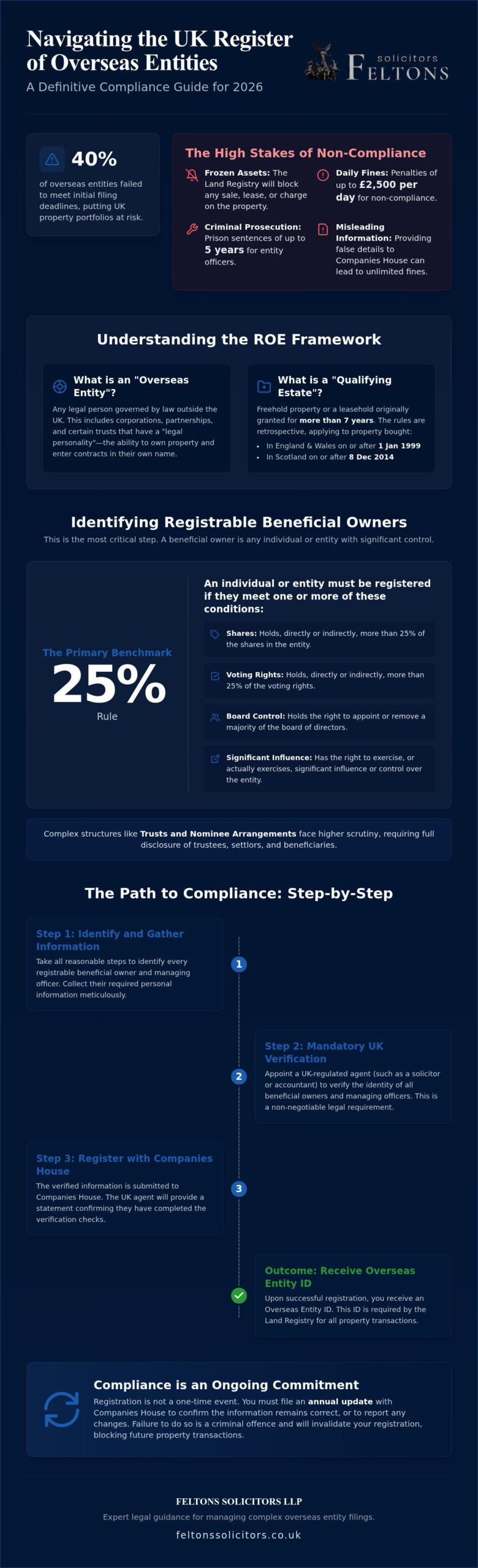
Did you know that nearly 40% of overseas entities failed to meet their initial filing deadlines, leaving their UK property portfolios vulnerable to freezing orders and significant fines? When the stakes include daily penalties of up to £2,500 and the potential for criminal prosecution, the pressure to maintain compliance is palpable. We understand that the technicalities of registering overseas entities uk property can feel overwhelming, particularly when trying to define beneficial owners within complex trust structures or identifying a suitably regulated UK agent for mandatory verification.

We’re here to provide the clarity and reassurance you need to manage these requirements with confidence. This definitive guide for 2026 offers expert insight into the registration process, helping you secure your Overseas Entity ID whilst safeguarding your property’s liquidity for future sales or charges. We will walk you through the essential compliance steps, from the initial Companies House application to the critical annual update requirements; ensuring your international investments remain protected and legally sound. By the end of this article, you’ll have a clear roadmap to navigate the Register of Overseas Entities with professional poise.

Key Takeaways

  • Understand the legal framework governing the Register of Overseas Entities to ensure your property interests remain transparent and compliant with UK law.
  • Learn how to identify registrable beneficial owners under the 25% rule, a critical step when registering overseas entities uk property to avoid severe financial penalties.
  • Discover why mandatory verification by a UK-regulated professional is the essential gatekeeper for obtaining your Overseas Entity ID.
  • Recognise that compliance is an ongoing commitment. Annual updates are vital to maintain the liquidity of your assets and prevent transaction delays.
  • Gain practical strategies for auditing your property portfolio and appointing expert legal guidance to manage complex filings on your behalf.

Understanding the Register of Overseas Entities (ROE) Framework

The introduction of the Register of Overseas Entities (ROE) represents a significant shift in how international investors hold assets in Britain. This framework was established under the Economic Crime (Transparency and Enforcement) Act 2022 to ensure that the ultimate owners of UK land are identifiable. Managed by Companies House, the register requires the disclosure of registrable beneficial owners, creating a transparent environment that discourages illicit finance. For many owners, registering overseas entities uk property is no longer a choice but a vital prerequisite for maintaining a functional property portfolio.

Failing to comply with these regulations carries severe consequences. Companies House has moved beyond an initial period of leniency to a strict enforcement model. Non-compliance is a criminal offence that can result in daily fines of up to £2,500 or, in the most serious cases, prison sentences of up to five years for the entity’s officers. Beyond these sanctions, the Land Registry will block any attempt to sell, lease, or charge the property; this effectively freezes the asset’s value until the entity is correctly registered.

What Qualifies as an Overseas Entity?

An overseas entity is defined as any legal person governed by the law of a country or territory outside the United Kingdom. This definition is purposefully broad, encompassing foreign corporations, limited partnerships, and certain types of trusts. The deciding factor in your registration obligation is whether the entity possesses “legal personality” under its home jurisdiction’s laws. If the body can own property, enter contracts, and sue or be sued in its own name, it likely falls within the scope of the ROE.

The Definition of a Qualifying Estate

The requirement for registering overseas entities uk property applies specifically to “qualifying estates.” In England and Wales, this includes freehold property or leasehold interests originally granted for a term of more than seven years. Accuracy is paramount here, as the regime is retrospective. Entities that purchased land in England and Wales on or after 1 January 1999 must be registered. Different dates apply across the UK, such as 8 December 2014 in Scotland. Since February 2022, the rules have tightened further; any entity that has disposed of property since that date must also provide details of those transactions to remain compliant with current transparency standards.

Identifying Registrable Beneficial Owners and Complex Structures

Determining exactly who must be named on the register is often the most challenging aspect of compliance. A registrable beneficial owner is generally any individual or legal entity that exerts significant control over the overseas entity. The primary benchmark used by Companies House is the 25% rule. If a person holds more than 25% of the shares or voting rights, they must be disclosed. However, control is not always a simple mathematical calculation. Even without meeting the shareholding threshold, an individual who has the right to appoint or remove a majority of the board of directors, or who otherwise exercises “significant influence or control”, falls under the registration requirement.

Accuracy is not just a matter of administrative diligence; it is a vital legal safeguard. Providing false or misleading information to Companies House is a criminal offence that can lead to unlimited fines. The Official UK Government Guidance emphasises that entities must take reasonable steps to identify their beneficial owners before filing. For those managing intricate global portfolios, our team at Feltons Solicitors LLP can provide the discreet expertise needed to map these relationships accurately, ensuring your filings are beyond reproach.

Dealing with Trusts and Nominee Arrangements

Trusts and nominee arrangements face even higher levels of scrutiny under the current framework. Because trusts often lack a single “owner” in the traditional sense, the ROE requires comprehensive details on trustees, settlors, and beneficiaries. This includes anyone else who has the power to exercise control over the trust’s activities. This level of transparency ensures that the true nature of property ownership cannot be obscured by multi-layered legal vehicles. For family offices, professional overseas entity beneficial owner registration is essential to ensure long-term compliance whilst maintaining the privacy of the wider family estate within the bounds of UK law.

Managing Officers: When No Beneficial Owner is Identified

In cases where no beneficial owner can be identified after exhaustive enquiries, the entity must instead provide details for its “managing officers”. These are typically the directors, managers, or company secretaries of the organisation. You cannot simply submit a “no-owner” declaration without demonstrating that every effort was made to find a registrable person. This level of transparency is particularly relevant when considering asset protection in divorce. If ownership of an overseas entity is contested during financial proceedings, the information held on the register can become a pivotal piece of evidence. Failing to correctly identify owners when registering overseas entities uk property could lead to complications that extend far beyond simple filing fees, potentially impacting the very foundation of your legal standing in the UK.

The Mandatory Verification Process: A Step-by-Step Guide

Verification serves as the essential gatekeeper for the entire system; Companies House will simply not issue an Overseas Entity ID without a formal verification statement from a UK-regulated agent. This is far more than a simple identification check. The process involves a rigorous audit of the entity’s structure to ensure every registrable beneficial owner has been correctly identified and their details validated against independent, reliable sources. Because the agent assumes significant legal liability for the accuracy of this data, the process is detailed and requires a methodical approach.

The process of registering overseas entities uk property hinges entirely on this verification stage. It’s important to understand that only specific UK-regulated professionals, such as solicitors, auditors, or insolvency practitioners, are authorised to perform these checks. These agents must verify the information no more than three months before the date the application is submitted to Companies House. If this window is missed, the verification becomes void, and the work must be repeated. This strict timeline ensures that the public register remains as current and accurate as possible.

The Verification Procedure for International Clients

For clients based outside the UK, we follow a structured three-step protocol to ensure compliance is met without unnecessary stress. First, we collate all essential constitutional documents, such as the Certificate of Incorporation and Articles of Association, alongside certified proof of identity for all beneficial owners. Second, we conduct an independent check of foreign registers and corporate structures. This is particularly vital for layered ownership models, as detailed in this Practical Guide to the ROE, to ensure no shadow controllers are overlooked. Finally, once satisfied, the agent submits the formal verification statement directly to Companies House to facilitate the issuance of the ID.

Why Feltons Solicitors LLP is Your Ideal Verification Partner

Choosing the right partner is about more than just filing a form. Our deep expertise in residential property law means we understand the underlying title and the specific requirements of the Land Registry. Feltons Solicitors LLP provides a discreet, boutique service tailored for international clients who value confidentiality and precision. By managing the verification process with such meticulous care, we mitigate the risk of transaction delays. When registering overseas entities uk property, having a trusted advisor ensures that your sales, charges, or leases can proceed without the administrative friction that often plagues less prepared entities.

Registering Overseas Entities for UK Property: A Definitive Guide for 2026

Ongoing Compliance: The Annual Update and Penalties

Maintaining the Register of Overseas Entities is a continuous legal obligation rather than a one-off administrative task. Once you have completed the initial process of registering overseas entities uk property, you must file an update statement every 12 months. This statement confirms that the information held by Companies House remains accurate or provides details of any changes to the beneficial ownership structure that occurred during the year. It’s a rolling commitment to transparency that ensures the UK property market remains secure and well-regulated.

Timing is critical for these filings. The update is due exactly one year from the date of the original registration or the previous update. You have a narrow 14-day window following this date to submit the filing. It’s a common misconception that no action is required if the entity’s structure remains static. On the contrary, a “no change” statement must be filed to keep the Overseas Entity ID valid. Without this active confirmation, the entity is deemed non-compliant, and the administrative burden of registering overseas entities uk property is effectively wasted.

Consequences of Non-Compliance in 2026

By 2026, Companies House has transitioned to a high-enforcement model. They are actively issuing substantial financial penalties to entities that miss their filing deadlines. However, the financial cost is often secondary to the transactional impact. A non-compliant entity loses its ability to deal with its land almost immediately. You cannot sell, lease for more than seven years, or mortgage the property whilst the register is out of date. Additionally, directors and managing officers face personal criminal liability; this makes administrative diligence a matter of personal security for those at the helm of the organisation.

The Link Between Compliance and Estate Planning

Neglecting the register can have profound implications for your wider legal affairs, particularly regarding succession. For instance, an out-of-date or inaccurate register can effectively paralyse the probate and estate planning process. If a property needs to be transferred or sold following the death of a beneficial owner, any discrepancy in the registration will cause significant delays at the Land Registry. Keeping your entity “sale-ready” through consistent updates ensures that your assets remain liquid and your legacy is protected for future generations.

Whilst overseas structures offer clear benefits for privacy and tax planning, they demand meticulous attention to detail. If you are concerned about your current compliance status or require a regulated agent to manage your annual filings, we invite you to speak with us. Contact Feltons Solicitors LLP today to ensure your UK property interests remain fully protected and compliant with all current regulations.

Practical Guidance for Registering and Managing Your Entity

Taking proactive steps now is the most effective way to safeguard your UK interests. The first priority for any international owner is to conduct an immediate audit of all UK property held in overseas names. It’s surprisingly common for older acquisitions to be overlooked, yet the Land Registry’s digital systems are increasingly efficient at flagging unregistered titles. Once identified, appointing a UK-regulated solicitor to manage the verification and filing process provides a single point of accountability. This approach ensures that the complex interplay between foreign corporate law and UK land requirements is handled with the necessary professional poise.

Efficiency in registering overseas entities uk property depends heavily on the state of your corporate records. As we noted previously, verification must be fresh; having your constitutional documents and proof of identity organised in advance is therefore vital. We recommend establishing a permanent digital vault for these records and setting calendar reminders for your annual update statement. Since Companies House now issues automatic penalties for late filings, a “set and forget” mindset is no longer viable for international investors who value their asset’s liquidity.

Resolving Land Registry Restrictions

A “restriction on title” is the primary mechanism the Land Registry uses to enforce compliance. This entry on the register prevents any disposition, such as a sale or a new lease, from being registered unless the entity has complied with its ROE obligations. Removing this restriction requires the successful submission of your registration and the issuance of an Overseas Entity ID. For entities that have already disposed of property but remain on the register, a specific removal process exists to clear the title record. This is particularly complex when an entity owns a block of flats, where leasehold enfranchisement experts are often required to manage the rights of tenants whilst ensuring the superior title remains compliant.

Securing Your Overseas Entity ID

The Overseas Entity ID is a unique alphanumeric code that acts as your passport for all future Land Registry dealings. Once issued, you can verify its status on the public register at any time. This ID must be quoted on every transfer, charge, or lease application you submit. Beyond the immediate administrative requirement, securing this ID allows you to incorporate ROE compliance into your wider legal strategy; for instance, you might explore John Zang Services to gain specialised counsel on how these regulations impact your broader corporate structures.

Whether you are restructuring for tax efficiency or preparing for a future sale, having a valid ID ensures that your transactions proceed without the friction of last-minute compliance hurdles. By treating registering overseas entities uk property as a core component of your asset management, you protect both your capital and your professional reputation. Our team is here to guide you through every stage of this process, providing the discreet, high-standard service your portfolio requires.

Securing Your UK Property Interests for the Long Term

UK land law has evolved significantly, making transparency a cornerstone of property ownership. By ensuring you are correctly registering overseas entities uk property, you protect your assets from the risk of freezing orders and substantial financial penalties. We have explored the necessity of identifying beneficial owners accurately and the vital role of the UK-regulated agent in the mandatory verification process. It is essential to remember that compliance is an active, annual commitment that preserves the liquidity of your investments and ensures your estate remains sale-ready at all times.

As a member of the Law Society specialising in high-value international property transactions, Feltons Solicitors LLP offers a boutique, partner-led legal service designed for those who value privacy and precision. We act as your sophisticated guide through these complex regulations, providing the calm expertise needed to manage your filings with absolute confidence. Contact Feltons Solicitors for expert assistance with your overseas entity registration to ensure your portfolio remains secure and compliant. We are here to help you navigate these requirements with ease and traditional professional integrity.

Frequently Asked Questions

What is the Register of Overseas Entities?

The Register of Overseas Entities is a public database managed by Companies House that identifies the beneficial owners of foreign entities owning land in the United Kingdom. Established under the Economic Crime (Transparency and Enforcement) Act 2022, its primary purpose is to increase transparency and combat money laundering within the UK property market.

Does my overseas company need to register if it bought land before 2022?

Yes, the registration requirement is retrospective for property purchased on or after 1 January 1999 in England and Wales. In Scotland, the requirement applies to land bought on or after 8 December 2014. If your entity still holds a qualifying estate, you must complete the process of registering overseas entities uk property to remain compliant with current law.

How much does it cost to register an overseas entity in the UK?

The mandatory government fee for registering an overseas entity with Companies House is £250. This is separate from any professional fees charged by your UK-regulated verification agent. Additionally, there is a £234 fee for filing the annual update statement and a £706 fee if you eventually apply for removal from the register.

Who is considered a “registrable beneficial owner”?

A registrable beneficial owner is generally any individual or legal entity that holds more than 25% of the shares or voting rights in the overseas entity. The definition also includes anyone who has the right to appoint or remove a majority of the board of directors, or who otherwise exercises significant influence or control over the entity’s activities.

Can I register an overseas entity without a UK solicitor?

Whilst an entity can technically submit its own application, it is impossible to complete the process without a UK-regulated agent. All information regarding beneficial owners must be verified by a professional such as a solicitor or auditor who is supervised under the Money Laundering Regulations. Companies House will not issue an Overseas Entity ID without this formal verification.

What happens if I miss the annual update deadline?

Missing the annual update deadline results in an immediate block on your property’s title, preventing you from selling, leasing, or mortgaging the asset. You may also face daily fines of up to £2,500 and potential criminal prosecution. Consistent diligence when registering overseas entities uk property is the only way to ensure your assets remain liquid and legally protected.

How long does the registration process take?

The registration timeline depends largely on the speed of the verification stage. Once a UK-regulated agent has verified the beneficial ownership and submitted the application, Companies House typically processes the request within a few working days. However, complex corporate structures or entities involving trusts may require additional time for thorough due diligence and document collation.

Is the information on the Register of Overseas Entities public?

Most information provided to the register is available to the public via the Companies House website, including the names of beneficial owners and the entity’s registered office. Certain sensitive details, such as full dates of birth and residential addresses, are protected from public view. This balance ensures transparency whilst respecting the personal privacy of the individuals involved.

Landlord Response to Lease Extension Notice: A Guide for Tenants in 2026

Landlord Response to Lease Extension Notice: A Guide for Tenants in 2026

You might view the official landlord response to lease extension notice as a daunting legal hurdle, yet it is actually the moment you regain control of your property’s future. It’s a tactical opening in a process designed to protect your interests as a leaseholder. We understand that waiting for a Section 45 counter-notice often brings a sense of trepidation. You may worry that your landlord will simply ignore your request, or perhaps you’re anxious that the demanded premium will far exceed your initial expectations.

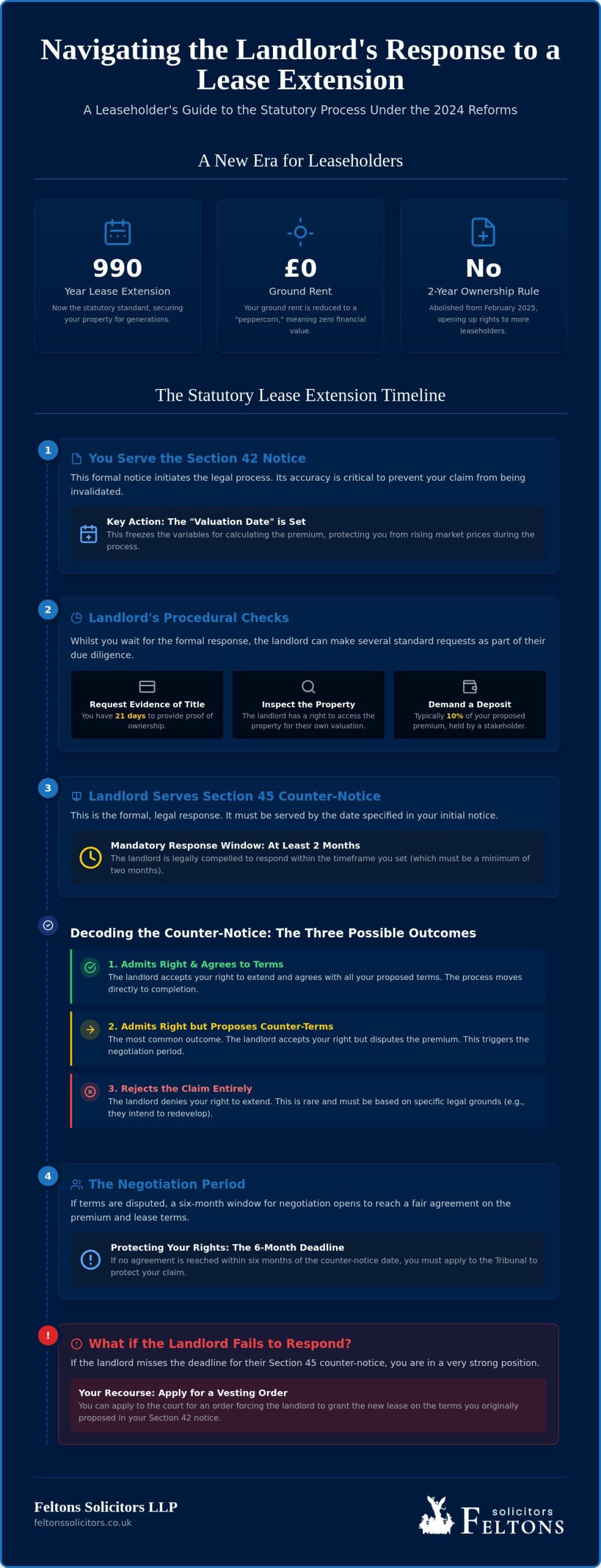
It’s important to remember that you aren’t at the mercy of a landlord’s whims. This guide will help you understand exactly how your landlord must respond under the latest 2024 reforms, ensuring you can navigate the statutory timelines with absolute confidence. Since the abolition of the two-year ownership requirement in February 2025, more tenants than ever are exercising their rights to secure a 990-year extension and a peppercorn ground rent.

We’ll walk you through the mandatory two-month response window, explain what happens during the subsequent six-month negotiation period, and provide clarity on how the Leasehold and Freehold Reform Act 2024 has simplified the path to securing your home’s long-term value.

Key Takeaways

  • Identify the statutory two-month window within which your landlord must formally serve a Section 45 counter-notice.
  • Prepare for the landlord’s right to request evidence of ownership or inspect the property under the strict 21-day rule.
  • Learn to interpret the landlord response to lease extension notice by identifying the three primary legal outcomes of a counter-notice.
  • Discover how to navigate the six-month negotiation period to secure a fair premium whilst protecting your statutory rights.
  • Ensure your application remains valid by managing precise legal deadlines with the help of a dedicated property solicitor.

Understanding the Landlord Response to a Lease Extension Notice

The official landlord response to lease extension notice is known as a Section 45 counter-notice. It isn’t a casual acknowledgement or a courtesy email; it’s a formal legal document that dictates the trajectory of your entire claim. Landlords are legally compelled to respond within a specific window, which must be at least two months from the date your initial notice is served. This response is a mandatory requirement under the Leasehold Reform, Housing and Urban Development Act 1993, as amended by subsequent legislation. Landlords cannot simply opt out or ignore the process without facing significant legal penalties.

One of the most protective elements for you as a tenant is the “valuation date.” This date is fixed the moment your solicitor serves the initial notice. It freezes the variables used to calculate the premium, such as the remaining lease term and market conditions, at that specific point in time. Even if property prices rise or the market fluctuates whilst you wait for the landlord’s counter-proposal, your costs remain anchored to the day you started the process. This provides a vital layer of financial security during the negotiation phase.

The Significance of the Section 42 Notice

Your journey begins with the Section 42 notice, which sets the stage for all future landlord behaviour. Accuracy at this stage is paramount. If your notice contains technical errors or unrealistic premium offers, a landlord might attempt to invalidate your claim entirely. This is where leasehold enfranchisement experts become invaluable partners. They ensure the foundation of your claim is unshakeable, prevents unnecessary disputes, and positions you as a serious, well-prepared leaseholder. To build a comprehensive Understanding Lease Agreements, it helps to view the lease as a diminishing asset that the statutory process is designed to replenish and protect.

The Statutory Timeline for 2026

The legal landscape in 2026 is governed by strict adherence to deadlines. The landlord must serve their counter-notice by the date specified in your Section 42 notice, provided that date is at least two months away. The Leasehold and Freehold Reform Act 2024 has streamlined these expectations, making it harder for landlords to use procedural delays as a tactical weapon. A valid response must clearly state whether the landlord admits your right to a new lease and which proposals they accept or reject. Missing the deadline for a landlord response to lease extension notice can have significant consequences for the freeholder, potentially allowing you to apply to the court for a vesting order on the terms originally proposed in your notice.

The Landlord’s Initial Actions: Evidence, Inspection, and Deposits

Once your Section 42 notice is served, the landlord’s solicitor will likely initiate a series of procedural checks. This stage occurs whilst you are waiting for the formal landlord response to lease extension notice, and it’s designed to ensure your claim is valid from the outset. You shouldn’t view these requests as a sign of hostility; they are standard components of the statutory process that allow the freeholder to verify your eligibility and prepare their own valuation.

One critical element is the 21-day rule. The landlord has a statutory right to request evidence of your ownership, a process technically known as “deduction of title.” Your solicitor must respond to this request within 21 days. Failing to meet this deadline won’t necessarily end your claim, but it can cause unnecessary friction and delays. According to official government guidance, these procedural steps are a standard part of the statutory route that protects both parties. If you’re unsure about the validity of a specific request, consulting with the team at Feltons Solicitors LLP ensures you don’t inadvertently jeopardise your claim.

The landlord is also entitled to demand a deposit. This is typically 10% of the premium you proposed in your initial notice. Having these funds ready is essential, as the deposit is usually due shortly after the landlord acknowledges the notice. This money is held by the landlord’s solicitor or a professional agent as a “stakeholder,” meaning it cannot be released to the landlord until the lease extension is completed or the claim is withdrawn.

Providing Evidence of Eligibility

The landlord will typically require an office copy of the Land Registry entry for your property. This document proves you are the registered leaseholder. Since the 2024 reforms, you no longer need to prove two years of ownership, but you must still demonstrate that you hold a qualifying long lease. It’s wise to organise your paperwork before serving notice so your solicitor can respond instantly to any “deduction of title” request. Promptness here signals that you are a well-advised tenant who understands the legal landscape.

Property Inspections and Valuations

The landlord response to lease extension notice involves more than just a single document; it also includes the freeholder’s right to inspect your home. They are entitled to access the property for valuation purposes, provided they give you at least three days’ written notice. The landlord’s surveyor will look at the property’s condition and any improvements you’ve made. Don’t be alarmed if their eventual valuation is higher than yours. Landlords often start with a “best case” figure for themselves, which then serves as the starting point for the six-month negotiation window. Before entering this phase, it is worth obtaining a reliable lease extension estimate so you can assess whether the landlord’s opening figure is genuinely inflated or within a reasonable range.

Decoding the Section 45 Counter-Notice: Three Possible Outcomes

The arrival of the Section 45 counter-notice is the defining moment of your claim. It’s the point where the landlord formally declares their position, moving the process from a unilateral request to a bilateral legal procedure. Whilst the document might appear complex, it essentially funnels your application into one of three distinct scenarios. Understanding these paths allows you to prepare for the next stage of the journey with a clear, calm perspective.

The vast majority of cases fall into Scenario A, where the landlord admits your right to the extension. However, this admission is almost always accompanied by a counter-proposal for a higher premium than you initially offered. In rarer circumstances, you may encounter Scenario B, a challenge to your legal eligibility, or Scenario C, where the landlord claims they intend to redevelop the building. This third option is typically only available to freeholders if the lease has less than five years remaining at the point of the landlord response to lease extension notice.

Admitting the Right to Extend

When a landlord admits your right, the focus shifts immediately from legal entitlement to financial negotiation. The counter-notice will specify which terms of your proposal are accepted and which are contested. Usually, the landlord will propose a significantly higher premium based on their own surveyor’s valuation. This is a standard tactical move. It initiates the “negotiation window,” a six-month period where both parties’ surveyors attempt to find a middle ground. Understanding your tenant lease extension rights is vital here; you aren’t obligated to accept the first counter-offer, and the statutory framework is designed to prevent landlords from making unreasonable demands.

Challenging the Claim

If a landlord challenges your right to a lease extension, they must state their specific reasons in the counter-notice. Since the Leasehold and Freehold Reform Act 2024 abolished the two-year ownership requirement in February 2025, the grounds for such challenges have narrowed significantly. Most disputes now centre on whether the property itself or the lease type qualifies under the Act. If a landlord persists with a challenge, the matter may need to be resolved in the County Court. Similarly, if they claim redevelopment grounds, they must prove to the court that they intend to demolish or reconstruct the premises and require possession to do so. These are complex legal hurdles that require a methodical, expert response to protect your home and your investment. If you share a building with other leaseholders facing similar challenges, exploring the option of collective enfranchisement solicitors to purchase the freehold outright may offer a more permanent solution to freeholder disputes.

Landlord Response to Lease Extension Notice: A Guide for Tenants in 2026

Negotiating Terms and Using a Lease Extension Calculator

Once you receive the landlord response to lease extension notice, you enter a critical six-month period known as the negotiation window. This isn’t a time for passive waiting; it’s the phase where your surveyor and the landlord’s surveyor attempt to narrow the gap between your initial offer and their counter-proposal. In 2026, the landscape is more favourable for tenants due to the Leasehold and Freehold Reform Act 2024. This legislation has abolished “marriage value,” which previously added significant costs for leases with fewer than 80 years remaining. Whilst the government is still finalising the specific valuation rates for secondary legislation, the removal of marriage value remains a landmark shift for leaseholders.

If negotiations stall, you have the right to apply to the First-tier Tribunal (Property Chamber) after two months, provided you do so before the six-month window expires. It’s a delicate balance. You want to give the professional surveyors enough time to find a reasonable middle ground without letting the statutory deadline slip. If you miss this six-month cutoff, your claim could be deemed withdrawn, forcing you to wait another year before starting again. Landlords often rely on these procedural delays to frustrate tenants, so keeping a strict eye on the calendar is essential.

The Role of the Lease Extension Calculator

A high-quality lease extension calculator serves as your primary defence against unrealistic landlord demands. By inputting your current ground rent, the years remaining on your lease, and an accurate property valuation, you can establish a realistic “premium range.” This data is vital when the landlord’s counter-notice demands a figure that feels excessive. Your solicitor uses these calculations as a benchmark to challenge the landlord’s assumptions, ensuring the final price reflects fair market value rather than an opportunistic grab. Using a calculator helps you enter the negotiation phase with clear, data-driven expectations. For a comprehensive breakdown of how these figures are constructed, a professional lease extension estimate guide can help you understand each component of the premium and identify where a landlord’s valuation may be inflated.

Missing Deadlines: The Tenant’s Advantage

What happens if you never receive a landlord response to lease extension notice? If the freeholder misses the deadline specified in your Section 42 notice, the law shifts heavily in your favour. This situation is often called a “deemed grant.” You can apply to the County Court for a Vesting Order, which effectively forces the landlord to grant the lease extension on the exact terms you proposed in your initial notice. It’s often the best possible outcome for a tenant, as it bypasses the negotiation phase entirely. To ensure you are positioned to capitalise on such procedural errors, speak with a specialist property solicitor to manage your statutory timeline with precision.

Securing a 990-year lease extension is a transformative milestone for any property owner, but the journey from serving a notice to final registration requires meticulous oversight. Feltons Solicitors LLP provides a calm, steady presence throughout this complex statutory process. We understand that the technicalities of property law are often accompanied by a sense of personal or financial pressure. Our role is to absorb that stress, managing every statutory deadline with precision so you can focus on the future of your home. By positioning ourselves as your discreet partner, we ensure that your interests are protected against opportunistic freeholders.

The period following the landlord response to lease extension notice is where expert intervention becomes most visible. Whilst the law provides the framework, it’s the tactical application of that law that determines your final costs. We coordinate closely with specialist surveyors to ensure your premium remains fair and reflects the 2024 reforms. Our team possesses the worldly experience necessary to handle both residential and commercial property matters, providing a level of high-end reliability that high-volume processing firms simply cannot match.

Professional Representation in Negotiations

Our role involves more than just processing paperwork; we act as your sophisticated guide during the high-stakes negotiation phase. When the landlord response to lease extension notice arrives with a higher premium demand, we work to bridge the gap between your valuation and theirs. We provide pragmatic, plain-English advice that helps you understand the “realistic range” for your specific property. Beyond the price, we scrutinise every line of the new lease. Our goal is to ensure that no unfavourable modern clauses are introduced that could affect the future saleability or value of your property.

A People-First Approach at Feltons Solicitors LLP

Feltons Solicitors LLP prioritises personal connection over high-volume processing. We believe that whilst technical legal work is paramount, the human impact of that work should never be forgotten. Our “people-first” philosophy means you’ll always have a direct line to a dedicated expert who understands the nuances of your specific case. We combine traditional professional integrity with modern efficiency, ensuring your new lease is registered at the Land Registry without delay. If you’re ready to take the next step in securing your property’s value, Feltons Solicitors LLP is here to guide you from the initial claim through to completion with quiet confidence and tailored care.

Taking Command of Your Leasehold Future

The statutory process for extending your lease is designed to provide you with long-term security. You should now feel equipped to handle the landlord response to lease extension notice, whether it arrives as an admission of your rights or a challenge to be resolved. The 2024 reforms have significantly strengthened your position, particularly through the abolition of marriage value and the introduction of 990-year terms. Staying vigilant regarding deadlines whilst using data-driven benchmarks for your premium is the most effective way to ensure a successful outcome.

Since 2010, Feltons Solicitors LLP has focused on providing bespoke property law advice. As specialists in leasehold enfranchisement, we possess the expertise required for complex residential and commercial conveyancing. We offer the steady presence you need to navigate these negotiations and secure your property’s value for generations to come.

Contact Feltons Solicitors LLP for expert guidance on your lease extension and let us manage the complexities of your claim with the discreet care you deserve. You’ve taken the first step toward a more secure home; we’re here to help you finish the journey with confidence.

Frequently Asked Questions

What is the deadline for a landlord to respond to a Section 42 notice?

The landlord must provide their response by the date specified in your Section 42 notice, which must be at least two months from the date the notice was served. This timeframe is a strict statutory requirement. If this deadline passes without a response, you gain the legal right to apply to the court for a vesting order to secure the extension on your original terms.

Can a landlord refuse a statutory lease extension request?

A landlord can only refuse your request if you fail to meet the legal eligibility criteria or if they can prove a genuine intention to redevelop the building. Redevelopment challenges are exceptionally rare and typically only apply when the lease has less than five years remaining. For the vast majority of qualifying tenants, the right to a lease extension is mandatory and cannot be denied.

What happens if the landlord and tenant cannot agree on the price?

If a premium cannot be agreed upon during the six-month negotiation window, either party can apply to the First-tier Tribunal for an independent determination. The Tribunal will review the evidence from both surveyors and set a fair price based on established valuation principles. Most cases reach a settlement before a hearing is necessary, as the costs of Tribunal proceedings often encourage both sides to compromise.

Does the landlord have to pay for their own valuation and legal fees?

The tenant is legally responsible for the landlord’s reasonable costs regarding the initial valuation and the conveyancing work required to complete the new lease. However, you aren’t required to pay for the landlord’s costs associated with negotiating the price or any costs related to a Tribunal application. These “negotiation costs” remain the landlord’s own financial responsibility throughout the process.

What is a Section 45 counter-notice and why is it important?

A Section 45 counter-notice is the formal landlord response to lease extension notice that confirms whether your right to a new lease is admitted or disputed. It’s a pivotal document because it contains the landlord’s counter-proposal for the premium and any specific changes they want to make to the lease terms. Receiving this notice officially moves your claim from the application stage into the active negotiation phase.

Can I still extend my lease if I cannot find my landlord?

You can still extend your lease even if the landlord is missing by following a specific legal route through the County Court. You must prove that you’ve made reasonable attempts to locate the freeholder before the court can grant a Vesting Order. The court then refers the case to the Tribunal to determine the premium, which you pay into a court account to finalise your new lease.

How does the Leasehold and Freehold Reform Act 2024 affect landlord responses?

The 2024 Act simplifies the landlord response to lease extension notice by standardising valuation methods and abolishing marriage value for all leaseholders. These reforms make it much harder for landlords to justify inflated premiums or use complex calculations to delay the process. The Act also ensures that the landlord must grant a 990-year extension, providing you with what is essentially a virtual freehold.

What is the “deposit” mentioned in the landlord’s response?

The deposit is a payment of 10% of your proposed premium that the landlord is entitled to request as soon as you serve your notice. This money is held by a solicitor as a stakeholder and acts as a guarantee of your commitment to the process. If the lease extension proceeds to completion, this deposit is simply deducted from the final premium you pay to the landlord.