
Complex Personal Injury Claims Solicitor: Navigating Life-Changing Litigation in 2026

Complex Personal Injury Claims Solicitor: Navigating Life-Changing Litigation in 2026

A life-changing injury often brings a sense of profound isolation, particularly when you’re faced with the daunting task of proving liability in a non-standard accident. You might worry that your case will be processed by a large legal firm where personal connection is sacrificed for volume. Choosing the right complex personal injury claims solicitor is about finding a sophisticated guide who views your recovery as a priority rather than a statistic.

Your future shouldn’t be a gamble. It’s natural to feel anxious about the rising costs of specialist care or the complexities of the 2026 legal landscape, including updated court fees and evolving liability standards. You deserve a partner who provides a calm, steady presence whilst navigating the intricate details of your claim. This guide explains how a specialist solicitor secures essential interim payments for immediate rehabilitation and builds cases for settlements that reflect your true long-term needs. We’ll examine the senior-led strategies required to manage high-value disputes and how a boutique approach ensures you’re never just another file in a system.

Key Takeaways

  • Identify the factors that elevate a case to high-value litigation and how forensic experts establish negligence in intricate accident scenarios.
  • See how a complex personal injury claims solicitor prioritises your long-term security by navigating disputes involving multiple parties or non-standard liability.
  • Gain insight into the resurgence of occupational diseases like silicosis and the critical steps required to hold employers accountable for respiratory protection failures.
  • Learn how to accurately quantify both immediate medical bills and lifelong needs, such as home adaptations, to ensure your settlement provides total financial stability.
  • Discover the benefits of a senior-led, boutique legal approach that values personal rapport and pragmatic advice over high-volume processing.

What Defines a Complex Personal Injury Claim?

Complexity isn’t just about the scale of the injury. It describes the legal and procedural hurdles that stand between a claimant and their recovery. Whilst a standard claim might follow a predictable path, a complex case involves layers of dispute that require a senior-led approach. It’s the difference between a straightforward admission of fault and a multi-year battle over intricate liability.

A complex personal injury claims solicitor often deals with cases where liability is split across multiple defendants. This is common in large-scale construction accidents or multi-vehicle collisions. In these instances, the difficulty lies in untangling who is responsible for what percentage of the harm. When several parties are involved, each with their own legal team and insurers, the litigation becomes a sophisticated exercise in coordination and forensic evidence gathering.

High-value claims also introduce the challenge of predicting the future. When an injury is life-changing, the legal team must account for decades of lost earnings and care costs. This process of calculating compensation requires a deep understanding of the Personal Injury Discount Rate, which stands at +0.5% as of 2026, and how it affects lump-sum payments for future losses. Without this specialist expertise, there’s a risk that a settlement won’t cover the claimant’s lifelong needs.

The Difference Between Serious and Complex Injuries

A serious injury, such as a compound fracture, is physically devastating but legally straightforward if the cause is clear. Complexity arises when the medical prognosis is unstable or when the injury affects multiple aspects of a person’s life over many years. This is why a complex personal injury claims solicitor looks beyond the immediate diagnosis. They coordinate with multi-disciplinary experts to understand how an injury will evolve, ensuring the claim doesn’t settle prematurely for an inadequate sum. It’s about protecting your interests for the next thirty years, not just the next three.

Common Scenarios Requiring Specialist Complex Litigation

Certain environments naturally produce more intricate legal disputes. These often include catastrophic brain and spinal cord injuries that demand lifelong, 24-hour care regimes. Workplace accidents involving several contractors are equally challenging, as equipment failure must be forensically analysed to determine the root cause of the incident. Fatal accident enquiries also fall into this category, where the solicitor represents bereaved families during inquests and subsequent dependency claims. In modern litigation, international elements add another layer of difficulty. If an accident occurs abroad or involves a foreign-registered entity, jurisdictional challenges require a solicitor with worldly experience to navigate conflicting legal systems.

Proving liability in a standard slip-and-trip is one thing; establishing negligence in a high-stakes industrial environment or a multi-vehicle pile-up is quite another. In these non-standard settings, the burden of proof rests heavily on the claimant. A complex personal injury claims solicitor must meticulously organise evidence to transform a collection of facts into a robust, undeniable narrative. This often involves commissioning accident reconstruction specialists who use 3D modelling and forensic data to pinpoint the exact moment a safety protocol failed. It isn’t just about what happened; it’s about proving exactly why it was avoidable.

For those facing life-altering injuries, waiting years for a final settlement isn’t an option. Senior solicitors prioritise securing interim payments. These funds provide immediate relief for private rehabilitation, medical equipment, and daily living costs whilst the main litigation continues. It’s a pragmatic approach that ensures your recovery starts now, not when the court process concludes. Securing these payments early provides a sense of financial security that allows you to focus entirely on your physical and emotional wellbeing without the constant pressure of mounting bills.

The Role of Expert Witnesses in Complex Claims

Expert testimony is the bridge between a physical injury and legal compensation. Choosing the right medical or engineering specialists is a nuanced task. Whilst larger firms might rely on high-volume panels, a boutique firm hand-picks advisors whose expertise matches the specific nuances of your case. These party-specific advisors provide detailed reports that withstand intense cross-examination. In some instances, your legal strategy might also consider state-level support like the Industrial Injuries Disablement Benefit, though this is separate from the civil damages pursued by your solicitor. The goal is to create a comprehensive picture of your future needs that the court cannot ignore.

Managing Multi-Party Liability and Contributory Negligence

Complexity often peaks when liability is shared amongst multiple defendants, and a complex personal injury claims solicitor must ensure no party evades their responsibility. This requires a methodical, orderly legal mindset to ensure every potential defendant is correctly identified and served. Defendants frequently attempt to reduce their payout by alleging contributory negligence, arguing that the claimant was partly at fault for their own injuries. Defending against these tactics requires a solicitor who is both a sophisticated guide and a firm advocate. If you’re concerned about the intricacy of your accident, seeking senior-led litigation advice can help clarify the path forward and protect the full value of your claim.

Specialist Focus: Silicosis and Occupational Lung Diseases

The UK stone masonry sector is currently witnessing a troubling resurgence of respiratory conditions, largely driven by the popularity of engineered stone. In May 2026, the Health and Safety Executive (HSE) launched a concentrated programme of over 1,000 inspections to address the unacceptable practice of dry cutting, which puts an estimated 600,000 workers at risk of silica exposure annually. For a complex personal injury claims solicitor, these cases represent a unique intersection of medical science and statutory duty. Silicosis is a preventable but incurable occupational disease caused by silica dust. This condition, along with other Silicosis and Occupational Lung Diseases, often goes undetected for decades due to its long latency period.

Unlike a sudden traumatic accident, the “date of knowledge” for a disease claim might occur years after the initial exposure. This delay creates evidentiary challenges that require a methodical legal mind to overcome. A specialist solicitor must trace historical employment records and safety protocols to prove that the exposure was significant and attributable to a specific workplace environment. It’s about building a bridge between past negligence and current suffering.

Employer Negligence and Statutory Breach

Employers have a clear legal duty to maintain the workplace exposure limit for respirable crystalline silica at or below 0.1 mg/m³. Proving a breach involves demonstrating that an employer failed to implement dust controls that were “as low as reasonably practicable.” This includes providing high-standard respiratory protective equipment and ensuring adequate ventilation. If an original employer has ceased trading, your legal team will work to trace their historical insurers to ensure the claim can still proceed. This persistence is vital for securing the financial security needed to manage a progressive illness.

Legal Support for Bereaved Families

The impact of occupational disease often extends beyond the individual, affecting entire families. Pursuing a claim on behalf of a deceased loved one involves a sensitive but rigorous process of quantifying loss. This includes securing dependency payments for spouses and children who have lost financial support. For those navigating this difficult path, our silicosis claim after death guide provides a detailed roadmap for fatal accident litigation. A complex personal injury claims solicitor acts as a discreet partner during these times, ensuring the human impact of the loss is fully recognised by the court whilst handling the technical complexities of the litigation.

Complex Personal Injury Claims Solicitor: Navigating Life-Changing Litigation in 2026

Calculating Compensation: Securing Your Future

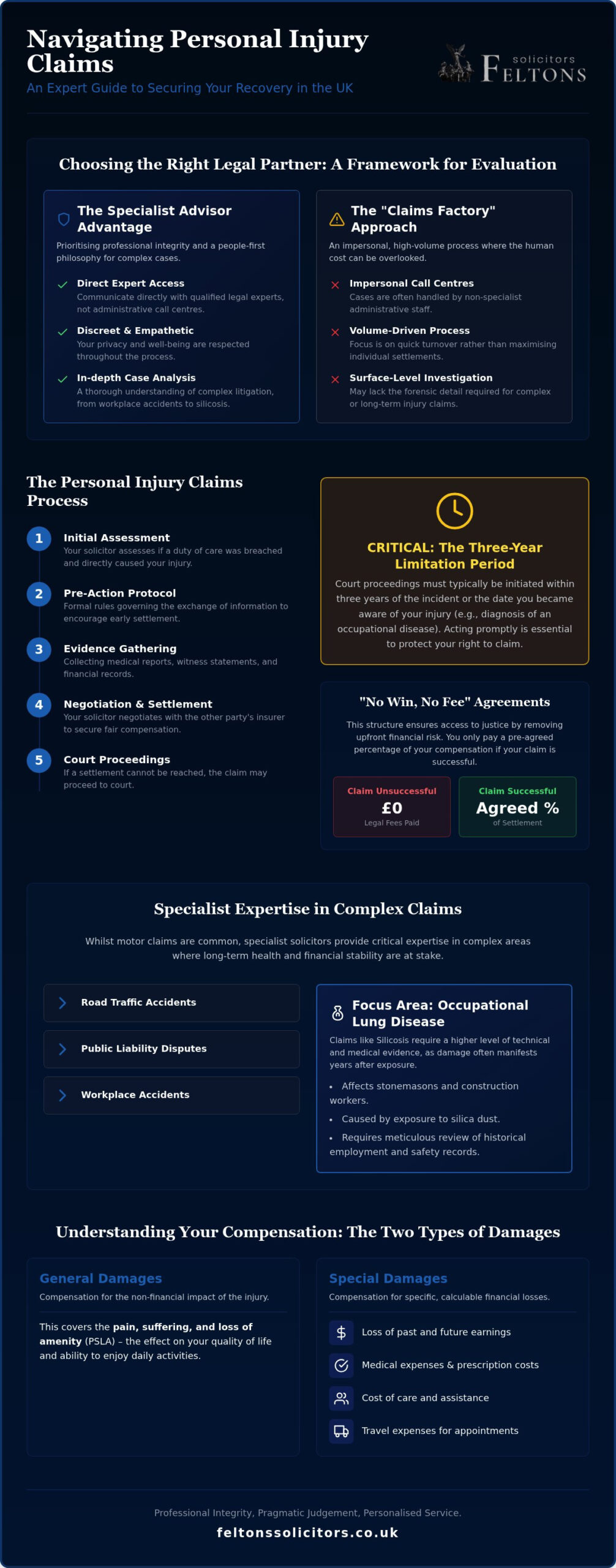
General damages compensate you for pain, suffering, and loss of amenity (PSLA). These figures are based on established judicial guidelines, but a complex personal injury claims solicitor ensures that every nuanced impact on your quality of life is professionally documented. Special damages cover your quantifiable financial losses. These include immediate medical bills, travel expenses, and the significant cost of home adaptations required to accommodate a disability. A settlement is not just a payout, but a financial blueprint for the rest of your life.

For younger claimants, calculating the loss of future earnings involves a “multiplier” effect. This process uses the Ogden Tables to estimate what you would have earned had the accident not occurred, accounting for career progression and pension contributions. As of 2026, the personal injury discount rate for England and Wales remains at +0.5%. This rate is used to calculate lump-sum compensation for future losses, and even a small percentage shift can significantly alter the final settlement. It’s a precise, mathematical exercise that requires a solicitor with a methodical and orderly legal mindset.

Future Care and Rehabilitation Needs

Securing your future involves assessing the lifelong costs of private nursing, specialised physiotherapy, and psychological support. In many high-value cases, we may advocate for Periodical Payment Orders (PPOs). These provide a guaranteed, tax-free income for life, which is adjusted annually for inflation. This approach offers a level of security that a single lump sum cannot always match, particularly when care needs are expected to increase as you age. A solicitor who looks beyond the immediate litigation will prioritise these structures to ensure you never run out of funds for essential care.

Personal Injury Trusts and Estate Planning

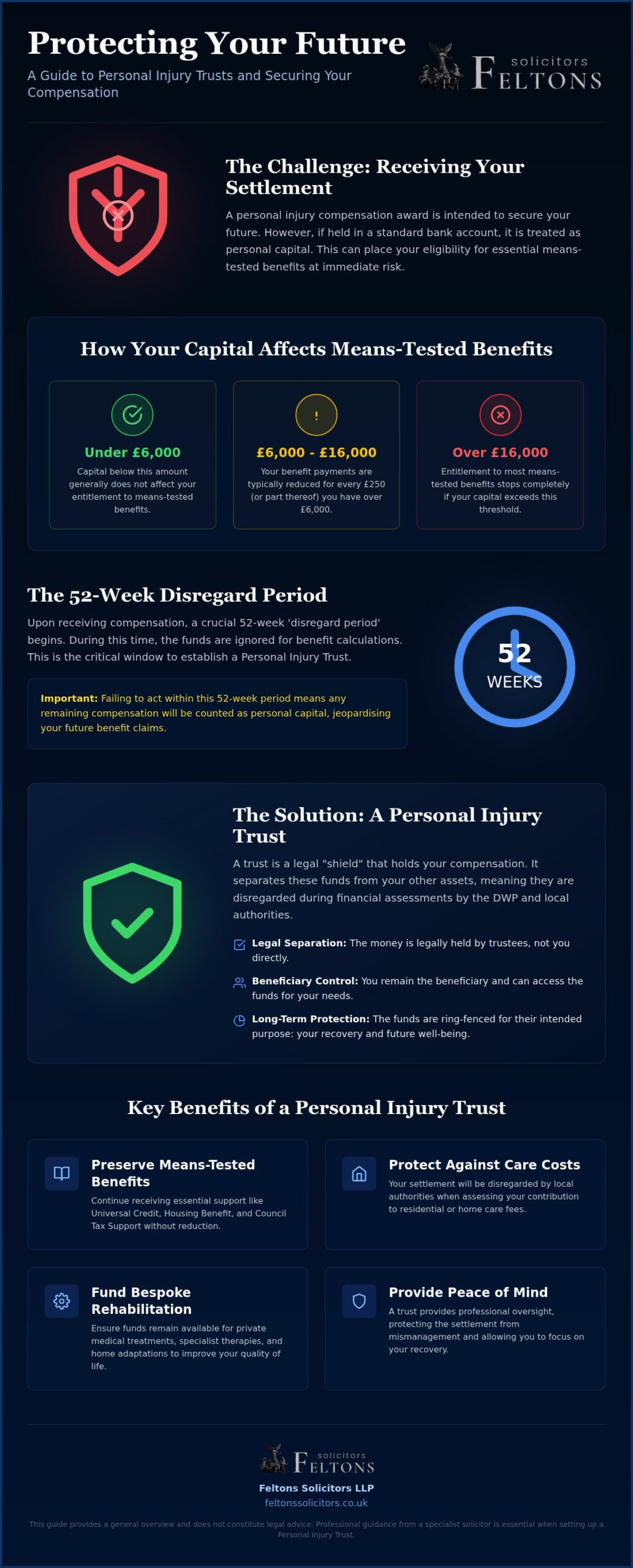
A successful claim often results in a significant sum that can inadvertently disqualify you from means-tested state benefits. We advise on the creation of Personal Injury Trusts to ring-fence your settlement, ensuring you maintain access to essential support whilst protecting your capital. This synergy between litigation and estate planning ensures your legacy and financial security are protected for the long term. If you are ready to discuss your case with a trusted advisor, you can speak with our senior solicitors to begin building your financial recovery plan.

The Feltons Approach: Boutique Care for Complex Needs

Choosing a complex personal injury claims solicitor is a decision that extends far beyond technical competence. It’s about finding a sophisticated guide who understands that behind every high-value dispute is a life that has been fundamentally altered. Feltons Solicitors LLP was established in 2010 with a commitment to providing discreet, high-standard service that prioritises personal connection over high-volume processing. We don’t believe in the “legal factory” model where cases are passed down to junior staff; instead, we provide senior-led attention for every complex matter we undertake.

Our approach bridges the gap between traditional professional integrity and modern efficiency. We provide pragmatic, plain-English advice that cuts through dense legalese, ensuring you remain fully informed at every stage of the litigation. This methodical flow mirrors a professional consultation, where information is presented in a highly organised manner to provide a sense of security and comprehensive care. By acting as a discreet partner, we value your privacy and personal rapport, ensuring that the human impact of your injury is never forgotten amongst the technical legal work.

A People-First Philosophy in Litigation

We believe that the technical success of a claim is only half the battle. A truly successful outcome is one where the claimant feels supported and empowered throughout the process. Our methodical and orderly approach to resolving high-stakes disputes ensures that every detail is captured, from the forensic evidence of the accident to the long-term psychological impact on the family. We prioritise the human element, recognising that the ultimate goal is your long-term rehabilitation and financial security. If you’re facing the challenges of life-changing litigation, we invite you to a confidential consultation to discuss your unique circumstances and explore how we can support your recovery.

National Expertise with a Personal Touch

Whilst we maintain the worldly experience necessary to handle complex, international-scale matters, we remain deeply rooted in our commitment to personalised care. We handle complex claims for clients across the United Kingdom, providing the strategic depth of a large firm with the tailored attention of a boutique practice. This combination allows us to manage intricate liability disputes and high-value compensation calculations with quiet confidence. Whether you require assistance with a catastrophic injury or a specialist silicosis claim, our team acts as a trusted advisor to secure the settlement you deserve. If you’re seeking a partner who values your future as much as you do, contact our senior solicitors to begin your journey toward financial stability and peace of mind.

Navigating the aftermath of a catastrophic injury requires more than just legal representation; it demands a partnership with a trusted advisor who understands the lifelong implications of your claim. We’ve explored how identifying the nuances of liability and precisely calculating future care costs are essential steps in protecting your long-term wellbeing. Whether you are managing the challenges of a specialist occupational disease or a life-changing accident, the right complex personal injury claims solicitor provides the steady, methodical guidance necessary to build a robust case.

Feltons Solicitors LLP offers senior-led expertise with a national reach, ensuring you receive boutique levels of care without sacrificing the worldly experience required for high-value litigation. We prioritise personal connection and traditional professional integrity to help you move forward with confidence. If you are ready to protect your future, speak with a specialist complex personal injury solicitor at Feltons Solicitors today. You don’t have to navigate these intricate challenges alone.

Frequently Asked Questions

What makes a personal injury claim “complex” in the eyes of the law?

Complexity is defined by legal, medical, or procedural hurdles rather than physical severity alone. It typically involves cases with multiple defendants, international jurisdictional issues, or intricate liability disputes where fault is contested. High-value claims requiring decades of future loss calculations also fall into this category. A complex personal injury claims solicitor manages these layers of difficulty to ensure that the litigation narrative is forensically sound and addresses all multi-disciplinary hurdles.

How long do I have to start a complex personal injury claim in the UK?

You generally have three years from the date of the accident or the “date of knowledge” of the injury to begin legal proceedings. This limit is governed by the Limitation Act 1980. For occupational diseases like silicosis, the three-year clock starts when you reasonably knew your illness was significant and caused by your work. It’s vital to seek senior-led advice early to ensure evidence is preserved and court deadlines are met.

Can I change my solicitor if I am unhappy with how my complex claim is being handled?

Yes, you have the right to transfer your case to a different firm at any stage of the litigation. Many claimants move from high-volume “legal factories” to a boutique complex personal injury claims solicitor to receive more personal, senior-led attention. Your new solicitor will coordinate the transfer of your file and handle the lien on your costs, ensuring the transition is smooth and your case remains on track for success.

What are interim payments, and can I receive them before my case is settled?

Interim payments are advance sums paid out of the final settlement to cover immediate needs like private rehabilitation, medical equipment, or lost earnings. You can receive them once the defendant has admitted liability or if the court is satisfied you will win. These payments are crucial for maintaining financial security during long-running disputes. They ensure you don’t have to wait years to access the care and home adaptations you need right now.

Will my complex personal injury claim have to go to court?

Most claims are settled through negotiation, with approximately 97% of personal injury cases in England and Wales concluding without a full trial. Whilst your solicitor will prepare every case as if it’s going to court to maintain a position of strength, a settlement is often reached during mediation. If a trial is necessary, your senior solicitor will provide a steady, calm presence to guide you through the process and represent your interests.

How is compensation calculated for life-changing injuries?

Compensation is split into general damages for pain and suffering and special damages for quantifiable financial losses. For life-changing injuries, we use the Personal Injury Discount Rate, currently +0.5%, to calculate lump-sum payments for future care and lost earnings. We also consider the “multiplier” effect for younger claimants. This methodical approach ensures your settlement acts as a comprehensive financial blueprint for your lifelong needs and provides long-term security.

What is a Personal Injury Trust, and do I need one?

A Personal Injury Trust is a legal arrangement that holds your compensation separately from your personal finances. This is often necessary to ensure your settlement isn’t “means-tested,” allowing you to remain eligible for certain state benefits. By ring-fencing these funds, you protect your capital for its intended purpose: your long-term care and rehabilitation. Your solicitor can advise on the synergy between litigation and estate planning to protect your legacy and future support.

Can I claim for silicosis if I was exposed to silica dust many years ago?

Yes, you can claim for silicosis even if exposure occurred decades ago, provided you are within three years of your “date of knowledge.” Because occupational lung diseases have long latency periods, the law allows for claims to proceed once symptoms are diagnosed. We trace historical insurers for companies that may have ceased trading, ensuring that the human impact of past negligence is addressed through contemporary legal action and financial support.

Will Solicitors: A Comprehensive Guide to Protecting Your Estate in 2026

Will Solicitors: A Comprehensive Guide to Protecting Your Estate in 2026

The £325,000 Inheritance Tax threshold has remained frozen since 2009. This means that as property prices continue to climb in 2026, more families find themselves unexpectedly liable for a 40% tax bill. It’s understandable to feel a sense of unease regarding the rules of intestacy or the potential invalidity of a DIY document, which is why many now seek out expert will solicitors to secure their legacy. You deserve the certainty that your life’s work will benefit the people you love most, rather than being lost to administrative errors or avoidable taxes.

Professional guidance allows you to transform a simple document into a strategic shield for your family’s future. This guide demonstrates how expert advice can help you navigate complex thresholds, protect modern digital assets, and ensure your final wishes are entirely watertight. We’ll explore the practical steps you can take today to secure your estate, provide lasting peace of mind for your beneficiaries, and establish a clear, professional plan for asset protection.

Key Takeaways

  • Understand how expert will solicitors provide more than just a document by offering strategic advice on asset distribution and legal compliance to protect your legacy.
  • Learn why the immediate savings of a DIY kit often lead to significant risks. Professional drafting ensures your estate remains tax-efficient and legally watertight.
  • Discover how to incorporate complex modern interests, such as digital assets and overseas property, into a legally binding UK framework.
  • Gain a clear roadmap of the professional consultation process, from identifying your core objectives to creating a comprehensive map of your financial world.
  • Explore how integrating your will with Lasting Powers of Attorney ensures total protection for both your assets and your personal welfare during your lifetime.

What Do Will Solicitors Do and Why Are They Essential?

Will solicitors are legal professionals who specialise in the precision-led drafting, witnessing, and execution of testamentary documents. Whilst it’s possible to write a basic expression of your wishes on a piece of paper, a solicitor ensures that those wishes are translated into a legally binding framework. They provide strategic oversight, ensuring that every asset is accounted for and that your distribution plan complies with current UK law. This professional guidance is about more than just paperwork; it’s about providing a steady presence during a complex life stage.

If you die without a valid will, your estate is subject to the rules of intestacy. This rigid legal process dictates who inherits your assets based on a strict hierarchy, often excluding unmarried partners, step-children, or close friends. By engaging a professional, you prevent the state from making these deeply personal decisions on your behalf. Expert involvement also creates a robust defence against future legal challenges. They ensure your document is resilient against claims of undue influence or lack of testamentary capacity, which are common grounds for contesting a will in the UK courts.

The Core Responsibilities of Your Legal Advisor

A trusted advisor takes a methodical approach to your affairs, ensuring no detail is overlooked. Their core responsibilities include:

  • Estate Mapping: Identifying the full scope of your estate, including property, savings, and sentimental personal effects.
  • Strategic Appointments: Advising on the selection of suitable executors and, crucially, legal guardians for minor children to ensure they’re cared for by people you trust.
  • Formal Execution: Ensuring that all legal formalities for witnessing and signing are strictly met. Even a minor technical error can render a will invalid, leading to significant distress for your loved ones.

When Professional Intervention is Non-Negotiable

Certain circumstances demand a higher level of technical expertise that a DIY kit simply cannot provide. If your family structure involves complex dynamics, such as children from previous relationships or multiple marriages, standard templates often fail to provide adequate protection for all parties. Professional intervention is equally vital for estates exceeding the £325,000 Inheritance Tax threshold. In these cases, strategic planning can significantly reduce the tax burden on your heirs. For those with business interests or international assets, will solicitors ensure that your UK will works in harmony with overseas regulations, providing a seamless transition of wealth across borders.

Solicitors vs. DIY Will Kits: Evaluating the Real Costs

The appeal of a DIY will kit is obvious: it’s inexpensive and can be completed in an afternoon. However, the immediate saving often masks a significant long-term risk. Unlike a static template, will solicitors provide a strategic shield that accounts for the nuances of your specific life circumstances. Shop-bought kits are designed for the “average” person, but few lives are truly average. When you opt for professional drafting, you’re investing in a document that is built to withstand scrutiny.

One of the most critical differences is the protection of professional indemnity insurance. If a solicitor drafts a document that is later found to be deficient, your estate has legal recourse. With a DIY document, your family is left to bear the financial burden of any errors alone. This financial safety net is a cornerstone of professional practice, providing a level of security that a simple form cannot replicate. It’s the difference between a generic product and a bespoke legal service.

The True Price of a ‘Cheap’ Will

A ‘cheap’ will often becomes an expensive legacy. Vague language, such as failing to define “personal effects” or “residuary estate” clearly, frequently leads to bitter litigation amongst beneficiaries. If the document is declared invalid due to a witnessing error, your estate falls under the rules of intestacy. Investing in professional fees now often saves your heirs tens of thousands of pounds in future legal costs. It also prevents the emotional toll of family disputes during an already difficult time.

Why Empathy and Expertise Matter

A sophisticated guide does more than fill in blanks. They act as a trusted advisor, identifying risks you might not have considered. For instance, the Property (Digital Assets etc) Act 2025 now requires specific consideration for cryptocurrency and online accounts. A template won’t ask about your digital footprint, but a specialist will.

At Feltons, we pride ourselves on delivering pragmatic, plain-English advice that prioritises your family’s unique dynamics. We understand that discussing your final wishes requires a delicate balance of technical precision and human empathy. If you’re ready to move beyond templates, you can explore our estate planning services to discuss a tailored approach to your estate. Our goal is to ensure your legacy is handled with the quiet confidence it deserves.

Managing Complex Assets: Digital Legacies and Overseas Interests

The modern estate has evolved significantly beyond physical property and traditional bank accounts. Today, your legacy likely includes a vast array of intangible assets, from cryptocurrency portfolios to professional social media presence and intellectual property. Expert will solicitors now play a vital role in ensuring these modern interests are not lost or locked away forever. Without specific provisions, your executors may find themselves legally barred from accessing essential online accounts, leading to the permanent loss of both financial value and sentimental memories.

The Rise of the Digital Estate

Digital assets encompass everything from online banking and investment platforms to digital creative works and loyalty points. To manage these effectively, your will must grant executors explicit legal authority to interact with service providers. This prevents a “digital dark age” where your online footprint becomes an inaccessible burden for your family. Under 2026 legal standards, a digital legacy is defined as the collective body of a person’s online data, digital property, and social presence that persists after their death.

Strategic planning involves more than just listing passwords; it requires a structured approach to asset discovery. We advise clients to maintain a secure, offline inventory of their digital holdings, which can be referenced in the will without compromising security. This ensures that assets like Bitcoin or NFTs, which are now formally recognised under the Property (Digital Assets etc) Act 2025, are identified and transferred according to your wishes rather than being forgotten in the depths of the blockchain.

International Assets and Overseas Entities

Owning property abroad introduces a layer of complexity that a standard UK will may not fully address. Different jurisdictions have varying rules on “forced heirship,” which can override your stated intentions if not managed correctly. Coordinating your UK arrangements with foreign legal requirements is essential to prevent conflicting instructions and protracted probate disputes. Professional drafting ensures that your global footprint is managed as a single, cohesive strategy.

For individuals with assets or interests in the United States, The Village Law Firm provides the specialised estate planning and administration expertise necessary to ensure your legacy is protected across different legal jurisdictions.

The landscape of property ownership has also been reshaped by transparency requirements. Understanding how overseas entity beneficial owner registration impacts your estate is crucial for those holding UK property through foreign structures. Failure to maintain these registrations can lead to significant delays in the transfer of property to your beneficiaries. By addressing these cross-border issues proactively, will solicitors help you mitigate the risk of international assets becoming a legal or financial liability for your heirs. We provide the discreet, worldly experience necessary to handle these intricate matters with precision.

Will Solicitors: A Comprehensive Guide to Protecting Your Estate in 2026

The Step-by-Step Process of Working with Will Solicitors

Engaging with will solicitors isn’t a mere transaction; it’s a methodical journey toward total peace of mind. The process begins with an initial consultation designed to establish trust and clarity. We don’t just ask about your assets; we seek to understand your primary objectives and the specific people you wish to protect. This isn’t a high-volume processing exercise. It’s a boutique experience where your personal connection to your legacy is prioritised from the very first meeting.

Following the consultation, we move into the vital phase of asset discovery. This is where we create a comprehensive map of your financial and personal world. We look beyond the obvious, examining property, savings, and those complex digital assets that define modern life. This methodical approach ensures that every facet of your estate is accounted for, leaving no room for ambiguity or future dispute. It’s about building a foundation that is both legally robust and personally meaningful.

Preparing for Your Consultation

To make the most of your time, it helps to gather key documents before we meet. Think about your pensions, property deeds, and life insurance policies. Consider your legacy in broader terms too. Are there charitable donations you’d like to make? Do you have specific bequests for sentimental items? Feltons’ methodical flow ensures that even the smallest detail is captured, reflecting our commitment to traditional professional integrity and modern efficiency.

Refining Your Wishes

Drafting is an iterative process. You’ll review the document with your solicitor to ensure it reflects your exact wishes with absolute precision. We’ll refine the language to ensure it’s legally watertight whilst remaining respectful to your beneficiaries. This stage also involves adjusting for tax efficiency. With the Inheritance Tax nil-rate band frozen at £325,000 until 2031, strategic drafting is essential to protect your heirs from unnecessary fiscal drag. We ensure the tone of the document remains clear, avoiding dense legalese in favour of plain English.

The final, critical step is the formal execution. The signing and witnessing ceremony must strictly adhere to legal formalities to ensure the will’s validity. Once complete, secure storage is paramount. We’ll advise on where to keep the original document and how to notify your executors of its location. A will is only effective if it can be found and verified when it’s needed most. If you’re ready to begin this methodical journey, you can contact our team of will solicitors today to discuss your requirements. We’re here to provide the calm, steady presence you need to secure your family’s future.

Beyond the Will: Integrated Asset Protection and Probate

A will shouldn’t exist in a vacuum. To achieve total protection, your testamentary wishes must be woven into a broader framework of estate planning. This integrated approach ensures that your assets are managed efficiently both during your lifetime and after you’ve passed. Whilst a will handles the distribution of your legacy, Lasting Powers of Attorney (LPA) safeguard your interests whilst you’re still alive. These documents allow you to appoint trusted individuals to make decisions about your health and finances if you ever lose the capacity to do so yourself.

Major life changes also necessitate a fresh look at your legal arrangements. If you’re navigating the end of a relationship, consulting a divorce and financial arrangements lawyer is vital. Marriage usually revokes an existing will; divorce can leave significant gaps in your estate’s protection. Expert will solicitors ensure that your updated documents reflect your new financial reality, preventing assets from inadvertently passing to an ex-partner.

Wills and Property Law

There is a powerful synergy between residential property law and the distribution of your estate. Your home is likely your most significant asset, so handling its transfer requires precision. We provide guidance on complex matters like leasehold extensions and enfranchisement, ensuring these property rights are maximised before they pass to your heirs. By using clever trust structures, we can help you protect the family home from being depleted by long-term care costs or unnecessary tax liabilities.

Probate and Estate Administration

When the time comes, the transition to probate should be as seamless as possible. Our role involves applying for a Grant of Probate, which gives executors the legal authority to manage your affairs. We handle the heavy lifting: settling outstanding debts, paying the correct amount of Inheritance Tax, and ensuring assets are distributed exactly as you intended. This methodical process provides a sense of security during a difficult time.

The practical side of estate administration often involves managing physical assets and property contents. In such cases, families may find that Clear This Ltd House Clearance Services offers a sensitive and professional way to handle house clearance throughout the Lancashire area.

Feltons’ “people-first” philosophy is particularly crucial during this stage. We act as a calm, steady presence for your family, handling the technical complexities so they can focus on their own well-being. By choosing experienced will solicitors, you ensure that the same high standard of care you received during the drafting process continues long after you’re gone. We remain your family’s discreet partner, protecting your legacy with traditional integrity and modern efficiency.

Securing Your Legacy for the Next Generation

Protecting your life’s work requires more than a simple document; it demands a strategic vision that accounts for both traditional property and modern digital assets. By moving beyond the limitations of DIY templates, you ensure your estate is resilient against legal challenges and tax inefficiencies. Expert will solicitors provide the steady, professional guidance needed to navigate these complexities with quiet confidence. Our boutique service combines national-level expertise with pragmatic, plain-English advice tailored specifically to your family’s unique dynamics.

Whether you’re managing a global asset portfolio or simply wish to provide peace of mind for your loved ones, a methodical approach is the most reliable way to safeguard your final wishes. We specialise in complex and international estate matters, ensuring that every detail is handled with discretion and integrity. It’s never too early to establish a clear plan for the future. You can book a confidential consultation with our specialist will solicitors to begin securing your legacy today. Taking this proactive step provides the certainty and security that you and your family deserve.

Frequently Asked Questions

How much do will solicitors typically charge in 2026?

Fees vary based on the complexity of your estate and the specific requirements of your family structure. A straightforward single document is generally more cost-effective than mirror wills for couples or complex arrangements involving trusts and overseas assets. We recommend discussing your needs during a consultation to receive a transparent estimate tailored to your circumstances. Investing in professional expertise ensures your document is robust, legally binding, and built to withstand future scrutiny.

Can I change my will after it has been signed and witnessed?

You can change your will at any time as long as you have the mental capacity to do so. For minor adjustments, a legal document called a codicil can be added to the existing will. However, if you wish to make significant changes, it’s usually better to draft a completely new document to avoid confusion or potential conflict. Your solicitor will ensure any updates are executed with the same formal rigour as the original.

What is the difference between an executor and a beneficiary?

An executor is the person responsible for managing your estate and carrying out the instructions in your will, whereas a beneficiary is someone who receives assets or property from the estate. It’s common for a person to be both an executor and a beneficiary, such as a spouse or adult child. Selecting an executor requires careful thought, as the role involves significant legal and financial responsibilities during the probate process.

How often should I review my will with a solicitor?

It’s advisable to review your will every three to five years to ensure it still reflects your wishes and financial situation. Certain life events make an immediate review essential, including marriage, divorce, the birth of children, or a significant change in your asset portfolio. Regular consultations with will solicitors allow you to adjust for legislative changes, such as updated tax thresholds or new regulations regarding digital property and overseas interests.

Do I need a separate will for property I own abroad?

Whether you need a separate will depends on the country where your property is located and its specific inheritance laws. Some jurisdictions have forced heirship rules that may conflict with your UK will. In many cases, having a local will in that country is the most efficient way to handle the property. Your UK solicitor will work to ensure your various testamentary documents are coordinated and don’t contain contradictory instructions.

What happens if my will is lost or destroyed?

If a will cannot be found after your death, the law may presume that you destroyed it with the intention of revoking it, which could lead to your estate being distributed under the rules of intestacy. This is why secure storage is so important. Whilst a copy may sometimes be accepted by the probate registry, the process is complex and requires significant evidence. Storing your original document with a professional firm provides a vital safety net.

Can a will be challenged in court after I die?

Yes, a will can be challenged in the UK courts on several grounds, including claims that the document was not properly executed or that the testator lacked mental capacity. Challenges can also arise under the Inheritance (Provision for Family and Dependants) Act 1975 if a close relative feels they haven’t been adequately provided for. Will solicitors use their expertise to draft robust documents that minimise the risk of these stressful and costly legal disputes.

Is a will made in 2026 valid if I move house or get married?

Moving house doesn’t invalidate your will, but getting married or entering a civil partnership usually revokes any existing document entirely unless it was made in expectation of that specific marriage. Conversely, divorce doesn’t revoke a will, but it treats your former spouse as if they had died before you, which can create unintended gaps in your distribution plan. You should always seek legal advice following these major life changes to ensure total protection.

Personal Injury Solicitors: A Comprehensive Guide to Compensation Claims in 2026

Personal Injury Solicitors: A Comprehensive Guide to Compensation Claims in 2026

The most effective personal injury litigation is a restorative journey, not just a financial transaction. When you’ve suffered an injury, the physical pain is often compounded by the weight of financial uncertainty and the confusing jargon of legal proceedings. It’s natural to feel overwhelmed by “No Win, No Fee” terms or the worry that you’ll be treated as just another file in a high-volume claim factory. Choosing the right personal injury solicitors shouldn’t add to your stress; it should be the moment you finally feel heard.

We understand that you’re looking for more than just a settlement; you’re looking for a way to rebuild your life. This guide provides the expert clarity you need to handle these complexities, ensuring you secure the compensation and support you deserve. We’ll examine the latest 2026 legal updates, including the 18th edition of the Judicial College Guidelines and the shifting landscape of the small claims track. By the end of this article, you’ll have a clear roadmap for your claim, from understanding the latest Solicitors Regulation Authority transparency rules to finding a boutique partner who puts your recovery at the centre of the process.

Key Takeaways

  • Understand the legal principle of “Duty of Care” and how identifying a breach is the essential first step in securing your compensation.
  • Learn why complex occupational conditions like silicosis require a specialist litigation approach compared to standard injury claims.
  • Discover how professional personal injury solicitors calculate General and Special Damages to ensure your settlement covers both physical pain and future financial security.
  • Explore the step-by-step process of evidence gathering, from medical assessments to witness statements, to build a robust and viable case.
  • Recognise the benefits of a boutique, partner-led service that offers pragmatic guidance tailored to your specific circumstances rather than high-volume processing.

What is a Personal Injury Claim and Who Can Benefit?

Understanding what is a personal injury claim starts with the concept of Tort law. In the United Kingdom, this legal framework allows an individual to seek a remedy for a civil wrong that has caused them harm. Whilst many associate these cases solely with physical accidents, the scope is much broader. It encompasses psychological trauma and long-term occupational illnesses, such as silicosis, which are often more complex than standard accident claims. The core objective is simple: to restore you, as far as money can, to the position you would have occupied had the injury never occurred. Engaging expert personal injury solicitors ensures that your case is treated with the focus of a boutique firm, rather than being processed through a high-volume claim factory.

At the heart of every case lies the principle of the “Duty of Care”. This is a legal obligation to avoid acts or omissions that could reasonably be foreseen to cause harm to others. When a person or organisation fails to meet this standard, they have breached their duty. However, a breach alone isn’t enough for a claim. You must also prove that this failure directly caused your injuries and subsequent financial losses. This link between the breach and the harm is known as causation, and it’s the foundation upon which every successful claim is built.

The Legal Basis for Compensation

Proving negligence requires a methodical approach. Your personal injury solicitors must establish four key elements: duty, breach, causation, and damages. Most cases begin under the Pre-Action Protocol. This set of rules encourages parties to exchange information early and settle disputes without the need for a stressful court hearing. It’s a pragmatic way to ensure transparency from the outset and provides a structured path toward a fair settlement.

Timing is critical. Under the Limitation Act 1980, most claimants have a three-year window from the date of the accident or the “date of knowledge” of an injury to issue court proceedings. For occupational diseases that develop over decades, this clock often starts only when a medical professional provides a formal diagnosis. Missing these deadlines can permanently bar you from seeking the compensation you deserve, so early legal advice is vital.

Who Can You Claim Against?

Liability can rest with various parties depending on where the incident occurred. Identifying the correct defendant is essential for a successful outcome:

  • Employers: They have a statutory duty to provide a safe working environment, making them responsible for workplace accidents or failures in occupational health.
  • Public authorities and private landowners: These entities are accountable for maintaining safe premises, such as pavements or shopping centres, under the Occupiers’ Liability Act.
  • Road users and insurance companies: This is the most common category, covering RTA claims where a driver’s negligence has caused harm to others.

In every instance, the aim is to hold the responsible party to account whilst securing the financial support you need for your recovery. Whether you’re dealing with a local council or a multinational corporation, the legal principles remain focused on your restoration.

Specialist Personal Injury Claims: Silicosis and Occupational Diseases

Occupational diseases demand a distinct legal strategy compared to sudden physical accidents. Whilst a trip or fall is immediate, industrial illnesses often simmer for decades before symptoms emerge. This long latency period means that personal injury solicitors must act as investigators, tracing exposure back through a claimant’s entire working history. It’s a complex process. It requires more than just legal knowledge; it requires a deep understanding of industrial processes and medical pathology to prove exactly when and where the damage occurred.

Silicosis has become a focal point of high-stakes litigation, often cited as the “new asbestos” within the UK construction and stone masonry sectors. The damage is often irreversible. Unlike a one-off incident, silica dust exposure is a cumulative harm that permanently scars the lung tissue. We focus on these intricate matters, providing the partner-led attention that high-volume firms often struggle to maintain. This boutique approach ensures that the human impact of your diagnosis is never overshadowed by the technicalities of the law.

Understanding Silicosis and Silica Dust Exposure

Stone masons and construction workers are frequently exposed to respirable crystalline silica (RCS) when cutting or grinding materials like engineered stone. Employers have a strict legal duty under the Control of Substances Hazardous to Health (COSHH) regulations to suppress dust and provide adequate respiratory protective equipment. If they failed to do so, even thirty years ago, they may be held liable. For those who have lost a loved one to this condition, our guide on Silicosis Claim After Death: A Legal Guide for Bereaved Families in 2026 explains the specific steps for seeking justice on behalf of an estate.

Other Occupational Lung Diseases

Beyond silicosis, we handle claims for occupational asthma, COPD, and pleural thickening. These respiratory conditions often involve multiple past employers, some of whom may no longer exist. Our role involves tracking down historical insurers and securing expert medical evidence from leading chest physicians to support your case. This meticulous approach ensures that every contributor to your condition is held accountable. If you believe your health has been impacted by industrial negligence, reaching out to specialist personal injury solicitors can help you understand your options for a secure future.

The Personal Injury Claim Process: Step-by-Step

The journey from injury to compensation is a methodical build, rather than a sprint. It begins with an initial consultation where the merits of your case are scrutinized. Unlike high-volume firms that might use automated checklists, boutique personal injury solicitors provide a partner-led review to assess the viability of your claim. This stage is about more than just legal theory; it’s about understanding the specific ways your life has been altered and identifying a clear path toward restoration.

Once the merits are established, your legal team begins the formal process of notification. A Letter of Claim is sent to the defendant, outlining the allegations of negligence and the nature of your injuries. Under the current Pre-Action Protocol, the defendant generally has three months to investigate and provide a reasoned response regarding liability. This structured exchange of information is designed to keep the process transparent and moving toward a resolution without unnecessary delays.

Gathering Vital Evidence

Evidence is the bedrock of any successful litigation. Whilst your personal recollection is important, the legal strength of your case relies on objective documentation that leaves little room for dispute. This involves a three-pronged approach:

  • Medical Expert Reports: We instruct independent specialists to assess your injuries. Their professional opinion provides the basis for valuing your pain, suffering, and loss of amenity.
  • Special Damages Documentation: This involves a meticulous record of financial losses. You should retain every receipt, invoice, and travel log related to your injury, as these form the basis of your financial recovery.
  • Liability Evidence: Photographs of the accident scene, witness statements, and CCTV footage are gathered early to ensure the facts remain clear before memories fade or scenes change.

Settlement Negotiations and Court

Most people fear a confrontational day in court, but the reality is quite different. The vast majority of claims settle through negotiation long before a trial date is set. A key tool in this process is the “Part 36” offer. This is a formal settlement offer that carries significant cost consequences if rejected. If a defendant refuses a reasonable Part 36 offer and you later achieve a better result at trial, they may be ordered to pay additional interest and higher legal costs. It’s a pragmatic mechanism that encourages both sides to be realistic.

If the defendant denies liability or offers an inadequate settlement, the case may progress toward litigation. Even then, the focus remains on reaching an agreement. Litigation is a tool to apply pressure and ensure the defendant takes your claim seriously. Throughout this process, your solicitors act as a steady guide, ensuring you’re informed of every risk and opportunity so you can make decisions with confidence.

Personal Injury Solicitors: A Comprehensive Guide to Compensation Claims in 2026

Calculating Compensation and “No Win, No Fee” Explained

Securing a fair settlement requires a meticulous breakdown of how the injury has impacted both your health and your finances. Professional personal injury solicitors categorise these losses into two distinct areas: General Damages and Special Damages. Whilst the former addresses the intangible impact of the injury, the latter focuses on the quantifiable financial strain you have endured. This dual approach ensures that your compensation package is comprehensive, covering every facet of your recovery journey.

General Damages, often referred to as compensation for Pain, Suffering, and Loss of Amenity (PSLA), are calculated based on the severity of your condition and the length of your recovery. Special Damages, by contrast, aim to reimburse you for out-of-pocket expenses. This includes lost earnings, prescription costs, and even the value of care provided by family members. For complex cases involving long-term conditions, we also factor in future losses, such as diminished pension contributions or the cost of ongoing private medical treatment.

How Much is My Claim Worth?

To estimate the value of PSLA, we look to the 18th edition of the Judicial College Guidelines, published in April 2026. This latest update included an approximate 8.26% inflationary uplift across most injury brackets. For instance, a moderate ankle injury now carries a recommended range between £18,150 and £35,130. These figures serve as a starting point, but the final award depends on the specific nuances of your medical evidence.

The total award can be adjusted through the principle of “contributory negligence”. If the defendant proves that you were partially responsible for the incident or failed to mitigate your losses, the court may reduce your compensation by a corresponding percentage. Our role is to build a robust case that minimises these arguments and protects your full entitlement.

Demystifying No Win, No Fee

Access to justice should never be limited by your immediate financial situation. Most claims are handled via a Conditional Fee Agreement (CFA), commonly known as “No Win, No Fee”. This arrangement means that if your case is unsuccessful, you don’t pay your solicitor’s fees. To provide total protection against the defendant’s legal costs, we typically arrange “After the Event” (ATE) insurance, ensuring you face no personal financial risk during the litigation.

If you win, the solicitor’s success fee is capped by law at 25% of the compensation awarded for PSLA and past financial losses. This cap does not apply to damages for future losses, ensuring the bulk of your long-term support remains intact. Transparency is a core value of our boutique service. Following the Solicitors Regulation Authority warning notice in January 2026, we prioritise clear, plain-English explanations of all costs from the outset. If you’re ready to discuss the specifics of your case, you can speak with our expert personal injury solicitors today for a straightforward assessment of your claim.

Why Choose a Boutique Firm for Your Personal Injury Claim?

High-volume law firms often prioritise turnover, treating legal matters as a series of administrative tasks. At Feltons, we reject this “claim factory” model in favour of a boutique service that puts your recovery first. Since our establishment in 2010 by Paula Felton, our focus has remained on providing pragmatic, straightforward advice that cuts through unnecessary legal jargon. We understand the emotional weight an injury carries. It’s not just a legal file, but a significant life event that requires empathy and discretion.

Our deep-rooted expertise in dispute resolution is a significant advantage in complex personal injury settlements. It allows us to anticipate the defendant’s tactics and negotiate from a position of quiet confidence. When you choose Feltons as your personal injury solicitors, you’re partnering with a firm that values personal rapport as much as technical excellence. We believe that the human impact of our work is just as important as the technical legal outcome.

The Value of Personalised Legal Support

The most significant benefit of a boutique firm is the level of direct access you receive. You won’t be passed between junior paralegals or anonymous case handlers. Instead, you’ll have a consistent point of contact who understands every nuance of your journey. This personal connection is especially vital in high-value or complex litigation, where a tailored strategy can make the difference between an average settlement and one that truly secures your future. We take the time to listen, ensuring that sensitive family-related injury matters are handled with the worldly experience and privacy they deserve. This standard of dedicated, partner-led representation is one we share with other specialist practices internationally, including the D’Intino Law Firm, LLC in Philadelphia, who provide tailored legal support for personal injury and criminal defence matters.

Getting Started with Feltons

Taking the first step shouldn’t feel like a commitment you’re not ready to make. We offer a free, no-obligation initial assessment to discuss the viability of your claim and explain your options in plain English. This is a chance for you to experience our “people-first” philosophy before deciding how to proceed. We believe in transparency, so you’ll know exactly where you stand from the very first conversation.

If you’re currently unhappy with your current firm, you aren’t stuck. Many clients find that high-volume firms don’t provide the level of care they need, particularly in specialist areas like silicosis claims. We can handle the entire process of transferring your files, making the transition seamless and stress-free. Your recovery deserves the focus of dedicated personal injury solicitors who see you as a person, not a statistic. Contact our team today to organise your consultation and begin the journey toward the restoration you deserve.

Securing Your Path to Restoration

Restoring your quality of life after an injury requires more than just a legal settlement; it demands a partnership based on trust and expert guidance. We’ve explored how the 2026 legal landscape prioritises transparency and how a methodical approach to General and Special Damages ensures your long-term security. Whether you’re handling a straightforward accident or a complex occupational disease, the focus should always remain on your individual recovery rather than high-volume processing.

Choosing the right personal injury solicitors is the most critical decision you’ll make during this journey. At Feltons, we bring decades of combined legal experience and specialist silicosis litigation expertise to every case we handle. Our partner-led boutique service ensures you receive the discreet, high-standard care you deserve. We treat every client as an individual, never as a case number.

If you’re ready to take the next step, we invite you to contact Feltons Solicitors for a confidential discussion about your claim. We are here to provide the steady, professional support necessary to navigate these complexities with confidence. You don’t have to face this transition alone.

Frequently Asked Questions

How long do I have to make a personal injury claim in the UK?

You generally have three years from the date of the accident or the “date of knowledge” of your injury to start a claim. For occupational diseases that develop slowly over time, this period begins only when you first receive a formal medical diagnosis. If the claim involves a child, the three-year limit doesn’t start until their 18th birthday, giving them until they are 21 to take action.

Can I still claim if the accident was partly my fault?

Yes, you can still seek compensation even if you were partially responsible for the incident. This legal principle is known as contributory negligence, and it results in your final settlement being reduced by a percentage that reflects your share of the blame. For example, if you are found to be 25% at fault for not wearing a seatbelt, you would still receive 75% of the total damages awarded.

What is the average payout for a personal injury claim?

There is no fixed “average” payout because every settlement is calculated based on your unique physical and financial circumstances. Expert personal injury solicitors use the Judicial College Guidelines to value the “pain and suffering” element, whilst financial losses like lost wages are calculated separately. A minor injury might settle for several thousand pounds, whereas life-altering conditions can result in settlements exceeding £500,000 to cover long-term care.

Do I have to go to court to win my personal injury case?

It’s highly unlikely that you’ll need to attend a court hearing to resolve your case. Most claims are settled through structured negotiations or formal “Part 36” offers long before a trial date is ever set. Court proceedings are typically a last resort used only when the defendant entirely denies liability or refuses to offer a settlement that reflects the true extent of your losses.

Can I make a claim for an injury that happened years ago?

You can make a claim for an older injury if you only recently became aware that it was caused by someone else’s negligence. This “date of knowledge” rule is particularly vital for industrial diseases like silicosis, where symptoms often appear decades after the initial exposure. If you are within three years of receiving that medical diagnosis, a claim is usually still viable despite the time passed.

How much will a personal injury solicitor charge me?

Most personal injury solicitors operate on a “No Win, No Fee” basis, which means you don’t pay any legal fees upfront. If your claim is successful, the solicitor’s success fee is capped by law at 25% of your compensation for pain and past financial losses. If the case is lost, you’re protected from paying the solicitor’s fees, provided you’ve acted honestly and followed their professional advice throughout.

Can I claim compensation for an illness caused by my former workplace?

Yes, you’re entitled to claim for illnesses caused by hazardous working conditions, even if you left that employment many years ago. Employers have a statutory duty to protect your health and are required by law to hold insurance to cover such claims. We specialise in tracing these historical insurers to ensure you receive the financial support you deserve for respiratory conditions or other industrial diseases.

What happens if the person or company responsible for my injury has gone bust?

You can still pursue a claim if a company has ceased trading because the compensation is usually paid by the insurers they held at the time of the incident. In road accidents involving untraced or uninsured drivers, the Motor Insurers’ Bureau (MIB) acts as a safety net to provide the necessary payout. Even if a defendant has gone bust, the mandatory insurance they held remains accessible to satisfy your claim.