

Buying a freehold share in a block of flats: what to consider

Buying a freehold share in a block of flats: what to consider

Buying a block’s freehold together can give leaseholders greater influence over the building, but it also means sharing decisions and ongoing responsibilities. If you’re researching “buying freehold share of block flats”, the key question is not only whether the freehold can be purchased, but whether enough leaseholders are willing to take it on together.

It is easy to focus on the potential benefits, such as having more say in how the building is managed. A collective purchase also involves coordinating participating flat owners, agreeing a valuation and following the legal process. The group needs to decide how the freehold will be owned and administered afterwards. A share of freehold does not automatically replace your flat’s lease.

This guide explains how collective enfranchisement works, how it differs from the Right to Manage, and what to investigate before committing. You’ll learn about eligibility, the purchase and legal checks, shared costs and the responsibilities that continue after completion, so you can assess whether buying together is the right route for your block.

Key Takeaways

  • Buying freehold share of block flats gives participating leaseholders collective ownership of the building’s freehold, but each flat will usually remain leasehold.
  • Check the building and participating owners against current collective enfranchisement eligibility rules before taking formal steps.
  • Compare collective enfranchisement with the Right to Manage: one involves buying the freehold, whilst the other transfers management functions.
  • Review the title, leases, building obligations and proposed ownership structure to understand what the group would take on.
  • Understand how the valuation, legal process and ongoing decisions could affect each participant before making commitments.

Buying a freehold share in a block of flats: what does it mean?

Buying a building’s freehold collectively means participating leaseholders acquire the freehold title to the building together, rather than each buying their individual flat outright. The flat owners may hold an interest in the freehold directly or through an ownership structure, such as a company. The structure affects how decisions are made, so review the title and relevant company or ownership documents before agreeing to participate.

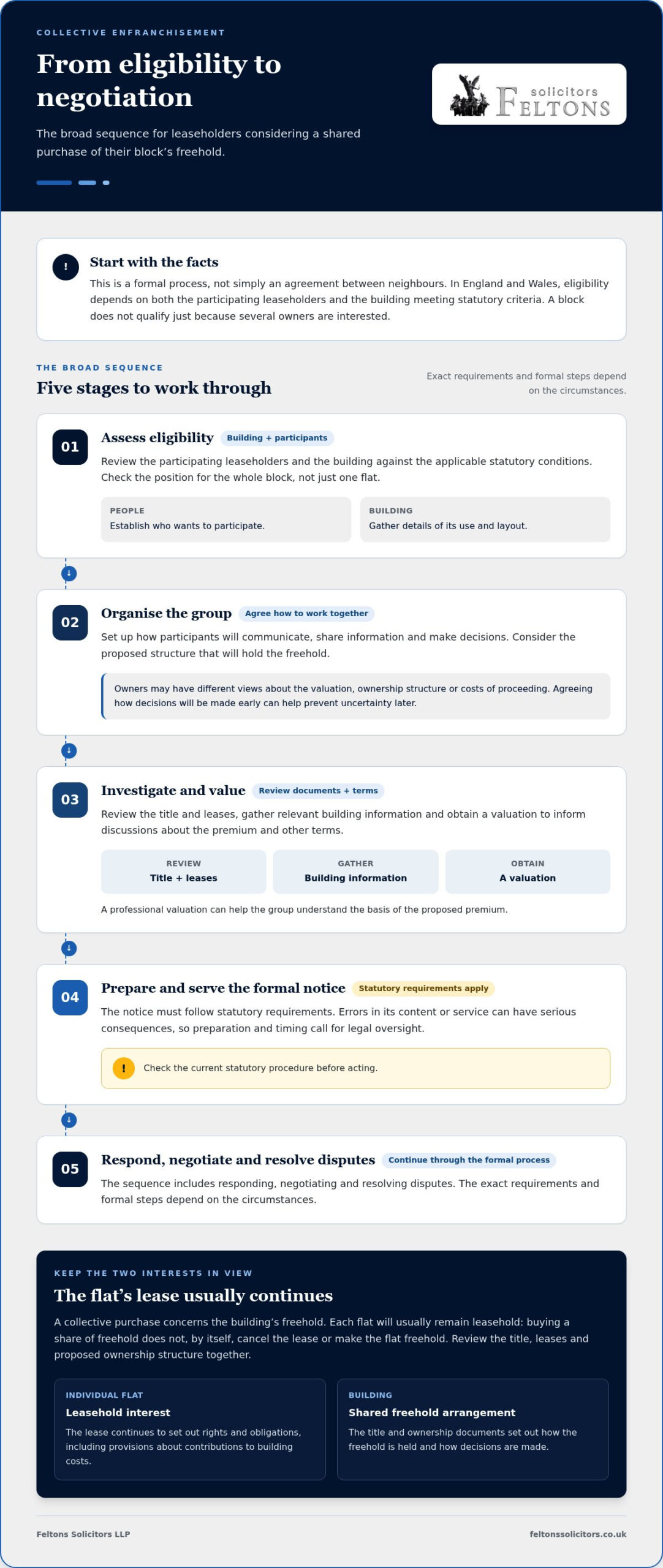
A flat will usually remain leasehold after the purchase. Its lease continues to set out rights and obligations, including provisions about contributions to building costs. Becoming a freehold shareholder does not, by itself, cancel the lease or make the flat freehold. A search for “buying freehold share of block flats” is therefore about two connected interests: the lease to an individual flat and a shared interest in the building’s freehold.

What does a share of freehold actually give a flat owner?

A share is not ownership of the entire building. It represents a stake in the arrangement that owns the freehold, with the rights set out in that arrangement. For example, if a company owns the freehold, a flat owner might hold a share in that company. The company, rather than each shareholder individually, would hold the registered freehold title.

The amount of influence an owner has depends on the title and the structure’s rules. The company’s articles of association, membership arrangements and decision-making procedures can determine how votes are counted and who can act for the freeholder. If the freehold is held another way, the legal documents will set out how the owners exercise their rights. Read these documents together. A share alone does not explain who can approve work, make decisions or deal with the building’s obligations.

How does collective enfranchisement differ from buying one flat?

Collective enfranchisement is the legal route through which participating leaseholders act together to acquire the building’s freehold. The process concerns the shared freehold purchase, rather than the transfer of one person’s flat. What is collective enfranchisement? provides a useful introductory description of this collective route.

By contrast, an ordinary flat conveyance transfers one flat from a seller to a buyer, along with the lease and its terms. It does not, by itself, transfer the building’s freehold or give the buyer a stake in it. A collective purchase requires participating owners to consider how they will acquire and hold the freehold together, as well as how their individual leases will operate afterwards.

This distinction is central to residential property law: the title to the flat and the title to the building are separate interests, even when they are connected through the same owner. The article Navigating Residential Property Law: A Comprehensive Guide for UK Homeowners explores the wider property context. Before proceeding, examine the proposed ownership structure and the documents that govern it, rather than relying on the informal phrase “share of freehold”.

How does collective enfranchisement work, and who may take part?

Collective enfranchisement is a formal process, not simply an agreement between neighbours to buy the freehold. In England and Wales, eligibility depends on the participating leaseholders and the building meeting statutory criteria. Assess those requirements before committing to a purchase or serving a notice. A block does not qualify simply because several owners are interested.

What should leaseholders establish before starting?

Start by establishing the facts about the building and the people involved. Identify who wants to participate, agree how the group will share information and make decisions, and gather the leases, title information and details of the building’s use and layout. These materials help assess which statutory criteria apply and identify issues that may affect the proposed purchase.

Agreeing how to make decisions early can prevent uncertainty later. Owners may have different views about the valuation, ownership structure or costs of proceeding. A professional valuation can help the group understand the basis of the proposed premium, whilst legal advice can assess eligibility, the transaction structure and the effect of the documents. Although “buying freehold share of block flats” sounds informal, statutory eligibility and notice requirements need careful assessment.

What are the main stages of the purchase?

The broad sequence is as follows. The exact requirements and formal steps depend on the circumstances, so check the current statutory procedure before acting.

  1. Assess eligibility. Review the participating leaseholders and the building against the applicable statutory conditions. Check the position for the whole block, not just one flat.
  2. Organise the group. Establish how participants will communicate, make decisions and arrange the proposed purchase. Consider the ownership structure that will hold the freehold.
  3. Investigate and value. Review the title and leases, gather relevant building information and obtain a valuation to inform discussions about the premium and other terms.
  4. Prepare and serve the formal notice. The notice must follow statutory requirements. Errors in its content or service can have serious consequences, so its preparation and timing call for legal oversight.
  5. Respond, negotiate and resolve disputes. The freeholder’s response may lead to discussions about the price or terms. Formal deadlines apply, and disputed matters may require a determination through the relevant legal process.
  6. Complete the purchase. Once the terms are settled, the parties proceed to transfer the freehold and register the resulting ownership arrangements.

Completion settles the purchase, but it does not determine how the building will be managed day to day. The group must also understand how the freehold will be held and how future decisions and obligations will be handled. Feltons’ leasehold enfranchisement and conveyancing services can help participants understand the transaction and its continuing implications.

Is buying the freehold better than right to manage?

Neither route is automatically better. Collective enfranchisement means participating leaseholders buy the building’s freehold. The Right to Manage (RTM) gives qualifying leaseholders a route to take over specified management functions without buying the title. The routes address different priorities, and their eligibility rules and legal consequences depend on the building and jurisdiction. In England and Wales, assess the current requirements for each before deciding.

ConsiderationCollective enfranchisementRight to Manage
OwnershipThe participating leaseholders acquire the building’s freehold, directly or through an ownership structure.The freeholder retains the freehold title; leaseholders do not acquire ownership through RTM.
Management controlThe new freehold owners can influence how the freehold is administered, subject to the leases and ownership structure.The RTM company takes on management functions covered by the statutory route, without buying the freehold.
ResponsibilitiesThe group must consider freehold ownership, decision-making and the building’s continuing obligations.The RTM company takes responsibility for the management functions it assumes, while leasehold obligations remain relevant.
May suit owners who…Want to acquire a stake in the freehold and are prepared to organise shared ownership and decisions.Want greater involvement in management but do not want to purchase the freehold.

When might buying the freehold suit the group?

Consider enfranchisement if owners want the freehold itself, perhaps to have a collective role in decisions about the building’s future and how the freehold is held. The group should also be prepared for the practical work of shared governance: agreeing how decisions are made, keeping ownership arrangements workable and addressing responsibilities that continue after completion.

Lease extensions may also form part of the group’s aims, but acquiring the freehold does not automatically change every flat’s lease. The legal position and any steps needed for an extension require separate consideration. Do not assume the purchase will increase a flat’s value, make it easier to sell or reduce future costs. Those outcomes depend on the circumstances and the documents in place.

When might right to manage be worth comparing?

RTM may be relevant where the priority is taking responsibility for building management, rather than acquiring the freehold title. The freeholder remains the owner, and the flat leases continue to matter. The group should understand which management functions would transfer and what taking them on would involve, alongside the statutory eligibility and procedure.

Compare both options against the same practical questions: what does the group want to control, who will make decisions, what ongoing work can participants take on, and are lease extensions or freehold ownership central objectives? A considered comparison of buying freehold share of block flats with RTM should account for the group’s long-term governance, not just the initial transaction. Legal advice on the relevant route can help clarify how it applies to the building.
Buying a freehold share in a block of flats: what to consider

What should you check before buying a freehold share?

Look beyond the proposed purchase terms. A freehold share connects the transaction to the building’s legal title, existing leases and the arrangements owners will rely on afterwards. Before committing, make sure the group understands both what it is acquiring and how it will handle the responsibilities that come with it.

Which documents and building matters deserve attention?

Use this checklist to organise the initial review:

  • Freehold title: Review the title register and plan to understand what land and parts of the building are included, who owns them and whether rights or restrictions affect the property.
  • Flat leases: Compare the leases for provisions on repairs, insurance, service charges, access and other shared obligations. Note differences that could affect how costs or responsibilities are allocated.
  • Ownership documents: If a company is to own the freehold, examine its constitutional documents, share or membership arrangements and decision-making rules. These documents explain who can act for the company and how owners exercise their rights.
  • Building records: Review available management records, planned or outstanding repairs, maintenance arrangements and any current disputes. These can reveal issues the group needs to address when setting future priorities.
  • Insurance: Establish how the building is insured now and how cover will be arranged and administered after completion, including who is responsible for keeping relevant records.
  • Valuation and process: Understand the valuation assumptions, the information used and how the proposed premium and terms have been assessed. Clarify the legal steps, responsibilities and commitments involved before the group proceeds.

The freehold title shows what is being acquired, while company documents explain how the owners can exercise their rights and make decisions. Reviewing one without the other may leave the group with an incomplete picture of its legal position. A solicitor can consider the title, leases and proposed structure together, and explain how they relate to the transaction.

How can the group prepare for shared responsibilities?

Shared ownership works best when practical arrangements are settled before a repair or disagreement brings them into focus. Decide how owners will raise issues, share information and record decisions. Agree who will maintain records, handle routine administration and communicate with leaseholders who are not participating in the purchase. Taking over the freehold also brings direct responsibility for building safety and communal upkeep, where property compliance and facilities specialists such as Sentric can assist with fire safety, electrical testing and ongoing maintenance requirements.

The group should also establish how contributions towards building obligations will be agreed and collected, and what process will apply if owners disagree about a repair, insurance matter or proposed work. When building works or alterations involve shared boundaries and party structures, consulting specialists such as Christopher Anthony Surveyors can ensure statutory party wall procedures are properly addressed. Do not rely on informal assumptions: the leases, ownership structure and agreed procedures need to fit together. These are useful issues to explore through leasehold enfranchisement guidance as you prepare for the purchase.

Before making commitments, have the proposed structure, documents and valuation reviewed as a connected whole. Explore Feltons’ collective freehold purchase services for support with leasehold enfranchisement and conveyancing.

How can a solicitor help with buying a freehold share?

A solicitor can help the group understand the legal transaction as a whole, from the proposed ownership structure to the obligations that continue after completion. This is particularly valuable where several leaseholders need to coordinate decisions, review shared documents and agree how the freehold will be held. Advice should be specific to the building, the participating owners and the law applying to the claim.

What legal support may cover during the transaction

At the outset, a solicitor can examine the freehold title, leases and relevant ownership documents, then explain how they affect the proposed purchase. They can help assess the group’s legal position and the structure for acquiring the freehold, identify issues that need attention, and clarify the rights and responsibilities involved. This gives leaseholders a clearer basis for making decisions before taking formal steps.

As the matter progresses, legal support may include preparing and serving statutory notices, managing responses, advising on negotiations and reviewing the terms of the transfer. The solicitor can also coordinate the legal work required for contracts and completion, keeping the group informed about decisions and documents needed along the way. Statutory procedures and deadlines need careful attention, and the precise steps depend on the facts and current law.

Legal advice should also look beyond completion. The group needs to understand how the freehold will be administered, how the ownership documents affect decision-making and how existing lease obligations fit with the new arrangements. This helps leaseholders consider the transaction and its ongoing implications together, rather than treating completion as the end of the matter.

Feltons’ conveyancing and leasehold enfranchisement work addresses the legal and transactional aspects of a collective freehold purchase. The firm takes a bespoke, pragmatic approach, with advice shaped around the group’s documents, proposed structure and circumstances.

Deciding on your next step

Before proceeding, bring the key questions together: does the proposed structure make sense, have you compared collective enfranchisement with other routes, and do participating owners understand the building’s obligations and future governance? For leaseholders considering buying freehold share of block flats, resolving these points early can clarify the decision-making process and help the group understand what it is undertaking.

A discussion tailored to the building can clarify the legal process, the documents to review and the next decisions for participating owners. Feltons can help you consider the transaction and its continuing implications. Discuss your freehold purchase with Feltons.

Make your next move with confidence

Before your neighbours commit, turn the shared interest into a clear plan. Agree what the group hopes to achieve, what decisions still need to be made and how each owner can take part. For anyone considering buying freehold share of block flats, an early legal discussion can help bring the building’s documents, proposed ownership structure and group priorities into focus.

Feltons offers tailored support in conveyancing and leasehold enfranchisement, with a bespoke, pragmatic approach to the transaction and its longer-term implications. Home visits are available at clients’ convenience, which can help the group discuss complex property matters in a setting that works for them.

Your circumstances are specific to your building and the owners involved. A considered conversation can help you identify the right questions and decide what to do next. Discuss your freehold purchase with Feltons, and take the next step with greater clarity.

Frequently Asked Questions

Is buying a share of freehold the same as owning my flat freehold?

No. A share in the building’s freehold does not turn the flat itself into a freehold property. The flat is generally transferred under its lease, while the freehold interest is held separately, either directly or through an ownership structure. Before purchase or sale, have the title register, lease and any company records considered together. This helps establish exactly what rights attach to the flat and what interest accompanies it.

Can one flat owner buy the freehold of a whole block alone?

Collective enfranchisement is generally a route for qualifying leaseholders to act together, rather than one owner simply acquiring the whole block’s freehold through that process. For anyone considering buying freehold share of block flats, distinguish a group claim from a separate private arrangement. Eligibility depends on current rules and the building’s circumstances, so seek tailored legal advice before assuming an individual or group qualifies.

Do you still have a lease after buying a share of freehold?

Usually, yes. Acquiring an interest in the freehold does not automatically cancel the lease for your flat. The lease remains relevant to matters such as the extent of the flat, rights over shared areas and obligations set out in its terms. For example, do not assume that holding a freehold share lets you alter a lease provision informally. Check the lease and ownership documents before agreeing any change.

Can you extend your lease after buying a share of freehold?

A share of freehold does not itself extend your flat’s lease. There may be ways to address the lease term, but the appropriate process depends on the lease, how the freehold is held and the rules that apply. Before agreeing an extension or variation, establish who has authority to act for the freeholder and what formal documents are needed. Legal advice can help clarify the route and its implications.

What happens if the freehold owners disagree about building decisions?

Disagreement can complicate decisions, but the applicable process depends on the ownership arrangement and its governing documents. If a company holds the freehold, its articles and decision-making rules may be relevant; the leases may also affect the issue. Keep a written record of proposals, responses and agreed actions. If a dispute concerns owners’ rights or obligations, seek advice before taking steps that could affect the building or other leaseholders.

Can a flat with a share of freehold still be sold?

Yes, a flat can generally be sold, but transferring the lease and the associated freehold interest may involve separate requirements. For example, where a company owns the freehold, its documents may set out how a departing owner’s share or membership is dealt with. Conveyancing should identify what passes to the buyer and what records or steps are needed, so the transfer reflects the property’s actual legal structure.

Collective Enfranchisement: A Complete Guide to Buying Your Freehold in 2026

Collective Enfranchisement: A Complete Guide to Buying Your Freehold in 2026

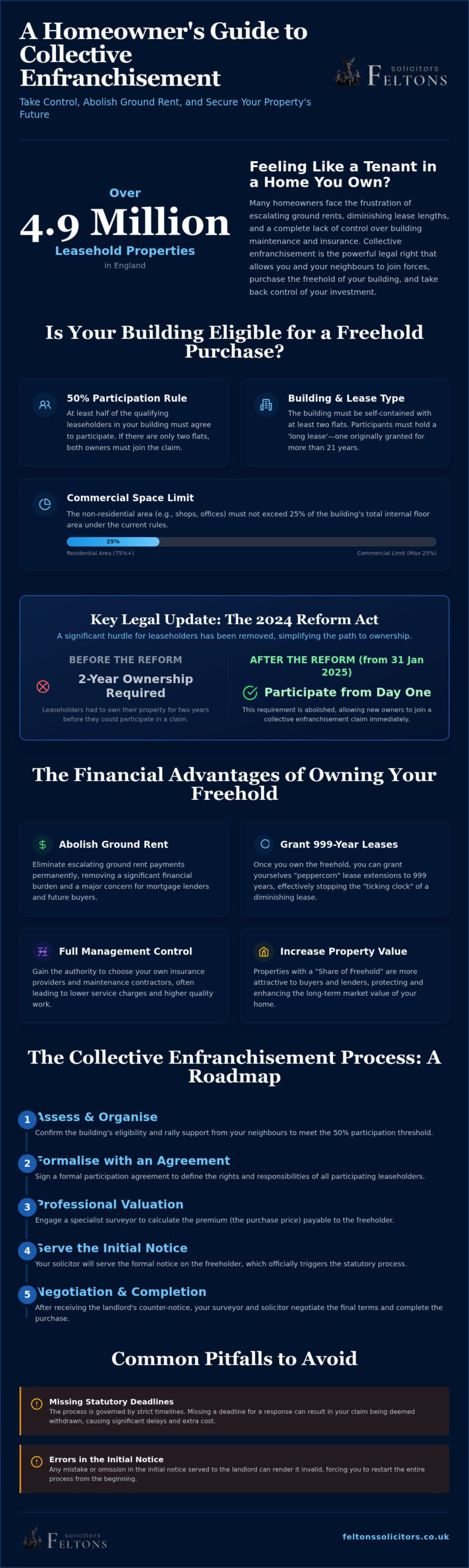
If you feel like a tenant in a home you supposedly own, you aren’t alone. With over 4.9 million leasehold properties in England, many homeowners face the same frustrations of escalating ground rents and a total lack of control over building insurance or maintenance. It is a distressing position to be in, especially when a diminishing lease makes your property increasingly difficult to sell. However, the legal right to collective enfranchisement offers a powerful solution, allowing you and your neighbours to join forces and purchase the freehold of your building outright.

We understand that the prospect of challenging a landlord can feel daunting, but taking this step is often the most effective way to future-proof your investment. This guide provides a clear, professional roadmap for navigating the current legal landscape in 2026. You will discover how to abolish ground rent, grant yourselves 999-year leases, and finally assume the authority your home deserves. From understanding the latest legislative updates to managing the coordination of your fellow leaseholders, we have outlined everything you need to know to secure your building’s future with confidence.

Key Takeaways

  • Understand the eligibility criteria, including the 50% participation rule, to determine if your building qualifies for a freehold purchase.
  • Learn how collective enfranchisement allows you to abolish ground rent entirely and grant yourselves 999-year leases to maximise property value.
  • Discover the importance of a formal participation agreement and specialist professional guidance in coordinating neighbours and meeting strict legal requirements.
  • Identify common procedural errors, such as missing statutory deadlines, that could potentially void your claim and cause unnecessary delays.
  • Gain a clear roadmap for taking full management control of your building, from insurance to maintenance, ensuring long-term security for your investment.

What is Collective Enfranchisement and Who is Eligible?

Collective enfranchisement is the statutory right that empowers leaseholders to join forces and purchase the freehold of their building. This process transforms your relationship with your home, moving you from the position of a tenant to a co-owner of the entire structure. For a deeper understanding of the legal framework and its origins, exploring What is Collective Enfranchisement? offers a useful foundation for this legal right. To trigger this process, at least 50% of the qualifying tenants in the block must participate. If the building contains only two flats, both owners must agree to the purchase to proceed.

The building itself must meet specific structural and usage criteria. It must be a self-contained building, or a self-contained part of a building, containing at least two flats. A critical factor is the proportion of commercial space within the premises. Currently, the non-residential floor area, such as shops or offices, must not exceed 25% of the total internal floor area. If your building’s commercial footprint is larger than this threshold, it won’t qualify under the rules applicable in 2026.

The Impact of the Leasehold and Freehold Reform Act 2024

The legal landscape in 2026 is significantly more accessible due to recent legislative shifts. On 31 January 2025, the government abolished the two-year ownership requirement for participants. This change means you can now participate in a claim from the very day you complete your property purchase. These reforms reflect a clear shift in favour of the leaseholder, simplifying the path to ownership and removing many of the traditional hurdles that previously protected landlords. Whilst there’s ongoing discussion about increasing the commercial limit to 50%, the 25% rule remains the active standard for claims initiated today.

Buildings That Do Not Qualify

Whilst the right is broad, certain properties remain exempt from the collective enfranchisement process. National Trust properties and specific Crown lands are protected from these claims. You might also find yourself ineligible if you live in a converted house with a resident freeholder, provided the building contains no more than four units and the freeholder has lived there as their only or principal residence for at least twelve months. Certain charitable housing trusts are also exempt, ensuring their property portfolios remain intact for their social purposes.

To qualify as an individual, you must hold a long lease. This is defined as a lease originally granted for a term of more than 21 years. It doesn’t matter if you live in the flat or if it’s an investment property; as long as you meet the “long lease” definition, you’re generally eligible to participate. This inclusivity ensures that a wide range of homeowners can take control of their building’s management and long-term financial health.

The Financial Benefits: Why Buying the Freehold Makes Sense in 2026

Undertaking collective enfranchisement is often the single most effective way to protect your property’s long-term market value. By removing the external freeholder, you eliminate the burden of escalating ground rents, which have become a significant point of concern for both mortgage lenders and prospective buyers. Once the freehold is secured, participating members can grant themselves “peppercorn” lease extensions, typically for a term of 999 years. This effectively removes the “ticking clock” of a diminishing lease, making the property far more attractive to future purchasers who prioritise “Share of Freehold” status.

Management control provides another direct financial advantage. Instead of being tied to the freeholder’s choice of expensive insurance providers or maintenance contractors, you gain the authority to tender these services yourself. This often leads to a marked reduction in annual service charges and better quality of care for the building’s infrastructure. If you’re unsure about the initial requirements for your block, reviewing The Collective Enfranchisement Process can help your group understand the preparatory steps needed to secure these savings.

Calculating the Premium and the End of Marriage Value

The premium is the price you pay the landlord for the freehold, determined by specialist surveyors who assess the loss of ground rent and the reversionary value of the building. Marriage value is the potential increase in value when a lease is extended or the freehold is bought. Whilst the Leasehold and Freehold Reform Act 2024 contains provisions to abolish marriage value for leases under 80 years, as of August 2026, these specific changes have not yet been implemented. This makes accurate professional valuation essential to ensure your group doesn’t overpay during negotiations whilst the older valuation rules remain in force.

Understanding the Total Cost of Enfranchisement

Budgeting for the project requires looking beyond the premium itself. Participating leaseholders are responsible for their own legal and valuation fees, as well as the landlord’s “reasonable” professional costs. Under current 2026 regulations, the rule requiring each side to bear their own costs is not yet in force, so the freeholder’s expenses remain a factor in your final budget. Many groups choose to distribute these costs through a formal participation agreement to ensure financial transparency amongst neighbours. For those seeking a tailored legal assessment of these potential costs, professional guidance can help streamline the process and prevent unexpected disbursements.

The Collective Enfranchisement Process: A Step-by-Step Roadmap

The foundation of a successful collective enfranchisement claim is the early and effective coordination of your group. Before any legal notices are served, we recommend drafting a formal participation agreement. This contract binds your neighbours to the project, ensuring everyone contributes their share of the costs and remains committed throughout the process. Once the group is aligned, you’ll need to instruct a specialist valuer to estimate the premium and a solicitor to manage the complex legal requirements. These professionals provide the steady guidance needed to navigate the statutory timetable without missing critical deadlines.

The formal process begins with the service of a Section 13 Initial Notice on the freeholder. This document triggers a strict legal timetable, giving the landlord at least two months to respond with a Counter-Notice. This response will either accept your right to buy or dispute it, often proposing a higher premium than your initial offer. It’s during this phase that the expertise of your legal team becomes invaluable, as they’ll handle the nuances of the landlord’s response and prepare for the negotiation stage.

Forming a Right to Enfranchise (RTE) Company

Most leaseholders choose to form a limited company to hold the freehold title. This structure provides a clear framework for ownership, where each participating leaseholder typically holds one share. Appointed directors from amongst the residents then oversee the building’s management post-completion, ensuring every decision reflects the collective’s best interests. When calculating the financial viability of this structure, it’s worth noting the availability of Stamp Duty Land Tax relief, which can provide substantial savings for collective claims.

Negotiation and the First-tier Tribunal

Following the Counter-Notice, there’s a statutory period for price negotiations. Your valuer will work to find a middle ground with the landlord’s surveyor, focusing on a fair market price. If an agreement isn’t reached within the required timeframe, an application can be made to the First-tier Tribunal (Property Chamber) to determine the premium. Once the price is settled, the process concludes with the TR1 transfer form and registration at HM Land Registry. This final step officially transfers the building’s ownership to your group, marking the beginning of your full control over the property.

Collective Enfranchisement: A Complete Guide to Buying Your Freehold in 2026

Common Pitfalls and How to Avoid Them

Success in collective enfranchisement depends on meticulous attention to detail. Because this is a statutory process, the law is exceptionally rigid regarding timelines and documentation. Missing a statutory deadline by a single day, such as the window to apply to a tribunal after receiving a Counter-Notice, is often enough to void the entire Section 13 Notice. This forces the group to wait twelve months before they can legally serve a new notice, during which time property values may rise or lease terms may shorten further.

Inaccurate information is another frequent hurdle. Every participant’s name and property description must match the Land Registry records exactly. If a notice is served with even a minor clerical error, a landlord may successfully challenge the validity of the claim in court. We also advise that all participants have their portion of the premium and professional fees secured in a dedicated account before the process begins. If a neighbour loses their funding mid-way, the remaining group may struggle to cover the shortfall, potentially leading to a costly withdrawal. Withdrawing from the project after the notice has been served usually triggers a requirement to pay the landlord’s “reasonable” legal and valuation costs up to that point.

If you are concerned about procedural errors or require a specialist review of your enfranchisement claim, professional oversight is the most reliable way to safeguard your investment.

Dealing with Missing or Absent Landlords

It is a common misconception that a missing freeholder prevents you from buying the freehold. If the landlord cannot be found after “reasonable” enquiries, your group can apply to the County Court for a Vesting Order. This legal mechanism allows the court to sign the transfer documents on the landlord’s behalf. The premium is then paid into court, where it is held in a special account should the freeholder eventually come forward to claim it.

Managing Non-Participating Tenants

Whilst you only need 50% of qualifying tenants to proceed, managing those who choose not to join requires careful financial planning. The participating group must “buy out” the entire freehold, including the portions related to the flats of non-participants. This increases the initial cost for those taking part. Crucially, non-participants do not receive the benefits of the project; they will not be granted 999-year leases and must continue paying ground rent to the new resident-owned company.

How Feltons Solicitors Facilitates Your Path to Freehold Ownership

Securing the freehold of your block is a significant legal undertaking that requires a steady, experienced hand. At Feltons Solicitors LLP, we act as a calm presence throughout the entire process, positioning ourselves as dedicated leasehold enfranchisement experts who prioritise your long-term property interests. We understand that the coordination of multiple neighbours can be complex. We provide the structured support necessary to keep your project moving forward. Our team manages every detail, from the initial drafting of participation agreements to the final registration of your new ownership at HM Land Registry.

We pride ourselves on a “people-first” philosophy. Whilst the technicalities of property law are paramount, we never lose sight of the human impact our work has on your home life and financial security. Our pragmatic approach focuses on resolving disputes with landlords efficiently, ensuring that your collective enfranchisement claim doesn’t become bogged down in unnecessary litigation. We translate complex legal requirements into plain English, giving you the confidence to make informed decisions for your building’s future.

Our National Property Law Expertise

Our experience extends across the country, handling claims for buildings ranging from small residential blocks to large, mixed-use developments. Mixed-use properties often present unique challenges, particularly regarding the 25% commercial floor space limit mentioned earlier in this guide. We possess the specialist knowledge required to handle both residential and commercial conveyancing aspects of these transactions. To ensure you pay a fair premium, we work in seamless integration with qualified surveyors, providing a unified strategy that protects your group from overvaluation or procedural delays.

Take the First Step Toward Building Control

Early legal consultation is vital for a successful collective claim. Many pitfalls, such as missing statutory deadlines or serving notices with incorrect tenant information, can be avoided with professional oversight from the outset. We assist your group in the formal formation and administration of your RTE Company, ensuring the structure is robust and ready to hold the freehold title. If you’re ready to abolish ground rent and take full management control, we invite you to contact our specialist team to discuss your building’s eligibility and begin your journey toward ownership.

Secure Your Property’s Future with Confidence

Buying your freehold is more than a legal transaction; it’s a strategic move to reclaim control and protect your home’s market value. By navigating the collective enfranchisement process, you can finally eliminate ground rent and secure the long-term stability of a 999-year lease. Whilst the 2026 legal landscape offers significant advantages for leaseholders, the strict statutory deadlines and complex coordination required amongst neighbours make expert oversight essential to a successful outcome.

At Feltons Solicitors, our specialist leasehold enfranchisement team provides the pragmatic and discreet legal advice needed to handle even the most intricate claims. With national UK coverage, we act as your sophisticated guide from the initial participation agreement to final registration. If you are ready to transition from leaseholder to freeholder, contact Feltons Solicitors for expert guidance on your collective enfranchisement claim. Taking this step today ensures your building remains a well-managed, high-value asset for years to come.

Frequently Asked Questions

How many tenants need to participate in collective enfranchisement?

At least 50% of the qualifying tenants in the building must participate. If the building has only two flats, both owners must join the claim. This threshold ensures the collective has the legal mandate to force the sale. It’s a critical first step in the collective enfranchisement process to confirm your group meets this statutory requirement amongst your neighbours before serving any formal notices.

Can a landlord refuse collective enfranchisement?

No, a landlord cannot refuse if the building and the tenants meet the statutory eligibility criteria. Whilst they can dispute the premium or the boundaries of the land being purchased, they cannot simply say no to the right itself. If a landlord attempts to obstruct a valid claim, the matter can be referred to the First-tier Tribunal (Property Chamber) for a legally binding determination.

How long does the collective enfranchisement process take?

The process typically takes between nine and twelve months from the service of the Initial Notice to final completion. This timeline accounts for the statutory response periods, valuation negotiations, and the legal work required for the transfer of title. If the case proceeds to a tribunal due to a dispute over the premium, the timeframe can extend significantly beyond a year.

Do I still have to pay service charges after buying the freehold?

Yes, you’ll still need to contribute to the cost of maintaining and insuring the building. The difference is that you and your fellow participants, usually through an RTE company, will now control how that money is spent. You gain the authority to choose contractors and insurance providers directly, which often results in more competitive rates and better service quality than a third-party landlord provides.

What happens to the ground rent once we own the freehold?

Ground rent is effectively abolished for all participating leaseholders once the freehold purchase is complete. Your group can grant yourselves new 999-year leases at a peppercorn rent, which means no money is actually paid. This removes the financial burden of escalating fees and makes your property far more attractive to future buyers and mortgage lenders who are increasingly wary of high ground rents.

Can we buy the freehold if some neighbours don’t want to join?

Yes, you can proceed as long as at least 50% of the qualifying tenants participate. The participating group will need to cover the cost of the entire freehold, including the portions attributed to the non-participating flats. Those who don’t join will remain leaseholders; they’ll pay their ground rent and service charges to your new resident-owned company instead of the old landlord.

What is the difference between Right to Manage and Collective Enfranchisement?

Right to Manage (RTM) allows leaseholders to take over the management of their building without buying the freehold. Collective enfranchisement is a more permanent solution where you actually purchase the ownership of the building and land. Whilst RTM gives you control over service charges and maintenance, enfranchisement also allows you to abolish ground rent and extend your own leases to 999 years.

Will buying the freehold increase the value of my flat?

Buying the freehold typically increases a property’s value by making it a Share of Freehold asset. This status is highly desirable because it removes the risks associated with short lease terms and escalating ground rents. Prospective buyers and lenders view these properties as more secure investments, often leading to a higher sale price and a faster transaction when you eventually decide to move.