

Cohabitation Property Dispute Lawyers UK: Your Rights and Next Steps in 2026

Cohabitation Property Dispute Lawyers UK: Your Rights and Next Steps in 2026

What if the property is registered in your former partner’s name, but you paid towards the deposit, mortgage or renovations? The title deeds matter, but they may not tell the whole story. Cohabitation property dispute lawyers UK can help you assess the ownership evidence and understand the options available.

If you’re unsure whether bank transfers, messages or an informal understanding support your position, you’re not alone. Unmarried partners don’t acquire the same rights as married couples simply by living together, and there is no “common law marriage” in England and Wales. A dispute is usually assessed under property and trust law, where the details of your contributions and any agreements may matter.

This guide explains the legal rules that may apply, the documents and other evidence to gather, and how a solicitor can help you consider negotiation, settlement or a court decision. It also covers the 2026 reform consultation. As of October 2026, the law has not changed, so understanding your position under the current rules remains essential.

Key Takeaways

  • Separate legal ownership shown on the title from any claimed beneficial interest, then identify exactly what is in dispute.
  • Gather title records, bank statements and messages. Distinguish evidence of payments from evidence of what both partners intended.
  • Consider negotiation or mediation as possible ways to resolve the disagreement before deciding whether formal proceedings are appropriate.
  • Cohabitation property dispute lawyers UK can assess the ownership evidence, potential claims and practical options for your circumstances.
  • A solicitor can help you understand the strengths and risks of your position, but the outcome depends on the facts and applicable law.

Unmarried partner rights in UK property disputes

A breakup can be difficult enough without uncertainty over who owns the home, who should keep paying the mortgage or whether a deposit should be repaid. A cohabitation property dispute arises when former partners disagree about their legal or beneficial interests in a property, including who owns it or how its value should be shared.

In England and Wales, living together doesn’t make a couple legally married, however long they have been together. Unmarried partners don’t automatically gain the same financial claims on separation as spouses. That doesn’t mean a non-owning partner can never have an interest in a home. A claim may depend on the property arrangements, contributions and evidence of what the parties intended. The applicable rules also depend on where the property is and which jurisdiction’s law applies.

Does living together create ownership rights in a home?

The title register identifies the legal owner or owners. A separate beneficial interest may also be claimed, even where the legal title is in one partner’s name, but living together alone doesn’t establish that interest. In England and Wales, disputes about interests in land may involve the Trusts of Land and Appointment of Trustees Act 1996 (TOLATA). The legal route and evidence needed depend on the circumstances.

Paying household bills, such as utilities or groceries, doesn’t necessarily prove a share of the property. Mortgage payments, a deposit or substantial renovation costs may be relevant, but no single payment automatically decides ownership. The key question is what the evidence shows about the parties’ intentions and the arrangement they made.

Which jurisdiction’s rules apply to a cohabitation dispute?

“UK law” isn’t one set of rules for every property dispute. England and Wales, Scotland and Northern Ireland have distinct legal systems, so the legal tests and procedures can differ. This article’s references to TOLATA and the absence of “common law marriage” relate to England and Wales. They shouldn’t be treated as a UK-wide statement of procedure or rights.

Start by establishing where the property is, then get advice based on the relevant jurisdiction before deciding how to proceed. The phrase cohabitation property dispute lawyers UK may describe the search, but a useful assessment must account for the specific legal system and facts.

In many property disputes, ownership evidence, not relationship status alone, shapes the claim. A solicitor can help distinguish what the title establishes from any beneficial interest being asserted, and assess how the available evidence may affect your options.

How courts assess ownership and interests in shared homes

In England and Wales, the property title is usually the starting point for working out legal ownership. A dispute may also concern beneficial ownership: the interests in the property that determine who is entitled to its value. Legal title shows who owns the property in law; beneficial ownership concerns who is entitled to its value, and in what shares.

The court will consider relevant documents and the parties’ intentions, which may be recorded expressly in a declaration of trust or other written agreement. Where there’s no clear agreement, intention may sometimes be inferred from conduct and the wider circumstances. The legal approach depends on whether the property is registered in one or both partners’ names, and the law differs across the UK.

Two leading England and Wales decisions illustrate how a court may consider shared ownership. In Stack v Dowden [2007] UKHL 17, the House of Lords considered how the beneficial shares of a home registered in joint names could differ from equal shares, taking account of the parties’ whole course of dealings. In Jones v Kernott [2011] UKSC 53, the Supreme Court considered how shares in a jointly owned home could be assessed when the parties’ intentions changed over time. These cases don’t create a simple formula for every dispute. Their application depends on the facts and legal context.

What if only one partner is named on the title deeds?

Sole legal ownership is a significant starting point, but it may not settle whether the other partner has a beneficial interest. A person asserting such an interest needs to establish it through the relevant facts and evidence. The court may consider what was agreed or understood, alongside conduct connected with acquiring or dealing with the home. The length of the relationship alone doesn’t transfer ownership, and no particular contribution guarantees a share.

Can mortgage payments, deposits or renovations affect a claim?

They can be relevant evidence, but they don’t automatically determine whether an interest exists or calculate its size. A deposit transfer may show who provided funds, for example, but context matters: was it intended as a contribution to ownership, a loan or something else? Mortgage statements, renovation invoices and payment histories may help build that picture, as can discussions, written agreements and later conduct.

Keep records together and note what each payment was for, rather than assuming that spending on the home speaks for itself. A careful review can help distinguish evidence of contribution from evidence of shared intention. Advice on property and dispute resolution can help clarify how those issues may apply to your circumstances.

What evidence can strengthen or weaken a cohabitation property claim?

Useful evidence helps show two different things: what each person paid, and what those payments or arrangements were understood to mean. A bank transfer may confirm that money changed hands, for example, but it may not establish whether it was intended as a contribution to ownership, a loan or an ordinary shared expense. The relevance and weight of evidence depend on the facts and the law of the applicable jurisdiction.

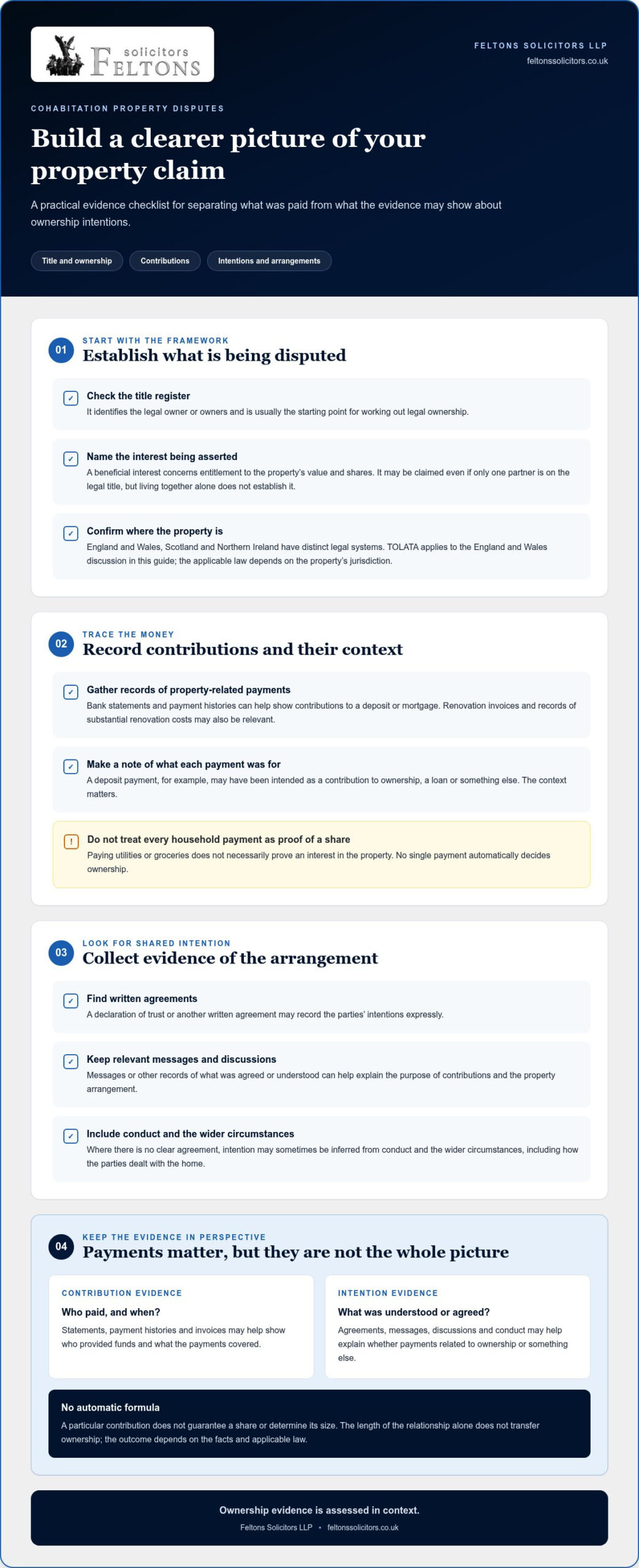
Before seeking advice, keep complete copies of relevant records and prepare a dated chronology. Note key payments, conversations and changes to the property as accurately as you can. Preserve original messages and documents. Don’t alter records or select only the parts that appear helpful. Missing paperwork doesn’t automatically defeat a claim, but it may make it harder to establish what was agreed or intended.

Which documents should you gather before seeking advice?

Start with records showing ownership, funding and the history of the home. Depending on the dispute, these may include:

  • Title documents and conveyancing correspondence, including records of how the property was purchased.
  • Mortgage statements, deposit records and bank statements showing transfers or payments.
  • Renovation invoices, receipts and related payment records.
  • Emails, text messages and other communications about ownership, contributions, repayments or plans for the property.
  • Any written agreement, such as a declaration of trust, alongside records of later discussions or changes in the arrangement.

For your chronology, record dates, amounts, the purpose of each payment and any relevant changes to the property. Add a short note of who was present for significant conversations and what you remember being said. Mark clearly where a date or detail is uncertain rather than filling gaps with assumptions.

How should you handle disputed contributions and informal promises?

Separate direct payments towards a deposit or mortgage from renovation spending, unpaid work, household bills and general living costs. These may provide different kinds of evidence, and none automatically proves a particular share. For instance, a transfer towards the mortgage shows a payment, while a message discussing whether that payment would give someone an interest may help explain its intended meaning.

Keep messages in their original context, including the surrounding conversation and date, rather than relying on isolated quotations or screenshots without context. Record informal promises as accurately as possible, but don’t assume a promise has one guaranteed legal effect. Cohabitation property dispute lawyers UK can review the documents and chronology together, assess what they may establish and identify gaps or conflicting accounts that need careful consideration.
Cohabitation Property Dispute Lawyers UK: Your Rights and Next Steps in 2026

What happens when cohabiting partners cannot agree about the property?

A disagreement doesn’t have to move straight to court. A measured approach can help you understand the issues, preserve options and avoid escalating matters before you know what each person is asking for. The right route depends on the property, the evidence, the jurisdiction and whether constructive discussion is possible.

A practical sequence is to:

  • Clarify the dispute: identify whether it concerns ownership shares, a proposed sale, occupation or the handling of mortgage payments.
  • Organise the evidence: bring together title documents, financial records and communications relevant to the disagreement.
  • Explore resolution: consider whether direct negotiation or mediation could help narrow the issues or reach agreed terms.
  • Assess formal options: take tailored advice on the available legal route and its risks before deciding whether to apply to court.

This staged approach can make discussions more focused. It also helps each person understand what remains unresolved, rather than treating every issue as one indivisible dispute.

Can negotiation or mediation resolve a property dispute?

Structured discussion may help former partners agree practical arrangements, such as a proposed sale or how to address a disputed payment. Mediation can provide a setting to explore those issues, but it isn’t suitable in every case or a guaranteed solution. Safety, each person’s willingness to participate and the nature of the disagreement all matter. Nobody should assume mediation is appropriate in every circumstance.

If you reach an agreement, make the terms clear and record them in writing. Consider legal review before relying on them, particularly where ownership interests, a sale or ongoing financial obligations are involved. For a broader view of alternatives and formal routes, read about dispute resolution options.

When might a court application under TOLATA be considered?

In England and Wales, the Trusts of Land and Appointment of Trustees Act 1996, commonly called TOLATA, may provide a route to ask the court to determine questions about interests in land. Depending on the circumstances and the application, the court may be asked to address matters such as the parties’ interests, sale of the property or occupation. The available orders depend on the facts and legal basis of the claim, so no particular result can be assumed.

A court application is a formal step. Before taking it, consider the evidence needed, the likely costs and procedural consequences, as well as whether another resolution route remains practical. TOLATA applies in England and Wales; Scotland and Northern Ireland have different legal systems. Cohabitation property dispute lawyers UK can assess which jurisdiction applies and help you weigh proportionate options without promising an outcome.

How UK cohabitation property lawyers can help you

A solicitor can bring structure to a dispute by reviewing the registered title, available documents and each partner’s account of what was agreed. They can assess possible claims, identify evidence gaps and explain the risks and practical implications of different routes, from further discussion to formal proceedings. The aim is to help you make informed decisions, not to promise a particular result before the facts have been examined.

Advice should be tailored to the property’s jurisdiction and your circumstances. A solicitor can help clarify the ownership position, consider how evidence may support or weaken a claim, and compare realistic resolution options. That assessment can also help you focus on the outcome you need, whether it involves discussing a sale, occupation or a disputed interest.

What should you prepare before speaking to a solicitor?

A concise summary makes it easier to identify the key questions. Gather what you can, even if some records are incomplete:

  • Title information, mortgage documents and conveyancing paperwork.
  • Deposit and payment records, including bank statements and mortgage contributions.
  • Any cohabitation agreement, declaration of trust or other written arrangement.
  • A brief timeline of the relationship, purchase and ownership arrangements, significant payments and changes to the property.

Also note the outcome you’re seeking and any immediate concerns, such as a proposed sale, transfer or alteration to the property. Bring the key questions you want answered. You don’t need to resolve every detail before seeking advice. Flag uncertainties clearly rather than making assumptions.

What should tailored legal advice help you understand?

After reviewing the information, advice should help you identify which jurisdiction’s rules apply, what the title establishes and whether further evidence may be needed. It should also set out possible routes to resolution and their practical implications, so you can consider what is proportionate for your objectives. The available options depend on the facts, and no outcome can be guaranteed in advance.

If you’d like more context on title and ownership concepts, consult the firm’s residential property law guide. For advice on a cohabitation property dispute, speak with Feltons Solicitors LLP. The firm’s family law, property and dispute resolution experience can help you assess your position and consider sensible next steps. Cohabitation property dispute lawyers UK should offer clear, practical guidance grounded in the evidence and your circumstances.

Take a clear next step with your property dispute

A cohabitation property dispute is assessed under the applicable law and on the evidence, not simply on how long you were together. The title is an important starting point, but documents, payments and what you both intended may also matter. Keep relevant records together and note where the facts or your former partner’s account differ.

Negotiation or mediation may help resolve some disagreements, while formal options may need consideration if agreement isn’t possible. The right route depends on your circumstances and the jurisdiction involved. Advice can clarify your position and practical choices, but no outcome can be guaranteed before the facts are reviewed.

If you’re looking for cohabitation property dispute lawyers UK, Feltons Solicitors can bring family law, property and dispute resolution experience to a tailored, pragmatic assessment of your situation. Discuss your property dispute with Feltons Solicitors and take an informed step towards resolving the issues. You don’t have to work through your options alone.

Frequently Asked Questions

Does living together for years give me rights to my partner’s house?

No. The length of time you’ve lived together doesn’t automatically give you ownership of your partner’s home. The registered title identifies the legal owner, but you may be able to assert a beneficial interest, depending on the facts, evidence and jurisdiction. Contributions to the purchase or mortgage, and evidence of shared intentions, may be relevant, but don’t guarantee a particular share. Seek tailored legal advice before making decisions about the property.

Can I claim a share of a house if my name is not on the deeds?

Possibly. Sole registered ownership is an important starting point, but it doesn’t necessarily resolve whether another person has a beneficial interest. Relevant evidence may include an agreement, payments towards the property and the parties’ conduct. No single contribution automatically creates an entitlement to a share. The legal framework differs across the UK, so advice should reflect where the property is and the circumstances of your claim.

What evidence do I need for a cohabitation property dispute?

Gather the title documents, mortgage statements, deposit records, bank transfers, renovation invoices and relevant correspondence. Messages or written agreements may help show what you and your former partner intended, not just who paid. Keep original records and prepare a dated chronology of key payments, discussions and property changes. Evidence is assessed as a whole, and which documents matter most depends on the dispute’s facts and the applicable jurisdiction.

Can I force the sale of a home after separating from my partner?

A sale may be agreed between the owners or, in some circumstances, sought through a court process. Whether that is possible depends on the legal ownership, any beneficial interests, the circumstances and the relevant jurisdiction. In England and Wales, an application under the Trusts of Land and Appointment of Trustees Act 1996 may be relevant. A court won’t necessarily order a sale, so obtain individual legal advice before taking formal steps.

Does the UK have common-law marriage?

Living together doesn’t generally give unmarried partners the same legal status as spouses simply because time has passed. In England and Wales, there’s no “common-law marriage”. That doesn’t mean a partner can never claim an interest in a home: property rights may arise through legal ownership or beneficial-interest principles, depending on the facts and jurisdiction. The rules aren’t identical across the UK, so consider advice specific to your circumstances.

How can a solicitor help with a cohabitation property dispute?

A solicitor can review the title, documents and each partner’s account, identify relevant legal issues, and explain possible evidence gaps. They can also discuss proportionate options, which may include negotiation, mediation or formal proceedings. Advice helps you understand your position and choices; it can’t guarantee a particular result. Feltons provides family law, property and dispute resolution services, with pragmatic advice tailored to individual circumstances.

Are cohabitation property laws the same across the UK?

No. There isn’t one uniform property dispute procedure for every UK jurisdiction. England and Wales, Scotland and Northern Ireland have distinct legal systems, and the applicable framework may depend on where the property is located. Avoid relying on a rule described as UK-wide without checking how it applies to your circumstances. Jurisdiction-specific legal advice can help clarify your position before you negotiate, make decisions about the property or take formal action.


Transfer of Equity Solicitors: A Strategic Guide to Reorganising Property Ownership

Transfer of Equity Solicitors: A Strategic Guide to Reorganising Property Ownership

What if the simple act of adding a partner to your property title inadvertently triggered a tax bill worth thousands of pounds? It is a common anxiety for homeowners who wish to reorganise their assets but feel overwhelmed by Stamp Duty liabilities or the technicalities of mortgage lender consent. When the stakes are this high, the guidance of experienced transfer of equity solicitors is more than a formality; it is a vital safeguard for your wealth. Whether you are managing a matrimonial breakdown or gifting a share of your home, the emotional weight is often as significant as the legal complexities.

You deserve a transition handled with both technical precision and empathy. This guide is designed to help you manage these changes, ensuring your equity remains protected and your future is secure. We understand that your property is more than just an asset; it is the foundation of your personal life. We will provide a clear roadmap through the nuances of UK property law and tax obligations. We preview the essential steps to achieve a legally robust transfer of title whilst maintaining the privacy and dignity your family dynamics require.

Key Takeaways

  • Identify the common scenarios for reorganising property interests, ranging from matrimonial settlements and new marriages to family gifting and tax planning.
  • Understand the pivotal role of mortgage lender consent and why it represents the most significant legal hurdle in the transfer process.
  • Follow a clear, step-by-step roadmap that covers everything from initial identity verification to the final registration of Title Deeds.
  • Discover how to navigate complex tax obligations, including the calculation of Stamp Duty Land Tax (SDLT) on the consideration provided.
  • Learn why engaging expert transfer of equity solicitors is vital for protecting your financial security whilst managing the sensitive human impact of property transitions.

Understanding Transfer of Equity: Why Reorganise Your Property Interests?

A transfer of equity occurs when the legal ownership of a property changes hands, but at least one of the original owners remains on the Title Deeds. This process differs significantly from a standard sale or purchase. In a typical market transaction, a property is sold, the mortgage is cleared, and the owners move on. A transfer of equity is instead a strategic reorganisation of existing interests. To gain a foundational perspective, one might ask, What is a transfer of equity? Simply put, it’s the legal mechanism used to add or remove individuals from a property’s title whilst keeping the property within a specific group or family unit.

Because these transitions often involve existing mortgages and significant tax implications, the expertise of a professional residential property law firm is essential. This isn’t merely an administrative update; it’s a formal legal shift that alters your financial liabilities and rights. Without precise guidance, homeowners risk future disputes or unintended tax consequences that can take years to resolve. Expert transfer of equity solicitors provide the technical accuracy needed to ensure the new ownership structure is legally robust and reflects your true intentions.

Matrimonial and Relationship Changes

Significant life transitions often necessitate a change in property holdings. Following a separation, a divorce and financial arrangements lawyer may advise removing a former partner from the title to finalise a financial settlement. Conversely, you might wish to add a new spouse or partner to the title of a home you already own to reflect a shared commitment. These moments require a delicate touch. We act as a calm, steady presence, balancing technical legal precision with the emotional sensitivity these personal changes demand.

Strategic Wealth and Estate Management

Beyond personal relationships, equity transfers are powerful tools for protecting your financial future. Gifting a share of a property to children or other family members can be a cornerstone of effective estate planning. However, the way you hold that equity is critical. You must decide between two primary structures:

  • Joint Tenants: Both parties own the whole property together. If one person passes away, their share automatically transfers to the survivor, regardless of what is written in a Will.
  • Tenants in Common: Each person owns a specific, defined percentage of the property. This allows you to leave your specific share to a chosen beneficiary in your Will.

Choosing between these options depends on your long-term goals and family dynamics. Transfer of equity solicitors help you navigate these choices, ensuring your property interests are organised in a way that respects your privacy and secures your legacy for the next generation.

If your property is subject to a mortgage, your lender is effectively a silent partner in any ownership change. Their consent is the primary hurdle in the process; without it, the transfer cannot legally proceed. Lenders view a change in ownership as a shift in their security. Whether you are removing a former partner or adding a new spouse, the bank must ensure their investment remains protected. Experienced transfer of equity solicitors act as the bridge between you and the financial institution, ensuring all criteria are met before any documents are signed.

Many homeowners choose to combine this transition with a remortgage. This synergy often makes financial sense, as it allows you to secure a better rate whilst simultaneously reorganising the title. If you stay with your current lender, they’ll conduct a full affordability assessment to ensure the remaining or new owners can comfortably meet the monthly repayments. If the bank refuses consent, usually due to a low credit score or insufficient income, the transfer will stall unless the mortgage is cleared in full. For those needing to explore alternative financing to bridge this gap, I Need Cash offers a way to compare various homeowner and personal loan products. Identifying these roadblocks early is a core part of our proactive approach.

Lenders prioritize risk management above all else. When a party is removed from a title, the bank must formally release them from their personal covenant to repay the debt. This “clean break” is vital for the outgoing individual, as it prevents them from being held liable for future arrears. For the remaining owner, the bank may require a ‘Deed of Covenant’ or a entirely new mortgage offer. They’ll scrutinise your income and outgoings with the same rigour as a fresh purchase; in such cases, Lee Tonks: Mortgage Guru can provide the independent advice needed to ensure the debt is sustainable on a single or revised set of earnings.

Coordinating with Financial Institutions

The timeline for a transfer is often dictated by the lender’s internal processing speeds. Your solicitor manages this coordination, ensuring that the mortgage offer aligns with the wider conveyancing process and Land Registry requirements. This involves significant back-and-forth communication to verify identity, confirm equity shares, and secure the final ‘letter of consent’.

Managing these moving parts requires a methodical mindset and a deep understanding of banking protocols. If you’re feeling uncertain about how your lender might react to a change in your circumstances, seeking advice from a specialist property solicitor can provide the clarity you need to move forward with confidence. We handle the technical liaisons, allowing you to focus on the personal transition at hand.

Your journey begins with a formal instruction. This stage involves rigorous Anti-Money Laundering (AML) checks, a mandatory requirement that ensures the integrity of the transaction and protects all parties from financial impropriety. Once identity is verified, we obtain the official copies of the title from the Land Registry. This review allows us to identify any existing charges, restrictions, or notices that might complicate the transition. It’s a methodical start that builds a secure foundation for the work ahead.

After reviewing the deeds, we move to the pivotal stage of securing lender consent, as discussed in our previous section. This involves a steady exchange of information with your bank to ensure the new ownership structure aligns with their lending criteria. Only when consent is in place can the formal transfer documents be prepared. Expert transfer of equity solicitors act as the primary coordinator here, ensuring that every piece of the puzzle fits perfectly before moving to execution.

Drafting the Transfer Deed (TR1)

The TR1 form is the legal instrument that effects the change in ownership. Within this document, we must clearly specify the ‘consideration’. This is the value being exchanged for the share of the property. It’s a common misconception that consideration only refers to cash; in a transfer of equity, the assumption of mortgage debt is also viewed as consideration by HMRC. We also confirm the ownership structure, whether you’ll hold the property as Joint Tenants or Tenants in Common. To prevent future ‘undue influence’ claims, transfer of equity solicitors often require the outgoing party to seek independent legal advice. This ensures they fully understand the rights they’re relinquishing, protecting the validity of the entire transaction.

Post-Completion Formalities

Once the TR1 is signed and witnessed, completion occurs. However, the legal work doesn’t end there. We must submit a Stamp Duty Land Tax (SDLT) return to HMRC, even if the transaction falls below the tax threshold and no payment is due. Following this, an application is made to the Land Registry to update the official record. Fees for this are typically submitted electronically, following the established HM Land Registry fee scales for transfers. This registration can take several weeks to process. Once finished, we provide you with the updated Title Register. This document serves as your final, definitive record of ownership, offering you the peace of mind that your property interests are correctly and securely organised.

Transfer of Equity Solicitors: A Strategic Guide to Reorganising Property Ownership

Financial Implications: SDLT, Capital Gains, and Valuation

While the legal mechanics of a transfer are vital, the financial consequences often present the most significant challenges. Many homeowners assume that if no money changes hands, no tax is due. This is a potentially costly misconception. In the UK, HM Revenue and Customs (HMRC) views the transfer of equity as a transaction with a specific value, known as ‘consideration’. Understanding how this value is calculated is where the guidance of transfer of equity solicitors becomes indispensable for protecting your long-term financial security.

An accurate property valuation is the cornerstone of this process. Whether you’re reorganising interests for tax planning or a family settlement, you must establish a fair market value. HMRC scrutinises transfers between ‘connected persons’, such as family members, and using an incorrect valuation can lead to penalties or prolonged investigations. We ensure your financial disclosures are pragmatic and robust, reflecting current market conditions whilst respecting your personal privacy.

The SDLT ‘Consideration’ Trap

Stamp Duty Land Tax (SDLT) is often triggered during a transfer because ‘consideration’ includes the value of any mortgage debt the new owner takes on. For example, if you’re added to a title for a property with a £300,000 mortgage, you’re effectively taking on responsibility for £150,000 of that debt. This £150,000 counts as consideration. Under 2026 rates, the standard SDLT threshold starts at £125,000. In this scenario, tax would be payable on the £25,000 that exceeds the 0% band. However, transfers resulting from a matrimonial breakdown or a court order are typically exempt from SDLT. We help you identify these exemptions early to avoid unnecessary payments.

Capital Gains Tax and Gifting

If the property is not your primary residence, such as a buy-to-let investment or a second home, Capital Gains Tax (CGT) may apply. For the 2026/2027 tax year, CGT rates for residential property stand at 18% for basic rate taxpayers and 24% for higher rate individuals. When gifting a share of a property to a child or family member, the ‘Market Value’ rule applies. HMRC calculates the gain based on the current value of the share being gifted, regardless of whether any money was paid. With an Annual Exempt Amount of just £3,000, these liabilities can accumulate quickly. Seeking early tax advice ensures you aren’t blindsided by a large bill months after the legal work is complete.

Managing the intersection of property law and tax obligations requires a steady, expert hand. If you’re planning to reorganise your property interests, consult our specialist property team to ensure your equity is protected and your tax liabilities are clearly understood before you proceed.

Reorganising property ownership is rarely a standalone task. It sits at the complex intersection of property law, family arrangements, and long-term tax planning. Each of these areas carries its own risks and requirements. A mistake in one can derail the others, leading to financial loss or personal friction. This is why the involvement of expert transfer of equity solicitors is vital. We don’t just process forms; we provide a strategic overview that ensures your transition is seamless and your interests remain protected.

In matrimonial transfers, the process is often emotionally charged. We act as a calm, steady presence, providing the technical precision needed whilst respecting the sensitivities of your situation. Our goal is to future-proof your property title. We ensure that every detail, from the specific wording of the Transfer Deed to the final Land Registry entry, is robust enough to withstand future scrutiny or potential disputes. By choosing a partner who understands the human impact of legal work, you ensure a transition that is as smooth as it is secure.

A Sophisticated Boutique Service

We pride ourselves on a “people-first” philosophy. Unlike high-volume firms that prioritise speed over substance, our boutique approach focuses on personal connection. We offer discreet, high-standard care that is particularly valued by high-net-worth clients who require a tailored experience. This bridges the gap between traditional professional integrity and the efficiency of modern legal delivery. You aren’t just a file number; you’re a partner in a process that values your privacy and unique circumstances. This level of individualized attention ensures that no detail is overlooked and every concern is addressed with poise and dependability.

Securing Your Property’s Future

Our expertise extends beyond simple title changes. As leasehold enfranchisement experts, we understand the nuances of complex title issues that often surface during an equity transfer. We coordinate holistically with your other professional advisors, such as accountants or surveyors, to ensure every financial and legal angle is covered. This collaborative approach provides a comprehensive service that secures the foundation of your property rights for years to come. It’s about more than the immediate change; it’s about building a legally robust future for your most valuable assets. To discuss your property ownership goals, contact our transfer of equity specialists today.

Securing Your Property Interests for the Long Term

Reorganising your property ownership is a significant legal transition that requires more than just administrative filing. It demands a strategic understanding of how mortgage lender consent, tax liabilities, and family dynamics intersect. By addressing these complexities with foresight, you ensure your equity is protected and your title remains legally robust against future challenges. Navigating the nuances of Stamp Duty and Capital Gains Tax is essential for maintaining your financial security whilst achieving your personal objectives.

At Feltons Solicitors LLP, we specialise in complex property and matrimonial transitions, providing pragmatic, professional advice tailored to your specific goals. Our discreet, boutique service ensures a human touch whilst maintaining the high-standard reliability you expect from a trusted advisor. When you engage transfer of equity solicitors who prioritise personal connection over high-volume processing, you gain a steady partner for your most valuable assets. We’re here to provide the calm, expert guidance needed to make your property reorganisation a success.

Secure your property’s future with Feltons Solicitors LLP. We look forward to guiding you through this transition with the poise and expertise your property deserves.

Frequently Asked Questions

Do I have to pay Stamp Duty when transferring equity in my home?

You may need to pay Stamp Duty Land Tax (SDLT) if the ‘consideration’ exceeds the current threshold. Consideration includes cash payments and the value of any mortgage debt the new owner takes on. For the 2026/2027 tax year, the standard threshold begins at £125,000. However, transfers resulting from a divorce or matrimonial breakdown are usually exempt. Consulting transfer of equity solicitors early ensures you don’t overlook potential exemptions or trigger unnecessary tax bills.

Can I transfer equity without my mortgage lender’s consent?

No, you cannot proceed without your mortgage lender’s formal consent. Because the lender has a legal charge over the property, they must approve any change to the ownership structure. They’ll conduct a full affordability assessment to ensure the remaining or new owners can meet the debt obligations. If consent is refused, the mortgage must be cleared in full before the transfer can occur. This is a critical hurdle that requires careful coordination.

How long does a typical transfer of equity take to complete?

A typical transfer of equity usually takes between four and eight weeks to complete. This timeline is heavily influenced by how quickly your mortgage lender provides consent and the complexity of your specific title. Whilst the legal drafting is relatively swift, external factors like HMRC filings and Land Registry registration can extend the process. We work methodically to ensure each stage is handled promptly to avoid any unnecessary delays for our clients.

Is a transfer of equity different if the property is a leasehold?

Yes, leasehold transfers involve additional administrative steps. You’ll likely need to notify the freeholder or management company of the change in ownership. There are often administrative fees for a ‘Notice of Transfer’ or ‘Notice of Charge’ as stipulated in your lease. As transfer of equity solicitors with expertise in leasehold matters, we manage these communications to ensure your lease remains compliant and your property rights are fully protected throughout the transition.

Do I need a new valuation of the property for a transfer of equity?

Yes, a formal valuation is often essential for both lender approval and tax compliance. HMRC requires the transfer to be based on a ‘fair market value’ to calculate potential Stamp Duty or Capital Gains Tax liabilities accurately. If you’re remortgaging as part of the process, your lender will also insist on an independent valuation to confirm their security. Establishing an accurate figure at the outset prevents future disputes with authorities or other parties.

What is the difference between a transfer of equity and a gift of property?

A transfer of equity involves at least one original owner remaining on the title, whilst a gift of property usually sees the entire interest transferred to someone else. Both scenarios are treated as disposals for tax purposes. If you’re gifting a share of a property that isn’t your main home, Capital Gains Tax may apply based on the market value. We provide the pragmatic advice needed to navigate these distinctions safely and securely.

Can a transfer of equity be challenged in the future by a former partner?

A transfer can be challenged if there’s evidence of ‘undue influence’ or if a party didn’t receive independent legal advice. To mitigate this risk, we ensure the process is transparent and that all parties understand the rights they’re relinquishing. A legally robust transfer, registered correctly at the Land Registry, provides the definitive record needed to protect your future interests. Our boutique approach prioritises these safeguards to ensure your property’s long-term security.

Does the outgoing person need their own solicitor for the transfer?

Yes, the outgoing person should always seek independent legal advice. Most transfer of equity solicitors and mortgage lenders require this to prevent a conflict of interest. It ensures that the individual leaving the title fully understands the financial and legal implications of their decision. This step is vital for the validity of the transfer, as it protects the transaction from future claims that the person was pressured or misinformed during the process.