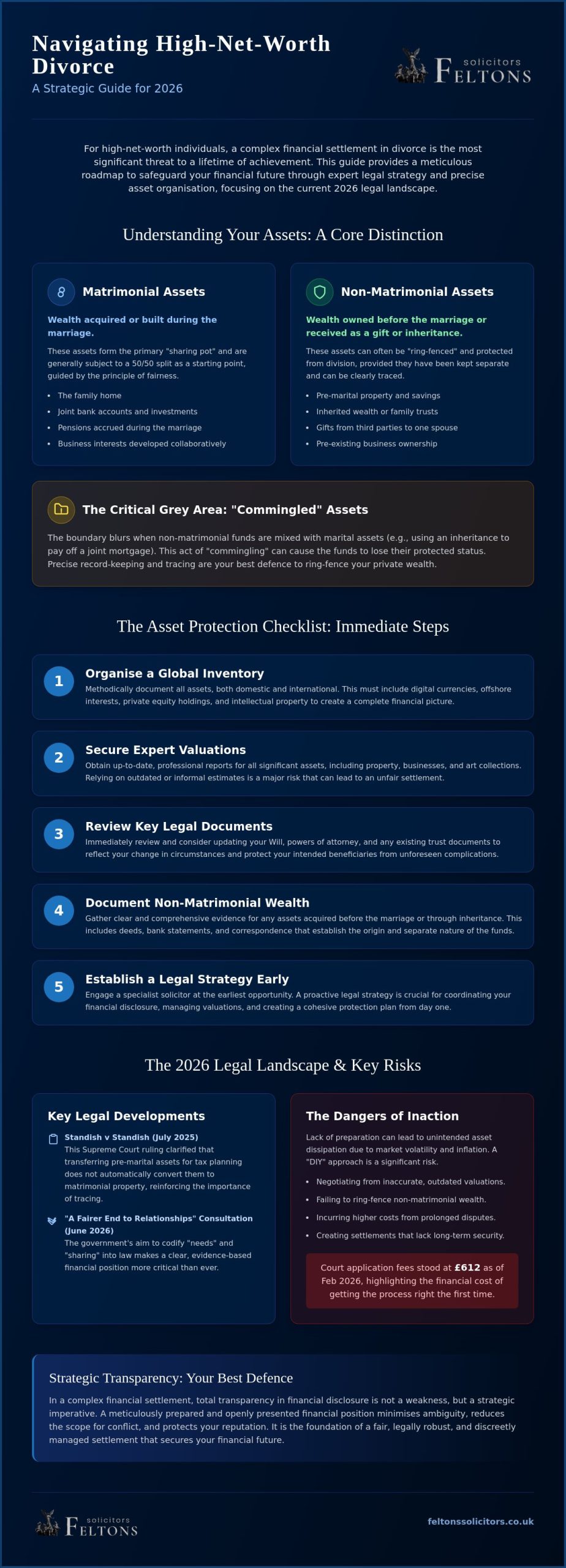

What if the division of your matrimonial assets wasn’t just a look back at what you’ve built, but a strategic blueprint for your financial independence? When facing a separation in 2026, it’s natural to feel overwhelmed by the complexity of financial disclosure or the rising costs of litigation. Many people worry about losing the family home or failing to secure a fair share of a pension. Working with specialist divorce asset division lawyers can provide the calm, steady guidance needed to navigate these high-stakes negotiations with confidence.
We understand that you want a settlement that is both fair and protective of your non-matrimonial property. This article explains how legal experts approach these settlements to secure your financial future whilst respecting your privacy. You’ll learn about the latest 2026 legal shifts, including the proposed “codification-plus” model and the increasing importance of qualifying nuptial agreements in modern family law. We’ll provide a clear overview of how the legal process works today, ensuring you feel informed and supported at every stage of the journey.
Key Takeaways
- Understand why the “yardstick of equality” is merely a starting point and how the Matrimonial Causes Act 1973 continues to shape modern financial settlements.
- Learn to distinguish between matrimonial and non-matrimonial assets to ensure that pre-marital wealth and inheritances are appropriately protected.
- Gain clarity on the “Section 25 factors” that judges use to determine a fair outcome based on your future needs and past standard of living.
- Discover how specialist divorce asset division lawyers utilise the Form E disclosure process to build a transparent and strategic foundation for your case.
- Explore the benefits of a discreet, boutique legal service that prioritises pragmatic solutions and personal rapport over high-conflict litigation.
Navigating the Legal Framework for Asset Division in 2026
The Matrimonial Causes Act 1973 remains the bedrock of financial settlements in England and Wales. Even as we move through 2026, this legislation provides the essential structure that courts use to reallocate wealth between separating spouses. It’s a system designed to be flexible. This flexibility allows judges to tailor outcomes to the specific needs of each family, rather than applying a one-size-fits-all rule that might lead to an unjust result.
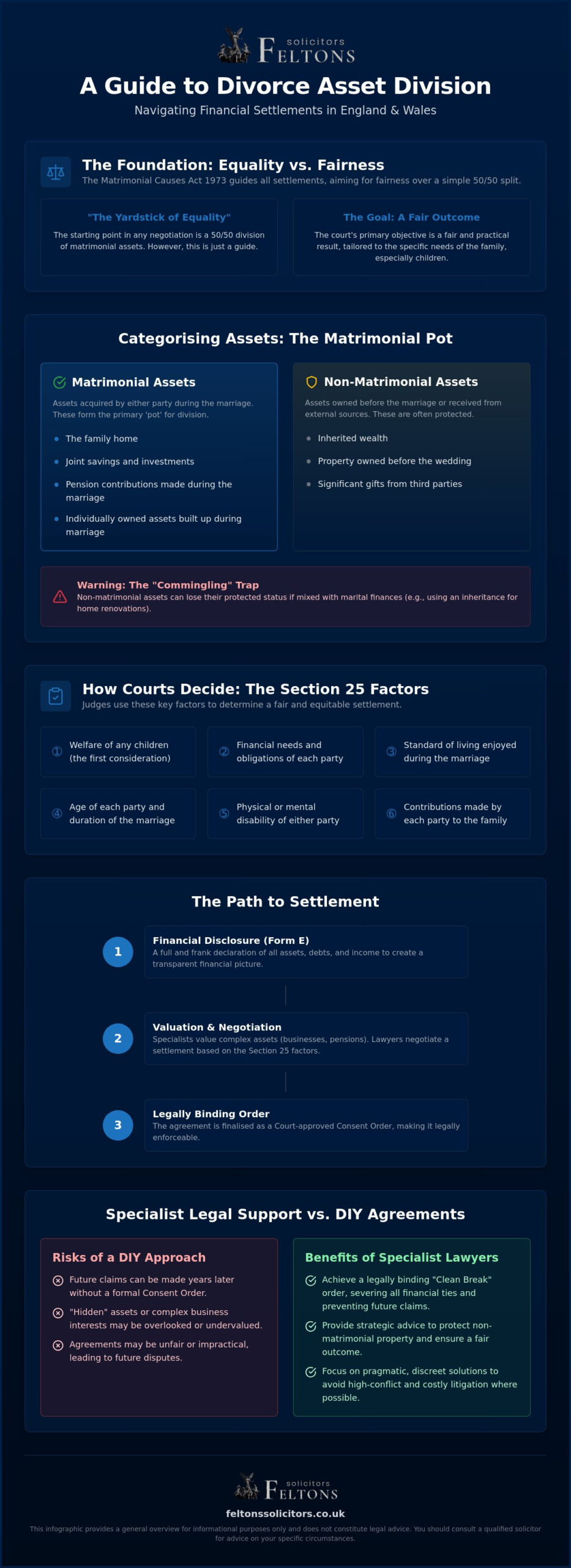
Whilst many people expect an automatic 50/50 split, the “yardstick of equality” is merely the starting point. The court’s ultimate goal is to achieve a result that’s fair and practical for both parties. In many cases, the primary focus is the welfare of any children involved. This often means that the parent with primary care responsibilities may receive a larger share of the matrimonial home or liquid assets to ensure the children have a stable environment. Understanding the legal framework for asset division is the first step toward reaching a resolution that respects your past contributions and your future needs.
A key decision in many divorces is whether to pursue a “clean break” order. This order severs all financial ties between you and your former spouse, preventing future claims against your wealth. However, if there’s a significant disparity in earning capacity, ongoing maintenance obligations might be necessary to ensure both parties can maintain a reasonable standard of living. Specialist divorce asset division lawyers help you determine which path provides the most security for your specific circumstances.
The Starting Point: Equality vs Fairness
In UK law, the concept of equitable distribution doesn’t always mean an equal split. While the court begins with the assumption of equality, it quickly pivots to consider factors like age, health, and future earning potential. A financial settlement is a legally binding resolution that provides absolute finality to the parties’ financial relationship. Expert divorce asset division lawyers work to ensure these deviations from the 50/50 baseline are justified and backed by robust evidence.
Why Legal Representation is Essential for Complex Estates
Attempting a DIY agreement carries significant risks. Without a formal Consent Order, your former spouse could potentially make a claim against your assets years after the divorce is finalised. This is particularly dangerous for those with complex estates, including commercial property or international interests. Experienced legal advisors possess the technical skills to identify “hidden” assets or accurately value business interests that might otherwise be overlooked. For a deeper look at these protections, see our guide on Divorce and Financial Arrangements Lawyer: A Guide to Protecting Your Assets in 2026. Our focus remains on achieving a pragmatic outcome that avoids unnecessary conflict whilst securing your long-term interests.
Identifying and Categorising Matrimonial vs Non-Matrimonial Assets
Determining what belongs in the “matrimonial pot” is one of the most critical steps in any financial settlement. Matrimonial assets generally include everything acquired by either party during the marriage, regardless of whose name appears on the deed or account. This encompasses the family home, joint savings, and even assets built up individually, such as pension contributions made during the years of marriage. Specialist divorce asset division lawyers focus on creating an exhaustive inventory to ensure nothing is overlooked during the disclosure phase.
Non-matrimonial assets are treated differently. These typically consist of inherited wealth, property owned before the wedding, or significant gifts from third parties. Whilst the court’s starting point is to protect these assets, they aren’t always immune from division. The “commingling” trap occurs when separate wealth is mixed with marital finances. For instance, if an inheritance is used to refurbish the family kitchen or pay down a joint mortgage, it may lose its non-matrimonial status. Tracing these funds requires a methodical approach to ensure your pre-marital wealth remains protected where possible.
The Family Home and Other Property Interests
For most couples, the family home is their most significant asset. Several options exist for its distribution: selling the property and splitting the proceeds, one party “buying out” the other’s share, or implementing a Mesher Order. A Mesher Order allows one parent to remain in the home with the children until a specific event, such as the youngest child finishing secondary school, at which point the house is sold. Our extensive experience in residential property law allows us to guide you through these property valuations with precision. We also handle the intersection of personal divorce and commercial property interests, ensuring that business premises aren’t unnecessarily jeopardised by the breakdown of a marriage.
Pensions, Investments, and Business Interests
Pensions are frequently undervalued or ignored, yet they often represent a substantial portion of a couple’s wealth. You must decide between pension sharing, which provides an immediate split of the pension credit, or pension offsetting, where one party keeps their pension in exchange for a larger share of other assets like the house. As you navigate the legal process of divorce, accurate valuation of private businesses is equally vital. A company’s “book value” rarely reflects its true worth in a matrimonial context, particularly when future maintainable earnings and shareholdings are considered. In 2026, we also see an increase in digital assets and international investments. These require a sophisticated guide to ensure they’re correctly categorised and valued. If you’re concerned about how complex investments might be split, speaking with our team can provide the clarity you need to move forward.
How Courts Determine a Fair Financial Settlement
The court’s primary objective is to reach a settlement that is fair, but “fair” is a subjective term that requires careful interpretation by divorce asset division lawyers. Rather than following a rigid formula, judges use a specific framework to evaluate the unique circumstances of each marriage. This process ensures that the final order is tailored to the practical realities of your life after the separation. It’s a nuanced balancing act that considers where you’ve been and, more importantly, where you’re going.
One of the most common misconceptions is the role of “conduct” or bad behaviour. In English law, the reasons for the breakdown of the marriage, such as adultery or unreasonable behaviour, rarely impact the financial outcome. The court only considers conduct if it’s so egregious that it would be “inequitable to disregard it,” which is an exceptionally high bar to meet. Instead, the focus remains firmly on financial needs and the standard of living enjoyed during the marriage. The court aims to ensure that neither party suffers a disproportionate drop in their lifestyle, provided there are enough assets to go around.
Equally vital is the recognition of non-financial contributions. The law treats the role of a stay-at-home parent or homemaker with the same weight as that of the primary breadwinner. This principle of “non-discrimination” ensures that the spouse who sacrificed their career to support the family isn’t penalised during the division of assets. Every contribution to the welfare of the family is valued, reflecting the partnership nature of a modern marriage.
The Section 25 Factors Explained
The Section 25 factors are the statutory checklist every judge must follow. These include the income, earning capacity, property, and other financial resources each party has or is likely to have in the foreseeable future. The court also examines the financial needs, obligations, and responsibilities of each individual. The age of the parties and the duration of the marriage are critical too; a twenty-year marriage will naturally result in a different settlement than a two-year union. These factors provide the structured logic behind what might otherwise feel like an arbitrary process.
Assessing Future Needs and Earning Capacity
A significant part of the court’s work involves balancing immediate housing needs with long-term retirement security. For a spouse who has been out of the workforce for several years, “earning capacity” isn’t just about what they could earn today. It involves a realistic assessment of their potential to re-train and re-enter the professional world. As you finalise these arrangements, it’s essential to look beyond the immediate settlement. Once your financial order is in place, updating your estate planning is a vital next step. You can find more information on this in our complete guide to estate planning, which ensures your legacy remains protected under your new circumstances. Our role as divorce asset division lawyers is to guide you through these transitions with discreet, professional authority, ensuring your interests are represented at every turn.
Strategic Steps to Organise Your Financial Disclosure
The process of reallocating wealth begins with total transparency. In English law, both parties have a Duty of Full and Frank Disclosure, which requires you to provide a complete and honest picture of your financial position. This isn’t a suggestion; it’s a strict legal requirement. Attempting to obscure the truth often leads to significant delays and increased costs. Experienced divorce asset division lawyers ensure that this process is handled with the necessary precision to protect your integrity and your future settlement.
The cornerstone of this process is Form E. This comprehensive financial statement requires you to list every asset, liability, and income stream you possess. You’ll need to gather specific evidence to support your claims, including twelve months of bank statements for every account held, your last three P60s, and up-to-date property valuations. For those with private pensions, obtaining a Cash Equivalent Transfer Value (CETV) is essential. Gathering these documents early allows your legal team to build a robust strategy based on verified facts rather than estimates.
Failing to disclose assets can have severe consequences. If the court discovers that information has been deliberately withheld, it can impose heavy cost penalties or even draw adverse inferences against the non-disclosing party. A financial order can be reopened years later if it’s proven that the original settlement was based on a lie. Honesty is the only viable legal strategy to achieve a final, binding resolution that cannot be challenged in the future.
The Importance of Transparency
The court takes a very dim view of any attempt to dissipate or hide wealth during a divorce. In cases involving complex estates or international interests, we often collaborate with forensic accountants to trace funds and ensure the matrimonial pot is accurate. A Freezing Order is a powerful legal injunction that prevents a spouse from disposing of or hiding assets before a final settlement is reached. This level of protection is vital for high-net-worth individuals where the risk of asset movement is high.
Avoiding Common Pitfalls in Asset Valuation
Accuracy is paramount when valuing your estate. You should never rely on online valuation tools for your property; these lack the local nuance and physical inspection required for a court-approved valuation. Similarly, using outdated pension CETVs can be a costly mistake, as values can fluctuate significantly within a few months. Our team helps you organise your disclosure methodically to minimise delays. If you’re ready to begin this process with expert support, contact Feltons Solicitors LLP today to discuss your financial arrangements.
Bespoke Legal Support from Feltons Solicitors
Feltons Solicitors LLP offers a refined alternative to high-volume legal practices. Established in 2010, our firm has built its reputation on a boutique model that prioritises the individual over the process. Our divorce asset division lawyers understand that behind every financial disclosure and property valuation is a human story. We apply a people-first philosophy, ensuring that the emotional and human impact of these life-altering changes remains at the forefront of our legal strategy. This approach allows us to act as a calm, steady presence during what is often a period of significant stress and upheaval.
Our advice is consistently pragmatic and focused on the future. Whilst we possess the technical depth to handle complex litigation, we prefer to achieve settlements that translate effectively into your daily life. We project an image of high-end reliability, acting with the quiet confidence that comes from years of handling sophisticated financial reallocations. By choosing a boutique firm, you gain a partner who values personal rapport and delivers a standard of service that respects both modern efficiency and traditional professional integrity.
Our Approach to Financial Arrangements
We believe that the best legal results are achieved through continuity and a deep understanding of your unique circumstances. At our firm, you will have a single, dedicated advisor who manages your case from the initial consultation through to the final order. This direct connection ensures that the nuances of your estate, from residential property to commercial interests, are fully understood and protected. Our worldly experience is particularly beneficial for managing cross-border assets, including the overseas entity registrations required for international wealth. This tailored attention ensures that complex international matters receive the same high standard of care as domestic ones.
Securing Your Future with Discreet Representation
Privacy is a core tenet of our family law practice and a priority for our clients. For high-net-worth individuals, discreet representation is not just a preference but a necessity to protect long-term interests and personal reputations. We guide our clients from conflict toward resolution, favouring dispute resolution and strategic negotiation over unnecessary litigation. As experienced divorce asset division lawyers, we value the trust you place in us and maintain the highest levels of confidentiality at all times.
If you require a partner who understands the complexities of matrimonial finance and the importance of professional discretion, we are here to help. We invite you to book a confidential consultation to discuss your specific needs and goals. Contact Feltons Solicitors LLP today to begin the process of securing your financial future with a team that puts your interests first.
Securing Your Financial Independence in 2026
Transitioning from the breakdown of a marriage to a stable financial future requires a methodical approach and expert oversight. We’ve explored how the legal framework in 2026 prioritises fairness over a simple 50/50 split, particularly when children’s welfare or complex property interests are involved. By accurately categorising your assets and committing to transparent disclosure, you build a foundation for a settlement that respects both your past contributions and your future requirements.
Specialist divorce asset division lawyers act as your sophisticated guide through these intricate negotiations, ensuring that no detail is overlooked and your privacy remains protected throughout. Feltons Solicitors LLP was established in 2010 to provide the pragmatic, discreet legal advice that high-net-worth individuals and those with complex property arrangements require. We invite you to secure your financial future with a confidential consultation at Feltons Solicitors LLP. Taking this first step allows you to move forward with clarity and the quiet confidence that your interests are in capable hands.
Frequently Asked Questions
How are assets divided in a divorce if there is no prenuptial agreement?
Assets are divided according to the framework set out in the Matrimonial Causes Act 1973. In the absence of a prenuptial agreement, the court begins with the “yardstick of equality,” aiming for a 50/50 split. However, this balance is frequently adjusted to account for the welfare of children, the financial needs of each party, and their respective earning capacities. Expert divorce asset division lawyers ensure these factors are correctly weighted to achieve a truly fair outcome.
Can I protect my inheritance from being split during a divorce settlement?
Inheritances can often be protected if they are classified as non-matrimonial assets. This protection usually applies if the funds were kept separate and not “commingled” with joint finances, such as paying off a shared mortgage. However, if the matrimonial pot is insufficient to meet the basic needs of both parties or the children, the court may still look at inherited wealth. Maintaining clear records is essential for ring-fencing these assets during negotiations.
What happens to my business if I get a divorce in the UK?
Your business is generally treated as a matrimonial asset if it was established or developed during the marriage. Courts typically aim to preserve the business as an income-generating entity rather than forcing a sale. This often involves an offsetting approach, where the business owner retains their shares while the other spouse receives a larger portion of the family home or liquid savings. Precise valuation is vital to ensure this trade-off is equitable and sustainable.
Is a 50/50 split of assets mandatory in a UK divorce?
An equal split is not mandatory in English law, as the primary goal is fairness rather than strict arithmetic equality. While 50/50 is the traditional starting point, judges frequently depart from this to meet the “needs” of the parties. For example, a parent with primary care of the children might receive a larger share of the home to ensure stability. Every case is unique, and the final distribution depends on the specific Section 25 factors involved.
How long does it typically take to reach a financial settlement?
Reaching a financial settlement typically takes between nine and eighteen months, depending on the complexity of the assets. Data from 2025 suggests an average timeline of 74 weeks from the initial application to the final order. Cases involving straightforward agreements can be resolved more quickly through a Consent Order. However, disputes over business valuations or international investments can extend the process, as detailed forensic evidence may be required for a fair resolution.
What is a Consent Order and why do I need one?
A Consent Order is a court-approved document that makes your financial agreement legally binding and final. You need one to achieve a “clean break,” which prevents either party from making financial claims against the other in the future. Without this order, your ex-partner could potentially claim a share of your future earnings or inheritances years after your separation. It provides the legal certainty required to move forward with your life independently and securely.
Can my ex-partner claim my pension after we are divorced?
Yes, pensions are considered matrimonial assets and are often subject to sharing or offsetting. Your ex-partner can claim a portion of the pension value built up during the marriage through a Pension Sharing Order. Alternatively, you might agree to keep your full pension in exchange for giving up a larger share of the family home. Our divorce asset division lawyers can help you evaluate which strategy offers the best long-term financial security for your retirement.
What happens if one party refuses to disclose their financial assets?
The court can impose serious sanctions if a party fails to provide full and frank financial disclosure. Judges may issue cost orders, where the offending party pays the other’s legal fees, or they may draw “adverse inferences,” assuming the hidden assets are of significant value. In extreme cases, a Freezing Order can be used to stop the disposal of assets. Honesty is always the most effective strategy to avoid reopening the case years later.