

A single oversight in the Register of Overseas Entities can result in a daily fine of £2,500 or, in more severe cases, a prison sentence. It’s perfectly natural to feel a sense of trepidation when facing the UK’s increasingly rigorous transparency laws. This is particularly daunting whilst you’re managing high-value transactions from a different time zone. Finding the right solicitors for international property buyers is essential to ensuring these complexities don’t jeopardise your acquisition. You want the security of British property, but the weight of enhanced anti-money laundering checks and complex tax obligations can make the process feel unnecessarily opaque.
This guide offers a comprehensive look at the legal landscape in 2026. We cover everything from navigating the 2% non-resident Stamp Duty surcharge to meeting the latest Companies House filing requirements. We’ll outline the essential conveyancing steps and explain how a partner-led approach ensures your investment is protected with the highest standard of professional integrity. By the end of this article, you’ll have a clear understanding of your registration obligations and the confidence to move forward with your UK property goals.
Key Takeaways
- Understand the mandatory requirements of the Register of Overseas Entities (ROE) to ensure your property acquisition remains fully compliant with 2026 transparency laws.
- Learn how experienced solicitors for international property buyers navigate the complexities of UK conveyancing whilst managing stringent remote identity verification.
- Identify the specific Stamp Duty Land Tax (SDLT) surcharges and tax obligations that apply to non-resident investors in both residential and commercial sectors.
- Discover a methodical, step-by-step conveyancing process designed to accommodate global investors operating across different time zones.
- Explore why a boutique, partner-led legal service provides the discretion and tailored expertise required for high-value international transactions.
The Landscape for International Property Buyers in 2026
The UK property market remains a beacon for global capital. Its legal system offers a level of predictability that’s rare in other jurisdictions, making it a preferred destination for those seeking long-term stability. Whilst the allure of London’s skyline or the steady yields of northern commercial hubs remains strong, the path to ownership has become more intricate for those residing outside our borders. In 2026, the primary challenge for investors isn’t just finding the right asset; it’s navigating a regulatory framework that demands absolute transparency. Instructing specialized solicitors for international property buyers is now a prerequisite for a successful acquisition. You need a legal partner who understands that a cross-border transaction is a dual exercise in property law and rigorous regulatory compliance.
Why the UK Remains a Global Investment Centre
English law continues to be the gold standard for property contracts. It provides a clear, enforceable framework that protects the interests of the buyer and seller alike. This transparency of title, managed through a robust Land Registry system, ensures that ownership is indisputable once registered. Beyond legal security, the UK offers diverse opportunities. Residential investors are drawn to consistent rental demand in major cities, whilst the commercial sector provides sophisticated assets ranging from Grade A office spaces to industrial hubs. These fundamentals haven’t changed, but the method of accessing them has evolved.
The Shift Towards Transparency and Compliance
Recent years have seen a definitive move towards greater corporate accountability. The Economic Crime (Transparency and Enforcement) Act has fundamentally altered the landscape, requiring overseas entities to disclose their beneficial owners before they can buy or sell UK land. Standard high-street firms often lack the dedicated infrastructure to handle these specific requirements. For the modern investor, proactive legal planning must begin long before an offer is made. This involves preparing for enhanced identity checks and ensuring your corporate structure is ready for scrutiny by Companies House.
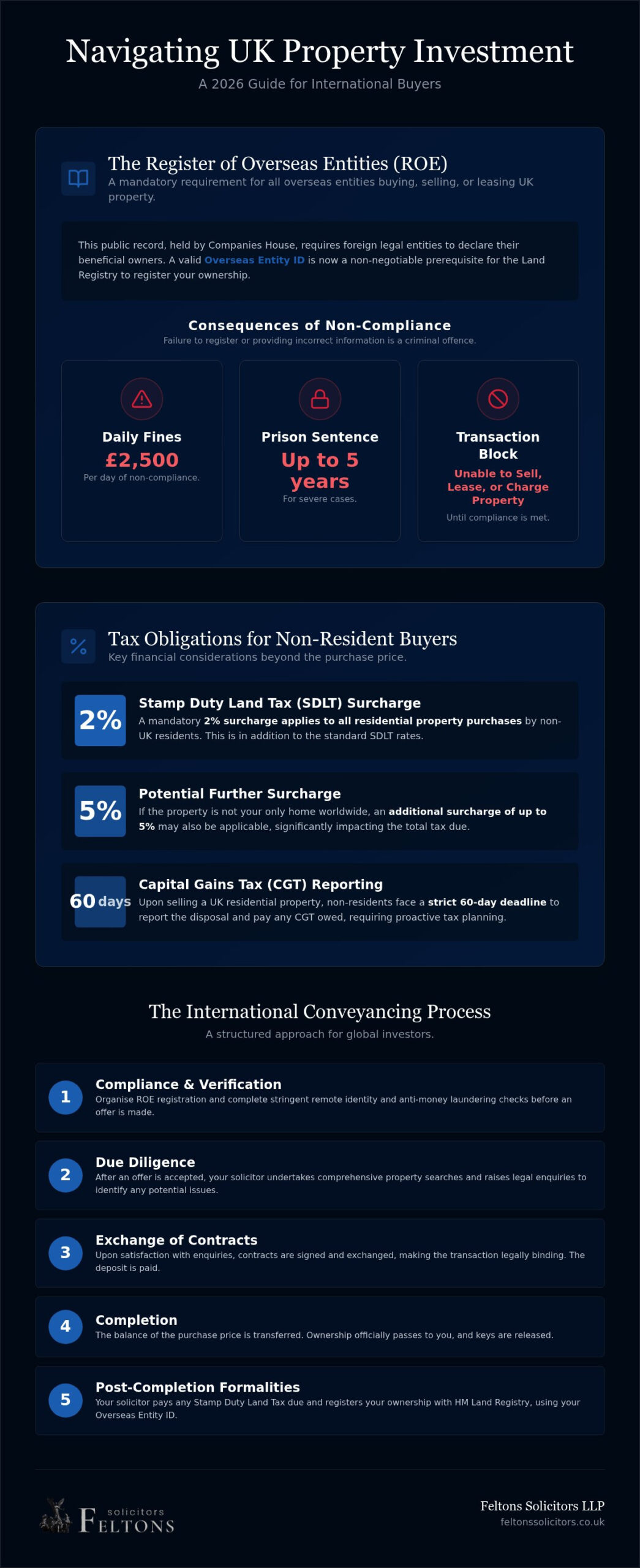
Managing the conveyancing process from abroad requires a solicitor who acts as a steady, local presence. In 2026, non-resident buyers face a mandatory 2% Stamp Duty Land Tax (SDLT) surcharge on residential purchases, which applies in addition to standard rates. If the property isn’t your only home worldwide, a further 5% surcharge may also apply. These financial implications, combined with the strict 60-day reporting deadline for Capital Gains Tax on disposals, mean that your legal advisor must be as much a tax and compliance strategist as they are a conveyancer. We’ve moved past the era of “standard” transactions; every international purchase now requires a bespoke, detail-oriented approach to ensure your investment remains secure and compliant.
Understanding the Register of Overseas Entities (ROE)
The Register of Overseas Entities is a mandatory public record held by Companies House that requires foreign legal entities to identify their beneficial owners before they can buy, sell, or lease property in the UK. This isn’t a mere administrative hurdle. It’s a critical legal requirement that dictates whether a transaction can actually proceed to completion. For those seeking solicitors for international property buyers, the focus has shifted from simple title searches to complex corporate verification. Without a valid Overseas Entity ID, the Land Registry will simply refuse to register your ownership, effectively stalling your investment indefinitely.
The role of a UK-regulated agent is central to this process. You can’t simply self-certify your ownership structure. A solicitor or qualified professional must verify the information before it’s submitted to Companies House. This verification must be based on reliable, independent evidence. If the information is found to be incorrect or if you fail to register, the consequences are severe. Non-compliance is a criminal offence. You could face daily fines of up to £2,500 or even a prison sentence of up to five years. Perhaps more importantly for investors, you’ll be legally restricted from selling, leasing, or charging the property until your status is regularised.
Who Qualifies as a Beneficial Owner?
A beneficial owner is typically any individual or legal entity that holds more than 25% of the shares or voting rights. This also includes anyone who has the right to appoint or remove a majority of the board of directors. Complex trust structures and nominee arrangements require a methodical approach to peel back the layers of control. It’s not a one-time obligation. You’re required to provide annual updates to Companies House to maintain your ROE ID. Failure to file an update within 14 days of the anniversary of your registration results in an immediate breach of the law.
The Verification Process for Overseas Entities
Verification is evidence-based and exceptionally rigorous. Solicitors must review original documents, including passports, corporate registers, and trust deeds, to satisfy the 2026 transparency standards. It’s sensible to start this process long before you’ve even identified a specific property. Delays in verification are one of the most common reasons for transactions to collapse in the final stages. If you’re navigating this for the first time, you can read our detailed guide on overseas entity beneficial owner registration to prepare your documentation. Ensuring your corporate structure is transparent is the first step toward a seamless acquisition. If you need assistance with these complex filings, our team can help you register an overseas entity with the necessary precision and discretion.
Residential vs. Commercial: Legal Considerations for Investors
Acquiring a luxury apartment in Mayfair requires a vastly different legal strategy than purchasing a logistics hub in the Midlands. Whilst both transactions demand meticulous title checks, the regulatory and tax hurdles vary significantly between the two sectors. Choosing solicitors for international property buyers who can pivot between these distinct legal landscapes is vital for a secure investment. High-value residential acquisitions often hinge on personal lifestyle requirements and long-term capital growth. Conversely, commercial units are driven by lease yields, tenant covenants, and VAT efficiency. Your legal partner must possess the versatility to handle both the personal nuances of a home and the technical rigour of a business asset.
Residential Investment: Surcharges and Leasehold Risks
Non-UK residents must account for the mandatory 2% Stamp Duty Land Tax (SDLT) surcharge on residential purchases in England. This is not a negotiable fee. It applies in addition to standard SDLT rates. If the property is an additional dwelling, such as a second home or a buy-to-let investment, a further 5% surcharge applies. This can bring the total tax burden to a significant level, making early tax planning essential. Beyond the initial purchase price, the UK’s leasehold system presents unique challenges for those unfamiliar with it. Many apartments are sold with diminishing lease terms that can eventually affect the property’s value and mortgageability.
Engaging leasehold enfranchisement experts is often necessary to extend these terms or even purchase the freehold. Managing ground rent issues and service charge disputes from abroad is notoriously difficult. A specialized residential property law firm will ensure that the lease terms are fair and sustainable before you commit your capital. They act as your eyes and ears on the ground, identifying hidden liabilities that could disrupt your long-term plans.
Commercial Property: Leases and Business Structures
Commercial acquisitions frequently involve Full Repairing and Insuring (FRI) leases. This structure typically places the entire burden of maintenance, repairs, and building insurance on the tenant. This is attractive for landlords seeking a “hands-off” investment, but it requires precise legal drafting to avoid future litigation over dilapidations. VAT is another critical factor. Many commercial properties are “opted to tax,” meaning a 20% VAT charge applies to the purchase price unless the transaction qualifies as a Transfer of a Going Concern (TOGC). Investors must also decide whether to hold the asset through a UK Special Purpose Vehicle (SPV) or an overseas company. Whilst an SPV can simplify local financing, an overseas entity triggers the mandatory ROE requirements mentioned earlier. Each structure has distinct tax and reporting implications that require careful, expert consideration.
The International Conveyancing Process Step-by-Step
Purchasing a property in the UK from several thousand miles away requires a structured roadmap. Whilst the core principles of land law remain constant, the logistical execution for overseas investors involves specific digital hurdles and stringent verification phases. Professional solicitors for international property buyers act as your primary coordinator, ensuring that the distance doesn’t lead to delays or missed deadlines. In 2026, the average conveyancing timeline ranges between 12 and 20 weeks, though chain-free transactions can often be completed in 8 to 12 weeks with proactive management.
The process begins with initial instruction and the opening of your file. This is immediately followed by a comprehensive review of the legal pack and title deeds. Your solicitor will negotiate the contract terms and raise specific enquiries regarding the property’s history, planning permissions, and any potential liabilities. Once satisfied, you’ll move to the “Exchange of Contracts.” At this stage, a deposit, typically 10% of the purchase price, is paid, and the transaction becomes legally binding. Completion follows shortly after, involving the transfer of the remaining funds, the submission of Stamp Duty Land Tax (SDLT) returns, and the final application to the Land Registry to record your ownership.
Remote Verification and Digital Onboarding
Modern legal practice has embraced digitalisation to facilitate remote acquisitions. Solicitors now utilise secure biometric ID applications to verify your identity without requiring a physical meeting. These apps scan your passport’s NFC chip and use facial recognition to satisfy UK anti-money laundering regulations. Whilst digital signatures are increasingly common for initial documents, some Land Registry filings in 2026 still require “wet ink” signatures on specific deeds. You’ll also need to provide detailed proof of funds. UK banking regulations are exceptionally strict; you must be prepared to show a clear trail of how your investment capital was accumulated, often spanning several months of bank statements.
Managing the Transaction Timeline
Coordinating a purchase across different time zones requires a methodical approach. Delays often occur when communicating with surveyors, lenders, or estate agents who operate on UK business hours. To mitigate this, many international buyers grant a limited Power of Attorney to their solicitor or a trusted UK representative. This allows legal documents to be signed on your behalf, ensuring the “Exchange” and “Completion” phases aren’t stalled by international courier delays. If you’re ready to begin your acquisition, our team provides expert residential and commercial conveyancing services tailored to the needs of global investors.
Why International Buyers Choose Feltons Solicitors
Selecting the right solicitors for international property buyers involves more than finding a firm to process a deed. It requires a partnership with a legal team that understands the weight of your investment and the complexities of your position as a global investor. Whilst many high-volume firms treat conveyancing as a factory-style process, Feltons Solicitors LLP operates with a boutique philosophy. Since 2010, we’ve positioned ourselves as a steady, dependable presence for clients navigating the UK’s intricate property laws. We prioritise personal connection and high-end reliability, ensuring that your transaction is handled with the quiet confidence and discretion it deserves.
Our approach bridges the gap between traditional professional integrity and modern, forward-thinking methodology. We understand that for an overseas investor, the technical legal work is only one part of the equation; the human impact and the need for clear, reassuring guidance are equally paramount. Whether you’re acquiring a high-value residence or managing a commercial portfolio, our role is to act as your sophisticated guide through the regulatory landscape of 2026. We provide holistic support that extends beyond the immediate purchase, offering expert estate planning to ensure your UK assets are protected for future generations.
A Trusted Advisor for Complex Transactions
We provide a partner-led service, meaning your case is never passed down to junior staff or automated systems. An experienced solicitor oversees every detail of your transaction, providing the sound judgment necessary for complex, high-value matters. This is particularly vital when dealing with the Registration of Overseas Entities or navigating contentious property disputes. Our expertise in both residential and commercial sectors allows us to manage sophisticated portfolios with a level of individualized attention that high-volume firms simply cannot match. We value privacy and personal rapport, acting as a discreet partner for high-net-worth individuals and corporate entities alike.
National Reach with a Personal Touch
Feltons operates on a national scale, yet our service remains deeply rooted in a people-first philosophy. We’ve developed a communication rhythm that respects your schedule, regardless of your time zone. You’ll never feel like just another file number; instead, you’ll have a dedicated advisor who provides regular, methodical updates. This steady flow of information is designed to make you feel informed and supported, turning a potentially stressful international purchase into a seamless, controlled experience. By combining worldly experience with a commitment to clear, “plain English” advice, we ensure that you remain in capable hands from the initial instruction to the final registration of your title.
Securing Your UK Property Investment in 2026
The UK property market remains a premier destination for global capital, but the legal landscape in 2026 demands a higher level of transparency than ever before. Successfully navigating the Register of Overseas Entities and managing non-resident tax surcharges requires more than just a standard conveyancing service. It requires a partner who understands the nuances of cross-border transactions and the importance of meticulous compliance. By prioritising early verification and digital onboarding, you can ensure that your acquisition proceeds without the risk of daily fines or criminal liability.
Feltons Solicitors LLP has been a trusted advisor for global investors since 2010. We specialise in the Registration of Overseas Entities, providing a boutique, partner-led service that prioritises your personal objectives. Our firm offers the sophisticated guidance necessary for high-value transactions whilst maintaining the discreet, tailored care you expect. If you’re looking for dedicated solicitors for international property buyers to safeguard your UK interests, we’re here to provide a steady and calm presence throughout the process. Contact Feltons Solicitors for expert international property advice and take the first step towards a seamless, compliant acquisition.
Frequently Asked Questions
Do I need to be in the UK to buy property as an international buyer?
No, you don’t need to be physically present in the UK to complete a property purchase. Modern solicitors for international property buyers use biometric ID applications and secure digital portals to manage the entire process remotely. You can also grant a limited Power of Attorney to your legal representative, allowing them to sign specific deeds on your behalf so that completion isn’t delayed by international courier times.
What is the Register of Overseas Entities and does it apply to me?
The Register of Overseas Entities is a mandatory record held by Companies House for foreign companies or legal structures that own UK land. It applies to you if you’re purchasing property through an overseas entity rather than in your personal name. You must identify your beneficial owners and have this information verified by a UK-regulated agent before the Land Registry will record your ownership of the property.
Are there extra taxes for non-residents buying property in the UK?
Yes, non-residents are subject to a mandatory 2% Stamp Duty Land Tax (SDLT) surcharge on residential purchases in England and Northern Ireland. If the property isn’t your only home worldwide, an additional 5% surcharge for additional dwellings typically applies. You should also account for the Non-Resident Landlord Scheme, which involves a 20% withholding tax on rental income unless you’re approved to receive gross payments.
How do solicitors verify proof of funds for overseas clients?
Solicitors verify funds by reviewing an audited trail of your capital’s origin, which usually requires at least six months of bank statements. You’ll need to provide clear evidence of the source of your wealth, such as property sale completion statements, inheritance documents, or dividend vouchers. UK anti-money laundering regulations are exceptionally rigorous, so providing a transparent paper trail is the best way to avoid transaction delays.
Can an overseas company own UK residential property?
An overseas company can own UK residential property, but this triggers specific regulatory and tax obligations. Beyond the mandatory Register of Overseas Entities filing, companies owning dwellings valued at over £500,000 are subject to the Annual Tax on Enveloped Dwellings (ATED). For the 2025/26 period, these annual charges ranged from £4,400 to £287,600 depending on the specific value of the property.
How long does the UK conveyancing process take for international buyers?
The average conveyancing process for international buyers in 2026 takes between 12 and 20 weeks. If the property is chain-free and your documentation is prepared in advance, this timeline can be reduced to 8-12 weeks. Working with experienced solicitors for international property buyers helps to manage the logistical challenges of different time zones and complex overseas corporate searches that often slow down standard transactions.
What happens if I fail to register my overseas entity with Companies House?
Failure to register or update an overseas entity is a criminal offence that carries severe penalties. You could face daily fines of up to £2,500 and prison sentences of up to five years for serious non-compliance. Most importantly for investors, you’ll be legally restricted from selling, leasing, or charging the property, as the Land Registry will block any dealings involving an unregistered entity.
Can I get a UK mortgage as a non-resident?
You can obtain a UK mortgage as a non-resident, though you’ll likely need to approach specialist lenders or private banks. These lenders typically require a higher deposit, often 25% or more of the purchase price, and may charge higher interest rates than for UK residents. Your solicitor will work closely with the lender to satisfy their specific international due diligence and identity verification requirements.