

Could an unresolved ownership detail complicate a UK property transaction? For an overseas entity, registration is more than a Companies House filing: it can affect the steps involved in buying, selling or holding UK property. A search for “register of overseas entities solicitors” may reflect a need to understand whether an entity falls within the regime and what its ownership structure must disclose.
It’s understandable to feel uncertain when information needs to be gathered across different jurisdictions, particularly if a property transaction is under way. This article explains the Register of Overseas Entities, the responsibilities it places on an overseas entity and the practical preparation registration may involve.
You’ll also learn how legal advice can connect registration with the wider property matter, so related steps are considered in context. Feltons Solicitors LLP provides registration of overseas entities alongside residential and commercial conveyancing, with pragmatic advice for national and international clients.
Key Takeaways
- Learn why an overseas entity’s connection with UK land or property may bring it within the Register of Overseas Entities regime.
- See the main stages of registration, from assessing the entity’s circumstances to organising information and maintaining its records.
- Understand how legal advice, verification and filing are distinct parts of the process, and why it helps to clarify responsibilities.
- Prepare for a more focused discussion by mapping the ownership structure and identifying who can provide relevant information.
- Explore how register of overseas entities solicitors london can help connect registration advice with the wider property matter.
What is the Register of Overseas Entities and who may need to use it?
If an overseas entity owns, buys or otherwise has a relevant connection with UK land or property, establish whether the Register of Overseas Entities rules apply before a transaction progresses. The answer depends on the entity’s legal form, its ownership and control, and the nature and location of its property activity. An organisation’s everyday description may not match how it is treated under the legislation, so it is important to assess the legal structure and the property circumstances together.
The Register of Overseas Entities is a Companies House register created to make information about overseas entities holding UK property, and the people who own or control them, more transparent. It is administered by Companies House, the UK’s registrar of companies. The register distinguishes the legal entity associated with property from the people or organisations behind its ownership and control.
What does the Register of Overseas Entities record?
An overseas entity is a legal entity governed by the law of a country or territory outside the UK. A company incorporated abroad is one example, although the precise classification depends on the entity’s legal status under the law that created it.
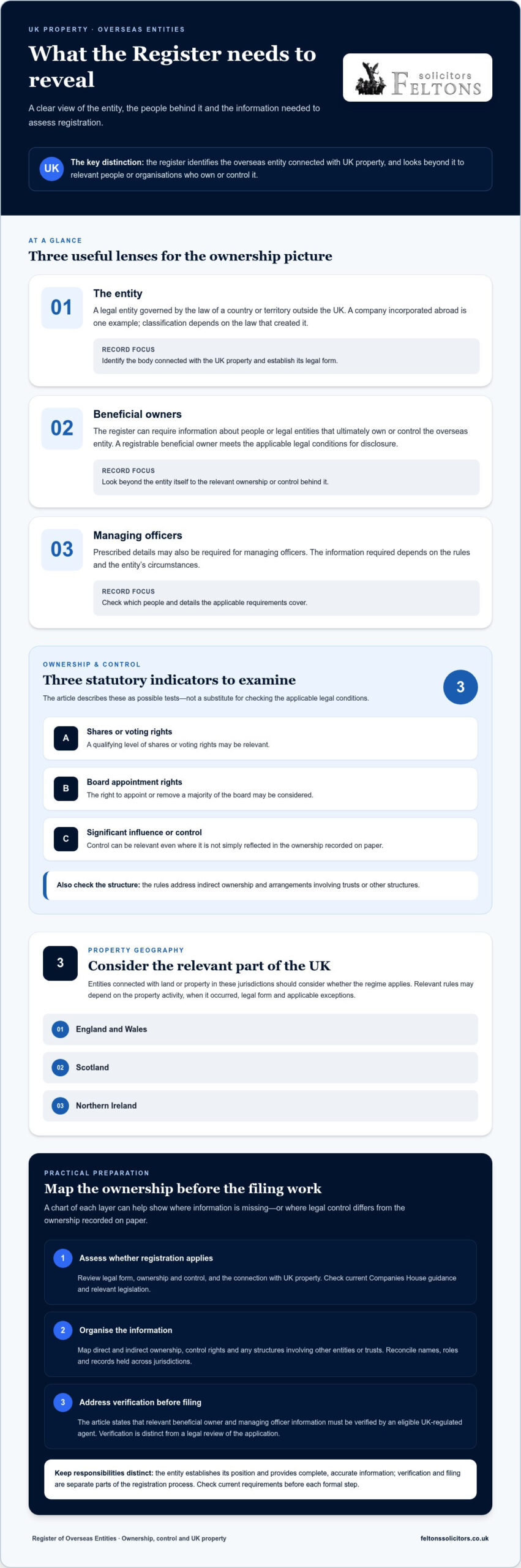
The register records prescribed details about the entity and information relating to its beneficial owners or managing officers, as required by the rules. A beneficial owner is, in broad terms, a person or legal entity that ultimately owns or controls the overseas entity. Statutory tests can include holding a qualifying level of shares or voting rights, having the right to appoint or remove a majority of its board, or exercising significant influence or control. Specific rules also address indirect ownership and arrangements involving trusts or other structures.
A registrable beneficial owner is someone who meets the applicable legal conditions for disclosure under the regime. The entity’s details identify the body connected with the UK property; beneficial ownership information looks beyond that body to relevant ownership or control. The two are related, but they are not interchangeable. Reviewing the structure carefully is particularly important where ownership passes through several companies or jurisdictions. A chart showing each layer can help reveal where information is missing or where legal control differs from the ownership recorded on paper.
Which overseas entities should consider their position?
Overseas entities connected with land or property in England and Wales, Scotland or Northern Ireland should consider whether the regime applies to their circumstances. The relevant rules can depend on factors such as the property activity, when it occurred, the entity’s legal form and any applicable exceptions. A foreign company’s name on property paperwork alone may not resolve every question about its reporting obligations.
Before drawing a conclusion, compare the entity’s circumstances with current Companies House guidance and the rules for the relevant part of the UK. The overseas entity beneficial owner registration guide offers further context on how ownership information connects with UK property. For advice specific to the entity, consider its legal structure, property activity and any planned transaction as one set of connected facts.
How does overseas entity registration work, from preparation to Companies House?
Registration is easier to manage when the entity first establishes what the rules require, then gathers information in a structured way. The precise filing route and evidence depend on the entity’s circumstances, so treat this as an overview rather than a substitute for current Companies House guidance. Keep a record of decisions and check the applicable requirements before each formal step. In practice, this means separating the questions of whether registration applies, what information must be disclosed, who verifies it and who submits and maintains the filing.
Accurate ownership information helps Companies House assess who ultimately owns or controls the entity and whether the application meets the regime’s requirements.
- Assess whether registration applies. Review the entity’s legal form, ownership and control, and its connection with UK property. The entity is responsible for establishing its position. Check current Companies House guidance and relevant legislation, including any rules or exceptions that may apply to the particular facts.
- Organise the entity and ownership information. Identify the details required about the overseas entity, its beneficial owners and, where relevant, managing officers. Map direct and indirect ownership, control rights and structures involving other entities or trusts. The entity is responsible for providing complete and accurate information. Where records are held across different jurisdictions, coordination may be needed to reconcile names, roles and ownership details.
- Address verification before filing. Current rules require relevant information about beneficial owners and managing officers to be verified by an eligible UK-regulated agent before registration. The applicable rules set who can act, the necessary supervision and authorisation, and the timing of verification. Check those requirements against current Companies House guidance. Verification is a distinct compliance function, not simply a legal review of the application.
- Submit and maintain the register details. The overseas entity must make the required application to Companies House, following the current filing process and requirements. After registration, it must meet the applicable update obligations, including filing an annual update statement even if there has been no change. The entity remains responsible for keeping its information accurate and meeting deadlines; confirm the current filing window and process with Companies House.
What information may be needed for an application?
Expect to organise information about the entity’s identity and legal form, its ownership and control, and relevant officers. The precise information and supporting material depend on the structure and the rules that apply. Where records are held in different jurisdictions, allow time to resolve differences in names, dates or ownership records. A useful first step is to compare the information held by the entity with records from each ownership layer, then note any gaps or inconsistencies. Don’t assume a generic document checklist will fit every entity; confirm current requirements before gathering or submitting evidence.
What role can a solicitor or verification agent play?
Legal advice can help clarify how the regime relates to the entity’s ownership and property circumstances, and identify issues that may need attention before an application. Verification is a separate formal role governed by eligibility and authorisation requirements. Filing is another distinct step, and responsibility for the application and ongoing compliance remains with the overseas entity. The roles may be handled by different parties. Feltons provides registration of overseas entities and conveyancing advice, helping clients consider the registration process alongside the property matter. You can discuss your registration and property circumstances with Feltons.
How should you assess legal support for overseas entity registration?
Useful legal support should make clear which parts of the matter require legal analysis, which involve formal verification and who is responsible for filing. These functions are related, but they aren’t automatically carried out by the same provider. Before work begins, establish the scope of advice, the information the entity will need to provide and how registration fits alongside any property transaction. This gives the entity a practical way to understand the work involved and its own continuing responsibilities.
A layered ownership structure doesn’t make registration impossible. It may mean that the people or entities behind the overseas entity need to be identified through several levels of ownership or control. Records held in different jurisdictions can add practical work, especially if information needs to be reconciled. Careful analysis helps build an accurate picture without treating complexity as a reason to assume something is wrong. It can also identify questions that need to be resolved before information is prepared for filing.
Why can ownership structures make the matter more involved?
For example, an overseas entity may be owned by another company, which is itself controlled by individuals or a further entity. The assessment needs to follow the relevant ownership and control through the structure, rather than stop at the first company named. Overseas records and differences in how entities are organised can affect how information is gathered. The aim is to understand and report the relevant facts accurately under the applicable rules.
| Question | Why it matters | What legal support can address |
|---|---|---|
| What does the structure show? | Indirect ownership or control can make it less obvious who may be reportable. | Analyse the structure and identify points that need clarification. |
| Who is responsible for verification? | Verification is a formal role subject to current eligibility and authorisation requirements. | Explain how the verification step fits the process and clarify responsibilities without assuming every legal adviser can perform it. |
| Who will submit and maintain the information? | Filing and ongoing compliance are distinct from advice and verification. | Clarify the filing arrangements and the entity’s continuing responsibilities under current Companies House guidance. |
How does registration relate to a property transaction?
Registration status may be relevant when an overseas entity deals with UK land or property. The effect depends on the circumstances and current legal requirements, so don’t assume a registration issue will have the same consequence in every transaction. Where a purchase, sale or other property matter is planned, considering registration alongside the conveyancing work can bring related questions into view. For example, the entity can identify how its ownership structure relates to the transaction and whether its registration position needs attention as part of the wider matter. The residential property law guide provides wider context on property matters.
Feltons Solicitors provides registration of overseas entities alongside residential and commercial conveyancing. This makes it possible to consider registration in the context of the property matter, with advice tailored to the entity’s circumstances. Focus on how ownership analysis, verification arrangements and property work relate, while keeping each party’s role distinct.
What practical steps can an overseas entity take before seeking registration advice?
A little preparation can make an initial discussion more focused. You don’t need to resolve every legal question or assemble a definitive set of documents first. Start by organising what the entity knows, noting what remains uncertain and identifying who can help clarify the information. This avoids spending time trying to make incomplete records look consistent before their significance has been considered.
Use this checklist as a way to prepare for advice, not as a complete list of application documents or filing requirements:
- Map ownership and control. Draw a clear outline from the overseas entity through any intermediate companies or other arrangements to the people or entities who may ultimately own or control it. Note where ownership and control differ.
- Identify information holders. Record who can explain the entity’s structure and who holds relevant company or ownership records, including contacts in other jurisdictions. This helps show where information may need to be requested.
- Compare key details. Check whether the entity’s name and other identifying details appear consistently across the records available to you. Flag spelling differences, incomplete information or changes in structure rather than trying to resolve their legal significance yourself.
- Note changes and gaps. Record changes in ownership or control and any parts of the structure you can’t yet explain. A simple note of what is known, what is uncertain and who may be able to clarify it can help guide the legal review.
- Keep sensitive information secure. Avoid sharing personal or confidential ownership details in public or unsecured channels. Organise the information privately and discuss an appropriate way to provide it as part of the legal process.
How can an entity organise its ownership information?
A simple structure chart can be a useful starting point. Show each ownership layer, the relationship between the parties and any known control rights, then annotate unclear points for discussion. If a record uses a different name or describes a structure differently, preserve the original detail and note the discrepancy. Don’t assume it is a minor issue or alter records to make them match; let a solicitor consider what the difference means under the applicable rules. This gives the legal review a clearer basis and helps distinguish confirmed information from points that still need investigation.
What should be considered alongside a property matter?
Registration and conveyancing are related when an overseas entity has a UK property matter, but they remain distinct legal tasks. Give your adviser a concise outline of the transaction and its current stage so registration questions can be considered in context. Useful details to note include:
- Whether the matter concerns a purchase, sale or another property transaction.
- The UK property involved and the entity’s connection to it.
- Any key steps already taken and decisions still to be made.
- Known timing considerations, without assuming these replace applicable filing requirements.
This context can help shape a tailored discussion of the entity’s registration position and the related property work. The overseas entity registration and beneficial ownership guide offers further background on the link between ownership information and UK property.
Feltons provides registration of overseas entities alongside residential and commercial conveyancing. A focused discussion can consider both the entity’s registration circumstances and the connected property matter, with a pragmatic approach tailored to the facts.
How can Feltons Solicitors support an overseas entity property matter?
An overseas entity’s registration and its UK property plans are closely connected, but each matter has its own legal considerations. Feltons Solicitors provides registration of overseas entities alongside residential and commercial conveyancing. The entity can discuss registration in the context of its wider property circumstances, rather than treating the register as an isolated administrative issue.
The right advice depends on the facts. An entity with a straightforward ownership structure and no active transaction may have different questions from one preparing to buy or sell property through several layers of ownership. Understanding both the entity and its property plans helps shape a practical discussion about what needs attention and which issues should be considered together.
What does a tailored legal approach bring to the matter?
Feltons takes a bespoke, pragmatic approach, helping clients consider their particular circumstances with clear, measured guidance. That may mean looking at how the entity’s structure relates to its UK property interests, or considering registration questions alongside conveyancing work. Advice is tailored to the matter, without assuming every entity’s requirements or transaction will be the same.
Feltons combines modern delivery with traditional values. The firm serves national and international clients, bringing a discreet, considered approach to matters that may involve information and interests across borders. Clear communication can help keep the legal issues understandable, especially where ownership arrangements or property plans raise questions that need careful analysis. It doesn’t remove the need to meet applicable requirements, but it can help the entity understand the issues and decisions in front of it.
When assessing legal support, consider whether the advice will address both the registration question and its relationship to the property matter. Registration, verification and filing are distinct functions, and their responsibilities should be understood clearly. Feltons provides registration and conveyancing services, while the precise steps and responsibilities in any case depend on the entity’s circumstances and current requirements.
What is a sensible next step?
To begin a focused conversation, outline the entity’s ownership structure as you currently understand it and note any areas that remain unclear. Add a brief description of the UK property matter, such as whether it involves a purchase, sale or another conveyancing issue, and where it stands. You don’t need to settle every point before seeking advice. A clear account of what is known, what needs clarification and how the property plans fit together is a helpful starting point.
Feltons can discuss the entity’s registration circumstances and any connected residential or commercial conveyancing needs. Discuss your overseas entity property matter with Feltons.
Take the next step with clarity
Before moving forward, consider what decision the entity needs to make and how its UK property plans shape that decision. A clear account of the ownership structure, any points that need clarification and the transaction’s current position can help make the first legal discussion focused and useful. You don’t need to have every answer before seeking guidance.
If you’re looking for register of overseas entities solicitors london, discuss the specific registration questions alongside any connected property requirements. Feltons can provide tailored legal advice on overseas entity registration and related conveyancing, with an approach shaped around your circumstances.
Discuss your overseas entity property matter with Feltons and take the next step with considered support.
Frequently Asked Questions
What is the Register of Overseas Entities?
It’s a Companies House register recording information about overseas entities and relevant beneficial ownership connected with UK land or property. Its purpose is to improve transparency about who owns or controls an entity. The information required depends on the entity and applicable rules. For example, a structure involving several companies may need closer analysis than a single overseas company. Use current official guidance, and seek legal advice if the ownership picture is complex.
Does an overseas entity need to register before dealing with UK property?
Not every property situation can be answered with a simple yes or no. Requirements depend on the entity’s relationship with the land, the type of dealing and the rules that apply. Before committing to a transaction, identify the property and proposed activity, then check current Companies House and land registration requirements. Legal advice can help assess the entity and transaction together.
Who can verify information for the Register of Overseas Entities?
Only a person who meets the verification requirements in force for the application may perform the formal verification role. Those rules can specify who is permitted to act and what authorisation is required, so check current Companies House guidance for the relevant filing. A solicitor may advise on the entity’s legal position without acting as its verification agent. Clarify each person’s role before relying on a verification statement in an application.
What information is needed to register an overseas entity?
An application may call for information about the overseas entity and people connected with its ownership or management. The details and supporting evidence depend on the entity’s structure and the current rules, so a general checklist can’t establish exactly what your case requires. As a practical first step, compare the entity’s records, map who owns or controls it, and note gaps or inconsistent details for legal review before preparing an application.
Can a solicitor help with both overseas entity registration and a property transaction?
Yes. Legal support can consider registration questions alongside a related property matter, although registration and conveyancing remain separate tasks with distinct requirements. Feltons Solicitors provides registration of overseas entities and residential and commercial conveyancing. For instance, if an entity is preparing for a property purchase, advice can take account of both the registration issue and the conveyancing context. The appropriate work depends on the entity’s circumstances and the rules that apply.
What happens if an overseas entity’s ownership information changes?
A change in ownership or control may affect the information the entity must keep current on the register. Keep a dated record of what changed, when it took effect and which records reflect the new position. Then check the current Companies House requirements promptly, rather than assuming the change can wait until a property transaction concludes. If a sale or purchase is also under way, raise the change as part of the legal discussion.
Is the Register of Overseas Entities the same as registering a company in the UK?
No. The Register of Overseas Entities concerns overseas entities with a relevant connection to UK land or property; it isn’t the process for incorporating a new UK company. An organisation might have separate company-law or registration obligations depending on its activities and legal status. For example, creating a UK subsidiary doesn’t by itself answer whether an overseas parent has responsibilities under the overseas entities regime. Assess each entity and obligation separately.