

Buying a freehold share in a block of flats: what to consider

Buying a freehold share in a block of flats: what to consider

Buying a block’s freehold together can give leaseholders greater influence over the building, but it also means sharing decisions and ongoing responsibilities. If you’re researching “buying freehold share of block flats”, the key question is not only whether the freehold can be purchased, but whether enough leaseholders are willing to take it on together.

It is easy to focus on the potential benefits, such as having more say in how the building is managed. A collective purchase also involves coordinating participating flat owners, agreeing a valuation and following the legal process. The group needs to decide how the freehold will be owned and administered afterwards. A share of freehold does not automatically replace your flat’s lease.

This guide explains how collective enfranchisement works, how it differs from the Right to Manage, and what to investigate before committing. You’ll learn about eligibility, the purchase and legal checks, shared costs and the responsibilities that continue after completion, so you can assess whether buying together is the right route for your block.

Key Takeaways

  • Buying freehold share of block flats gives participating leaseholders collective ownership of the building’s freehold, but each flat will usually remain leasehold.
  • Check the building and participating owners against current collective enfranchisement eligibility rules before taking formal steps.
  • Compare collective enfranchisement with the Right to Manage: one involves buying the freehold, whilst the other transfers management functions.
  • Review the title, leases, building obligations and proposed ownership structure to understand what the group would take on.
  • Understand how the valuation, legal process and ongoing decisions could affect each participant before making commitments.

Buying a freehold share in a block of flats: what does it mean?

Buying a building’s freehold collectively means participating leaseholders acquire the freehold title to the building together, rather than each buying their individual flat outright. The flat owners may hold an interest in the freehold directly or through an ownership structure, such as a company. The structure affects how decisions are made, so review the title and relevant company or ownership documents before agreeing to participate.

A flat will usually remain leasehold after the purchase. Its lease continues to set out rights and obligations, including provisions about contributions to building costs. Becoming a freehold shareholder does not, by itself, cancel the lease or make the flat freehold. A search for “buying freehold share of block flats” is therefore about two connected interests: the lease to an individual flat and a shared interest in the building’s freehold.

What does a share of freehold actually give a flat owner?

A share is not ownership of the entire building. It represents a stake in the arrangement that owns the freehold, with the rights set out in that arrangement. For example, if a company owns the freehold, a flat owner might hold a share in that company. The company, rather than each shareholder individually, would hold the registered freehold title.

The amount of influence an owner has depends on the title and the structure’s rules. The company’s articles of association, membership arrangements and decision-making procedures can determine how votes are counted and who can act for the freeholder. If the freehold is held another way, the legal documents will set out how the owners exercise their rights. Read these documents together. A share alone does not explain who can approve work, make decisions or deal with the building’s obligations.

How does collective enfranchisement differ from buying one flat?

Collective enfranchisement is the legal route through which participating leaseholders act together to acquire the building’s freehold. The process concerns the shared freehold purchase, rather than the transfer of one person’s flat. What is collective enfranchisement? provides a useful introductory description of this collective route.

By contrast, an ordinary flat conveyance transfers one flat from a seller to a buyer, along with the lease and its terms. It does not, by itself, transfer the building’s freehold or give the buyer a stake in it. A collective purchase requires participating owners to consider how they will acquire and hold the freehold together, as well as how their individual leases will operate afterwards.

This distinction is central to residential property law: the title to the flat and the title to the building are separate interests, even when they are connected through the same owner. The article Navigating Residential Property Law: A Comprehensive Guide for UK Homeowners explores the wider property context. Before proceeding, examine the proposed ownership structure and the documents that govern it, rather than relying on the informal phrase “share of freehold”.

How does collective enfranchisement work, and who may take part?

Collective enfranchisement is a formal process, not simply an agreement between neighbours to buy the freehold. In England and Wales, eligibility depends on the participating leaseholders and the building meeting statutory criteria. Assess those requirements before committing to a purchase or serving a notice. A block does not qualify simply because several owners are interested.

What should leaseholders establish before starting?

Start by establishing the facts about the building and the people involved. Identify who wants to participate, agree how the group will share information and make decisions, and gather the leases, title information and details of the building’s use and layout. These materials help assess which statutory criteria apply and identify issues that may affect the proposed purchase.

Agreeing how to make decisions early can prevent uncertainty later. Owners may have different views about the valuation, ownership structure or costs of proceeding. A professional valuation can help the group understand the basis of the proposed premium, whilst legal advice can assess eligibility, the transaction structure and the effect of the documents. Although “buying freehold share of block flats” sounds informal, statutory eligibility and notice requirements need careful assessment.

What are the main stages of the purchase?

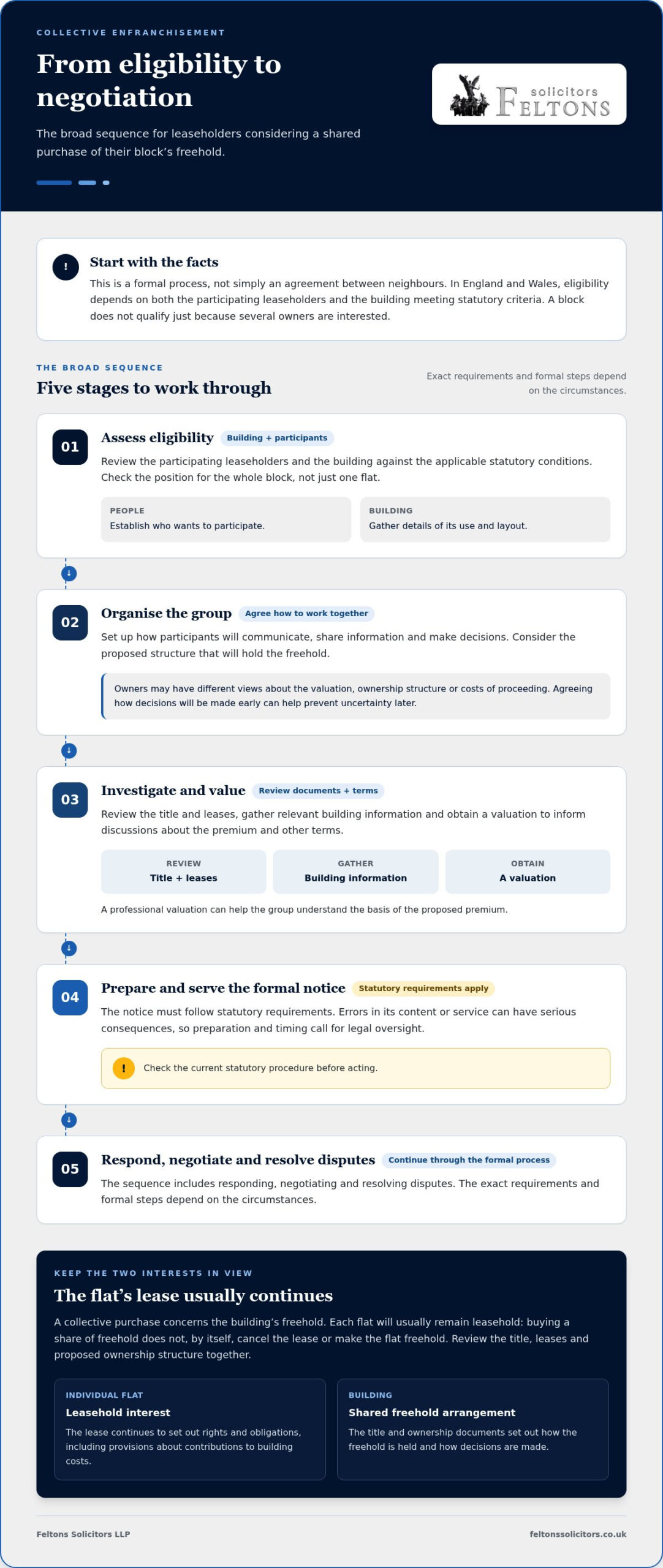
The broad sequence is as follows. The exact requirements and formal steps depend on the circumstances, so check the current statutory procedure before acting.

  1. Assess eligibility. Review the participating leaseholders and the building against the applicable statutory conditions. Check the position for the whole block, not just one flat.
  2. Organise the group. Establish how participants will communicate, make decisions and arrange the proposed purchase. Consider the ownership structure that will hold the freehold.
  3. Investigate and value. Review the title and leases, gather relevant building information and obtain a valuation to inform discussions about the premium and other terms.
  4. Prepare and serve the formal notice. The notice must follow statutory requirements. Errors in its content or service can have serious consequences, so its preparation and timing call for legal oversight.
  5. Respond, negotiate and resolve disputes. The freeholder’s response may lead to discussions about the price or terms. Formal deadlines apply, and disputed matters may require a determination through the relevant legal process.
  6. Complete the purchase. Once the terms are settled, the parties proceed to transfer the freehold and register the resulting ownership arrangements.

Completion settles the purchase, but it does not determine how the building will be managed day to day. The group must also understand how the freehold will be held and how future decisions and obligations will be handled. Feltons’ leasehold enfranchisement and conveyancing services can help participants understand the transaction and its continuing implications.

Is buying the freehold better than right to manage?

Neither route is automatically better. Collective enfranchisement means participating leaseholders buy the building’s freehold. The Right to Manage (RTM) gives qualifying leaseholders a route to take over specified management functions without buying the title. The routes address different priorities, and their eligibility rules and legal consequences depend on the building and jurisdiction. In England and Wales, assess the current requirements for each before deciding.

ConsiderationCollective enfranchisementRight to Manage
OwnershipThe participating leaseholders acquire the building’s freehold, directly or through an ownership structure.The freeholder retains the freehold title; leaseholders do not acquire ownership through RTM.
Management controlThe new freehold owners can influence how the freehold is administered, subject to the leases and ownership structure.The RTM company takes on management functions covered by the statutory route, without buying the freehold.
ResponsibilitiesThe group must consider freehold ownership, decision-making and the building’s continuing obligations.The RTM company takes responsibility for the management functions it assumes, while leasehold obligations remain relevant.
May suit owners who…Want to acquire a stake in the freehold and are prepared to organise shared ownership and decisions.Want greater involvement in management but do not want to purchase the freehold.

When might buying the freehold suit the group?

Consider enfranchisement if owners want the freehold itself, perhaps to have a collective role in decisions about the building’s future and how the freehold is held. The group should also be prepared for the practical work of shared governance: agreeing how decisions are made, keeping ownership arrangements workable and addressing responsibilities that continue after completion.

Lease extensions may also form part of the group’s aims, but acquiring the freehold does not automatically change every flat’s lease. The legal position and any steps needed for an extension require separate consideration. Do not assume the purchase will increase a flat’s value, make it easier to sell or reduce future costs. Those outcomes depend on the circumstances and the documents in place.

When might right to manage be worth comparing?

RTM may be relevant where the priority is taking responsibility for building management, rather than acquiring the freehold title. The freeholder remains the owner, and the flat leases continue to matter. The group should understand which management functions would transfer and what taking them on would involve, alongside the statutory eligibility and procedure.

Compare both options against the same practical questions: what does the group want to control, who will make decisions, what ongoing work can participants take on, and are lease extensions or freehold ownership central objectives? A considered comparison of buying freehold share of block flats with RTM should account for the group’s long-term governance, not just the initial transaction. Legal advice on the relevant route can help clarify how it applies to the building.
Buying a freehold share in a block of flats: what to consider

What should you check before buying a freehold share?

Look beyond the proposed purchase terms. A freehold share connects the transaction to the building’s legal title, existing leases and the arrangements owners will rely on afterwards. Before committing, make sure the group understands both what it is acquiring and how it will handle the responsibilities that come with it.

Which documents and building matters deserve attention?

Use this checklist to organise the initial review:

  • Freehold title: Review the title register and plan to understand what land and parts of the building are included, who owns them and whether rights or restrictions affect the property.
  • Flat leases: Compare the leases for provisions on repairs, insurance, service charges, access and other shared obligations. Note differences that could affect how costs or responsibilities are allocated.
  • Ownership documents: If a company is to own the freehold, examine its constitutional documents, share or membership arrangements and decision-making rules. These documents explain who can act for the company and how owners exercise their rights.
  • Building records: Review available management records, planned or outstanding repairs, maintenance arrangements and any current disputes. These can reveal issues the group needs to address when setting future priorities.
  • Insurance: Establish how the building is insured now and how cover will be arranged and administered after completion, including who is responsible for keeping relevant records.
  • Valuation and process: Understand the valuation assumptions, the information used and how the proposed premium and terms have been assessed. Clarify the legal steps, responsibilities and commitments involved before the group proceeds.

The freehold title shows what is being acquired, while company documents explain how the owners can exercise their rights and make decisions. Reviewing one without the other may leave the group with an incomplete picture of its legal position. A solicitor can consider the title, leases and proposed structure together, and explain how they relate to the transaction.

How can the group prepare for shared responsibilities?

Shared ownership works best when practical arrangements are settled before a repair or disagreement brings them into focus. Decide how owners will raise issues, share information and record decisions. Agree who will maintain records, handle routine administration and communicate with leaseholders who are not participating in the purchase. Taking over the freehold also brings direct responsibility for building safety and communal upkeep, where property compliance and facilities specialists such as Sentric can assist with fire safety, electrical testing and ongoing maintenance requirements.

The group should also establish how contributions towards building obligations will be agreed and collected, and what process will apply if owners disagree about a repair, insurance matter or proposed work. When building works or alterations involve shared boundaries and party structures, consulting specialists such as Christopher Anthony Surveyors can ensure statutory party wall procedures are properly addressed. Do not rely on informal assumptions: the leases, ownership structure and agreed procedures need to fit together. These are useful issues to explore through leasehold enfranchisement guidance as you prepare for the purchase.

Before making commitments, have the proposed structure, documents and valuation reviewed as a connected whole. Explore Feltons’ collective freehold purchase services for support with leasehold enfranchisement and conveyancing.

How can a solicitor help with buying a freehold share?

A solicitor can help the group understand the legal transaction as a whole, from the proposed ownership structure to the obligations that continue after completion. This is particularly valuable where several leaseholders need to coordinate decisions, review shared documents and agree how the freehold will be held. Advice should be specific to the building, the participating owners and the law applying to the claim.

What legal support may cover during the transaction

At the outset, a solicitor can examine the freehold title, leases and relevant ownership documents, then explain how they affect the proposed purchase. They can help assess the group’s legal position and the structure for acquiring the freehold, identify issues that need attention, and clarify the rights and responsibilities involved. This gives leaseholders a clearer basis for making decisions before taking formal steps.

As the matter progresses, legal support may include preparing and serving statutory notices, managing responses, advising on negotiations and reviewing the terms of the transfer. The solicitor can also coordinate the legal work required for contracts and completion, keeping the group informed about decisions and documents needed along the way. Statutory procedures and deadlines need careful attention, and the precise steps depend on the facts and current law.

Legal advice should also look beyond completion. The group needs to understand how the freehold will be administered, how the ownership documents affect decision-making and how existing lease obligations fit with the new arrangements. This helps leaseholders consider the transaction and its ongoing implications together, rather than treating completion as the end of the matter.

Feltons’ conveyancing and leasehold enfranchisement work addresses the legal and transactional aspects of a collective freehold purchase. The firm takes a bespoke, pragmatic approach, with advice shaped around the group’s documents, proposed structure and circumstances.

Deciding on your next step

Before proceeding, bring the key questions together: does the proposed structure make sense, have you compared collective enfranchisement with other routes, and do participating owners understand the building’s obligations and future governance? For leaseholders considering buying freehold share of block flats, resolving these points early can clarify the decision-making process and help the group understand what it is undertaking.

A discussion tailored to the building can clarify the legal process, the documents to review and the next decisions for participating owners. Feltons can help you consider the transaction and its continuing implications. Discuss your freehold purchase with Feltons.

Make your next move with confidence

Before your neighbours commit, turn the shared interest into a clear plan. Agree what the group hopes to achieve, what decisions still need to be made and how each owner can take part. For anyone considering buying freehold share of block flats, an early legal discussion can help bring the building’s documents, proposed ownership structure and group priorities into focus.

Feltons offers tailored support in conveyancing and leasehold enfranchisement, with a bespoke, pragmatic approach to the transaction and its longer-term implications. Home visits are available at clients’ convenience, which can help the group discuss complex property matters in a setting that works for them.

Your circumstances are specific to your building and the owners involved. A considered conversation can help you identify the right questions and decide what to do next. Discuss your freehold purchase with Feltons, and take the next step with greater clarity.

Frequently Asked Questions

Is buying a share of freehold the same as owning my flat freehold?

No. A share in the building’s freehold does not turn the flat itself into a freehold property. The flat is generally transferred under its lease, while the freehold interest is held separately, either directly or through an ownership structure. Before purchase or sale, have the title register, lease and any company records considered together. This helps establish exactly what rights attach to the flat and what interest accompanies it.

Can one flat owner buy the freehold of a whole block alone?

Collective enfranchisement is generally a route for qualifying leaseholders to act together, rather than one owner simply acquiring the whole block’s freehold through that process. For anyone considering buying freehold share of block flats, distinguish a group claim from a separate private arrangement. Eligibility depends on current rules and the building’s circumstances, so seek tailored legal advice before assuming an individual or group qualifies.

Do you still have a lease after buying a share of freehold?

Usually, yes. Acquiring an interest in the freehold does not automatically cancel the lease for your flat. The lease remains relevant to matters such as the extent of the flat, rights over shared areas and obligations set out in its terms. For example, do not assume that holding a freehold share lets you alter a lease provision informally. Check the lease and ownership documents before agreeing any change.

Can you extend your lease after buying a share of freehold?

A share of freehold does not itself extend your flat’s lease. There may be ways to address the lease term, but the appropriate process depends on the lease, how the freehold is held and the rules that apply. Before agreeing an extension or variation, establish who has authority to act for the freeholder and what formal documents are needed. Legal advice can help clarify the route and its implications.

What happens if the freehold owners disagree about building decisions?

Disagreement can complicate decisions, but the applicable process depends on the ownership arrangement and its governing documents. If a company holds the freehold, its articles and decision-making rules may be relevant; the leases may also affect the issue. Keep a written record of proposals, responses and agreed actions. If a dispute concerns owners’ rights or obligations, seek advice before taking steps that could affect the building or other leaseholders.

Can a flat with a share of freehold still be sold?

Yes, a flat can generally be sold, but transferring the lease and the associated freehold interest may involve separate requirements. For example, where a company owns the freehold, its documents may set out how a departing owner’s share or membership is dealt with. Conveyancing should identify what passes to the buyer and what records or steps are needed, so the transfer reflects the property’s actual legal structure.


Freehold Purchase Solicitors: A Definitive Guide to Securing Your Property Rights in 2026

Freehold Purchase Solicitors: A Definitive Guide to Securing Your Property Rights in 2026

Why should you continue paying for the ground beneath your feet when the law now offers a clearer path to total ownership? It’s a question many leaseholders face as they watch ground rents climb and feel the weight of a shortening lease impact their property’s saleability. We understand that managing a leasehold can feel like an endless cycle of rising costs and limited control over your own home.

Engaging expert freehold purchase solicitors is no longer just a legal formality; it’s a strategic move to reclaim control over your building and eliminate the burden of marriage value costs forever. You deserve the peace of mind that comes with full land ownership and the significant market value increase it brings. We’ll show you how to navigate these complexities whilst protecting your investment for the long term.

This guide explores the nuances of collective enfranchisement and the latest 2026 regulatory reforms. We’ll walk through the essential steps to secure your property’s future, ensuring you have the knowledge to move forward with confidence and professional clarity.

Key Takeaways

  • Understand why transitioning from leasehold to freehold is a vital move for your property’s market value and long-term autonomy in 2026.
  • Learn the essential differences between individual house purchases and collective enfranchisement for flats to identify the right legal path for your home.
  • Discover how specialist freehold purchase solicitors help you calculate the purchase premium and navigate the valuation process to ensure a fair price.
  • Master the statutory timeline from serving initial notices to managing landlord counter-notices without unnecessary delays or disputes.
  • Identify the specific criteria for selecting a legal partner who combines modern efficiency with a deep understanding of complex leasehold law.

Understanding Freehold Purchase: Why Transitioning from Leasehold is a Strategic Move

Owning a leasehold property is fundamentally different from owning the land itself. Whilst you have the right to occupy the space for a set period, you remain a tenant in the eyes of the law. Transitioning to a freehold interest changes this dynamic entirely, moving you from a position of restricted occupancy to absolute ownership. Experienced freehold purchase solicitors help facilitate this shift, ensuring the legal title to the land and the building is transferred securely into your hands.

The property landscape changed significantly in 2026. Government reforms have targeted the most punitive aspects of leasehold, such as escalating ground rents that previously rendered many flats unsellable. These changes make the path to freehold acquisition more transparent and financially viable than ever before. By acting now, you can lock in the benefits of these reforms and protect your home from future legislative shifts that might favour landlords.

The Long-Term Financial Impact of Leasehold Restrictions

Ground rent clauses are a primary concern for modern homeowners. Many older leases contain “doubling” clauses that see ground rent swell every decade, often exceeding the thresholds set by mortgage lenders. This makes remortgaging or selling nearly impossible without a formal lease extension or a freehold purchase. Marriage value represents the increase in the property’s total value following the merger of the leasehold and freehold interests, which must be shared with the landlord if the lease has fewer than 80 years remaining. Beyond this, landlords retain a “reversionary interest,” meaning they technically regain full possession of the property once the lease expires. Securing the freehold eliminates this leverage, ensuring your asset remains yours indefinitely.

Autonomy and Building Management

Buying your freehold allows you to adopt a “landlord mindset.” You’re no longer at the mercy of a third-party freeholder or an unresponsive management company. Through the process of Collective Enfranchisement, you and your neighbours can take over the building’s management. This provides the freedom to choose your own contractors, select competitive insurance providers, and ensure maintenance is carried out to your standards rather than the cheapest bidder’s.

The administrative benefits are equally compelling. Leaseholders often face exorbitant fees for “licences to alter” or permissions for simple lifestyle choices, such as keeping a pet. Freehold ownership removes these bureaucratic hurdles. Working with freehold purchase solicitors ensures these restrictive covenants are properly addressed during the transfer, providing you with true autonomy over your living space and eliminating unnecessary service charge disputes.

The route to owning your freehold depends largely on the architecture of your home. It’s not a one-size-fits-all process. For owners of houses, the path is often a solo journey, whilst flat owners must act in unison with their neighbours. Understanding these distinctions is the first step in any successful claim. Expert freehold purchase solicitors can help you determine your building’s eligibility, particularly concerning the “25% rule.” This rule dictates that if more than a quarter of the building’s internal floor area is used for non-residential purposes, such as shops or offices, the building may not qualify for statutory purchase. For the most recent updates on these thresholds, the UK Government’s Leasehold Toolkit provides a comprehensive overview of how 2024 reforms have refined these criteria.

Buying the Freehold of a House

If you own a leasehold house, your rights are primarily governed by the Leasehold Reform Act 1967. The process is generally more straightforward than for flats, but it isn’t without complexity. You no longer need to worry about the restrictive two-year residency rules that once hampered claims, as recent reforms have largely abolished these requirements for most leaseholders. One common pitfall occurs when a house is part of a “managed estate.” In these instances, you might secure the freehold of the building but remain tied to estate management charges for shared gardens or private roads. It’s vital to have your residential conveyancing documents reviewed early to understand exactly what land is included in the transfer.

Collective Enfranchisement for Flat Owners

For those in blocks of flats, the process is known as Collective Enfranchisement. It’s a powerful statutory right that allows at least 50% of the qualifying tenants to join forces and buy the freehold. This requires high levels of coordination amongst residents. You’ll typically need to set up a “Nominee Purchaser” company to hold the title on behalf of the participating residents. This company becomes the new landlord, giving you direct control over the building’s future. If you’re dealing with a “missing landlord” who cannot be found, don’t lose hope. Your freehold purchase solicitors can apply for a Vesting Order through the County Court, allowing the sale to proceed even in the landlord’s absence.

Finally, keep a close eye on any “Section 5” notices. If your landlord decides to sell the freehold to a third party, they’re legally required to offer it to the tenants first under the Right of First Refusal. This is often a golden opportunity to bypass a long statutory claim and secure your rights quickly.

Buying your freehold is a strategic capital investment that fundamentally alters your property’s financial profile. The most significant cost you’ll encounter is the “Purchase Premium,” which represents the compensation paid to the landlord for the loss of their asset and future income streams. It’s standard practice that the buyer also covers the freeholder’s reasonable legal and valuation costs. Whilst this may feel like an additional burden, it’s a statutory requirement that ensures the process remains orderly. Despite these initial outlays, the investment often pays for itself through a substantial increase in property equity and the total elimination of future ground rent liabilities.

The Valuation Process: How the Price is Determined

A specialist surveyor is indispensable for establishing a fair purchase price. They calculate the “diminution in value” of the landlord’s interest and the capitalised value of the ground rent income they’ll be losing. The remaining lease term is the most critical factor in this equation. If your lease has dropped below the 80-year threshold, the cost increases because “marriage value” must be shared with the landlord. This valuation framework was formalised by the Leasehold Reform Act 1967, which provides the legal basis for these calculations. A robust, evidence-based valuation acts as your primary defence against landlord over-pricing and ensures negotiations begin from a position of strength.

Additional Costs and Disbursements

Beyond the premium, you must budget for essential disbursements and taxes. Stamp Duty Land Tax (SDLT) is a key consideration for any freehold acquisition. As of April 1, 2025, SDLT in England is charged in slices: 0% on the first £125,000, 2% on the portion between £125,001 and £250,000, and 5% on the portion up to £925,000. You’ve only 14 days from the date of completion to file your return and pay any tax due. You’ll also need to account for Land Registry fees and the administrative costs associated with forming a Nominee Purchaser company for collective claims. Engaging specialist freehold purchase solicitors ensures that you are shielded from inheriting hidden leasehold liabilities or onerous title defects that could compromise your future ownership.

Ultimately, the financial benefits of securing your freehold extend far beyond simple ground rent savings. Properties with a share of freehold or full freehold title are significantly more attractive to lenders and future buyers, often commanding a premium on the open market. By removing the landlord’s leverage, you’re not just buying land; you’re securing the long-term saleability of your home.

Freehold Purchase Solicitors: A Definitive Guide to Securing Your Property Rights in 2026

The Step-by-Step Statutory Process: From Initial Notice to Final Completion

Navigating a freehold claim requires a methodical approach, especially as the 2024 and 2025 legislative updates have introduced more rigid procedural timelines. Engaging freehold purchase solicitors at the outset ensures that every statutory deadline is met, shielding you from the risk of your claim being deemed withdrawn. The process is a chronological sequence of legal triggers that, when managed correctly, leads to a seamless transfer of ownership.

Preparation and Initial Notices

Accuracy is the cornerstone of the Initial Notice. Whether you’re serving a Section 13 notice for a block of flats or a Section 5 notice for a house, the information must be beyond reproach. This includes verifying the title numbers, current lease details, and the full names of all participating leaseholders. An invalid notice can lead to significant delays and cost penalties. It’s also vital to set a realistic “proposed price” in the formal notice. Whilst you’ll want a favourable deal, an absurdly low offer can be interpreted as a failure to serve a valid notice, potentially stalling the process for months.

Negotiation and Completion

Once the notice is served, the landlord typically has two months to respond with a Counter-Notice. This is where disputes often arise, usually concerning the purchase premium or the specific rights included in the transfer. If a deadlock occurs, the matter may be referred to the First-tier Tribunal (Property Chamber) for an independent determination. However, most cases are settled through professional negotiation between surveyors and solicitors before a hearing becomes necessary.

The final stage is the conveyancing phase. This involves drafting the TR1 form to transfer the legal title and ensuring the funds are ready for completion. Following the transfer, your freehold purchase solicitors will manage the final registration at HM Land Registry. This step is crucial as it officially dissolves the old leasehold titles and registers the new freehold interest, providing you with the ultimate security of tenure. If you’re ready to begin this journey, our team at Feltons offers expert leasehold enfranchisement advice to guide you through each statutory milestone.

Selecting the Right Freehold Purchase Solicitors for Your Transaction

Selecting freehold purchase solicitors is a decision that extends beyond mere administrative support. This is a technical area of law where a single procedural error can invalidate a claim and cost thousands in wasted legal fees. Specialist expertise is non-negotiable because the statutory timelines are rigid and the valuation arguments are often highly nuanced. You need a partner who understands the intricacies of the Leasehold Reform Act and the practical realities of property management.

At Feltons, our approach combines modern efficiency with traditional professional integrity. We recognise that for many, buying the freehold is a once-in-a-lifetime strategic move to secure an asset. Meticulous due diligence is the foundation of our service, ensuring that your new title is free from restrictive covenants or hidden liabilities that could hamper future saleability. We treat every instruction with a boutique level of care, prioritising personal connection over high-volume processing.

The Boutique Advantage: Tailored Legal Support

We purposefully avoid the “conveyancing factory” model. Complex enfranchisement claims require a level of attention that high-volume firms simply cannot provide. You’ll have direct access to senior practitioners who take the time to understand your specific goals for the building. This bespoke approach ensures your property rights are aligned with your broader long-term objectives, such as estate planning and wealth preservation. By integrating these perspectives, we help you build a secure foundation for your legacy whilst resolving your immediate property concerns.

Proactive Dispute Resolution

Managing the interpersonal dynamics of a group of leaseholders is often the most challenging aspect of a collective purchase. We act as a steady, neutral presence, facilitating agreement amongst residents whilst ensuring the legal process remains on track. This coordination is vital when dealing with recalcitrant landlords who may attempt to frustrate the process through silence or complex counter-proposals. Our freehold purchase solicitors are committed to providing pragmatic advice that avoids unnecessary litigation, yet we possess the worldly experience necessary to handle contentious matters should they arise.

Our philosophy is people-first. Whilst the technical legal work is paramount, we never lose sight of the human impact of our work. We guide you through each stage with quiet confidence, ensuring you feel supported and informed throughout the transition from leaseholder to freeholder. Secure your property’s future whilst navigating the process with confidence—contact Feltons Solicitors LLP today.

Securing Your Home’s Future and Absolute Autonomy

Transitioning to freehold ownership is a definitive step towards protecting your property’s market value and gaining total control over your living environment. We’ve explored the importance of navigating the 2026 statutory landscape with precision, from serving accurate initial notices to capitalising on the latest ground rent reforms. Whether you’re pursuing an individual claim for a house or coordinating a collective enfranchisement for a block of flats, the process demands technical rigour and a pragmatic approach to valuation.

Working with dedicated freehold purchase solicitors ensures that every stage of your transaction is handled with the discreet care and professional integrity your investment deserves. Instruct our specialist freehold purchase solicitors to begin your enfranchisement journey today. Our team provides sophisticated, high-standard advice focused on long-term asset protection for property owners nationwide. Taking action now removes the burden of leasehold restrictions and places the future of your home firmly back in your hands.

Frequently Asked Questions

How long does the freehold purchase process typically take?

A standard freehold purchase typically takes between six and twelve months from the service of the initial notice to final completion. This timeline fluctuates based on the landlord’s responsiveness and the complexity of the valuation negotiations. If the matter requires a determination from the First-tier Tribunal regarding the premium, you should expect the process to extend beyond the one-year mark.

Do I need 100% of the flat owners to agree to a collective enfranchisement?

You don’t need every flat owner to participate; the legal requirement is at least 50% of the qualifying tenants. Whilst 100% participation is ideal for sharing costs, the process can proceed as long as half the building is committed. Those who choose not to participate will remain leaseholders, but their new landlord will be the company formed by the participating neighbours.

Can a landlord refuse to sell the freehold if I meet the criteria?

A landlord cannot refuse to sell the freehold if you meet the statutory qualifying criteria under the relevant legislation. This is a mandatory right rather than a discretionary request. The only grounds for a valid refusal are technical, such as the building failing the 25% non-residential floor space rule or the tenants failing to meet the participation thresholds.

What happens to my existing lease once I have bought the freehold?

Your existing lease technically remains in place, but you effectively become your own landlord. Most owners choose to grant themselves a new 999-year lease at a peppercorn ground rent immediately after completion. This merger of interests effectively nullifies the restrictive terms of the old lease whilst providing a clean, highly marketable title for future lenders and buyers.

Is it better to extend my lease or buy the freehold?

Buying the freehold is generally the superior strategic move because it provides absolute autonomy and eliminates ground rent forever. Lease extensions are often a solo endeavour, whereas freehold purchase for flats requires collective action. If you value direct control over building maintenance and service charges, the freehold is the more robust long-term investment for your property asset.

How much are the landlord’s legal fees that I am required to pay?

You are legally required to pay the landlord’s reasonable legal and valuation costs incurred during the statutory process. These costs must be justified and relate specifically to the procedure, such as verifying your right to buy and preparing the transfer. Experienced freehold purchase solicitors will scrutinise these fee notes to ensure you aren’t being overcharged for standard administrative tasks.

Can I buy the freehold if my lease has already dropped below 80 years?

You can still buy the freehold if your lease has dropped below 80 years, but the premium will be higher. This is because marriage value must be included in the purchase price, representing the profit made by merging the leasehold and freehold interests. Acting before the lease hits this critical threshold is vital to avoid significantly higher costs and complex valuation disputes.

What is a “Nominee Purchaser” and why is it required for flats?

A Nominee Purchaser is the legal entity, usually a limited company, formed to hold the freehold title on behalf of the participating tenants. It’s required for flats to ensure the building is managed as a single asset rather than being fragmented amongst individuals. Your freehold purchase solicitors will help you incorporate this company and draft the participation agreements that govern its operation.