

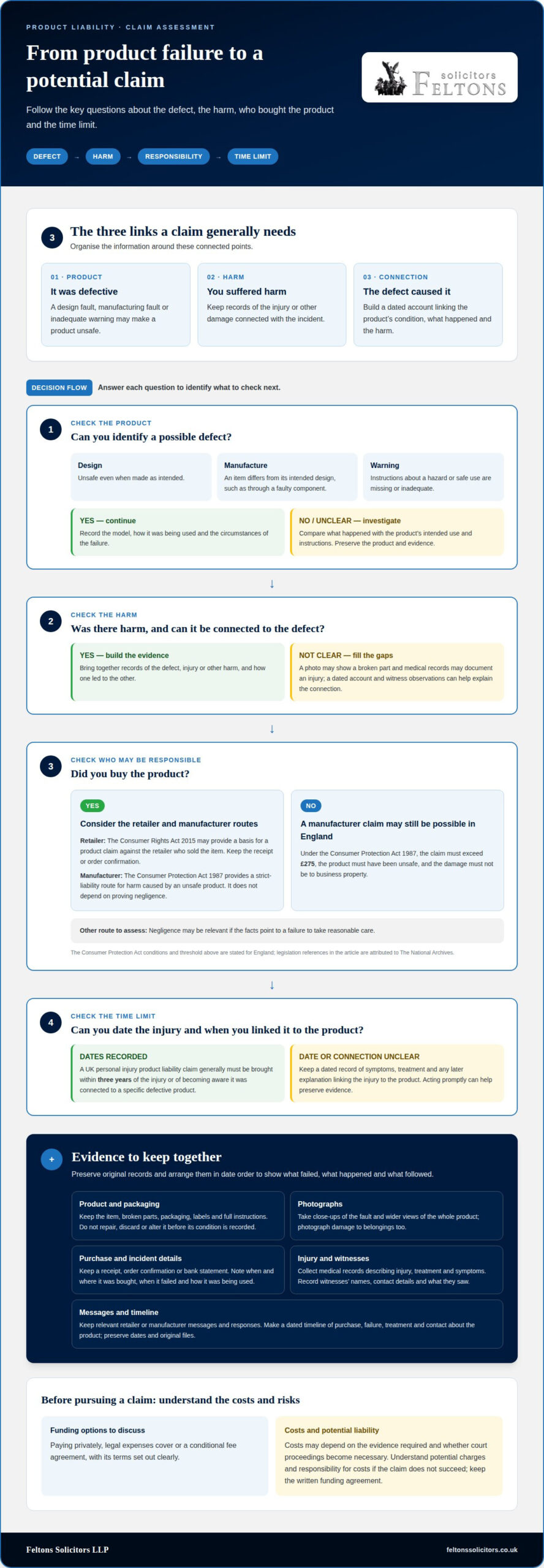
Defective product injury compensation claims may be possible if an unsafe product caused your injury. In the UK, a personal injury claim generally must be brought within three years of the injury or of becoming aware that it was connected to a specific defective product, according to The National Archives. A product may be defective because of its design, manufacture or inadequate warnings about hazards or safe use.
After an injury, it can be difficult to tell whether a product fault caused it and what to do with the product and paperwork. The evidence you preserve can help show what went wrong, how you were injured and who may be responsible.
This guide explains when you may have a claim, what evidence can support it and how liability may depend on the circumstances. It covers product liability, negligence and personal injury claims, as well as the usual steps from an initial letter to negotiations or court proceedings.
Key Takeaways
- Assess whether the product may have been unsafe and who could be responsible for the harm.
- Preserve the product and gather records, photographs and witness details that may support your account.
- Understand how the legal route can depend on whether you bought the product and the type of loss involved.
- Learn how Feltons Solicitors LLP can assist with personal injury claims and what may happen as a claim progresses.
Can I make a product liability claim?
Start by identifying the suspected defect, the businesses connected to the product and the harm it caused. These details can help establish whether you may have a claim and who could be responsible.
-
Identify the type of product defect
Describe what went wrong and compare it with how the product was intended to work. A design defect may make a product unsafe even when manufactured correctly. A manufacturing defect occurs when an individual item differs from its intended design, such as through a faulty component. A warning defect may involve missing or inadequate instructions about a hazard or safe use. Record the product model and the circumstances of the failure.
-
Identify potentially liable manufacturers, importers or suppliers
Trace the product’s route from maker to seller using its packaging, labels, instructions and purchase records. The manufacturer may be liable if an unsafe product caused harm. Importers and suppliers may also help identify responsible businesses and the product’s route into the UK. Keep their names and addresses where available.
In England, a person who did not buy the product may claim compensation from its manufacturer under the Consumer Protection Act 1987 if the claim exceeds £275, the product was unsafe and the damage was not to business property, according to The National Archives (UK legislation). For consumer help in England, contact the Citizens Advice consumer helpline on 0808 223 1133.
-
Check the claim time limit
Note the injury date and when you first connected it to the product. A UK personal injury product liability claim generally must be brought within three years of the injury or of becoming aware that it was connected to a specific defective product, according to The National Archives. Keep a dated record of symptoms, treatment and any later explanation linking the injury to the product. Acting promptly can also help preserve evidence.
-
Review costs, funding options and risks
Before pursuing a claim, establish what the legal work may cost and which funding route applies. Options to discuss include paying privately, using legal expenses cover or entering a conditional fee agreement, with its terms set out clearly. Costs may depend on the evidence required and whether court proceedings become necessary.
Consider the financial risk if the claim does not succeed, including responsibility for costs under the agreed funding terms. Ask for a clear explanation of potential charges and liabilities before authorising work, and keep the written agreement for reference.
Evidence to support a claim
Build a clear record connecting the product, the fault and your injury. A UK claim generally needs evidence that the product was defective, you suffered harm and the defect caused it.
-
Collect evidence to support the claim
Keep the product, packaging, instructions, labels and any broken parts. Don’t repair, discard or alter the product before its condition has been recorded. If keeping it is impractical, take clear photographs from several angles, including close-ups of the defect and wider shots showing the whole product.
Gather proof of purchase, such as a receipt, order confirmation or bank statement. Record when and where you bought the item, when it failed and what happened next. Write down the sequence while details are fresh, including how you were using the product and any visible damage to belongings. Photograph that damage too.
Collect medical records describing your injury, treatment and symptoms. Ask witnesses for their names and contact details, then note what each person saw. Keep relevant messages with the retailer or manufacturer, including reports of the fault and their responses. Store copies together, preserving dates and original files.
-
Establish what must be proved
Organise the evidence around three points: the product was defective, you suffered injury or other harm, and the defect caused that harm. A photograph of a broken component may show its condition, while medical records document an injury. Neither necessarily explains how the failure happened, so link the evidence with a dated account and witness observations.
Compare the product’s condition with its instructions and intended use. Note, for example, whether a part failed during ordinary use or whether a warning about the hazard was missing. Keep the full instructions, as a single page may lack important context. Create a simple timeline covering purchase, failure, medical treatment and any contact about the product.
Presenting these records in order can clarify the connection between defect and injury. For help assessing evidence for an injury claim, you can explore personal injury claims.
Negligence, breach of contract and strict liability
Identify the legal route that best fits your relationship to the product, the fault and the loss. In the UK, a product claim may rely on consumer rights, strict liability or negligence.
- Consider a claim against the retailer under the Consumer Rights Act 2015, which The National Archives (UK legislation) identifies as a basis for a product claim against the retailer that sold the item. This route focuses on the purchase and the retailer’s obligations. Keep the receipt or order confirmation, and describe how the product failed to meet the standard you expected. For example, a newly purchased appliance that stops working because of a faulty component may raise a retailer claim.
- Consider strict liability under the Consumer Protection Act 1987 when an unsafe product caused harm. This route does not depend on proving that the manufacturer was negligent, but the claim still needs evidence of a defect, damage and a connection between them. A manufacturer claim may be relevant even if you were not the buyer. Whether you can include the product’s cost in a compensation claim may depend on the circumstances of the claim.
- Assess negligence if the facts point to a failure to take reasonable care, such as a manufacturer overlooking a safety issue during production. A negligence claim requires proof of negligence, so identify the conduct or omission and how it caused the harm. If you did not buy the product and the claim is below £275, you may claim through negligence for damage caused by it against either the manufacturer or seller. Gather evidence that connects the relevant business, its conduct and the damage.
Separate the product’s purchase cost from other losses when organising your claim. A refund or replacement affects whether you can also claim the item’s cost. The legal basis determines what must be established against the retailer, manufacturer or seller.
Personal injury claims
An injury caused by a product is pursued as a personal injury claim. Set out the physical impact separately from financial losses so each can be assessed clearly.
-
Identify the compensation that can be claimed
List the injury’s effects and resulting costs, including medical expenses and earnings lost because you could not work. Keep bills, appointment records and payslips together, and note how each expense relates to the injury. For example, record travel to treatment separately from a routine journey.
In defective product injury compensation claims, include ongoing needs, such as treatment or support you still require, and explain how the injury affects everyday activities. Someone who did not buy the faulty product may claim for damage and distress, but not the product’s own cost. Keep the product price separate from injury-related losses, especially if you have received a refund or replacement.
-
Calculate the compensation amount
Prepare a schedule of losses listing each expense, its date and the document that supports it. Include lost earnings with records showing income before and after the injury, and distinguish actual losses from future costs. A clear breakdown explains how the injury affected your finances without relying on an unsupported total.
An assessment considers the injury and its effects alongside related financial losses. The nature and duration of symptoms, treatment, recovery and impact on daily life help describe the injury; receipts and employment records support expenses and lost earnings. Compensation for a defective product injury depends on the evidence and consequences, so no single figure applies to every case.
A UK product liability claim may proceed through a letter of claim, compensation negotiations and, if needed, court proceedings where a judge decides compensation. For help pursuing an injury claim, discuss your personal injury claim with a solicitor.
Feltons Solicitors LLP: Personal Injury and Silicosis Claims
Feltons Solicitors LLP handles personal injury claims, including injuries caused by defective products. If you have been hurt and need help understanding a potential claim, the evidence or the compensation process, the firm can assist with the legal aspects.
Share the key details of what happened, the injury and the product involved. Relevant records, including medical documents, photographs and proof of purchase, can help clarify the circumstances and losses claimed. A solicitor can assess how the evidence relates to liability and the next steps in pursuing a claim.
For legal support with a personal injury claim, contact Feltons Solicitors LLP to discuss your situation.
Consider your next step
After an injury, deciding whether to pursue a claim can be difficult while you manage treatment and its effects on daily life. Advice on defective product injury compensation claims can help you understand how the evidence and circumstances relate to your options, and what information may be needed to move forward.
Before speaking to a solicitor, gather the records you have and note any questions about the injury, product or impact on your work and routine. You do not need to resolve every detail before seeking guidance. A focused discussion can clarify the legal issues and practical next steps for your situation.
Feltons Solicitors LLP also assists with divorce and financial arrangements, wills, probate and estate planning, and residential and commercial conveyancing. To discuss an injury claim, contact Feltons Solicitors LLP. Taking a considered next step can help you approach the process with greater clarity.
Frequently Asked Questions
What counts as a defective product under UK law?
A product may be defective if its design, manufacture or warnings make it unsafe. The assessment concerns product safety, not simply whether an item stopped working or disappointed you. For example, a component that breaks during intended use may raise a safety issue, while ordinary wear may not. The product’s instructions, purpose and circumstances of use help explain the difference.
Who can claim compensation for an injury caused by a defective product in the UK?
A person injured by an unsafe product may be able to claim even if they did not buy it. Under the Consumer Protection Act 1987, The National Archives (UK legislation) states that a non-buyer may claim against the manufacturer where the claim exceeds £275, the product was unsafe and the damage was not to business property. The appropriate defendant and legal route depend on the facts.
What evidence is needed to support a defective product injury claim?
Useful evidence includes the product, proof of purchase, photographs of the fault, medical records and witness details. Keep digital records too, such as order confirmations, messages to the retailer and the manufacturer’s response. For example, a dated photograph alongside a treatment record may help establish when the failure happened and when the injury was documented. Preserve original files and keep copies of records.
How do you make a defective product injury claim in England and Wales, Scotland or Northern Ireland?
Start by documenting the incident, seeking medical attention and keeping evidence of the injury and product. A UK product liability claim may then proceed through a letter of claim, compensation negotiations and, if needed, court proceedings where a judge decides compensation. The legal process and rules can differ between England and Wales, Scotland, and Northern Ireland, so take advice relevant to where the claim is brought.
Can a consumer claim under the Consumer Protection Act 1987 as well as the Consumer Rights Act 2015?
These Acts provide different potential routes: the Consumer Protection Act 1987 may support a claim against a manufacturer for harm caused by an unsafe product, while the Consumer Rights Act 2015 may support a claim against the retailer that sold it. The National Archives (UK legislation) identifies the latter as a basis for a retailer claim. Which route applies depends on the product, injury and parties involved.