

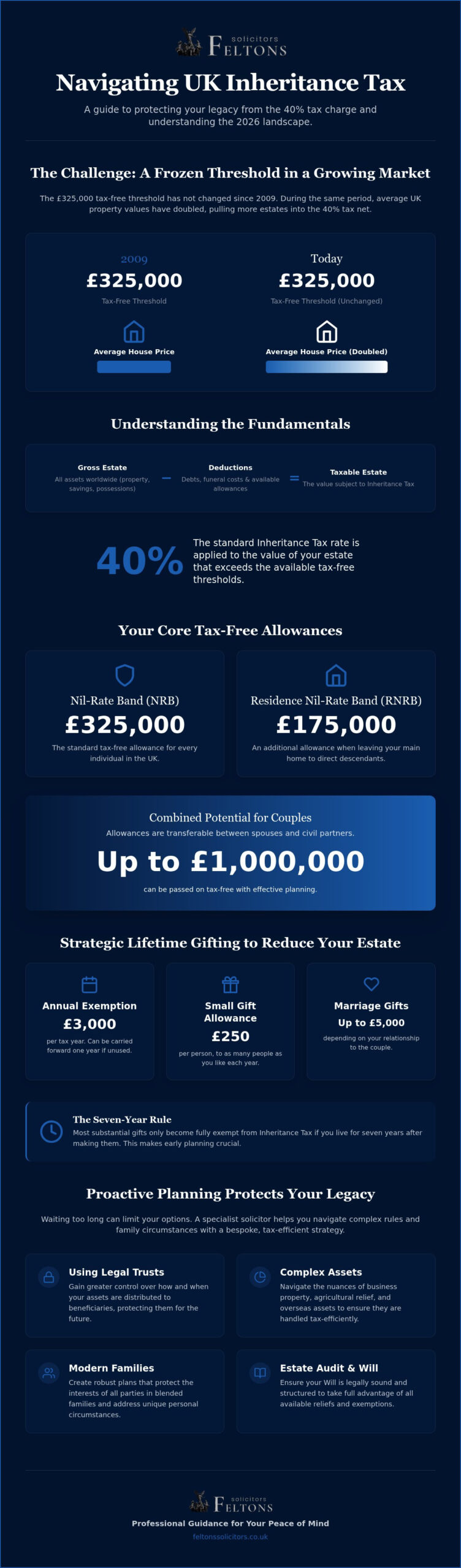
Did you know that the £325,000 inheritance tax threshold has remained unchanged since 2009, even though average UK house prices have doubled in that time? This fiscal drag means more families than ever are facing a 40% charge on their hard-earned assets. It’s natural to feel a sense of unease when considering how complex HMRC rules or life changes like remarriage might impact what you leave behind. Engaging specialist inheritance tax planning solicitors allows you to move past this uncertainty with a clear, professional strategy designed to protect your wealth.
We understand that your legacy is about more than just numbers; it’s about the long-term security of the people you love. You’ll discover how to navigate the 2026 tax landscape to ensure your beneficiaries receive their full entitlement whilst minimising unnecessary liabilities. This guide provides a methodical overview of current thresholds, the new £2.5 million cap on business property relief, and practical steps to ensure your Will is both tax-efficient and robust enough to protect overseas or commercial assets.
Key Takeaways
- Understand how the 40% Inheritance Tax rate applies to your estate and why current thresholds make proactive planning essential for 2026.
- Learn to maximise your tax-free entitlements through strategic use of the spousal exemption and annual gifting allowances.
- Discover how legal trusts can provide you with greater control over the distribution of assets whilst protecting your beneficiaries.
- See how specialised inheritance tax planning solicitors can help you navigate the nuances of overseas property, business assets, and the needs of modern blended families.
- Gain clarity on the estate audit process to ensure your legacy is protected through a bespoke, tax-efficient strategy.
Understanding Inheritance Tax in 2026: The Foundations of Estate Protection
Inheritance Tax (IHT) is the charge levied on the total value of your estate, including your home, savings, and personal possessions, after you pass away. Currently, the standard rate is set at a significant 40% on any value that exceeds your available tax-free thresholds. Whilst this figure may seem daunting, IHT is frequently described as a “voluntary tax” by legal professionals. This is because the UK tax system provides a variety of legitimate exemptions and reliefs that can significantly reduce, or even eliminate, the final bill. By working with experienced inheritance tax planning solicitors, you can ensure these mitigations are applied correctly to your specific circumstances.
Distinguishing between your gross estate and your taxable estate is the starting point for any robust plan. Your gross estate encompasses every asset you own globally; however, your taxable estate is the figure that remains once all debts, funeral expenses, and available allowances are subtracted. For a deeper historical context on Understanding Inheritance Tax in the UK, it is clear that whilst the tax has evolved, the core principle remains a levy on the transfer of wealth between generations.
The Thresholds: Nil-Rate Band and Residence Nil-Rate Band
The primary tool for protecting your legacy is the Nil-Rate Band (NRB), which currently allows every individual to pass on up to £325,000 tax-free. This threshold has been frozen since 2009 and is set to remain at this level until at least April 2031. To complement this, the Residence Nil-Rate Band (RNRB) provides an additional £175,000 allowance if you leave your main home to direct descendants, such as children or grandchildren. For married couples and civil partners, these allowances are fully transferable. This means a couple can effectively shield up to £1 million from the 40% tax rate, provided their estate is structured to utilise both sets of allowances efficiently.
Why Proactive Planning is Essential
The combination of frozen thresholds and rising asset values has created a phenomenon known as “bracket creep.” Since the Nil-Rate Band was first frozen, average UK house prices have approximately doubled, drawing thousands of families into the tax net who previously would have been exempt. Early intervention is the only reliable way to combat this stealth tax. Planning ahead opens doors to more sophisticated strategies, such as structured lifetime gifting or the use of trusts. The seven-year rule dictates that most gifts made during your lifetime only become fully exempt from inheritance tax if you survive for at least seven years after making the transfer. Waiting too long to organise your affairs can limit your options and leave your family with a larger liability than necessary.
Strategic Allowances and Exemptions: Maximising Your Tax-Free Threshold
Building on the basic thresholds discussed previously, the UK tax system offers several specific exemptions that allow you to pass on assets without triggering a tax bill. Understanding how to “stack” these allowances is a core part of the work performed by inheritance tax planning solicitors. The most significant of these is the spousal exemption. Generally, any assets left to a husband, wife, or civil partner who is domiciled in the UK are exempt from IHT, regardless of the value. This allows for the seamless transfer of wealth between partners, ensuring the survivor remains financially secure.
Beyond the spousal exemption, you can utilise various gifting allowances each year to gradually reduce the size of your taxable estate. According to the official government guidance on Inheritance Tax, these allowances are designed to encourage lifetime giving. Key annual exemptions include:
- Annual Exemption: You can give away up to £3,000 worth of assets or cash each tax year. If you don’t use it, you can carry it forward for one year only.
- Small Gift Allowance: You can give as many gifts of up to £250 per person as you wish, provided you haven’t used another exemption on the same individual.
- Gifts in Consideration of Marriage: You can gift up to £5,000 to a child, £2,500 to a grandchild, or £1,000 to any other person for their wedding or civil partnership ceremony.
Proactively using these smaller allowances can have a meaningful cumulative effect over a decade or more. If you’re unsure how these fit into your wider legacy, you might consider our estate planning services to ensure your strategy is fully optimised.
Potentially Exempt Transfers (PETs) and the Seven-Year Rule
When you make a gift that exceeds your annual allowances, it is classified as a Potentially Exempt Transfer (PET). These gifts only become fully tax-free if you survive for seven years after the date of the transfer. If you pass away within this window, the gift is added back into your estate for tax purposes. However, taper relief may apply if you survive at least three years, gradually reducing the tax rate on the gift. It’s vital to avoid a “reservation of benefit.” For instance, gifting your home to your children whilst continuing to live there rent-free will likely result in the property still being treated as part of your estate by HMRC.
Exemptions for Business and Agricultural Property
For those with commercial interests, Business Property Relief (BPR) and Agricultural Property Relief (APR) are indispensable tools. As of 6 April 2026, 100% relief for these assets is capped at a combined total of £2.5 million per person. Any value exceeding this threshold receives 50% relief. This change makes regular reviews essential for business owners and farmers. Ensuring your assets continue to qualify for these reliefs requires precise legal structuring, as even minor changes in how a business is run can affect its eligibility for protection.
The Role of Trusts and Lifetime Giving in Modern Tax Planning
A trust is essentially a legal vehicle that allows you to set aside assets for specific beneficiaries whilst retaining a degree of control over how and when those assets are accessed. Unlike an absolute gift, where the recipient gains immediate and total ownership, a trust involves appointing trustees to manage the property or capital on behalf of your loved ones. This distinction is vital for families who wish to protect assets from potential divorce or bankruptcy, or simply to ensure that younger beneficiaries are mature enough to handle their inheritance. According to A guide to Inheritance Tax, trusts are a cornerstone of effective estate management, though they require precise legal drafting to remain tax-efficient.
Setting up these arrangements involves professional oversight to ensure they comply with current legislation. When considering these options, it’s helpful to view them as part of a broader estate planning strategy tailored to your long-term goals. Our inheritance tax planning solicitors work to ensure that every trust structure is robust, discreet, and aligned with your family’s unique requirements.
Common Trust Structures for IHT Mitigation
Different families require different levels of flexibility. Bare trusts are the most straightforward, often used to hold assets for children until they reach the age of 18. Once the beneficiary reaches this age, they have an absolute right to the capital. Discretionary trusts offer significantly more protection. Here, the trustees have the power to decide which beneficiaries receive payments and when. This is particularly useful for shielding assets from creditors or managing the needs of a “blended” family. Interest in possession trusts are frequently used to provide a surviving spouse with the income from an estate for the remainder of their life, whilst ensuring the underlying capital eventually passes to children from a previous marriage.
Gifting from Excess Income
One of the most powerful yet underutilised tools in the UK tax system is the “Normal Expenditure out of Income” exemption. This allows you to make regular gifts of any size, provided they are made out of your surplus post-tax income and don’t diminish your standard of living. Unlike the seven-year rule for capital gifts, these transfers are immediately exempt from inheritance tax. However, the burden of proof lies with your executors. HMRC requires evidence that the gifts formed a settled pattern of giving. Meticulous record-keeping is essential. You must be able to demonstrate that your remaining income was sufficient to maintain your usual lifestyle. Professional inheritance tax planning solicitors can provide the necessary framework to document these gifts correctly, ensuring they stand up to HMRC scrutiny.
Planning for Complexity: Business Assets, Overseas Property, and Modern Families
Modern family structures often bring layers of emotional and financial complexity that traditional Wills may fail to address. For blended families, the challenge lies in providing for a surviving spouse whilst ensuring that children or step-children from previous relationships receive their intended inheritance. Without precise legal drafting, assets can inadvertently pass away from your chosen beneficiaries. For example, a simple Will leaving everything to a second spouse could result in your own children being disinherited if that spouse later changes their own Will. Our inheritance tax planning solicitors specialise in creating bespoke structures, such as life interest trusts, to balance these competing needs with sensitivity and professional rigour.
Significant life events like divorce also fundamentally alter your tax position. Once a decree absolute is issued, your former spouse is treated as having predeceased you for the purposes of your Will. This change immediately removes the spousal exemption, potentially exposing your entire estate to the 40% tax rate. If you’re currently managing a separation, it’s vital to review your divorce and financial arrangements alongside your estate plan to prevent an unexpected tax burden on your estate.
International Assets and Overseas Entities
If you hold property or investments abroad, your UK domicile status determines whether HMRC taxes your worldwide assets. International estates require a high level of transparency to remain compliant with evolving regulations. This includes the mandatory overseas entity beneficial owner registration for those holding UK property through foreign structures. Our team provides the worldly experience needed to coordinate these complex, cross-border matters, ensuring your global legacy is protected and your reporting obligations are met.
Charitable Giving and the Reduced IHT Rate
Philanthropy offers a meaningful way to support causes you value whilst also providing a tangible financial benefit to your estate. If you choose to leave at least 10% of your net estate to a registered charity, HMRC reduces the Inheritance Tax rate on the remainder of your taxable assets from 40% to 36%. For high-value estates, a charitable legacy can effectively lower the total tax bill whilst simultaneously funding vital work for a cause close to your heart. It’s a pragmatic solution that serves both your community and your family’s financial interests. If your estate involves multiple jurisdictions or complex family dynamics, we invite you to discuss your requirements with our bespoke estate planning team.
Navigating the Planning Process with Feltons Solicitors
Choosing the right legal partner is a decision that carries weight across generations. At Feltons Solicitors LLP, we operate with a people-first philosophy, ensuring that while the technical details of tax law are managed with precision, the human impact of our work remains the priority. We act as a calm, steady presence for our clients, helping you move from a state of uncertainty to one of quiet confidence regarding your family’s future.
The journey begins with a comprehensive initial audit. This methodical review catalogues your current assets, including property, business interests, and savings, whilst identifying your specific legacy objectives. From there, we move into bespoke strategy development. We don’t believe in one-size-fits-all templates. Instead, we craft a plan that balances maximum tax efficiency with the practical, everyday needs of your family. Our inheritance tax planning solicitors ensure that every recommendation is grounded in your unique circumstances, providing a roadmap that is as functional as it is protective.
A Discreet and Professional Partnership
As a boutique firm, we offer a level of discretion and personal connection that larger, high-volume practices often cannot match. We understand that high-net-worth individuals require a tailored approach that respects their privacy. We frequently act as a central coordinator, working alongside your existing wealth managers and accountants to ensure your legal and financial strategies are perfectly aligned. Throughout this process, we maintain a commitment to “plain English” communication. We strip away the dense, archaic legalese to ensure you have a clear, transparent understanding of your position at every stage.
Next Steps: Securing Your Family’s Future
Preparing for your first consultation is a straightforward process. It is helpful to gather a rough schedule of your assets, any existing life insurance policies, and a copy of your current Will. If you don’t have an up-to-date Will, this will be our first priority, as it serves as the essential anchor for any wider tax strategy. Legislation and family circumstances change over time, so we also provide ongoing support to ensure your plan remains robust in the face of future HMRC updates. Taking these steps now provides the peace of mind that comes from knowing your loved ones are protected. You can organise a discreet consultation with our estate planning experts today to begin the process of safeguarding your family legacy.
Securing Your Family’s Financial Future for Generations
Protecting your legacy in 2026 requires a proactive approach that balances technical efficiency with your family’s unique needs. By utilising available thresholds and strategic gifting, you can ensure your assets remain within your family rather than being lost to unnecessary tax liabilities. Whether you’re managing complex international property or navigating the nuances of a blended family, the right legal framework provides lasting peace of mind.
Expert inheritance tax planning solicitors offer more than just technical advice; they serve as a trusted guide through the shifting landscape of HMRC regulations. At Feltons Solicitors LLP, we combine specialist expertise in property law and overseas entities with a discreet, boutique service that values personal rapport. Our pragmatic approach ensures that your estate remains tax-efficient whilst staying adaptable to future changes. Contact Feltons Solicitors for expert inheritance tax planning advice and take the first step towards a more secure, well-organised future for your loved ones.
Frequently Asked Questions
What is the current Inheritance Tax threshold for 2026?
The standard Nil-Rate Band remains at £325,000 for 2026, a figure that has been frozen since 2009 and is set to remain at this level until April 2031. You may also be eligible for the Residence Nil-Rate Band of £175,000 if you leave your main home to direct descendants. Combined, these allowances allow an individual to pass on up to £500,000 tax-free, whilst married couples can potentially shield up to £1 million.
Can I give my house to my children to avoid Inheritance Tax?
You can gift your home to your children, but you must generally move out or pay a full market rent to avoid “Reservation of Benefit” rules. If you continue to live in the property rent-free, HMRC will likely treat the home as part of your taxable estate regardless of the gift. Additionally, you must survive seven years after the transfer for the gift to fall entirely outside your estate for tax purposes.
Do I have to pay Inheritance Tax on assets left to my spouse?
Assets left to a UK-domiciled spouse or civil partner are typically exempt from Inheritance Tax regardless of their total value. This spousal exemption is a fundamental tool used by inheritance tax planning solicitors to ensure the surviving partner remains financially secure. It’s important to remember that this exemption does not apply to cohabiting partners who are not legally married or in a civil partnership.
What is the seven-year rule for gifts in the UK?
The seven-year rule dictates that most lifetime gifts only become fully exempt from Inheritance Tax if the donor survives for at least seven years after the date of the transfer. If death occurs within three years, the gift is taxed at the full 40% rate. Between three and seven years, taper relief may reduce the tax rate on the gift on a sliding scale, provided the gift exceeds the Nil-Rate Band.
How does the Residence Nil-Rate Band work if I sell my home?
If you sell your home or downsize to a smaller property, you may still be able to claim the Residence Nil-Rate Band through “downsizing additions.” This relief ensures that individuals are not penalised for moving into more manageable accommodation or care homes. To qualify, you must have sold your former residence after 8 July 2015 and left assets of equivalent value to your direct descendants in your Will.
Is it possible to reduce the 40% Inheritance Tax rate?
You can reduce the standard 40% Inheritance Tax rate to 36% by leaving at least 10% of your net estate to a registered charity. This reduced rate applies to the remainder of your taxable assets after the charitable donation is made. It’s a pragmatic way to support a cause you value whilst simultaneously lowering the overall tax burden on the inheritance your family receives.
What happens if I die without a Will in place?
Dying without a Will, known as dying intestate, means your estate is distributed according to strict legal rules rather than your personal wishes. This often results in assets passing to relatives in a way that is not tax-efficient, potentially wasting available exemptions. Proactive estate planning ensures your legacy is protected and your family avoids the stress and uncertainty of complex probate and intestacy laws.
Can business owners claim relief on their company assets?
Business owners can often claim Business Property Relief (BPR) to shield their commercial interests from a 40% tax charge. From 6 April 2026, 100% relief is available on the first £2.5 million of combined business and agricultural property per person. Any value exceeding this £2.5 million threshold receives a reduced relief rate of 50%, making regular reviews with inheritance tax planning solicitors essential for high-value enterprises.