
Did you know that failing to update the Register of Overseas Entities can result in daily fines of up to £2,500 or even a prison sentence? For international investors, the British property market remains an attractive prospect, but the legal framework has shifted from simple title deeds to a rigorous regime of transparency and taxation. Understanding uk property law for foreign nationals is no longer just about finding the right postcode; it’s about mastering the dual burden of mandatory registration and non-resident surcharges.
It’s understandable if the sheer volume of modern regulations, from the Economic Crime Act to the 5% additional dwelling surcharge, feels overwhelming. We believe that professional property acquisition should be a calm, methodical process rather than a source of stress. This guide provides the expert legal clarity required to help you manage these complexities with quiet confidence. We’ll examine the rigorous Anti-Money Laundering checks currently in place, explain how to minimise tax liabilities legally, and outline the essential steps for maintaining compliance with Companies House in 2026.
Key Takeaways
- Understand why registering beneficial owners on the Register of Overseas Entities is a mandatory first step for foreign corporate buyers to avoid severe legal penalties.
- Learn how to navigate the 2% non-resident surcharge and the 5% additional dwelling surcharge to accurately calculate your total Stamp Duty Land Tax liability.
- Prepare for the rigorous Anti-Money Laundering (AML) and source of wealth checks that are central to mastering uk property law for foreign nationals.
- Discover the importance of a UK-specific “Situs Will” to protect your property assets and simplify the probate process for your international heirs.
- Gain a clear, methodical roadmap of the conveyancing process to ensure every stage of your investment aligns with the latest 2026 legal requirements.
Understanding Ownership: Can Foreign Nationals Buy UK Property?
The United Kingdom remains one of the most accessible property markets for international investors. Unlike many jurisdictions that impose strict caps or citizenship requirements, British law allows foreign nationals to purchase property regardless of their residency status. This openness is a cornerstone of English land law, which provides a robust and transparent framework for securing assets. However, whilst the door is open, the path is paved with specific regulatory requirements that have evolved significantly. Understanding uk property law for foreign nationals requires a clear grasp of how assets are held and the specific rights attached to different types of tenure.
Individual vs Corporate Ownership
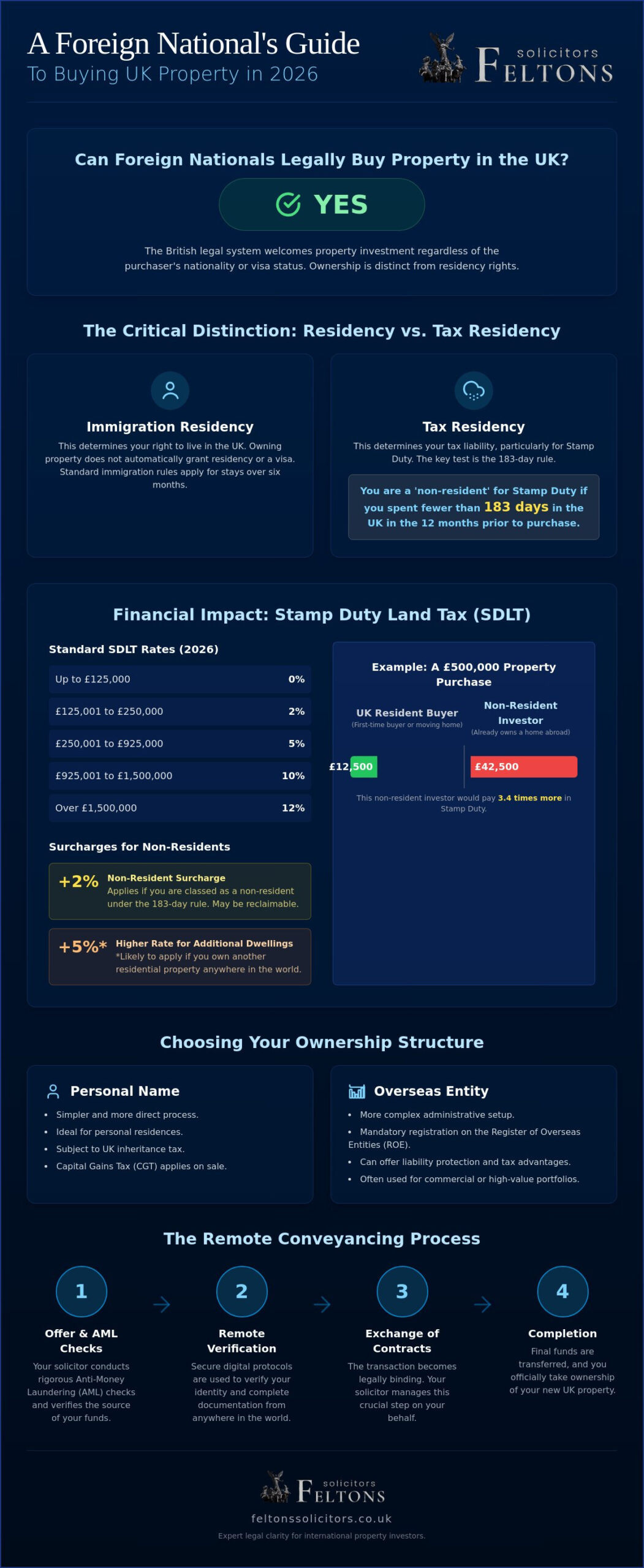
Choosing between purchasing in a personal name or via an overseas corporate entity is a primary decision for any investor. Buying as an individual is often legally simpler. It involves straightforward Anti-Money Laundering (AML) checks and avoids the ongoing filing requirements associated with company structures. It’s a direct route for those seeking a holiday home or a basic buy-to-let investment where simplicity is the priority.
The distinction between freehold and leasehold is a unique aspect of the British system that often surprises international buyers. It’s a fundamental concept that dictates your long-term responsibilities and the property’s eventual value. Most houses are sold as freeholds, whilst apartments are almost exclusively leasehold interests.
- Freehold: This represents absolute ownership of both the building and the land it stands on. You’re responsible for all maintenance and have the most control over the asset.
- Leasehold: This is a right to occupy the property for a fixed term, often 99, 125, or even 999 years. You own the property but not the land, and you’ll typically pay annual ground rent or service charges to a freeholder.
Whilst leasehold ownership is standard for UK flats, it requires careful due diligence. We recommend reviewing the remaining lease term and the specific obligations contained within the agreement early in the process. A lease with fewer than 80 years remaining can become difficult to mortgage or sell, making expert legal review essential.
Foreign nationals should also be aware of operational legalities like the “Right to Rent.” If you intend to lease your property, you’re legally obliged to check that your tenants have the legal right to reside in the UK. Failure to do so can lead to significant penalties. Additionally, whilst the “Right to Buy” scheme exists, it’s generally reserved for long-term tenants of social housing and is rarely applicable to private international investment. Mastering uk property law for foreign nationals means looking beyond the purchase price to these operational and structural details.
The Register of Overseas Entities: Essential Compliance for International Owners
The Economic Crime (Transparency and Enforcement) Act 2022 introduced the Register of Overseas Entities (ROE), a mandatory database managed by Companies House. For any international body wanting to buy, sell, or lease UK land, this isn’t optional. It’s a fundamental requirement of uk property law for foreign nationals. The legislation aims to combat financial crime by ensuring the true owners of British property are identifiable. This level of transparency has become a standard expectation for those entering the UK market, reflecting a shift towards global accountability.
Who Qualifies as a Beneficial Owner?
Identifying a “beneficial owner” usually involves looking for individuals who hold more than 25% of the shares or voting rights in the entity. This process becomes complex when dealing with trusts or multi-layered corporate structures where ownership is indirect. All information submitted to Companies House must be checked by a UK-regulated agent. This “Verification Service” is a critical legal step; without it, the registration is considered invalid. We ensure that every piece of data is meticulously cross-referenced to provide a steady, reliable foundation for your property holdings.
The Impact on Conveyancing and Refinancing
The Land Registry will not register a transfer of title unless the overseas entity has a valid Overseas Entity ID. This means that failing to complete your overseas entity beneficial owner registration can bring a multi-million pound transaction to a grinding halt. Lenders are equally cautious. They won’t release funds for refinancing or new mortgages unless your compliance is fully documented and up to date. A proactive approach to registration ensures that your investment remains liquid and your professional reputation remains untarnished.
Compliance is an ongoing duty. You must file an annual update statement within 14 days of the registration anniversary, even if no changes have occurred. As of 2026, these updates must now include historic reporting on beneficial ownership changes that occurred between 28 February 2022 and 31 January 2023. Failure to comply is a criminal offence. It can lead to daily fines of up to £2,500 or even imprisonment for up to five years. Whilst this focuses on transparency, you must also account for the non-resident Stamp Duty Land Tax surcharge when calculating the total cost of your investment. If you’re unsure how these rules apply to your specific structure, seeking professional verification services early can prevent costly delays and ensure a smooth transaction.
Taxation and Surcharges: Navigating SDLT for Non-Residents
While the UK property market is welcoming, the tax regime for international buyers is precise and layered. Success requires more than just capital; it demands a clear understanding of how the Treasury views your residency status. For most buyers, the primary hurdle is Stamp Duty Land Tax (SDLT). Under current uk property law for foreign nationals, a 2% surcharge applies to the purchase of residential property in England and Northern Ireland by non-UK residents. This isn’t a tax on citizenship, but on physical presence.
The “residency test” is the critical metric here. You’re generally considered a non-resident if you haven’t been present in the UK for at least 183 days during the 12 months before your purchase. This means even a British citizen living in Dubai or Singapore will likely trigger the surcharge. Beyond SDLT, corporate buyers must also account for the Annual Tax on Enveloped Dwellings (ATED). For the 2025-26 period, this annual charge for company-held properties ranges from £4,450 to over £292,350, depending on the property’s value. We help our clients navigate these figures with methodical care to ensure no hidden costs disrupt their investment strategy.
The Non-Resident SDLT Surcharge
The 2% surcharge is added to all other applicable SDLT rates. For instance, if you’re purchasing a second home or a buy-to-let property, you’ll also face the 5% additional dwelling surcharge that came into effect on 31 October 2024. This can lead to a significant combined tax bill. However, the system allows for some flexibility. If you move to the UK and stay for at least 183 days within the year following your purchase, you may be eligible to claim a full refund of the 2% surcharge. This claim must be made within two years of the purchase date, requiring diligent record-keeping of your travel and residency periods.
Capital Gains and Inheritance Tax
Your tax obligations don’t end at the point of purchase. When you eventually sell a UK residential property as a non-resident, you’re liable for Capital Gains Tax (CGT) on any profit made since April 2015. For the 2026/27 tax year, these rates are 18% for basic-rate taxpayers and 24% for higher-rate taxpayers. You must report the sale and pay any tax due within 60 days of completion; missing this deadline results in immediate penalties.
Inheritance Tax (IHT) also applies to “Situs” assets, which are assets physically located in the UK. Even if you’re domiciled abroad, your UK property is subject to a 40% tax rate on value exceeding the £325,000 nil-rate band. Because these rules are so technical, many investors choose a residential property law firm to help structure their purchases through trusts or specific ownership models. Professional guidance ensures that you remain compliant whilst legally minimising your long-term tax exposure.

The Conveyancing Process: Step-by-Step Guidance for Overseas Investors
Buying property in the UK follows a structured legal timeline. For those based abroad, this process requires a solicitor who understands the specific nuances of international transactions. It isn’t just about the paperwork. It’s about moving capital across borders within a highly regulated system. This is where uk property law for foreign nationals becomes most practical, ensuring that every stage of the transaction remains compliant and secure.
Navigating AML and Source of Wealth
UK solicitors are bound by strict Anti-Money Laundering (AML) regulations. These checks are often more intensive for international clients because of the complexity of verifying foreign financial records. You’ll need to provide clear evidence for two distinct categories: Source of Funds and Source of Wealth. Many buyers confuse the two, but they’re handled differently during the due diligence phase.
- Source of Funds: This refers to the specific money being used for the deposit and purchase price. You’ll need to show the bank trail of where this money is currently held.
- Source of Wealth: This is a broader look at how you accumulated your overall net worth. It might involve providing audited business accounts, evidence of a property sale, or inheritance documentation.
Preparing this financial history early is vital. If your funds come from a jurisdiction with different banking standards, your UK solicitor will need time to verify the documents. Working with a specialist consultancy such as Finsign Corporate Solutions to prepare certified translations, clear audit trails, and verified financial records can prevent the conveyancing process from stalling at a critical moment.
You don’t need to be physically present in the UK to complete your purchase. Most modern law firms use secure digital signatures and encrypted portals to manage the exchange of documents. However, certain high-value documents may still require physical certification by a local notary or at a British embassy. This ensures that the Land Registry can safely record your title deed once the transaction is complete.
If you anticipate being unavailable during time-sensitive stages, appointing a Power of Attorney (PoA) is a sensible precaution. A PoA allows a trusted representative to sign legal documents on your behalf. Once the exchange of contracts occurs, the agreement becomes legally binding. Completion follows shortly after, with the final transfer of funds through the UK banking system. This methodical approach ensures your investment is protected from the first enquiry to the final handover of keys.
If you’re looking for a partner to handle your transaction with discreet, high-standard care, our team specialises in residential and commercial conveyancing for international clients. We provide the calm, steady guidance needed to manage these complex requirements with absolute clarity.
Long-Term Management: Wills, Trusts, and Estate Planning for International Owners
Securing a British asset is a significant milestone, but it’s merely the beginning of your journey as an international owner. Long-term success depends on how you protect that investment for the next generation. Within the framework of uk property law for foreign nationals, the intersection of property rights and succession planning is often where the most complex challenges arise. We believe in providing a steady, reassuring presence to help you manage these matters with foresight and quiet confidence.
Why You Need a UK-Specific Will
Many investors mistakenly believe a Will drafted in their home country is sufficient for their British holdings. Whilst it might be legally valid, the practical reality of UK probate can be gruelling for foreign executors. Relying on a foreign document often triggers a conflict of laws, requiring expensive legal opinions and the “resealing” of grants through the UK courts. A “Situs Will”, a document specifically dedicated to your UK-based property, circumvents these hurdles. It allows your executors to act immediately, ensuring your wishes are carried out without the shadow of international bureaucracy. It’s a simple step that provides immense relief to heirs during a difficult time.
The Role of Professional Estate Planning
Professional estate planning involves more than just drafting a document; it’s about integrating your property into a wider strategy for tax efficiency and asset protection. For those holding leasehold interests, this includes managing lease extensions or enfranchisement to maintain the property’s market value. We’ve seen how easily value can erode if these legal timelines are ignored. A proactive strategy ensures the asset remains a viable part of your portfolio for decades. The Feltons approach is pragmatic, focusing on the depth of our expertise to handle the nuances of your international life.
Trusts can be particularly effective for international owners seeking to ring-fence assets. They provide a layer of protection against global instability whilst offering a clear path for succession that avoids the public nature of probate. However, these structures must be balanced against the UK’s transparency requirements, such as the Register of Overseas Entities. Our role is to act as your sophisticated guide, ensuring these two worlds, privacy and transparency, coexist harmoniously.
Our philosophy is rooted in being people-first. We understand that behind every corporate structure or title deed is a family or a business looking for security. By utilising bespoke management structures, we help you build a legacy that is both robust and compliant. Choosing a boutique partner means your international affairs receive the discreet, tailored attention they deserve, ensuring your British property remains a source of pride rather than a legal burden.
Securing Your British Property Legacy
The 2026 legal landscape for international investors is defined by a shift towards total transparency and precise tax obligations. Navigating uk property law for foreign nationals successfully requires balancing the immediate requirements of the Register of Overseas Entities with long-term estate planning. Whether you’re managing the 2% non-resident SDLT surcharge or ensuring your assets are protected by a UK-specific Will, the key is methodical preparation. Each step, from the initial AML checks to the final transfer of funds, demands a high standard of professional integrity.
We understand that the complexity of British regulations can feel daunting. Feltons Solicitors LLP provides a calm, steady presence for those seeking high-end reliability. With decades of experience in residential and commercial conveyancing and specialist expertise in the Registration of Overseas Entities, we offer the discreet, boutique service your portfolio requires. It’s our priority to ensure your international life is supported by sound legal judgment and tailored care.
Contact Feltons Solicitors for expert guidance on UK property law and overseas entity registration to ensure your investment remains secure and compliant. We look forward to acting as your sophisticated guide as you build your future in the UK property market.
Frequently Asked Questions
Can a foreign national get a mortgage to buy property in the UK?
Yes, foreign nationals can obtain mortgages in the UK, although lending criteria are typically stricter than for residents. You will generally require a larger deposit, often ranging from 25% to 40% of the property value. Some lenders also impose minimum income thresholds; for example, certain major banks require a basic annual income of at least £75,000. It’s essential to consult with a specialist broker to identify lenders comfortable with international income streams.
Do I need to live in the UK to own property there?
No, there are no legal restrictions requiring you to live in the UK to own property. Foreign nationals can purchase and hold assets regardless of their nationality or residency status. However, it’s important to understand that property ownership does not confer any immigration or residency rights. If you intend to rent the property out whilst living abroad, you must comply with the Non-Resident Landlord Scheme to manage your UK income tax obligations correctly.
What is the Register of Overseas Entities and does it apply to me?
The Register of Overseas Entities is a mandatory database managed by Companies House to identify beneficial owners of foreign corporate structures. It applies to you if you intend to purchase UK property through an overseas company or entity. Compliance is a critical part of uk property law for foreign nationals; without a valid Overseas Entity ID, the Land Registry will block your transaction. You must also file an annual update statement to remain compliant.
How much extra Stamp Duty do non-residents pay in 2026?
In 2026, non-residents pay a 2% surcharge on top of standard Stamp Duty Land Tax (SDLT) rates for residential property. If the purchase is an additional dwelling, such as a buy-to-let or second home, a further 5% surcharge applies. This means the total tax burden can be significantly higher for international investors. You may be eligible for a refund of the 2% surcharge if you become a UK resident within 12 months of completion.
Can I buy UK property through an offshore company?
Yes, purchasing through an offshore company is permitted and remains a common strategy for international investors. However, this structure triggers mandatory registration on the Register of Overseas Entities and potential liability for the Annual Tax on Enveloped Dwellings (ATED). For the 2025-26 tax year, ATED charges range from £4,450 to £292,350 based on property value. This approach requires careful legal structuring to balance privacy with the UK’s rigorous transparency requirements.
What happens to my UK property if I die without a UK Will?
If you die without a UK Will, your property may be subject to English intestacy rules or complex “conflict of laws” issues between jurisdictions. This often results in a protracted probate process for your heirs. Additionally, UK-situated assets are subject to Inheritance Tax at a rate of 40% for values exceeding the £325,000 nil-rate band. Establishing a UK-specific Will ensures your assets are distributed according to your wishes whilst simplifying the legal burden for your family.
How long does the conveyancing process take for an overseas buyer?
The conveyancing process for an overseas buyer typically takes between 8 and 12 weeks, although international factors can extend this timeline. Delays often stem from the rigorous Anti-Money Laundering (AML) and Source of Wealth checks required by UK solicitors. Verifying foreign bank statements and corporate documents across different jurisdictions takes time. To ensure a steady pace, we recommend preparing all financial documentation and certified ID copies before your offer is accepted.
Is it possible to complete a UK property purchase entirely remotely?
Yes, it is entirely possible to complete a UK property purchase without visiting the country. Most aspects of uk property law for foreign nationals now accommodate digital signatures and secure online portals for document exchange. You will likely need to provide certified copies of your identity documents from a local notary or embassy. Alternatively, you can appoint a UK-based representative via a Power of Attorney to sign legal contracts and manage the completion process on your behalf.