
Is a standard 50/50 split actually the fairest way to divide your life’s work, or is it simply a convenient starting point that overlooks your specific future needs? You’ve spent years building your assets, and the prospect of losing the family home or seeing a hard-earned pension fund diminished is understandably daunting. It’s entirely natural to feel a sense of anxiety regarding your financial independence whilst navigating the legal system. We understand that you seek a resolution that is both discreet and efficient, prioritising stability over conflict.
This guide provides the expert insight required to secure a favourable financial settlement divorce uk, ensuring your interests remain protected through meticulous disclosure and bespoke negotiation. By moving beyond generic templates, we focus on tailored strategies that reflect the true value of your matrimonial estate. You’ll learn how to achieve a definitive clean break, understand the 2026 court fee updates, and discover how to safeguard your wealth for the years ahead. We offer the steady, professional guidance you need to move forward with absolute confidence and peace of mind.
Key Takeaways
- Learn how courts apply Section 25 factors to determine a fair financial settlement divorce uk, moving beyond the common misconception of an automatic 50/50 split.
- Understand your legal obligation for full and frank financial disclosure and how the meticulous completion of Form E protects your future interests.
- Explore the benefits of alternative dispute resolution methods, such as mediation and arbitration, to reach a discreet agreement whilst avoiding a bitter court battle.
- Discover why a financial consent order is essential to achieving a definitive clean break and preventing future claims from your former spouse.
- Gain insight into managing complex or international assets with a calm, steady approach that prioritises your long-term financial security and peace of mind.
Understanding Financial Settlements in UK Divorce Law
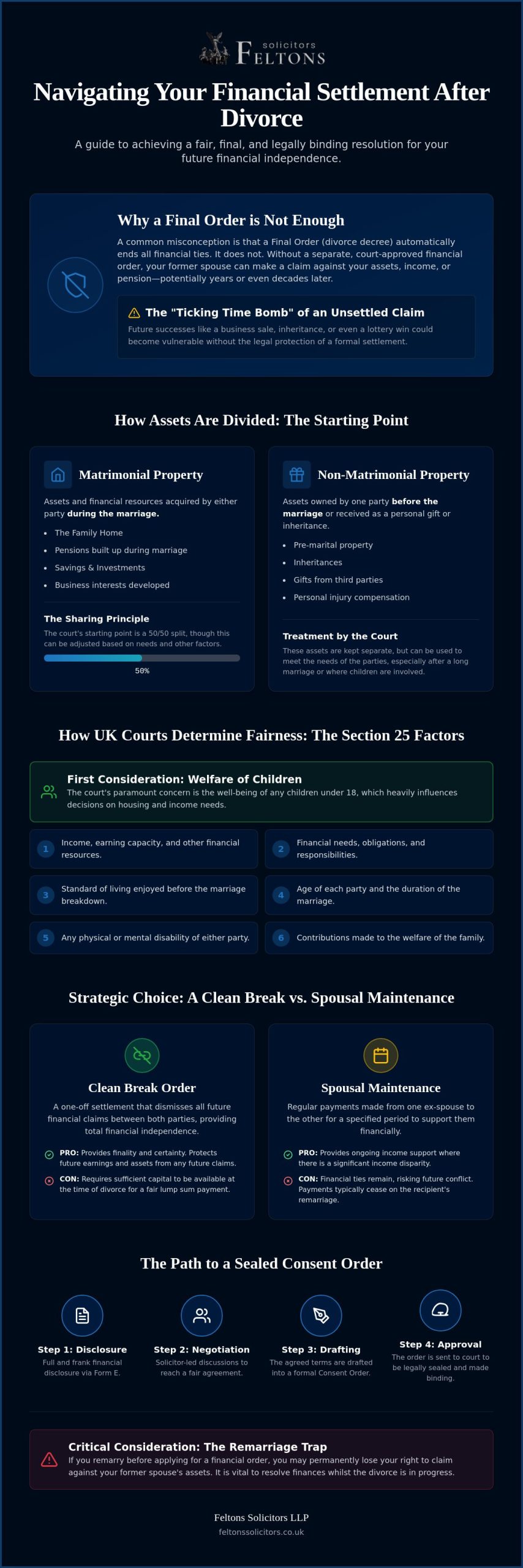
A financial settlement in UK divorce is a legally binding agreement that details how assets, property, and income are divided between separating parties. It is a common misconception that the divorce process itself automatically addresses these financial matters. The divorce petition merely ends the legal contract of marriage. In contrast, a financial order provides the finality needed to secure your future. Without a court-sealed order, your former spouse could potentially make a claim against your assets years, or even decades, after the decree is absolute.
Achieving a “clean break” is often the primary objective for those seeking a discreet and efficient resolution. A Clean Break Order dismisses future financial claims, ensuring that any wealth you build post-divorce remains yours alone. Relying on an informal “handshake” agreement is a significant risk. These arrangements lack legal enforceability and offer no protection if circumstances change or relationships sour. Only a court-approved order provides the peace of mind that your financial obligations are truly concluded.
The Legal Framework: Matrimonial Causes Act 1973
The Matrimonial Causes Act 1973 remains the primary authority for a financial settlement divorce uk. When reviewing an application, the court’s first priority is always the welfare of any children under eighteen. Beyond this, judges exercise broad discretion to achieve a result that is “fair”. Modern interpretations have shifted away from rigid formulas towards a pragmatic assessment of each party’s future needs, earning capacity, and contributions to the family. This ensures that the settlement is tailored to the specific realities of your household rather than a generic template.
Matrimonial vs Non-Matrimonial Assets
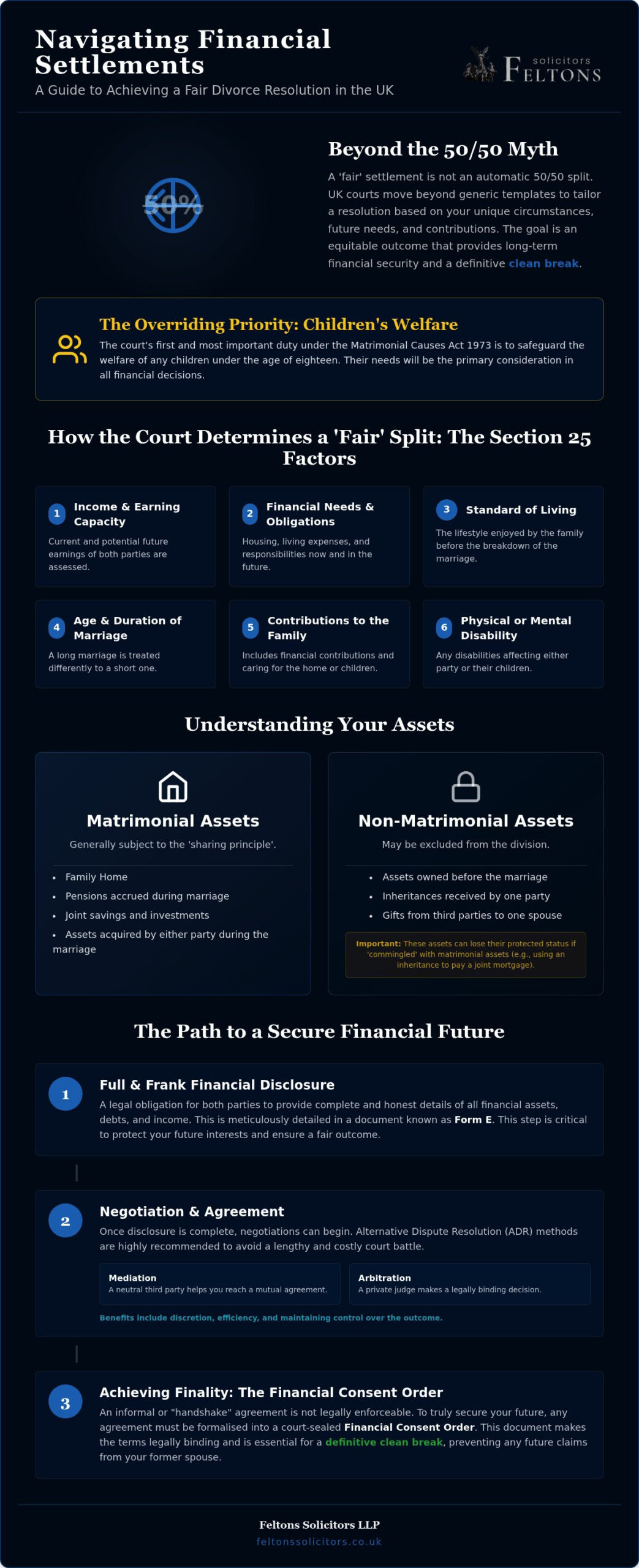
Distinguishing between asset types is essential for a precise and equitable division. Matrimonial assets generally include everything acquired during the marriage, such as the family home, joint savings, and pensions. These are typically subject to the sharing principle. Non-matrimonial assets often include property owned before the wedding or specific inheritances and gifts received during the relationship.
However, the treatment of non-matrimonial assets is rarely straightforward. If these assets have been “commingled”, for instance by using an inheritance to pay off a joint mortgage, they may lose their protected status. The court evaluates how long the marriage lasted and whether these assets are required to meet the other party’s basic needs. Expert legal insight is vital here to ensure your pre-marital wealth is appropriately ring-fenced wherever possible, maintaining your financial independence post-divorce.
How the Court Determines a ‘Fair’ Financial Split
The concept of “fairness” in a financial settlement divorce uk is often misunderstood as a simple mathematical exercise. Whilst a 50/50 division is frequently used as a starting point for long marriages, it’s by no means an automatic rule in English and Welsh law. The court’s primary objective is to reach an equitable outcome that reflects the unique circumstances of the family. This involves balancing various factors, including the standard of living enjoyed during the marriage. Judges rarely consider personal “conduct” or “blame” for the breakdown of the relationship unless it’s exceptionally egregious and has a direct, significant impact on the financial position. Instead, the focus remains on practical needs and future security.
The Section 25 Criteria Explained
Judges derive their authority from a specific set of criteria known as the Section 25 factors. These rules require a thorough, methodical assessment of each party’s position. The court will examine your income and earning capacity, looking not just at what you earn now, but what you could potentially earn in the future. They’ll also consider your current and future financial needs, obligations, and responsibilities. The age of each party and the duration of the marriage play a significant role; a twenty-year marriage is treated very differently from a two-year union. Additionally, the court weighs contributions to the welfare of the family, ensuring that a spouse who sacrificed their career to manage the home is not financially penalised. This discretionary approach allows for a tailored resolution that accounts for the nuances of your specific household.
Prioritising the Needs of Children
The court has a statutory duty to place the welfare of any children under eighteen at the forefront of its decision-making. This priority often dictates the division of the family home. If one parent remains the primary caregiver, the court may prioritise their housing needs to ensure the children have a stable and secure environment. This might result in an unequal split of capital to facilitate a property purchase or a deferred sale of the matrimonial home. The goal is to minimise disruption to the children’s lives, even if it means a less-than-equal division of the current assets. Understanding how these factors apply to your situation is essential for long-term planning. If you require a bespoke assessment of your matrimonial assets, our team provides the steady, professional guidance needed to navigate these complexities with confidence.
The Critical Role of Full and Frank Financial Disclosure
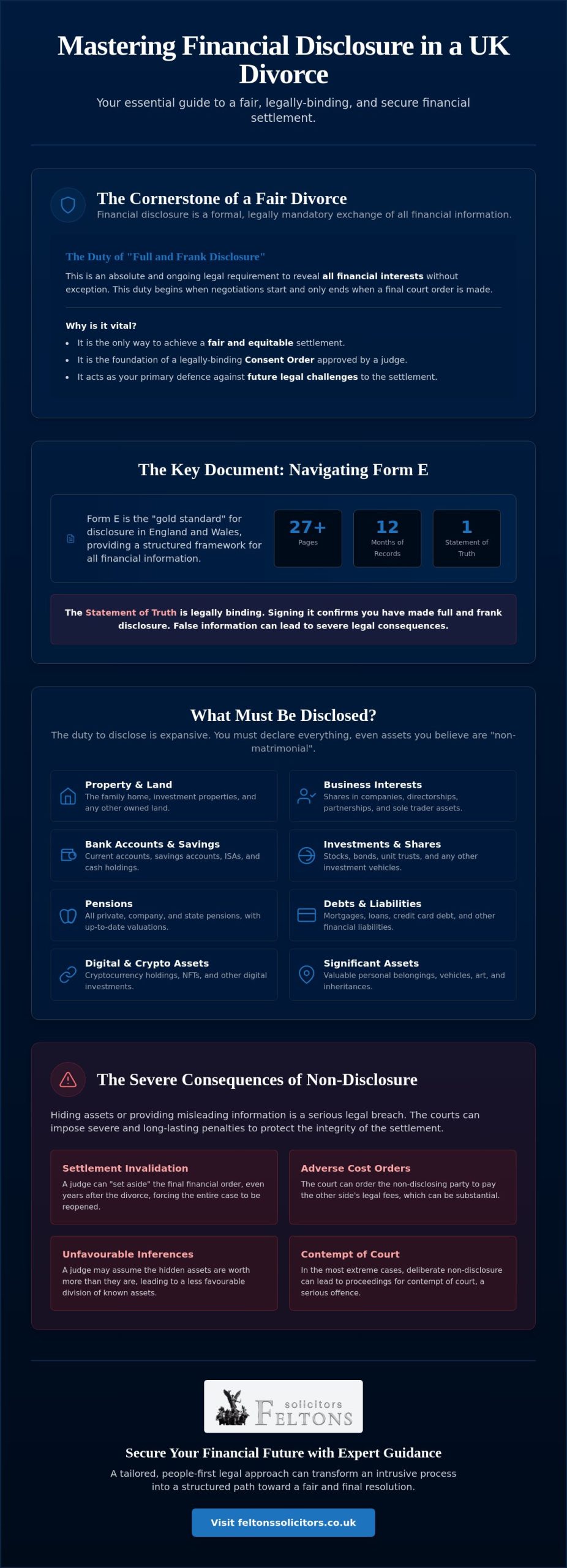
Full and frank disclosure is the cornerstone of any robust financial settlement divorce uk. It requires both parties to provide a comprehensive and honest overview of their global financial position, ensuring that negotiations are based on fact rather than assumption. This process is primarily facilitated through “Form E”, a detailed document that organises your financial evidence, including bank statements, property valuations, and income details. Providing a complete picture from the outset isn’t merely a procedural requirement; it’s a strict legal obligation. If one party is found to have hidden assets or provided misleading information, the court has the power to set aside the final order, potentially reopening the litigation years later at significant expense.
The strategic completion of Form E ensures that the negotiation starts from a position of absolute clarity. We often engage professional valuers to assess complex assets, such as private collections or property portfolios, to prevent disputes over their true worth. This methodical approach ensures that the matrimonial “pot” is accurately defined before any division begins, providing the firm foundation necessary for a fair and lasting agreement.
Dealing with Pensions and Business Assets
Pensions are frequently the most significant asset after the family home, yet they remain one of the most misunderstood areas of asset division. A Pension Sharing Order provides a definitive clean break by transferring a percentage of one party’s pension credit to the other. In contrast, a Pension Attachment Order acts more like maintenance, where payments are made only once the pension holder retires. It is vital to note that whilst many private schemes can be split, the new state pension (for those reaching state pension age from April 2016) cannot be shared. For high-value pots, we often recommend actuarial reports to determine the true value of the income stream. Similarly, valuing a family business requires a nuanced look at liquidity and future earnings to ensure the settlement remains sustainable for both parties.
International Assets and Overseas Entities
Identifying and valuing investments held abroad adds another layer of complexity to the disclosure process. Modern divorce proceedings frequently involve overseas entity beneficial owner registration, which provides essential transparency for UK property held by foreign organisations. Our expertise in cross-border financial arrangements allows us to navigate these international nuances with calm, steady precision. We ensure that every offshore interest is correctly accounted for, protecting your interests regardless of where the assets are located. This level of meticulous detail is essential for securing a settlement that is both comprehensive and legally sound.
Negotiating Your Settlement: Mediation, Arbitration, and Consent Orders
Reaching an agreement outside the courtroom is increasingly the preferred route for those seeking a discreet and efficient resolution. Alternative Dispute Resolution (ADR) offers a more controlled environment for resolving a financial settlement divorce uk, prioritising cooperation over conflict. Mediation is a primary pillar of this approach. It allows both parties to discuss their needs with a neutral third party, often reducing the overall cost of proceedings whilst fostering a more amicable atmosphere. This is particularly beneficial when children are involved, as it sets a cooperative tone for future co-parenting and reduces the emotional strain on the family unit.
For complex cases that require a definitive decision but seek to avoid the delays of the public court system, arbitration is a sophisticated alternative. In this process, a private judge, known as an arbitrator, reviews the evidence and makes a binding decision. It’s significantly faster than the traditional court route and offers a level of privacy that high-net-worth individuals often prioritise. This ensures that sensitive financial details and business interests remain confidential, away from the public record.
The Process of Securing a Consent Order
Once an agreement is reached through negotiation or mediation, it must be formalised into a Consent Order to become legally binding. This document is meticulously drafted by solicitors to reflect the agreed terms with absolute precision, covering everything from property transfers to pension sharing. A judge then reviews the order to ensure it’s “fair” and meets the statutory requirements of the Matrimonial Causes Act. Without this judicial seal, your agreement remains informal and lacks the power to prevent future claims. For a deeper look at strategic asset division, see our guide to protecting your assets.
When Negotiation Fails: The Path to Court
If an agreement cannot be reached through ADR, the court process provides a structured path to a resolution. This typically involves three distinct stages: the First Appointment (FDA), the Financial Dispute Resolution (FDR) hearing, and the Final Hearing. The FDR is a pivotal moment in the litigation. It’s a “without prejudice” hearing where a judge gives a non-binding indication of the likely outcome if the case were to proceed to a trial. This insight often encourages a settlement, as both parties can see the risks and costs of continuing to a Final Hearing. Expert litigation support is essential during these stages to ensure your position is presented with clarity and authority. If you find yourself facing a contested split, we recommend seeking a professional consultation on divorce and financial arrangements to protect your long-term interests.
Securing Your Future with Feltons Solicitors
Feltons Solicitors LLP offers a boutique experience that prioritises the individual behind the legal case. We understand that navigating a financial settlement divorce uk is one of the most significant transitions you’ll ever face. Our approach is defined by a sophisticated blend of professional authority and empathetic reassurance. We position ourselves as a calm, steady presence during what is often a high-pressure period. By focusing on a personal connection rather than high-volume processing, we ensure that every client receives the discreet, high-standard service they deserve.
We specialise in handling complex, international-scale matters with the worldly experience required for high-net-worth asset division. Whether your estate involves overseas entities or intricate business structures, our team provides the pragmatic, sound judgment needed to secure your financial independence. We value modern efficiency, but we never compromise on the traditional professional integrity that has defined our firm since Paula Felton established it in 2010. This combination of heritage and forward-thinking methodology ensures your financial settlement divorce uk is handled with absolute precision.
A People-First Philosophy to Legal Service
Our “people-first” philosophy means that we never forget the human impact of the technical legal work we perform. We prioritise personal rapport and privacy, acting as your discreet partner throughout the entire process. We guide you through every step of the financial settlement process, from the initial disclosure to the final court-sealed order. Our goal is to provide a sense of security and comprehensive care, ensuring you feel supported and in capable hands. We offer tailored strategies that reflect your specific goals, whether you seek a clean break or the long-term protection of children’s assets.
Next Steps: Contacting Our Trusted Advisors
Taking the first step towards a resolution is often the hardest part. We invite you to arrange an initial consultation with our expert family law team to discuss your specific needs in a confidential setting. To make the most of this meeting, it’s helpful to gather a preliminary list of your assets, including property values, pension statements, and any business interests. This allows us to provide more targeted, practical advice from the very beginning.
Our communication rhythm is steady and deliberate. We respect your time and opt for a methodical flow that guides you through information without the frantic energy of high-pressure sales. If you’re ready to secure your financial future with a partner who values your peace of mind as much as your legal success, we’re here to help. Contact our trusted advisors today to begin your journey toward a discreet and efficient resolution.
Securing Your Financial Independence for the Years Ahead
Transitioning into a new chapter of life requires more than just legal paperwork; it requires a strategy that protects your hard-earned assets and provides long-term security. We’ve explored how the court balances Section 25 factors and why a court-sealed Consent Order is the only way to achieve a definitive clean break. A successful financial settlement divorce uk relies on meticulous disclosure and the ability to navigate complex arrangements, such as pensions and international property, with absolute precision.
Feltons Solicitors has provided boutique, personalised legal service since 2010. We offer the calm, steady presence needed to handle complex international-scale matters whilst prioritising your privacy and peace of mind. Our team is dedicated to helping you achieve a resolution that is both efficient and fair. If you’re ready to move forward with confidence, please contact Feltons Solicitors for a discreet consultation. You deserve a trusted advisor who understands the human impact of your legal journey and works tirelessly to secure your financial future.
Frequently Asked Questions
How long does a financial settlement take in the UK?
A financial settlement typically takes between six and twelve months to conclude if an agreement is reached through negotiation or mediation. If the matter proceeds to a contested court hearing, the timeline can extend significantly beyond a year. It’s important to understand that the financial process runs parallel to the divorce petition but remains a distinct legal matter. Seeking a prompt resolution helps provide the certainty needed to plan for your post-divorce future.
Can I claim my husband or wife’s pension after divorce?
Pensions are often the most significant asset in a marriage and are almost always included in a financial settlement divorce uk. You may be entitled to a portion of your spouse’s pension through a sharing order or an attachment order. However, the new state pension, for those reaching retirement age after April 2016, cannot be shared. We often use actuarial reports to ensure these complex funds are valued accurately before any division is agreed.
What happens to the family home in a financial settlement?
The treatment of the family home depends on the specific needs of each party, with the court prioritising the welfare of any children involved. Common outcomes include selling the property and dividing the proceeds or one party buying out the other’s share to remain in the home. In some cases, a deferred sale order is used to ensure children have a stable environment until they reach adulthood. Every situation requires a bespoke approach to achieve fairness.
Is a financial settlement always 50/50 in the UK?
No, there is no automatic 50/50 split in English and Welsh law. Whilst an equal division is a frequent starting point for long marriages, the court exercises broad discretion under Section 25 of the Matrimonial Causes Act. Factors such as the length of the marriage, each party’s earning capacity, and their future financial needs can lead to an unequal split. The primary goal is to reach an outcome that is equitable and sustainable for both individuals.
Do I need a solicitor for a financial settlement?
You are not legally required to instruct a solicitor for negotiations, but professional representation is essential for drafting a legally binding Consent Order. A solicitor ensures the document accurately reflects your agreement and provides the necessary protection against future claims. Without a court-sealed order, your financial ties remain open, leaving you vulnerable to claims years after the divorce. Expert guidance also helps you navigate complex asset valuations and ensures your long-term interests are fully protected.
What is a Clean Break Order and do I need one?
A Clean Break Order is a court-sealed document that ends the financial relationship between you and your former spouse. It prevents either party from making any future claims against the other’s income, assets, or inheritance. Most individuals require this order to achieve true financial independence and peace of mind. Without it, your former partner could potentially apply for a share of your wealth many years later if your financial circumstances improve significantly or you receive a windfall.
Can a financial settlement be changed after the divorce is finalised?
A financial settlement is usually final once a court has issued a sealed order, particularly if it includes a clean break clause. However, an order can be challenged or set aside in exceptional circumstances, such as a failure to provide full and frank disclosure or evidence of fraud. Additionally, a “Barder event”, which is a significant and unforeseen change occurring shortly after the order, may allow for a review. These cases are rare and require sophisticated legal expertise.
How much does a financial settlement cost in legal fees?
The total cost of a financial settlement divorce uk depends on the complexity of your assets and whether the division is agreed amicably. Court filing fees for 2026 are fixed at £62 for a consent order and £321 for a contested financial order. Professional fees vary based on the level of negotiation or litigation support required. Investing in expert advice early often reduces overall costs by avoiding a protracted court battle and ensuring a more efficient resolution.