

Could a covenant that blocks your plans be changed without a lengthy dispute? The right route depends on what the restriction protects, how it affects your property and whether the person entitled to enforce it can be found. Restrictive covenant discharge solicitors can help assess those points, but the first step is a careful review of the title and your proposed use.
It’s understandable to feel stuck when a title restriction appears to rule out an extension, change of use or development. In some cases, negotiation with the beneficiary may lead to a deed of release or modification. For land in England and Wales, an application under section 84 of the Law of Property Act 1925 may be another option. The relevant legal grounds and supporting evidence need close assessment.
This guide explains the available routes, the factors that may influence an application and why identifying the beneficiary matters. You’ll also find out which title documents and evidence to gather, and what to ask a solicitor about directly relevant experience and who would handle your matter. This can help you choose a proportionate next step.
Key Takeaways
- Understand how a restrictive covenant can limit the use of land, and why it may not be straightforward to identify who benefits from it.
- Compare a negotiated deed of release or variation with an application to the Upper Tribunal (Lands Chamber) under section 84.
- Assess the covenant’s wording, purpose and practical impact, then gather title documents, plans and evidence about the site.
- Use restrictive covenant discharge solicitors to help evaluate the possible route, and ask about relevant experience, strategy, scope and risks.
- Feltons Solicitors LLP provides property legal services and dispute resolution. Check directly whether it accepts this type of instruction and who would handle it.
Restrictive covenant discharge: what it means for your property
A restrictive covenant is a legally binding promise that limits how land can be used. For example, a deed might prevent a property owner from building anything other than a single dwelling. The land subject to the restriction is the burdened land. Another property, person or organisation may have the benefit and be entitled to enforce it. The benefit is not always easy to identify from the current title. The general principles are outlined in Covenant (law).
Discharge removes the restriction, whilst modification changes its terms, perhaps to allow a particular use or a defined alteration. Neither is automatic. In England and Wales, section 84 of the Law of Property Act 1925 provides a route to ask the Upper Tribunal (Lands Chamber) to discharge or modify certain restrictive covenants, if the relevant statutory grounds are made out. The law and procedures differ across the UK, so the property’s jurisdiction matters.
How to identify a restrictive covenant in your title documents
Start with the registered title, including any entries that refer to deeds or other documents. The register may summarise a restriction without setting out its full wording. The original conveyance or transfer referred to in the register can provide important detail about the covenant’s scope, purpose and the land it affects. If that document is not readily available, further investigation may be needed. Tracing who can enforce the covenant may also require research into historic ownership and how the benefit was attached or transferred.
What discharge can and cannot achieve
Removing or changing a covenant addresses that restriction only. It does not grant planning permission, building regulations approval or any other consent your project may require. Those matters need to be considered separately.
Age alone does not make a covenant unenforceable, and a lack of past enforcement does not necessarily mean it can be ignored. Its wording, purpose, the land affected and the evidence available all matter. If you seek advice from restrictive covenant discharge solicitors, be ready to explain the intended use or works and provide the relevant title documents. A solicitor can assess possible routes, but no outcome should be assumed before the facts and applicable legal tests have been examined.
How restrictive covenants may be discharged or modified
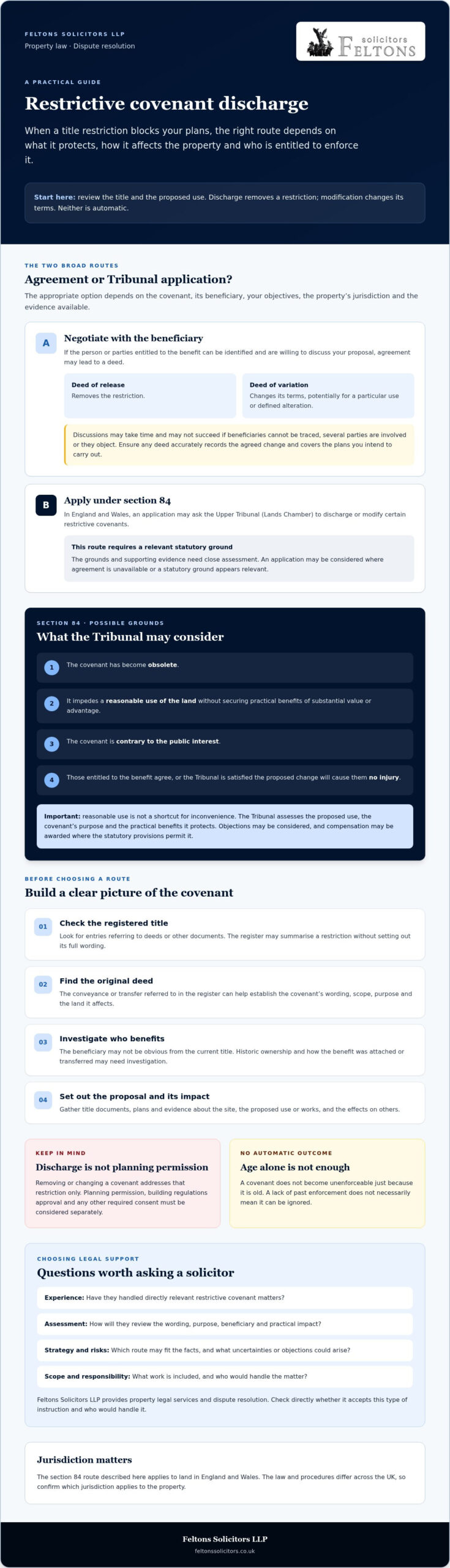
There are two broad routes: reach an agreement with the person or parties entitled to the covenant’s benefit, or apply to the Upper Tribunal (Lands Chamber) in England and Wales. A negotiated deed of release removes the restriction, while a deed of variation changes its terms. An application under section 84 of the Law of Property Act 1925 asks the Tribunal to discharge or modify it. The appropriate route depends on the covenant’s wording, who benefits, the property’s jurisdiction, your objectives and the evidence available.
Section 84 provides several grounds for an application. These include that the covenant has become obsolete, that it impedes a reasonable use of the land without securing practical benefits of substantial value or advantage, or that it is contrary to the public interest. An application may also be possible where those entitled to the benefit agree, or where the Tribunal is satisfied that the proposed discharge or modification will cause no injury to them. The distinct framework for conservation covenants discussed in the Law Commission report illustrates why the legal treatment of covenants depends on their type and context.
When negotiation with the beneficiary may be considered
Negotiation may be a practical first route if the beneficiary can be identified and is willing to discuss your proposal. A solicitor can investigate the title and relevant historic documents to establish who may hold the benefit. If agreement is reached, make sure the deed accurately records what is being released or varied and covers the plans you intend to carry out. Discussions can take time and may not succeed if beneficiaries cannot be traced, several parties are involved or they object.
When a section 84 application may be relevant
An application may be worth considering where agreement is unavailable or the statutory grounds appear relevant. The reasonable-use ground is not a shortcut for inconvenience. The Tribunal assesses the proposed use alongside the covenant’s purpose and the practical benefits it protects. Evidence about the land, the proposed change and its effects on others will be important. The Tribunal can consider objections and may award compensation where the statutory provisions permit it. Check the current procedure before preparing an application.
Before choosing a route, clarify what you need the covenant to allow and assemble the title documents and plans. Restrictive covenant discharge solicitors can help assess the evidence and explain the risks of negotiation and a Tribunal application. If you are considering advice, you can review Feltons’ property and dispute-resolution services and ask whether the firm accepts this type of instruction and who would handle it.
How to assess your prospects and compare solicitors
There’s no reliable shortcut to judging whether a covenant can be changed. Prospects depend on its exact wording and purpose, when it was created, which land it affects and how your proposal would alter the position of those who may benefit. A covenant’s age may be relevant, but age alone does not establish that it is obsolete or unenforceable.
Consider the practical impact on both sides. Even a modest alteration may affect a neighbour’s property or an amenity the covenant was intended to protect. Objections, uncertainty over who can enforce the restriction, questions about its enforceability and possible compensation may all influence the route, evidence needed and level of risk. The UK Government guidance on discharging covenants outlines the Upper Tribunal application process and can help you understand what information may be required.
What evidence may support an application
Gather the registered title, historic transfers or conveyances, plans referred to in those documents and any correspondence about the covenant. Then describe exactly what you want to do. Drawings showing a proposed extension or development can make your request clearer than a general description. Depending on the proposal and any issues in dispute, ask whether planning, valuation or other professional evidence would help explain the land’s context, practical effects or potential impact on others.
Questions to ask restrictive covenant discharge solicitors
Compare advice by its relevance and clarity, not just by confidence of tone. Ask who would handle the matter and what directly relevant experience they can confirm, including experience with section 84 applications if that route is being considered. You can also ask:
- Which routes may be available, and what facts could strengthen or weaken each?
- How might objections, enforceability issues or compensation affect the strategy?
- What evidence and procedural steps may be needed, and who will manage them?
- What work is included in the proposed scope, how will fees be explained, and how will you be kept informed?
A careful adviser should explain uncertainties as well as possible next steps. Restrictive covenant discharge solicitors should assess your specific documents and objectives before suggesting a route, rather than treating every restriction as the same problem.
What the discharge process involves and what can affect it
A measured process starts with the documents and your practical objective, not with an assumption that a Tribunal application is necessary. Typically, the work proceeds through these stages:
- Review the title: check the register and the deeds it refers to for the covenant’s wording and context.
- Define the objective: clarify the specific use, alteration or development you want to carry out.
- Assess the route: consider whether discussion with the beneficiary, a formal application or another option is appropriate.
- Prepare the evidence: assemble plans, relevant correspondence and supporting material for the chosen route.
- Act: negotiate and document any agreement, or follow the applicable Tribunal procedure.
Negotiation and Tribunal proceedings involve different people and uncertainties. A negotiated release or variation depends on locating the relevant beneficiary and reaching agreement on terms. A Tribunal application follows formal procedural steps and may draw objections from people claiming the covenant’s benefit. The evidence required, number of parties involved, complexity of the title and need to respond to objections can all affect progress and legal fees. Ask for a clear explanation of what the proposed work includes and how additional steps may be handled. No timetable or outcome should be assumed before the circumstances are assessed.
Preparing for an initial legal discussion
Bring the registered title, the deeds referred to in it, relevant plans and correspondence about the restriction. Write down exactly what you hope to do, who you understand may benefit, any previous approaches or objections, and relevant project or transaction dates. Separate the result you need, such as permission for a defined extension, from your assumption about the legal route. This helps the solicitor assess the options against your objective.
Understanding risks, objections, and alternatives
An unsuccessful application may leave the covenant in place, affecting or preventing your plans. Ask the solicitor to explain the risk of objections, possible compensation, potential adverse-party costs and procedural issues that may apply to your case. Consider practical alternatives too: a revised design, negotiated consent or another arrangement may meet your needs with less uncertainty. Early assessment gives you a clearer basis for weighing those choices.
Before instructing restrictive covenant discharge solicitors, confirm who will handle the matter, what directly relevant experience they can demonstrate, and how they will explain risks and fees as the case develops. Feltons provides property legal services and dispute resolution. Contact Feltons to ask whether it accepts instructions of this kind and who would manage the work.
Choosing legal support for restrictive covenant discharge
The right legal support should combine careful property-document review with a clear, proportionate strategy. A solicitor should explain what can be established from the title, what remains uncertain and which options fit your intended use, rather than implying that discharge is assured.
When comparing restrictive covenant discharge solicitors, look for relevant property-law experience, a reasoned assessment of the available routes, a transparent scope of work and considered advice about risks. Ask how the solicitor will address potential objections, what evidence may be needed and how you’ll be kept informed. Clear communication matters, particularly if the matter involves several beneficiaries or a formal application.
What a tailored legal assessment should cover
A useful initial assessment should consider the covenant’s wording and purpose, the title history, the land affected and your specific plans. Ask the solicitor to explain which routes may be available, what evidence could support them and what might weaken your position. The advice should consider objections and practical alternatives, not just your preferred legal route. Before proceeding, clarify the proposed scope, likely stages, communication arrangements and how fees will be explained as the matter develops.
A measured next step with Feltons Solicitors
Feltons Solicitors provides residential and commercial property legal services, alongside litigation and dispute resolution. These services may be relevant when assessing a property restriction and the possibility of a dispute, but the firm’s specific experience with restrictive covenant discharge is not confirmed in the information available for this guide. Ask directly whether the firm can advise on your matter.
In particular, confirm whether the solicitor handling your case has experience with the covenant in question and, if relevant, section 84 applications and Upper Tribunal proceedings. Ask what documents are needed for an initial review. The registered title, deeds referred to in it, relevant plans and a concise description of your intended use can help frame that discussion.
If you’re ready to take a measured next step, discuss your property law requirements with Feltons Solicitors. A conversation about the restriction and your plans can help establish whether the firm accepts this type of instruction and what further information it would need to assess the options.
Take a considered next step with your property plans
A restrictive covenant may not have to prevent your plans, but the right option depends on its wording, purpose, the land affected and the evidence available. Negotiation, a deed of release or variation, and an application to the Tribunal each involve different considerations. A careful review of the title and your intended use can help clarify realistic routes and risks before you commit to a course of action.
When speaking with restrictive covenant discharge solicitors, ask about directly relevant experience, who will handle the matter, what evidence may be needed and how the scope and fees will be explained. Feltons Solicitors, established in 2010, provides property and conveyancing legal services, as well as litigation and dispute resolution. Confirm the firm’s specific experience with covenant discharge directly.
Discuss your property law requirements with Feltons Solicitors, including the title restriction and the use you have in mind. A measured first conversation can help you decide what to do next with greater clarity.
Frequently Asked Questions
Can a restrictive covenant be discharged without the beneficiary’s consent?
Yes. In England and Wales, you can apply to the Upper Tribunal (Lands Chamber) under section 84 of the Law of Property Act 1925 without the beneficiary’s agreement. You’ll need to establish a relevant statutory ground with supporting evidence. The Tribunal may consider objections and the effect of the proposed change on those entitled to the covenant’s benefit. The outcome isn’t guaranteed, so assess the evidence and risks before applying.
What are the grounds for discharging a restrictive covenant?
In England and Wales, section 84 includes grounds such as the covenant having become obsolete, impeding reasonable use of the land or being contrary to the public interest. An application may also be possible if those entitled to the benefit agree, or if the Tribunal considers that discharge or modification would cause them no injury. The legal test depends on the ground relied on, and the applicant must support it with relevant evidence.
How do I find out who can enforce a restrictive covenant?
Start with the registered title and any deeds or transfers referred to in it. The wording may identify land that benefits from the covenant, but it may not name a current person entitled to enforce it. Historic conveyances, ownership records and the way the covenant’s benefit was transferred may need investigation. A solicitor can review these documents and help trace potential beneficiaries, though the answer may not be immediately clear.
How long does it take to discharge a restrictive covenant?
There’s no single timetable. A negotiated release may depend on identifying all relevant beneficiaries, reaching agreement and preparing appropriate documents. A Tribunal application follows formal steps, and progress can be affected by the evidence required, objections, the number of parties and whether a hearing is needed. Ask your solicitor for a case-specific estimate and what could cause delay. Treat any early timeframe as an estimate, not a guarantee.
Can I build on my property while a restrictive covenant is in place?
Don’t assume you can build simply because you have planning permission or the covenant is old. Planning permission and compliance with a private covenant are separate issues. If the proposed work breaches an enforceable restriction, proceeding without consent or a legal resolution may expose you to a dispute and affect your plans. Check the covenant’s wording and obtain advice before starting work. A Tribunal application or agreement may be relevant, but neither is automatic.
What documents should I give a solicitor about a restrictive covenant?
Provide the registered title, the conveyance or transfer containing the covenant, and any other deeds referred to in the register. Include relevant plans, correspondence with potential beneficiaries, previous requests for consent or objections, and drawings showing your proposed works or use. A clear note of your objective and any project or transaction dates is useful too. Restrictive covenant discharge solicitors can then assess what further documents or professional evidence may be needed.
Can a restrictive covenant be modified rather than discharged?
Yes. Modification changes the covenant’s terms, while discharge removes it. For example, an owner might seek permission for a defined alteration rather than removing the restriction in full. In England and Wales, section 84 allows the Upper Tribunal to consider modification as well as discharge, subject to the relevant statutory ground and evidence. A negotiated variation may also be possible if the beneficiary agrees. The appropriate scope depends on your plans and circumstances.