

Did you know that when the Register of Overseas Entities was established, over 12,000 entities failed to meet their initial transparency deadlines, leaving their UK property interests vulnerable to severe legal restrictions? You likely recognise that holding international assets requires a high degree of diligence, yet the intricacies of overseas entity beneficial owner registration can feel unnecessarily burdensome. It’s understandable to worry about the risk of criminal prosecution or the prospect of HM Land Registry freezing a critical transaction due to a filing error.
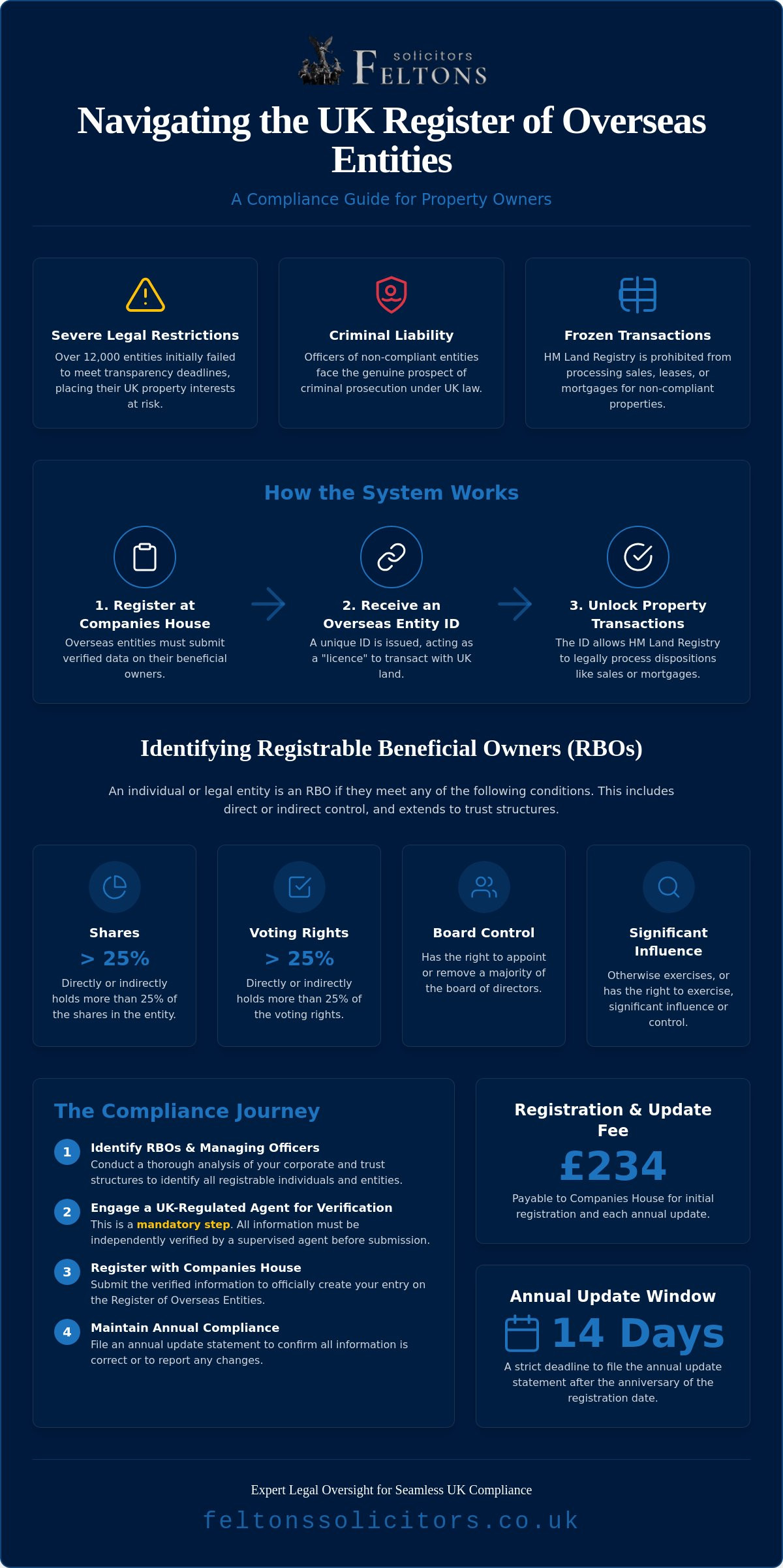
This guide offers a steady, expert hand to help you navigate these regulatory waters with confidence. We’ll provide the clarity you need to ensure your registration is handled correctly, protecting your reputation and your investments from the substantial fines now being enforced. We’ll outline the current 2026 fee structures, including the £234 registration and update costs, the essential role of UK-regulated verification agents, and the methodical steps required to achieve seamless compliance with Companies House.
Key Takeaways
- Understand the essential legal requirements under the Economic Crime Act to ensure your UK property titles remain secure and tradable.
- Identify your Registrable Beneficial Owners by applying the specific 25% threshold for shares and voting rights within your corporate structure.
- Learn why mandatory verification by a UK-regulated agent is a critical prerequisite for a valid overseas entity beneficial owner registration.
- Navigate the strict 14-day window for annual update statements to prevent the risk of frozen assets or substantial financial penalties.
- Recognise how professional legal oversight bridges the gap between complex international entities and current UK compliance standards.
The Register of Overseas Entities: Legal Requirements in 2026
The legal framework governing foreign-owned property in the United Kingdom has undergone a profound transformation. At the heart of this change is the Register of Overseas Entities (ROE), established by the Economic Crime (Transparency and Enforcement) Act 2022. This legislation mandates that any foreign entity wishing to own land in the UK must disclose its true controllers. By 2026, the regulatory climate has shifted from initial education to strict enforcement. Authorities now demand absolute precision in every overseas entity beneficial owner registration, viewing even minor discrepancies as potential compliance failures.
Compliance is no longer a one-time hurdle. The 2026 landscape requires more rigorous data accuracy than in previous years, reflecting a broader push for transparency in global capital flows. For property owners, this means that the information held by Companies House must be verified and updated with meticulous care. Failure to do so doesn’t just result in administrative letters; it can lead to daily fines of up to £2,500 and, in the most serious cases, criminal liability for the entity’s officers. These sanctions are designed to ensure the register remains a reliable source of truth for government agencies and the public alike.
Which Entities Fall Under the Scope?
An “overseas entity” is broadly defined as any legal person, such as a corporation, partnership, or trust, that is governed by the law of a country or territory outside the UK. The scope is notably retrospective. In England and Wales, the requirement applies to land acquired on or after 1 January 1999. In Scotland, the threshold date is 8 December 2014. Whilst certain exemptions exist, they are rarely applicable in practice for commercial or residential holdings. Most international structures holding UK property will find themselves firmly within the remit of the Act.
The Role of Companies House and HM Land Registry
The relationship between Companies House and HM Land Registry is now inextricably linked. When a successful overseas entity beneficial owner registration is completed, the entity is issued a unique Overseas Entity ID. Think of this ID as a “licence” to deal with UK land. Without it, HM Land Registry is legally prohibited from registering any “qualifying disposition” of the property. This means your ability to sell, lease for more than seven years, or even grant a legal charge, such as a mortgage, will be entirely blocked. A valid registration is the key that unlocks your asset’s liquidity; without it, your property transactions will simply stall at the final hurdle. For those entities planning to actively develop their property, this legal compliance often goes hand-in-hand with technical requirements, such as obtaining transport planning reports from specialists like mltraffic.co.uk to support planning applications.
Identifying Registrable Beneficial Owners (RBOs)
Identifying who truly controls an offshore structure is the most technically demanding aspect of overseas entity beneficial owner registration. It isn’t always a straightforward matter of looking at a share certificate. The law sets out specific tests to ensure that those with genuine power cannot remain hidden behind layers of corporate paperwork. According to the official government guidance, an individual or legal entity is registrable if they meet any of the following conditions:
- Holding more than 25% of the shares in the entity.
- Holding more than 25% of the voting rights.
- Having the right to appoint or remove a majority of the board of directors.
Beyond these numerical thresholds, a “catch-all” condition applies to anyone who exercises significant influence or control. This might involve veto rights over major decisions or the ability to direct the entity’s activities through informal arrangements. If you’re unsure how these tiers apply to your specific portfolio, seeking professional legal counsel can provide the reassurance that your filings are accurate and defensible.
The Impact of Trust Structures
Trusts are a primary focus for the 2026 transparency rules. If an overseas entity is held by a trust, the trustees are typically considered registrable beneficial owners. However, the disclosure requirements don’t stop there. You’ll also need to provide details about the settlor, beneficiaries, and any protectors who have the power to influence the trust’s administration. This level of transparency is mandatory for discretionary trusts, even if no distributions have been made to beneficiaries yet.
Indirect Ownership and Parent Undertakings
Many properties are held through a chain of companies. If an individual holds their interest through a “parent undertaking” that is itself a registrable entity, the chain must be traced until a registrable person or a qualifying legal entity is found. This prevents “shell company” loops from obscuring the ultimate owner. Collaborative control, where two or more people act together to meet the 25% threshold, also triggers registration. These “joint interests” require a careful analysis of shareholder agreements and voting patterns.
In rare cases where no individual meets the criteria after exhaustive searches, the entity must instead register its managing officers. This includes directors, managers, or company secretaries. It’s a “fallback” position that ensures there’s always a named person accountable for the entity’s UK property interests. This step should only be taken when you’ve documented that no other beneficial owners exist, as Companies House may request evidence of your due diligence.
For investors based in the Gulf region, you can explore company formation with Ali Al-Masardi Law Firm to ensure your entity is correctly structured from its inception, making subsequent UK compliance much smoother.
The Verification Process: Why Professional Assurance is Essential
The process of overseas entity beneficial owner registration is not a self-service administrative task. Under the 2022 Act, self-certification is strictly prohibited. Every piece of information submitted to Companies House must first be scrutinised and verified by a UK-regulated agent. This requirement ensures that the data on the register is accurate and legally robust. Regulated agents, such as solicitors or qualified accountants, must provide an “agent assurance code” to prove they’ve conducted the necessary due diligence. This rigorous oversight explains why thousands of entities have historically struggled with their filings; as of January 2023, only 19,510 out of 32,440 overseas entities had successfully declared their beneficial owners.
This verification is a heavy responsibility. If an agent fails to perform rigorous checks, Companies House has the power to revoke their assurance code, effectively barring them from the register. At Feltons Solicitors LLP, we position ourselves as a calm, steady presence for clients facing these complex requirements. We understand that for many international owners, the requirement for transparency must be balanced with a need for discretion. Our approach prioritises a boutique level of care, ensuring that while your compliance is absolute, your personal information is handled with the highest standard of professional integrity.
Acceptable Sources of Evidence
Verifying ownership often requires looking beyond simple company books. We rely on independent, third-party registries to confirm the standing of an entity and its controllers. This becomes complex in jurisdictions without public registers or where corporate records are not digitally accessible. In these instances, we work closely with international legal counsel to obtain certified translations of constitutive documents. It’s vital to remember that these verification checks must be conducted no more than 3 months before the date of the application. This ensures that the information provided to Companies House is current and reflects the present reality of the entity’s control structure.
Managing the Risks of Public Disclosure
Privacy is a significant concern for many property owners. Whilst the ROE is a public register, not all information is visible to the world. Specific details, such as a beneficial owner’s residential address or full date of birth, are generally withheld from public view. However, if a person is at serious risk of violence or intimidation, they may apply for “protected status”. This prevents their information from being disclosed even in a limited capacity. Professional guidance is vital here. We help you organise your disclosure to maintain maximum privacy whilst ensuring you remain fully compliant with your statutory obligations.
Maintaining Compliance: Annual Updates and Removals
Securing your initial Overseas Entity ID is a significant milestone, but it does not mark the end of your regulatory obligations. The overseas entity beneficial owner registration is a live requirement that demands ongoing attention. Every year, an overseas entity must file an update statement to confirm that the information held by Companies House remains accurate. This statement is due no later than 14 days after the anniversary of your initial registration. Even if your ownership structure has remained entirely static over the past twelve months, the filing is still mandatory. Since May 1, 2024, the annual update fee has stood at £234, reflecting the increased resources Companies House now dedicates to maintaining the register’s integrity.
A critical risk for many property owners is the “stale” or expired ROE ID. If the annual update is missed, the entity’s status on the public register will change to “undated,” effectively invalidating the Overseas Entity ID. This creates an immediate block at HM Land Registry. Imagine the stress of a sensitive conveyancing transaction stalling at the final hour because your registration is out of date. Buyers and lenders will typically refuse to proceed until the compliance gap is closed. Proactive management of your international portfolio data is the only way to prevent these avoidable delays. If you need to register an overseas entity or manage an upcoming annual update, Feltons Solicitors LLP provides the steady oversight required to keep your status flawless.
Updating Beneficial Owner Information
When changes in control occur, such as the transfer of shares or the appointment of a new director, these must be recorded during the update process. Any new beneficial owner must undergo the same rigorous verification by a UK-regulated agent that was required during the initial registration. Handling the death or insolvency of an individual RBO requires particular sensitivity and legal precision. In these cases, the entity must identify the successor or the person who has stepped into a position of significant influence to ensure the register remains transparent and compliant with the 2022 Act.
Applying for Removal from the Register
If an overseas entity no longer owns any “qualifying estate” in the UK, it may apply to be removed from the register. This process involves a fee of £706 and requires a formal application to Companies House. However, you cannot simply walk away. There is a persistent “duty to deliver” information even after an entity is dissolved or the property is sold. You must ensure that all historical annual updates are complete and that any changes in beneficial ownership up to the point of the property’s disposal have been correctly verified. This methodical approach ensures a clean exit and protects the entity’s officers from future legal disputes.
Expert Legal Support for Overseas Entities
Feltons Solicitors LLP acts as a vital bridge between complex international corporate structures and the specific, often rigid, demands of UK law. We understand that for offshore trustees and directors, the administrative burden of overseas entity beneficial owner registration can feel like an unnecessary distraction from core business activities. Our role is to absorb that complexity, providing a clear path to compliance that respects your time and your privacy. As a boutique residential property law firm, we prioritise personal connection over high-volume processing. This individualised attention ensures that your registration is not merely a box-ticking exercise, but a robust shield for your high-value UK assets.
The current regulatory environment leaves no room for ambiguity. By positioning ourselves as a calm, steady presence, we help you manage the detailed disclosure requirements that international banks and the Land Registry now expect as standard. We work closely with your existing professional advisors to ensure that every filing is technically perfect. This collaborative approach reduces the risk of transaction blocks and protects your officers from the threat of personal liability. Our focus is on providing high-end reliability, allowing you to hold UK property with absolute confidence in your legal standing. Where your portfolio includes leasehold interests, our leasehold enfranchisement experts can also advise on extending your lease or acquiring the freehold to further strengthen your long-term property rights. For those managing leasehold assets from abroad, our dedicated guidance on leasehold extension for overseas landlords explains how the 2024 reforms and ROE compliance requirements intersect to protect your investment.
Dispute Resolution and Contentious Registration
Internal disagreements regarding who qualifies as a registrable beneficial owner can occasionally arise, particularly within multi-layered trusts or family offices. These situations require more than just administrative filing; they need expert mediation and sound legal judgement. We draw on our deep experience as contentious probate solicitors to resolve complex ownership questions, especially when property is held within an estate or subject to conflicting claims. Whether you’re facing a challenge from a beneficiary or navigating a commercial ownership block, engaging experienced dispute resolution solicitors can help you find a path forward that avoids the drain of protracted litigation whilst maintaining your standing on the register and protecting the entity’s interests.
A Holistic Approach to Property Law
Compliance shouldn’t exist in a vacuum. We ensure that your overseas entity beneficial owner registration aligns perfectly with your long-term estate planning goals and wider tax considerations. For our corporate clients, we provide strategic advice that mirrors the meticulous standard found in leading commercial litigation firms UK. This protects your entity from transparency risks that could lead to future disputes or legal challenges. By integrating ROE compliance into a broader legal strategy, we help you secure your UK property interests for the long term. We invite you to contact us today to discuss how we can support your international portfolio with the discretion and professional integrity it deserves.
Securing Your UK Property Interests for the Future
The regulatory landscape for international property owners is undoubtedly more demanding than in years past. Success requires more than just an initial filing; it necessitates a commitment to annual diligence and absolute transparency. By recognising the importance of correct identification and adhering to the strict 14-day update window, you protect your assets from the risk of frozen transactions and significant financial penalties. Maintaining a valid overseas entity beneficial owner registration is now the fundamental cornerstone of holding UK land through a foreign structure.
At Feltons Solicitors, we provide the specialist expertise in international property law required to handle even the most complex verification cases. Our boutique approach ensures direct partner involvement in your matters, offering a level of discreet, high-standard care that larger firms often struggle to replicate. We take pride in being a steady, dependable partner for offshore trustees and directors alike. Contact Feltons Solicitors for expert assistance with your overseas entity registration to ensure your portfolio remains fully compliant and your property rights are robustly protected. You’re in capable hands, and we’re here to guide you through every step of the process with quiet confidence.
Frequently Asked Questions
What is the deadline for overseas entity beneficial owner registration?
Registration is a mandatory requirement for any overseas entity that currently holds or intends to acquire UK property. Whilst the initial transition period for existing owners ended on 31 January 2023, new entities must register before applying to HM Land Registry. Failure to meet these timelines results in an immediate block on your ability to deal with the land, making compliance an urgent priority for any active property interests.
Can a solicitor verify an overseas entity for the register?
Yes, a solicitor who is a UK-regulated agent is authorised to perform the mandatory verification checks required for the register. This professional assurance is a legal prerequisite, as Companies House will not accept self-certified applications. At Feltons, we provide this service with a focus on precision, ensuring that all beneficial ownership data is verified according to the strict standards set by the 2022 Act.
What are the penalties for failing to register a beneficial owner?
Non-compliance carries severe consequences, including civil financial penalties that start at £10,000 and can increase based on the property’s value. You may also face daily fines of up to £2,500 for ongoing failure to register. In the most serious cases, officers of the entity can face criminal prosecution, resulting in prison sentences of up to five years or unlimited fines, alongside strict property transfer blocks.
Does the Register of Overseas Entities apply to residential property only?
No, the registration requirement applies to both residential and commercial land interests in the UK. Any “qualifying estate,” which includes freehold titles and leaseholds granted for more than seven years, falls within the scope of the legislation. Whether you hold a single luxury apartment or a vast commercial portfolio, your overseas entity beneficial owner registration must be current to ensure your legal title remains secure.
How much does it cost to register an overseas entity in the UK?
As of May 2024, the Companies House fee for initial registration is £234. This same fee of £234 applies to your mandatory annual update statements. If you eventually dispose of all your UK property and wish to be removed from the register, the application for removal fee is £706. These costs are separate from the professional fees charged by your UK-regulated verification agent.
What information is made public about beneficial owners?
The public register displays the name, correspondence address, and the specific nature of the beneficial owner’s control over the entity. For your privacy, sensitive data such as your home address and full date of birth are not visible to the general public. However, this information remains accessible to law enforcement agencies and HMRC to maintain the transparency standards intended by the Economic Crime Act.
Can I sell my UK property if my overseas entity is not registered?
You cannot legally complete a sale, lease, or mortgage of UK land if your entity is not correctly registered with Companies House. HM Land Registry will place a restriction on your property title that prevents the registration of any “qualifying disposition” without a valid Overseas Entity ID. This mechanism ensures that overseas entity beneficial owner registration is completed before any capital can be extracted from the asset.
How often do I need to update my overseas entity registration?
You must file an update statement at least once every twelve months to maintain a valid registration status. This statement must be submitted within 14 days of the anniversary of your initial registration date. Even if no changes have occurred within your corporate structure, you are still legally required to confirm the accuracy of the existing information to avoid your ID being marked as “expired.”