
The line on your title plan may not be the legal boundary. Most registered properties in England and Wales are subject to the general boundaries rule, so the plan usually indicates the boundary’s general position rather than fixing it precisely. Boundary dispute mediation solicitors in the UK can help you assess deeds and other evidence, then explore mediation before court proceedings.
It’s understandable to expect a clear answer from the Land Registry plan, especially when a fence or wall appears to mark the divide. But the legal position may depend on how title documents, historic features and conditions on the ground fit together.
This article explains what title plans and deeds can show, what evidence may help establish a boundary, and how mediation works. It also covers when a surveyor’s input may be useful, how to record an agreement, and why court costs make litigation a route to consider carefully rather than an automatic first step.
Key Takeaways
- Treat the title plan as a guide to the boundary’s general position, then compare it with deeds and evidence from the land itself.
- Gather relevant documents and photographs before deciding whether expert input could help clarify the dispute.
- Consider negotiation or mediation as a route to agreement before court proceedings, which can bring substantial costs.
- Make any agreed boundary clear in the documents and plan, so uncertainty is less likely to arise again when a property is sold.
- Where an expert is involved, their role is to assist the tribunal impartially, not simply to support the party paying for their report.
Court costs and unreasonable refusal to mediate
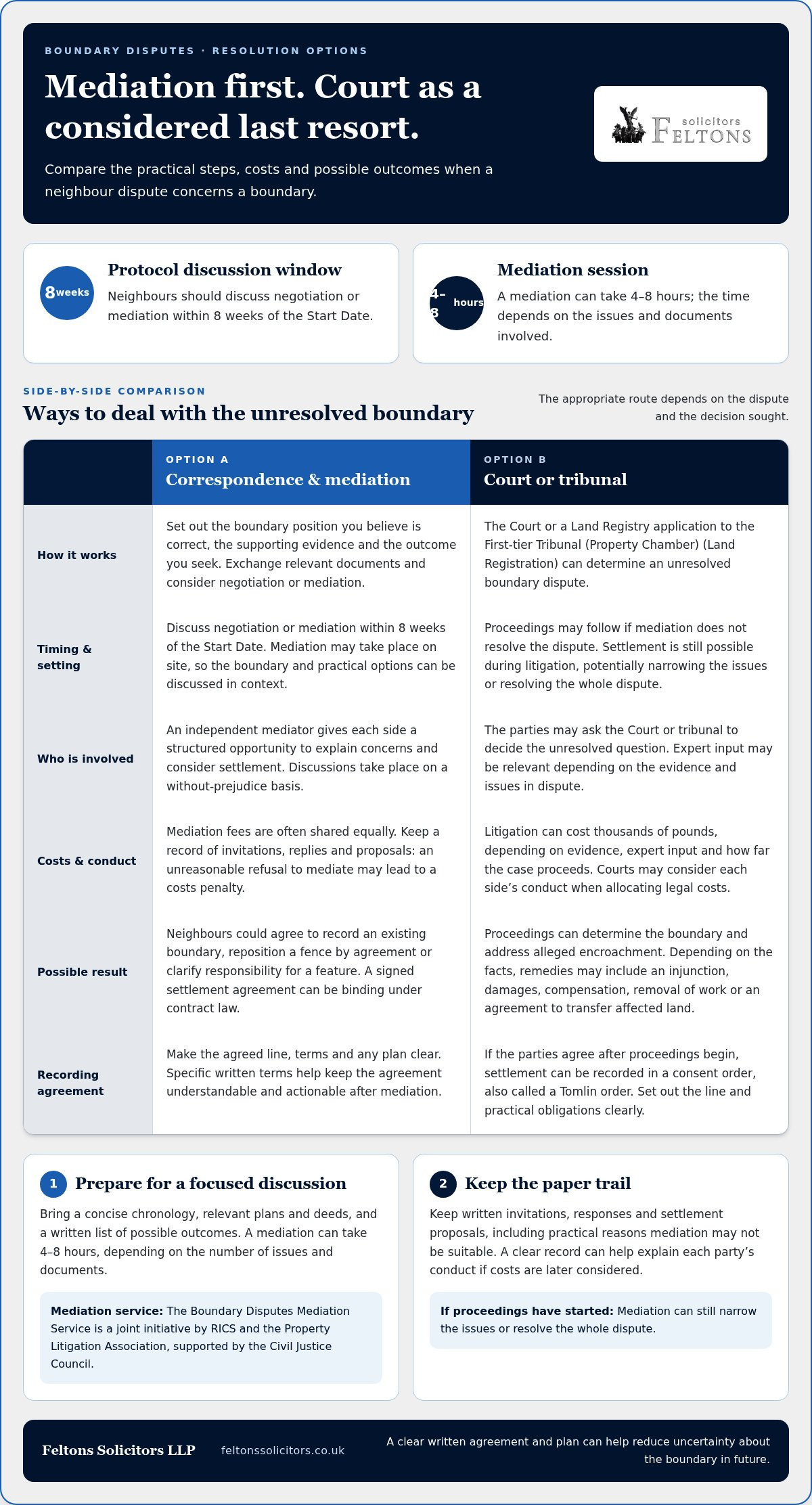
Mediation is recommended before court, and boundary proceedings should be a last resort after the parties have tried alternative dispute resolution. A party who unreasonably refuses mediation may face a costs penalty, even if they later succeed on the boundary question. Courts can consider each side’s conduct when deciding who should bear the legal costs, so a clear written invitation and a reasoned response matter.
In Huntley v Armes, cited by the Court of Appeal (Civil Division) as [2010] EWCA Civ 396, the dispute concerned a strip measuring 14 inches. The case is a reminder that a small area can still lead to formal proceedings and cost consequences. Keep records of proposals, replies and any practical reasons mediation may not be suitable; those details can help explain your conduct if a judge later considers costs.
The Boundary Disputes Protocol identifies the Court or a Land Registry application to the First-tier Tribunal (Property Chamber) (Land Registration) as routes for determining an unresolved boundary dispute. The appropriate route depends on the nature of the dispute and the decision sought. A solicitor can advise on the process, evidence and remedies relevant to your rights before you make an application.
Starting proceedings does not rule out settlement. The parties can mediate during litigation, potentially narrowing the issues or resolving the whole dispute. If they agree, the settlement can be recorded in a consent order, also called a Tomlin order, once proceedings have begun. Set out the agreed line and practical obligations clearly, rather than relying on an informal conversation or ambiguous sketch.
Where the dispute involves building work near a shared wall, distinguish boundary questions from party-wall issues. The Party Wall Act 1996 concerns building work affecting shared structures between two properties, according to UK Parliament. UK Parliament also identifies a 3 metre provision as a frequently misunderstood component of the Party Wall etc Act 1996. That provision should not be treated as deciding ownership of a disputed strip of land.
Court proceedings can determine the boundary and address alleged encroachment. Depending on the facts, possible remedies include an injunction, damages, compensation, removal of work or an agreement to transfer affected land. If construction is still under way, prompt advice may preserve more practical options. Planning permission or building regulations approval does not itself give a neighbour ownership of, or a right to build on, your land.
Before escalating, organise the title documents, photographs and a concise chronology of events. Identify the outcome you want, such as confirming the boundary, stopping work or recording an agreement. Then consider whether negotiation or mediation could achieve that outcome without a final hearing. If the other party declines, keep a record of their reasons and your response; the courts may consider that conduct when allocating costs.
Alternative dispute resolution
Mediation is one route to a practical agreement, alongside focused correspondence and expert discussions. If it fails, the parties can still pursue litigation, which can cost thousands of pounds depending on the evidence, expert input and issues in dispute. A solicitor handling boundary dispute mediation in the UK can help assess which route best fits the unresolved points.
Correspondence and mediation
Start with a clear letter setting out the boundary position you believe is correct, the evidence supporting it and the outcome you seek. Neighbours can then exchange relevant documents and consider whether negotiation or mediation could resolve the difficult points. Under the Boundary Disputes Protocol, they should discuss negotiation or mediation within 8 weeks of the Start Date.
Mediation gives each side a structured opportunity to explain its concerns and consider a settlement with an independent mediator. Discussions take place on a without-prejudice basis, and mediation fees are often shared equally. Boundary mediations can take place on site, helping everyone discuss the precise line and practical options in context.
The Boundary Disputes Mediation Service is a joint initiative by RICS and the Property Litigation Association, supported by the Civil Justice Council. A mediation can take 4-8 hours, though the time depends on the number of issues and documents involved. Prepare a concise chronology, relevant plans and deeds, and a written list of possible outcomes before the meeting. For neighbours considering boundary dispute mediation in the UK, this preparation helps keep discussion focused on achievable terms.
Keep proposals specific. Neighbours might, for example, agree to record an existing boundary, reposition a fence by agreement or clarify responsibility for a feature. A signed settlement agreement can be binding under contract law. Make its terms and any plan clear, so the agreement remains understandable and actionable after mediation ends.
Options after unsuccessful mediation
The Boundary Disputes Protocol identifies the Court or the First-tier Tribunal (Property Chamber) (Land Registration), by way of a Land Registry application, as routes for determining an unresolved boundary dispute. The next step depends on what remains disputed, the available evidence and the decision needed.
Litigation can cost thousands of pounds. The expense depends on how much evidence must be gathered, whether expert reports are needed and how far the case proceeds. Court proceedings may also result in a costs decision, so keep mediation invitations, responses and settlement proposals to show how each party approached dispute resolution.
When legal advisers are instructed after the initial 8-week period, the Protocol says they should consider whether further negotiation or mediation is appropriate and inform the other party within 2 weeks of appointment. For advice on the legal route and next steps, explore dispute resolution support.
Land Registry title plans and legal boundaries
A boundary solicitor reviews title documents and evidence, explains the issues and advises on practical next steps. To find a specialist near you, look for experience in property disputes and boundary evidence, rather than relying on distance alone.
Finding the legal boundary
Start by comparing the Land Registry title plan with the deeds and physical features on the ground. Most registered properties in England and Wales follow the general boundaries rule, so a title plan usually indicates a boundary’s general position rather than its precise measurement. A line on the plan may represent several metres on the ground, so it may not settle a disagreement by itself.
Check whether the official copies record a boundary agreement or formal boundary determination. These can be exceptions to the general guide shown by a title plan. Ordnance Survey maps physical features, not legal boundaries, and its mapping is not precise enough to establish ownership on its own.
Legal and surveying advice
An initial legal assessment brings the available documents together and identifies what remains disputed. A solicitor can compare the title plan, deeds, correspondence and neighbours’ accounts, then advise whether negotiation, a boundary agreement or further evidence may help. This also clarifies the outcome you are seeking, such as confirming the existing line or resolving a claim over land.
If comparing documents does not resolve the position, a specialist surveyor can interpret measurements, historic features and how plans relate to the ground. Consider carefully whether that expertise is needed before instructing an expert, since involving one too early can add considerable expense. The key question is whether a surveyor’s independent analysis would answer an unresolved point.
Risks of moving a fence or wall
Moving a fence does not automatically change the legal boundary or transfer ownership. If a neighbour’s new fence appears to cross the line, moving it back before establishing the boundary can escalate the dispute and complicate a later settlement. Record its location with dated photographs and preserve relevant correspondence before taking physical action.
A solicitor can assess the evidence and explain how a proposed change might affect the parties’ positions. If the dispute concerns building work, distinguish ownership from planning permission or building regulations approval. Those approvals do not themselves give someone ownership of, or a right to build on, neighbouring land.
Boundary litigation can become costly, particularly if the parties need expert reports or a court determination. The eventual expense depends on the issues, evidence and how far proceedings progress, so an early assessment can identify what needs clarification before litigation is considered. Record any settlement clearly, with an accurate plan, to reduce the risk of the same uncertainty returning when either property is sold.
Gathering evidence and interpreting title deeds
Build a clear record before discussing the boundary with the other owners. Comparing title documents with historic features and evidence from the ground can help identify where accounts differ.
Land Registry plans and boundary evidence
Use the Land Registry title plan as one part of the evidence, not as a precise survey. Most registered properties in England and Wales are subject to the general boundaries rule, so a plan usually shows the boundary’s general position. A line may represent several metres on the ground.
Compare the plan with the physical features it may relate to, such as a wall, hedge or old fence line. Ordnance Survey maps show physical features rather than legal boundaries, so they cannot settle ownership by themselves. Record any difference between the mapped line and what you see on site.
Evidence used to establish a boundary
Gather documents and observations that may explain how the boundary was created and treated over time. Useful material can include title plans, conveyance documents, dated photographs, correspondence between owners and details of historic features on the land. Keep each item in date order and note what it shows.
Boundary disputes can involve deeds 150 years old. Pre-registration deeds may contain a plan or a detailed written description, and those details can be compared with the present layout. A surveyor can help interpret measurements, historic features and the relationship between documents and conditions on the ground.
Make a short chronology of events, including when a fence was installed, repaired or moved, and when either party first objected. Label photographs with their dates and viewpoints. If a previous owner discussed the boundary, preserve letters or messages and identify anyone who witnessed the conversation.
The Boundary Disputes Protocol sets out practical steps for exchanging material. Neighbours should assemble and exchange relevant documents within 4 weeks of the Start Date. After identifying the First Conveyance, parties should exchange documentary evidence and identify proposed witnesses within 3 weeks.
These steps help both parties see which points are agreed and which remain disputed. For example, documents might establish the original line, while photographs show that a later fence was placed elsewhere. Discuss the difference before deciding whether further expert evidence is needed.
Keep the evidence organised in a shared schedule: list each document, its date, its source and the point it supports. Separate direct evidence, such as a deed plan, from interpretation, such as what a physical feature may indicate. This helps owners discuss the same material and consider whether a boundary agreement or further assessment could resolve the disagreement.
Boundary disputes
Boundary disputes can involve a fence, a wall, building work or long occupation of disputed land. Procedures differ across the UK: the Boundary Disputes Protocol and Land Registry routes discussed here concern England and Wales, not Scotland or Northern Ireland.
Start by defining the issue and the outcome you want. Is the disagreement about the boundary’s position, ownership of a strip, responsibility for a shared feature or construction crossing the line? These questions can overlap, but may require different evidence and remedies. For example, an extension built across a boundary raises questions about the land occupied and whether work should stop or be removed.
Long use of land can also complicate a claim. In England and Wales, a new-style adverse possession claim may rely on a condition in Schedule 6 paragraph 5 of the Land Registration Act 2002. That makes it important to distinguish a claim based on occupation from a disagreement about interpreting a deed. Gather evidence of how the land was used and who controlled it, then identify the specific basis of each party’s position.
A surveyor’s role is to provide independent evidence on physical features, measurements and how documents relate to conditions on the ground. The Boundary Disputes Protocol says expert instructions should follow CPR Part 35.3, according to the Civil Procedure Rule Committee. Under that rule, the expert’s duty to help the tribunal overrides obligations to the person instructing or paying them. Their opinion should address the issue, not advocate for either neighbour.
Before commissioning expert work, set out the question the surveyor must answer and the material they need. If the parties jointly appoint an expert, agree the instruction and provide relevant documents consistently. A concise report focused on the disputed line can help narrow complex disagreements. If litigation follows, a boundary surveyor may need to prepare a CPR-compliant expert report for the court.
Possible outcomes depend on the claim. They may include an agreed boundary, an injunction, damages, compensation, removal of encroaching work or a formal transfer of affected land. A boundary agreement can record where the existing legal boundary lies, but cannot be used to give or sell land to a neighbour. If ownership of land is changing, the parties may need a formal transfer instead.
Set out the unresolved issue, evidence and outcome you want before choosing the next step. Discuss your boundary dispute and the legal options available for resolving it.
Feltons Solicitors LLP: Divorce and Financial Arrangements
Feltons Solicitors LLP provides residential and commercial conveyancing when resolving a boundary issue involves a formal transfer of land. A boundary agreement records where the existing legal boundary lies; it cannot itself give or sell land to a neighbour. If a proposed settlement changes ownership, conveyancing support can help with the property transaction involved.
Before taking that step, establish whether the agreement confirms the existing line or transfers part of a title. Keeping that distinction clear helps ensure the paperwork reflects what both owners have agreed. For help with a property transaction arising from a boundary settlement, contact Feltons Solicitors LLP.
Take a considered next step
A boundary disagreement can affect more than the line on a plan. It may shape how neighbours use their gardens, maintain shared features and approach future property decisions. Before agreeing a way forward, set out the outcome you need and consider how the agreement will be recorded and understood by future owners.
Solicitors handling boundary dispute mediation in the UK can help you assess the legal issues and identify a practical route towards resolution. Feltons Solicitors LLP also advises on divorce and financial arrangements, wills, probate and estate planning, and residential and commercial conveyancing. Conveyancing may be relevant if resolving the dispute involves transferring part of a title.
If you’re ready to discuss your circumstances and possible next steps, contact Feltons Solicitors LLP. A clear starting point can help you approach the dispute with greater confidence.
Frequently Asked Questions
Establishing where the boundary actually is?
Compare the registered title, any filed deeds and the history of the disputed strip, rather than relying on a fence line alone. Note where fixed features sit and whether earlier photographs or conveyancing records show a different arrangement. A useful first step is to mark the disputed section on a copy of the plan, then list the documents or observations that support each neighbour’s position. This focuses discussions on evidence, not assumptions.
How long will it take to resolve a dispute?
There is no single timetable for a boundary dispute: the time depends on the issues, available documents and whether an agreement is reached. A mediation can sometimes resolve the dispute in 4-8 hours, but preparing for it and recording an agreement take additional time. If parties need expert reports or a court decision, the process will involve further steps. Set a practical aim for each stage, such as exchanging documents or narrowing disputed points.
Is the mediation outcome binding?
A settlement recorded in an agreement signed by both parties is binding, and a formal settlement agreement can be enforced under contract law. Before signing, make sure the written terms match the decision reached: identify the boundary clearly, describe any agreed work or responsibilities, and attach a plan both parties understand. If court proceedings have already begun, the settlement may be recorded in a consent order, also called a Tomlin order.
What happens if an agreement cannot be reached?
If mediation does not produce an agreement, the parties can continue negotiating or seek a formal decision through court proceedings or an application to the First-tier Tribunal (Property Chamber) (Land Registration). The next step depends on the unresolved issue and the decision needed. Before proceeding, list the points that are agreed, those still contested and the evidence supporting each position. This can help keep any later application focused.
What if the neighbour has used the land for years?
Long occupation can be relevant, but it does not by itself resolve a boundary disagreement. In England and Wales, a neighbour’s use of land may raise an adverse possession issue, even where the registered title appears to include that land. Record how the area has been occupied, maintained or enclosed, and whether permission was given. Dates, historic photographs and correspondence can help distinguish a long-standing arrangement from a later change in position.
Who can apply for mediation?
Either neighbour can propose mediation, and both parties need to participate for a jointly agreed settlement to emerge. A written proposal can identify the disputed area, the outcome sought and the documents each side should bring. The Boundary Disputes Protocol says neighbours should discuss whether to negotiate or mediate within 8 weeks of its Start Date. Legal advisers can also consider whether further mediation is appropriate when instructed later.
Who pays the fees?
Mediation fees are often shared equally between the parties, though they can agree another arrangement. Clarify who will pay which share before arranging the session, and establish how separate expenses, such as expert input, will be handled. Keep a written record of that agreement. If the dispute later reaches court, a judge may also consider whether either party unreasonably refused mediation when deciding costs.
How much do UK boundary dispute solicitors charge, and what are typical costs?
Solicitor fees depend on the case and are provided after a quote request; the main cost factors include the work required, the complexity of the dispute, the evidence and whether expert reports or court proceedings are involved. Boundary disputes can run into thousands of pounds to resolve legally, with litigation generally adding further stages and expense. Mediation may help contain costs, but its suitability depends on what remains disputed.