
Pulmonary Fibrosis Compensation Claims: A 2026 Guide

Pulmonary Fibrosis Compensation Claims: A 2026 Guide

Could pulmonary fibrosis diagnosed years after leaving work still be linked to workplace exposure? For some people, past contact with harmful dust, fumes or chemicals may be relevant to pulmonary fibrosis compensation claims. However, a diagnosis alone doesn’t establish that a claim is possible. The circumstances and evidence matter.

It’s understandable to be unsure where to begin, particularly if an employer has closed, work records are hard to find or you’re concerned about deadlines. A careful assessment considers whether the condition may be connected to workplace exposure and whether an employer may have failed to take reasonable steps to protect you.

This 2026 guide explains the potential basis for a claim, the medical and employment records that may help, and why expert evidence can matter. It also outlines issues to consider when seeking legal advice, including limitation periods, which depend on the relevant UK jurisdiction and individual circumstances. The aim is to help you consider possible next steps without assuming that every case will qualify.

Key Takeaways

  • A pulmonary fibrosis diagnosis alone doesn’t establish that workplace exposure caused the condition or that compensation is available.
  • Pulmonary fibrosis compensation claims may depend on evidence connecting the diagnosis and exposure history to a potentially responsible employer.
  • If records are incomplete, start building a work-history timeline and look for other sources that may help reconstruct past exposure.
  • Prioritise medical care, then preserve relevant employment records and correspondence for an informed assessment.
  • When speaking with a solicitor, ask about their occupational-disease experience, how they assess evidence and whether your circumstances fit their expertise.

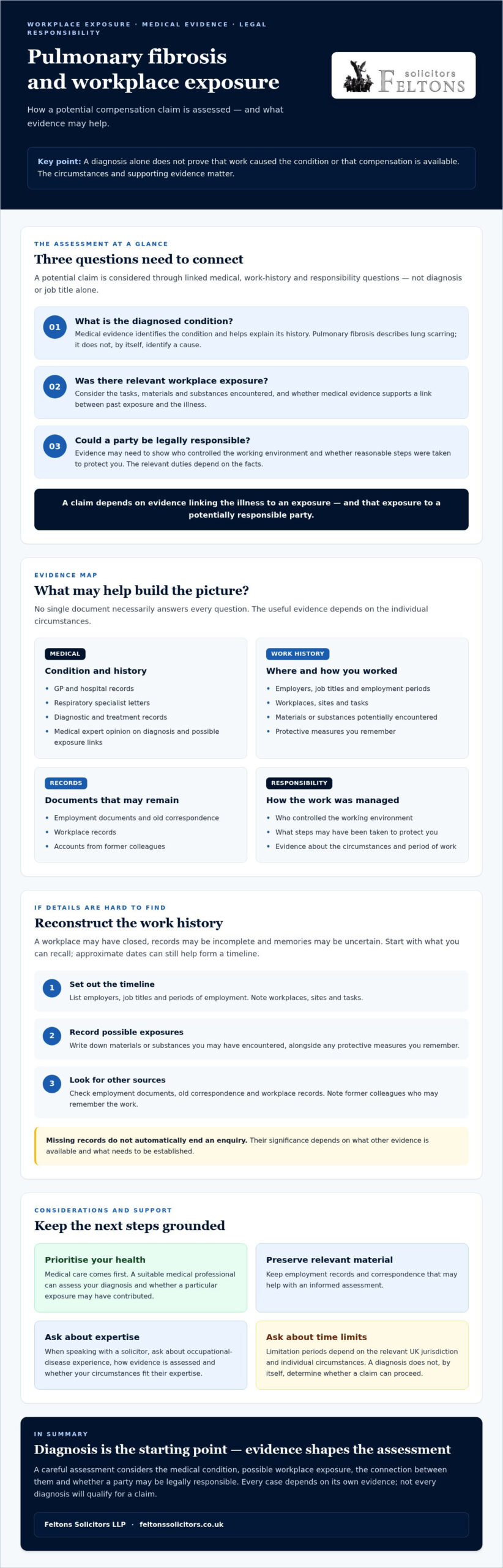
A pulmonary fibrosis diagnosis can raise difficult questions, especially if you’ve worked around dust, fumes or other substances. The diagnosis is a starting point for investigation, not proof that work caused the illness or that compensation is due. A claim may warrant assessment if the available evidence suggests workplace exposure caused or materially contributed to the condition and a party may be legally responsible for that exposure.

What does pulmonary fibrosis mean in a compensation claim?

Pulmonary fibrosis describes scarring in the lungs. As scar tissue builds up, lung tissue can become thicker and stiffer, making it harder for oxygen to pass into the bloodstream. The term describes a change in the lungs, rather than one single cause. Some cases have no identifiable cause; others may be associated with an underlying disease, treatment or exposure. The Pulmonary fibrosis overview provides background, but it can’t determine what caused an individual’s condition.

Diseases that involve lung scarring aren’t interchangeable. A diagnosis such as idiopathic pulmonary fibrosis (IPF) has a different meaning from a condition linked to a known cause. Only an appropriate medical professional can assess an individual diagnosis and whether a particular exposure may have contributed.

When can workplace exposure become legally relevant?

Past work may be relevant if a person encountered a potentially harmful substance and medical evidence supports a connection with their illness. Dust, fumes or chemicals may form part of that investigation. But identifying an exposure alone doesn’t establish that it caused the condition or that an employer was at fault.

In short: a diagnosis identifies the medical condition; occupational causation concerns whether work exposure caused or materially contributed to it; legal responsibility asks whether a party can be held accountable on the evidence.

These questions need to be considered together. A solicitor may examine the tasks involved, when and where exposure occurred, who controlled the working environment, and what records or witness accounts remain. The relevant legal duties and potential responsibility depend on the facts, including the period and circumstances of the work. Pulmonary fibrosis compensation claims aren’t decided by diagnosis or job title alone. Medical evidence, exposure history and evidence about responsibility all matter.

How do pulmonary fibrosis claims connect diagnosis, exposure and responsibility?

A claim is assessed through several connected questions, not a single document or recollection. The evidence needs to establish the diagnosed condition, the person’s exposure history, whether that exposure caused or materially contributed to the illness, and whether a party may be legally responsible. A claim depends on evidence linking the illness to an exposure and that exposure to a potentially responsible party.

What medical evidence may help assess a claim?

Relevant material may include GP and hospital records, letters from respiratory specialists, diagnostic reports and treatment records. A solicitor can advise which documents may assist in a particular case. Medical experts may also be asked to consider the diagnosis and whether the available evidence supports a possible link with past exposure. The evidence needed will depend on the individual circumstances.

Medical records can confirm a diagnosis and help explain its history, but they don’t, on their own, establish who caused the illness or whether an employer breached a legal duty. Those are separate questions that require evidence about work and responsibility as well as medical opinion.

How can someone reconstruct a past exposure history?

When work took place many years ago, details can be difficult to recall and records may be incomplete. Start with a timeline, even if some dates are approximate. Note:

  • Employers, job titles and periods of employment.
  • Workplaces, sites, tasks and materials or substances potentially encountered.
  • Protective measures you remember, and the names of former colleagues who may recall the work.

Possible sources include employment documents, old correspondence, workplace records and accounts from people who worked alongside you. Don’t assume that a missing file ends the enquiry. Its importance depends on what other evidence exists and what needs to be established.

Keep the different strands of evidence distinct. A work record may help show where and when you worked, but it won’t necessarily prove exposure or medical causation. A medical report may explain the illness without identifying a legally responsible party. Pulmonary fibrosis compensation claims therefore require the evidence to be considered as a whole, with gaps and uncertainties assessed rather than assumed away.

Some people also want to check whether a state benefit may be relevant. GOV.UK explains the eligibility rules for Industrial Injuries Disablement Benefit. Eligibility depends on the prescribed disease and personal circumstances, and the benefit route is distinct from establishing legal liability in a compensation claim.

If you’d like to understand whether your exposure history and available records fit a firm’s experience, you can discuss the evidence and relevant legal issues with Feltons Solicitors LLP. The firm handles personal injury claims, including specialist silicosis litigation, and can assess whether the circumstances are relevant to its experience.

Can I make a pulmonary fibrosis compensation claim if proof is difficult?

Difficulty tracing past exposure doesn’t automatically rule out a claim, but evidence remains central. A long interval between work and diagnosis can make the link feel hard to prove, but it doesn’t answer by itself whether a claim is possible. The strength of a case depends on what can be established about the illness, potential exposure, medical causation and legal responsibility.

There isn’t a single test for eligibility. Each case needs an individual assessment, taking account of the medical evidence, available work history, applicable law and whether a potentially responsible party can be identified. A solicitor can review what is available, explain where evidence may be incomplete and consider whether further enquiries could help. That assessment can clarify the issues, but it can’t guarantee that a claim will proceed or succeed.

What if an employer or work records are no longer available?

Old employers may have closed, changed names or no longer hold relevant records. Other sources may still provide useful detail, such as personal papers, payslips, photographs, correspondence, former colleagues’ recollections or archived workplace information. A solicitor may also investigate whether a potentially responsible organisation or relevant insurer can be traced, but this isn’t always possible.

Record what you remember, even if dates or job details are uncertain. Note the roles you held, places you worked, tasks you carried out and substances or materials you recall encountering. Be clear about what you know first-hand and what you’re unsure of. Missing documents don’t settle the question either way; their significance depends on the wider evidence and what a case needs to prove.

Does a diagnosis automatically mean compensation is available?

No. A diagnosis confirms a medical condition, but it doesn’t establish that work caused or contributed to it, or that another party is legally responsible. Pulmonary fibrosis can have different causes, and appropriate medical experts may need to consider the diagnosis and possible explanations alongside the person’s exposure history.

That’s why pulmonary fibrosis compensation claims shouldn’t be judged on assumptions based on a job title, a remembered substance or the time between exposure and diagnosis. An individual assessment can help distinguish what the evidence supports from what still needs investigation. If you’re uncertain, gather the information you can and ask a solicitor to assess the available material, remaining gaps and relevant legal issues before drawing conclusions about entitlement.
Pulmonary Fibrosis Compensation Claims: A 2026 Guide

What steps should I take to start a pulmonary fibrosis claim?

Start with your health, not paperwork. Continue to seek medical care and follow advice from your healthcare team; gathering information for a possible claim shouldn’t delay treatment. You don’t need to prove legal causation yourself. A clear account of your work and the records you can locate can help a solicitor identify what may need further investigation.

What information should I prepare before speaking to a solicitor?

Begin with a simple timeline and add to it as you remember details. Approximate dates are useful if exact ones aren’t available. Keep copies of relevant documents, but don’t worry if your file is incomplete.

  • Step 1: Note your diagnosis, when you received it, and any relevant medical appointments, reports or correspondence you have.
  • Step 2: List employers, job roles, work locations and approximate dates, including periods when you may have encountered dust, fumes or other substances.
  • Step 3: Gather available supporting material, such as employment records, payslips, workplace documents or correspondence, and note former colleagues who may remember the work.
  • Step 4: Write down questions and uncertainties, including gaps in dates or details you can’t recall clearly. Don’t guess or try to decide what caused the condition.

An initial review can help identify which information may be relevant and what else might be needed. Preserve records and correspondence where you can, but medical care comes first.

Why should I check the time limit promptly?

Personal injury limitation rules may apply, but the relevant deadline can depend on when you became aware of the injury and its possible connection to work, alongside other facts. Rules also differ across UK jurisdictions, so don’t assume a deadline based on general guidance alone. A solicitor can check which rules apply to your circumstances and whether any time limit may affect the next steps.

Don’t assume that ongoing symptoms, delayed diagnosis or discussions with an employer automatically pause a deadline. If you’re considering pulmonary fibrosis compensation claims, seek case-specific legal advice promptly rather than waiting until every record has been found. Early advice can help clarify the issues while you continue to focus on your health.

Feltons Solicitors LLP handles personal injury claims, including specialist silicosis litigation. To discuss whether your work history and available records fit the firm’s experience, contact Feltons Solicitors LLP about your circumstances.

Occupational disease cases can involve medical questions, old employment histories and evidence about who was responsible for working conditions. The right solicitor should be able to explain how they’ll assess those issues, what remains uncertain and how they’ll keep you informed. Ask questions before deciding whether to instruct a firm, and make sure you understand the proposed approach.

What should I ask a solicitor before instructing them?

Ask for clear, practical answers about the work involved. For example:

  • What experience does the firm have with occupational disease claims, and how would it investigate my exposure history?
  • How would it assess medical causation and identify any potentially responsible parties?
  • Who would handle my matter, how would updates be provided, and how would important decisions be discussed?
  • What funding arrangements may be available, and how would fees, disbursements and any other costs apply to my circumstances?

Ask for costs and funding information in writing before deciding. Arrangements vary, so don’t assume that a particular funding option is available or suitable. A solicitor should explain the terms relevant to your case in language you can follow.

How can Feltons Solicitors LLP assess whether its experience is relevant?

Feltons Solicitors LLP handles personal injury claims, including specialist silicosis litigation, as well as complex disputes. That experience may be relevant where the facts connect with the firm’s occupational-disease work, but it doesn’t establish that every pulmonary fibrosis matter falls within its expertise. Relevance depends on the individual diagnosis, suspected exposure, available evidence and legal issues.

An initial discussion can help clarify what is known, what may need investigation and whether the circumstances fit the firm’s experience. Ask directly about Feltons Solicitors LLP’s current expertise in relation to your particular condition and any suspected workplace exposure, and what the next steps would involve.

Readers considering a related issue may also find the guide Silicosis Claim After Death: A Legal Guide for Bereaved Families in 2026 useful. It concerns a different occupational disease and situation, so it shouldn’t be taken as an indication that the legal issues or outcome will be the same.

If you’d like to discuss your exposure history, available evidence and relevant legal questions with Feltons Solicitors LLP, Discuss your circumstances with Feltons Solicitors LLP. The discussion can help establish whether the firm’s experience is relevant; it can’t determine the outcome of a claim in advance.

Take a considered next step

A pulmonary fibrosis diagnosis doesn’t, by itself, establish that work caused the condition or that compensation is available. A potential claim needs evidence connecting the medical diagnosis with workplace exposure and a legally responsible party. Where old records are missing or the link is uncertain, an individual review can help identify what is known and what may need further investigation.

If you’re considering pulmonary fibrosis compensation claims, keep relevant medical and employment information, write down what you remember and seek case-specific advice about evidence and time limits. Don’t delay medical care while gathering documents.

Feltons Solicitors LLP handles personal injury claims, including specialist silicosis litigation, and provides pragmatic advice on complex disputes. An initial discussion can help assess whether your circumstances fit the firm’s relevant experience, without assuming eligibility or an outcome. Discuss your circumstances with Feltons Solicitors LLP and take the next step with a clearer understanding of your options.

Frequently Asked Questions

Can I claim compensation for pulmonary fibrosis caused by workplace exposure?

Possibly, if evidence supports a connection between workplace exposure and your condition, and establishes that a party may be legally responsible. A diagnosis alone doesn’t prove either point. Pulmonary fibrosis compensation claims are assessed individually, taking account of medical opinion, work and exposure history, available records and applicable law. A solicitor can review what you know and explain whether further investigation may be needed, without guaranteeing eligibility or an outcome.

How do I prove that work caused my pulmonary fibrosis?

You’ll generally need evidence about the diagnosis, potential workplace exposure, medical causation and responsibility. Useful material may include medical records and reports, a timeline of employers and roles, workplace documents, correspondence and recollections from former colleagues. Medical experts may be asked to consider possible causes, while a solicitor assesses the legal evidence. No single record necessarily proves the whole case, and the evidence required depends on your circumstances.

Is pulmonary fibrosis the same as silicosis?

No. Pulmonary fibrosis describes scarring in lung tissue, whereas silicosis is a specific lung disease associated with breathing in respirable crystalline silica dust. The terms aren’t interchangeable, although lung scarring may be relevant to different diseases. A medical professional must assess an individual’s diagnosis and possible cause. Feltons handles personal injury claims, including specialist silicosis litigation, but that doesn’t mean every pulmonary fibrosis condition falls within its current expertise.

How long do I have to make a pulmonary fibrosis compensation claim?

Personal injury claims generally have a three-year time limit, often linked to when the injury and its possible connection to work became known. This isn’t a universal answer: the relevant rules may depend on your circumstances and UK jurisdiction. Don’t assume that ongoing symptoms, delayed diagnosis or discussions with an employer pause a deadline. Seek prompt, case-specific advice so a solicitor can check which limitation rules apply to you.

Can I make a claim if my former employer has closed?

A former employer closing down doesn’t necessarily rule out a claim, but it can make identifying the responsible party more complex. A solicitor may investigate whether relevant historical records or an insurer can be traced, alongside other evidence such as personal papers and former colleagues’ accounts. There’s no guarantee that an organisation, insurer or document will be found. The available evidence and legal position need to be assessed individually.

What should I do first if I suspect work contributed to pulmonary fibrosis?

Continue with medical care and follow your healthcare team’s advice. Then make a timeline of your employers, roles, work locations and any substances you remember encountering. Keep relevant medical, employment and workplace records, and note gaps or questions rather than trying to prove causation yourself. Consider seeking legal advice promptly, as limitation rules may apply. An initial assessment can help clarify which evidence may assist and what further information might be needed.

Party Wall Dispute Legal Advice: When to Get Help

Party Wall Dispute Legal Advice: When to Get Help

The most useful first step in a party wall dispute may not be a formal legal letter. If you’re unsure whether the Party Wall etc. Act 1996 applies, or building work is about to begin without agreement, it’s understandable to feel you need to act quickly. Sound party wall dispute legal advice can help you clarify your options and risks before the disagreement escalates, without treating every concern as a court case.

This article explains how to check the position and what to do if work has started or you haven’t received a clear response. You’ll learn which documents to gather, how a party wall surveyor’s role differs from a solicitor’s, and when each may be useful. It also explains how to approach the next step proportionately, keep a clear record and protect your position. Legal advice can help you understand your rights and routes forward, but it doesn’t replace a surveyor’s role in the Act’s dispute process. If you’re considering a solicitor, first confirm they can assist with your particular issue.

Key Takeaways

  • Check whether the proposed work may fall within the Party Wall etc. Act 1996 before treating the matter as a general boundary disagreement.
  • Keep copies of notices, plans and correspondence. Then check what work is planned and whether the relevant notice and response steps have been followed.
  • A party wall surveyor deals with the statutory process; a solicitor can help explain legal options and wider dispute-resolution risks. One does not automatically replace the other.
  • Use party wall dispute legal advice to clarify your position, understand possible next steps and decide whether specialist input is proportionate.
  • Before instructing an adviser, ask about their relevant experience, the scope of help they can provide, the likely process and the information they’ll need from you.

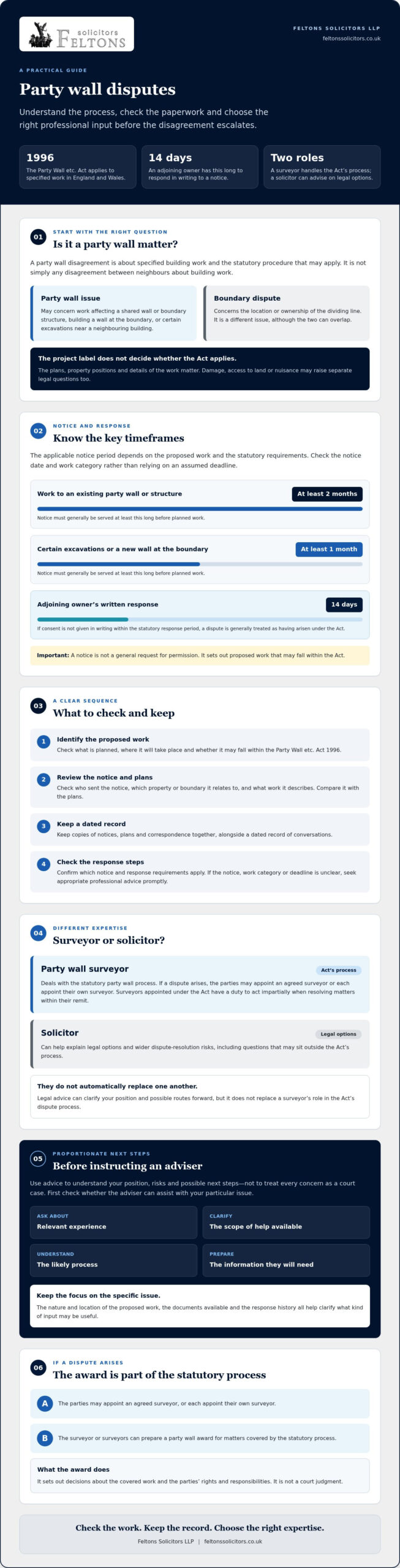
A party wall disagreement is not simply any dispute between neighbours about building work. It concerns work that may fall within the Party Wall etc. Act 1996, the framework for specified work in England and Wales. A statutory party wall matter may arise when work covered by the Act affects a shared wall, a boundary structure or nearby land, and the owners need to follow the relevant procedure.

A party wall dispute concerns the statutory process for specified building work; a general boundary dispute concerns where ownership or the property line lies. The issues can overlap, but they are not interchangeable. The Act does not apply to every renovation or neighbour disagreement, so the nature and location of the proposed work matter. The Party Wall etc. Act 1996 offers background on the legislation, but the particular facts still need to be assessed.

What kinds of work can raise a party wall issue?

Depending on the circumstances, the Act may apply to work directly affecting a party wall or structure, building a wall at the boundary, or certain excavations near a neighbouring building. Calling a project an extension or loft conversion doesn’t establish whether the Act applies. The plans, the properties’ positions and the details of the work all matter.

Check the proposed work and property circumstances before assuming that a notice is or isn’t required. If the scope is unclear, a qualified party wall professional can assess the building work and its relationship to the Act.

Is this a party wall matter or another property dispute?

A boundary disagreement concerns the location or ownership of the dividing line. A party wall issue concerns specified work and the procedure that may govern it. Concerns about damage, access to land or nuisance may raise separate legal questions, even when they relate to the same building project.

One situation can therefore call for more than one kind of input. A party wall surveyor may be relevant to the Act’s process, while a solicitor may help assess wider legal rights or dispute-resolution options. Party wall dispute legal advice can help identify which questions need attention, but a short online description cannot determine your rights. Keep the plans and correspondence together, and seek advice based on the full circumstances before taking a position.

How the party wall process works: notices, responses and awards

The process depends on the proposed work and whether the relevant notice has been served. A notice is not a general request for permission. It sets out proposed work that may fall within the Party Wall etc. Act 1996. The applicable notice period and response timetable depend on the proposed work and the statutory requirements that apply.

For example, the research for this guide confirms that notice for work to an existing party wall or structure must generally be served at least two months before work is planned, while notice for certain excavations or a new wall at the boundary must generally be served at least one month beforehand. An adjoining owner has 14 days to respond in writing. Check the notice date and work category carefully, and seek advice if either is unclear.

What should an owner do after receiving a party wall notice?

Start by checking who sent the notice, what work it describes and which property or boundary it relates to. Compare it with any plans you’ve received, then keep copies of the documents together with a dated record of conversations and correspondence. GOV.UK’s Party walls and building work guidance provides practical information about the process.

Don’t rely on an assumed deadline or respond without checking what the notice requires. The relevant period may depend on the notice and the work involved. If you’re unsure how to respond, obtain appropriate professional advice promptly.

What happens if an adjoining owner dissents or does not respond?

If the adjoining owner doesn’t consent in writing within the statutory response period, a dispute is generally treated as having arisen under the Act. The parties may then appoint an agreed surveyor, or each appoint their own surveyor. Surveyors appointed under the Act have a duty to act impartially when resolving matters within their remit.

Where the statutory process applies, the surveyor or surveyors can prepare a party wall award. This document sets out decisions about the covered work and the parties’ rights and responsibilities. It isn’t a court judgment, although it is legally binding. An award may be appealed to the county court within 14 days of service.

The sequence depends on the circumstances. If a notice wasn’t served, the Act’s surveyor procedure may not be available, and the appropriate route can differ. Party wall dispute legal advice may help clarify wider legal options, but it doesn’t replace a surveyor’s role in the statutory process. For related property or dispute questions, you can ask Feltons Solicitors about its property and dispute resolution services and whether it can assist with your specific issue.

Party wall surveyor or solicitor: which advice do you need?

The right professional depends on the question you need answered. A party wall surveyor deals with matters within the Party Wall etc. Act 1996 process, while a solicitor can advise on legal rights, how the Act may apply and wider dispute-resolution options. Their roles differ. Instructing a solicitor doesn’t automatically replace a surveyor appointed under the Act.

Use this comparison to identify a sensible first question:

Your concern Professional who may help Suitable first question
How proposed work should be dealt with under the Act, or what an award should address Party wall surveyor “Does this work fall within your remit under the Act?”
Uncertainty about legal rights, alleged damage, access or possible court action Solicitor, subject to confirming relevant experience and service scope “Can you advise on this issue, and what documents do you need to assess it?”
Questions about both the statutory process and wider legal rights Potentially both, with each professional’s role agreed clearly “Which parts of the matter can you advise on, and who should address the others?”

When is a party wall surveyor usually the relevant professional?

A surveyor is generally the relevant professional for resolving matters within the Act’s procedure, including considering the works and preparing or dealing with a party wall award. Surveyors appointed under the Act must act impartially in that process, rather than simply advocate for the person who appointed them. Before proceeding, check the surveyor’s appointment, precise remit and how the statutory role applies to your circumstances.

A surveyor’s role doesn’t automatically extend to deciding who owns a disputed strip of land, interpreting every property agreement or resolving all questions about access. Those issues may need separate legal input.

When may party wall dispute legal advice be useful?

Legal advice may help if you’re unsure how the legislation applies, damage is alleged, access is contested or someone threatens legal proceedings. A solicitor can review the documents, explain potential options and risks, and help you understand whether the issue extends beyond the surveyor-led process. Seeking advice doesn’t mean you’ve committed to going to court. Early clarity may help you consider proportionate ways forward.

Consider seeking advice promptly if a deadline is approaching, an injunction is raised or the impact on your property could be substantial. Feltons Solicitors handles property law and litigation and dispute resolution matters, but its available information doesn’t confirm a dedicated party wall service. Establish whether the firm can assist with your specific issue before instructing it.

Party Wall Dispute Legal Advice: When to Get Help

Party Wall Disputes: Practical Steps Before Escalation

A calm, organised response can help you understand what has happened before taking a formal step. First preserve the available records, clarify the work and check whether any notice or party wall award exists. Then consider whether a surveyor, solicitor or both may be appropriate. This isn’t about conceding a point; it’s about making decisions with a clearer picture of the facts.

Which documents and evidence should you gather?

Bring the key information together in one place. Keep original documents unchanged, and note when you received or created each item. Useful records may include:

  • Party wall notices, plans, schedules of condition and any award.
  • Letters, emails and messages exchanged with the neighbour, building owner or surveyor.
  • Dated photographs showing the property before work, visible changes or damage.
  • A factual timeline of what you observed, when it happened and who you contacted.

Separate what you’ve personally seen from what you suspect or have been told. For example, record when a crack appeared and where it is, rather than assuming what caused it. For wider background on property matters, Feltons’ residential property law guide may provide useful context.

How can you communicate without making the dispute worse?

Keep messages courteous, concise and focused on the work and the information you need. You could ask for a copy of the relevant notice or plans, or request clarification about what work is planned and when. Avoid unsupported allegations or statements that could be read as accepting responsibility or confirming a legal position. If you’re uncertain, get advice before making substantive admissions or assurances.

Don’t obstruct access or try to stop building work yourself without first checking your position. Equally, don’t assume that silence or an informal conversation resolves the issue. Keep a copy of each communication and note any reply.

Seek prompt, case-specific advice if work is underway and you’re concerned that a procedural step may have been missed, if damage is alleged, or if someone raises urgent court action. Party wall dispute legal advice can help assess legal options and risks, while a party wall surveyor may be needed for matters within the Act’s process. To ask whether the firm can assist with your particular property or dispute issue, contact Feltons Solicitors about its services.

Choose an adviser based on the issue you need resolved, not simply the fact that neighbours disagree. A party wall surveyor may be the appropriate professional for matters within the Act’s procedure; a solicitor may be able to advise on wider legal rights or dispute-resolution options. Before instructing anyone, explain the particular concern and confirm that it falls within their experience and service scope.

What should you ask before instructing a solicitor?

Ask whether the firm can advise on your specific party wall issue and any connected property dispute. Confirm who would handle the matter, what work the proposed instruction covers and how you’ll receive updates. You can also ask what documents are needed to assess your position, what the possible next steps might be, and how costs will be explained before you decide whether to proceed.

Useful questions include:

  • Have you dealt with issues of this type, and can you advise on the particular facts?
  • Would the matter require input from a party wall surveyor as well as a solicitor?
  • What information or documents do you need before advising on options and risks?
  • How will the scope of work, likely timescales and costs be set out?

Costs, timescales and prospects depend on the documents, the work involved and the points in dispute. An adviser should explain the basis of any estimate and what could affect it, rather than promise a particular outcome.

When might a dispute need a more formal route?

Court action isn’t the automatic next step. A disagreement may be addressed through the relevant surveyor process or another proportionate route, depending on the facts. However, unresolved questions about legal rights, alleged property damage or an urgent risk may justify discussing formal options with a solicitor. Seek advice promptly if proceedings are threatened or a deadline may affect your choices.

Feltons Solicitors handles property law and dispute resolution matters, but the available information doesn’t confirm that the firm accepts party wall instructions. Confirm whether it can assist with your specific issue, and ask what legal work it could undertake. Party wall dispute legal advice should help you understand options and risks, not assume that litigation is inevitable or replace the surveyor’s statutory role.

If you’d like to establish whether the firm can help with your circumstances, discuss your property dispute with Feltons.

Take a measured next step with confidence

A party wall concern is easier to assess when you separate the statutory process from wider property questions. Check the proposed work and any notices, preserve relevant records, and identify what remains unresolved. A party wall surveyor may be relevant to matters under the Act, while a solicitor can help explain legal options and risks beyond the surveyor’s remit.

Good party wall dispute legal advice doesn’t mean court action is inevitable. It can help you understand the available routes and decide what is proportionate to your situation. The right next step depends on the documents, the work and the specific issues involved.

Feltons Solicitors provides property law and conveyancing services and handles litigation and dispute resolution. The firm’s available information doesn’t confirm a dedicated party wall service, so ask whether it can assist with your particular issue before instructing. For a discussion about your circumstances, discuss your property dispute with Feltons. A clear understanding of your options can help you move forward calmly.

Frequently Asked Questions

Does every party wall dispute need a solicitor?

No, not every party wall matter requires a solicitor. Where the statutory process applies, a party wall surveyor may deal with matters within that process. A solicitor may be useful if there are wider questions about legal rights, alleged damage, access or possible court action. Party wall dispute legal advice can help clarify your options, but check that the solicitor can advise on your particular circumstances.

Can I stop my neighbour’s building work because I dispute it?

Disagreeing with your neighbour doesn’t automatically give you the right to stop their work. Don’t obstruct the work or access without first checking your legal position. If you believe work that may require notice has started without the proper process, or there’s an immediate risk to your property, seek prompt, case-specific advice. The appropriate remedy depends on the facts and may involve the courts rather than the Act’s surveyor procedure.

What happens if I disagree with a party wall award?

A party wall award is legally binding unless it’s successfully challenged. If you disagree, get advice promptly: an appeal must be made to the county court within 14 days of the award being served. Don’t assume that raising concerns with a surveyor pauses this period. Gather the award and related correspondence, and ask an adviser to explain whether your grounds and circumstances justify an appeal.

Do I need a party wall surveyor or a solicitor?

Choose according to the issue. A party wall surveyor deals with matters within the Act’s statutory process, including preparing or dealing with an award. A solicitor may advise on legal rights and wider disputes, such as alleged damage or threatened proceedings. You may need input from both, but a solicitor doesn’t automatically replace a surveyor appointed under the Act. Confirm each professional’s role and scope before instructing them.

Who pays for party wall dispute legal advice?

Don’t assume that party wall process costs and solicitor fees are treated the same way. In most cases, the building owner who initiates the work is responsible for the costs of the Act’s process, including the adjoining owner’s surveyor fees. A solicitor’s fees are separate, so ask the solicitor to explain who would be responsible for their costs and whether any recovery may be possible in your circumstances.

Does the Party Wall etc. Act 1996 apply throughout the UK?

No. The Party Wall etc. Act 1996 applies in England and Wales, not throughout the whole UK. If the property is in Scotland or Northern Ireland, don’t assume that this Act or its procedure applies. The relevant rules depend on where the property is and what work is proposed. Check the position with a suitably qualified professional before relying on a notice, deadline or process described for England and Wales.

What documents should I take to a party wall solicitor?

Take the party wall notice, plans, any award and correspondence with your neighbour, building owner or surveyor. Include dated photographs and a short timeline of events, especially if you’re concerned about damage or work changing. Keep original records unaltered, and distinguish what you’ve observed from what you suspect. If you don’t have every document, take what’s available and ask the solicitor what else is needed to assess the issue.

Breach of Commercial Lease Legal Advice: What to Do Next

Breach of Commercial Lease Legal Advice: What to Do Next

What looks like a clear lease breach may not be one. A missed payment, unauthorised alteration or failure to meet a repair obligation can raise urgent concerns, but the answer depends on the lease wording, the facts and any notice already served. If you’re seeking breach of commercial lease legal advice, it can be difficult to know whether to negotiate, remedy the issue or take formal action, especially when a deadline is approaching.

This guide explains what may count as a breach and how to respond. It covers how to check the relevant lease terms, organise correspondence and evidence, and consider the potential consequences before acting. A notice or missed payment should not be ignored, but neither does an allegation mean court action is inevitable. Reviewing the documents can help clarify your position and identify a practical next step.

Key Takeaways

  • The signed lease is the starting point. Check the specific obligation and any relevant variations before deciding that a breach has occurred.
  • Keep the lease, notices, correspondence and relevant payment records together so the facts can be assessed clearly.
  • A suspected breach doesn’t automatically mean court action. Possible next steps may include putting matters right or seeking a negotiated resolution.
  • Breach of commercial lease legal advice can help clarify potential risks, remedies and proportionate options based on the documents and circumstances.
  • Before taking formal action or responding to a notice, consider having an adviser review your commercial property dispute and the applicable legal context.

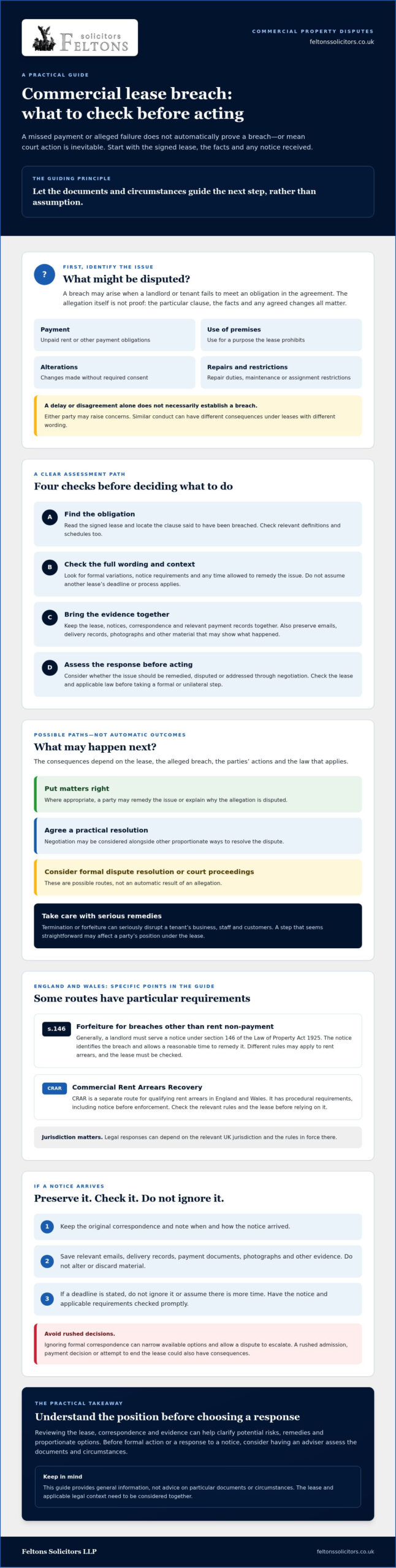
What counts as a breach of a commercial lease?

It is not always clear whether a problem is a lease breach or a disagreement about what the lease requires. Start with the signed lease. A breach occurs when a landlord or tenant fails to meet an obligation in that agreement. Examples may include unpaid rent, alterations made without required consent, using the premises for a prohibited purpose or failing to meet a repair obligation.

An allegation is not proof that a breach has occurred. The relevant clause, the surrounding facts and any agreed changes to the lease all matter. Similar conduct can have different consequences under leases with different wording. This guide provides general information, not advice on your particular documents or circumstances.

Which lease obligations are commonly disputed?

Disputes may concern payment obligations, permitted use, repairs and maintenance, alterations, or restrictions on assigning the lease. For example, a disagreement about who must carry out particular repairs may turn on the wording of the repairing covenant and any related schedule.

Either party may be accused of breaching the agreement. A tenant might allege that a landlord has failed to meet an obligation, just as a landlord might raise concerns about rent or how the property is used. A delay or disagreement alone does not necessarily establish a breach. Check what the lease requires and whether the circumstances meet that requirement.

Why the exact lease wording matters

Read the clause said to have been breached alongside relevant definitions, schedules and any formal variations. These may qualify or explain the obligation. Check whether the lease sets out how a notice must be given or allows time to remedy a particular problem. Requirements can be specific to the agreement, so do not assume that a deadline or process in another lease applies to yours.

The legal response may also depend on the relevant UK jurisdiction and the rules in force there. Seek advice based on the documents and current law before taking action. For a general explanation of the contract concept, see What counts as a breach of a commercial lease? The phrase “breach of contract” covers a broad area. Whether a particular lease obligation has been broken requires closer assessment.

If you are unsure how the wording applies, breach of commercial lease legal advice can help you assess the lease, correspondence and available options before responding. Let the documents and facts guide your next step, rather than assumption.

What can happen after a commercial lease breach?

The consequences depend on the lease terms, the nature of the alleged breach, the parties’ actions and the law that applies. A problem may be resolved by putting matters right or agreeing a practical way forward. In other cases, a landlord or tenant may consider formal dispute resolution or court proceedings. None of these outcomes follows automatically from an allegation.

A landlord may record the concern, review the relevant lease provisions and consider any contractual remedies. A tenant may investigate the allegation, gather records, remedy the issue where appropriate or explain why they dispute it. Either party should take care before acting unilaterally: a step that seems straightforward could affect their position under the lease.

Possible remedies are not automatic

Termination or forfeiture can have serious consequences, including disruption to a tenant’s business, staff and customers. Check the lease and legal requirements before treating these as available options. In England and Wales, forfeiture for a breach other than non-payment of rent generally requires a landlord to serve a notice under section 146 of the Law of Property Act 1925, identifying the breach and allowing a reasonable time to remedy it. Different rules may apply to rent arrears, and the lease must be checked.

Commercial Rent Arrears Recovery (CRAR) is a separate route for qualifying rent arrears in England and Wales. It has procedural requirements, including notice before enforcement. Check the relevant rules and the lease before relying on it. These remedies do not replace consideration of negotiation or other proportionate ways to resolve the dispute.

Respond promptly to formal notices

Keep the original correspondence and note when and how each notice arrived. Save emails, delivery records, payment documents, photographs and other relevant evidence. Do not alter or discard material that may help establish what happened. Notice wording, delivery methods and response periods can vary, and legal requirements differ by jurisdiction. If a notice specifies a deadline, do not ignore it or assume there is more time. Have the document and applicable rules checked promptly.

Ignoring formal correspondence can narrow the options available and allow a dispute to escalate. A rushed admission, payment decision or attempt to end the lease could also have consequences. Breach of commercial lease legal advice can help clarify the documents, risks and possible next steps before you act. Feltons Solicitors LLP provides commercial conveyancing and litigation and dispute resolution. You can enquire about its dispute resolution services to check whether it can assist with your particular commercial property dispute.

Does a commercial lease breach always mean court action?

No. An alleged breach does not automatically require a court claim. The right response depends on the lease, the evidence, the urgency of the issue and its effect on the business. A discussion or agreed remedy may be proportionate in some disputes; others may need structured dispute resolution or formal proceedings. Negotiation cannot guarantee agreement, and proceedings cannot always be avoided.

Where a practical conversation is appropriate, the parties can set out what they believe happened, refer to the relevant lease terms and consider a workable remedy and timescale. Put any agreement in writing, including what each party will do and by when. Keep discussions separate from any formal deadline: negotiation does not necessarily change a notice period or other time limit.

Compare the possible routes

Route Purpose Considerations and when advice may help
Informal discussion Clarify concerns and explore a practical solution directly. May suit a straightforward disagreement, but record any agreed steps and check that deadlines are protected.
Solicitor-led negotiation Set out a party’s position and seek a resolution through legal representatives. Advice may help assess the lease, evidence and wording of a proposal before it is sent or accepted.
Other dispute resolution Use a structured process to help the parties address the dispute without immediately asking a court to decide it. Suitability depends on the issues, the parties’ willingness to engage and any applicable requirements.
Litigation Ask a court to determine a dispute where other steps have not resolved it or a formal decision is needed. Consider the evidence, business impact, available remedies and current procedural rules with a legal adviser.

When escalation needs careful thought

Seek advice if key facts are disputed, similar issues keep arising, or the dispute is affecting access to or use of the premises, trading or important business decisions. A threatened termination or other urgent action also calls for prompt assessment. Do not assume a particular remedy is available, or that withholding payment is safe, without checking the lease and legal position.

Court routes and procedure depend on the circumstances and jurisdiction, so confirm current requirements before acting. Breach of commercial lease legal advice can help you weigh a proportionate response against the practical risks. Feltons Solicitors LLP provides litigation and dispute resolution. You can enquire about dispute resolution to check whether the firm can assist with your particular commercial property dispute.

Breach of Commercial Lease Legal Advice: What to Do Next

What should you do if you suspect a commercial lease breach?

A measured response starts with a clear record of what has happened and what the lease requires. Before replying to an allegation or taking action, work through these steps:

  • 1. Identify the concern. Write down what happened, when it happened and who was involved. Separate confirmed facts from assumptions or points that still need checking.
  • 2. Locate the relevant clause. Find the obligation in the signed lease, then check related definitions, schedules and any later variations or side letters. Note any notice procedure or deadline that may apply.
  • 3. Gather and preserve records. Keep the lease and related documents alongside notices, correspondence and relevant payment records. Make a dated chronology so the sequence is easy to follow.
  • 4. Seek tailored advice before deciding what to do. A review of the documents and evidence can help clarify your position and inform a proportionate response.

Do not ignore a formal notice, make an admission just to end a difficult exchange, or take an irreversible step without understanding its possible effect. If a deadline is stated, flag it promptly when seeking advice.

Documents and evidence to prepare

Gather the signed lease, side letters, licences, variations and relevant schedules. Add emails, messages, photographs, invoices and payment records where they relate to the issue. Keep original files and documents where possible. For important communications, record the date, sender or recipient, how they were delivered and when they arrived. An organised file helps an adviser assess both the lease wording and the events surrounding the dispute.

Questions to ask before choosing legal advice

Ask whether the adviser can assess the specific lease and alleged breach, and whether the firm can assist with your type of commercial property dispute. Clarify which documents they need, which deadlines require attention, and what risks and resolution options may be relevant. Advice should be based on your circumstances, not on the assumption that one remedy fits every dispute.

Feltons Solicitors LLP provides commercial conveyancing and litigation and dispute resolution, with a pragmatic approach to complex matters. To discuss your circumstances and ask whether the firm can assist, discuss your commercial property dispute with Feltons. Tailored breach of commercial lease legal advice can help you understand the documents and make an informed decision about what to do next.

Tailored legal advice can turn a worrying allegation into a clearer assessment of your position. A solicitor may review the lease and any variations alongside relevant correspondence, notices and evidence, then consider the legal context that applies. This can help identify what is agreed, what remains contested and which parts of the lease need closer interpretation.

That review may clarify the strengths and risks of each party’s position, possible remedies and practical ways forward. Depending on the circumstances, options could include addressing an issue, negotiating or considering formal dispute resolution. Advice should explain the choices and their implications, without assuming that litigation is inevitable or promising a particular result.

What a first discussion may need to cover

Be ready to explain who the parties are, which premises are involved and which lease clause is at the centre of the concern. Outline what has happened so far, including any notices received, response dates and steps either party has taken. Mention immediate business concerns, such as the effect of the dispute on operating from the premises.

An initial discussion can help establish what information is needed and whether the matter may fit the firm’s services. It cannot determine the outcome without an appropriate review of the documents, evidence and relevant circumstances. If a notice gives a deadline, make that clear at the outset.

Choosing a proportionate way forward

Before committing to a response, ask what options are available, what risks each may carry and whether any time limits need attention. A measured approach may focus on resolving the underlying issue where practical, while preserving your position if the dispute continues. The right course depends on the lease, evidence, urgency and business impact.

Feltons Solicitors LLP provides property law and commercial conveyancing services, alongside litigation and dispute resolution. Its stated approach is pragmatic and tailored to complex matters, but whether it can assist will depend on the nature of your dispute. An enquiry can help establish whether your circumstances fit the firm’s services; it does not guarantee an outcome.

If you’re considering breach of commercial lease legal advice, you can contact Feltons Solicitors to discuss your situation and ask whether the firm can assist. A clear explanation of the documents, options and next steps can help you make an informed decision before taking action.

Take a considered next step

A suspected lease breach needs a document-led response. Check the relevant terms, keep a clear record of events and pay close attention to formal notices and deadlines. An allegation does not automatically mean court action, but acting without understanding the lease could create further risk.

Tailored breach of commercial lease legal advice can help you assess the evidence, understand potential options and choose a proportionate way forward. Feltons Solicitors LLP provides property law and conveyancing services, including commercial conveyancing, as well as litigation and dispute resolution for domestic and international clients. The firm describes its approach as pragmatic advice for complex matters. Whether it can assist will depend on your specific circumstances.

To discuss your commercial property dispute and ask whether Feltons can help, contact Feltons Solicitors LLP. With a clearer understanding of your position, you can decide on your next step with greater confidence.

Frequently Asked Questions

What is considered a breach of a commercial lease?

A breach occurs when a landlord or tenant fails to meet an obligation set out in the lease. Examples may include unpaid rent, using the premises outside the permitted use, carrying out unauthorised alterations or failing to meet a repair obligation. Whether conduct amounts to a breach depends on the precise wording, any variations and the circumstances. A disagreement or delay alone does not necessarily prove that a contractual obligation has been broken.

What should I do if I receive a commercial lease breach notice?

Read the notice carefully, note when and how it arrived, and identify any stated deadline. Keep it with the lease, related correspondence and documents that may help explain the issue. Check which clause is said to have been breached, but do not assume the allegation is correct or ignore it. Before admitting liability, agreeing to a remedy or taking action, consider getting advice based on the documents and applicable law.

Can a landlord end a commercial lease because of a breach?

A landlord may have remedies for a breach, but ending the lease is not automatic. Check the lease for relevant rights, and consider any legal requirements that apply to the steps a landlord must take. For example, in England and Wales, forfeiture for some breaches requires a notice and an opportunity to remedy the breach; different rules may apply to rent arrears. The position depends on the facts and jurisdiction, so seek tailored advice before acting.

Can a tenant challenge an alleged breach of a commercial lease?

Yes. A tenant may dispute whether the lease imposes the obligation alleged, whether the facts establish a breach, or whether the landlord has followed the required process. Review the relevant clause, variations, notices and supporting evidence, then keep a clear record of events and communications. Breach of commercial lease legal advice can help assess the tenant’s position and consider a proportionate response without assuming that either party’s account is established.

How quickly should I respond to a commercial lease breach notice?

Check the notice immediately and seek advice promptly, especially if it states a response date or refers to formal action. There is no single response period for every notice: time limits and service requirements can depend on the lease, the type of alleged breach and the applicable law. Record the date and method of delivery, and do not assume that informal discussions pause or extend a formal deadline.

Can a commercial lease dispute be resolved without going to court?

Yes, some disputes may be resolved through direct discussion, solicitor-led negotiation or another suitable dispute resolution process. The parties might clarify what happened, discuss a possible remedy and record any agreement in writing. These approaches are not guaranteed to succeed, and court proceedings may still be considered if the dispute remains unresolved or a formal decision is needed. The evidence, urgency, lease terms and business impact can all inform which route is appropriate.

What documents should I take to a commercial lease solicitor?

Take the signed lease, relevant schedules, side letters, licences and any variations, along with notices and related correspondence. Emails, messages, photographs, invoices and payment records may also help, depending on the issue. Keep original documents and note important dates, recipients and delivery details. A short chronology can help explain what happened and distinguish confirmed facts from assumptions. The solicitor may identify other documents needed after reviewing the material.