
A long-term partner may inherit nothing under intestacy if they weren’t married to the deceased or in a civil partnership. In England and Wales, the intestacy rules set who inherits, and lawyers handling estate administration under those rules can help manage the legal and practical steps. Where a spouse or civil partner and descendants survive, the spouse receives personal possessions, the first £322,000 and half of the remainder for deaths on or after 26 July 2023, according to The National Archives; descendants receive the other half.
It’s understandable to expect a person’s wishes or family circumstances to guide what happens, but without a will, the statutory order of entitlement applies. The result can be surprising, particularly for unmarried partners, stepchildren and relatives from different relationships.
This guide explains who may inherit, how administrators gather records and value assets, and when Letters of Administration may be needed. It also outlines how legal support can help identify beneficiaries, deal with estate assets and distribute them, so you can understand the next steps.
Key Takeaways
- Who inherits depends on the statutory order of entitlement, set out in Section 46 of the Administration of Estates Act 1925, as amended, according to The National Archives.
- Gathering records of assets, debts and ownership helps administrators establish what belongs in the estate and what needs valuing.
- Letters of Administration may be needed to give an administrator authority to deal with estate assets when there’s no will.
- Legal support can help identify beneficiaries, organise the administration process and handle the distribution of the estate under the rules.
How long does dealing with an intestate estate usually take?
In England and Wales, the order of entitlement on intestacy is set out in Section 46 of the Administration of Estates Act 1925, as amended, according to The National Archives. The rules for a surviving spouse changed following the Inheritance and Trustees’ Powers Act 2014, according to The National Archives.
For deaths on or after 26 July 2023, the statutory legacy for a surviving spouse or civil partner is £322,000, according to The National Archives. The amount is subject to review and can change. A surviving spouse must survive the deceased by 28 days before inheriting under intestacy, according to The National Archives.
Who inherits depends on which relatives survive the deceased. A spouse or civil partner comes first, followed by descendants, parents, siblings and their children, then more distant relatives. Children from different relationships and legally adopted children inherit equally. Stepchildren are not treated as children unless legally adopted, and an unmarried partner does not inherit under these rules.
If the deceased leaves a spouse or civil partner and children, the spouse receives personal possessions and the statutory legacy. The remaining estate is divided equally between the spouse and the children collectively. Without a spouse, children inherit equally; if a child died earlier, their children may inherit that branch’s share. If there are no children, entitlement moves to parents, siblings and other relatives.
Scotland and Northern Ireland have different intestacy rules from England and Wales. In Scotland, prior rights include the family home up to £473,000; in Northern Ireland, a surviving spouse must survive the deceased by 28 days.
Jointly owned assets may pass outside the estate and intestacy rules. A life insurance policy or pension scheme may instead pass to its nominated beneficiary. Administrators should identify ownership and nominations before calculating beneficiaries’ shares, to avoid including assets that pass separately.
Careful identification can prevent disputes about who is entitled. An intestate estate typically takes 12 to 24 months to administer, around 3-6 months longer than administration with a will. Confirming family relationships, ownership and any beneficiary nominations helps establish the correct distribution before assets are released.
Gathering documents and valuing assets
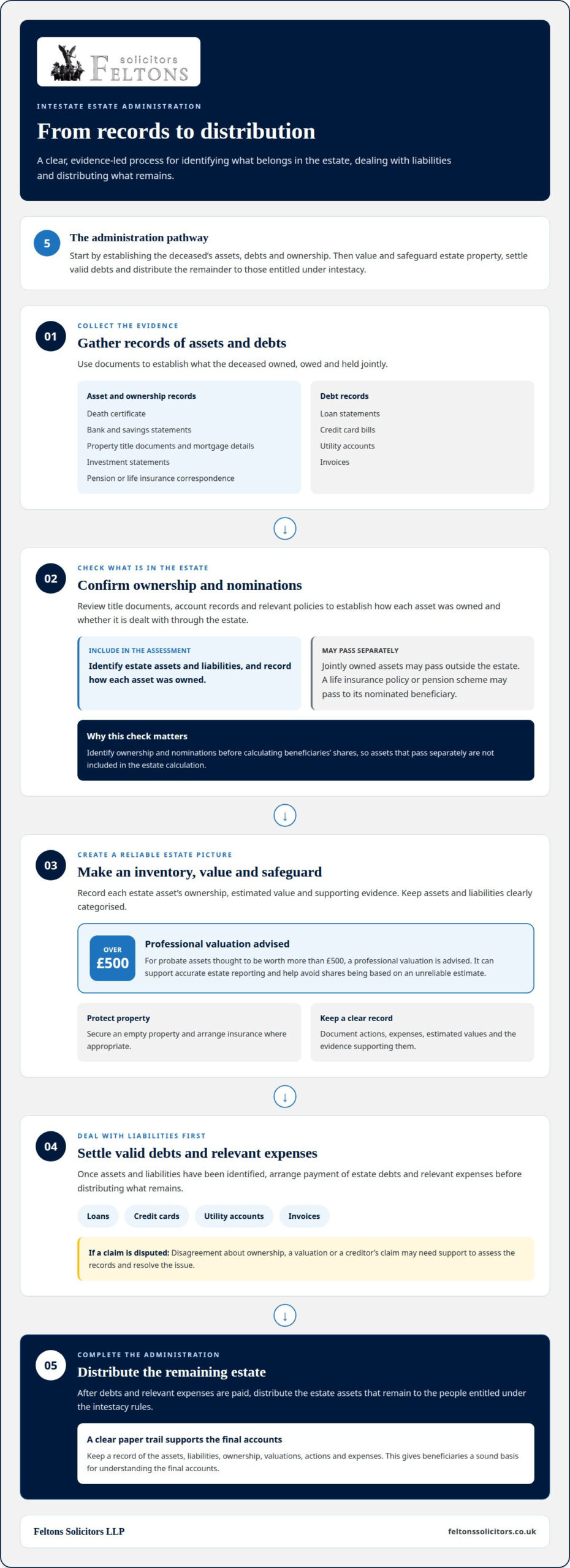
Estate administration starts by establishing what the deceased owned, owed and held jointly. The administrator gathers key records, prepares an inventory of assets and liabilities, secures property, arranges valuations, settles valid debts and distributes the estate to those entitled under intestacy.
Useful records include the death certificate, bank and savings statements, property title documents, mortgage details, investment statements, and pension or life insurance correspondence. For debts, gather loan statements, credit card bills, utility accounts and invoices. These records help distinguish estate liabilities from assets that may pass directly to a nominated beneficiary.
Joint ownership can affect whether assets are included in an estate or distributed under intestacy rules. The administrator should establish how each asset was owned by reviewing title documents, account records or the relevant policy. Joint ownership can affect whether a home or account is available for distribution to beneficiaries.
Record each asset’s ownership, estimated value and supporting evidence. Secure an empty property, arrange insurance where appropriate, and keep clear records of actions and expenses. A professional valuation is advised for probate assets thought to be worth more than £500. This can support accurate estate reporting and help prevent beneficiaries receiving shares calculated from an unreliable estimate.
If the deceased was married, property records and financial statements can help clarify which assets belonged to them, which were jointly held and which may pass under a nomination. Parents or other relatives may inherit under the statutory order, but only estate assets are distributed through that process. Keep these categories separate in the inventory.
After identifying assets and liabilities, the administrator arranges payment of estate debts and relevant expenses before distributing what remains. If ownership, valuations or a creditor’s claim is disputed, probate and estate administration support can help assess the records and resolve the issue. A clear paper trail gives beneficiaries a sound basis for understanding the final accounts.
Do I need letters of administration straight away?
An administrator may not need legal authority immediately, but usually needs it to collect and distribute estate assets. In England and Wales, that authority is generally a Grant of Letters of Administration.
Applying for Letters of Administration
The person with the highest priority applies: first the surviving spouse or civil partner, then children, parents, siblings, grandparents, and aunts and uncles. This order determines who may apply to act as personal representative, not who receives each asset. Intestacy rules determine who inherits separately.
The applicant establishes the estate’s assets and liabilities, identifies beneficiaries and submits the application. If all beneficiaries are adults, one person can apply alone. If minor beneficiaries are entitled, two personal representatives are required. The applicant should also consider whether a small estate can be dealt with without a grant, as financial institutions set their own thresholds.
Letters of Administration and Probate Applications
When someone dies without a will, the administrator applies for Letters of Administration rather than a Grant of Probate. The grant authorises them to deal with assets held in the deceased’s sole name, such as a bank account that requires formal authority before funds can be released.
Approval can take up to 16 weeks, depending on the Probate Registry’s workload. This is the application period, not the full time needed to administer the estate. Before applying, the representative gathers asset information and considers any inheritance tax reporting or payment required.
A grant is required in most cases, but not every estate needs one. For example, an institution may release a modest account without a grant under its own threshold. This does not remove the administrator’s duty to follow intestacy rules and account for estate assets.
A surviving spouse or civil partner has priority to apply, but cohabitation alone does not give an unmarried partner that priority. Family agreement can help relatives organise the application, but it does not change the legal order. If relatives dispute who should apply, the application and estate administration may become more complex.
Legal help with intestate estate administration
Legal support can help an administrator apply intestacy rules correctly, keep estate records clear and address disputes between relatives. Administrators have less discretion than executors named in a will, so decisions about the estate must follow statutory entitlement rules. A solicitor advising on estate administration can explain how those duties apply to the circumstances.
A solicitor can help establish who may inherit, confirm the administrator’s authority and prepare the steps needed to collect assets. For example, a bank may require a grant before releasing an account held solely in the deceased’s name. The administrator must also keep beneficiaries informed and retain records of payments, debts and decisions.
Extra care is needed where a beneficiary is under 18, family relationships are disputed or estate assets have unclear ownership. In England and Wales, two personal representatives are required when an intestate estate has minor beneficiaries entitled to it. Lawyers experienced in estate administration under intestacy rules can help coordinate the process and explain how this requirement affects the administration.
Relatives may agree to rearrange an estate’s distribution through a deed of family arrangement, provided all affected beneficiaries agree and have capacity. This can address a family’s particular circumstances, but it does not allow the administrator to change the distribution alone. Legal advice can clarify who must consent and how to record the agreement.
Solicitor fees for intestacy and estate administration depend on the case and are provided after a quote request. Cost factors include the number and type of assets, the records available, the work involved in obtaining a grant, tax reporting and whether disputes arise.
Legal help may be especially useful when relatives disagree about who should administer the estate, a surviving spouse or civil partner’s entitlement is contested, or creditors and beneficiaries need careful coordination. A solicitor can help distinguish legal entitlement from family expectations and clarify the administrator’s responsibilities.
If you’re dealing with an intestate estate, discuss estate administration support to clarify the next steps and the work involved.
Feltons Solicitors LLP: Wills, Probate, and Estate Planning
Feltons Solicitors LLP can help administrators understand their responsibilities and progress an intestate estate in England and Wales. Its Wills, Probate, Trusts and Estate Planning service can support you with identifying beneficiaries, applying for Letters of Administration, managing estate assets and questions about distribution.
Consider legal help when family relationships are complex, asset ownership is unclear, beneficiaries disagree or the estate includes property that must be dealt with. Advice can clarify the next steps and help keep the administration aligned with intestacy rules.
To discuss support with an intestate estate, contact Feltons Solicitors LLP.
Take the next step with confidence
Before administration moves forward, consider whether any uncertainty could affect the people involved. Unclear family relationships, competing accounts of ownership or disagreement about an administrator’s role can complicate decisions. Intestacy rules estate administration lawyers can help identify which questions need resolving and explain how to document decisions responsibly.
Legal advice may be useful when a decision affects several beneficiaries or family discussions become difficult. A solicitor familiar with intestacy and estate administration can clarify the administrator’s responsibilities and help map out practical next steps. They can also distinguish legal entitlement from family expectations, giving you a clearer understanding of the process.
For guidance tailored to your circumstances, contact Feltons Solicitors LLP for help. A considered conversation can help you decide how to proceed with care and confidence.
Frequently Asked Questions
Who inherits if there is no will?
In England and Wales, eligible relatives inherit according to the statutory order, not their personal closeness to the deceased. A spouse or civil partner has priority, with descendants also entitled when the deceased leaves children or other descendants. If there are no descendants, the spouse or civil partner may inherit the whole estate. Otherwise, entitlement can pass to parents, siblings and more distant relatives. Unmarried partners are not entitled under intestacy.
Can step children inherit under Intestacy?
Stepchildren do not automatically inherit under intestacy unless the deceased legally adopted them. For example, a stepchild who lived with the deceased for many years is not treated as their child for statutory distribution without adoption. Beneficiaries may agree to rearrange an estate’s distribution through a deed of family arrangement, provided everyone affected has capacity and agrees. The arrangement must be made within two years of the death.
Can the outcome of intestacy be disputed?
Yes. A dispute may concern whether someone qualifies as a beneficiary, how an asset is owned or whether the administrator has followed the statutory order. Keep relevant records, such as family documents, property papers and estate accounts, together to clarify the issue. Beneficiaries can agree to a different distribution through a deed of family arrangement if everyone affected has capacity and consents. If they disagree, legal advice may help.
How can I find out if someone left a valid Will?
Look through the deceased’s important papers, correspondence and secure storage for an original will or details of the solicitor who prepared it. Ask relatives who may know where documents were kept, and contact any solicitor known to have advised the deceased. If you find a will, share it with the person handling the estate before relying on intestacy, as it may cover all or only part of the estate.
How can intestacy be avoided?
Make a will that records how you want your estate distributed and appoints someone to administer it. Review it when family circumstances or assets change, so its instructions remain relevant. Keep the signed document safe and tell someone you trust where it is stored. A will can also address intentions that intestacy may not reflect, such as providing for an unmarried partner or a stepchild who has not been adopted.
How long does it take to sort out an estate without a will?
Administering an estate without a will typically takes 12 to 24 months, around 3-6 months longer than administration with a will. The time depends on practical tasks such as identifying beneficiaries, obtaining asset information, dealing with debts and securing any grant needed to access accounts. Locating relatives or resolving disagreements can add further work, so the administrator’s progress depends on how quickly each issue is addressed.