

Could a disagreement over the premium be mistaken for a defective response? Or could a procedural flaw be missed because the counter-notice looks complete? For leaseholders, landlord counter notice lease extension errors can be difficult to identify. A difference over price or proposed terms is not necessarily a statutory defect, and not every mistake makes a notice invalid.
It’s understandable to want a clear answer quickly. The date in your Section 42 claim notice matters: the landlord must serve a Section 45 counter-notice by that date, which must be at least two months after the claim notice is served. This checklist shows you how to compare the response with each proposal in your claim, distinguish a procedural concern from a substantive disagreement, and understand why next steps depend on the facts and applicable deadlines. It also explains how to preserve your options without assuming that an apparent error automatically decides the claim. If something doesn’t match, review the notices and service records promptly to clarify the position before time runs out.
Key Takeaways
- Focus on the statutory lease-extension process for flats. Informal negotiations follow a different route.
- Use the landlord counter notice lease extension errors checklist to spot unanswered proposals, without treating every disagreement as a defect.
- Keep the original claim notice, counter-notice and service evidence together, then record key dates and possible omissions.
- Prepare neutral questions about anything unclear before deciding how to respond.
- A specialist review can consider the notices, service record, lease and current legal framework together, helping clarify options and risks.
Landlord counter-notice errors: what leaseholders should check first
First, identify what kind of response you’ve received. In a statutory lease-extension claim, a landlord’s counter-notice is the formal response to a qualifying flat leaseholder’s claim notice under the Leasehold Reform, Housing and Urban Development Act 1993. It is not simply any letter discussing an extension. An informal offer or negotiation should not be treated as a statutory counter-notice without checking its status.
This distinction matters because a letter can raise questions without resolving them. A landlord may respond to the claim but disagree with the leaseholder’s proposed terms. That is different from a potential procedural defect, such as a concern about the response date or whether the document addresses the claim. The phrase landlord counter notice lease extension errors can refer to both, but they need to be assessed separately.
What is a Section 45 counter-notice?
Section 45 refers to the landlord’s formal counter-notice in the statutory lease-extension route. It responds to the leaseholder’s Section 42 claim notice. The response date is stated in that claim notice and must be at least two months after it was served. Find that date and compare it with the counter-notice and the available service records.
A counter-notice is different from informal correspondence, such as an email proposing different terms or inviting further discussion. Keep those communications, but don’t assume they replace or amend the statutory documents. The legal effect of a response can depend on the claim, how and when documents were served, and the law that applies to the claim. A suspected error is a reason to examine the paperwork, not proof that the notice is invalid or that the leaseholder is automatically entitled to their proposed terms.
Which lease-extension claims does this checklist cover?
This checklist focuses on qualifying leaseholders of flats using the formal statutory route. It is not a general guide to every leasehold transaction. Leasehold houses, collective enfranchisement claims and privately negotiated extensions may involve different procedures, documents or legal tests. Don’t assume the same checks or consequences apply.
For wider context, leasehold enfranchisement covers the broader area of leasehold rights, although a general overview cannot determine whether a particular notice complies with statutory rules. Feltons’ leasehold enfranchisement and extension guidance provides further context on statutory lease extensions and related property rights.
Before assessing individual wording, put the original claim notice and the alleged counter-notice side by side. Confirm you’re comparing the correct documents, note the response date specified in the claim, and keep the originals and any evidence showing how they were served. This gives you a clear starting point for identifying unanswered proposals or timing concerns, without confusing a disagreement over terms with a defect in the statutory process.
Check the counter-notice against each proposal in your claim
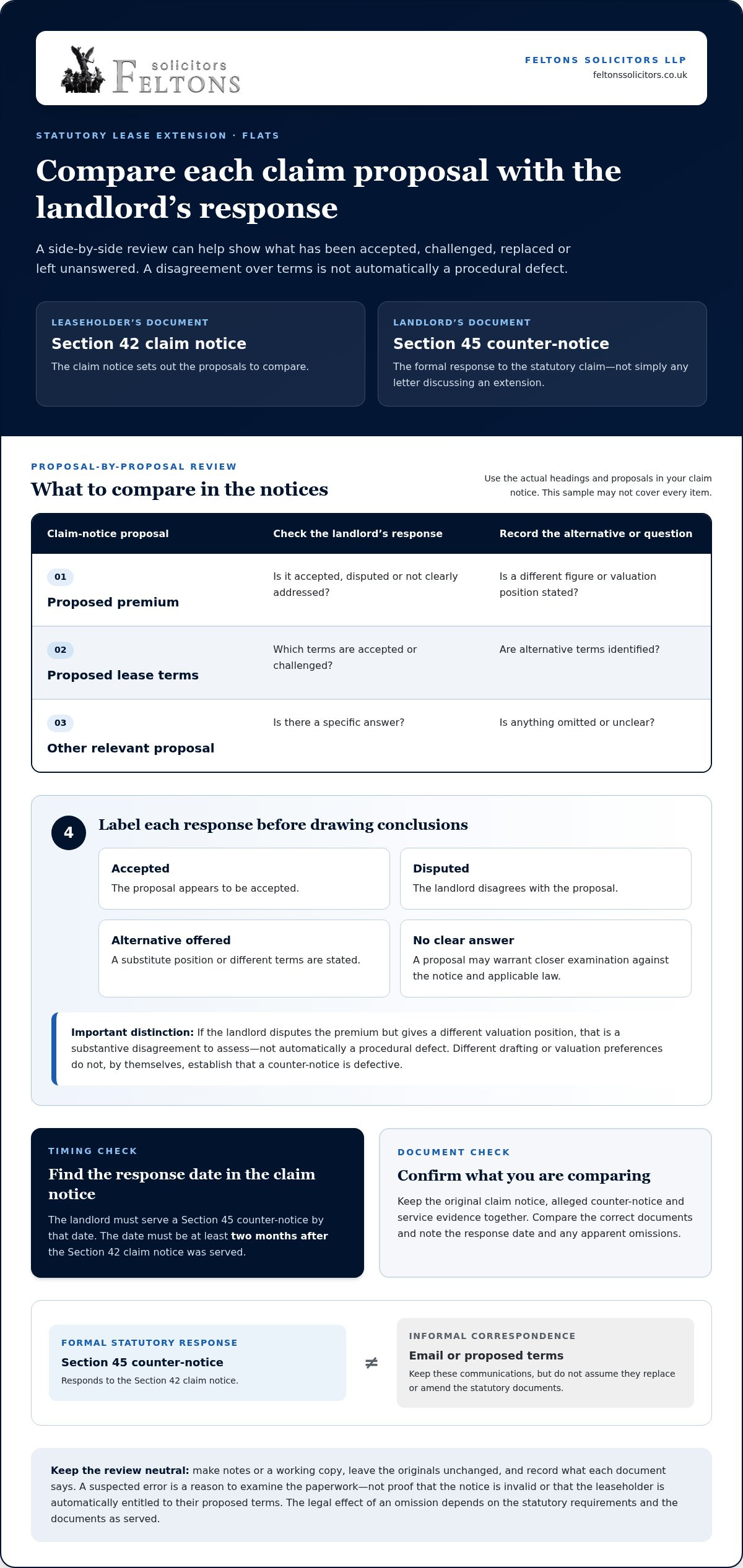
A side-by-side review can show where the landlord has responded clearly, proposed an alternative or left a point unanswered. Keep the original Section 42 claim notice beside the Section 45 counter-notice and compare them item by item. A general statement such as “the terms are disputed” may not show how the landlord has addressed each proposal.
Make a working copy or notes for comparison, but leave the original documents unchanged. The table below can help organise your review. It is a practical checklist, not a substitute for checking the statutory requirements that apply to the claim.
Has the landlord answered the claim notice proposals?
| Claim-notice proposal | Landlord response | Stated alternative or point to clarify |
|---|---|---|
| Proposed premium | Accepted, disputed or not clearly addressed? | Is a different figure or position stated? |
| Proposed lease terms | Which terms are accepted or challenged? | Are alternative terms identified? |
| Other relevant proposal | Is there a specific answer? | Is anything omitted or unclear? |
Use the actual headings and proposals in your notice. Don’t assume this sample covers every item. For each proposal, mark whether the response appears to accept it, disagree with it, offer a substitute or say nothing. For example, if the landlord disputes the premium but gives a different valuation position, that is a substantive disagreement to assess, not automatically a procedural defect. A proposal with no identifiable response may warrant closer examination against the notice and the law.
Different drafting or valuation preferences do not, by themselves, establish that a counter-notice is defective. Record what the documents say before drawing conclusions. Lease Advice on Section 45 counter-notice offers independent background on the process. The legal effect of a specific omission depends on the statutory requirements and the documents as served.
Is an entitlement challenge or other response clearly stated?
Next, identify the apparent basis of the landlord’s response. Does it appear to accept the claim, dispute the leaseholder’s entitlement or rely on another statutory ground? Note the wording and any explanation, but don’t assume that a challenge succeeds or fails simply because of how it reads in isolation.
If the landlord disputes entitlement or refers to another ground, record the stated basis and any particulars. Then check whether the relevant legislation requires particular content, wording or supporting detail for that type of response. Requirements can depend on the claim and the law in force, so a brief explanation is not conclusive proof of a defect.
This document-by-document approach helps distinguish an unanswered proposal from a genuine disagreement about the premium or lease terms. If the comparison raises questions, a solicitor experienced in leasehold enfranchisement can assess the notices, service record and applicable rules together. Specialist lease-extension advice can help clarify your options and risks without assuming a particular outcome.
Late, missing or defective counter-notice: separate error from dispute
A late response, no response, a possible defect in the document and a disagreement over terms are different situations. Don’t treat them as interchangeable or as automatic proof that the leaseholder will obtain the terms they proposed. The distinction matters because the right next step depends on what happened, the evidence of service and the statutory rules applying to the claim.
Use this comparison to record the issue before deciding what it means. It helps organise the facts, but does not determine validity or remedy.
| Situation | What to establish | Why it matters |
|---|---|---|
| Late response | Compare the date served or received with the response date in the claim notice, and check service evidence. | A timing issue may require urgent legal assessment. |
| No response | Check whether a counter-notice was served, including whether it may have gone to another address or representative. | Absence and delayed receipt aren’t necessarily the same issue. |
| Possible content defect | Identify the precise omission, unclear answer or inconsistency in the document. | The legal significance depends on the statutory requirements and facts. |
| Disagreement on terms | Record the premium or lease term proposed by each side. | A difference may be part of the negotiation, not a notice defect. |
What makes a late or missing response different?
Start with the timeline. Note the response date specified in the claim notice, when and how that notice was served, and when the counter-notice arrived, if it did. Keep envelopes, delivery records, emails and correspondence that may help establish service. The date you received a document may not, by itself, establish when it was legally served, so don’t rely on memory or assumptions about post.
A response received after the stated date raises a different question from a situation where no response appears to have been served. In either case, don’t assume a remedy follows automatically. The appropriate court route, applicable period and possible consequences must be checked against current law and the specific service record before action is taken. If a deadline may be close, seek advice promptly rather than waiting for negotiations to resolve the uncertainty.
When is a disagreement not necessarily a notice error?
A landlord may dispute the leaseholder’s valuation or propose different drafting. That can be a substantive disagreement within the statutory process. It is distinct from questions about whether the notice was served on time or contains the response required by law. A premium that differs from the leaseholder’s figure, for example, does not alone establish a procedural flaw.
Leasehold legislation and its commencement arrangements can change. For a claim made in 2026, check which provisions are in force and whether transitional rules apply to the date and type of claim. Assess a potential defect alongside eligibility, the full notices and service evidence. Even if a challenge is justified, it does not automatically settle every issue or secure the leaseholder’s preferred premium or terms.
A leaseholder’s checklist after receiving a landlord counter-notice
A calm, organised review helps you identify what needs attention without making assumptions about the legal effect of an apparent error. Work through these steps in order. Keep original documents intact, note what you observe and check relevant statutory time limits before deciding how to respond.
What documents and dates should you preserve?
- Preserve the complete record. Keep the original claim notice and counter-notice, all attachments, covering letters and relevant correspondence. Save electronic copies in their original format where possible. Don’t write on, edit or replace the originals.
- Collect evidence of service. Retain available proof of dispatch, delivery or receipt, such as postal records, envelopes, emails and acknowledgements. Record what each item shows, including the address used and any delivery information, rather than relying on recollection.
- Build a chronology. List the date of each notice, its stated response date, when it was sent and received, and any later communication. Mark dates as confirmed or uncertain so an estimate isn’t mistaken for established evidence.
- Compare the documents. Note which claim proposals appear to have a response, which are unclear and which may not be addressed. Record the relevant page or paragraph and quote the wording accurately in separate notes.
- Check time limits independently. Statutory negotiations and later court or tribunal steps can involve distinct time limits. Don’t assume discussions, a request for clarification or the other party’s conduct pauses a deadline. Have the applicable period and how it is calculated assessed against current law and the facts.
How should you raise a potential defect?
Describe the concern neutrally. Identify the proposal in the claim notice, point to the corresponding part of the counter-notice, and explain whether the response seems absent, unclear or inconsistent. Separate that observation from a disagreement about the premium or drafting. This gives a solicitor a precise issue to assess and helps keep correspondence focused.
Avoid declaring that the counter-notice is invalid or that a particular outcome must follow before the legal and factual position has been reviewed. The effect of a possible defect depends on the statutory requirements, service evidence and circumstances of the claim. Keep negotiations moving where appropriate, but don’t let them distract you from checking deadlines or obtaining advice on any procedural step that may be required.
For broader property context, Feltons’ residential property law guidance provides further background. For a tailored assessment of the notices, documents and potential next steps, discuss your lease-extension notice with Feltons’ property law team.
When specialist lease-extension advice can help resolve a counter-notice issue
A specialist review can help you work out whether a concern is procedural, relates to the substance of the proposed terms or needs further investigation. The phrase landlord counter notice lease extension errors can describe very different issues. Their significance depends on the documents, how they were served and the law that applies to the claim. Legal advice can clarify your options and risks, but cannot guarantee that a challenge will succeed or determine the outcome in advance.
What can a solicitor review?
A solicitor can consider the claim notice and counter-notice alongside the lease, correspondence and available evidence of service. Reviewing them together puts an apparent omission or timing concern in context, rather than treating one line in a letter as decisive. The review should also take account of the statutory framework currently in force and any relevant transitional rules.
With that information, a solicitor can explain whether a point appears to need clarification, further evidence or a formal response, and what risks may follow from each option. The advice should reflect the specific stage of the claim, including any dates that could affect negotiations or a later procedural step. It is a considered assessment, not a promise of a particular remedy or timescale.
How to prepare for a focused discussion
A clear file makes it easier to understand the issue. You don’t need to decide for yourself whether the notice is defective before seeking advice. Organise the record so the relevant facts and questions are easy to identify.
- Prepare a chronology. Record when the claim notice and counter-notice were sent and received, how they were served, and when replies or other relevant communications followed. Distinguish confirmed dates from estimates.
- Mark the points in question. Identify the specific proposal or passage that appears missing, unclear or disputed. Note the relevant page or paragraph, and describe the concern neutrally.
- Include relevant supporting documents. Bring the lease, complete notices and attachments, service evidence, correspondence and any valuation or proposed lease-term discussions that relate to the disagreement.
- List the decisions you need to make. For example, ask what deadline may apply, whether a response is advisable and what further information would help assess the position. Don’t assume continued negotiations pause a statutory time limit.
This preparation supports a focused assessment of the notice, service record, lease and current legal framework together. Feltons’ leasehold enfranchisement team can help you understand the issues and available next steps. Use the leasehold enfranchisement support guidance as a starting point.
Take the next step with clarity
A concern about landlord counter notice lease extension errors doesn’t need to lead to a rushed decision. Turn uncertainty into a focused question: what does the notice say, what evidence supports its service, and what options remain under the law that applies to your claim?
Keep your documents and chronology together, and seek a considered view before acting on an assumption or letting a relevant deadline pass. Feltons provides property law and conveyancing support, including leasehold enfranchisement and lease extensions. A review can help you understand the issue and weigh possible next steps in light of your circumstances, without presuming that a challenge will succeed.
Discuss your lease-extension counter-notice with Feltons and take a clear, measured step towards resolving the uncertainty.
Frequently Asked Questions
What is the difference between a statutory and an informal lease extension?
A statutory extension follows a formal legal procedure, while an informal extension is negotiated directly with the landlord. The routes can produce different terms and protections, so compare the proposed lease carefully rather than assuming an informal offer matches the statutory outcome. This article focuses on the statutory route for flats. Before choosing or relying on either approach, consider how current legislation applies to your lease, eligibility and circumstances.
Does the Section 45 counter-notice process apply to leasehold houses?
This checklist concerns the statutory lease-extension route for flats, so don’t automatically apply it to a leasehold house. Different property types can involve different rights, notices and procedures. The relevant route may depend on the property’s legal status and the right being claimed, not simply on the fact that it is leasehold. Check the legislation and guidance for the specific property, and get advice on the lease and claim before acting.
Can a landlord change a counter-notice after serving it?
Whether a landlord can correct, replace or amend a served counter-notice depends on the circumstances, applicable rules and stage of the claim. Don’t assume a later letter cures an earlier issue, or that it has no legal effect. Keep both versions, including attachments and envelopes, and note when each arrived. Assess questions about landlord counter notice lease extension errors against the full sequence of documents, particularly if a time limit may be running.
Does a landlord have to include a valuation with the counter-notice?
A counter-notice and a valuation are not necessarily the same document. The counter-notice is the landlord’s formal response under the applicable statutory rules. Valuation material may be provided or discussed separately as negotiations progress. Check whether the response addresses the premium and whether valuation information arrived in separate correspondence. Don’t conclude that the counter-notice is invalid solely because no valuation is attached. Requirements and consequences depend on the law and circumstances of the claim.
Can I continue negotiating after receiving a counter-notice?
Yes, the parties may continue discussing the premium and lease terms after a counter-notice, but negotiation doesn’t necessarily replace formal steps. Keep a dated record of offers, replies and agreed points, and make clear which proposal each communication concerns. Don’t assume ongoing discussions extend or suspend a statutory time limit. Before waiting for further correspondence, check the deadlines and procedure that apply to your claim.
Do the 2024 leasehold reforms change counter-notice rules in 2026?
Not every provision of the Leasehold and Freehold Reform Act 2024 necessarily applies to every claim in 2026. Reforms may commence at different times, and transitional provisions can affect which rules apply. Check the relevant commencement regulations and current official guidance against the type of right claimed and the dates involved. Don’t rely on a general summary of the Act to determine whether a specific counter-notice meets the rules for your case.